Adam Hilger, IOP Publishing Ltd, 1989. - 523 Pages.
Computer simulation of systems has become an important tool in
scientific research and engineering design, including the
simulation of systems through the motion of their constituent
particles. Important examples of this are the motion of stars in
galaxies, ions in hot gas plasmas, electrons in semiconductor
devices, and atoms in solids and liquids. The behavior of the
system is studied by programming into the computer a model of the
system and then performing experiments with this model. New
scientific insight is obtained by observing such computer
experiments, often for controlled conditions that are not
accessible in the laboratory. Computer Simulation using Particles
deals with the simulation of systems by following the motion of
their constituent particles.
This book provides an introduction to simulation using particles
based on the NGP, CIC, and P3M algorithms and the programming
principles that assist with the preparations of large simulation
programs based on the OLYMPUS methodology. It also includes case
study examples in the fields of astrophysics, plasmas,
semiconductors, and ionic solids as well as more detailed
mathematical treatment of the models, such as their errors,
dispersion, and optimization. This resource will help you
understand how engineering design can be assisted by the ability to
predict performance using the computer model before embarking on
costly and time-consuming manufacture.

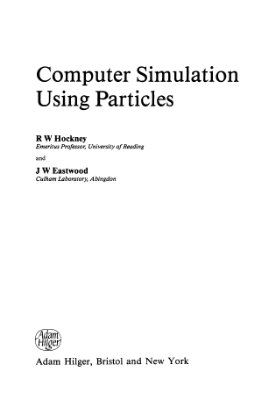
Hockney R.W., Eastwood J.W. Computer Simulation Using Particles
Похожие разделы
- Академическая и специальная литература
- Биологические дисциплины
- Матметоды и моделирование в биологии
- Академическая и специальная литература
- Геологические науки и горное дело
- Матметоды и моделирование в горно-геологической отрасли
- Академическая и специальная литература
- Информатика и вычислительная техника
- Компьютерное моделирование
- Академическая и специальная литература
- Математика
- Высшая математика (основы)
- Математика для инженерных и естественнонаучных специальностей
- Академическая и специальная литература
- Машиностроение и металлообработка
- Конструирование и проектирование в машиностроении
- Матметоды и моделирование в машиностроении
- Академическая и специальная литература
- Наноматериалы и нанотехнологии
- Матметоды и моделирование в нанотехнологии
- Академическая и специальная литература
- Промышленное и гражданское строительство
- Матметоды и моделирование в строительстве
- Академическая и специальная литература
- Радиоэлектроника
- Матметоды и моделирование в радиоэлектронике
- Академическая и специальная литература
- Связь и телекоммуникации
- Матметоды и моделирование в связи и телекоммуникациях
- Академическая и специальная литература
- Топливно-энергетический комплекс
- Математические задачи энергетики
Смотрите также
Wilkins M. Computer simulation of dynamic phenomena
By Mark L. Wilkins. Springer-Verlag Berlin Heidelberg New York, Scientific computation. Includes bibliographical references. ISBN 3-540-63070-8 (alk. paper) Elements of Fluid Mechanics. Numerical Techniques. Modeling the Behavior of Materials. Two-Dimensional Elastic-Plastic Flow. Sliding Interfaces in Two Dimensions. Elastic—Plastic Flow in Three Space Dimensions. Sliding Surfaces in Three Dimensions. Magnetohydrodynamics of HEMP. Appendices.