Амстердам, ELSEVIER, 2003, -1012 p.
Photovoltaics is about to celebrate 50 years of its mode era.
During this time, the industry has grown from small satellite power
supplies to utility-scale systems that are now routinely installed
in many countries of the world. Solar cells capable of producing
power in excess of 500 MW were manufactured in 2002, providing
electricity to a variety of applications ranging from small
consumer products, power systems for isolated dwellings and remote
industrial equipment to building-integrated solar arrays and
megawatt-size power stations. This PracticaI Handbook of
Photovoltaics addresses the need for a book that summarises the
current status of know-how in this field. It represents a detailed
source of information across the breadth of solar photovoltaics and
is contributed to by top-level specialists from all over the world.
Over 1,000 references, bibliographies and web sites guide the
reader to further details, be it specific information for
industrial production and research or a broad overview for policy
makers. Thirty-seven chapters in the handbook cover topics from
fundamentals of solar cell operation to industrial production
processes, from molecular photovoltaics to system modelling, from a
detailed overview of solar radiation to guidelines for installers
and power engineers, and from architectural integration of solar
cells to energy payback, C02 emissions and photovoltaic markets.
Appendices include extensive bibliography and lists of standards,
jouals and other sources of information which can be found in a
printed or electronic form.
The main credit for this handbook must go to the 47 contributors
who have produced a unique compilation of the contemporary
knowledge in photovoltaic science and technology.
Our thanks go to our families for their patience and support
without which this book would have never seen the light of day.

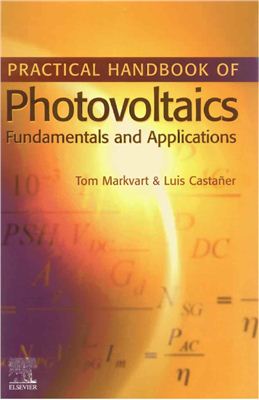
Markvart T, Castafier L. (ed.). Practical Handbook of Photovoltaics: Fundamentals and Applications
Похожие разделы
Смотрите также
Ashby N., Miller S. Principles of Modern Physics
Holden-Day INC. ,1970, 540 pages. This book is intended as a general introduction to modern physics for science and engineering students. It is written at a level which presurnes a prior tull year’s course in classical physics, and a knowledge of elementary differential and integral calculus. The material discussed here includes probability, relativity, quantum mechanics, atomic physics, statistical mechanics, nuclear physics and elementary parti...
Cachan M., Groningen T., Paris T. Hamiltonian Dynamics - Theory and Applications
Springer, 188 pages, 1999. The textbook covers topics on: Physical Applications of Nekhoroshev Theorem and Exponential Estimates, The Adiabatic Invariant Theory and Applications, Lectures on Hamiltonian Methods in Nonlinear PDEs.
David J., Cheeke N. Fundamentals and Applications of Ultrasonic Waves
CRC Press LLC, 2002 - 450 pages. Книга представляет переработку семестрового курса и нескольких сокращенных курсов, которые на протяжении 10 лет читались авторами в Монреальском университете Concordia (Канада) студентам старших курсов и аспирантам. Изложены основные разделы физической акустики, включая кристаллоакустику, волноводное распространение ультразвуковых волн, а также теорию излучения, отражения и рассеяния ультразвука.
Gibilisco S. Physics Demystified: A Self-Teaching Guide
McGraw-Hill Professional, 2002. - 618 pages. Now anyone with an interest in the physical sciences can master physics -- without formal training or drowning in a sea of complicated formulas and equations. In Physics Demystified best-selling author Stan Gibilisco offers a fun, effective, and totally painless way to learn the fundamentals and general concepts of physics. With Physics Demystified you master the subject one simple step at a time ' a...
Kneipp K., Moskovits M., Kneipp H.(Eds.) Surface-Enhanced Raman Scattering. Physics and Applications
Springer-Verlag Berlin Heidelberg 2006. – 500 p. The book is divided into two parts. The first section begins with the basic physics behind SERS, providing both an overview and a summary of recent developments in the field. The second part of the book concentrates on some of the exciting applications of SERS.
Sadd M. Elasticity: Theory, Applications, and Numerics
Academic Press, 1 edition, 473 pages, 2004, ISBN-10: 0126058113 Although there are several books in print dealing with elasticity, many focus on specialized topics such as mathematical foundations, anisotropic materials, two-dimensional problems, thermoelasticity, non-linear theory, etc. As such they are not appropriate candidates for a general textbook. This book provides a concise and organized presentation and development of general theory of...
Ufimtsev P.Ya. Fundamentals of the Physical Theory of diffraction
NJ: Wiley&Sons, 2007. - 348 pages (англ. яз. ) Новая книга П. Я Уфимцева, развивающая созданную им физическую теорию дифракции, основанную на методе краевых волн. Вводится и обсуждается важное понятие теневого излучения. Методы, излагаемые в книге, применяются как к электромагнитным, так и к акустическим волнам. В книге имеется большое количество задач.
Williams G., Henry J. Chaos Theory Tamed
Joseph Henry Press, 1st edition, 406 pages, 1997, 0309063515. What is this business called 'chaos'? What does it deal with? Why do people think it's important? And how did the term 'chaos' - long associated with disorder - come to signify a new paradigm in the orderly realm of mathematics? The concept of chaos is one of the most exciting and rapidly expanding research topics of recent decades. Chaos might underlie many kinds of well-known process...