
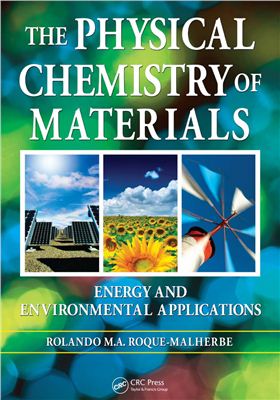
Boca Raton, FL:CRC Press, Taylor & Francis Group, LLC, 2010. – 500
p.
In recent years, the area dealing with the physical chemistry of materials has become an emerging discipline in materials science that emphasizes the study of materials for chemical, sustainable energy, and pollution abatement applications. Written by an active researcher in this field, Physical Chemistry of Materials: Energy and Environmental Applications presents methods for synthesizing and characterizing adsorbents, ion exchangers, ionic conductors, heterogeneous catalysts, and permeable porous and dense materials. It also discusses their properties and applications.
The book explores various examples of these important materials, including perovskites, zeolites, mesoporous molecular sieves, silica, alumina, active carbons, carbon nanotubes, titanium dioxide, magnesium oxide, clays, pillared clays, hydrotalcites, alkali metal titanates, titanium silicates, polymers, and coordination polymers. It shows how the materials are used in adsorption, ion conduction, ion exchange, gas separation, membrane reactors, catalysts, catalysts supports, sensors, pollution abatement, detergency, animal nourishment, agriculture, and sustainable energy applications.
Features
Provides an overview of the theoretical aspects of materials physics
Examines the structure, synthesis, properties, and applications of adsorbents, catalysts, ion exchangers and conductors, and permeable materials
Describes the characterization of materials
Explains diffusion in dense and porous materials
Studies some of the most important aspects of solid-state electrochemistry
Rising pollution levels and the need for sustainable energy have necessitated new ways of using certain materials to combat these problems. Focusing on this emerging discipline, Physical Chemistry of Materials describes the methods of syntheses and characterization of adsorbents, ion exchangers, ionic conductors, catalysts, and permeable materials. It tackles key issues in materials science and physical chemistry.
In recent years, the area dealing with the physical chemistry of materials has become an emerging discipline in materials science that emphasizes the study of materials for chemical, sustainable energy, and pollution abatement applications. Written by an active researcher in this field, Physical Chemistry of Materials: Energy and Environmental Applications presents methods for synthesizing and characterizing adsorbents, ion exchangers, ionic conductors, heterogeneous catalysts, and permeable porous and dense materials. It also discusses their properties and applications.
The book explores various examples of these important materials, including perovskites, zeolites, mesoporous molecular sieves, silica, alumina, active carbons, carbon nanotubes, titanium dioxide, magnesium oxide, clays, pillared clays, hydrotalcites, alkali metal titanates, titanium silicates, polymers, and coordination polymers. It shows how the materials are used in adsorption, ion conduction, ion exchange, gas separation, membrane reactors, catalysts, catalysts supports, sensors, pollution abatement, detergency, animal nourishment, agriculture, and sustainable energy applications.
Features
Provides an overview of the theoretical aspects of materials physics
Examines the structure, synthesis, properties, and applications of adsorbents, catalysts, ion exchangers and conductors, and permeable materials
Describes the characterization of materials
Explains diffusion in dense and porous materials
Studies some of the most important aspects of solid-state electrochemistry
Rising pollution levels and the need for sustainable energy have necessitated new ways of using certain materials to combat these problems. Focusing on this emerging discipline, Physical Chemistry of Materials describes the methods of syntheses and characterization of adsorbents, ion exchangers, ionic conductors, catalysts, and permeable materials. It tackles key issues in materials science and physical chemistry.