
Benton M.J. Introduction to paleobiology and the fossil record
Подождите немного. Документ загружается.

248 INTRODUCTION TO PALEOBIOLOGY AND THE FOSSIL RECORD
interest in the defi nition of the base of the
Cambrian System. Nevertheless, the biologi-
cal affi nities of many members of the Tom-
motian fauna have yet to be established. The
assemblage, although dominated by minute
species, together with small sclerites of larger
species, represents the fi rst major appearance
of hard skeletal material in the fossil record,
some 10 myr before the fi rst trilobites evolved
(see p. 363).
This type of fauna is not restricted to the
Tommotian Stage; small shelly fossils are also
common in the overlying Adtabanian Stage
(see below) and similar assemblages of mainly
phosphatic minute shells have been reported
from younger condensed sequences in the
Paleozoic. The shell substance of the carbon-
ate skeletons within the fauna seems to have
been controlled by the ambient seawater
chemistry; Nemakit-Daldynian assemblages
were mainly aragonite, whereas younger
shells were mainly calcitic (Porter 2007).
Tommotian-type faunas probably fi nally dis-
appeared with the escalation of predation
during the Mesozoic.
Some scientists such as Stephen Jay Gould
suggested the less time-specifi c term, small
shelly fossils to describe these assemblages.
The fauna is now known to include a variety
of groups united by their minute size and
sudden appearance near the base of Cam-
brian. The small shelly fauna probably domi-
nated the earliest Cambrian ecosystems when
many metazoan phyla developed their own
distinctive characteristics, initially at a very
small scale. Nevertheless, some of this small
size may be a preservational artifact, since
phosphatization only works at a millimeter
scale.
Composition and morphology
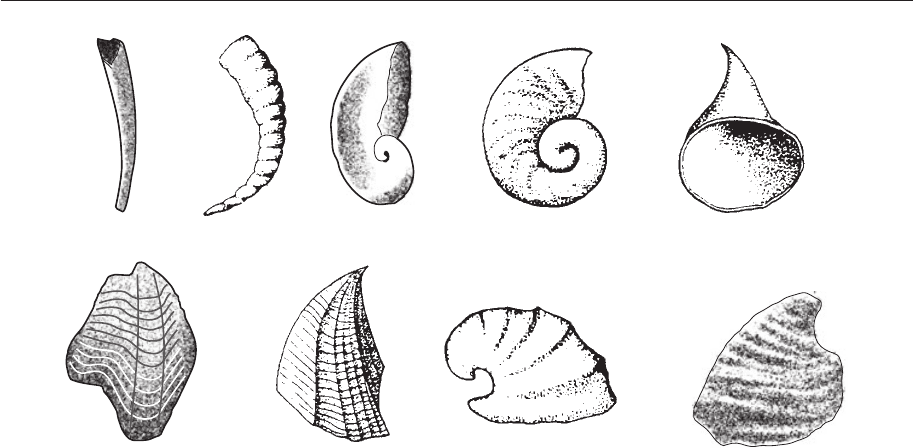
Many of the Tommotian skeletons (Fig. 10.12)
were retrieved from residues after the acid
etching of limestones; thus there is a bias
towards acid-resistant skeletal material in any
census of the group as a whole. Moreover,
there is currently discussion concerning
whether the acid-resistant skeletons of the
Tommotian-type animals were primary con-
structions or secondary replacement fabrics.
Or perhaps these shells survived in the sedi-
ments because of particular chemical condi-
tions in the oceans at the time that allowed
phosphatic fossils to survive (Porter 2004).
The Tommotian animals had skeletons com-
posed of a variety of materials. For example,
Cloudina and the anabaritids were tube-build-
ers that secreted carbonate material, whereas
Mobergella and Lapworthella consisted of
sclerites comprising organisms that secreted
phosphatic material; Sabellidites is an organic-
Hertzina Lapworthella Pelagiella Aldanella Fomitchella
AnabarellaLatouchellaTommotiaCamenella
Figure 10.12 Elements of the Tommotian-type or small shelly fauna. Magnifi cation approximately ×20
for all, except Fomitchella which is about ×40. (Based on various sources.)

ORIGIN OF THE METAZOANS 249
walled tube possibly of an unsegmented
worm.
Many of the Tommotian animals are form
taxa (that is, named simply by their shapes)
because the biological relationships of most
cannot be established and often there are few
clues regarding the function and signifi cance
of each skeletal part. Most are short-lived and
have no obvious modern analogs. Two groups
are common – the hyolithelminthids have
phosphatic tubes, open at both ends, whereas
the tommotiids are usually phosphatic, cone-
shaped shells that seem to belong in bilater-
ally symmetric sets.
Discoveries of near-complete examples of
Microdictyon-like animals from the Lower
Cambrian of China have helped clarify the
status and function of some elements of the
Tommotian fauna. These worms have round
to oval plates arranged in pairs along the
length of the body, which may have provided
a base for muscle attachment associated with
locomotion. As noted previously, many of the
small shelly fossils are probably the sclerites
of larger multiplated worm and worm-like
animals (Box 10.5).
The Meishucunian biota
The Meishucunian Stage of South China has
yielded some of the most diverse Tommotian-
type assemblages in strata of Atdabanian age
(see Appendix 1). Qian Yi and Stefan Bengt-
son (1989) have described nearly 40 genera
that belong to three largely discrete, succes-
sive assemblages through the stage. First,
the Anabarites–Protohertzina–Arthrochites
assemblage is dominated by tube-dwelling
organisms such as Anabarites; the Siphongu-
chites–Paragloborilus assemblage contains
mobile mollusk-like and multiplated organ-
isms together with some tube-dwellers and
possible predators; whereas the Lapworth-
ella–Tannuolina–Sinosachites association has
mainly widespread multiplated animals.
Many of these fossils are known from
Lower Cambrian horizons elsewhere in the
world, highlighting the global distribution
of many elements of the fauna. However,
the three “community” types are rather
mysterious, and probably represent different
ecosystems, but it is hard to speculate
further.
Distribution and ecology
Although it is still unclear whether many of
the Tommotian skeletons are single shells or
single sclerites and the autecology of most
groups is unknown, the assemblage was cer-
tainly the fi rst example in evolution of a skel-
etalized benthos. Very few of the Tommotian
skeletal parts exceed 1 cm; nevertheless many
shells were the armored parts of larger worm-
like animals. And both mobile and fi xed forms
occurred together with archaeocyathans and
non-articulate brachiopods. The microben-
thos of the Tommotian was succeeded by a
more typical Cambrian fauna, dominated by
trilobites, non-articulate brachiopods, mono-
placophoran mollusks and primitive echino-
derms together with the archaeocyathans
during the Atdabanian Stage (Fig. 10.14).
Cambrian explosion
The Cambrian explosion suddenly generated
many entirely new and spectacular body plans
(Box 10.6) and coincides with the appearance
of the Bilateria over a relatively short period
of time (Conway Morris 1998, 2006). This
rapid diversifi cation of life formed the basis
for Stephen Jay Gould’s bestseller, Wonderful
Life (1989), which took its title from the
Frank Capra 1946 fi lm It’s a Wonderful Life.
The rapid appearance of such a wide range of
apparently different animals has suggested
two possible explanations. The “standard”
view is that the diversifi cation of bilaterians
happened just as fast as the fossils suggest,
and that some reasons must be sought to
explain why many different animal groups
apparently acquired mineralized skeletons at
the same time. An alternative view arose after
initial molecular studies had suggested that
animals diverged some 800 myr before the
beginning of the Cambrian (e.g. Wray et al.
1996). If these molecular views were correct,
then the absence of fossils of modern animal
phyla through the Proterozoic would have to
be explained by an interval of cryptic evolu-
tion of probable micro- and meioscopic organ-
isms, living between grains of sand, operating
beneath the limits of detection prior to the
explosion (Cooper & Fortey 1998). Greater
refi nement of Cambrian stratigraphy, the tax-
onomy and phylogeny of key Cambrian taxa
and their relative appearance in the fossil

250 INTRODUCTION TO PALEOBIOLOGY AND THE FOSSIL RECORD
Box 10.5 Coelosclerites, mineralization and early animal evolution
The coeloscleritophorans are an odd group of animals based on the unique structure of their sclerites
that appeared fi rst in the Tommotian (Fig. 10.13). The sclerites are made of thin mineralized walls
surrounding a cavity with a small basal opening. Once formed, the sclerites did not grow and were
secreted by the mineralization of organic material occupying the cavity. The sclerites have longitu-
dinal fi bers and overlapping platelets within the mineralized wall. These animals may be extremely
important in understanding the origin of biomineralization and the fuse for the Cambrian explosion,
as argued by Stefan Bengtson (2005). Coelosclerites may be structures that are not known in any
living animal but that were shared by both the bilaterians and non-bilaterians and probably charac-
terized both ecdysozoans and spiralians. Coelosclerites may then have been lost, possibly by pro-
genesis (see p. 145) from the larval to juvenile stages. If these features were developed in larger
bilaterians then it is possible that within the Ediacara fauna giant forms – tens of centimeters in
length – lurked, adorned by spiny and scaly sclerites. This is a controversial but nonetheless stimu-
lating view that adds even more variety to our interpretations of early metazoan evolution.
1
2
3
45
7
8
100 μm
6
Figure 10.13 Coelosclerites. Chancelloriids: 1 and 2, Chancelloria; 3, Archiasterella; 4,
Eremactis. Sachitid: 5, Hippopharangites. Siphonoguchitids: 6, Drepanochites; 7, Siphogonuchites;
8, Maikhanella. Scale bars, 100 μm. (Courtesy of Stefan Bengtson.)

ORIGIN OF THE METAZOANS 251
record, together with a revised molecular
clock (see p. 133), have suggested an alterna-
tive hypothesis. The current Lower to Middle
Cambrian fossil record displays the sequential
and orderly appearance of successively more
complex metazoans (Budd 2003), albeit rather
rapidly (Fig. 10.16), and the timing is closely
matched by revised molecular time scales
(see p. 235; Peterson et al. 2004). Neverthe-
less there is some suggestion from the biogeo-
graphic patterns of trilobites that the diver-
gence of many metazoan lineages may have
already begun 30–70 myr earlier (Meert &
Lieberman 2004) and speciation rates during
the explosion were not in fact so incredible
compared with those of other diversifi cations
preserved in the fossil record (Lieberman
2001).
Much of our knowledge of the Cambrian
explosion is derived from three spectacular,
intensively-studied Lagerstätte assemblages:
Burgess (Canada), Chengjiang (China) and
Sirius Passet (Greenland). The diversities of
the Cambrian “background” faunas are gen-
erally much lower and arguably contain less
morphologically different organisms. Recon-
structions of these seafl oors are possible (Fig.
10.17). But whereas the Cambrian explosion
provided higher taxa, in some diversity, the
Ordovician radiation generated the sheer
biomass, biodiversity and biocomplexity that
would fi ll the world’s oceans.
Ma
METAZOA
Diploblasts
Triploblasts
Coelenterates
Ecdysozoans Lophotrochozoans Deuterostomes
First known fossil
Key transitions
?
?
?End of ice age
?First fossil
metazoans
Mistaken Point
faunas
“Advanced”
Ediacara faunas
Cloudina
Shelly fossils
Abundant shelly
fossils
Sirius Passet
Chengjiang
Kaili
Burgess Shale
Wheeler
Formation
650
510
520
530
540
550
560
570
Fungi
Vendobionts
Sponges
Clenophores
Stem-group cniderians
Stem-group triploblasts
Stem-group ocdysozoans
Stem-group lophotrochozoens
Stem-group deuterostomes
Anthozoans
Other cnidarians
Placozoarts
Priapulida
Nematodes
Lobopodians/Anomalocaridids
Arthropods
Platyhelminthes
Moullusks
Hallcerilds
Annelids
Brachiopods
Phoronids
Hemichordates
Echinoderms
Cephalochordates
Chordates
VENDIAN CAMBRIAN
δ °C
PDB
Figure 10.14 Stratigraphic distribution of Late Precambrian and Early Paleozoic metazoan taxa, some
key morphological transitions and the carbon isotope record (δ
13
C). PDB, Vienna Pee Dee beleminite,
the standard material for relative carbon isotope measurements. (Based on various sources.)

252 INTRODUCTION TO PALEOBIOLOGY AND THE FOSSIL RECORD
Box 10.6 Roughness landscapes
There have been a number of explanations for the rapid explosion of life during the Early and Mid
Cambrian involving all sorts of developmental (genetic), ecological and environmental factors. Why,
too, was this event restricted to the Cambrian? Was there some kind of developmental limitation,
an ecological saturation, or were there simply no further ecological opportunities left to exploit?
One interesting model that may help explain the ecological dimension of the event involves the use
of fi tness landscapes. The concept is taken from genetics but can be adapted to morphological infor-
mation (Marshall 2006). Biotas can be plotted against two axes, each representing morphological
rules that can generate shapes. The Ediacara fauna has only three recognizable bilaterians, so the
landscape is relatively smooth with only three peaks. On the other hand the Cambrian explosion
generated at least 20 bilaterian body plans and a very rough landscape rather like the Alps or the
Rockies (Fig. 10.15). What roughened the landscape, or why were there more bilaterians in the
Cambrian fauna? Much of the bilaterian genetic tool kit was already in place in the Late Proterozoic
and the environment was clearly conducive to their existence. The “principle of frustration” (Mar-
shall 2006), however, suggests that different needs will often have confl icting solutions, ensuring that
the best morphological design is rarely the most optimal one. Is it possible that, with the rapid
development of biotic interactions such as predation, many morphological solutions were developed,
some less than optimal but nevertheless driving a roughening of the fi tness landscape. Thus “frustra-
tion”, the multiplication of attempted solutions to new opportunities, led to the roughening of the
Cambrian landscape and may have been an important factor in the Cambrian explosion.
Figure 10.15 Comparison of Ediacara and Cambrian landscapes: (a) fi tness landscapes; (b)
locally optimal morphologies (Nicklas’ plants); and (c) locally optimal morphologies (bilaterian
animals). (Based on Marshall 2006.)
(a)
(b) (c)
Ediacaran
Cambrian
Fitness
Morphogenetic rule 1
Morphogenetic rule 2
Fitness
Morphogenetic rule 1
Morphogenetic rule 2
Increased number
of frustrated needs
roughens landscape
1
1
2
2
3
3
1
1
1
2
3
4
5
6
7
8
9
10
11
12
13
14
15
16
17
18
19
20
2
3
2 312 3
4
4
5
5
6
6
7
7
8
8
9
9
10
10
12
12
11
11
13
13
14
14
15
15
16
16
17
17
18
18
19
19
20
20

ORIGIN OF THE METAZOANS 253
Ordovician radiation
During an interval of some 25 myr, during the
Mid to Late Ordovician, the biological com-
ponent of the planet’s seafl oors was irrevers-
ibly changed. A massive hike in biodiversity
was matched by an increase in the complexity
of marine life (Harper 2006). The event wit-
nessed a three- to four-fold increase in, for
example, the number of families, leveling off
at about 500; these clades would dominate
marine life for the next 250 myr. Nevertheless
the majority of “Paleozoic” taxa were
derived from Cambrian stocks. With the
exception of the bryozoans (see p. 313), no
new phyla emerged during the radiation,
although more crown groups emerged from
the stem groups generated during the Cam-
brian explosion.
The great Ordovician radiation is one of
the two most signifi cant evolutionary events
in the history of Paleozoic life. In many ways
the Ordovician Period was unique, enjoying
unusually high sea levels, extensive, large epi-
continental seas, with virtually fl at seabeds,
and restricted land areas, many probably rep-
resented only by archipelagos. Magmatic and
tectonic activity was intense with rapid plate
movements and widespread volcanic activity.
Island arcs and mountain belts provided
sources for clastic sediment in competition
with the carbonate belts associated with most
of the continents. Biogeographic differentia-
tion was extreme, affecting plankton, nekton
and benthos, and climatic zonation existed,
particularly in the southern hemisphere.
Finally, during the Mid Ordovician, the Earth
was bombarded with asteroids that appear in
some way also to be linked to the biodiver-
sifi cation (Schmitz et al. 2008). Taken together,
these conditions were ideal for all kinds of
speciation processes and the evolution of eco-
logical niches. Most signifi cant was the diver-
sifi cation of skeletal organisms, including the
brachiopods, bryozoans, cephalopods, con-
odonts, corals, crinoids, graptolites, ostra-
codes, stromatoporoids and trilobites that we
will read about later.
Whereas the Cambrian explosion involved
the rapid evolution of skeletalization and a
range of new body plans, together with the
extinction of the soft-bodied Ediacara biota
and the appearance of the Bilateria, the Ordo-
vician diversifi cation generated few new
higher taxa, for example phyla, but witnessed
a staggering increase in biodiversity at the
family, genus and species levels. This taxo-
nomic radiation, which included members of
the so-called “Cambrian”, “Paleozoic” and
“Modern” evolutionary biotas (see p. 538),
set the agenda for much of subsequent marine
life on the planet against a background of
sustained greenhouse climates. Although
many outline analyses have been made, there
are relatively few studies of the ecological and
environmental aspects of the Ordovician
diversifi cation (Bottjer et al. 2001). Moreover
the causes of the event, and its relationship to
both biological and environmental factors,
are far from clear. Evolution of the plankton,
however, may have been a primary factor
(Box 10.7).
Traditional Gould 1989 Fortey et al. 1996
Budd &
Jensen 2000
Cambrian
Recent
Time
Relative
disparity
?
Figure 10.16 Modes of the Cambrian explosion. (Based on Budd & Jensen 2000.)

254 INTRODUCTION TO PALEOBIOLOGY AND THE FOSSIL RECORD
(a)
(b)
Figure 10.17 The Cambrian (a) and Ordovician (b) seafl oors. (Based on McKerrow 1978.)

ORIGIN OF THE METAZOANS 255
Box 10.7 Larvae and the Ordovician radiation
Many factors, mainly ecological and environmental, have been invoked to explain the great Ordovi-
cian biodiversifi cation or Ordovician radiation. Did the diversifi cation have its origins in the plank-
ton? Most early bilaterians probably had benthic lecithotrophic larvae (see p. 241). But the Cambrian
oceans, relatively free of pelagic predators, offered great possibilities. Exploitation of the water
column by larvae occurred a number of times independently, turning the clear waters of the Early
Cambrian into a soup of planktonic organisms in the Ordovician. The fossil record and molecular
clock data suggest that at least six different feeding larvae developed from non-feeding types between
the Late Cambrian and Late Silurian (Peterson 2005). In addition to planktotrophic larvae, the
oceans were rapidly colonized by diverse biotas of other microorganisms such as the acritarchs (see
p. 216). The dramatic diversifi cation of the suspension-feeding benthos coincides with the evolution
of planktotrophy in a number of different lineages (Fig. 10.18). These factors had an undoubted
effect on the diversifi cation of Early Paleozoic life, which reached a plateau of diversity during the
Ordovician.
Planula
Tadpole
Dipleurula
Feeding
Dipleuruala
Feeding
trochophores
Tornaria
Veliger
Ve l i g er
Trochophores
Pilidium
Cnidaria
Ascidia
Crinozoa
Eleutherozoa
Hemichordata
Pteriomorphia
Nuculoida
Vetigastropoda
Sorbeochoncha
Phyllodocida
Spionidae+
Serpulidae
Hoplonemertea
Heteronemertea
Ecdysozoa
Ediacaran
Early Early
Cambrian
600 500 400 300 Ma
Ordovician
MMMMLLL
S
EEE
Devonian
Late Late
Early
Late
Carboniferous Permian
1800
1600
1400
1200
1000
800
600
400
200
0
Number of taxa/genera
suspension feeding taxa
trace fossil genera
Figure 10.18 Origin of larval types and the Ordovician radiation as deduced from the fossil
record and molecular clock data. The numbers of genera of key suspension-feeding taxa are
indicated on the histogram in light tint, and, in dark tint, the numbers of genera of trace fossils.
(Based on Peterson 2005.)

256 INTRODUCTION TO PALEOBIOLOGY AND THE FOSSIL RECORD
SOFT-BODIED INVERTEBRATES
Of the 25 or so commonly recognized animal
phyla, fewer than nine (35%) have an ade-
quate fossil record. Many are small phyla rep-
resented by relatively few species. However,
there are a number of larger phyla whose
poor fossil record refl ects the lack of a pre-
servable skeleton, although a number of these
soft-bodied forms are preserved in fossil
Lagerstätten. Most are worms or worm-like
organisms (Fig. 10.19). But in spite of unspec-
tacular fossil records, there is considerable
interest in these poorly represented inverte-
brates. The origins of many higher taxa must
be sought within the plexus of worm-like
organisms. Moreover, the evidence from the
Burgess Shale and other such exceptionally
preserved faunas suggests that many of these
soft-bodied groups dominated certain marine
paleocommunities in terms of both numbers
and biomass and additionally contributed to
associated trace fossil assemblages.
The platyhelminths or the fl atworms are
bilateral animals with organs composed of
tissues arranged into systems. Most are para-
sites, but the turbellarians are free-living
carnivores and scavengers. The Ediacaran
animals Dickinsonia and Palaeoplatoda
have been assigned to the turbellarian fl at-
worms by some authors; similarly Platyden-
dron from the Middle Cambrian Burgess
Shale has been ascribed to the
platyhelminthes.
Machaeridia
Tardigrada
Pantopoda
Onychophora
Polychaeta
Xenusia
Cambrian
Vendian
parapodium
?
lobopodium
antennulae
compound
eye
biramous
arthropodium
Crustacea
Trilobita
Chelicerata
Figure 10.19 Signifi cance of the diverse worm-like animals at the Precambrian–Cambrian boundary
and the postulated origins of some major clades. (Based on Dzik, J. & Krumbiegel, G. 1989. Lethaia
22.)

ORIGIN OF THE METAZOANS 257
The ribbon worms, or nemertines, are char-
acterized by a long anterior sensory probos-
cis. The majority are marine, although some
inhabit soil and freshwater. Although the
bizarre Amiskwia from the Middle Cambrian
Burgess Shale was assigned to this group,
recent opinion suggests it is merely conver-
gent on the nemertine body shape. Some of
the Tommotian animals may also be nemer-
tine worms. The nematodes or roundworms
are generally smooth and sac-like.
The priapulid worms are exclusively
marine, short and broad with probosces
(“noses”; singular, proboscis) covered in
spines and warts. The Middle Cambrian
Burgess Shale contains seven genera assigned
to at least fi ve families. The Burgess forms are
all characterized by priapulid probosces, and
most have little in common with modern
forms. Nevertheless the most abundant taxon,
Ottoia, is very similar to the living genus Hal-
icryptus. Elsewhere in the fossil record the
Upper Carboniferous Mazon Creek fauna has
yielded Priapulites, which has a distinctly
modern aspect.
The annelid worms, such as the common
earthworm and lugworm, have ring-like exter-
nal segments that coincide with internal parti-
tions housing pairs of digestive and reproductive
organs; the nervous system is well developed
and the head has distinctive eyes. The annelid
body is ornamented by bristles that aid loco-
motion and provide stability. Most are preda-
tors or scavengers living in burrows. The
polychaetes or paddle worms have the most
complete fossil record; the record is enhanced
by the relatively common preservation of ele-
ments of the phosphatic jaw apparatus known
as scolecodonts (see p. 359). Although some
Ediacaran animals, such as Spriggina, have
been associated with the polychaetes, the fi rst
undoubted paddle worms are not known until
the Cambrian. A diverse polychaete fauna has
been described from the Burgess Shale; it even
contains Canada spinosa, similar to some
living polychaetes.
Review questions
1 Traditional methods of reconstructing the
phylogeny of the early metazoans based
on morphology have encountered prob-
lems. Is the concept of body plans still
useful and if so, for what?
2 Interpretations of Ediacaran biotas are as
far from a consensus as ever. Why are the
Ediacara organisms so diffi cult to classify
and understand?
3 The identifi cation of embryos and trace
fossils are both important evidence of
animal life. How can both be used to indi-
cate the presence of metazoan life?
4 Was the Cambrian explosion one of
animals or fossils? How large was the role
of taphonomy in the manifestation of the
Cambrian explosion?
5 Within an interval of 100 million years the
planet’s seafl oors were changed for ever.
Briefl y compare and contrast the changing
seascapes through the Ediacaran, Cam-
brian and Ordovician periods.
Further reading
Briggs, D.E.G. & Fortey, R.A. 2005. Wonderful strife:
systematics, stem groups, and the phylogenetic signal
of the Cambrian radiation. Paleobiology 31 (Suppl.),
94–112.
Brusca, R.C. & Brusca, G.J. 2002. Invertebrates, 2nd
edn. Sinauer Associates, Sunderland, MA.
Conway Morris, S. 2006. Darwin’s dilemma: the reali-
ties of the Cambrian explosion. Philosophical Trans-
actions of the Royal Society B 361, 1069–83.
Gould, S.J. 1989. Wonderful Life. The Burgess Shale
and the Nature of History. W.W. Norton & Co.,
New York.
Nielsen, C. 2003. Animal Evolution. Interrelationships
of the Living Phyla, 2nd edn. Oxford University
Press, Oxford, UK.
Valentine, J.W. 2004. On the Origin of Phyla. Univer-
sity of Chicago Press, Chicago.
References
Aguinaldo, A.M.A. & Lake, J.A. 1998. Evolution of
multicellular animals. American Zoologist 38,
878–87.
Bengtson, S. 2005. Mineralized skeletons and early
animal evolution. In Briggs, D.E.G. (ed.) Evolving
Form and Function. New Haven Peabody Museum of
Natural History, Yale University, New Haven, CT, pp.
101–17.
Bottjer, D.J., Droser, M.L., Sheehan, P.M. & McGhee,
G.R. 2001. The ecological architecture of major
events in the Phanerozoic history of marine life. In
Allmon, W.D. & Bottjer, D.J. (eds) Evolutionary
Paleoecology. Columbia University Press, New York,
pp. 35–61.
Brasier, M.D. & McIlroy, D. 1998. Neonereites unise-
rialis from c. 600 Ma year old rocks in western