
Benton M.J. Introduction to paleobiology and the fossil record
Подождите немного. Документ загружается.

308 INTRODUCTION TO PALEOBIOLOGY AND THE FOSSIL RECORD
LIFESTYLE BRACHIOPOD TAXA ADAPTATIONS
Attached by pedicle
Epifaunal – hard substrate (1)
(plenipedunculate)
Epifaunal – soft substrate (2)
(rhizopedunculate)
Cryptic
Interstitial
Cemented
Encrusting (3)
Clasping spines (4)
Mantle fibers
Unattached
Cosupportive (5)
Coral-like (6)
Recumbent
Pseudofaunal (7) and inverted (8)
Free-living (9, 10)
Mobile
Infaunal (11)
Semi-infaunal (12)
Orthides, rhynchonellides,
spiriferides and terabratulides
Chlidonophora and Cryptopora
Argyrotheca and Terebratulina
Acrotretides and Gwynia
Craniops and Schuchertella
Craniids and disciniids
Linoproductus and Tenaspinus
Orthotetoids
Pentamerids and trimerellids
Gemmellaroids and
richthofeniids
Strophomenides
Waagenoconcha and Marginifera
Cyrtia, Chonetes, Neothyris
and Terebratella
Linguloids
Camerisma and Magadina
1
2
4
3
5
6
7
8
9
10
11
12
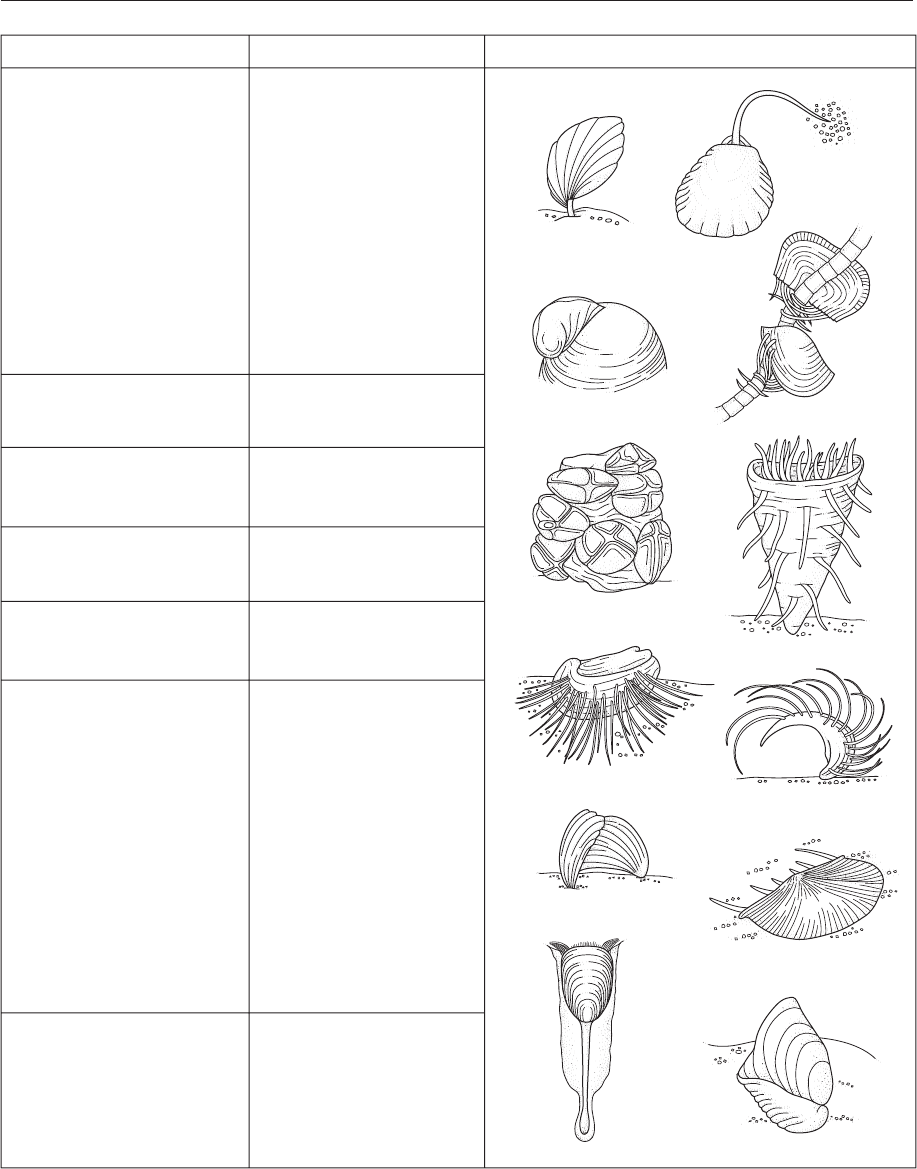
Figure 12.9 Brachiopod lifestyles. (Courtesy of David Harper and Roisin Moran.)

SPIRALIANS 1: LOPHOPHORATES 309
Box 12.3 Chinese lingulides
Did early lingulides live in burrows like many of their descendants? Xianshanella haikouensis from
the Lower Cambrian Chengjiang fauna, South China was a subcircular animal with horny setae and
a massive pedicle. Zhang Zhifei and his colleagues (2006) have shown that these earliest brachiopods
did not live in burrows, but actually attached themselves to the shells of other invertebrates – an
epibenthonic rather than infaunal mode of life (Fig. 12.10). Moreover the Chengjiang lingulide has
a lophophore, a U-shaped digestive tract and an anteriorly-located anus; these advanced features
were already present in the lingulate brachiopod lineage right from the start it seems.
number of quite different non-articulated and
articulated taxa were cemented to the sub-
strate, whereas some groups evolved clasping
spines to help stabilize their shells. In a number
of groups the pedicle atrophied during ontog-
eny. Many taxa thus developed strategies
involving inverted, pseudoinfaunal and recum-
bent life modes; a number lived in cosupport-
ive clusters and others mimicked corals. Not
all brachiopods were sessile; a few, such as
Lingula, adopted an infaunal lifestyle (Box
12.3), whereas the articulated forms Camer-
isma and Magadina were semi-infaunal.
Throughout the Phanerozoic the brachio-
pods have participated in a spectrum of level-
bottom, benthic paleocommunities. Pioneer
studies on Silurian brachiopods suggested that
their paleocommunities were depth related,
and a predictable succession of faunas, each
characterized by one or more key brachiopods,
has been identifi ed (Fig. 12.11). The onshore–
offshore assemblages of the Lingula, Eocoelia,
Pentamerus, Stricklandia (or its close relative
Costistricklandia) and Clorinda paleocommu-
nities, fi rst identifi ed in the Silurian of Wales,
form the basis of benthic assemblage (BA)
zones 1–5, ranging from intertidal environ-
ments to the edge of the continental slope;
more basinal environments are included in
BA6. Parallel studies on Mesozoic brachio-
pods have, on the other hand, suggested that
brachiopod-dominated paleocommunities
were controlled by substrate rather than depth
(Fig. 12.12). Clearly, in reality, a combination
of these and other factors controlled the distri-
butions of the Brachiopoda in a complex
system of suspension-feeding guilds.
Brachiopods have also acted as substrates
for a variety of small epifaunal animals (see
p. 97). The progressive and sequential coloni-
zation of Devonian spiriferids, by Spirorbis,
itself a possible lophophorate (Taylor & Vinn
2006), Hederella, Paleschara and Aulopora
marked the development of an eventual climax
paleocommunity on the actual brachiopod
shell itself. Were they feeding on incoming
brachiopod food or just waste? The general
view is that these animals congregated beside
the inhalant currents on the median parts of
the anterior commissure, and benefi ted from
the indrawn particles of food. An alternative
view, and it is hard to prove or disprove, is
that they were taking advantage of waste
being ejected from the brachiopod.
Brachiopods not only acted as suitable sub-
strates for an epifauna, they were also prone
to attack (Box 12.4) and drill holes suggest
predation and in some cases attachment of
other brachiopods themselves (Robinson &
Lee 2008).
Brachiopods, functional morphology
and paradigms
Martin Rudwick, an English brachiopod
expert just beginning his career in the 1960s
(he is now a distinguished historian of
geology), proposed the paradigm approach in
functional interpretation of fossils. His idea
was to create an engineering model for a func-
tion, such as water fl ow in feeding. For
example, does the costation, the zig-zag
pattern of ridges and furrows, of the anterior
commissure of the brachiopod have a real
functional signifi cance? In numerical terms it
can be shown that costation increases the
length of commissure and hence the intake
area that may be held open without increasing
Continued

310 INTRODUCTION TO PALEOBIOLOGY AND THE FOSSIL RECORD
(a) (b)
(c)
(d)
Dva
Dva
Vva
Vva
Dva
Vva
Vs
Vs
Vs
B
B
Pc
Pc
Pc
Co
Ds
Um?
Ct Ct
A
St
Dd
Dt
Figure 12.10 Chinese lingulides: Reconstruction of the Chengjiang lingulid Xianshanella. A, anal
opening; B, brachial arm; Co, cone-like organisms; Ct, cheek of trilobite; Dd, digestive tract; Dva,
dorsal visceral area; Pc, pedicle cavity; St, stomach; Um?, possible umbonal muscle; Vs, setae
fringing ventral valve; Vva, ventral visceral area. Scale bars, 2 mm. (From Zhang et al. 2006.)

SPIRALIANS 1: LOPHOPHORATES 311
Outcrop area
Graptolitic muds
TurbiditesT
Shelf margin
Current direction
Land area
Lingula community
Eocoelia community
Pentamerus community
Costistricklandia community
Clorinda community
G
L
E
P
S
C
N
050
km
T?
Anglesey
Aberystwyth
Haverfordwest
Bristol Channel
Llandovery
Presteigne
Wenlock
Shropshire
Malvern
Malvern
line
May Hill
LAND
Cardigan Bay
G
G
G
G
G
G
C
C
C
C
S
P
P
P
E
E
E
L
L
Rosemarket
Lingula sp.
Eocoelia curtisi
Pentamerus
oblongus
Costistricklandia
lirata alpha
Clorinda globosa
Figure 12.11 Lower Silurian depth-related paleocommunities developed across the Welsh and Anglo-
Welsh region. (Based on Clarkson 1998.)
Clastic
dykes
4
Rocky
sea-floor
Transported
shallow-water
material
Unstable coastlines Normal coastlines
Flysch-type
deposits
7
Floating algae
6
Dominantly
pelagic
sediments
5
Normal
muddy
sediments
2
Normal
sand-grade
sediments
1
Coarse
littoral
sediments
Coast without
reefs
Coast with
reefs
Lagoonal
sediments
Reef
3
Reef
detritus
Figure 12.12 Mesozoic palaeocommunities developed across Alpine Europe. Numbers 1 to 7 refer to
the seven different biotypes described on the fi gure. (Based on Ager, D.V. 1965. Palaeogeogr.
Palaeoclimatol. Palaeoecol. 1.)

312 INTRODUCTION TO PALEOBIOLOGY AND THE FOSSIL RECORD
Box 12.4 Brachiopod predation
Brachiopods were eaten by gastropods, arthropods and other predators, and the best evidence is
found in Paleozoic examples, especially in the Devonian. Many predatory gastropods feed by drilling
into the shells of their prey, and two types of drill hole are commonly present in Paleozoic brachio-
pods: small, cylindrical holes made by Oichnus simplex and larger, often beveled holes made by O.
paraboloides; these are, of course, ichnogenera (see p. 525) and not actual brachiopods (Fig. 12.13).
After the Devonian peak in drilling diversity, there was apparently a marked drop in the frequency
of drilled shells, particularly after the Mid Carboniferous. Many Carboniferous and Permian groups
such as the productides have thickened shells with an armor of frills, lamellae and spines, all perhaps
acting as defense against marauders. Maybe the prey had won this early arms race or perhaps the
introduction of mollusks into these communities provided fresh and preferable seafood for the preda-
tors. Nevertheless, if we use the Recent Antarctic benthos as a model for the Paleozoic fauna, there
is a lack of fast-moving durophagous predators (Harper 2006). Some authors have speculated that
the toxins within the fl esh of some modern groups, such as the rhynchonellids, may have protected
them from attack.
Figure 12.13 Brachiopod predation: boring of Oichnus paraboloides in the conjoined valves of
Terebratulina from the Pleistocene rocks of Barbados. Scale bar is in millimeters. (Courtesy of
Stephen Donovan.)

SPIRALIANS 1: LOPHOPHORATES 313
the gape of the two shells. Thus an increased
volume of nutrient-laden fl uid may fl ow into
the mantle cavity while grains of sediment
with diameters exceeding the shell gape will
still be excluded. So far so good.
During the Permian, a group of aberrant
productoids, called the richthofeniids, mim-
icked corals and built biological frameworks
that may be found as fossils in the Salt Ranges
of Pakistan and the Glass Mountains of Texas.
These brachiopods have a cylindrical pedicle
valve attached to the substrate and a small,
cap-like brachial valve. It is diffi cult to under-
stand how these animals fed. A possible sce-
nario involves the fl apping of the upper,
brachial valve to generate currents through the
brachiopod’s mantle cavity. Rudwick fi lmed
the fl ow of water through the cylindrical,
lower, pedicle valve as the upper valve was
moved up and down. Fluid did in fact move
effi ciently through the animal, bringing in
nutrients and fl ushing out waste. The para-
digm, however, failed the test of fi eld-based
evidence. Specimens of the athyride Compos-
ita apparently in life position occur attached to
the upper valve of the richthofeniid. Vigorous
fl apping of the valve was thus unlikely and it
would not have been an ideal attachment site
for an epifauna. Rather, these aberrant animals
may have developed lophophores with a ciliary
pump action to move currents through the
valves. One hypothesis has been rejected, and
another stands as a possibility – we cannot
prove how the richthofeniid brachiopods func-
tioned, but the paradigm approach offers a
reasonably objective way for paleontologists
to approach these problems.
Distribution in space: biogeography
The biogeographic patterns of the linguli-
formean brachiopods were quite different
from those of the craniiformeans and rhyn-
chonelliformeans. The former had planktotro-
phic larval phases (see p. 241) with a facility
for wide dispersal; in contrast the lecithotro-
phic larvae of the latter were short-lived and
thus individual species were less widely distrib-
uted. Cambrian brachiopods were organized
into tropical and polar realms. Linguliformeans
developed widespread distributions in shelf
and slope settings; rhynchonelliformeans were
more diverse in the tropics, preferring shallow-
water carbonate and mixed carbonate-
siliciclastic environments. In the Ordovician,
brachiopod provincialism generally decreased
during the period. Provinciality was most
marked during the Early Ordovician, when a
range of platform provinces associated with
the continents of Baltica, Gondwana, Lauren-
tia and Siberia (see Appendix 2) were supple-
mented by centers of endemism associated
with a range of microcontinents and volcanic
arcs and island complexes.
Provincialism was reduced during the Silu-
rian with the close proximity of many major
continents. By the Wenlock, however, two
broad provinces, the cool-water Clarkeia and
the mid-latitudinal Tuvaella faunas, empha-
sized an increasing endemism, climaxing
during the Ludlow and Prídolí epochs. Pro-
vinciality was particularly marked during the
Mid Devonian coincident with peak diversi-
ties in the phylum. Clear biogeographic pat-
terns continued into the Carboniferous, but
the Permian was characterized by higher
degrees of provinciality probably associated
with steep climatic gradients.
During the Triassic, brachiopod faunas, fol-
lowing an interval of cosmopolitan disaster
taxa, became organized into Boreal (high-lati-
tude) and Tethyan (low-latitude) realms (Box
12.5). This pattern continued throughout the
Mesozoic, but with centers of endemism and
occasional modifi cations due to ecological
factors such as the circulation of ocean currents
and the local development of chemosynthetic
environments. Biogeographic patterns among
living forms refl ect their Cenozoic roots: a
southern area, the northern Pacifi c, and a
northern area (Atlantic, Mediterranean, North
Sea and the circumpolar northern oceans) are
based on a variety of articulated brachiopod
associations. The linguliformeans have more
widespread, near-cosmopolitan distributions.
BRYOZOA
Besides these, there were the Bryozoa, a
small kind of Mollusk allied to the Clams,
and very busy then in the ancient Coral
work. They grew in communities, and
the separate individuals are so minute
that a Bryozoan stock looks like some
delicate moss. They still have their place
among the Reef-Building Corals, but
play an insignifi cant part in comparison
with that of their predecessors.
Atlantic Monthly (April, 1863)

314 INTRODUCTION TO PALEOBIOLOGY AND THE FOSSIL RECORD
Box 12.5 Tethyan brachiopods in Greenland: a Cretaceous Gulf Stream
current?
Brachiopods can give clues about ancient ocean currents. Today, the Gulf Stream runs out from the
Caribbean, sweeps up the eastern seaboard of North America, and then detaches from the coast just
north of New York and heads across the Atlantic to wrap the shores of Britain and western Europe
in warmer-than-expected waters. Has the Gulf Stream always fl owed the same way? Some Cretaceous
brachiopods give us a clue. David Harper and colleagues (2005) showed how some Early Cretaceous
brachiopod faunas from East Greenland were a mix of animals from two ocean provinces, Tethyan
(low latitude) and Boreal (high latitude). The Boreal, shallow-water assemblage is dominated by
large terebratulids and ribbed rhynchonellids, and occurs adjacent to a fauna containing Tethyan
elements, more typical of deeper water, including Pygope (see p. 311). How did these exotic, tropical
visitors travel so far north? Harper and colleagues suggested that an Early Cretaceous out-of-Tethys
migration was helped by the early and persistent northward track of a proto-Gulf Stream current
(Fig. 12.14). These kinds of studies of changing patterns of paleobiogeography through time are
critical for understanding modern climate and ocean patterns.
?
?
?
Greenland
Gondwana
Russian
Platform
Mediterranean
Tethys
P
a
l
e
o
e
q
u
a
t
o
r
B
o
r
e
a
l
O
c
e
a
n
N
o
r
t
h
S
i
b
e
r
i
a
A
r
c
t
i
c
C
a
n
a
d
a
P
o
l
i
s
h
F
u
r
r
o
w
Land area
Present-day
coastline
Migration route
Figure 12.14 Tethyan brachiopods in East Greenland: Pygope and the proto-North Atlantic
current (arrows), one of its possible migration routes. The star indicates the Lower Cretaceous,
East Greenland locality.
Bryozoans are the only phylum in which all
species are colonial. Many skeletons are
exquisitely designed, but fragment very easily
after death. Although relatively common,
bryozoans are among the least well-known
invertebrates. There are about 6000 living
and 16,000 fossil species, and most are marine
(Box 12.6). Superfi cially resembling the corals
and hydroids, the bryozoans (“moss animals”)
are like minute colonial phoronids (see p.
298) with tiny individuals or zooids, com-
monly less than 1 mm in diameter. Each zooid
is celomate with a separate mouth and anus
together and a circular or horseshoe-shaped

SPIRALIANS 1: LOPHOPHORATES 315
lophophore equipped with a ring of 8–100
tentacles – a major organizational jump from
the cnidarians. The bryozoan lophophore is
constructed differently from those of the bra-
chiopods and phoronids and it may be a
mistake to think that all three groups are
closely related just because they possess cili-
ated feeding organs. Individual zooids are
enclosed by a gelatinous, leathery or calcare-
ous exoskeleton, usually in the form of slender
tubes or box-like chambers called zooecia.
The primary function of most zooids is the
capture of food, but some are specialists in
defense, reproduction or sediment removal;
the bryozoan colony thus functions as a well-
organized unit.
Morphology: Bowerbankia
The genus Bowerbankia is a relatively simple
bryozoan useful for illustrating the general
anatomy of bryozoan zooids (Fig. 12.15).
Each living zooid is enclosed by a body wall
or cystid. The lophophore, with its beating
cilia, extends outwards from the zooid and
comprises a ring of 10 tentacles, directing
food to a central mouth leading into a U-
shaped gut; the feces fi nally exit out through
an anus. A funiculus extends along the stolon
connecting all the zooids. This is thought to
be a homolog of the blood vessels found in
other animals. The individual zooids are her-
maphrodites, developing eggs and sperm at
different times; the eggs are usually fertilized
in the tentacle sheath, developing later into
trochophore larva.
Ecology: feeding and colonial morphology
Feeding strategies of bryozoans have had a
major infl uence on the style of colony growth.
Feeding behavior patterns are correlated with
the shape of the colony and the size of the
zooids. Bryozoan colonies can grow in a
variety of modes from encrusting runners,
uniserial or multiserial branches that split,
and sheets where growth occurs around the
entire margin, to more erect type forms that
have complex three-dimensional morpholo-
gies (Box 12.7). Many elegant forms have
evolved such as the bush- and tree-like trepo-
stomes of the Paleozoic, the spiral Archimedes
and vase-shaped Fenestrella, in both of which
the entire colony may have acted like a sponge.
But bryozoan colonies can also move. For
example, colonies of Selenaria can scuttle
across the seafl oor. Stilt-like appendages or
setae project downwards from specialized
zooids and as the setae move in waves, the
colony is transported across the seabed. Such
a lifestyle can be traced back to the Late Cre-
taceous when free-living colonies, the so-
called lunulitiforms, evolved their regular
shape, without interference from adjacent
objects on the seafl oor.
Zooid size can give important clues about
environment and particularly water tempera-
ture. Increased ranges of seasonal variation in
temperature seem to be correlated with an
increased amount of variation in the size of
zooids in the colony (O’Dea 2003). It is not
clear why there is this relationship, but nev-
ertheless zooid size may also be a useful envi-
ronmental proxy.
Evolution: main fossil bryozoan groups
The oldest bryozoans in the fossil record
occur in the Tremadocian Stage of the Lower
Ordovician, but it is very likely that primitive,
soft-bodied bryozoans existed during the
Cambrian but have not been fossilized; numer-
ous families of bryozoans are found in the
succeeding Floian Stage. The Stenolaemata
dominated Paleozoic bryozoan faunas (Fig.
12.17). The trepostomes or stony bryozoans
commonly had bush-like colonies with pris-
matic zooecia having polygonal apertures.
The group diversifi ed during the Ordovician
to infi ltrate the low-level benthos. Genera
such as Monticulipora, Prasopora and
Parvohallopora are typical of Ordovician
assemblages.
The cryptostomes, although originating
during the Early Ordovician, were more abun-
dant during the Mid and Late Paleozoic as the
trepostomes declined; in some respects the
group forms a link with the net-like fenes-
trates that were particularly common in the
Carboniferous (Fig. 12.18). Fenestella, itself,
may be in the form of a planar mesh, cone or
funnel. The branches of the colony are con-
nected by dissepiments; rectangular spaces or
fenestrules separate the branches that contain
the biserially-arranged zooids. Archimedes,
however, has a meshwork wound around a
screw-shaped central axis. Richard Cowen
and his colleagues (University of California)

316 INTRODUCTION TO PALEOBIOLOGY AND THE FOSSIL RECORD
have modeled the feeding strategies of these
screw-shaped colonies and other fenestrates.
Carboniferous fenestrate colonies usually had
inward-facing zooids and probably drew
water in through the top of the colony and
fl ushed it out through the fenestrules at the
sides. On the other hand, Silurian colonies
had outward-facing zooids and sucked in
water through the fenestrules, expelling it out
of the open top of the colony.
In general both the cryptostomes and fenes-
trates outstripped the trepostomes during the
Late Paleozoic, many of the fenestrates popu-
lating reef environments. Although both
groups disappeared at the end of the Permian
or soon after, they were still conspicuous
members of the Late Permian benthos; both
Fenestella and Synocladia form large, vase-
shaped colonies in the communities of the
Zechstein reef complex in the north of England
(a)
(b)
lophophore
collar
muscular
sphincter
metacel
retractor
muscle
stolon
tissue
cords
parietal
muscles
gut
transverse
parietal
muscles
ovary
frontal
membrane
retractor
muscles
operculum
anus
lophophore
operculum
closing
muscle
metacel
testis gut
lateral
pores
tissue
cord
parietal
muscles
Figure 12.15 Morphology of two living bryozoans: (a) a stenolaemate and (b) a gymnolaemate. (Based
on various sources.)

SPIRALIANS 1: LOPHOPHORATES 317
Box 12.6 Bryozoan classifi cation
Class PHYLACTOLAEMATA
• Cylindrical zooids with horseshoe-shaped lophophore. Statoblasts arise as dormant buds. Fresh-
water with non-calcifi ed skeletons. Over 12 genera
• Triassic, possibly Permian to Recent
Class STENOLAEMATA
• Cylindrical zooids with calcareous skeleton. Membraneous sac surrounds each polypide; lopho-
phore protrudes through an opening at the end of the skeletal tube. Marine, with an extensive
fossil record. Contains the following orders: trepostomes (Ordovician–Triassic), cystoporates
(Ordovician–Triassic), cryptostomes (Ordovician–Triassic), cyclostomes (Ordovician–Recent)
and fenestrates (Ordovician–Permian). About 550 genera
• Ordovician (Tremadoc) to Recent
Class GYMNOLAEMATA
• Cylindrical or squat zooids of fi xed size with circular lophophore, usually with a calcareous
skeleton. The majority are marine but some are found in brackish and freshwater environments.
Includes the cheilostomes (Jurassic–Recent). Over 650 genera
• Ordovician (Arenig) to Recent
Box 12.7 Module iteration: building a Lego bryozoan
Bryozoan colonies grow by iteration, repeating the same units again and again until the colony is
built. But is this process just a simple addition of individual units (zooids) within the colony? If so,
the opportunity for evolution and morphological complexity would be very limited. There may be
a whole hierarchy of types of modules that are in fact iterated (repeatedly re-evolved). For example,
much more variability will be generated if a branch rather than a zooid is duplicated and attached
to various parts of the colony in various different orientations. Steven Hageman of Appalachian
State University suggested just this in a paper published in 2003: there is a hierarchy of such modules
and those second-order blocks will have a much greater effect on morphological change and evolu-
tion of the colony than simply duplicating the zooids. This can be easily demonstrated by an analogy
with a Lego model. The individual blocks, if iterated, will form only fairly simple patterns, but build
a structure and iterate that and suddenly considerable morphological complexity can be generated
from relatively simple building blocks (Fig. 12.16).
Continued