
Blackburn J.A., Dulmus C.N. (Editors). Handbook of gerontology: evidence-based approaches to theory, practice, and policy
Подождите немного. Документ загружается.


456 E
VIDENCE
-B
ASED
F
AMILY AND
C
OMMUNITY
P
RACTICE
WHAT IS CHRONIC CARE?
Chronic care is an umbrella term that includes acute, subacute, postacute, and
primary facility-based care, in-home care, and community-based services. As the
range of services available for older adults with chronic conditions has increased,
the term chronic care has evolved to describe any combination of medical (acute,
primary, postacute, ambulatory) and social services. Although this type of sup-
port traditionally has been called long-term care, the terminology is changing for
several reasons. Originally, long-term care referred to nursing home care. During
the past several decades, a variety of programs and services were developed to
support older adults in community settings and in their own homes, often called
home-and community-based services (HCBS). Chronic care typically involves
multiple organizations interacting in a loose network rather than in a tight bu-
reaucratic structure. In addition to services, chronic care is often defined by the
population served, including individuals who are functionally impaired and/or
who have medically complex chronic conditions. Terminology to describe those
receiving services varies. For example, those who receive care in facilities are
called residents, those served in day care are called participants, care managers
usually refer to their clients, and those receiving hospice are patients.
Characteristics of chronic care services include the following:
• Are supportive and concerned with maintaining or improving functioning
over an extended period of time, usually 90 days or more
• Encompass social and environmental needs, and are therefore broader than
the acute care medical model
• Are often low-tech, high-touch, hands-on services
• Affect multiple aspects of life over an extended period of time
• Are provided on a formal or informal (family and friends) basis
• Are difficult to define due to variability within services and blurred bound-
aries across services
• Include a wide range of health services, health-related support services, and
housing
• Involve a broad range of help with daily activities that chronically disabled
individuals need for a prolonged period of time (Stone, 2000)
About 60% of those who use chronic care services are older adults. Although
on any given day only about 4% of those age 65 and over are in facility-based care
(i.e., nursing homes), about 14% of older adults require functional assistance of
some type. Consumers of chronic care services also include children and adults
under the age of 65 with developmental disabilities, severe chronic mental disor-
ders, HIV/AIDS, or disabling physical disabilities. Trends such as population
aging, technological advances, the restructuring of health care services toward
less hospital-based care, managed care, and alternative delivery systems are
transforming the field of chronic care service delivery. These trends result in in-
creased demand for services and expanded efforts to identify and apply effective
innovations in multiple settings.
Figure 17.1 illustrates the categories and types of services that may be in-
cluded under the rubric of chronic care. The continuum of chronic care services
for older adults includes a wide range of medically and socially focused services
(Alkema, Shannon, & Wilber, 2003; Dychtwald & Zitter, 1991). These services are
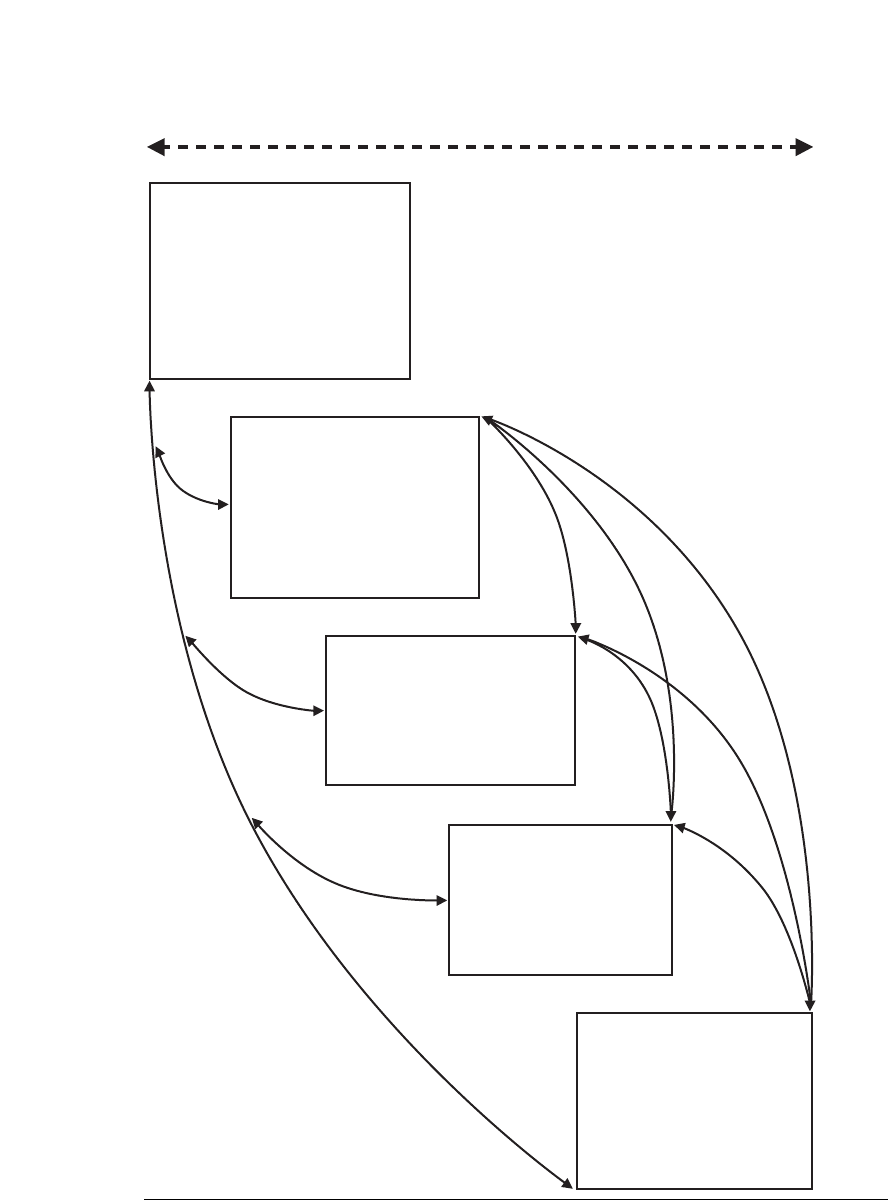
457
Figure 17.1 The Continuum of Chronic Care Service Delivery for Older Adults.
Adapted from “Using Interagency Collaboration to Serve Older Adults with Chronic Care
Needs: The Care Advocate Program,” by G. E. Alkema, G. R. Shannon, and K. H.
Wilber, 2003,
Family and Community Health, 26
(3), 221–229. Adapted with permission.
Geriatric Inpatient - Mental Health
Geriatric Rehabilitation
Sub acute Unit
Skilled Nursing Facility
Intermediate Care Facility
Inpatient Hospital
Geriatric Outpatient Care
Geriatric Evaluation and Management
Home Health Care
Hospice
Group I - Institutional
Adult Day Care / Day Health Care
Respite Care
Health Assessment
Medical / Social Case Management
Health Screening
Board and Care Homes
Assisted Living Facilities
Adult Foster Care
Disease Management
Group II - Personal Care / Evaluation
Information and Assistance
Health Promotion
Senior Centers
Health Education
Caregiver Education
Congregate / Home-Delivered Meals
Resource Counseling
Group III - Health / Wellness
Adult Protective Services
Telephone Reassurance
Friendly Visitor
Emergency Response System
Retirement Communities
Guardianship
Socialization Activities
Group IV - Safety / Support
Senior Housing
Homemaker Services
Chore Services
Employment
Legal Planning
Financial Services / Management
Transportation
Community Recreation
Volunteerism
Group V - Lifestyle
Medical Social

458 E
VIDENCE
-B
ASED
F
AMILY AND
C
OMMUNITY
P
RACTICE
provided in private homes, community settings, and a variety of 24-hour facili-
ties. Starting at the highest level of intensity, services extend from institutional-
level care, such as hospitals and nursing facilities, down to lifestyle services,
which include legal and financial advice, transportation, and recreation services.
Intensity and dosage of an intervention varies significantly within each specific
service type based on what is appropriate for the consumer’s needs (Weissert,
Chernew, & Hirth, 2003). The arrows represent links between service groups, sig-
nifying that consumers and providers may access any level of care needed as all
groups are connected to each other, and they can access a direct link back to
institutional-level care when appropriate. As policy makers and practitioners
work toward creating a true chronic care model integrating medical and social
care, they must account for myriad service options available and unique configu-
rations of these services together to address the multiple and often unpredictable
needs of older adults with chronic conditions.
CORE VALUES GUIDING SERVICE
DELIVERY TO OLDER ADULTS
One of the major challenges in serving older and dependent adults is to provide
the appropriate level of support while safeguarding basic rights of autonomy and
self-determination. A fundamental approach to keep the important goal of safety
from incorrectly trumping individual freedom is to operationalize these values in
programs available for older adults (Wilber, 2000; Wilber & Alkema, 2006). These
core values include (a) striving to offer the least restrictive appropriate alterna-
tive; (b) facilitating the older person’s ability to live wherever he or she is most
comfortable, often called “aging in place”; (c) centering decisions to the greatest
extent possible around client preferences and expressed needs through programs
that offer consumer choice and direction; (d) drawing from the repertoire of
available interventions to develop an individualized plan of treatment; (e) sup-
porting informal caregivers; and (f) clinically integrating medical, social, and
housing services. Ideally these values are operationalized in the context of self-
determination and person-environment fit, offering providers appropriate tools
to balance respect for the client’s personal freedom with legitimate concerns
about personal safety.
The least restrictive appropriate alternative is a term that originated with a court
case, Lake v. Cameron (1966), in which the District of Columbia Court of Appeals
ruled that less restrictive alternatives must be sought before an individual may be
held in an institution. Since then, this ruling solidified the values that consumers
should be served with as few constraints placed on them as possible, and their
rights and liberties should be recognized and respected. This trend is evident in
state efforts to implement the Olmstead decision, also based on a court ruling. Olm-
stead v. L.C. was decided by the U.S. Supreme Court in 1999. Based on the federal
Americans with Disabilities Act (ADA), the Court found that the ADA prohibits
states from unnecessarily institutionalizing individuals with disabilities due to
the state’s failure to serve them in the most integrated setting appropriate to their
needs and preferences. Although states must respond by making reasonable ac-
commodations for community care options, states are not required to fundamen-
tally alter their existing programs (Rosenbaum, 2000). For a comprehensive update
on state planning to meet the Olmstead decision, see Fox-Grage, Folkemer, and
Lewis (2004).

Community- and Facility-Based Care 459
Aging in place (Callahan, 1993), which we broaden to encompass aging wherever
the older adult wants to live, recognizes that individuals should not be forced to re-
locate to different settings due to needing higher levels of care. Rather, to the ex-
tent possible, services should be designed so that consumers can use them in the
setting of their choice, typically their home, and should be flexible enough to ad-
dress changing needs. Aging in place includes home modifications to make the
living environment manageable and safe (Pynoos, Nishita, & Perelman, 2003),
and incorporating personal care or other compensatory services into the home
environment. Another example of residential-based services that support this
mission is a movement toward cohousing and intentional communities (Thomas,
2004). Day services, such as adult day care (discussed later in this chapter), may
also help with aging in place when there is adequate transportation to facilitate
access and when services support independent living.
Consumer-centered and consumer-directed care suggest that, to the extent feasi-
ble, the recipient of services makes decisions about care rather than the provider
dictating the approach. To support informed decisions, providers need to listen to
recipients’ concerns and questions, inform them of available choices, and discuss
the consequences of using available options (Curry & Wetle, 2001; Kaufman &
Becker, 1996). Recent studies of consumer-directed services in the United States
suggest two general models of implementing consumer-directed support when
providing personal care (Benjamin, 2001). The first model provides full decision-
making power to consumers, who are responsible for hiring, firing, and managing
care providers, and finances the service provision through a fiscal intermediary.
The second model, exemplified in the Cash and Counseling Program, provides a
fixed monthly allowance in a spending account that participants can spend to-
ward disability-related goods and services (B. Phillips & Schneider, 2002). Cash
comes with support from professional case management counseling and fiscal
management to assist consumers with the hiring, firing, and supervising of care
through a local contracted agency. By balancing consumer choice with profes-
sional support, this model can be adapted to consumers of varying functioning
levels. Additionally, literature on the philosophy of consumer direction acknowl-
edges that older adults desire professional support to help with identifying and
assisting with service needs, but maintains that the consumer is responsible for
decisions about when, if, and how he or she wants to use services (Coleman, 2001;
R. A. Kane, 2001; Squillace & Firman, 2002).
Support for family caregiving challenges the long-held myth that families relin-
quish the care of their older adult relatives to nonfamily providers. In reality,
among older adults not residing in 24-hour care facilities, unpaid informal care-
givers provide about 80% of the care (Doty, Stone, Jackson, & Drabek, 2001;
Wiener, Illston, & Hanley, 1994). Given the high demands of caring for a frail
older person, high stress, burnout, and caregiver burden may become problems
(Zarit, Reever, & Bach-Peterson, 1980). Formal services that value, support, and
complement informal care, including counseling, support groups, and respite ser-
vices, offer useful means to ensure continuity and service effectiveness.
Individualized treatment plans are an important component of chronic care ser-
vices given that a one-size-fits-all approach will not meet the varied needs of di-
verse older adults. Given that community- and facility-based services have the
potential to affect every aspect of an individual’s life, treatment planning should
be personalized and targeted to both the needs and preferences of the older
adult. Individualized treatment planning begins with a thorough assessment

460 E
VIDENCE
-B
ASED
F
AMILY AND
C
OMMUNITY
P
RACTICE
Box 17.1
Chronic care services are also distinct in that they include therapeutic, compensa-
tory, and palliative approaches. Whereas acute health care focuses more on thera-
peutic treatment, the long-term care component of chronic care traditionally
focuses on compensatory and palliative care (R. A. Kane, Kane, & Ladd, 1998). Al-
though therapeutic care has been the focus in health care, the increasing need for
chronic care services requires attention from compensatory and palliative care.
Therapeutic treatment emphasizes:
• Getting better
• Treatment
• Improved functioning
• Reduced decline
Compensatory care focuses on:
• Adapting to disability
• Compensating for areas of impairment
• Consumer focus and control
Palliative care focuses on:
• Increasing daily comfort
• Controlling pain
• Supporting clients and their caregivers at any stage of a serious illness
process, including assessment of the older adult’s needs and preferences and the
informal and professional care systems that provide assistance (Moxley, 1989).
Based on this assessment, treatment plans are developed in context of the older
adult’s service preferences, availability and geographic proximity of those ser-
vices, and eligibility requirements. Treatment plans serve as guiding strategies
to implementing needed services and should be dynamic and responsive to the
individual’s changing needs.
Finally, given that chronic care services tend to be highly fragmented, the array
of specialized services needed by each person must be woven together into a clini-
cally integrated service package for each consumer. Chronic care is a complex en-
deavor, involving a variety of health and social services offered in different
settings by a variety of different professionals and paraprofessionals. Its complex-
ity includes different terminology, administration, financing, and reimbursement.
The fragmentation of health and social care delivery systems, described by the In-
stitute of Medicine (2001, p. 4) as a “nightmare to navigate,” makes it difficult for
those with chronic conditions to gain access to services and coordinate them across
the different types of care needed. Clinical integration of services seeks to over-
come the fragmentation that results from multiple programs and providers engag-
ing in the older person’s care. When it is necessary to weave together services from
numerous providers, the goal of clinical integration is to provide services that con-
sumers perceive to be seamless. Specific means for clinical integration include case
management, multidisciplinary teams, coordination of services offered by differ-
ent organizations, and service integration within a single organization. Regardless
of the approach, it is important that the fragmented delivery system does not nega-
tively affect the older adult’s ability to access and use care (see Box 17.1).

Community- and Facility-Based Care 461
TRENDS AND INCIDENCE
Chronic conditions are highly prevalent in the United States, affecting over 125
million people, or about 40% of the population (Anderson & Horvath, 2002; Wu &
Green, 2000). By 2020, this number is expected to increase to 157 million people
(Wu & Green, 2000). The five most common chronic health conditions are hyper-
tension (26%), mental conditions (22%), respiratory diseases (18%), arthritis
(13%), and heart disease (12%). One of these—heart disease—and four others
(cancers, strokes, chronic obstructive pulmonary disease, and diabetes) are re-
sponsible for two-thirds of all deaths in the United States (Centers for Disease
Control and Prevention, 2002). Nearly half of those diagnosed with a chronic con-
dition (one-fifth of the U.S. population) cope with more than one such condition
(Wu & Green, 2000).
In addition to diagnoses, another way to define who needs chronic care ser-
vices is by identifying people who have functional impairment. Feldman and
Kane (2003) note that defining functioning as “activities of daily living” (ADLs) is
a key concept for long-term care research and provides the backbone of long-term
care practice. Katz, Ford, Moscovitz, Jackson, and Jaffe (1963) defined ADLs as
bathing, dressing, toileting, transferring, continence control, and eating. A few
years later, Lawton and Brody (1969) added a related category which they called
instrumental activities of daily living (IADLs). Whereas ADLs focus on personal
care, IADLs address a person’s ability to manage the environment: managing
money, using the telephone, grocery shopping, personal shopping, using trans-
portation, housekeeping, and managing medications. In 2003, 35% of Americans
age 65 and above reported having at least one ADL or IADL limitation caused by
a chronic condition (National Center for Health Statistics, 2005). Ten percent of
those age 75 and above reported an ADL limitation, and 18% reported an IADL
limitation due to a chronic condition (National Center for Health Statistics, 2005).
Twenty-five percent of those with a chronic condition experience at least one ac-
tivity limitation, and those with multiple chronic conditions are significantly
more likely to have activity limitations. For example, 67% of patients with five or
more chronic conditions have activity limitations (Anderson & Horvath, 2002).
The consequences of having multiple chronic conditions include greater risk for
disability, greater need for caregiver support, greater use of health care services,
and mortality (Anderson & Horvath, 2002).
Although chronic conditions affect people across the demographic spectrum,
women are more likely than men to have a chronic condition (Wu & Green, 2000).
The majority of people with chronic conditions are under 65, but those over 65 are
more likely to have multiple chronic conditions (Anderson & Horvath, 2002; Wu
& Green, 2000). Considering the aging of the population and increasing life ex-
pectancy estimates over the next 40 years (Campbell, 1996; Lee, Miller, & Ed-
wards, 2003; O’Hara-Devereaux, Falcon, Li, & Kristensen, 1999), the projected
impact of chronic conditions on individuals, caregivers, and the U.S. health care
system is substantial. About 70% of health care dollars in the United States are
spent on chronic illnesses (Hoffman, Rice, & Sung, 1996).
In addition to affecting physical and functional health, chronic conditions also
may affect the mental health and coping abilities of older adults (Germain &
Gitterman, 1996), especially if the condition has associated pain. Pain is related
to impaired physical function (Scudds & Robertson, 2000; Williamson & Schulz,
1992), physical disability (Scudds & Robertson, 1998), and increased depression
(Magni, 1991; Parmelee, Thuras, Katz, & Lawton, 1995) among older adults.

462 E
VIDENCE
-B
ASED
F
AMILY AND
C
OMMUNITY
P
RACTICE
Physical functioning level, number of health conditions, and previous episodes of
depression have been consistently associated with depression across studies
(Copeland, Chen, & Dewey, 1999; Roberts, Kaplan, Shema, & Strawbridge, 1998).
Equally important, depressive symptoms have been linked with increased dis-
ability, impaired functioning, increased morbidity and mortality, and decreased
quality of life (Herrmann, Black, Lawrence, Szekely, & Szalai, 1998; Lesperance,
Frasure-Smith, & Talajic, 1996; Penninx, Leveille, Ferrucci, van Eijk, & Guralnik,
1999; Schoevers et al., 2000; Wells & Sherbourne, 1999). In a large prospective co-
hort study of older adults in the United States, depressed individuals had a
greater decline in physical functioning and performance over a 4-year period
than nondepressed participants (Penninx et al., 1998). As a result of these factors,
people with multiple chronic conditions often experience reduced quality of life.
I
MPACT OF
C
HRONIC
C
ONDITIONS ON
C
AREGIVERS
One key component of supporting those with chronic conditions is that they re-
quire ongoing care, most often provided by caregivers and health care profession-
als (Anderson & Horvath, 2002). The Kaiser Family Foundation (2002) estimated
that there are approximately 45 million adult caregivers; the vast majority are
middle-aged married women, one-third of whom reported having a serious med-
ical condition of their own. About 20% of caregivers stated that their physical
health has suffered due to care-giving activities (Kaiser Family Foundation, 2002;
Metropolitan Life Insurance Company, 1999). Informal caregivers provide exten-
sive support services: direct personal care (bathing, grooming, etc.), medication
assistance, instrumental activities (shopping, meal preparation, etc.), transporta-
tion, and care coordination with health service professionals (Kaiser Family
Foundation, 2002; Kutner, 2001; Metropolitan Life Insurance Company, 1999). For
those with chronic conditions who received assistance with care coordination,
over 50% reported that their informal caregivers provide that service (Harris In-
teractive Inc., 2000).
The economic value of informal caregiving in 2000, based on what services
would cost in the private sector, was estimated to be $257 billion (Arno, 2002;
Arno, Levine, & Memmott, 1999). Transitions through and out of the labor force
indicate another significant cost of caregiving. Informal caregivers who were
engaged in paid work reported a high incidence of formal adjustments to their
work schedules, including use of paid time off, decreased hours, leaves of ab-
sence, transitions from full- to part-time work, and early retirements (Metro-
politan Life Insurance Company, 1999). Sixteen percent of those who retired at
age 62 did so because of a family member’s poor health, and 33% of Californians
who retired between ages 45 and 70 did so for personal health reasons (Yelin &
Trupin, 1999). The economic costs are realized in the form of out-of-pocket
expenses, decreased paychecks, and decreased allotments to retirement
savings such as Social Security and defined contribution plans (Coleman &
Pandya, 2002; Kaiser Family Foundation, 2002; Metropolitan Life Insurance
Company, 1999).
The need to receive ongoing care often generates concerns for people with
chronic conditions, including the ability to afford care, fear of losing independ-
ence, and worries about becoming a burden to caregivers (Harris Interactive
Inc., 2000). Although informal caregivers may provide care for a close family

Community- and Facility-Based Care 463
member, many seek some form of professional or paraprofessional guidance
about care-giving (Kutner, 2001). Several studies have documented the negative
psychological impact on caregivers as a result of the high stress they experience
when caring for a loved one (O’Connor, Pollitt, Roth, Brook, & Reiss, 1990;
Schulz, O’Brien, Bookwala, & Fleissner, 1995). Among caregivers of people with
Alzheimer’s and other chronic diseases, there is a positive correlation between
the intensity of the caregiver’s psychological morbidity and the length of time
providing care (Gonzalez-Salvador, Arango, Lyketsos, & Calcedo Barba, 1999).
Recent studies have also found that caregivers of loved ones with Alzheimer’s
disease may suffer from depression due not only to the severity of the symptoms
of their infirmed family member, but also due to a lack of available resources
(Gonzalez-Salvador et al., 1999; Vitaliano, Russo, Young, & Maiuro, 1991).
A
CCESS TO
C
HRONIC
C
ARE
S
ERVICES
It is well known that about 15% of the population lacks basic health insurance
coverage, but most people are not aware that traditional health insurance gener-
ally does not cover chronic care services such as custodial care in a facility, HCBS,
and respite for caregivers. Traditional health care is financed through employer-
based funding mechanisms, yet most working individuals do not need or demand
long-term care insurance coverage. Traditional health care service delivery em-
ploys a medical model that covers two major areas: hospital and physician care,
also called acute and primary care. Based on this model, about 90% of Americans
lack long-term care insurance coverage to pay for chronic care services. Although
most people believe that they are unlikely to need these services, the data suggest
otherwise. For example, in 2001, 12 million people in the United States needed
some form of chronic care services, and more than half were age 65 and above
(Stone, 2000). One study found that 43% of those 65 and above would spend some
time in a nursing facility in their lifetime, and more than half would remain for at
least 1 year (Kemper & Murtaugh, 1991).
ETIOLOGY AND PROGNOSIS OF FACILITY- AND
COMMUNITY-BASED CARE MODELS
In this section we discuss the etiology of several types of facility- and community-
based care models that serve older adults with chronic conditions. We discuss the
future of these types of care models given the scope of population aging that the
United States will experience over the next 50 years.
F
ACILITY
-B
ASED
C
ARE
M
ODELS
Nursing Homes The origins of modern chronic care began with the early institu-
tions for the poor: the county home or “poor home” (Singh, 2005). Because these
“homes” often served to warehouse people who lacked financial or care-giving
resources, they carried the stigma of a service of last resort. Unlike modern-day
facilities, they lacked a medical component of care. This type of care expanded
during the Depression as homeowners supplemented their income by taking in
older adult boarders. The Social Security Act that passed in 1935 included old age
assistance, which provided funding and expanded the number of nursing homes.

464 E
VIDENCE
-B
ASED
F
AMILY AND
C
OMMUNITY
P
RACTICE
Nursing homes were used when hospital or medical care failed to provide cura-
tive measures for chronic conditions (Abramovice, 1988; Starr, 1984).
In 1960, a shortage of hospital beds increased discharges to less costly nursing
homes. Five years later, financial incentives for nursing facilities were part of the
passage of two of Lyndon Johnson’s Great Society programs: Medicare (for adults
age 65 and above) and Medicaid (for low-income people of all ages). New nursing
homes were designed according to hospital regulations for services and physical
plants. Although Medicaid was not developed to provide custodial care for older
adults, funding available through the Medicaid program led to a boom in the
nursing home industry (Abramovice, 1988).
With the extensive growth, however, came new problems. Nursing home scan-
dals hit the papers in San Diego with tales of neglect and woefully inadequate care.
In addition to newspaper articles, a book was published in 1975 called Tender Loving
Greed: How the Incredibly Lucrative Nursing Home “Industry” Is Exploiting America’s
Old People and Defrauding Us All (Mendelson, 1975). These exposés resulted in out-
rage and created a national backlash against the industry. The 1971 White House
Conference on Aging encouraged the development of home- and community-based
services as alternatives to nursing home care. One of the most dramatic changes
was the industry’s transformation from charity and religious-based organizations
to 75% proprietary ownership. In addition to increasing involvement from the pro-
prietary private sector, small “mom and pop” homes were bought up by corpora-
tions, and several large nursing home chains emerged (Abramovice, 1988).
The nursing home scandals led to a two-pronged effort to improve care for
older and dependent adults: the development of alternatives to nursing homes
and regulatory efforts to improve care in facilities (Miller & Weissert, 2000; Mol-
lica, 2003; Weissert, Cready, & Pawelak, 1988). Alternatives included a number of
HCBS such as adult day care, personal care, and care management (discussed
later). The Nursing Home Reform Act was passed in 1987 to provide fundamen-
tal reform to nursing home operations based on review of standards developed
by the Institute of Medicine (1986). Sometimes referred to as OBRA ’87 because
it was part of the congressional Omnibus Budget Reconciliation Act, it included
improvements in quality assurance measurement based on resident assessments
and care planning. This legislation focused on “residents’ rights” and called for
reduction in and a rationale for use of restraints (physical and chemical). The
Resident Assessment Instrument was developed and implemented to standard-
ize the evaluation and care planning for nursing home residents. This assess-
ment included the Minimum Data Set, which provides a standardized tool for
assessing residents’ functional capacity and care needs and is assessed at admis-
sion and then quarterly.
Despite progress from OBRA ’87 reforms, scandals again made news in the
1990s with a scathing article in Time accusing nursing homes of poor care and
outright neglect (Carlson, 1995). In response the Senate Aging Committee asked
the General Accounting Office (GAO; 1998) to investigate. The GAO report found
that nearly one third of California nursing homes surveyed had serious or poten-
tially life-threatening care problems; licensing enforcement was not catching
many of these problems in the survey process; and when problems were recog-
nized, sufficient state- and federal-level enforcement did not exist. Recommenda-
tions focused on increasing the federal role of nursing home regulations and
enforcement in homes that persisted in providing substandard care.

Community- and Facility-Based Care 465
During this time, a grassroots response to the problems in nursing home set-
tings was evolving under the rubric of “culture change” in all types of facility-
based care. Culture change involves a major shift in thinking about how care
should be provided, focusing on a philosophy that is more consumer-directed, in-
dividualized, supportive, and homelike. The overall goal of culture change is to
direct the focus of facility-based care as places where elders can live and grow
rather than decline and die (Thomas, 1996, 2004). Some of the more prominent
leaders in this effort are the Eden Alternative, the Wellspring Movement, and the
Pioneer Network. Traditionally, a quality-of-life perspective for nursing home
residents has been subjugated by the primacy of quality of care for three reasons:
(1) greater objectivity in measuring quality of care, (2) focus from the disability
community to move people out of nursing homes rather than to improve quality
of life inside, and (3) lack of definitive measurement of quality of life from the
nursing home reform champions (R. A. Kane, 2003).
In addition to increased regulations, federal funding structures began to
change for a variety of facility-based providers starting in the 1980s. Hospital re-
imbursement changed from billing for services after the fact to the prospective
payment for diagnostic related groups. This change contributed to the increased
discharging of patients with greater health care needs to skilled nursing facilities
that received Medicare reimbursement for postacute care. Skilled nursing facili-
ties began expanding their scope of service to include rehabilitation, ventilator
patients, dementia care units, and hospice. Hospitals responded to this change by
opening their own nursing home wings or “distinct parts,” which directly com-
peted with community nursing homes for Medicare-funded rehabilitation pa-
tients. In tandem, Medicare payments to nursing facilities and home health
organizations increased dramatically and at a much higher rate then other
Medicare-funded services. In response, Congress passed legislation in the Bal-
anced Budget Act of 1997 to subsequently fund nursing facilities through a
prospective payment system, as they had done with hospitals and physicians pre-
viously. All of these changes shifted the financing of Medicare services from fee-
for-service arrangements to fixed payments in hopes of controlling costs through
a reimbursement system based on patient acuity and staff time required to ad-
dress the patient’s needs.
Other Facility-Based Settings As nursing homes evolved to meet changing de-
mands, other residential approaches emerged, evolved, and expanded, including
assisted living facilities, board and care homes, supportive housing communities,
and continuing care retirement communities. Assisted living facilities (ALF) are
recognized as a key component of long-term care (Stefanacci & Podrazik, 2005).
Building on Zimmerman et al. (2005), ALF provide room, board, 24-hour staffing,
and assistance with one or more activities of daily living in 24-hour state-licensed
care facilities, excluding licensed health facilities and nursing facilities. Similar
to nursing homes, assisted living facilities include housing; however, they differ
in that their focus is primarily on hospitality services rather then skilled nursing
care or rehabilitation. Some assisted living facilities provide IADL support such
as medication management and personal care support for ADLs. These services
are often part of a cafeteria plan, where residents can select the special support
they need and pay additional monthly premiums accordingly. Although some
states do not use the term “assisted living,” we use it generically here to include