
Gary Dahl. Advertising for Dummies
Подождите немного. Документ загружается.


In the following sections, I unravel the costs of color printing and offer some
less-expensive solutions. I also break down the various types of printers to
give you a better idea of what can work for you (and your bottom line).
Adding a little (or a lot) of color
Today, buying a personal color printer can cost as low as $500, but if you add
just one color to your collateral advertising, you may add a few more zeros to
your overall printing costs. Add two or three more colors, and you may be in
for a serious dose of sticker shock. In addition, paper costs alone have sky-
rocketed over the years, and professional printers have never been embar-
rassed about charging a lot of money for their work. Be sure you know what
you’re getting yourself into before you design something so elaborate that
you can’t afford it. I talk about color in more detail later in the chapter, but
you really do need to know up front: The more color you use, the bigger your
budget should be.
You can get away with producing a very nice and relatively inexpensive piece
in just one color: black. If what you’re saying is strong and if what you’re
showing is interesting, then black ink on a white background may do the job
nicely.
I receive postcard-size mailers on a weekly basis from local real estate agents
showing off their listings. They include a photo of the house, a brief descrip-
tion, the asking price, and a photo of the agent. These pieces of collateral
advertising are well-designed with easy-to-understand copy, and if I were in
the market for a new home, they would be quite effective in arousing my
interest. They’re all printed on glossy card stock in black and white. Nothing
could be simpler — and the costs are relatively low, too.
Printing cheap: No such thing?
Printing isn’t cheap — unless you do it yourself, and even then, you have the
cost of investing in a high-quality paper and toner cartridges, which increase
considerably if you buy a color printer. The number of pages, colors, photos,
die-cuts, and clever folds you design into your piece is in direct proportion to
your blood pressure when you get the cost-of-printing estimate. As a rule,
quick print jobs usually cost a few cents per copy. The major-league brochure
jobs cost a few dollars a copy. Be sure you remember these dollar signs
before you even begin to design your ad.
Also keep in mind that the type of printer you use affects costs, because
printing prices vary widely according to the capabilities and equipment of
each printer. Check out the following printing options:
142
Part II: Creating Great Ads for Every Medium
15_045833 ch10.qxp 11/22/06 3:43 PM Page 142

National chain shops: The national chain copy shops (FedEx Kinko’s,
Staples, and Office Depot) have given small businesses many more print-
ing options. These quick-print specialists are very good at producing
small jobs where cost is more important than quality. You can either
visit your local branch or check out their services online, simply by
uploading the document you want printed.
Large printing firms: Large printing firms that have presses that cover a
square city block are capable of doing the most exquisite work — if you
have the budget for it.
Printers specializing in small to mid-size jobs: Other printers are
experts in small to mid-size jobs, such as letterheads, envelopes, and
business cards — they’re also qualified to do brochures, flyers, mailers,
and the like.
The key is to pick the type of printer who can handle (at a cost you can
afford) the type of printing you need. I use one local printer for my company
newsletters, corporate image items, and one- or two-color mailers. Located in
a small strip mall, this printer does great work and charges a very reasonable
price for smaller jobs. But for full-color, multi-page extravaganzas, I go to a
large firm that has a huge press and the binding capability (collating and
stapling the pages together) that is required when producing large brochure
jobs.
Another factor affecting costs is how many prints you need. Typically, the
per-unit cost goes down the more items you print. For that reason, printing
5,000 units is often more economical than printing just 1,000.
If you only need 1,000 copies for a particular mailing, you can save money in
the long run by printing 5,000 and then, at a later date, imprinting the addi-
tional pieces with information relevant to a future sale or announcement.
With advance planning, you can save a lot of money on printing costs. For
example, I have a client who does regular mailings to his list of current cus-
tomers — about 2,500 people. We generally print 10,000 pieces, which are
designed with space for updated copy that can be printed in one color later.
By printing 10,000 units the first time around and then sending the brochure
with updated copy and a new sales message in four separate mailings, this
client saves a ton of money on printing bills.
Although printing services are everywhere, good printers are a little more
rare. To find a suitable printer, ask other small businesses in your neighbor-
hood which printers they use, thumb through the Yellow Pages, or if you hire
a graphic designer (see “Hiring a pro to do the design work for you” later in
the chapter), let the designer advise you.
143
Chapter 10: Collateral Advertising and Direct Mail
15_045833 ch10.qxp 11/22/06 3:43 PM Page 143
The single most-important factor to any printing project is the final proofing
of the artwork before you release it to the printer. Even though you have the
opportunity to see a final proof from the printer prior to the actual press run
(usually called a blue line), any changes or corrections that aren’t on the orig-
inal artwork are charged back to you at a premium rate.
If you decide to buy your own color printer, you need to know the volume of
pages you’ll be printing per month, then check the number of pages per
minute that your printer can handle: For example, one model of Brother
printer can print 30,000 pages a month. Also check the paper stock the
printer can handle, depending on what you want: Heavy stock can sometimes
be difficult, so if you need to print on heavy paper, you’ll need to get a printer
that can handle that (not all printers can). Finally, check the resolution (the
number of dpi, or dots-per-inch). Remember, you want your collateral adver-
tising to look great.
144
Part II: Creating Great Ads for Every Medium
Digital printers: When you have the need for speed
Digital printing is printing a finished product
directly from a computer or a CD. Years ago, you
had to create a
paste-up
(a hand-assembled,
full-size facsimile containing all the elements of
your finished brochure) or
film
(a picture of your
final paste-up) and take it to a traditional offset
printer for printing. But printing has evolved so
that most printing is now done digitally, where
all you need to do is give a disk or upload an
electronic file to a printer or copy shop. Digital
printing offers you the following advantages:
You get a quicker turnaround time.
Making changes (even at the last minute)
is less expensive, because you can change
your file so easily.
Short runs
(a relatively small number of fin-
ished pieces) are more affordable.
You can print ads on any paper stock.
You can merge the ad with a mailing list to
print addresses directly onto the pieces.
Your computerized mailing list is fed into the
press, and each address is imprinted on the
individual mailing pieces as they run
through the press. This process eliminates
the need for later affixing mailing labels to
each printed piece and saves money at the
mailing house.
Digital printing has become crucial to busi-
nesses that may want to test the waters with a
particular brochure without printing zillions of
copies and spending huge amounts of money.
Last-minute digital printing of jobs such as
trade-show flyers, price lists, and pamphlets
has bailed out many a company with the need
for speedy, last-minute collateral pieces or mul-
tiple copies of a new press release. Turnaround
time for the average digital printing job is mea-
sured in days, not weeks, and they can some-
times be done in 24 hours.
15_045833 ch10.qxp 11/22/06 3:43 PM Page 144

Designing the Best Collateral Ads
for Your Business
Collateral advertising has numerous purposes — and the different kinds of
collateral advertising at your disposal are numerous as well. You should
research carefully, always keeping your budget in mind, to determine which
form of collateral advertising best suits your needs. Types of collateral ads
include:
Brochures: These can be anything from a single sheet, folded in two or
three, to a stapled booklet that’s almost a mini-catalog, either in one
color printing or more. You can leave brochures behind with prospec-
tive clients at the end of a sales presentation. You can also keep a stack
of them on the counter at your place of business or send them as direct
mail. You can also send out brochures to people who request more infor-
mation about your business.
Postcards: Just like the 4-x-6-inch cards you send from vacation to your
family and friends back home, these postcards are typically a picture of
your product, your service in action, or some other aspect of your busi-
ness, with brief info on the back, perhaps announcing an upcoming sale
or other news. These puppies are ideal for reducing cost and getting
read without having to be opened. Postcards can be sent to current cus-
tomers to announce an upcoming sale, perhaps including a perforated
coupon or return card good for a preferred-customer discount. Figure 10-1
shows an example of a very effective postcard.
Newsletters: These can be as simple as a page (kind of like those typed
letters you get from long-lost friends at holidays, telling you what every-
one in the family has been doing during the year) to 4 pages or even 16
pages. Many small business owners (and consultants) write their own
newsletters, to keep their company’s products and services uppermost
in their customers’ minds. Your newsletter could provide information on
trends in the industry; news and reviews of new products or services —
either your own or others’; or just fun-to-read articles that your cus-
tomers may enjoy.
Business cards: These need no explanation: They’re an evolution of the
old-fashioned “calling cards” that provide your name, your business’s
name, address, phone number, fax number, e-mail address, Web site, and
any other contact info you want to include. Some people include their
photo — a great idea for customers who are more likely to remember
your face than your name. Or you might include a picture of your store-
front or office on the front of the card, with your contact info on the
back. Anything that makes your card stand out from the rest in the
Rolodex is helpful!
145
Chapter 10: Collateral Advertising and Direct Mail
15_045833 ch10.qxp 11/22/06 3:43 PM Page 145
Electronic direct mail: Whether via e-mail, Web content, or text messag-
ing, electronic direct mail is the fastest-growing area of direct mail.
Check out Chapter 6 for more info on Web-based and e-mail advertising.
Freebies and samples: These tchotchkes are small, dimensional devices
relevant to your business, product, or ad campaign. They can include a
product miniature, a free sample, a toy, or another creative element.
Whatever you’re trying to accomplish, a collateral piece, in one or more of its
many forms, can do the job. How well it does the job is up to you.
Even though collateral advertising should be a stand-alone advertising vehi-
cle and must contain selling points and a call to action, it hardly ever makes a
sale on its own. Instead, it’s an integral piece of the overall advertising
puzzle. A glossy, well-designed collateral piece can say a lot about your busi-
ness (for example, that you’re a classy business that sells classy products or
provides a luxury service), and, if it’s done right, it can play on the emotions
of your customers and generate increased sales.
Striving for a simple design and clear copy
You have a message you want to communicate, but hundreds of advertising
messages bombard the consumer everyday. So how do you accomplish the
former in spite of the latter? Through the simple, interesting design and a
clear message that are essential to a good collateral piece.
For veteran and novice grant writers alike, putting
to
gether a great proposal can be a daunting task.
Grant Writing For Dummies, 2nd Edition co
v
ers all the
bases, with step-by-step guidance from an expert with
ov
er $40 million in grants to her name. Beverly Browning
will show you how to research your options, deal with
application forms, and give prospective funding sources
the specifics they want. With this up-to-date, bestselling
guide, you’ll increase your odds of gaining funding from
government, corporate, and private foundation sources.
Av
ailable at
dummies.com
®
and wherever books are sold.
The fun and easy way
®
to get the funding you need!
0-7645-8416-2 • 356 pp. • $21.99 US/$28.99 CAN
Wiley,the Wiley logo, For Dummies, and related trademarks and trade
dress are trademarks or registered trademarks of John Wiley & Sons, Inc. and/or its affiliates.
Figure 10-1:
A promo-
tional
postcard.
The back
(not shown)
is large
enough to
allow for the
customer’s
mailing
address and
a small
order form.
146
Part II: Creating Great Ads for Every Medium
15_045833 ch10.qxp 11/22/06 3:43 PM Page 146

Just as with broadcast commercials (see Chapters 8 and 9) or print ads
(Chapter 7), the collateral material you use as part of your overall advertising
strategy must make an instant impression on the recipient — a positive
impact that compels the consumer to open, read, and respond. Writing and
designing these materials isn’t any big mystery. The same elements you
strive for in other media are the ones you should strive for in this media as
well: an interesting design; clear, concise copy; the promise of something to
benefit the consumer; and a call to action.
You can’t expect much involvement from the reader in your brochure —
actually, you can’t expect any involvement, only a cursory glance at best.
So the simpler your message, the better.
Deciding what to include in your ad
Whether you’re preparing an elaborate multi-page, multi-color collateral
piece such as an overview of what products or services your company offers
or a simple black-and-white postcard destined to be mailed to a preferred
customer list, the rules are the same:
Keep it attractive, relevant, simple, and, above all, reader friendly.
Don’t expect the recipients to give it much time (they’re on the receiving
end of tons of this stuff, just like you are).
147
Chapter 10: Collateral Advertising and Direct Mail
Paying attention to what you read
A good place to start when deciding on a col-
lateral ad design for your business is to ask
yourself, “Why do I read some of the collateral
advertising I receive, and why do I toss the
rest?” What is it about the design and layout, or
the written promise, of some pieces that grabs
your attention, and even compels you to
respond? If you can answer this question,
you’re on your way to designing your own suc-
cessful piece, because the design and copy ele-
ments that work on you may also work on your
customers.
If you find a brochure that you really like, save it.
As a matter of fact, collect all the ones you like
and make a file. I’m not suggesting you plagia-
rize these, but they can be a great source of
inspiration. For example, I have a client who’s
saved nearly every direct-mail piece, in-store
promotional piece, brochure, pamphlet, and
flyer he’s come in contact with for decades. The
guy uses direct mail on a regular basis and
always needs new ideas. He keeps huge scrap-
books of this stuff to use as references when
he’s preparing his own collateral pieces. He
doesn’t copy them verbatim; he uses them to
jumpstart
his own imagination.
If you can train yourself to do some subjective
analysis of the design and copy of brochures
and pamphlets that appeal to you, you can then
put this newfound design sense to work in your
own advertising.
15_045833 ch10.qxp 11/22/06 3:43 PM Page 147
Use interesting graphics and a provocative headline to interest them
enough to at least give the piece a fighting chance at being opened and
read.
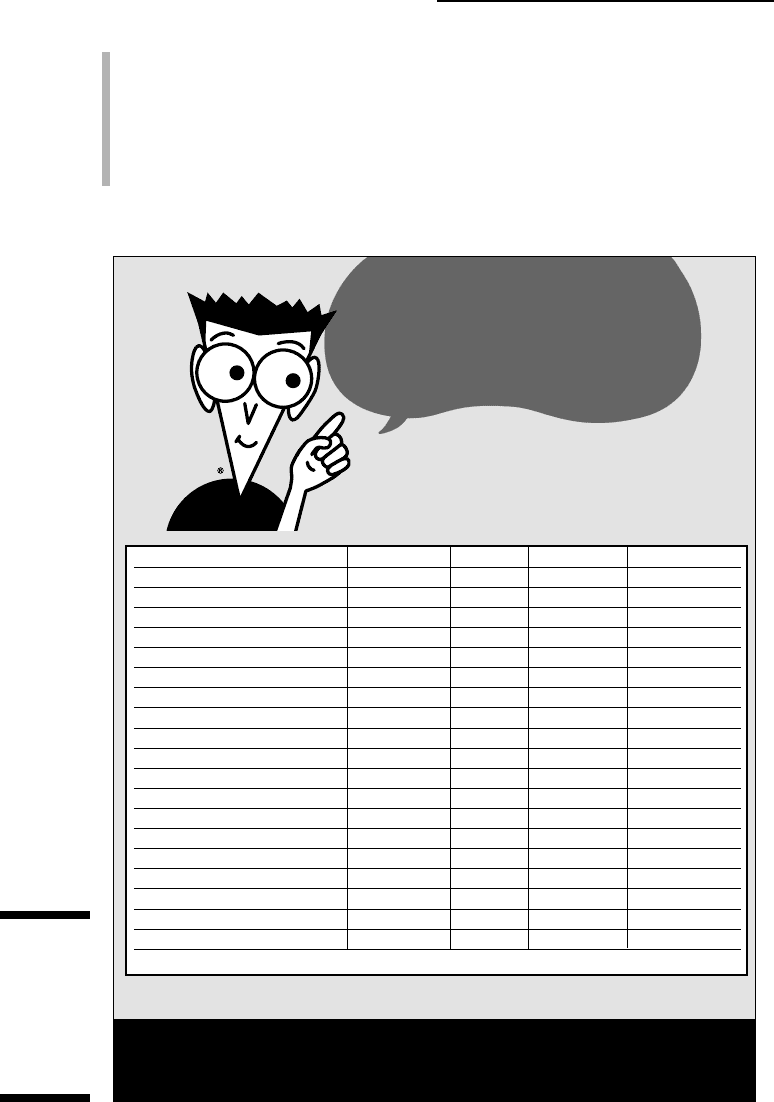
If you have room anywhere in your ad, and if you’re selling a product
that can be shipped to the customer, it’s helpful to include an order
form, like the one shown in Figure 10-2.
ITEM QTY Available
*
Price
**
QTY Ordered Extended Price
***
15.1$0001sneP pilC lerraB
44.0$0007sniahC yeK
00.8$034esuoM retupmoC
59.5$002guM retummoC
55.2$008sdraC g
niyalP
45.1$068smrahC eniW
Wine For Dummies Tip Cards 800 No Charge
71.0$0052reluR kramkooB
98.2$051gaB etoT
00.2$0051seizooK
00.1$004sgaB tfiG repaP
34.4$57strihS-T
00.3$0021sallerbmU
00.8$003staH llabesaB
00.2$0022sniP lepaL
2-Pocket Folder (not pictured) 1100 $1.00
Clear Plastic Dummies Man Logo Cup 375 $1.20
00.3$054koobetoN laripS
16.1$0053draynaL
TOTAL:
*As of 05/02/05
**US Dollars
***QTY ordered x Price
Dummies
Premiums
Order Form
To order, contact:
David Hobson, Marketing Assistant
10475 Crosspoint Blvd. Indianapolis, IN 46256 U.S.A. Phone #: 317.572.3406 e-mail: dhobson@wiley.com
Availability is subject to change
Figure 10-2:
This order
form
appears on
the inside of
a folding
flyer.
148
Part II: Creating Great Ads for Every Medium
15_045833 ch10.qxp 11/22/06 3:43 PM Page 148

When you’re designing a collateral piece, include only those elements that
are essential to your message and avoid the temptation to incorporate too
much information. Think about whether a particular graphic element focuses
your readers’ attention, or whether it only confuses them. If you’ve included
something in your collateral advertising that is pure ornamentation and is, in
fact, a distraction, toss it out and start again. For example, as mentioned, a
picture of you or your business or products is helpful (for customer recall),
but artwork that’s only used to break up text isn’t.
In the following sections, I outline the various elements of a good collateral
piece and show you how to make each element help to deliver your all-
important sales message.
Putting the important copy points at the top
When you’re organizing the words (or copy) that go into your ad, imagine a
stepladder. Put your most important copy points on the top step, the next
most-important points on the next step down, and so forth. Make a list of the
various components that you want to include in your brochure, ranking the
elements from the most important to the least. Then feature the most-signifi-
cant points more boldly in order to make an instant impact on the reader.
For example, if you’re creating a piece announcing a sale or other special
event, get right to the point and make the line at the very top of your ad say
what’s most important: “Sale!” Don’t get cute and make the first thing the
reader sees something like, “Due to continued customer demand. . . .”
Write an eye-stopping headline and brief, succinct body copy. Don’t confuse
your readers with a long-winded explanation of how to build a watch; just tell
them, in plain English, why they should buy a watch from you. The difference
between having your piece read or having it tossed into the garbage is the
split second it takes for your recipient to be either intrigued or bored.
Don’t be reluctant to throw out unnecessary copy the brochure can live with-
out. Pare down your list of copy points to the bare-bones selling message. Get
rid of the superfluous and concentrate on the important. The less work you
create for the recipient, the better. Make it easy for potential customers to
instantly grasp your message.
Using the right typeface
Use a typeface that best expresses the tone of your brochure. Look at the dif-
ferent fonts in your computer word-processing program, and see what
options you have. For example:
If the piece is meant to be humorous and whimsical, find a typeface
that’s silly or goofy. Keep in mind, though, that the type you choose
needs to be very readable, so make sure you choose a large-enough ver-
sion of these fonts so that the type design doesn’t interfere with your
message, which is the most important factor.
149
Chapter 10: Collateral Advertising and Direct Mail
15_045833 ch10.qxp 11/22/06 3:43 PM Page 149
If your piece is serious, like an announcement of a presale open house
for your preferred customers, choose a typeface that’s dignified and
solid.
If you’re sending out a mailer to announce a big sale, use a typeface that
is big, bold, and direct. You can find lots of examples of these — but
beware of using type that’s too bold, because that’s distracting for read-
ers. Use boldface type judiciously, to call attention to the most impor-
tant message in your advertising piece.
Don’t use more than two or three different typefaces in your collateral adver-
tising. Numerous typefaces tend to confuse and distract the reader’s eye
rather than focus it. Also, where possible, avoid underlines, boldfaces, italics,
outlines, borders, stars, bars, and any other visual distractions. These cutesy
elements only add clutter and distract your readers from your message.
Including graphic elements
Your graphic choices are many and varied — everything from photographs to
full-color drawings, black-and-white line art to a clever typeface treatment.
Choose the graphic element that best conveys the essence of what you’re
trying to sell, and what you’re attempting to accomplish with the printed
piece you’re creating.
If you’re showing a particular product that is now on sale, then a photograph
(either one supplied by the manufacturer or shot by a local photographer)
may be the way to go. Show the item, give the price or the call to action (for
example, “This dress marked down 50 percent this weekend only”), and make
sure these elements jump off the page quickly.
Use graphics if they add to the sell of the piece. Don’t include graphics purely
as design elements if they just distract from the message. Don’t clutter your
design with multiple graphic images unless each of them has some relevance
to the piece. The biggest mistake made by retail advertisers is trying to fit
too much information into a single ad. Jamming too much information into a
single piece only confuses the reader.
Considering color
Here again, multiple colors increase your printing costs. And, although color
does add interest and impact, it’s not always necessary. You can do many
effective brochures and mailers in black and white. The message and design
is what makes or breaks your sales piece, not the addition of several colors.
You can also print one color on a contrasting color paper. Printing papers
come in nearly infinite varieties and colors. A nice shade of blue ink on a
cream-colored paper may work as well as four-color process on white paper
if your message and design are well planned and executed.
150
Part II: Creating Great Ads for Every Medium
15_045833 ch10.qxp 11/22/06 3:43 PM Page 150

On the other hand, certain brochures simply cry out for four-color process. If
you’re selling something — food, clothing, fine art — that must be shown in
all its multicolored glory, then you want to go the full-color route. A prospec-
tive customer may have trouble picturing the beauty of a painting, for
instance, if you did your sales piece only in black and white.
Choosing the right paper
Printing involves more than color and ink. Printing papers come in numerous
colors, textures, weights, and finishes. Coated paper (which is usually slick
and glossy) gives more depth and brilliance to your piece and reproduces
photographs much better, even if it’s only printed with black ink. Soft-finish,
textured papers are perfect for a classy brochure or for letterheads and cards
that require a solid business image. You can also save a tree by using recy-
cled paper (and then tell the world about it in little, tiny type inside your
brochure), but keep in mind that some recycled papers cost more.
The different weights (thickness and heft) of paper give you multiple choices
when you produce collateral. You can use heavy weights for postcards and
brochure covers, light weights for mailers stuffed into envelopes, and so on.
Paper samples come in small demonstration packets prepared by numerous
paper companies. Your printer trots out paper samples until you’re cross-
eyed with confusion, and then he hauls out a bunch more. You may want to
find out which papers are available to you before you get too far in your
brochure design. Paper is an integral part of the brochure-design equation. A
paper with a rich appearance and feel adds greatly to the ambience of your
finished piece. Your printer can help you make your choice.
Getting help with your design
You can safely say that anyone can design a brochure. You could design one. I
could design one. Even your kid — the one who shows great aptitude for
drawing lovely pictures or coloring within the lines — could design one. But,
why send out a piece that looks amateurish and a bit rough around the edges
when you can create something to be proud of with just a little advanced
planning and careful thought?
When creating collateral ads, weigh the costs of hiring someone with the
skills (such as design) or equipment (color printers and so on) to help you
versus doing it yourself. For example, a concert promoter who did a mailing a
few years ago designed her own brochure, using photos she obtained from
the musicians who were performing. She chose to do this herself because
she’s a creative, talented person with a good eye for design.
151
Chapter 10: Collateral Advertising and Direct Mail
15_045833 ch10.qxp 11/22/06 3:43 PM Page 151