
Gliklikh Y.E. Global and Stochastic Analysis with Applications to Mathematical Physics
Подождите немного. Документ загружается.


146 7 Stochastic Analysis on Manifolds
By assumption, L>r(m). Moreover, ρ
m, γ(τ)
is not greater than the
length of γ on the interval [ a, τ), which, in turn, is not greater than L, i.e.,
L ≥ ρ
m, γ(τ)
.Thus
L
∗
>
L
L + L
=
1
2
.
Since (2.2) holds for an arbitrary γ, ρ(m, m
) > 1/2 and the lemma is proved.
Proof. [of Theorem 7.10] By construction, the metric ·, ·
∗
is conformal to
the original metric ·, ·. By definition, a normal chart of the metric ·, · at m
contains the metric ball V
m
r(m)
with respect to the distance ρ. It follows
from Lemma 7.12 that ρ(m, m
) <r(m)whenρ(m, m
) < 1/2. Thus, at every
point m ∈ M, the normal chart of the metric ·, · contains the ball centered
at m and having the radius 1/2 with respect to the metric ρ
∗
. Therefore,
·, ·
∗
is the desired metric. The theorem is proved.
Theorem 7.13 Let there exist a Riemannian metric on M possessing a uni-
form Riemannian atlas such that a smooth Itˆo vector field (a(t, m),A(t, m))
is uniformly bounded with respect to the norm of the functional space C
1
generated by this metric. Then for every initial condition ξ(0) = m
0
∈ M
equation (7.2) with this Itˆo vector field has a unique solution well-defined for
all t ∈ [0, +∞).
Theorem 7.13 is proved by the argument presented at the beginning of
this Section, modified by replacing distances with respect to the Euclidean
norm by Riemannian distances.
7.2 The Itˆo Bundle and Itˆo Equations on a Manifold
The investigation of equations in Itˆo form on manifolds was initiated by
Itˆo’s paper [149] and yielded interesting constructions clarifying the geometric
nature of stochastic differential equations (see, e.g., [21, 23, 77]).
According to the Itˆo formula (6.10), under a coordinate change ϕ
βα
a
solution of the equation in Itˆoform(6.16) transforms into the equation
dϕ
βα
(ξ(t)) = ϕ
βα
[a(t, ξ(t))dt + A(t, ξ(t))dw(t)]
+
1
2
tr ϕ
βα
(A(t, ξ(t)),A(t, ξ(t)))dt, (7.6)
i.e., the solutions are cross-sections of a special fiber bundle. In order to
describe this bundle precisely, according to Definition 1.32, we first describe
its structure group.
Let M be a smooth manifold of dimension n. Denote by L(R
k
, R
n
)the
space of linear operators sending R
k
to R
n
,byGL(n, R) the group of in-
vertible n × n matrices (or invertible linear operators acting on R
n
)andby

7.2 The Itˆo Bundle and Itˆo Equations on a Manifold 147
L
2
(R
n
) the set of bilinear mappings α : R
n
× R
n
→ R
n
(cf. the notation of
Section 1.2).
Definition 7.14. The ItˆogroupG
I
is the set of pairs (B, β)whereB ∈
GL(n, R)andβ ∈ L
2
(R
n
), with the operation defined by the following equal-
ity:
(B,β) · (C, γ)=(B ◦ C, B ◦γ(·, ·)+β(C(·),C(·))). (7.7)
Theorem 7.15 G
I
with operation (7.7) is indeed a group.
Proof. The associativity of (7.7) is verified by direct calculation. The unit in
G
I
is the pair (I,0) where I is the unit operator and 0 is the zero bilinear
mapping. For a pair (B,β) the inverse element with respect to (7.7)isthe
pair (B,β)
−1
=(B
−1
, −B
−1
◦ β(B
−1
(·),B
−1
(·))).
Remark 7.16. As for every Lie group, the tangent space T
(I,0)
G
I
at the unit
(I,0) of G
I
has the structure of a Lie algebra. Note that T
(I,0)
G
I
consists
of the pairs {(D, δ)},whereD ∈ L(R
n
), the group of all linear operators in
R
n
(n × n matrices) and δ ∈ L
2
(R
n
). Direct calculations with left-invariant
vector fields on G
I
according to formula (1.7) determining the Lie bracket
yields the following formula for the bracket of vectors (D, δ)and(E,)from
T
(I,0)
G
I
:
[(D, δ), (E,)] = (DE −ED,E(δ(I,D)) − D((I,E))). (7.8)
We call the Lie algebra with bracket (7.8)theItˆo algebra.
Recall that for a bilinear operator Ψ (·, ·)onann-dimensional Euclidean
space taking values in the same space, its trace is the vector defined by the
formula
trΨ =
n
i=1
Ψ(e
i
,e
i
) (7.9)
where e
1
,...,e
n
is an orthonormal frame and the trace does not depend on
the choice of orthonormal frame.
Let Ψ be a bilinear operator on the tangent space T
m
M of a Riemannian
manifold which takes values in T
m
M. Denote by Ψ
k
ij
its coefficients with
respect to the basis
∂
∂q
1
,...,
∂
∂q
n
in a chart and by g
ij
the components of the
metric tensor (see Notation 1.51 and Remark 1.52). Then it is easy to see
that in local coordinates the trace is described by the formula
trΨ = g
ij
Ψ
k
ij
. (7.10)
Define the left action of group G
I
on the product R
n
× L(R
k
, R
n
)bythe
formula
(B,β) · (X, A)=
BX +
1
2
trβ(A(·),A(·)),B◦ A
. (7.11)

148 7 Stochastic Analysis on Manifolds
Definition 7.17. The ItˆobundleI(M ) over a manifold M is the bundle
described in Definition 1.32 with standard fiber R
n
×L(R
k
, R
n
) and structure
group G
I
that acts on R
n
× L(R
k
, R
n
) from the left by formula (7.11).
It is clear that the remaining two elements from the Definition 1.32 of
the bundle (i.e., the total space and projection), are determined here by the
standard fiber and structure group. We emphasize that over every chart U
α
on M the Itˆo bundle is presented as a direct product U
α
×(R
n
×L(R
k
, R
n
))
and under the change of coordinates ϕ
βα
from the chart U
α
to another chart
U
β
an arbitrary point (m
α
, (a
α
,A
α
)) is transformed according to the rule
(m
α
, (a
α
,A
α
)) →
ϕ
βα
m
α
,
ϕ
βα
a
α
+
1
2
tr ϕ
βα
(A
α
,A
α
),ϕ
βα
A
α
. (7.12)
It is not hard to describe the principal Itˆo bundle, i.e., the principal bundle
with G
I
as the structure group. In every chart U
α
it is presented as a direct
product U
α
× G
I
and under the change of coordinates ϕ
βα
to a chart U
β
it
transforms according to the rule
(m
α
, (B
α
,γ
α
)) →
ϕ
βα
m
α
,
ϕ
βα
B
α
,ϕ
βα
γ
α
(·, ·)+ϕ
βα
(B
α
(·),B
α
(·))
.
It is easy to see that I(M) is a bundle associated with the principal Itˆo
bundle where the left action on the fiber is given by formula (7.11).
Definition 7.18. The cross-sections of the Itˆo bundle I(M ) are called the
Itˆo equations.
We introduce the notation (ˆa, A) for an Itˆo equation, the value at a
point m is denoted by (ˆa
m
,A
m
)or(ˆa(m),A(m)) (in the non-autonomous
case (ˆa(t, m),A(t, m))). This notation makes sense in every chart. Notice
that the second element of the pair is well-defined as a linear operator
A
m
: R
k
→ T
m
M (under changes of coordinates A transforms as a linear
operator of this sort, see formula (7.12)). Taking a trivialization in a chart,
ˆa can be identified with a vector from T
m
M, but this identification depends
on the choice of chart and trivialization (the transformation rule for ˆa under
changes of coordinates depends on A). Convenient coordinate and invariant
descriptions of Itˆo equations will be given below.
Let (ˆa, A)beanItˆo equation and w(t) be a Wiener process in R
k
.Ina
given chart U
α
we consider the following stochastic differential equation in
Itˆoform
dξ(t)=ˆa(t, ξ(t))dt + A(t, ξ(t))dw(t). (7.13)
Comparing the Itˆo formula (7.6) and formula (7.12), one can easily see that
equation (7.13) has the correct transformation rule under a change of coor-
dinates, i.e., (7.13) can be considered on the entire manifold M.
A solution of (7.13) is a diffusion process according to Definition 6.17
(see also Section 6.2.3) and so it is a semi-martingale since ξ(t)inachart
7.2 The Itˆo Bundle and Itˆo Equations on a Manifold 149
is the sum of an Itˆo integral
t
0
A(t, ξ(t))dw(t) (i.e., an ordinary martingale)
and a Lebesgue integral
t
0
ˆa(t, ξ(t))dt (i.e., a process with bounded variation
of sample paths). Recall (see Section 6.1.4) that under coordinate changes
semi-martingales are transformed into semi-martingales, i.e., the notion of a
semi-martingale is well-defined on manifolds.
However the notion of a martingale is ill-defined on manifolds since under
a coordinate change a martingale is transformed to a semi-martingale. A
natural generalization of the notion of a martingale to the case of processes
on manifolds is the notion of a martingale with respect to a connection that
arises in the works of L. Schwartz and P.A. Meyer. We refer the reader to
[69, 179, 180, 204, 205] where a detailed description of this material in the
general case can be found. Here we introduce it only for the particular case
of diffusion processes.
The construction of the generator described in Section 6.3 is valid for
a solution of (7.13). Recall that a generator is a second order vector field
on M (see Section 2.9). Introduce a connection H on M and consider the
corresponding field of fiber-wise linear operators H : τM → TM defined by
formula (2.45).
Definition 7.19. A diffusion process with generator A is called a martingale
with respect to a connection H if HA =0.
For specialists we mention that in the general case a semi-martingale
is called a martingale with respect to a connection H if the mapping H sends
its quadratic characteristic to zero.
The notions of strong and weak solutions is naturally transferred to
stochastic equations (7.13)aswellastoequations(7.2). The existence of
local solution theorems (in charts) also remain valid. Let us present a theo-
rem of existence of a global solution.
Use the natural trivialization of I(M )ineverychartandforanItˆo equation
(ˆa, A) determine in this trivialization the norm ˆa
m
as the Riemannian norm
of the vector in T
m
M that corresponds to the first element of the pair (ˆa, A)
with respect to the given trivialization, and the norm A
m
as the norm of
the linear operator A sending R
n
to T
m
M where the latter is equipped with
the Riemannian inner product. Recall that a Riemannian metric possessing
a uniform Riemannian atlas exists on every finite-dimensional manifold (see
Section 7.1.2).
Theorem 7.20 Let an Itˆo equation (ˆa(t, m),A(t, m)) be smooth in m ∈ M
and continuous in t ∈ [0, ∞).LetonM there exist a Riemannian metric
possessing a uniform Riemannian atlas and let in the charts of that atlas, in
every ball V
m
(r), the estimates ˆa(t, m
) <C and A(t, m
) <C hold for
all t ∈ [0, ∞) and m
∈ V
m
(r) where the constant C>0 does not depend on
the choice of chart and ball. Then for every initial condition ξ(0) = m
0
∈ M
there exists a unique strong solution ξ(t) of equation (7.13) that is well-defined
for t ∈ [0, ∞).

150 7 Stochastic Analysis on Manifolds
Theorem 7.20 is proved by the same argument as Theorem 7.13 (see the
beginning of Section 7.1.2). It is a modification of classical existence state-
ments for solutions of stochastic differential equations on manifolds that are
proved in various settings in [23, 40, 66, 149, 177]. The difference is that
we use the charts of a uniform Riemannian atlas and postulate the uniform
boundedness of the equation in the balls of that atlas with respect to that
metric, while in the above-mentioned papers the existence of a special atlas
and boundedness with respect to Euclidean norms in the balls in the charts
are required (the exact formulation varies depending on the setting).
We should mention that the proof of Theorem 7.20 is quite analogous to
that of [23, Theorem 2.2]. A modification is required only for proving the
estimates (Propositions 2.1 and 2.2 of [23]): one should replace Euclidean
norms in the tangent space by Riemannian norms and Euclidean distances
in charts by Riemannian distances. The proof of [23, Theorem 2.2] remains
valid without change, taking into account the obvious statement that for
every m
∈ V
m
(
r
2
) the inclusion V
m
(
r
2
) ⊂ V
m
(r) holds.
Remark 7.21. Theorem 7.20 is a general statement on the existence of solu-
tions for t ∈ [0, ∞) (completeness of stochastic flow). Some known conditions
of completeness of flow follow from this theorem as simple corollaries.
For example, let for an equation in Itˆoform(6.16)inR
n
the following
condition of Wintner type (see Theorem 3.39) be fulfilled:
a(t, m) + A(t, m) <L(m), (7.14)
where t ∈ [0, ∞); m ∈ R
n
; L :[0, ∞) → (0, ∞) is continuous and satisfies
inequality (3.16) (the norms are with respect to the Euclidean metric in R
n
).
For example if L(u)=K(1 + u), K>0, formula (7.14) turns into an Itˆo
condition of linear growth (6.21). Without loss of generality we can suppose
that L is smooth (see the proof of Corollary 3.42). Pass to a new Riemannian
metric (3.17), with respect to which from (7.14) it follows that the equation
is uniformly bounded for all t ∈ [0, ∞)andm ∈ R
n
. The existence of a
uniform Riemannian atlas for the metric (3.17)onR
n
is obvious. Thus from
Theorem 7.20 and Condition (7.14) it follows that the flow of the equation
in R
n
is complete.
Define another left action of G
I
on R
n
× L(R
k
, R
n
) by the formula
(B,β) · (X, A)=
BX −
1
2
trβ(A(·),A(·)),B◦ A
. (7.15)
Definition 7.22. The backward ItˆobundleI
∗
(M) over a manifold M is a
bundle (according to Definition 1.32) with standard fiber R
n
× L(R
k
, R
n
)
and structure group G
I
that acts on R
n
×L(R
k
, R
n
) from the left by formula
(7.15).
Over every chart U
α
on M the backward Itˆo bundle is presented as a
direct product U
α
× (R
n
× L(R
k
, R
n
)) and under the change of coordinates

7.3 Itˆo Equations in Belopolskaya-Daletskii Form 151
ϕ
βα
from the chart U
α
to another chart U
β
an arbitrary point (m
α
, (a
α
,A
α
))
is transformed according to the rule
(m
α
, (a
α
,A
α
)) →
ϕ
βα
m
α
,
ϕ
βα
a
α
−
1
2
tr ϕ
βα
(A
α
,A
α
),ϕ
βα
A
α
. (7.16)
Definition 7.23. The cross-sections of a backward Itˆo bundle I
∗
(M)are
called backward Itˆo equations and are denoted by (ˆa
∗
,A).
7.3 Itˆo Equations in Belopolskaya-Daletskii Form
If a connection is specified on a manifold M, one can apply it to identify the
Itˆo equations from Section 7.2 with the Itˆo vector fields from Section 7.1 so
that this identification is invariant with respect to changes of coordinates,
i.e., it is well-defined on the entire manifold.
Definition 7.24. An Itˆo vector field (a, A)andanItˆo equation (ˆa,
ˆ
A)are
said to canonically correspond to each other at a point m ∈ M with respect
to the connection H if at m they coincide under the trivialization in the
normal chart of H at m. If this identification is fulfilled at all points m ∈ M,
(a, A)and(ˆa, A) are said to canonically correspond to each other with respect
to H on M.
Lemma 7.25 An Itˆo vector field (a, A) and an Itˆo equation (ˆa,
ˆ
A) canoni-
cally correspond to each other with respect to a connection H on M if and
only if in every chart U
α
the fields of linear operators A and
ˆ
A coincide and
a and ˆa are related by the formula
ˆa(t, m)=a(t, m) −
1
2
tr Γ
m
(A(t, m),A(t, m)), (7.17)
where Γ
m
(·, ·) is the local connector of H in the chart.
Proof. The equality A(t, m)=
ˆ
A(t, m) trivially follows from the facts that at
every point the linear operators coincide in the normal chart and have the
same rule of transformation under changes of coordinates.
To prove (7.17), choose some m ∈ U
α
and consider the normal chart U
n
of H at this point. Let X, Y ∈ T
m
M. Consider the vector in T
(m,X)
TM
which is described in U
n
by the quadruple (m, X, Y, 0) (see Section 2.1).
Then by formula (2.10) in another chart U
α
this vector takes the form
(ϕ
αn
m, ϕ
αn
X, ϕ
αn
Y,ϕ
αn
(X, Y )). Since in U
n
the local connector of H at
m equals zero, from formula (2.19) we obtain that Γ
m
(X, Y )=−ϕ
αn
(X, Y )
in U
α
.
Since a(t, m)andˆa(t, m) coincide after trivialization, in the chart U
n
and
under the change of coordinates ϕ
αn
they transform by formulae (1.1)and
(7.12), respectively, and in the chart U
α
they satisfy the relation
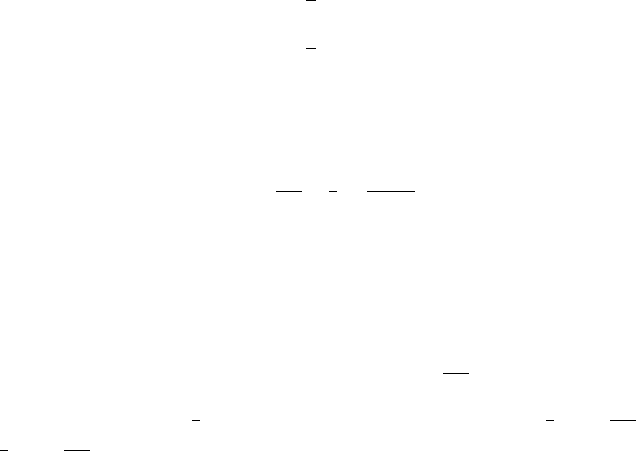
152 7 Stochastic Analysis on Manifolds
ˆa(t, m)=a(t, m)+
1
2
tr ϕ
αn
(A(t, m),A(t, m))
= a(t, m) −
1
2
tr Γ
m
(A(t, m),A(t, m)).
The proof of sufficiency is based on the same formulae.
The generator A of the flow of (ˆa, A) is well-defined on a manifold, it is a
second order tangent vector (see Section 2.9) that in local coordinates of some
chart U
α
takes the form A =ˆa
k
∂
∂q
k
+
1
2
a
ij
∂
2
∂q
i
∂q
j
where ˆa
k
are coordinates of
ˆa and a
ij
are elements of the matrix AA
∗
.
Lemma 7.26 Let (a, A) be the Itˆo vector field canonically corresponding to
the Itˆo equation (ˆa, A) with respect to the connection H.Thena = H(A)
where H : τM → TM is the mapping generated by the connection H via
formula (2.45).
Proof. Note that trΓ
m
(A(t, m),A(t, m)) = Γ
k
ij
a
ij
∂
∂q
k
where, as above, a
ij
are the elements of the matrix AA
∗
in local coordinates. By Lemma 7.25
ˆa(t, m)=a(t, m) −
1
2
trΓ
m
(A, A). Then HA = a(t, m) −
1
2
Γ
k
ij
a
ij
∂
∂q
k
+
1
2
Γ
k
ij
a
ij
∂
∂q
k
= a(t, m).
We now turn to the construction of Ya.I. Belopolskaya and Yu.L. Daletskii
(see, e.g., [43, 23]), by means of which it is very easy to describe the Itˆo
equations in terms of Itˆo vector fields and connections.
Definition 7.27. The forward stochastic differential
a(t, m)dt + A(t, m)dw(t)
at a point m ∈ M given by an Itˆo vector field (a, A) is the class of stochastic
processes in the tangent space T
m
M that consists of the solutions of all
stochastic differential equations of the form
X(t + s)=
t+s
t
˜a(τ,X(τ ))dτ +
t+s
t
˜
A(τ,X(τ))dw(τ ),
where ˜a(τ,X) is a vector field on T
m
M;
˜
A(τ,X):R
k
→ T
m
M is a linear
operator depending on the parameters τ ∈ R and X ∈ T
m
M; and the fol-
lowing conditions are satisfied: ˜a(τ,X)and
˜
A(τ,X) are Lipschitz continuous,
are equal to zero outside some neighborhood of the origin in T
m
M and such
that for τ ≥ t the equalities ˜a(τ,0) = a(t, m)and
˜
A(τ,0) = A(t, m) hold.
Note that since ˜a(τ,X)and
˜
A(τ,X) are Lipschitz continuous, the process
X(t + s) is a strong solution of the equation and so it is well-defined for every
Wiener process in R
k
.
Let H be a connection and consider its exponential mapping exp.
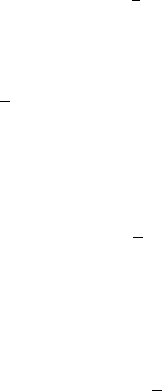
7.3 Itˆo Equations in Belopolskaya-Daletskii Form 153
Definition 7.28. We say that a process ξ(t) satisfies the Itˆo equation in
Belopolskaya-Daletskii form
dξ(t) = exp
ξ(t)
(a(t, ξ(t))dt + A(t, ξ(t))dw(t)) (7.18)
if for every point ξ(t) there exists a neighborhood of ξ(t)inM such that
before ξ(t + s), s ≥ 0, leaves this neighborhood, ξ(t + s) a.s. coincides with a
process from the class exp
ξ(t)
(a(t, ξ(t))dt + A(t, ξ(t))dw(t)).
Theorem 7.29 Let (a, A) be the Itˆo vector field canonically corresponding
to (ˆa, A) with respect to the connection H. Equation (7.13) for a process ξ(t)
is fulfilled if and only if equality (7.18) holds for ξ(t).
Proof. Let Γ
m
(·, ·) be the local connector of H in a chart U
α
. By formula
(7.17)wehavethatˆa(t, m)=a(t, m) −
1
2
tr Γ
m
(A(t, m),A(t, m)). Thus equa-
tion (7.13)inU
α
can be equivalently written by means of the Itˆo vector field
(a(t, m),A(t, m)) in the form
dξ(t)=a(t, ξ(t))dt −
1
2
tr Γ
ξ(t)
(A(t, ξ(t)),A(t, ξ(t)))dt + A(t, ξ(t))dw(t).
(7.19)
Recall that in the chart U
α
the exponential mapping of H for m ∈ U
α
and
X ∈ T
m
M to within terms of order X
3
is presented via the Taylor expansion
(see [63])
exp
m
X = m + X −
1
2
Γ
m
(X, X)+.... (7.20)
From formula (7.20)andTheorems6.10 and 6.12 it follows that to within
terms of order higher than dt the equality
exp
ξ(t)
(a
ξ(t)
dt + A
ξ(t)
dw(t)) = ξ(t)+a(t, ξ(t))dt
−
1
2
tr Γ
ξ(t)
(A(t, ξ(t)),A(t, ξ(t)))dt
+ A(t, ξ(t))dw(t) (7.21)
holds. The assertion of the theorem follows by comparing equalities (7.19)
and (7.21).
Thus for equations of type (7.18) the existence of solution theorems from
Section 7.2 are applicable.
Remark 7.30. In the literature the local expression (7.19)for(7.18)is
known as the Itˆo equation in Baxendale’s form after P. Baxendale who inde-
pendently found this presentation of Itˆo equations in charts (see. [21]). We use
this term strictly for the local description, retaining the term “Itˆo equation in
Belopolskaya-Daletskii form” for global expressions of type (7.18). The first
publication by Ya.I. Belopolskaya and Yu.L. Daletskii in this direction was
[44]. Notice also Gangolli’s paper [77] where local connectors were first used
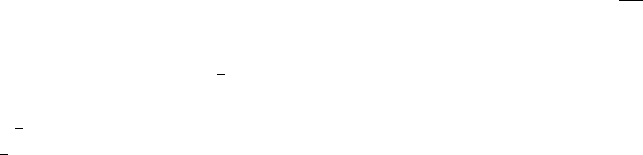
154 7 Stochastic Analysis on Manifolds
for the covariant description of diffusion processes on manifolds. This paper
was the inspiration for further constructions.
By Theorem 7.29, having specified various connections, we can express an
Itˆo equation in different Belopolskaya-Daletskii forms corresponding to those
connections. Thus it is a reasonable idea to look for the “best” connection
relative to a given problem. A “good” connection, well-defined in some special
cases, is described in [43]. Equations in Belopolskaya-Daletskii form with
respect to this connection are equations in Stratonovich form.
The next statement gives an example of another useful connection.
Theorem 7.31 Let (ˆa, A) be an Itˆo equation on a manifold M that is
smooth, autonomous and such that A(m) has rank equal to dim M at all
m ∈ M. Then there exists a connection on M such that the corresponding
equation in Belopolskaya-Daletskii form has no drift, i.e., it is described as
dξ(t) = exp
ξ(t)
(A(ξ(t))dw(t)). (7.22)
Proof. Since A(m) is smooth and has rank equal to dim M at all m ∈ M ,
the symmetric (2, 0)-tensor field AA
∗
on M is smooth and positive definite.
Hence it can be taken as a metric (2, 0)-tensor on M. Denote its matrix in a
chart by (a
ij
). Then the (0, 2)-tensor (a
ij
)=(a
ij
)
−1
is a Riemannian metric
on M.Notethata
ij
and a
ij
are the components of this metric tensor. Denote
by H the Levi-Civit´a connection of this metric, by Γ (·, ·) its local connector
and by Γ
k
ij
the corresponding Christoffel symbols of the second kind. Thus the
equation in Belopolskaya-Daletskii form corresponding to (ˆa, A) with respect
to H in a chart takes the form (7.19) with the above local connector where
(a, A)istheItˆo vector field canonically corresponding to (ˆa, A) with respect
to H.
In [148, Proposition V.4.3] it is shown that for every vector a = a
k
∂
∂q
i
(in particular for a, the first term of the Itˆo vector field (a, A)) there ex-
ists a Riemannian connection
¯
H ofthemetric(a
ij
) with Christoffel sym-
bols
¯
Γ
k
ij
such that a
k
=
1
2
a
ij
(Γ
k
ij
−
¯
Γ
k
ij
). Denote by
¯
Γ (·, ·) its local con-
nector. Recall that tr Γ (A, A)=a
ij
Γ
k
ij
. Thus, replacing a(t, ξ(t)) in (7.19)
by
1
2
a
ij
(Γ
k
ij
−
¯
Γ
k
ij
), we obtain that the equation takes the form dξ(t)=
−
1
2
tr
¯
Γ
ξ(t)
(A(ξ(t)),A(ξ(t)))dt+A(ξ(t))dw(t). Hence the equation in Belopol-
skaya-Daletskii form corresponding to (ˆa, A) with respect to
¯
H is (7.22).
Corollary 7.32 Let A(m) be a smooth autonomous second order vector field
on M with invertible matrices of coefficients at second derivatives. Then there
exists a connection on M such that A is the generator of a solution of a type
(7.22) equation with respect to this connection.
Remark 7.33. Theorem 7.31 and Corollary 7.32 are obtained by modifying
to Itˆo equations a construction from [148, Section V.4] involving equations in
Stratonovich form. The generalization of that construction to the case where
7.3 Itˆo Equations in Belopolskaya-Daletskii Form 155
A has non-maximal but constant rank, for equations in Stratonovich form, is
presented in [68, Theorem 2.1.1].
We describe the transformations of equations of type (7.18) under certain
special mappings. Let M and N be manifolds equipped with connections.
Denote the exponential mapping on N by exp
N
and retain the notation exp
for the exponential mapping on M.LetF : M → N be a C
2
-mapping that
sends geodesics of the connection on M to geodesics of the connection on N.
This means that F ◦exp(X) = exp
N
(TF ◦X)forX ∈ TM (see Section 2.4).
From this we immediately obtain the statement that replaces Theorem 7.7
for equations (7.18)(see[23]):
Theorem 7.34 Under the above-mentioned assumptions for a solution ξ(t)
of equation (7.18) on M the process F (ξ(t)) on N satisfies the equation
dF (ξ(t)) = exp
N
F (ξ(t))
(TF(a(t, ξ(t))dt + TFA(t, ξ(t))dw(t)).
Now we can present several existence theorems adapted to equation (7.18).
For this we introduce the following notion.
Definition 7.35. We say that a connection H and a Riemannian metric ·, ·
on M are compatible if ·, · has a uniform Riemannian atlas in whose charts
on the balls V
m
(r) the local connector Γ
m
(X, X) at all m
∈ V
m
(r) is uni-
formly bounded in the norm generated by the metric, as a quadratic operator
of X, by a certain constant C
0
> 0 independent of the choice of chart and
ball.
It is obvious that on a compact manifold every Riemannian metric and
every connection are compatible. Another class of examples exhibiting this
behavior are the left-invariant (right-invariant) Riemannian metrics and con-
nections on Lie groups. Indeed, a left-invariant metric ·, · on a Lie group G
has a uniform Riemannian atlas constructed by left shifts to points g ∈ G of
a specified chart in a neighborhood of the unit. The estimates for the local
connector of a left-invariant connection in the charts of the obtained atlas
remain the same as in the above-mentioned chart at the unit, i.e., they are
independent of the choice of chart and ball. The same argument is valid for
right-invariant metrics and connections.
Let a connection H be given on M. Denote by exp its exponential mapping.
Theorem 7.36 Let an Itˆo vector field (a(t, m),A(t, m)) be smooth in m ∈ M
and continuous in t ∈ [0, ∞). Let there exist a Riemannian metric on M ,
compatible with H, with respect to which a(t, m) <C
1
and A(t, m) <C
1
(here C
1
> 0 is a constant) for all t, m. Then for every initial condition
ξ(0) = m
0
there exists a strong and strongly unique solution ξ(t) of equation
(7.18), well-defined for all t ∈ [0, ∞).
Using Theorem 7.29 and formula (7.19), Theorem 7.36 is reduced to The-
orem 7.20.