
Gliklikh Y.E. Global and Stochastic Analysis with Applications to Mathematical Physics
Подождите немного. Документ загружается.


256 11 Newtonian Mechanics
Let ¯α(t, m, X) be the vector field on M (depending on X ∈ T
m
M)phys-
ically equivalent to the 1-form ˜α(t, m, X) with respect to the Riemannian
metric ·, ·, which gives rise to the kinetic energy of the system. In other
words, ¯α(t, m, X),Y =˜α(t, m, X)(Y ) for any Y ∈ T
m
M.
Definition 11.2. A vector field a(t, m, X)wheret ∈ R, m ∈ M and X ∈
T
m
M such that πa(t, m, X)=π(m, X)=m is called a vector force field.
One can easily see that ¯α(t, m, X), as defined above, is an example of a
vector force field.
Remark 11.3. In the remainder of the book, with the exception of Chap-
ter 16, we shall consider only mechanical systems with a finite-dimensional
configuration space. The force fields are usually introduced as vector fields
and the passage to 1-forms is left to the reader as a simple exercise.
The motion of a mechanical system is governed by Newton’s second law,
i.e., the equation:
D
dt
˙m(t)=¯α (t, m(t), ˙m(t)) , (11.2)
where
D
dt
is the covariant derivative of the Levi-Civit´a connection of the metric
·, · (see Section 2.6). Recall also that a curve m(t) is a solution of (11.2)if
andonlyifthecurve(m(t), ˙m(t)) in TM is an integral curve of the vector field
Z +¯α(t, m, X)
l
, (11.3)
where Z is the spray of the Levi-Civit´a connection of ·, · and ¯α(t, m, X)
l
is
the vertical lift of ¯α(t, m, X)tothespaceV
(m,X)
⊂ T
(m,X)
TM.
Acurvem(t)onM is called a trajectory of the mechanical system if it is
a solution of (11.2). For any initial conditions m(0) = m
0
and ˙m(0) = X
0
∈
T
m
0
M, there exists a trajectory m(t) on a sufficiently small interval of time
provided that, for example, ˜α(t, m, X) satisfies the Carath´eodory condition
[74]. To see this, observe that, since Z is smooth, the field (11.3)onTM sat-
isfies the Carath´eodory condition and the local existence of a solution follows
from the classical existence theorem for ordinary differential equations. Below
we investigate the existence of trajectories for more general force fields (for
instance, in the case of a discontinuous force field, this question is related to
the passage from (11.2) to differential inclusions). Assume, for example, that
¯α(t, m, X) is locally Lipschitz. Then the trajectory is unique for any given
initial conditions.
The existence of trajectories on (−∞, ∞) may be analyzed using the meth-
ods developed in Section 3.1. Let us point out that if the Riemannian metric
which gives rise to the kinetic energy is complete, then, by the Hopf-Rinow
theorem, the trajectories of the system with zero force field (i.e., geodesics)
are defined on (−∞, ∞). From the physical point of view, this means that
a free particle in the system does not escape to infinity in finite time. Note
that the assumptions that the Riemannian metric is complete and that a
11.2 Mechanical Systems on Lie Groups 257
solution of the Cauchy problem for trajectories is unique are easy to justify
for systems arising in physics. Here, however, we usually do not require in
advance that the solution should be unique.
The cotangent vector p physically equivalent to the velocity ˙m with respect
to the metric ·, · (i.e., where p = ˙m, ·) is called the momentum of the
system. Consider the operator L: TM → T
∗
M sending a vector X ∈ T
m
M
to the covector X, · ∈ T
∗
m
M. The operator L is called the inertia operator
(or the inertia tensor). In particular, p = L(˙m). In terms of the inertia
operator, the kinetic energy of the system is given by the relation K(X)=
L(X)
(X)/2.
The manifold M is often equipped with a canonical Riemannian metric
(·, ·) (e.g., the standard inner product in R
3
), which is not related to the
metric ·, · giving rise to K. In this case, we may identify vectors and cov-
ectors by means of (·, ·). Then X, Y =(LX, Y )whereL is a (1, 1)-tensor
field of self-adjoint linear operators in tangent spaces. L is also called the
inertia tensor; in fact this tensor is physically equivalent to L. Sometimes it
is convenient to define the kinetic energy not by the metric ·, · but by the
self-adjoint operator L: TM → TM once the canonical metric (·, ·) is given.
11.2 Mechanical Systems on Lie Groups
Consider a mechanical system which has a Lie group as the configuration
space with the kinetic energy given by a right- or left-invariant metric. We
shall call such a system a mechanical system on the group.
The best known example of a mechanical system on a group is the system
describing the motion of a rigid body which rotates about a stationary point
in R
3
. It is easy to see that the configuration space of this system, i.e., the
set of all possible positions of the rigid body with a stationary point, is
the special orthogonal group SO(3). Choosing an orthonormal basis in R
3
,
we may identify SO(3) with the group of all orthogonal matrices with unit
determinant. Recall that the Lie algebra so(3) of SO(3) at e =idisidentified
with R
3
(see Section 1.2) so that after this identification, the Killing form
(A, B)=tr(A◦B) and the commutator [A, B]=A◦B−B◦A on so(3) become
the standard inner and vector products on R
3
, respectively. The Riemannian
metric obtained from the Killing form by left translations turns out to be bi-
invariant. This metric is used as the canonical metric to express the kinetic
energy via the inertia tensor.
Let g(t) be a trajectory on SO(3) corresponding to the motion of the rigid
body. The velocity vector ˙g(t) ∈ T
g(t)
SO(3) can be translated to the algebra
so(3) = T
e
SO(3) (and so to R
3
) in two different (and non-commuting) ways:
by left translation and by right translation (see Section 1.2). The vectors
ω
c
(t)=TL
−1
g(t)
˙g(t)andω
s
(t)=T R
−1
g(t)
˙g(t)
belong to so(3), which we have identified with the space R
3
where the body
moves (see above). The vector ω
c
is the angular velocity with respect to the
258 11 Newtonian Mechanics
body coordinates (i.e., the coordinate system “attached” to the body and
moving along with it) and the vector ω
s
is the angular velocity in the space
coordinates (i.e., with respect to a coordinate system fixed in space).
Let L: R
3
→ R
3
be the inertia operator (tensor) of the rigid body. Recall
that L depends on the shape of the body and on the distribution of its mass.
The operator L is self-adjoint with respect to the standard inner product
on R
3
. Let us define a new inner product A, B
e
=(LA, B)onso(3). This
inner product gives rise to the left-invariant Riemannian metric ·, ·,which
determines the kinetic energy by the general formula K(X)=X, X/2.
Note that the choice of the left-invariant metric is motivated by physics: the
kinetic energy depends on the angular velocity with respect to the body’s
coordinates, but not on the position of the body in space.
Remark 11.4. In Chapter 16 we consider a mechanical system on the
infinite-dimensional group of diffeomorphisms. This system describes the hy-
drodynamics of an ideal incompressible fluid and the energy is given by a
right-invariant (weak) Riemannian metric.
The classical Euler equation of motion of a rigid body (with a stationary
point) describes the time variation of the angular velocities ω
c
and ω
s
,as
well as the angular momenta M
c
= L(ω
c
)andM
s
= L(ω
s
). Thus, the Eu-
ler equation is an equation in the algebra so(3) or in the dual space so(3)
∗
.
Throughout this book, we adopt the following terminology of [47]. The equa-
tions in SO(3) are said to describe the motion in the material coordinates or
in the Lagrangian representation. The equations for ω
s
in so(3) are said to
be with respect to the space coordinates or in the Eulerian representation,
whereas the equations for ω
c
are in the body coordinates or in the convective
representation. Similar terminology is used for the corresponding angular
momenta equations.
Analogous terms are used to describe a mechanical system on an arbitrary
Lie group G. Thus, Newton’s equation on G is called the equation of motion in
the material coordinates (the Lagrangian representation). The corresponding
equation on the Lie algebra is called the Euler equation. If the equation
is obtained by right translations, then it is said to be with respect to the
space coordinates (the Eulerian representation), while for left translations it
is with respect to the body coordinates (the convective representation), etc.
This also applies to the so-called Eulerian and Lagrangian specifications in
hydrodynamics.
Mechanical systems on groups, especially the Euler equation on Lie alge-
bras, have been studied very intensively in the last few decades and there is a
substantial literature devoted to the subject. A detailed introduction to this
field may be found in Appendix 2 of [3].
11.3 Conservative Mechanical Systems
Definition 11.5. A mechanical system is called conservative if its force field
is independent of velocities (and is usually autonomous) and is equal to −dU,
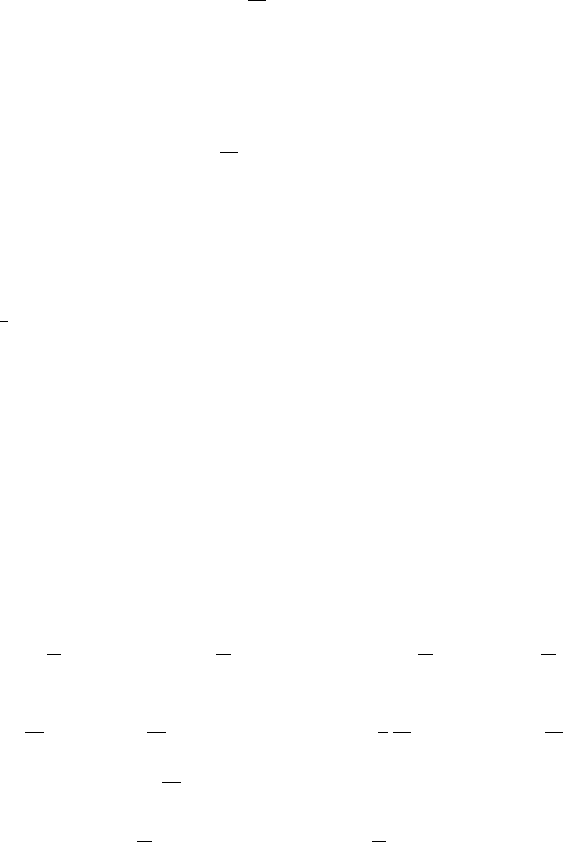
11.3 Conservative Mechanical Systems 259
the negative differential of a certain real function U on M which we call the
potential energy.
Thus the vector force field of a conservative mechanical system is −grad U
where the gradient is calculated with respect to a Riemannian metric defining
the kinetic energy, i.e., X, grad U=dU(X) for any vector field X on M.
For a conservative system Newton’s law (11.2) is transformed into
D
dt
˙m(t)=−grad U. (11.4)
Recall that X, grad U= XU for any vector field X on M,whereXU denotes
the derivative of the function U along the vector field X. In particular, for a
trajectory m(t) (i.e. a solution of (11.4)) this means that
d
dt
U(m(t)) = ˙m, grad U. (11.5)
Recall also that the gradient of U depends both on U and on the Rieman-
nian metric ·, ·, i.e., on the form of the kinetic energy.
Now we can derive the principal laws of dynamics as theorems.
There is a notable difference in the definitions of kinetic and potential
energy: the kinetic energy is a function on TM (indeed, it assigns the value
1
2
X, X to any vector X ∈ TM) while the potential energy is a function
on M. This is not convenient because, for example, we cannot sum these
functions. To overcome this obstacle we extend U to TM by the formula
U◦π : TM → R (11.6)
where π : TM → M is the natural projection.
Definition 11.6. The function E = K + U◦π : TM → R is called the total
energy.
Theorem 11.7 (Conservation of energy law). The total energy is con-
stant along any trajectory m(t) of a conservative mechanical system.
Proof. Since the Levi-Civit´a connection is Riemannian, from (2.30) it follows
that
d
dt
˙m(t), ˙m(t) =
D
dt
˙m(t), ˙m(t) + ˙m(t),
D
dt
˙m(t) =2
D
dt
˙m(t), ˙m(t).
Taking into account formula (11.5)weget
d
dt
E(m(t)) =
d
dt
(K(˙m(t)) + U(m(t))) =
1
2
d
dt
˙m(t), ˙m(t)+
d
dt
U(m(t))
=
D
dt
˙m(t), ˙m(t)
+ grad U, ˙m(t).
Since by (11.4)
D
dt
˙m(t)=−grad U,weget
d
dt
E(m(t)) = 0.

260 11 Newtonian Mechanics
11.4 Hamilton’s Principle of Least Action
The Lagrangian of a natural mechanical system is the function L = K−U ◦π.
Let us recall some notions and formulae from the calculus of variations. A
function whose argument is a curve (for the sake of definiteness we assume
all curves to be parametrized by t in the interval t ∈ [0,T]), not a point, is
(in the calculus of variations) called a functional.
The functional of action of the above-mentioned Lagrangian L is
A(m(t)) |
T
0
=
T
0
L(m(t))dt =
T
0
1
2
˙m(t), ˙m(t)−U(m(t))
dt. (11.7)
We shall also deal with two more functionals: the functional of length
s(m(t)) =
T
0
˙m(t)dt =
T
0
˙m(t), ˙m(t)dt (cf. formula (1.19)) and the so-
called functional of action A
0
(which is a particular case of (11.7) with U =0)
A
0
(m(t)) =
T
0
˙m(t)
2
dt =
T
0
˙m(t), ˙m(t)dt. (11.8)
Foracurvem(t)itsvariation m(t, s) is a smooth mapping from [0,T] ×
(−ε, ε)intoM such that m(t, 0) = m(t). The term “variation” refers to the
fact that by varying s, we vary the curve m(t), i.e. we obtain curves near to
it. As in Section 2.6 (see Lemma 2.57), we consider the vector fields
∂
∂t
and
∂
∂s
on the image of a variation. In particular, the field of vectors
∂
∂s
along the
curve m(t)=m(t, 0) will be denoted by W (t) and called the field of variation.
Definition 11.8. A variation m(t, s) is called a variation with fixed end-
points if m(0,s) = const and m(T,s) = const for all s.
In particular, for a variation of a curve with fixed ends we have
∂
∂s
(0,s)=0
∂
∂s
(T,s)=0. (11.9)
The variation of a functional with respect to the variation of a curve is an
analog of the derivative of a function in ordinary analysis. It is denoted by
δ
ds
. To find the variation of a functional one should substitute the variation of
the curve into the functional and differentiate the obtained expression with
respect to s at s =0.
The extremal (an analog of the extremum) is a curve at which the variation
of the functional with respect to each variation of the curve equals zero. An
extremal with fixed end-points of a functional is a curve at which the variation
of the functional with respect to each variation of the curve with fixed ends
equals zero.
Lemma 11.9 The variation of the functional of action A
0
at a smooth curve
m(t) with respect to the variation m(t, s) with fixed ends is equal to

11.4 Hamilton’s Principle of Least Action 261
δ
ds
A
0
= −2
T
0
D
dt
˙m(t),W(t)
dt, (11.10)
where W (t) is the field of variation m(t, s).
We refer the reader to [181] for a proof of Lemma 11.9.Notethatin[181]
the variation is found in the class of piecewise smooth curves, from which
(11.10) follows as a particular case. This equation suffices for our purposes,
since the trajectories of mechanical systems are smooth.
Theorem 11.10 The geodesics of the Levi-Civit´a connection, and only these
geodesics, are extremals with fixed ends of the functional of action A
0
.
Proof. Let m(t) be a geodesic, i.e.,
D
dt
˙m(t) = 0. Then expression (11.10)
equals zero for any W (t). Thus the variation of A
0
at m(t) equals zero with
respect to each variation of this curve with fixed ends. By definition this
means that m(t)isanextremalofA
0
with fixed ends.
Let m(t) be an extremal with fixed ends, i.e., expression (11.10) equals zero
for each W (t). This can happen only if the second factor under the integral
is zero. Hence
D
dt
˙m(t) = 0 for all t, i.e., m(t) is a geodesic.
Theorem 11.11 The geodesics of the Levi-Civit´a connection, and only these
geodesics, are extremals with fixed ends of the functional of length.
Proof. First we derive an analog of formula (11.10):
∂
∂s
T
0
∂
∂t
dt
|s=0
=
∂
∂s
T
0
∂
∂t
,
∂
∂t
dt
|s=0
=
T
0
∂
∂s
∂
∂t
,
∂
∂t
dt
|s=0
=
1
2
T
0
∂
∂s
∂
∂t
,
∂
∂t
∂
∂t
,
∂
∂t
dt
|s=0
.
Recall that the length (unlike the action A
0
) does not depend on the
parametrization. Hence we can change the parametrization t in the varia-
tion m(t, s)sothat
∂
∂t
(t, s) =
∂
∂t
,
∂
∂t
does not depend on t, i.e., is equal
to some constant C(s). Then
∂
∂s
T
0
∂
∂t
dt
|s=0
=
1
2C(s)
T
0
∂
∂s
∂
∂t
,
∂
∂t
dt
|s=0
,
which differs from (11.10) only by the presence of the factor
1
2C(s)
before the
integral. Thus the remaining argument coincides word-for-word with that of
the proof of Theorem 11.10.
So, unlike the straight lines of Euclidean spaces, the geodesics of the
Levi-Civit´a connection realize only local minimums of length. In addition
we should mention that sometimes several geodesics can connect two points

262 11 Newtonian Mechanics
and yet it can happen that there exists no geodesic with length equal to
the Riemannian distance between those points. Conditions under which such
geodesics exist are given by the Hopf-Rinow Theorem (Theorem 3.68).
The next statement is often regarded as the central law of mechanics (see,
e.g., [171]).
Theorem 11.12 (Hamilton’s principle of least action). The trajecto-
ries of a natural mechanical system, and only these trajectories, are the ex-
tremals of the functional of action (11.7) with fixed ends.
Proof. The variation of A with respect to the variation m(t, s) of the curve
m(t), t ∈ [0,T], is calculated as follows:
∂
∂s
T
0
1
2
m
t
(t, s),m
t
(t, s)−U(m(t, s))
dt
|s=0
=
∂
∂s
T
0
1
2
m
t
(t, s),m
t
(t, s)dt
|w=0
−
∂
∂w
T
0
U(m(t, s))
dt
|s=0
.
The first integral on the right-hand side here is one half of the variation of
the functional A
0
and so we can substitute formula (11.9) divided by 2 for
its value. For the second integral we have:
∂
∂s
T
0
U(m(t, s)))dt
|s=0
=
T
0
∂
∂s
U(m(t, s)))dt
|s=0
,
which is equal to
t
0
grad U,
∂
∂s
m(t, s)dt
|s=0
by the definition of gradient.
Recall (see above) that
∂
∂w
m(t, s)
|s=0
is the field of variation denoted by
W (t). Thus, the formula of variation with fixed ends of A takes the form
−
T
0
D
dt
˙m(t),W(t)
dt −
t
0
grad U,W(t)dt. (11.11)
Now let m(t) be a trajectory, i.e.,
D
dt
˙m(t)=−grad U by (11.4). In this
case, by (11.11) the variation of A is equal to zero for any W , i.e., m(t)is
an extremal. If (11.11) equals zero for every W (t),
D
dt
˙m(t)=−grad U and so
the extremal is a trajectory.
For conservative systems we also have the principle of least action in Mau-
pertuis form. According to this principle, trajectories with total energy h are
simply the geodesics of a new metric (the so-called Jacobi metric):
(h −U)·, ·. (11.12)
Note that the Jacobi metric (11.12) is Riemannian only when h>U
everywhere on M . Hence, in this case, the analysis of trajectories reduces
to the description of geodesics on M with the metric given by (11.12). If
11.5 Noether’s Theorem 263
there are points where the value of U is greater than or equal to h, then the
trajectories lie in the domain Ω
h
=
m ∈ M
U(m) <h
called the domain
of possible motion (with boundary). The geometry of this domain has been
studied by many authors in connection with certain problems of mechanics.
Particularly active research in this area was initiated by the works of Kozlov.
In [169] the reader may find a detailed review of this subject.
Remark 11.13. A more complex case is where one has the so-called gyro-
scopic force in addition to the potential one. A gyroscopic force field has the
form ˜α
1
(m, X)=ω(X, ·), where ω is a 2-form on M. (Recall that the 1-form
˜α
1
(m, X) takes the value ω
m
(X, Y )onY ∈ T
m
M.) Usually one assumes that
the form ω is closed or even exact. An example of a gyroscopic force is the ac-
tion of a magnetic field on a charge. Substantial progress in the study of such
systems was achieved by Novikov [193]. Another approach was developed in
[169].
11.5 Noether’s Theorem
Recall the following:
Definition 11.14. A non-constant smooth function on a manifold, on which
a differential equation is given, is called the first integral or an integral of
motion of the equation if it is constant along every solution of the equation.
Sometimes one says that the equation has a conservation law .
Examples of first integrals (conservation laws) are the Hamiltonian for a
Hamiltonian system (see Remark 3.69) and the total energy for a conservative
mechanical system (see Theorem 11.7).
In this section, for the case of conservative mechanical systems, we
prove one of the most important theorems in contemporary natural science,
Noether’s theorem, which gives a standard method of finding conservation
laws.
Definition 11.15. A one-parameter diffeomorphism group g
s
is a mapping
g : R × M → M, jointly smooth in all variables, for which the following
conditions are satisfied:
(i) for each s ∈ R the mapping g
s
: M → M is a diffeomorphism (i.e., g
s
is one-to-one and smooth and g
−1
s
is also smooth);
(ii) for each m ∈ M and all s, u ∈ R the relation g
s+u
(m)=g
s
(g
u
(m))
holds (this relation is usually written as g
s+u
= g
s
◦ g
u
).
From (ii) above it is clear that g
0
(m)=m for each m ∈ M and that
g
−1
s
= g
−s
.
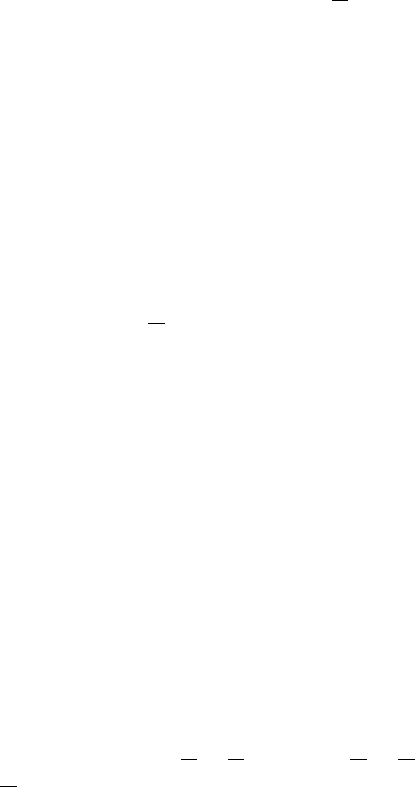
Denote by g(m) the set of points obtained from m by the action of g
s
for all s ∈ R; such a set is called a trajectory or orbit of the one-parameter
diffeomorphism group g
s
.
264 11 Newtonian Mechanics
For m ∈ M consider the vector Y
m
=
d
ds
g
s
(m)|
s=0
. Assigning, for each
m ∈ M, the vector Y
m
to the point m we obtain a smooth vector field Y on
M that is called the generator of the group g
s
. Note that the orbits of the
group, and only the orbits, are integral curves of its generator Y .
Recall that on a compact manifold M every smooth autonomous vector
field is a generator of a one-parameter diffeomorphism group that is the flow
of the vector field. In the general case of non-compact manifolds, a smooth
vector field is a generator of a one-parameter diffeomorphism group if the
flow is complete.
Definition 11.16. Agroupg
s
is said to preserve a non-constant function
f : M → R if f is constant along the orbits of g
s
.
It is clear that g
s
preserves a smooth function f if and only if for every
m ∈ M the relation
d
ds
f(g
s
(m))|
s=0
= Yf|
g=0
= 0 holds where Y is the
generator of g
s
.
Let g
s
be a one-parameter diffeomorphism group on M .Thenitiseasyto
see that Tg
s
is a one-parameter diffeomorphism group on the tangent bundle
TM where Tg
s
is the tangent mapping to g
s
.LetL = K−U◦π : TM → R
be the Lagrangian of a conservative mechanical system.
Definition 11.17. A one-parameter diffeomorphism group g
s
is said to pre-
serve the Lagrangian L if Tg
s
preserves L according to Definition 11.16.
Theorem 11.18 (E. Noether) Let on the configuration space M of a con-
servative mechanical system with Lagrangian L = K−U◦π there be a one-
parameter diffeomorphism group g
s
that preserves the Lagrangian L.Then
this system has a conservation law.
Proof. Consider a trajectory m(t) of the mechanical system for t ∈ [0,l].
Recall that m(t) satisfies Newton’s second law (11.4). Applying the diffeo-
morphisms in g
s
,fors ∈ (−ε, ε), to m(t), we obtain the set N = g
s
m(t)in
M as the image of the mapping m :[0,l] × (−ε, ε) → M, m(t, s)=g
s
m(t).
Consider the vector fields
∂
∂t
=
∂
∂t
m(t, s)and
∂
∂s
=
∂
∂s
m(t, s)onN. It is clear
that
∂
∂s
coincides with the generator Y of the group g
s
.
Lemma 11.19 For any given s
∗
∈ (−ε, ε) the curve m(t, s
∗
) is a trajectory
of the mechanical system.
Proof. [of Lemma 11.19] By Hamilton’s principle of least action (Theo-
rem 11.12) the trajectory m(t) is an extremal with fixed ends of the ac-
tion functional with Lagrangian L.Sinceg
s
preserves L, the values of the
action functional on the curves under the action of g
s
are preserved. Thus
m(t, s
∗
)=g
s
∗
γ(t) is also an extremal, i.e., it is a trajectory of the mechanical
system.

11.5 Noether’s Theorem 265
By the hypothesis, g
s
preserves the Lagrangian L, i.e., for all t the value
L(m(t, s)) = K(
∂
∂t
) −U(m(t, s)) is constant in s, i.e.,
∂
∂s
L(m(t, s)) =
∂
∂s
K
∂
∂t
−
∂
∂s
U(m(t, s)) = 0.
Taking into account the definition of K, formula (2.29) defining the notion of a
Riemannian connection and Lemma 2.57 on the second covariant derivative
(recall that they are both valid for the Levi-Civit´a connection), we obtain
that
∂
∂s
K(
∂
∂t
)=
∂
∂s
1
2
∂
∂t
,
∂
∂s
= ∇
∂
∂s
∂
∂t
,
∂
∂t
= ∇
∂
∂t
∂
∂s
,
∂
∂t
.
Applying consequently formula (11.5), Newton’s second law (11.4)and
Remark 2.27 we obtain
∂
∂s
U(m(t, s)) = dU
∂
∂s
=
∂
∂s
, grad U
= −
∂
∂s
,
D
dt
∂
∂t
= −
∂
∂s
, ∇
∂
∂t
∂
∂t
.
Thus
0=
∂
∂s
L(m(t, s)) =
∇
∂
∂t
∂
∂s
,
∂
∂t
+
∂
∂s
, ∇
∂
∂t
∂
∂t
.
By formula (2.29) this expression equals
∂
∂t
∂
∂s
,
∂
∂t
. Hence,
∂
∂t
∂
∂s
,
∂
∂t
=0,
i.e.,
∂
∂s
,
∂
∂t
is constant in t.
We have shown that along every trajectory m(t) of the mechanical system
the product Y, ˙m is constant where ˙m is the velocity vector of the trajectory
and Y is the generator of the one-parameter diffeomorphism group g
s
.
As the first application of Noether’s theorem we prove the momentum
conservation law for some special systems.This law is not as universal as the
conservation of energy law since it is not valid for all conservative systems.
Consider the motion of two material particles in R
3
.Letx be the vector
in R
3
corresponding to the first particle and y the vector corresponding to
the second particle. It is clear that the system’s state at a given time is
described by the pair x, y of vectors in R
3
, i.e., the configuration space is
R
6
= R
3
× R
3
. We allow the particles to be located at the same point R
3
(otherwise the configuration space would have the form (R
3
× R
3
)\ where
is the diagonal set {(x, y) ∈ R
3
× R
3
|x = y}).
The kinetic energy here is the sum of the kinetic energies of both particles.
It depends only on the velocities and does not depend on the positions of the
particles. This situation is natural for Euclidean spaces, where it is possible
to translate the vectors along the space.
Suppose that the force depends only on the distance between the par-
ticles and does not depend on the positions of the particles (this situation
occurs, for example, in Newton’s law of gravitation and in Coulomb’s law in
electrostatics). Denote the force by ¯α(t, x
1
− y
1
,x
2
− y
2
,x
3
− y
3
). It is clear