
Gupta S.P. (ed.) Ion Channels and Their Inhibitors
Подождите немного. Документ загружается.

(bound state) was extracted and minimized in water (free state) to obtain the
reference electrostatic and van der Waals energies. The difference in the computed
energy values (Dele and Dvdw) between the bound and the free states were used to
derive linear regression fits to the experimental pIC
50
. The estimated interaction
energy was used to establish the preference of each ligand for one of the two
states. The computed pIC
50
values of the 21 ligands that prefer to bind the open-
state model were predicted with an RMSD of 1.2 [pIC
50Open
¼0.166(Dvdw) +
0.002(Dele)]. For the 11 compounds that preferentially interact with the partially
open-state model, the pIC
50
values were calculated with an RMSD of 0.85
[pIC
50Closed
¼0.155(Dvdw) + 0.0004(Dele)]. Given the fact that both models
had essentially the same coefficients for the (Dvdw) term, a single model was
generated combining the energies for each ligand docked into its best fit state.
Plotting the experimental versus computed pIC
50
values five outliers were
identified. The model obtained [pIC
50Combined
¼0.163(Dvdw) + 0.0009(Dele)]
omitting those five outliers showed an RMSD of 0 .56 and an r
2
of 0.82. The
equation reveals that the most important contribution to the hERG affinity arises
from Dvdw, in agreement with the previous observations, which indicated that
hydrophobicity and aromaticity were the most important physicochemical features
of Phe656 and of Tyr652, respectively [103].
O
¨
sterberg et al. [98] used molecular dynamics (MD) simulations and the linear
interaction energy (LIE) method to calculate the binding affinity of six sertindole
analogues docked into the homology model of the hERG channel in the open sta te.
For each ligand, the pose with the lowest energy was selected from the two or three
best clusters, and was submitted to molecular dynamics (MD) simulations. The K
þ
ions can occupy the selectivity filter with the 1010 (K
þ
–H
2
O–K
þ
–H
2
O) or with the
0101 (H
2
O–K
þ
–H
2
O–K
þ
) configurations. The binding free energies for hERG
indicated that the 1010 is the most favorable conformation. The higher value of
binding free energies obtained with the 0101 configuration is due to the electrostatic
repulsion between the basic nitrogen of the blocker and the K
þ
ion facing the
central cavity. The plot of the calculated LIE free energies versus the experimental
values shows a good correlation between these two terms.
Also, Farid et al. [99] obtained a good correl ation between the predicted and the
experimental ligand binding free energy of four sertindole analogs. The compounds
were docked into the homology model of the hERG channel in the open state using
the induce-fit protocol. The correlation between the Extra Precision (XP) scoring in
Glide and the experimental binding affinity shows an r
2
of 0.95. The analysis of the
terms of the Extra Precision (XP) scoring indicates that the Glide-XP lipophilic
contact and the Glide-XP van der Waals energy terms are favorable for hERG
inhibitors, while the Glide-XP penalty for buried polar groups term is unfavorable.
The GOLD docking software was used to dock 56 known blockers into a closed-
state model [92]. For each ligand, the best pose was selected and the docking
GOLDScore fitness was used to derive a linear regression fit to the experimental
pIC
50
. The model achieved an r
2
of 0.60 and a q
2
of 0.56, demonstrating that it can
be used to predict the binding affinity of hERG inhibitors.
226 A. Schiesaro and G.F. Ecker
5.10 Case Studies: Docking Studies and Improvement
of the Selectivity
A structure-activity relationship combined with docking studies was used by Price
et al. [115] to reduce the hERG affinity in a series of CCR5 antagonists. Docking
of the lead compound into a homology model of the hERG channel in the closed
state revealed that the benzimidazole group fits perfectly to the lipophilc region
described by the four Tyr652. This result suggested that it was possible to reduce
the affinity of the compounds for the hERG channel by replacing the benzimidazole
moiety with other moieties. This led to the discovery of maraviroc, a potent CCR5
antagonist, which does not interact with the hERG channe l.
Micheli et al. [100] performed an interesting study on the combination of
docking experiments with structure-activity relationship (SAR) to improve the
affinity of a series of 1,2,4-Triazol-3-yl-thiopropyl-tetrahydrobenzazepines with
the dopaminergic receptor D
3
and to avoid the interaction with the hERG channel.
The compounds were docked manually into homology models of the hERG channel
in the closed and the open state. The docking experiments predict that the lead
compound assumes a U-conformation, probably due to interactions with Tyr652,
Phe656 and intramolecular p–stacking interaction. The pose shows that the charged
nitrogen atom and the quinoxaline ring form hydrogen-bonds with serines in the
pore of the hERG channel. Based on the docking results, two strategies were used to
tackle hERG liability. In the first one the hydrop hilicity of the compounds was
increased. This strategy led to a compound highly selective for the D
3
receptor and
with a reduced affinity for the hERG channel. The second strategy was to reduce the
p interactions between the isoxazolyl group and the hERG channel breaking
the coplanarity between the isoxazolyl and the benzazepine moieties. This strategy
led to a reduction of hERG activity, without affecting the D
3
potency.
Also, Dinges et al. [116] used a combination of SAR and docking results to
develop KDR kinase inhibitors with an optimized hERG profile. One kinase
inhibitor was manually docked into a model of the hERG channel in the closed
state. The best fit was obtained by orienting the compound parallel to the pore of the
channel, with the acetylenic ether group oriented toward the cytoplasmatic side of
the hERG channel. The pose predicts that the 1,4-dihydroindeno [1,2-c]pyrazole
forms p–stacking interactions with Phe656, that the charged nitrogen atom on the
N-methylpiperazine moiety can make p–cation interactions with Tyr652, and that
the external nitrogen forms a hydrogen-bond with Ser624. Based on this pose three
strategies were developed. The first strategy consisted on the modification of the
basic side chain. This approach led to compounds with a reduced hERG affinity, but
the antitumoral efficacy was compromised. In the second strategy the polarity of
the acetylenic chain was increased. This led to molecules with an attenuated
hERG activity, but also the KDR affinity was reduced, except for the compound
bearing the glycol ether moiety that inhibited 76% tumor growth in the MX-1
tumor xenograft model. The third approach used the introduction of groups
that disrupt electronically or sterically the p–stacking interaction between the
Prediction of hERG Channel Inhibition Using In Silico Techniques 227
1,4-dihydroindeno [1,2-c]pyrazole and Phe656. The substitution of the methylene
bridge with a carbonyl group reduced the hERG affinity, without affecting the KDR
inhibitions.
In a recent study, Levoin et al. [117] combined homology modeling and docking
to refine a homology model of the H
3
receptor. The model of the H
3
receptor was
optimized in three different ways: ten independent molecular dynamics simulations
of the proteins embedded in the membrane; ten independent simulated annealing
(SA) runs with the most active compound of ten clusters obtained from the training
set of inhibitors of each prot ein; iterative simulated annealing (ISA) with a rigid
potent compound. The ligands were docked in the refined models and subsequently
the first ranked pose of each ligand was selected, and the affinity with the protein
was assessed using the DOCK_SCORE, Ligscore1-2, PLP1-2, Jain, PMF, and
Ludi_1-3 scor ing functions. The performance of the prediction was then evaluated
using the ROC curve and the area under the curve (AUC). The best performing
model in the screening of the training set compounds was the one refined via the
ISA method, which achieved an AUC value of 0.73. Similar results were obta ined
with the test set, where the model showed an AUC of 0.71. To predict also the
interactions with antitarget proteins, the same procedure was applied to refine the
homology models of hERG and CYP2D6. Also in these cases, the refinement
process leads to a better performance of the homology models by producing an
AUC > 0.69 for both antitarget proteins.
Recently, Shamovsky et al. [38 ] used a combination of pharmacophore
modeling, QSAR and docking to develop a successful lead optimization strategy
that overcomes the undesirable interactions with hERG. The aim of the docking
experiments performed on a homology model of the hERG channel in the closed
state was to explain the intrinsic hERG binding. To achieve this aim two
compounds, which represent extreme cases of intrinsic hERG binding were docked
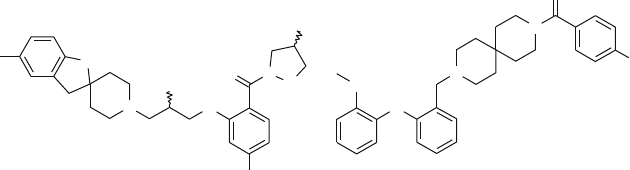
into the homology model of hERG. The compound A (Fig. 4) makes cooperative
hydrogen–bond interactions with Ser624, whereas the compound B forms coopera-
tive p–stacking interactions with Tyr652. The docking poses suggest that also the
amino acids Leu622, Ser649, and Phe656 are involved in the intrinsic interactions
between the hERG channel and the blockers.
N
Cl
O
OH
O
OH
O
N
O
OH
N
O
O
N
O
Cl
Compound A
Compound B
Fig. 4 2D structure of the two compounds docked in hERG channel
228 A. Schiesaro and G.F. Ecker
5.11 Orthogonal Binding Site?
In contrast to the accepted idea that the blockers bind the hERG channel longitudi-
nally to the z axis, Zachariae et al. [118] proposed an orthogonal binding site.
During MD simulations of a homology model of the hERG channel in the closed
state the four Tyr652 adopted a “down conformation” with the aromatic ring plane
pointing into the central cavity. The “down conformation,” which is stabilized by
the interactions with Phe656, opens a way to the membrane. This can explain why
the cavity size of hERG in the closed state is larger than the vestibule of KcsA
and can accommodate bulky compounds, such as MK-499 [3]. Docking studies
performed on several compounds such as dofetilide, terfenadine, and cisapride, and
previously published pharmacophore models [28–30, 33] corroborate this model.
The pose of dofetilide suggests that the charged nitrogen atom is close to the K
þ
binding site, and that the two aromatic rings form p–stacking interactions with two
Tyr652 of opposite subunits. The binding position of terfenadine shows that the two
neighboring aromatic rings of the molecule interact with two Tyr652 of adjacent
subunits. In the case of cisapride, the two phenyl rings interact with two opposite
Tyr652.
5.12 Docking Results
The main goal of the docking technique is to model the molecules in the binding site
and to find the bound conformation of the compounds as close as possible to the
crystal poses, allowing the analysis of the interactions between the ligand and
the target protein.
Mitcheson et al. [6] docked MK-499 into a closed state homology model of the
hERG channel. The analysis of the poses shows that the p-CN phenyl ring and
the benzopyran form p–stacking interactions with Phe656 and Tyr652, while the
methanesulfonanilide moiety is placed into the pocket delimited by Gly648, Thr623
and Ser624.
Karczewski et al. [104] docked MK-499 into a homo logy model of the hERG
channel in the closed state. The docking poses of MK-499 predict that the hydroxyl
group forms a hydrogen-bond with Ser624, but the contribution of this interaction
to the complex stabilization is modest due to the distance between the two hydroxy
oxygens (3.4 A
˚
). In the docking pose of the carbonyl analog the distance between
the oxygen of the side chain of Ser624 and the one of the substituent is 3.0 A
˚
.This
indicates that the hydrogen-bond between the carbonyl analog and Ser624 is
stronger than the previously discussed one, which might explain the insensitivity
to the Phe656Ala mutation.
Two possible binding modes of chloroquine were proposed by Sanchez-Chapula
et al. [5]. In the first binding mode, the molecule forms p –stacking interactions with
Phe656 on three subunits, as well as a hydrogen-bond with Ser649, while the
Prediction of hERG Channel Inhibition Using In Silico Techniques 229
diethyl groups of the tail of the molecule form hydrophobic interactions with
Tyr652. In the second binding pose, the quinoline group makes p–stacking
interactions with Tyr652 and Phe656. Th e nitrogen atom attached to the quinoline
forms a hydrogen-bond with Ser649 and the ethyl group attached to the charged
nitrogen interacts with Tyr652 through hydrophobic interactions.
The aligned inhibi tors used to generate the CoMSiA model of Pearlstein et al.
[21] were docked into a homology model of the hERG channel in the open state.
The proposed binding mode suggests that the Phe656 forms p–stacking interactions
with an aromatic ring, that a second hydrophobic group can interact with another
Phe656, and that the charged nitrogen atom makes p–cation interactions with
Tyr652. The tail region of the blockers reaches into the pore region that extends
from Tyr652 to the selectivity filter.
Moreno et al. [4] studied the effect of irbesartan on hERG, KvLQT1 + minK,
hKv1.5 and Kv4.3 channels using the patch clamp technique. The homology
models of hERG and hKv1.5 channels in the closed state were generated using
the KcsA crystal structure as template. The pose obtained from manual docking of
ibersartan shows that the blocker forms a hydrogen-bond and p–stacking
interactions with Tyr652, p–stacking interactions with Phe656 and van der Waals
interactions with Thr623.
The pose of clofilium proposed by Perry et al. [12] shows p–stacking
interactions between the Tyr652 and the phenyl ring of the molecule, in addition
to the hydrophobic interactions of the aliphatic tail of clofilium with Phe656 and the
interactions of the chlorine with Thr623, Ser624, and Val625.
Duncan et al. [88] docked erythromycin into a model of the hERG channel in the
open state. All the poses with low energy interact with Phe656, while the interaction
with Tyr652 is prevented by the large size of the molecule that restricts the ability of
erythromycin to move up into the inner cavity. The docking poses obtained with a
model of the closed state shows high energy values due to steric clashes, indicating
that the molecule cannot fit into the closed-state channel. Visual inspection reveals
that the molecule is too large for the central cavity of the hERG channel in the
closed state.
Yoshida et al. [49] docked the hERG blocker pimozide into an open-state model
to examine the correspondence between the molecular determinants derived from
the 2D-QSAR model with the 3D structure of the channel. The docking pose
suggests that the fluorine atoms and the carbonyl group of pimozide forms hydro-
gen bond interactions with Ser649 and Ser624, respectively.
Hosaka et al. [95] performed a flexible docking of nifekalant into an open-state
model. Consistent with the mutagenesis data, docking simulations suggest that
the entire molecule is placed in the central cavity surrounded by Thr623, Ser624,
Tyr652, and Phe656 of different subunits and located in close vicinity to Ser649.
O
¨
sterberg et al. [98] docked a series of sertindole analogs into a homology model
of the hERG channel in the open state. The do cking pose of sertindole suggests that
the carbonyl oxygen forms a hydrogen bond with the water molecule located in the
selectivity filter. The imidazolidinone group makes good interactions with Thr623
230 A. Schiesaro and G.F. Ecker
and Ser624. Interestingly, the charged nitrogen is almost superposed to the crystal-
lographic position of the K
þ
ion in KvaP.
Farid et al. [ 99] used the induce-fit docking protocol to dock 12 known hERG
blockers into hERG channel models in the open and closed state. S-terfenadine
interacts with four Tyr652 and two Phe656. It forms T-shaped interactions with four
of the six aromatic amino acids. The docking results show that the poses of R- and
S-terfenadine are similar. S-terfenadine interacts simultaneously with four Tyr652
and two Phe656. The replacement of a T-sha pe interaction with a parallel one is the
only important difference between the S-and R-terfenadine. S-terfenadine forms
hydrogen-bonds with the backbone oxygen of the amino acid Leu622, and with the
side chains of Ser624 and Ser649. R-terfenadine makes four hydrogen-bonds, three
of them are with Ser624 of different subunits and the fourth one is with Tyr652.
Also, the poses of (+)-cisapride and ()-cisapride are similar. (+)-cisapride
interacts with three Tyr652 and two Phe656, making two T-shaped interactions
with the Tyr652 on opposite subunits, and a parallel interaction with one Phe656.
The pose predicts also that the piperidine NH forms a hydrogen-bond with Ser624.
The only difference between (+)-cisapride and ()-cisapride is that the interaction
with Phe656 is replaced by an interaction with Tyr652. MK-499 interacts simulta-
neously with four aromatic amino acids (two Tyr652 and two Phe656). The
molecule is predicted to be near Thr623, Ser624, Ser649, and Ala653, with which
it can interact. The aliphatic chain of S-ibutilide interacts with three Tyr652 and
one Phe656. The phenyl ring forms a T-shaped interaction with Tyr652. The
methanesulfonanilide group and the basic nitrogen are predicted to make hydro-
gen-bonds with two Ser624 of adjacent subunits. The pose of R-ibutilide is a
mirror image of the one of S-ibutilide. Clofilium makes simultaneous interactions
with four Tyr652 and three Phe656. The pose predicts one T-shaped interaction with
Tyr652 and two with Phe656. Sertindole interacts with three Tyr652, two of which
make T-shaped interactions. The docking pose shows also interactions with one
Phe656. The pose of sertindole A5 predicts the interactions with two Tyr652 and
one Phe656. It makes T-sha ped interactions with one Tyr652 and one Phe656. The
pose predicts also a hydrogen-bond between the backbone oxygen of Thr623 and
the dimethylamine NH group. Sertindole A1-A4 interact with Tyr652 and Phe 656.
Moreover, it makes hydrogen-bonds with Ser649 and with the backbone oxygen of
Leu622.
Masetti et al. [91] constructed a homology model of the hERG channel in the
open and in the closed state. Subsequently, the two models were embedded in a
membrane bilayer, solvated, and the system was neutralized. Both models were
subjected to molecular dynamics simulations of 5 ns. The docking of astemizole
into the hERG channel in the closed state could not provide any reasonable pose.
Reliable binding poses were identified only when astemizole was docked into
snapshots of MD simulations of the hERG channel in the open state. The top
ranked pose shows that the benzimidazole ring forms p–stacking interactions
with Tyr652 and parallel displaced interactions with Phe656 of the same subunit.
The p-fluorophenyl interacts with Tyr652 through parallel displaced interactions.
The pose predicts also a possible hydrogen-bond between the fluorine atom and
Prediction of hERG Channel Inhibition Using In Silico Techniques 231
Ser624, and the charged nitrogen atom of the piperidine ring forms a p–cation
interaction with Phe656. The p-methoxybenzene ring is shown to be exposed to the
cytoplasm.
The pose of terfenadine reported by Du et al. [92] shows that the t-butylphenyl
moiety forms hydrop hobic interactions with the amino acids Ser649, Tyr652,
Ala653, and Phe656, whereas the diphenylmethanol group makes hydrophobic
interactions with Ser624, Ser649 and Tyr652. The phenyl ring of the hERG blocker
ibutilide is predicted to form hydrophobic interactions with Thr623, whereas the
alkyl chain makes hydrop hobic interactions with Thr623, Ser649, Tyr652, Ala653
and Phe656. Furthermor e, the nitrogen atom of the methylsulfonamide moiety can
form a hydrogen-bond with Thr623.
Singleton et al. [93] docked a series of dofetilide derivatives bearing a fluores-
cent group into a hERG channel homology model of the closed state. The poses
highlight that the compounds lie in the inner pore, where they interact with Tyr652
and Phe656. The polycycl ic conjugated dyes occupy the central cavity.
Models of hERG channel in the open and closed state were generated by
Stansfeld et al. [94] using as template the structure of MthK, KvaP, and KcsA.
As the models showed only partial agreement with mutagenesis data, a series of
KcsA-based intermediate models were generated rotating the four S6 domains. To
obtain homology models where the Ph e656 can interact with the blockers also a
series of intermediate models, which simulate the channel opening, were crea ted.
The docking poses of compounds E-4031, dofetilide, ibutilide, and dronedarone
show that the methanesulphonamide makes hydrogen-bonds with Thr623 and
Ser624. A phenyl ring is predicted to form p–stacking interactions with Tyr652.
The methanesulphonamide MK-499 does not interact with the amino acids Thr623
and Ser624. The pose of dronedarone predicts that the charged nitrogen atom is
placed in the same position of the K
þ
identified in the inner pore in the KvaP crystal
structure. The docking pose of fluvoxamine suggests that the protonated nitrogen is
placed below Phe656, whereas the trifluoromethyl group lies in the central cavity
and shows hydrogen–bond interactions with Thr623 and Ser624. The poses of
propafenone and vesnarione make p–stacking interactions with Tyr652. For
propafenone, it is also predicted that the charged nitrogen atom is placed between
the Phe656 residues, with which it can form p–cation interactions. The pose of
terfenadine indicates that this compound interacts with Tyr652 and Phe656. In the
case of clofilium and cisapride the molecules make p–stacking interactions with
Tyr652, whereas the polar groups interact with the amino acids Thr623 and Ser624 .
In the docking poses of quinidine and chloroquine, the basic nitrogen is placed
above Phe656 and the ring system forms p–stacking interact ions with Tyr652.
In summary, numerous docking studies have been conducted and they support
findings from QSAR and mutation studies. However, with respect to prediction
of strong hERG binders, docking definitely suffers from the still unsolved issue of
proper binding free energy calculations. In addition, the channel is quite flexible
and compounds might bind to the closed, semiopen and/or open states. This renders
hERG binding prediction solely based on docking quite risky.
232 A. Schiesaro and G.F. Ecker
6 Conclusions
Within this review , we presented ligand-based and structure-based approaches to
predict the potential risk of compounds for binding to the hERG potassium channel
in a strength, which might lead to Torsades de Points. Although numerous studies
have been conducted and most of them exhibit good to excellent predictivity, this
issue still is not completely resolved. QSAR studies definitely suffer from the small
chemical space the training compounds are covering, which renders generalization
of the models difficult. Although pharmacophore models and docking could over-
come this general drawback of QSAR approaches, they very often do not take into
account the plasticity of the channel. Finally, channel opening and closing is
a dynamic process and interaction with drugs can occur at any step. Thus, in
an industrial setup, high throughput biological testing and repeated lead optimiza-
tion cycles are still the method of choice to get rid of unwanted hERG activity.
Finally, there is increasing evidence that, in addition to hERG, other cardiac ion
channels are involved in Td P. Thus, prediction of the final clinical outcome on the
organismic level will require integrated approaches, as for example, pursued by
large EU-projects such as the Virtual Physiological Human Network of Excellence
(http://www.vph-noe.eu) or the eTox project, which aims at prediction of the
toxicological profiles of small molecules in early stages of the drug development
pipeline (http://193.146.190.66/etox-web/index.html).
Acknowledgments Andrea Schiesaro is grateful for financial support by the University of
Vienna under the framework of the PhD program “Molecular Drug Target” and for support
from the Innovative Medicines Initiative (eTox, 115002).
References
1. Gene Connection for the Heart. http://www.fsm.it/cardmoc/
2. Witchel HJ, Hancox JC (2000) Familial and acquired long qt syndrome and the cardiac rapid
delayed rectifier potassium current. Clin Exp Pharmacol Physiol 27:753–766
3. Mitcheson JS, Chen J, Sanguinetti MC (2000) Trapping of a methanesulfonanilide by closure
of the HERG potassium channel activation gate. J Gen Physiol 115:229–240
4. Moreno I, Caballero R, Gonzalez T et al (2003) Effects of irbesartan on cloned potassium
channels involved in human cardiac repolarization. J Pharmacol Exp Ther 304:862–873
5. Sanchez-Chapula JA, Navarro-Polanco RA, Culberson C et al (2002) Molecular
determinants of voltage-dependent human ether-a-go-go related gene (HERG) K+ channel
block. J Biol Chem 277:23587–23595
6. Mitcheson JS, Chen J, Lin M et al (2000) A structural basis for drug-induced long QT
syndrome. Proc Natl Acad Sci USA 97:12329–12333
7. Mitcheson JS (2008) hERG potassium channels and the structural basis of drug-induced
arrhythmias. Chem Res Toxicol 21:1005–1010
8. Kamiya K, Niwa R, Mitcheson JS et al (2006) Molecular determinants of HERG channel
block. Mol Pharmacol 69:1709–1716
9. Kamiya K, Niwa R, Morishima M et al (2008) Molecular determinants of hERG channel
block by terfenadine and cisapride. J Pharmacol Sci 108:301–307
Prediction of hERG Channel Inhibition Using In Silico Techniques 233
10. Stork D, Timin EN, Berjukow S et al (2007) State dependent dissociation of HERG channel
inhibitors. Br J Pharmacol 151:1368–1376
11. Witchel HJ, Dempsey CE, Sessions RB et al (2004) The low-potency, voltage-dependent
HERG blocker propafenone–molecular determinants and drug trapping. Mol Pharmacol 66:
1201–1212
12. Perry M, de Groot MJ, Helliwell R et al (2004) Structural determinants of HERG channel
block by clofilium and ibutilide. Mol Pharmacol 66:240–249
13. Arias C, Gonzalez T, Moreno I et al (2003) Effects of propafenone and its main metabolite,
5-hydroxypropafenone, on HERG channels. Cardiovasc Res 57:660–669
14. Katchman AN, Koerner J, Tosaka T et al (2006) Comparative evaluation of HERG currents
and QT intervals following challenge with suspected torsadogenic and nontorsadogenic
drugs. J Pharmacol Exp Ther 316:1098–1106
15. Kiehn J, Thomas D, Karle CA et al (1999) Inhibitory effects of the class III antiarrhythmic
drug amiodarone on cloned HERG potassium channels. Naunyn Schmiedebergs Arch
Pharmacol 359:212–219
16. Mergenthaler J, Haverkamp W, Huttenhofer A et al (2001) Blocking effects of the antiar-
rhythmic drug propafenone on the HERG potassium channel. Naunyn Schmiedebergs Arch
Pharmacol 363:472–480
17. Paul AA, Witchel HJ, Hancox JC (2002) Inhibition of the current of heterologously
expressed HERG potassium channels by flecainide and comparison with quinidine, pro-
pafenone and lignocaine. Br J Pharmacol 136:717–729
18. Sanchez-Chapula JA, Ferrer T, Navarro-Polanco RA et al (2003) Voltage-dependent profile
of human ether-a-go-go-related gene channel block is influenced by a single residue in the S6
transmembrane domain. Mol Pharmacol 63:1051–1058
19. Schwoerer AP, Blutner C, Brandt S et al (2007) Molecular interaction of droperidol with
human ether-a-go-go-related gene channels: prolongation of action potential duration with-
out inducing early afterdepolarization. Anesthesiology 106:967–976
20. Clancy CE, Kurokawa J, Tateyama M et al (2003) K+ channel structure-activity
relationships and mechanisms of drug-induced QT prolongation. Annu Rev Pharmacol
Toxicol 43:441–461
21. Pearlstein RA, Vaz RJ, Kang J et al (2003) Characterization of HERG potassium channel
inhibition using CoMSiA 3D QSAR and homology modeling approaches. Bioorg Med Chem
Lett 13:1829–1835
22. Sanguinetti MC, Tristani-Firouzi M (2006) hERG potassium channels and cardiac arrhyth-
mia. Nature 440:463–469
23. Morais Cabral JH, Lee A, Cohen SL et al (1998) Crystal structure and functional analysis of
the HERG potassium channel N terminus: a eukaryotic PAS domain. Cell 95:649–655
24. Chen J, Mitcheson JS, Tristani-Firouzi M et al (2001) The S4-S5 linker couples voltage
sensing and activation of pacemaker channels. Proc Natl Acad Sci USA 98:11277–11282
25. Cui J, Melman Y, Palma E et al (2000) Cyclic AMP regulates the HERG K(+) channel by
dual pathways. Curr Biol 10:671–674
26. Thai KM, Ecker GF (2007) Predictive models for HERG channel blockers: ligand-based and
structure-based approaches. Curr Med Chem 14:3003–3026
27. Aronov AM (2008) Tuning out of hERG. Curr Opin Drug Discov Devel 11:128–140
28. Morgan TK Jr, Sullivan ME (1992) An overview of class III electrophysiological agents:
a new generation of antiarrhythmic therapy. Prog Med Chem 29:65–108
29. Ekins S, Crumb WJ, Sarazan RD et al (2002) Three-dimensional quantitative structure-
activity relationship for inhibition of human ether-a-go-go-related gene potassium channel.
J Pharmacol Exp Ther 301:427–434
30. Cavalli A, Poluzzi E, De Ponti F et al (2002) Toward a pharmacophore for drugs inducing the
long QT syndrome: insights from a CoMFA study of HERG K(+) channel blockers. J Med
Chem 45:3844–3853
234 A. Schiesaro and G.F. Ecker
31. Aronov AM, Goldman BB (2004) A model for identifying HERG K+ channel blockers.
Bioorg Med Chem 12:2307–2315
32. Testai L, Bianucci AM, Massarelli I et al (2004) Torsadogenic cardiotoxicity of antipsy-
chotic drugs: a structural feature, potentially involved in the interaction with cardiac HERG
potassium channels. Curr Med Chem 11:2691–2706
33. Aronov AM (2006) Common pharmacophores for uncharged human ether-a-go-go-related
gene (hERG) blockers. J Med Chem 49:6917–6921
34. Crumb WJ Jr, Ekins S, Sarazan RD et al (2006) Effects of antipsychotic drugs on I(to),
I (Na), I (sus), I (K1), and hERG: QT prolongation, structure activity relationship, and
network analysis. Pharm Res 23:1133–1143
35. Johnson SR, Yue H, Conder ML et al (2007) Estimation of hERG inhibition of drug
candidates using multivariate property and pharmacophore SAR. Bioorg Med Chem 15:
6182–6192
36. Kramer C, Beck B, Kriegl JM et al (2008) A composite model for HERG blockade.
ChemMedChem 3:254–265
37. Garg D, Gandhi T, Gopi Mohan C (2008) Exploring QSTR and toxicophore of hERG K+
channel blockers using GFA and HypoGen techniques. J Mol Graph Model 26:966–976
38. Shamovsky I, Connolly S, David L et al (2008) Overcoming undesirable HERG potency of
chemokine receptor antagonists using baseline lipophilicity relationships. J Med Chem 51:
1162–1178
39. Coi A, Massarelli I, Testai L et al (2008) Identification of “toxicophoric” features for
predicting drug-induced QT interval prolongation. Eur J Med Chem 43:2479–2488
40. Cianchetta G, Li Y, Kang J et al (2005) Predictive models for hERG potassium channel
blockers. Bioorg Med Chem Lett 15:3637–3642
41. Li Q, Jorgensen FS, Oprea T et al (2008) hERG classification model based on a combination
of support vector machine method and GRIND descriptors. Mol Pharm 5:117–127
42. Ermondi G, Visentin S, Caron G (2009) GRIND-based 3D-QSAR and CoMFA to investigate
topics dominated by hydrophobic interactions: the case of hERG K+ channel blockers. Eur J
Med Chem 44:1926–1932
43. Aptula AO, Cronin MT (2004) Prediction of hERG K+ blocking potency: application of
structural knowledge. SAR QSAR Environ Res 15:399–411
44. Keseru GM (2003) Prediction of hERG potassium channel affinity by traditional and
hologram qSAR methods. Bioorg Med Chem Lett 13:2773–2775
45. Fioravanzo E, Cazzolla N, Durando L et al (2005) General and independent approaches to
predict HERG affinity values. Internet Electron J Mol Des 4:625–646
46. Song M, Clark M (2006) Development and evaluation of an in silico model for hERG
binding. J Chem Inf Model 46:392–400
47. Zolotoy AB, Plouvier BP, Beatch GB et al (2003) Physicochemical determinants for drug
induced blockade of HERG potassium channels: effect of charge and charge shielding. Curr
Med Chem Cardiovasc Hematol Agents 1:225–241
48. Coi A, Massarelli I, Murgia L et al (2006) Prediction of hERG potassium channel affinity by
the CODESSA approach. Bioorg Med Chem 14:3153–3159
49. Yoshida K, Niwa T (2006) Quantitative structure-activity relationship studies on inhibition
of HERG potassium channels. J Chem Inf Model 46:1371–1378
50. Seierstad M, Agrafiotis DK (2006) A QSAR model of HERG binding using a large, diverse,
and internally consistent training set. Chem Biol Drug Des 67:284–296
51. Ekins S, Balakin KV, Savchuk N et al (2006) Insights for human ether-a-go-go-related gene
potassium channel inhibition using recursive partitioning and Kohonen and Sammon
mapping techniques. J Med Chem 49:5059–5071
52. Leong MK (2007) A novel approach using pharmacophore ensemble/support vector machine
(PhE/SVM) for prediction of hERG liability. Chem Res Toxicol 20:217–226
Prediction of hERG Channel Inhibition Using In Silico Techniques 235