
Hitchner James, Mard Michael. Financial Valuation Workbook
Подождите немного. Документ загружается.


13. The closed-end funds to be used should match as closely as possible the specific
portfolio structure of the FLP. For instance, if the FLP is holding only technol-
ogy stock and some blue chips, the selected closed-end funds should have a
similar asset mix so that the market perception of risk will be appropriately
reflected for the type of portfolio being held by the FLP.
14. As a point of reference, publicly traded open-end mutual funds issue and
redeem shares directly to and from the fund itself. Consequently, if the demand
for an open-end fund increases, the fund issues more shares. An open-end
mutual fund normally prices unit purchases and redemptions at the transaction
cost-adjusted net asset value. Therefore, these types of funds will continually
dilute and grow with purchases and shrink with sales. Typically, they do not
experience the price fluctuations that closed-end funds do.
15. An analysis of closed-end funds with similar investment characteristics to the
subject FLP can provide an indication of the adjustment to net asset value that
the market would require.
16. Since closed-end funds are publicly traded, the difference between the trading
price and net asset value has nothing to do with marketability. In addition, be
aware that some funds are thinly traded and, as a result, are not good indica-
tors of market dynamics.
17. The derived discount from net asset value (NAV) can be viewed in two ways.
The first is as a discount:
NAV ×(1–D) = Valuewhere D = Discount
NAV – $1,000,000 ×(1 – .20) = $800,000
or it can be viewed as a market multiple:
NAV ×Multiple=Value
$1,000,000×.80=$800,000
CHAPTER 14: SHAREHOLDER DISPUTES
1. State statutes and judicial precedent control this area of valuation. Although
analysts should not be acting as attorneys, it is important that they become
generally familiar with the statutes and case law in the jurisdiction where the
lawsuit has been filed.
2. Shareholder dispute cases arise under two different state statutes, dissenting
shareholder actions, and minority oppression (dissolution) actions.
3. In both dissenting and oppressed shareholder disputes, the statutes are clear—
the standard of value is fair value.
4. Not only is the standard of value important in determining the methodology
that will be performed and the discounts and premiums that will or will not be
applied, but the courts have also shown that they do not equate fair value and
fair market value.
5. When preparing a fair value analysis, the valuation analyst must look at the
state statute to establish the valuation date.
6. The courts look to the valuation analyst to provide a well-reasoned, objective
valuation to aid the court in its findings. This requires the analyst to maintain
his or her objectivity and independence.
92 VALTIPS

7. Currently, the three approaches to value: market, income, and asset, are all
acceptable in the shareholder dispute arena, although it is important to gener-
ally understand the appropriate court cases in the particular jurisdiction.
Methodologists (or preferred methods) vary from one jurisdiction to the other.
8. Various courts interpret methodologies differently and will refer to commonly
known methods by other names.
CHAPTER 15: VALUATION ISSUES IN ESOPs
1. Both private and publicly held corporations can establish employee stock
ownership plans (ESOPs) to encourage their employees to think and act like
owners.
2. Closely held companies and some thinly traded publicly held companies must
be valued by an independent valuation analyst.
3. The ultimate responsibility for a financial valuation of a closely held company
ESOP resides squarely with the plan trustee.
4. Every ESOP valuation must fulfill the regulations of both the Internal Revenue
Service (IRS) and the Department of Labor (DOL).
5. The capital to conduct such transactions is generally borrowed by the ESOP from
or through the sponsoring company, although the company can also simply con-
tribute new shares of stock to an ESOP, or contribute cash to buy existing shares.
6. Expounding on the DOL “adequate consideration” requirement, the ESOP
cannot pay more than fair market value for its shares.
7. Plan provisions written at the time of the inception of the ESOP are very impor-
tant and have an effect on when distributions will occur.
8. The greater the employee turnover, the higher the expected level of repurchase
obligation. The higher the growth of stock value of the sponsoring company,
the more the per-share distributions must be. The impact on the dollar amount
of the repurchase obligation can be substantial.
9. The effort to understand and plan strategies for dealing with repurchases is
needed early in the life of an ESOP company.
10. By making loans through the ESOP, the company receives a number of tax
benefits.
11. There is no limit on the term of an ESOP loan other than what lenders will
accept. ESOP loans typically amortize over five to seven years.
12. The company measures compensation expense on the basis of the fair value (an
accounting term not to be confused with fair market value) of the shares to be
released, which can cause some dramatic fluctuations in recorded compensa-
tion expense.
13. ESOP valuations are usually those of a noncontrolling interest, unless com-
pelling requisite relevant factors and empirical evidence are available to sup-
port a control value.
14. When valuing a minority block of stock of a closely held corporation, there is no
range of discounts that will universally be applicable in any given circumstance.
15. A put right is the legal right, not the requirement, of a participant, under cer-
tain circumstances of plan termination, to convert their sponsoring company
stock held in their individual accounts to cash under a detailed time-specific
formula.
Chapter 15: Valuation Issues in ESOPs 93

16. It is difficult to forecast repurchase obligations much further than a few years
and to estimate the present value of future repurchase obligations.
17. In order to comply with the requirements of the DOL, the analyst’s conclusion
of fair market value must be reflected in a written document.
18. The valuation is generally made on an annual basis and may be used in several
scenarios over which the analyst has little or no control.
CHAPTER 16: VALUATION IN THE DIVORCE SETTING
1. The analyst must know the specific definition of value that is to be used in
determining a value in a divorce setting. Failure to do so could result in the val-
uation being excluded if challenged.
2. The various definitions and components of goodwill have often caused confusion.
Therefore, it is important to fully understand its meaning in the context being used.
3. Since state laws are so diverse, the analyst must constantly be alert to not only
the espoused standard of value in a particular jurisdiction, but also the varia-
tions imposed by judicial decisions.
4. Personal goodwill is that goodwill that attaches to the persona and the personal
efforts of the individual. It is generally considered to be difficult to transfer, if at
all. Entity goodwill is the goodwill that attaches to the business enterprise.
5. If analysts present their case well and support the allocations with sound logic,
the court will be more likely to accept their value conclusions as a reasonable
approximation of the personal versus entity goodwill.
6. In the case of a law or accounting practice, location of the client might not be
as important, except in smaller communities.
7. The analyst should consider the number of employees, the job titles and job
descriptions, the pay scale, and the length of service in a goodwill review.
8. In determining the fair market value of a professional practice, the issue of con-
trol of clients, patients, customers, and so forth, relates to the transferable
value of the practice. Thus, the issue of nonowner professionals and their
impact on value should be considered in addition to the consideration of the
owner’s of personal entity goodwill.
9. The arguments set forth be proponents of a personal goodwill element for com-
mercial businesses sound similar to a key person discount.
10. Generally, divorce decrees specify amounts of marital assets (identified in dol-
lars) allocated to each spouse. The amounts are specific (as indicated) instead of
a range of amounts. Therefore, the analyst in a divorce situation will normally
be asked to determine a specific amount of value instead of a range of value.
11. Although noncompliance to standards does not necessarily invalidate the valu-
ation report for the court (that decision is up to the judge), the cross-examin-
ing attorney can nevertheless use noncompliance as a tool for impeachment.
CHAPTER 17: VALUATION ISSUES IN SMALL BUSINESSES
1. Small businesses tend to have lower-quality financial statements. Outside
accountants are less likely to have prepared the financial statements. Their
statements tend to be tax oriented rather than oriented to stockholder disclo-
sure as in larger companies.
94 VALTIPS

2. Adjustments from cash basis accounting to accrual basis accounting are common
among the smallest companies. Other adjustments to place the statements more
in compliance with GAAP are also more likely to be needed in small companies.
3. The characteristics of small businesses tend to result in overall higher risk than
is found in larger businesses. Among small businesses, these characteristics tend
to be extreme, and risk tends to increase as size decreases.
4. It may be necessary to make certain adjustments to improve comparability of
the subject company to industry norms, publicly traded companies, or compa-
nies involved in market transactions considered in the valuation process.
5. When valuing a control interest in a small business, it is appropriate to adjust
discretionary items. When valuing a minority interest, it is not always appro-
priate to adjust for discretionary items because the owner of a minority inter-
est is not in a position to change these items.
6. Business brokers can provide insight into the qualitative factors being consid-
ered in a particular market.
7. Earnings in the latest 12 months and average earnings in recent years tend to
be given the most weight in establishing prices for small businesses.
Capitalization of earnings/cash flow is often an appropriate method for these
small businesses.
8. Many valuation analysts assume that the guideline public company method is
never applicable to small businesses. For the mom-and-pop very small business,
this may be a safe assumption. For the small businesses at the other end of the
spectrum, this assumption is not safe. There are a large number of publicly
traded companies with market capitalization less than $50 million, putting
them within reasonable range for some small businesses.
9. The valuation analyst must exercise caution using transaction databases because
they define variables in different ways.
10. Revenue and discretionary earnings are two of the most common multiples
used in the guideline company transaction method.
11. Value indications derived from the guideline company transaction method are
on a control basis.
12. Although rules of thumb may provide insight on the value of a business, it is
usually better to use them for reasonableness tests of the value conclusion.
13. The excess cash flow/earnings method is widely used for small businesses, but
analysts frequently misuse it.
CHAPTER 18: VALUATION ISSUES IN PROFESSIONAL
PRACTICES
1. Many professional practices obtain most of their patients or clients through
referrals based on the reputation of specific professionals.
2. An important issue in valuing professional practices is distinguishing between
the goodwill that is solely attributable to the professional (and difficult to
transfer) and the goodwill that is attributable to the practice.
3. Although professional practices are valued for the same reasons as other types
of businesses, litigation (including disputes among principals and marital disso-
lutions) and transactions (including the sale of a practice, an associate buying in,
and buy-sell formulas) account for a large portion of the valuation work.
Chapter 18: Valuation Issues in Professional Practices 95

4. Goodwill may be the primary intangible asset found in professional practices.
But the definition of goodwill differs in different scenarios.
5. When a professional practice is being valued for transaction or litigation purposes
(depending on state law and judicial precedent), it may be important to identify
professional and practice goodwill separately and to discuss the likelihood that a
portion of the professional goodwill can be transferred in a transaction.
6. Analysts should have a clear understanding of state law as it pertains to mari-
tal dissolution in divorce valuations.
7. It is important to be sure the professional’s earnings and/or the practice’s eco-
nomic income have been calculated in the same manner as the comparative
compensation data in a divorce valuation.
8. In a small professional practice, value may be greater if a successor for the key
professional is in place. Bringing in an associate and introducing the associate
to clients or patients may facilitate the transfer of some professional goodwill
and may increase the price received by the exiting professional.
9. When valuing professional practices, it is important to analyze and make
appropriate adjustments to the financial statements. The widespread use of
cash basis accounting may require a number of adjustments.
10. If the practice owns material amounts of nonoperating assets such as art collections
and antiques in excess of what is customary in the decor of comparable offices, it
may be necessary to value these assets separately from practice operations.
11. If the economic benefits stream being discounted or capitalized is pretax earn-
ings or pretax earnings plus owners’ compensation and benefits, the discount
rate or the capitalization rate should be higher than if the benefits stream is
after-tax net cash flow.
12. Guideline company transactions are often used as a reasonableness test of val-
ues obtained by other methods.
13. The usefulness of past transactions in the subject company is often limited by
the way the transactions are structured. A substantial portion of the transferred
practice value may be included through salary differentials, and it may be dif-
ficult to distinguish that portion of the salary differential attributable to the
buyout of a practitioner. Prior transactions also sometimes reflect a punishment
to the exiting practitioner for early withdrawal of capital and the practitioner’s
professional services.
14. Although rules of thumb may provide insight on the value of a professional
practice, it is usually only appropriate to use them for reasonableness tests of
the value conclusion.
CHAPTER 19: VALUATION OF HEALTHCARE
SERVICE BUSINESSES
1. In the mergers and acquisition marketplace, the demand for business valuation
services has shifted away from transactions involving physician practices
toward other types of deals.
2. Reimbursement is a critical assumption in the financial projections of health-
care organizations. Many analysts make the inaccurate assumption that reim-
bursement will continue to increase at the national inflation rates. Analysts
96 VALTIPS

must first understand the payor mix of the business being valued, including
how specific payors reimburse for services and the prospect for future changes
in that reimbursement.
3. The volatility of reimbursement for individual procedures can be very high. It
is important to consider all prospective reimbursement changes when perform-
ing the valuation analysis.
4. Individual physicians exert a significant amount of control over the direction
of patient referrals to healthcare service providers.
5. Valuation analysts should understand that the level of scrutiny may be very
high when providing opinions of fair market value that could be subject to the
Federal anti-kickback laws. A very large number of transactions are subject to
the anti-kickback regulations.
6. It is important to identify applicable situations and seek advice from healthcare
attorneys on the Federal fraud and abuse implications of valuations performed
in the healthcare services industry.
7. Appropriately factoring the regulatory environment into the valuation is
important when valuing healthcare businesses.
8. It may be necessary to consult a qualified tax lawyer in order to understand
how to appropriately consider the tax laws when valuing a business that
involves a tax-exempt enterprise.
9. If a valuation is being performed as a result of regulatory requirements, the val-
uation must apply the fair market value standard of value.
10. It is important to understand what is included in the revenue stream of the sub-
ject entity, since professional versus technical revenue generation involves dif-
ferent valuation dynamics.
11. A negative reimbursement trend for certain healthcare services is not uncom-
mon. It may be erroneous to assume that reimbursement will increase at infla-
tionary rates without having performed some level of reimbursement analysis.
12. One of the erroneous assumptions commonly made in healthcare valuations is
that variable expenses are always solely a function of revenue.
13. The net result of volatile reimbursement levels for some healthcare entities is
declining margins, making it important for the valuation analyst to carefully
track variable costs.
14. Historically, public healthcare companies have been acquisitive and have had
high valuation multiples. As a result, the multiples generated by public compa-
nies are usually not comparable to those of private businesses.
15. Many analysts try to force the use of guideline transaction multiples. This can
increase the risk of a flawed valuation. Unfortunately, it is rare when the infor-
mation is at the level of detail necessary to perform a stand-alone guideline
transaction analysis.
16. Many minority interests in healthcare businesses do not exhibit the char-
acteristics that affect the magnitude of discounts in other closely held businesses.
17. The analyst should read the operating and/or partnership agreement in order
to determine the level of minority or marketability discounts, if any.
18. The regulatory and legal issues may pertain to the valuation of entities in many
industry niches.
19. A common oversimplification is utilizing limited market transaction data with-
out thoroughly understanding the transactions, potentially leading to faulty
conclusions.
Chapter 19: Valuation of Healthcare Service Businesses 97

20. When valuing a dialysis center, it is important to understand the center’s rela-
tionship with the nephrologist. It is critical in assessing risk.
Case Study #1: Valuation of a Surgery Center
1. It is important to understand the underlying components in the case mix, since
the reimbursement rates for each specialty are not homogeneous.
2. The analysis will want to ascertain the likelihood that the top 10 surgeons will
continue to perform cases at a center, which affects the specialty growth rates
used in the projections.
3. Some analysts obtain a sampling of the surgery center’s explanation of benefits
(EOBs) from the most recent surgical cases to understand the dynamics of the
payor mix. An adequate sampling of 25 to 30 EOBs with the associated gross
and net charges for that procedure will provide an understanding of the main
procedures performed under each specialty as well as help assess the reason-
ableness of the facility’s overall charge rates.
4. Nonoperational expenses such as automobiles for personal use should be
removed from the operating expense profile.
Case Study #2: Valuation of a Hospital
1. Assets, limited as to use and investments are considered excess assets and there-
fore may be added back to the resulting DCF value to arrive at the total value.
Assets, limited as to use refers to those assets that are earmarked for specific
activities (e.g., related future capital expenditures, etc.). Investments refer to
cash/marketable securities.
2. Simply adding inpatient days plus outpatient cases would be erroneous, since
patients who are treated on an outpatient basis in the hospital are not meas-
ured in terms of days. As a result, the hospital applies an outpatient conversion
factor to convert the outpatient cases into outpatient days. This is necessary in
order to arrive at adjusted patient days, the term for measuring a hospital’s
occupancy rate and capacity.
CHAPTER 20: VALUATIONS OF INTANGIBLE ASSETS
1. This growth of intangible assets relative to tangible assets has been a major
force propelling our U.S. economy.
2. Intangible assets receiving legal protection are called intellectual property,
which is generally categorized as: patents, copyrights, trade names (-marks,
-dress), trade secrets, and know-how.
3. There are approximately three dozen Statements which require consideration
of fair value.
4
98 VALTIPS
4
Michael Mard, Task Force Report to Business Valuation Subcommittee (2000).

4. Since return requirements increase as risk increases and since intangible assets
are more risky for a company than are tangible assets, it is reasonable to
conclude that the returns expected on intangible assets typically will be
at or above the average rate of return (discount rate) for the company as a
whole.
5. A principal difference between the two definitions of value is that fair value for
the business enterprise considers synergies and attributes of the specific buyer
and specific seller, while fair market value endeavors to be a more objective stan-
dard, contemplating a hypothetical willing buyer and a hypothetical willing
seller.
6. Goodwill is the excess of the cost of an acquired entity over the net amounts
assigned to assets acquired less liabilities assumed.
5
7. Under SFAS No. 142, amortization of goodwill is not allowed. Instead, good-
will is tested annually for impairment.
8. A present value technique is often the best available technique with which to
estimate the fair value of a group of assets (such as a reporting unit).
9. The second step of the goodwill impairment test is triggered if the carrying
value of the reporting unit, including goodwill, exceeds the fair value of the
reporting unit.
10. The subject of IPR&D has been comprehensively addressed in the AICPA Best
Practices Guide, Assets Acquired in a Purchase Business Combination to be
used in Research and Development Activities: A Focus on Software, Electronic
Devices and Pharmaceutical Industries (IPR&D Practice Aid).
11. IPR&D can be generally defined as a research and development project that
has not yet been completed. Acquired IPR&D is an intangible asset to be used
in R&D activities.
12. To be recognized as assets, IPR&D projects must have substance, that is,
sufficient cost and effort associated with the project to enable its fair value to
be estimated with reasonable reliability.
6
Further, the IPR&D must be incom-
plete in that there are remaining technological, engineering, or regulatory
risks.
7
13. Including tax effects in the valuation process is common in the income and cost
approaches, but not typical in the market approach, since any tax benefit is
already factored into the quoted market price.
14. Transfer pricing takes place within non-arm’s length transactions, generally
between subsidiary and parent. Because of perceived abuses in establishing tax
deductible charges between related entities, the IRS has been quite vigilant in
reviewing such arrangements.
15. A company’s tangible and intangible rates of return can be presented as in the
figure below (example only).
Chapter 20: Valuations of Intangible Assets 99
5
Financial Accounting Standards Board, Statement of Financial Accounting Standards No.
142, Goodwill and Other Intangible Assets, Appendix F (June 2001).
6
Randy J. Larson et al., Assets Acquired in a Business Combination to Be Used in Research
and Development Activities: A Focus on Software, Electronic Devices, and Pharmaceutical
Industries (New York: AICPA, 2001), at 3.3.42.
7
Ibid., at 3.3.55.
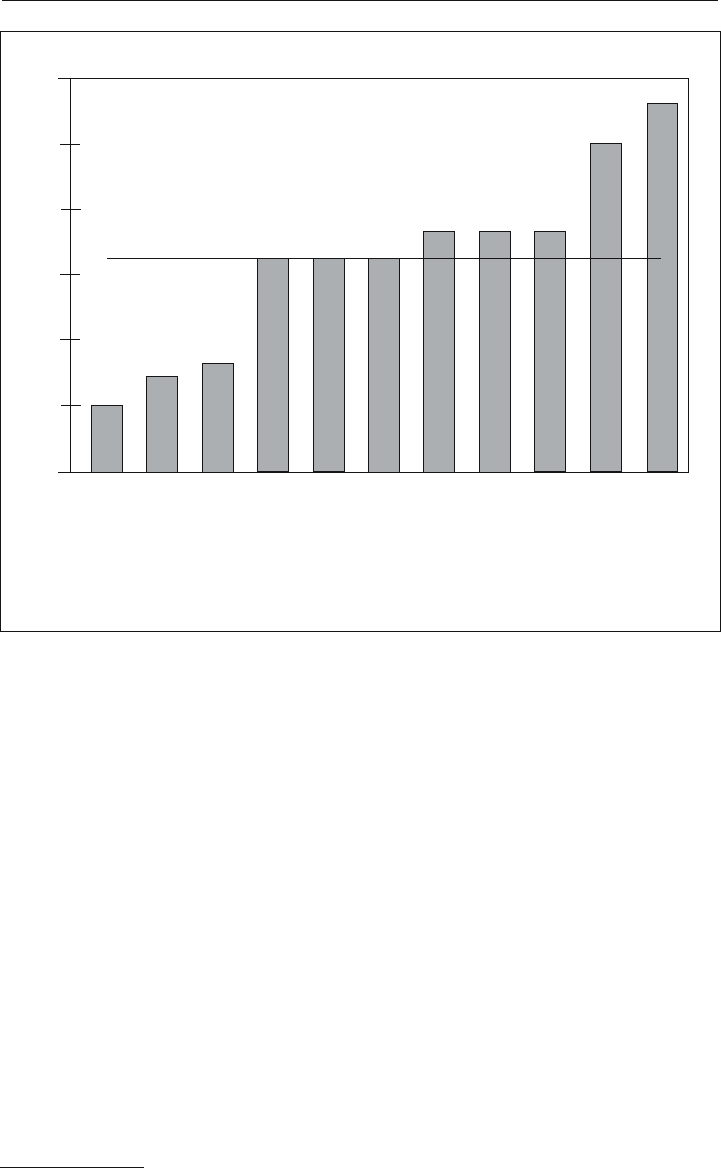
Where
a. The midline of the distribution represents the company’s discount rate;
b. Items below the midline represent returns on tangible assets (such as work-
ing capital: 5%, and land and buildings: 7%;
c. Items above the midline represent returns on intangible assets (such as
IPR&D: 25%, and customer base: 18%); and
d. The highest rate of return represents the riskiest asset, goodwill.
16. The risk premium assessed to a new product launch should decrease as a proj-
ect successfully proceeds through its continuum of development since the
uncertainty related to each subsequent stage diminishes.
17. Under GAAP, an acquiring company must record the fair value of the assets
acquired in a business combination. SFAS No. 141 mandates such purchase
accounting for all acquisitions.
8
18. The appropriate rate of return in valuing the enterprise is the weighted average
cost of capital, the weighted average of the return on equity capital, and the
return on debt capital. The weights represent percentages of debt to total cap-
ital and equity to total capital. The rate of return on debt capital is adjusted to
reflect the fact that interest payments are tax deductible to the corporation.
100 VALTIPS
8
Financial Accounting Standards Board, Statement of Financial Accounting Standards No.
141, Business Combinations (June 2001), at 13.
30%
25%
20%
15%
10%
5%
0%
Working Capital
Land and Buildings
Machinery and
Equipment
Trade Name
Noncompete
Agreement
Assembled
Workforce
Technology
Software
Customer Base
IPR&D
Goodwill
Risk/Return Distribution
5%
7%
8%
16%
16% 16%
18%
18% 18%
25%
28%
© Copyright 2002 The Financial Valuation Group, LC. Used with permission.

19. The formula for the amortization benefit of an amortizable intangible asset is:
AB = PVCF ×(n / (n – ((PV(Dr,n, –1)×(1 + Dr ) ^ 0.5) × T)) –1)
Where
AB = Amortization benefit
PVCF = Present value of cash flows from the asset
n = 15 year amortization period
Dr = Discount rate
PV(Dr,n,-1) × (1 + Dr) ^ 0.5=Present value of an annuity of $1 over 15
years, at the discount rate
T = Tax rate
20. Valuation of a customer base using the costs approach requires the identifica-
tion of the selling costs associated with the generation of new customers. For
example, management indicated that the split in selling costs was roughly
equivalent to the revenue split between new and existing customers. Thus, the
valuation is based on that split. Depending on the nature of the business, this
split between new and existing customers may vary greatly. Thus, the valuation
analyst will need to appropriately identify the costs associated with generating
the new customers. This is probably most easily done based on an allocation
of the sales team’s time such as 40 percent spent on finding new customers, 60
percent to handle existing ones. Or, there may be certain sales or marketing
people or departments that are devoted entirely to servicing existing accounts,
while others spend all of their time finding new ones. In such cases, the costs
can be broken out on a departmental or individual level. For many smaller
businesses, top executives also spend a large amount of time in the generation
of new customers, so these costs must also be considered in the analysis.
21. Use of the cost approach also assumes that the customers and selling effort
required to obtain them are all relatively equivalent. If the company has a few
customers that make up the majority of its business, then the cost approach
may not be as appropriate to determine the value of the customer base.
22. It should be noted that the income approach is often recommended for valuing
a customer base. For many consumer products and “old economy” businesses,
the customer relationship may have much higher value than the technology
associated with the products being sold, since these products are often a com-
modity or near commodity that may be easily substituted with products from
another vendor. The customer relationship may allow the sale of multiple prod-
ucts and services through the same sales channels. An income approach may be
more appropriate in these cases.
23. SFAS No. 141 specifically prohibits the recognition of assembled workforce as
an intangible asset apart from goodwill.
9
24. Trade names and trademarks must be considered individually to determine
their remaining useful life. Trade names and trademarks that are associated
with a company name or logo (e.g., McDonald’s) typically have indefinite lives.
Many product trade names and trademarks also will have an indefinite life if
no reasonable estimate can be made of the end of the product life (e.g., Coca
Chapter 20: Valuations of Intangible Assets 101
9
Financial Accounting Standards Board, Statement of Financial Accounting Standards No.
141, Business Combinations, (June 2001), at 39.