
Kelly Laurence, Diplomacy and Murder in Tehran
Подождите немного. Документ загружается.

on his place in Russian literature, and deals only briefly with his life as
a diplomat. In Russia, studies of his diplomatic career have long been
dominated by the conspiracy theory, the nub of which was the allegedly
treacherous role played by the British in bringing about his death in
Tehran. This was in line with Soviet Cold-War attitudes, but also
because British sources, in particular the records of the Foreign Office
and India Office Library papers about Persia, were not available to
Soviet scholars during the communist period. It is one of the aims of
this book to right this picture, and to re-assess the whole question of
British and Russian relations in Persia in this period. It is also a chance
to examine Griboyedov’s own role in the ‘Great Game’, then starting.
There was scarcely a major player on the eastern chess board with whom
he was not familiar, from the Shah, the Crown Prince Abbas Mirza and
their ministers, to Sir John Macdonald and Dr McNeill, the key figures
in the English mission, and Yermolov and Paskievich on the Russian side.
For Russians, Griboyedov will always be loved as the poetic author
of an immortal comedy, whose alienated hero, Chatsky, expressed the
hopes and disillusions of the Decembrist generation and who, like
Pushkin and Lermontov, died young, cut off by violence in his prime.
His role as a diplomat is less well known, but his life – and death – are
impossible to understand unless the Georgian and Persian dimensions
are taken into account. His years of unwilling exile in the east had
helped to form his character; the warmth and exoticism of Tiflis, the
majestic beauty of the landscape, the brief but intense happiness of his
marriage to the Georgian princess, Nina Chavchavadze, had reconciled
him to the idea of living permanently in Georgia. Had he lived, he would
have resigned from the imperial service for a life of writing and study on
his father-in-law’s estates. In the end it was only his body that returned
to Georgia. He was buried as he had wished, in the monastery of St
David, on a steep hillside above Tiflis, looking out towards the distant
mountains of the Caucasus.
Diplomacy and Murder in Tehran
4

Alexander Griboyedov’s family left no papers, and at best we only have a
sketchy picture of his parents’ position in the ranks of the minor nobility
in the province of Vladimir. Tradition had it that the family originally came
from Poland, settling in Russia and changing their name from Gribovsky
to Griboyedov some time before the sixteenth century. The first official
reference to the family was in 1614, when Tsar Mikhail Fyodorovich
rewarded Mikhail Yefimovich Griboyedov ‘for his many services’ against
the Poles and Lithuanians with some villages in the district of Vyazma. In
1650, Ivan Griboyedov escorted Tsar Aleksei Mikhailovich to Kashin, and
in 1669 Fyodor Akimovich Griboyedov wrote A History of the Tsars and
Grand Dukes of the Russian Land for the benefit of the imperial children.
Another Griboyedov served Peter the Great. Griboyedov’s mother, a distant
cousin of his father, was also a Griboyedov, with a lineage traceable back
to the 1630s and certain high-ranking civil servants round Kazan.
By the early eighteenth century, the Griboyedovs had been accepted
as part of the Vladimir nobility, with records going back to 1685.
1
The
writer’s grandfather, Ivan Nikoforovich (1721–1800) served in the Life
Guards Preobrazhensky Regiment in the Russo–Swedish wars. In 1755,
he was commissioned as a captain in the Siberian Grenadiers, and
finally retired in 1782 with the rank of Court Counsellor (Nadvorny
Sovietnik; see Appendix II). He is recorded as owning five villages,
together with 88 male serfs or ‘souls’, in the 1780s.
The few facts available about his son, Griboyedov’s father, point to
what seems to have been a rather unsatisfactory career. Born in 1760,
5
I
A Moscow
Education

Sergei Ivanovich Griboyedov joined the Smolensk Dragoons as a cadet
in 1775. Promotion came when Prince Yuri Trubetskoy, a Lieutenant
General in the Crimea, took him onto his regular staff as a captain in
the Kinburnsky Dragoon Regiment. But he served in no campaigns, and
in 1785 was allowed to retire on the grounds of illness, with the rank of
‘Sekund-Major’.
2
Already before his retirement, on temporary leave in 1782, he had
joined the ranks of the heavy-gambling landowners in the Province of
Vladimir. Here he was caught up in a disagreeable local scandal, when he
fleeced an inexperienced sixteen-year-old, Nikita Artamonovich Volkov,
an orphan and the ward of the public prosecutor, of 14,000 roubles at
cards. The ensuing outcry reached the ears of the provincial governor,
who insisted that the money be repaid.
Once retired, the Major spent most of his time in the country,
neglecting his estates and refusing to take part in the local assembly of
Vladimir gentry on the grounds of ill health. His wife did not encourage
him to join her in Moscow, and he may well have sought consolation
among the serf girls on his estate. It seems likely that Alexander’s so-
called foster-brother, Alexander Gribov, later his devoted servant and
companion, was actually the Major’s son; according to the convention
of the time, children born out of wedlock were often given a shortened
version of the father’s surname.
The Major was certainly not a father to help his son get on in worldly
terms, and Alexander’s ambition, touchiness and extreme sensitivity in
matters of honour may well have owed something to his negative example.
His mother, Anastasiya Fyodorovna, on the other hand, was tight-fisted
and authoritarian, determined to keep up her position in society despite
her unfortunate marriage. Good-looking and intelligent, she was known
Diplomacy and Murder in Tehran
6
The Griboyedov family crest,
courtesy of N. Volkov-Muromtsov

for her blunt judgements and sharp tongue; Alexander would find her
overbearing attitudes increasingly irritating as he grew up.
Alexander Sergeyevich Griboyedov was born on 4 January 1795; his
sister, Mariya, was born four years later.
3
The two children spent most of
their childhood in Moscow. The family house (destroyed in the great fire
of 1812) was 17 Novinsky Boulevard, on the corner of today’s Tchaikovsky
and Devyatinsky Streets.
4
The freehold belonged to Alexander’s mother’s
brother, Aleksei Fyodorovich, who had rented it to his sister and her
husband, presumably on favourable terms.
5
It was a spacious two-
storey building to which, in 1806, Alexander’s mother added a servants’
wing, selling part of a family estate in the Kropkovka region to do so.
Even though she was badly off herself, Alexander’s mother had
grand connections.
6
One of her sisters was married to the Minister of
Education, Count Razumovsky, while her brother, Aleksei Fyodorovich,
was a landowner on a splendid scale. He had been married twice, first
to a Princess Odoyevsky – one of their daughters, Lisa, married
Alexander’s future patron and Commander-in-Chief Prince Paskievich –
and then to Nastasia Naryshkina, a country neighbour. Alexander’s
mother had been lent a house on her brother’s estate at Khmelita, and
she spent her summer holidays there each year, leaving her husband
behind to drink and gamble with his cronies.
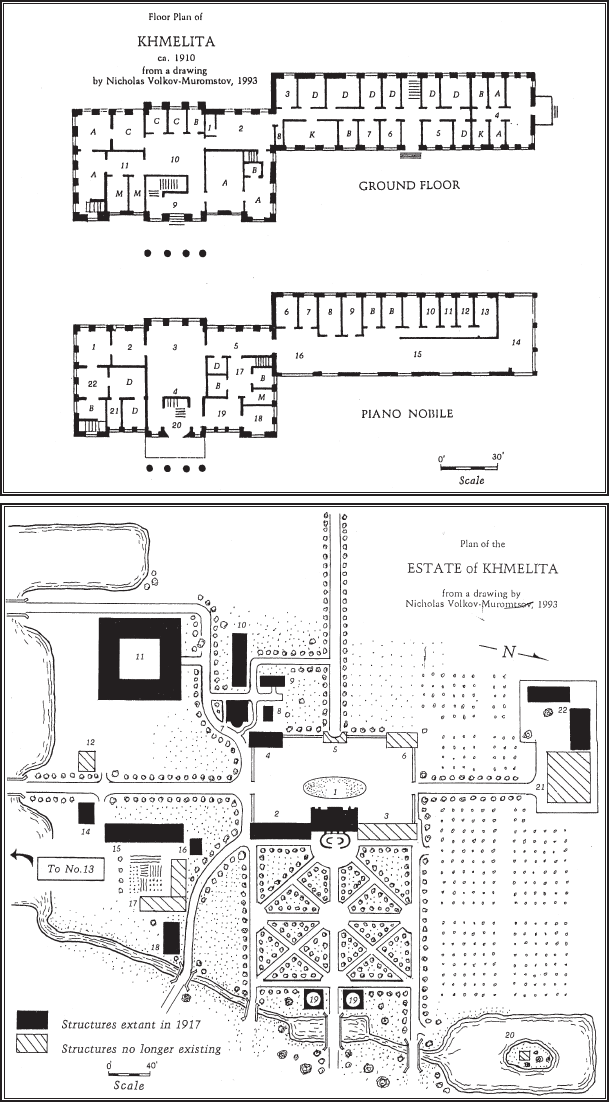
Khmelita, near Vyazma, about 150 miles from the provincial capital
of Smolensk, was one of Russia’s great estates.
7
It extended for over
21,000 acres, and gave employment to 3000 serfs. The main house
stood on an eminence on the lower slopes of the Valdai Hills, with two
of the estate’s three churches visible from its windows. Originally built
in the Russian baroque style, probably by the architect of the Stroganov
Palace in St Petersburg, it had been enlarged and remodelled on classical
lines by Griboyedov’s uncle. The house was destroyed in the Second
World War, but we have a description of it, much as Griboyedov would
have known it, from the son of its last pre-revolutionary owner, Nicholas
Volkov-Muromtsov, who was brought up there.
Writing in 1991, two years before his death at the age of ninety-two,
he described it as consisting of a central building, with two 120-foot
two-storeyed wings and a parade square in front, with low walls linking
two side annexes and a triumphal entrance arch. At the back of the
house a pente douce, or ramp, led to the ballroom in the centre, and
there was a formal park of 25 acres, whose main avenue of limes formed
a second approach. Beyond the park, a road ran through a wilderness
across an artificial river with a pseudo-marble bridge. There was a
manège and a stud farm nearby – ‘In my time,’ wrote Volkov, ‘this did
not exist’
8
– a series of stables, barns and cattlesheds, and an enormous
building that housed the serf actors and a gypsy choir.
A Moscow Education
7
Diplomacy and Murder in Tehran
8

Other serfs lived further away. One of them, a certain ‘waterman’
called Prokop, was still alive when Volkov was born. He had been born
in 1799, a date Volkov’s father verified from the church records, and died
at the age of 112, having insisted on working until the day before he
died. ‘This was nothing extraordinary in strong Russian country people,’
wrote Volkov. ‘In our district around Khmelita there were three other
people over 110, two women and one man.’
9
Prokop remembered
Alexander’s visits as a boy. ‘He was much older than me,’ he said – four
years is a big gap to the very young. ‘They say he wrote something.’
Khmelita was reduced to only a few walls in the Second World War.
It is now a museum directed by the dynamic Viktor Kulakov dedicated
to the memory of Alexander Griboyedov. ‘The restorers had no idea of
what the house was like,’ wrote Volkov.
On knocking off the stucco they found that the house originally was
built in the Russian baroque style. When my book with photos (of the
house before the Revolution) reached the restorers it was too late. The
house had been restored in baroque. The restorers now pretend that the
house was converted [to the classical style] in the 1830s. Poor A.S.G.
would never recognise Khmelita as now restored.
10
In the days of Alexander’s uncle, Khmelita was a hive of activity. It had
every sort of workshop. There were cabinet-makers, mirror-makers,
gilders, architects, gun-makers; as Prokop said proudly, ‘There was no
need to buy anything, everything was made at Khmelita’. The immediate
household included the usual French tutor, in this case an Abbé Baudet,
a German drawing master, Herr Mayer, and an English harpist and
musical director, Mr Adams. There was a house theatre, built in the
south wing, with its own troupe of serf actors and actresses and a gypsy
band; in the summer there would be as many as three performances a
week, attended by the local gentry. Every summer too there would be
several grand balls. The house would be illuminated, and neighbours came
from far and wide: Volkonskys, Lobanov-Rostovskys, Sheremet’yevs,
Naryshkins and so on. From an early age, Alexander was mixing with
some of Russia’s leading families.
Aleksei Fyodorovich was a genial and expansive host, gallant to the
ladies, and, in the eyes of Alexander’s childhood friend and neighbour
Vladimir Lykoshin, a ‘heedless merry sort of fellow’.
11
But his geniality
was only skin-deep. In an undated sketch, entitled The Character of My
Uncle,
12
Alexander gave a cold appraisal of his mother’s brother:
It will fall to the lot of historians to explain why such a mixture of vices
and amiability was so prevalent and widespread in that [his uncle’s]
generation. On the surface they were chivalrous and gallant, but in their
hearts there was not an ounce of feeling … In plain words, everyone had
the spirit of dishonesty in their souls, and deceit on their tongues. It
A Moscow Education
9
seems that at present this is no longer the case – but my uncle belonged
to that epoch. He fought like a lion against the Turks under Suvorov,
then fawned his way into the drawing rooms of those in favour in St
Petersburg and in his retirement lived off gossip. His favourite moral
admonition was, ‘As I see it, my dear fellow …’
13
The character of Famusov, the fussy, self-serving bureaucrat of Woe
from Wit was perhaps already there in outline.
The long holidays at Khmelita, giving Alexander his first taste of life
in the grand manner, must have also underlined his sense of being a
poor relation. For his mother, disillusioned by her marriage, the worldly
establishment of her two children would become an overriding passion.
Extremely cultivated herself, she devoted herself to their education.
Both children were intensely musical. There is a strong possibility that
they studied with the Irish pianist and composer John Field (the inventor
of the nocturne), who was living in Russia at the time.
14
Alexander would
derive solace all his life from music, the piano and composing, while his
sister Mariya was one of the finest amateur harpists of the day.
At the age of eight, Alexander entered the Pension for the Sons of the
Nobility, or Noble Pension, in Moscow;
15
his friend, Vladimir Lykoshin,
a country neighbour from Khmelita, joined the school at the same time.
Founded in 1779, the Noble Pension adjoined the buildings of the
Imperial University, which for most of its pupils would be the next stage
in their education, leading to an eventual career in the civil service or
the army. The links between the university and Pension were close. The
university literary society, where distinguished poets, such as Zhukovsky,
recited their poems, held its meetings in the hall of the Pension; there
were many shared lectures and teachers, and the university bookstore
and printing press were housed on the pension’s premises.
Alexander attended the Pension as a half-boarder. A German tutor,
Johann Petrosilius, later librarian of Moscow University, was engaged to
coach him at home. There was a French tutor for Lykoshin, and it is
probable that the two boys shared lessons. Alexander was surely recalling
their tutors when Chatsky, the hero of Woe from Wit, reminisces about
his schooldays:
Our mentor, you remember his cap and gown,
His index finger and all the signs of education,
How our tender minds would quiver like a leaf
How from our early days we were brought up on the belief
That without Germans there is no salvation.
And Guillaumet, the Frenchman, always on the town –
Is he married yet?
16
In 1806, at the precocious age of eleven, Alexander was admitted to the
University. Lykoshin, two years older, was admitted at the same time.
Diplomacy and Murder in Tehran
10

With the agreement of their parents, the boys were allowed to install
themselves under the supervision of their tutors in a rented flat on
Gazetny Pereulok; other friends and cousins from the Khmelita circle
soon moved in as well.
Situated next to the Mokhovaya, the great street leading from the
Kremlin, the Imperial University had been founded in 1754 by the
Empress Elizabeth; its statutes had been renewed by Alexander I in
1804. Degrees from the university – bachelor (‘candidate’), master and
doctor – approximated to ranks in the civil and military hierarchies and
determined the level of entry to them. They were obtainable in four
faculties: political and moral sciences; physical sciences and mathematics;
medical sciences; and literature, or belles lettres. Both Alexander and
Lykoshin entered this last faculty. The courses included Greek Literature
and Grammar, Rhetoric and Russian Poetry, World History, History and
Statistics and Geography of the Russian empire, Oriental languages,
German, French and English. It was an ambitious curriculum, compa-
rable with that provided for Pushkin and his galaxy of friends at the
Lycée at Tsarskoye Selo. But whereas the Lycée was always an elitist
institution, with students personally approved by the Tsar, Moscow
University was open not only to the aristocracy, but to commoners
(raznotchintsy) and the children of the lower clergy (popovichi). There
was little mixing between groups, however, and the popovichi especially,
with their ugly yellow-collared uniforms, were generally looked down on
by their better-off contemporaries.
In June 1808, Alexander and Lykoshin took the examination which
entitled them to the rank of candidates for degrees. Both presented a
thesis, their special subject being ‘The Migration of the Slavs’. Maubert,
Lykoshin’s French tutor, and the German Petrosilius were present at
their formal examination by Professor Aviat de Vattoy,
17
a good-natured
figure who had supervised their studies and given them the run of his
French library.
Having gained their rank as candidates (which brought with it the
privilege of wearing an embroidered collar), both Alexander and Lykoshin
moved from the faculty of literature to that of law. Alexander obtained
his degree when he was only fifteen. He then planned to take his
doctorate in natural sciences and mathematics; he was only prevented
from doing so by the war of 1812.
Looking back on his friend’s university career, Lykoshin commented
that Alexander had been no more than an average student, lively and
amusing, but with no sign of a literary vocation, beyond a ‘certain
indeterminate power of concentration’.
18
All the same, the range of his
studies, covering literature, law and the sciences in a few short years,
was remarkable. So too were his interests. He had a natural gift for
A Moscow Education
11
languages, reading both Latin and Greek, and speaking French, German,
Italian and English fluently. He was widely read in foreign literature, a
lover of Shakespeare, Schiller and Goethe, a passionate admirer of
Voltaire, ‘that bronze bust come alive,’ as he described him, ‘the picture
of decrepitude and withered genius’.
19
Like most of his university
contemporaries, he was steeped in the ideas of the Enlightenment and,
despite the horrors of the French Revolution, had begun to question his
own country’s institutions. But, like them, he remained an ardent
Russian patriot, fiercely interested in the progress of Russian arms in
the Napoleonic campaigns. He was devoted too to the rituals of the
Russian Orthodox Church, and had studied the Bible closely; years later,
his friend Küchelbecker recalled how, in a period of doubt, Griboyedov
had brought him back to a belief in the immortality of the soul.
According to his friend Beguichov, whom he would first meet in
1813, Griboyedov’s tastes and literary judgements were already formed
by the time he left Moscow University.
20
It is hard to trace specific
influences, but one of the most important, according to Griboyedov
himself, was that of Professor Johann Gottlieb Bühle, with whom he
studied aesthetics and philosophy. Bühle, already a well-known
European figure when he joined the university in 1804, was one of the
most remarkable philosophers and political scientists of the day, and,
as editor of Revue des Beaux Arts, a pioneer in the study of Russian art
and antiquities. Deeply read in Russian history, he was firmly anti-
Napoleon, even at a time when the Tsar was swearing friendship to the
Emperor at Tilsit. From him Griboyedov imbibed a hatred of the then
fashionable Gallomania, which would later be echoed in Woe from Wit.
In a long tirade against ‘a little Frenchman from Bordeaux’,
21
who is
greeted like a king at Moscow parties, Chatsky denounces society’s
‘sickening love for foreign ways’:
Let them call me a believer in the faith of old,
But our northern land is worse a hundred fold
Since we gave up our customs, language and the good old days.
Another important influence during his university years was the
German Johann Gottlieb John, who in 1810 replaced Petrosilius as his
tutor. Eleven years older than his pupil, he would become a close friend.
His particular speciality was the classics, but he was also passionately
interested in the theatre, both at the university and thereafter – he was
later to run the German theatre in St Petersburg.
It was a passion Alexander shared. His apprenticeship as a playwright
began in Moscow, where there was a thriving theatrical tradition dating
back to the days of Peter the Great. The Petrovsky Theatre, founded by the
Empress Elizabeth, offered a varied diet of German, French and Russian
plays to the Moscow public, while many of the nobility, Alexander’s uncle
Diplomacy and Murder in Tehran
12

among them, had their own troupes of serf actors and actresses, and gave
lavish entertainments in their homes. The Pension and the university also
had their own theatres, where stagecraft was taught by two professors,
and students played the female roles. Alexander’s first attempt at play
writing, a parody of Ozerov’s patriotic tragedy Dmitri Donskoy, was
performed at the university theatre when he was only fifteen. The play,
entitled Dmitri Dyranskoy (or ‘nonsense’)
22
has been lost, but, according to
his friend Stepan Beguichov, who read it in manuscript, it was a spoof
on the quarrel between the Russian and German teaching bodies at the
university. The dénouement was a witty one, not unknown in the groves
of academe today: Professor Dryanskoy comes forward to read the first
number of his new academic journal; all the Germans fall asleep.
Alexander’s years at the Imperial University, immensely formative in
many ways, laid the foundation of some lasting friendships. They
included some of the leading liberal figures of his generation, future
Decembrists or sympathisers, among them Peter Chaadayev, his very
close friend at university, later to fall foul of the authorities for his
Western ideas, Artamon Muravyov, Ivan Turgeniev and Sergei
Trubetskoy, all to be exiled to Siberia for their part in the Decembrist
rising of 1825. At the same time, through his mother’s assiduously
cultivated contacts, he was able to plunge into the pleasure-loving world of
Moscow society, that upper-class ant-heap which the French invasion
of 1812 was soon to overturn.
In contrast to the official world of St Petersburg, centring around
the court and government, pre-invasion Moscow had a reputation for
informality and jollity. Its essence, in Byelinsky’s phrase, was a kind of
‘patriarchal domesticity’. Its leaders of society tended to be landowners,
gossipy and sociable, their easy-going way of life supported by a
substantial income from the country estates to which they would return
from May to October each year. Its masculine headquarters was the
English Club,
23
a kind of Moscow Athenaeum or Brooks’s, which
Griboyedov would have visited with his uncle. Tolstoy describes the
typical club members as being ‘elderly and respected persons, with
broad self-confident faces, fat fingers and resolute gestures and voices’.
Count Rostov, fussing about Bagration’s dinner party at the club in War
and Peace, epitomises his kind.
24
For the young and old of both sexes there was a constant flow of
visits and receptions. Every day of the week had its pre-determined
host, ‘at home’ for any friend who came to call, the Razumovskys on
Thursdays, the Arkharoviches on Fridays and so on, often several on
one day. Amongst the most welcoming salons, supposedly a source for
many of the characters from Woe from Wit, was that of Griboyedov’s
kinswoman, Marya Ivanovna Rimskaya-Korsakova.
25
Warm-hearted and
A Moscow Education
13