
Kratz R.F., Siegfried D.R. Biology For Dummies
Подождите немного. Документ загружается.


151
Chapter 10: Biodiversity and Classification
include algae in the plant kingdom, but many biologists draw the line at
including algae in the plant kingdom.
✓ Fungi: Fungi may look a bit like plants, but they aren’t photosynthetic.
They get their nutrition by breaking down and digesting dead matter.
Their cells have walls made of chitin (a strong, nitrogen-containing
polysaccharide), and they don’t produce swimming cells during their
life cycle. Kingdom Fungi includes mushrooms, molds that you see on
your bread and cheese, and many rusts that attack plants. Yeast is also
a member of kingdom Fungi even though it grows differently (most fungi
grow as filaments, but yeast grows as little oval cells).
✓ Protista: Kingdom Protista is defined as everything else that’s eukary-
otic. Seriously. Biologists have studied animals, plants, and fungi for
a long time and defined them as distinct groups long ago. But many,
many, eukaryotes don’t fit into these three kingdoms. A whole world of
microscopic protists exists in a drop of pond water. The protists are
so diverse that some biologists think they should be separated into as
many as 11 kingdoms of their own. But so far no one has pushed to make
that happen, which is certainly good news for you because we bet you
don’t want to memorize the names of 15 kingdoms of eukaryotes.
What about viruses?
Here’s a riddle for you: What has genetic mate-
rial, exists by the billions, functions like a living
parasite, but isn’t truly a living thing? A virus!
That’s right, those nasty little bugs that cause
diseases, ranging from the human immunode-
ficiency virus (HIV) and food poisoning to the
common cold and even some forms of cancer,
may be the world’s most efficient parasites.
But, in the strictest sense of the word, viruses
aren’t really alive because they can’t reproduce
outside of a host cell.
Unlike living things, viruses aren’t made of cells.
They’re just very tiny pieces of DNA or RNA
covered with protein as protection. Because
they’re so small — a fraction of the size of
bacteria — you can’t see them, even with the
aid of a light microscope.
No one really knows how viruses evolved. Some
biologists think they were originally intracellular
parasites that got so good at what they did —
being parasitic, that is — that they were able
to survive with nucleic acid alone. Others think
viruses are cellular escapees, genes that ran
away from home but can’t replicate until they
return to a specific kind of host cell. Still others
think viruses may represent an offshoot of life
from its very beginning, before cells evolved. For
the details on how viruses attack cells and repro-
duce, head to Chapter 17.
16_598757-ch10.indd 15116_598757-ch10.indd 151 5/7/10 11:49 PM5/7/10 11:49 PM
152
Part III: It’s a Small, Interconnected World
Climbing the Tree of Life: The
Classification System of Living Things
Much like you’d draw a family tree to show the relationships between your
parents, grandparents, and other members of your family, biologists use a
phylogenetic tree (a drawing that shows the relationships between a group of
organisms) to represent the relationships between living things. This “tree of
life” allows them to categorize all the diverse organisms that call planet Earth
home and organize them into manageable classifications.
Although you probably know how your family members are related to each
other, biologists have to use clues to figure out the relationships between
living things. The types of clues they use to figure out these relationships
include
✓ Physical structures: The structures that biologists use for comparison
may be large, like feathers, or very small, like a cell wall (flip to Chapter
4 for more on this and other parts of a cell’s structure). For example,
organisms with feathers are related to each other and are included in a
group called birds.
Biologists consider reproductive structures to be especially important
for determining relationships.
✓ Chemical components: Some organisms produce unique chemicals.
Bacteria, for example, are the only cells that make a hybrid sugar-
protein molecule called peptidoglycan. If biologists encounter an organ-
ism that produces this molecule, they can safely group it in with other
bacteria.
✓ Genetic information: An organism’s genetic code determines its traits,
so by reading the genetic code in DNA, biologists can go right to the
source of differences between species. Even organisms that seem
incredibly different, like you and the bacteria E. coli, have some traits in
common. For example, all cells on Earth contain ribosomes for making
proteins, which means biologists can read a gene that has the code for
one of your ribosomal proteins and compare it to the gene that has the
code for one of E. coli’s ribosomal proteins.
The more characteristics two organisms have in common with each other, the
more closely related they are. Characteristics that organisms have in common
are called shared characteristics.
Based on structural, cellular, biochemical, and genetic characteristics, biolo-
gists can classify life on Earth into groups that reflect the evolutionary his-
tory of the planet. That history indicates that all life on Earth began from one
16_598757-ch10.indd 15216_598757-ch10.indd 152 5/7/10 11:49 PM5/7/10 11:49 PM

153
Chapter 10: Biodiversity and Classification
original universal ancestor after the Earth formed 4.5 billion years ago. All the
diversity of life that exists today is related because it’s descended from that
original ancestor.
The next sections break down the various classifications of living things and
explain how each one gets its own unique scientific name.
Mastering the domains
You can interpret the degree of relationship between two organisms by look-
ing at their positions on a phylogenetic tree.
✓ Each organism or group being compared has a branch on the tree.
One branch represents all the animals, and another branch represents
all the plants.
✓ The smaller the distance between two groups, the closer the relation-
ship between them. The distance between animals and plants is a great
deal less than the distance between animals and any of the bacteria, so
animals are much more closely related to plants than they are to bacteria.
✓ If two branches meet at a common point, then the groups represented
by those branches evolved from a common ancestor. Groups with
a common point that’s far away separated further back in time than
groups with a common point that’s near.
When biologists used genetic information to compare all life on Earth, they
discovered that living things fall into three main groups called domains. The
three domains of life are
✓ Bacteria: Consisting mostly of single-celled organisms, bacteria are
prokaryotic, meaning they lack a nuclear membrane around their DNA
(refer to Chapter 4 for the details on prokaryotic cells). Most bacteria
have a cell wall made of peptidoglycan.
✓ Archaea: These are single-celled, prokaryotic organisms. In addition to
their genetic differences from bacteria, archaeans have some chemical
differences, including the fact that their cell walls are never made of
peptidoglycan.
✓ Eukarya: Organisms in the Eukarya domain may be single-celled or
multicellular; either way, their cells are eukaryotic, meaning they have a
nuclear membrane around their DNA (see Chapter 4 for more on eukary-
otic cells). This domain contains familiar organisms such as animals,
plants, mushrooms, and seaweed.
16_598757-ch10.indd 15316_598757-ch10.indd 153 5/7/10 11:49 PM5/7/10 11:49 PM
154
Part III: It’s a Small, Interconnected World
Organizing life into smaller
and smaller groups
Being able to categorize the three largest, and most distantly related, groups
of living things on Earth into domains (as explained in the preceding section)
is great, but biologists need smaller groups to work with in order to deter-
mine how similar different types of organisms are. Hence the creation of the
taxonomic hierarchy, a naming system that ranks organisms by their evolu-
tionary relationships. Within this hierarchy, living things are organized into
the largest, most-inclusive group down to the smallest, least-inclusive group.
The taxonomic hierarchy is as follows, from largest to smallest. (Note that
organisms are placed into each category based on similarities within that
particular group of organisms. Whatever characteristics are used to define a
category must be shared by all organisms placed into that category.)
✓ Domain: Domains group organisms by fundamental characteristics
such as cell structure and chemistry. For example, organisms in domain
Eukarya are separated from those in the Bacteria and Archaea domains
based on whether their cells have a nucleus, the types of molecules
found in the cell wall and membrane, and how they go about protein
synthesis.
✓ Kingdom: Kingdoms group organisms based on developmental charac-
teristics and nutritional strategy. For example, organisms in the animal
kingdom (Animalia) are separated from those in the plant kingdom
(Plantae) because of differences in the early development of these
organisms and the fact that plants make their own food by photosyn-
thesis whereas animals ingest their food. (Kingdoms are most useful in
domain Eukarya because they’re not well defined for the prokaryotic
domains.)
✓ Phylum: Phyla separate organisms based on key characteristics that
define the major groups within the kingdom. For example, within king-
dom Plantae, flowering plants (Angiophyta) are in a different phylum
than cone-bearing plants (Coniferophyta).
✓ Class: Classes separate organisms based on key characteristics that
define the major groups within the phylum. For example, within
phylum Angiophyta, plants that have two seed leaves (dicots, class
Magnoliopsida) are in a separate class than plants with one seed leaf
(monocots, class Liliopsida).
✓ Order: Orders separate organisms based on key characteristics that
define the major groups within the class. For example, within class
16_598757-ch10.indd 15416_598757-ch10.indd 154 5/7/10 11:49 PM5/7/10 11:49 PM
155
Chapter 10: Biodiversity and Classification
Magnoliopsida, nutmeg plants (Magnoliales) are put in a different order
than black pepper plants (Piperales) due to differences in their flower
and pollen structure.
✓ Family: Families separate organisms based on key characteristics that
define the major groups within the order. For example, within order
Magnoliales, buttercups (Ranunculaceae) are in a different family than
roses (Rosaceae) due to differences in their flower structure.
✓ Genus: Genera separate organisms based on key characteristics that
define the major groups within the family. For example, within family
Rosaceae, roses (Rosa) are in a different genus than cherries (Prunus)
thanks to differences in their flower structure.
✓ Species: Species separate eukaryotic organisms based on whether they
can successfully reproduce with each other. You can walk through a
rose garden and see many different colors of China roses (Rosa chinen-
sis) that are all considered one species because they can reproduce with
each other.
Think of how biologists organize living things like how you might organize
your clothing. In your first round of organizing, you might make groups of
pants, shirts, socks, and shoes. From there, you might go into the shirt group
and organize your shirts into smaller groups, such as short-sleeved versus
long-sleeved shirts. Then perhaps you’d organize them by type of fabric, then
color, and so on. At some point, you’d have very small groups with very simi-
lar articles of clothing — perhaps a group of two short-sleeved, button-down,
blue shirts, for example. All of your clothing would be organized in a hierar-
chy, from the big category of clothing all the way down to the small category
of short-sleeved, button-down, blue shirts.
People have lots of funny sayings to help them remember the taxonomic hier-
archy. Our favorite, because it’s so hard to forget, is Dumb Kids Playing Chase
On Freeways Get Squished. The first letter of each word in the sentence repre-
sents the first letter of a category in the taxonomic hierarchy. If you don’t like
this particular saying, just search the Internet for “taxonomic hierarchy mne-
monic,” and you’ll find many more.
All life on Earth is related, but relative position within the taxonomic hier-
archy demonstrates the degree of that relationship. For instance, you and
a carrot are both in domain Eukarya, so you definitely have some things in
common, but you have more characteristics in common with organisms that
are part of the animal kingdom.
Table 10-1 compares the classification, or taxonomy, of you, a dog, a carrot,
and E. coli.
16_598757-ch10.indd 15516_598757-ch10.indd 155 5/7/10 11:49 PM5/7/10 11:49 PM

156
Part III: It’s a Small, Interconnected World
Table 10-1 Comparing the Taxonomy of Several Species
Taxonomic
Group
Human Dog Carrot E. coli
Domain Eukarya Eukarya Eukarya Bacteria
Kingdom Animalia Animalia Plantae Eubacteria
Phylum Chordata Chordata Angiophyta Proteobacteria
Class Mammalia Mammalia Magnoliopsida Gammaproteo-
bacteria
Order Primates Carnivora Apiales Enterobacteriales
Family Hominidae Canidae Apiaceae
(Umbelliferae)
Enterobacteriaceae
Genus Homo Canus Daucus Escherichia
Species H. sapiens C. famil-
iaris
D. carota E. coli
Of the organisms listed in Table 10-1, you have the most in common with
a dog. You’re both animals possessing a central nervous chord (phylum
Chordata), and you’re both mammals (class Mammalia), which means you
have hair and the females of your species make milk. However, you also have
many differences, including the tooth structure that separates you into the
order Primates and a dog into the order Carnivora. If you compare yourself
to a plant, you can see that you have certain features of cell structure that
place you together in domain Eukarya, but little else in common.
Two organisms that belong to the same species are the most similar of all. For
most eukaryotic organisms, members of the same species can successfully
sexually reproduce together, producing live offspring that can also reproduce.
Bacteria and archaea don’t reproduce sexually, so their species are defined by
chemical and genetic similarities.
Playing the name game
When biologists discover a new organism, they give it a scientific name.
They’ve been doing this for hundreds of years according to a system devel-
oped by Swedish naturalist Carl Linnaeus in the 1750s. Linnaeus created a
classification system that included some of the categories, such as kingdom
and class, that are still used today in the taxonomic hierarchy. Linnaeus also
proposed the system of binomial nomenclature that modern biologists use to
give every type of living thing a unique name that has two parts.
16_598757-ch10.indd 15616_598757-ch10.indd 156 5/7/10 11:49 PM5/7/10 11:49 PM

157
Chapter 10: Biodiversity and Classification
In binomial nomenclature, the first part of an organism’s name is the genus,
and the second part is the species name, or specific epithet. The rules for
using binomial nomenclature are as follows:
✓ The genus is always capitalized.
✓ The species name is never written without the genus, although the
genus can be abbreviated by just the first letter.
✓ Both the genus and species should be italicized or underlined to indi-
cate that the name is the official scientific name.
According to these rules, humans may be correctly identified as Homo sapi-
ens or H. sapiens.
16_598757-ch10.indd 15716_598757-ch10.indd 157 5/7/10 11:49 PM5/7/10 11:49 PM

158
Part III: It’s a Small, Interconnected World
16_598757-ch10.indd 15816_598757-ch10.indd 158 5/7/10 11:49 PM5/7/10 11:49 PM

Chapter 11
Observing How Organisms
Get Along
In This Chapter
▶ Discovering how organisms interact with each other and their environment
▶ Analyzing populations and their growth (or lack thereof)
▶ Tracing the path of energy and matter on planet Earth
O
ne of the amazing things about this planet is that even though different
parts of the world have different climates, the organisms living there
somehow manage to get what they need to survive from each other and the
world around them. This chapter explores Earth’s various ecosystems and
details how the interactions between organisms work to keep life on Earth in
balance. It also covers how scientists study groups of organisms to stay on
top of how their populations are growing (or declining).
Ecosystems Bring It All Together
Life thrives in every environment on Earth, and each of those environments
is its own ecosystem, a group of living and nonliving things that interact with
each other in a particular environment. An ecosystem is essentially a little
machine made up of living and nonliving parts. The living parts, called biotic
factors, are all the organisms that live in the area. The nonliving parts, called
abiotic factors, are the nonliving things in the area (think air, sunlight, and
soil).
Ecosystems exist in the world’s oceans, rivers, forests — they even exist in
your backyard and local park. They can be as huge as the Amazon rain forest
or as small as a rotting log. The catch is that the larger an ecosystem is, the
greater the number of smaller ecosystems existing within it. For example, the
ecosystem of the Amazon rain forest also consists of the soil ecosystem and
the cloud forest ecosystem (found at the tops of the trees).
17_598757-ch11.indd 15917_598757-ch11.indd 159 5/7/10 11:50 PM5/7/10 11:50 PM
160
Part III: It’s a Small, Interconnected World
A particular branch of science called ecology is devoted to the study of eco-
systems, specifically how organisms interact with each other and their envi-
ronment. Scientists who work in this branch are called ecologists, and they
look at the interactions between living things and their environment on many
different scales, from large to small.
The sections that follow explain how ecologists classify Earth’s various eco-
systems and how they describe the interactions between the planet’s many
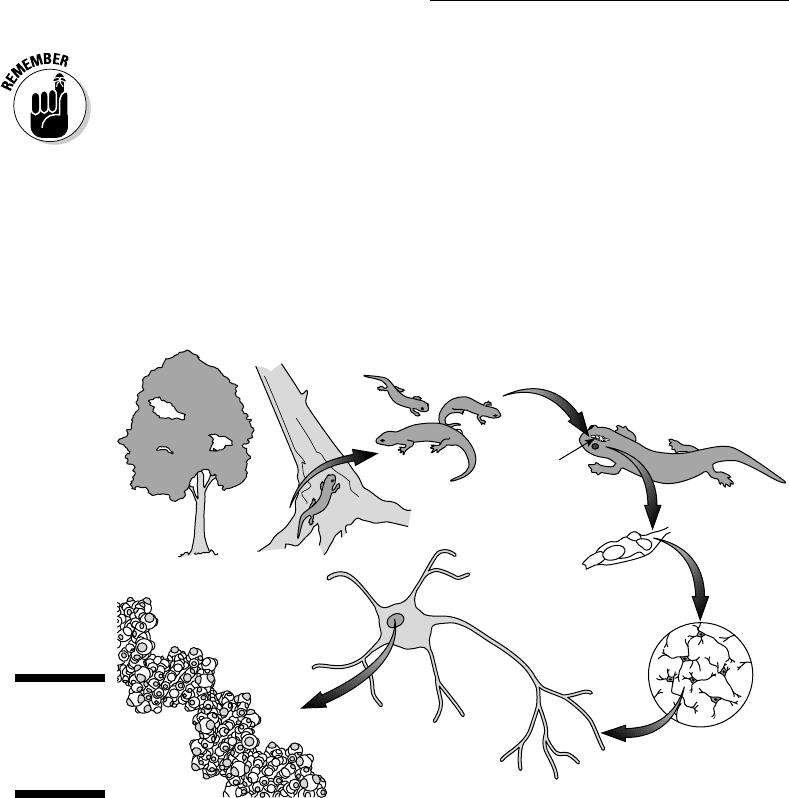
species. Before you check them out, take a look at Figure 11-1 to get an idea
of how living things are organized.
Figure 11-1:
The orga-
nization of
living things.
Organ system level
Nervous system
Organ level
Brain
Tissue level
Nervous tissue
Molecular level
Molecule of DNA
Cellular level
Nerve cell
Organism level
Salamander
Brain
Population level
Group of salamanders
Ecosystem level
Forest
Community level
All organisms in forest
Biomes: Communities of life
All the living things together in an ecosystem form a community. For example,
a forest community may contain trees, shrubs, wildflowers, squirrels, birds,
bats, insects, mushrooms, bacteria, and much more. The different types of
communities found on Earth are called biomes. Six major types of biomes
exist:
17_598757-ch11.indd 16017_598757-ch11.indd 160 5/7/10 11:50 PM5/7/10 11:50 PM