
Kratz R.F., Siegfried D.R. Biology For Dummies
Подождите немного. Документ загружается.


301
Chapter 19: Reproduction 101: Making More Animals
✓ Secondary sex characteristics: These develop as an animal matures,
and they’re far less obvious than primary sex characteristics, which are
the male and female reproductive organs. Secondary sex characteristics
in humans include hair growth and distribution (beards in males), deep-
ening of the voice (in males), increase in muscle mass (males), increase
in amount and distribution of fat (in females), and development of
breasts (in females). Male deer grow antlers, male lions grow manes, and
male peacocks develop a fan of beautiful tail feathers.
Human reproductive cycles
Even though humans are capable of reproducing year-round, reproductive
cycles are still involved. Sperm can fertilize an egg any given day of the week,
but eggs can only be fertilized a few days out of every month. Human sexual
reproduction is therefore controlled by the monthly ovarian cycle (the devel-
opment of the egg in the ovary) and menstrual cycle (the periodic series of
changes associated with menstruation), both of which are controlled by hor-
mones (for more on hormones, see Chapter 18).
As described in the earlier “Oh, oh, oogenesis: Making eggs” section, an
oocyte needs to complete meiosis and mature into an egg before it can be
released by the ovary. Believe it or not, the brain runs this process.
The hypothalamus, which is found at the center of the brain, keeps a
check on how much of the hormones estrogen and progesterone are float-
ing through the bloodstream. When the levels decline, the hypothalamus
secretes a hormone called gonadotropin-releasing hormone (GnRH) that heads
straight for the pituitary gland (which is also found in the center of the brain)
and stimulates part of the pituitary to secrete follicle-stimulating hormone
(FSH) and luteinizing hormone (LH). FSH and LH begin the ovarian cycle
by kick-starting meiosis again and continuing development of the follicles
(another name for the oocytes that are suspended in meiosis) so they can
release an egg. As the follicles grow, they release the hormone estrogen.
When the hypothalamus detects rising levels of estrogen in the bloodstream,
it releases even more GnRH, causing the pituitary gland to release a large
amount of LH about midway through the ovarian cycle. LH stimulates the
release of the egg from the follicle in the ovary — in other words, LH triggers
ovulation. It also triggers the remaining follicle cells to develop into a mass
of cells called the corpus luteum, which secretes estrogen and progesterone
for the rest of the ovarian cycle (about two more weeks). These hormones
prepare the body for a possible pregnancy by spurring the tissues lining the
uterus to develop thicker blood vessels, which brings more nutrients into the
uterus.
26_598757-ch19.indd 30126_598757-ch19.indd 301 5/8/10 12:05 AM5/8/10 12:05 AM

302
Part IV: Systems Galore! Animal Structure and Function
The hypothalamus can detect when the levels of estrogen and progesterone
have reached the point where the lining of the uterus is ready for implanta-
tion. If fertilization
✓ Has occurred: The fertilized egg implants in the lining of the uterus
and an embryo begins developing. That embryo immediately starts to
secrete the hormone human chorionic gonadotropin (hCG). The presence
of hCG ensures that estrogen and progesterone production continue so
the lining of the uterus remains nourished by larger blood vessels. After
the placenta (a blood-filled, nutrient-rich temporary organ) has formed,
the embryo gets its nutrients and blood supply through the umbilical
cord connecting the embryo to the placenta, which is connected to the
mother’s blood supply. Therefore, the production of hCG by the embryo
declines after the placenta is up and running.
Pregnancy tests detect the presence of hCG. Because hCG is produced
solely by fertilized eggs, only women with a fertilized egg in their bodies
should have detectable levels of hCG.
✓ Hasn’t occured: No hCG is produced, and the hypothalamus tells the
pituitary gland to stop producing FSH and LH. The lack of FSH and LH
stops the production of estrogen and progesterone, which causes the
lining of the uterus, sometimes referred to as the endometrium, to stop
receiving all that extra nourishment. The endometrium then starts to
disintegrate and eventually sloughs off and is carried out of the body by
the menstrual flow. The first day of menstrual flow is the first day of the
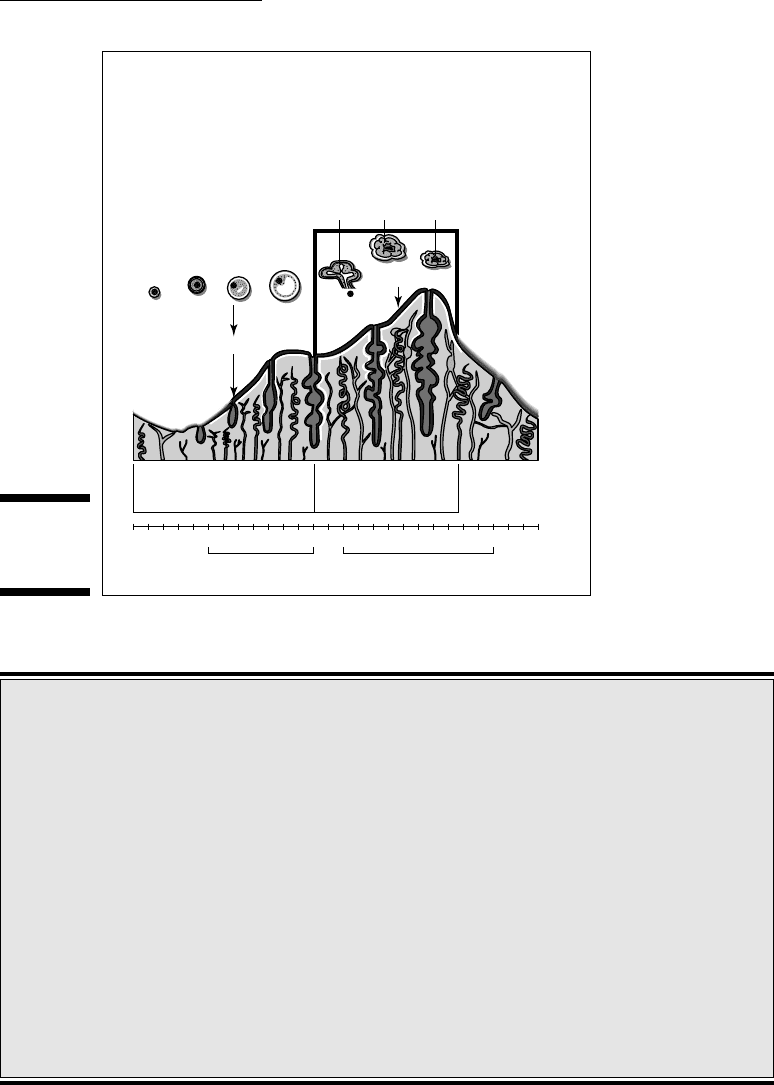
menstrual cycle (pictured in Figure 19-1). The drop in LH also causes the
corpeus luteum to disintegrate, ending the ovarian cycle.
The ovarian cycle and the menstrual cycle occur simultaneously and are synchro-
nized to each other by hormones, but each cycle consists of different events.
✓ The ovarian cycle includes the development of the follicle, the secretion
of hormones by the follicle, ovulation, and the formation of the corpus
luteum. It occurs in the ovary, takes about 28 days to go from beginning
to end, and is controlled by GnRH, FSH, LH, and estrogen.
✓ The menstrual cycle includes the thickening of the endometrium to
prepare for possible implantation and the shedding of the endometrium
if there’s no implanted embryo. It occurs in the uterus, takes about 28
days, and is controlled by the levels of progesterone and estrogen.
Many more eggs are fertilized in a woman’s lifetime than she may realize.
Not every fertilized egg results in a bouncing baby boy or girl. If the hormone
levels aren’t right from the start, a fertilized egg may never implant or may
implant but not secrete enough hormones to maintain the pregnancy. If an
embryo doesn’t produce a sufficient amount of hCG, the pregnancy fails to
continue, and the embryo aborts itself (a spontaneous abortion is another term
for a miscarriage). An unusually heavy menstrual period that started a few
days late is often really the spontaneous abortion of a fertilized egg that didn’t
work out.
26_598757-ch19.indd 30226_598757-ch19.indd 302 5/8/10 12:05 AM5/8/10 12:05 AM
303
Chapter 19: Reproduction 101: Making More Animals
Figure 19-1:
The men-
strual cycle.
Follicular
phase
Luteal
phase
Days
Proliferative phase Secretory phase
Menstruation
Immature follicle
Developing follicle
Developing follicle
Mature follicle
Ovulation
Full corpus luteum
Shrinking corpus luteum
Progesterone
Estrogen
146 14 21 28
From LifeART®, Super Anatomy 3, © 2002, Lippincott Williams & Wilkins
Talk about overstaying your welcome
After a follicle develops and releases an egg, the
empty follicle is called a corpus luteum, which
is Latin for “yellow body.” If the egg becomes
fertilized and implants in the uterus, the corpus
luteum hangs around to help out with the begin-
ning stages of pregnancy. It secretes proges-
terone for a few weeks until the placenta is fully
developed and can secrete progesterone on its
own. (The progesterone helps keep the lining
of the uterus rich with blood and nutrients for
the developing embryo.) Sometimes the corpus
luteum sticks around for a few months, but in
most cases, it eventually shrinks and withers
away during the pregnancy.
Notice how we said “in most cases”? About
10 percent of the time, the corpus luteum
hangs out in the ovary far longer than it should.
Sometimes it remains even if the woman isn’t
pregnant. When that happens, the corpus
luteum can turn into a cyst, which is aptly called
a corpus luteum cyst. Usually, this cyst on the
ovary isn’t a problem, unless it continues to
grow, twist, or rupture. Only then does it need
to be removed surgically.
26_598757-ch19.indd 30326_598757-ch19.indd 303 5/8/10 12:05 AM5/8/10 12:05 AM

304
Part IV: Systems Galore! Animal Structure and Function
How humans mate
The most important thing you should know about mating is that members
of different species can’t successfully reproduce with each other. After all,
the whole point of sexual reproduction is to create a new generation that
contains the genetic information from the previous generations. Interspecies
sexual reproduction doesn’t work because different species contain different
numbers of chromosomes, and those chromosomes contain differing genes.
For instance, humans carry 46 chromosomes in each cell, whereas chimpan-
zees have 48 per cell. If a human and a chimp were to mate, the cell divisions
wouldn’t be equal, and a theoretical offspring (we won’t even go there) prob-
ably wouldn’t be able to survive.
Eggs are actually surrounded by a layer of proteins on top of the plasma mem-
brane that contains receptor molecules made solely for receiving sperm of the
same species. In human eggs, the zone that prevents fertilization by a different
species is called the zona pellucida. Only human sperm can crack the code to
get into the egg.
In the following sections, we stick to how humans make babies. (If your
parents have yet to have this conversation with you, you can let them know
they’re off the hook.)
Human reproductive systems
Before you dive into the details of human sexual reproduction, it helps to
know a little bit about the organ systems involved. As you can see in Figure
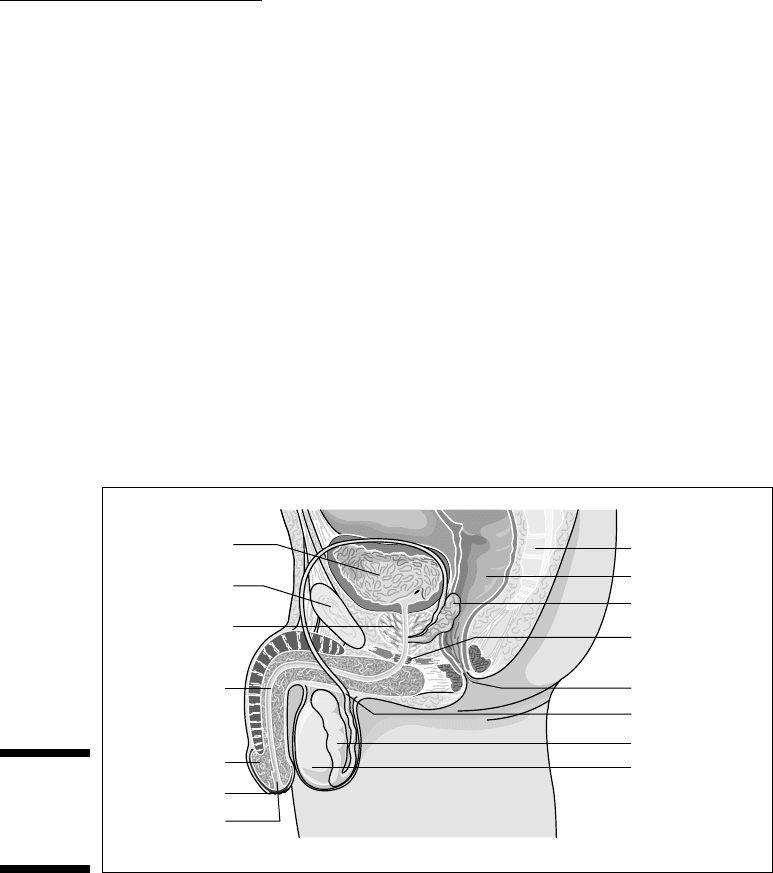
19-2, the male reproductive system is made up of the penis, the testes, and
the seminiferous tubules. Sperm is made in these tubules through the pro-
cess of spermatogenesis (which we explain earlier in this chapter).
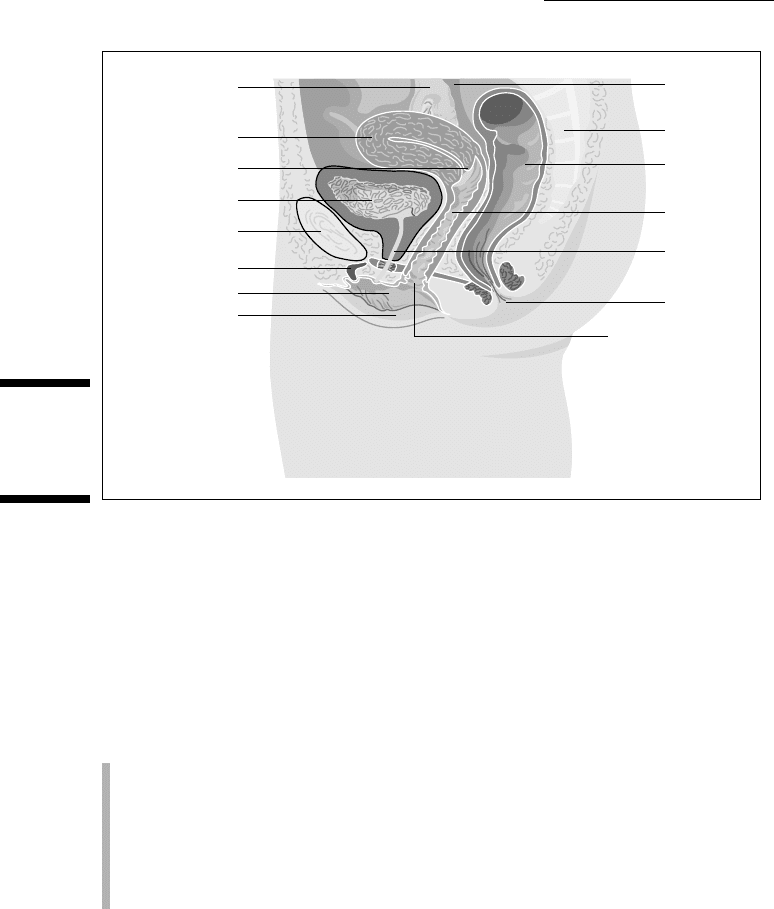
The female reproductive system consists of the vagina, the uterus, the ova-
ries, and the fallopian tubes (see Figure 19-3). A woman’s egg cells are pro-
duced in her ovaries through the process of oogenesis (which we walk you
through earlier in this chapter).
Sexual intercourse
In order to prepare the body for sexual intercourse (the insertion of the man’s
penis into the woman’s vagina), men and women engage in activities that
increase arousal (responsiveness to sensory stimulation). When a man is
sexually aroused, his penis becomes erect because the erectile tissue within
the penis fills with blood. This erection allows the penis to stiffen so it can
26_598757-ch19.indd 30426_598757-ch19.indd 304 5/8/10 12:05 AM5/8/10 12:05 AM
305
Chapter 19: Reproduction 101: Making More Animals
remain inside a woman’s vagina during intercourse. In females, the clitoris
is the sexually sensitive organ. It has erectile tissue and a glans tip, just like
a penis does. When a woman becomes aroused, the erectile tissue within
the clitoris (which is located toward the front end of the labia just under the
pubic bone) fills with blood, and the increased pressure causes drops of fluid
to be squeezed out of the tissue. This lubrication prepares the vagina for
sexual intercourse so the erect penis can be inserted into it easily.
When the penis is fully inside the vagina, the tip of the penis is as close as
possible to the woman’s cervix. The cervix is the bottom end of the uterus,
which extends down into the vagina. Sperm must travel through the cervix
to enter the uterus. During sexual intercourse, sperm travel from the man’s
epididymides (tubules in the scrotum that store produced sperm) to his vas
deferens, tubes that carry sperm from the scrotum to the urethra so they can
be ejaculated.
The actions that occur during sexual intercourse serve to bring the man and
woman to the climax of stimulation, which is followed shortly by orgasm.
Figure 19-2:
The male
reproduc-
tive system.
Vertebrae
Rectum
Seminal vesicle
Bulbourethral
(Cowper's) gland
Anus
Vas deferens
Epididymis
Testis
Urinary bladder
Pubic bone
Prostate gland
Urethra
Glans penis
Foreskin
Urethral
orifice
From LifeART®, Super Anatomy 1, © 2002, Lippincott Williams & Wilkins
26_598757-ch19.indd 30526_598757-ch19.indd 305 5/8/10 12:05 AM5/8/10 12:05 AM
306
Part IV: Systems Galore! Animal Structure and Function
Figure 19-3:
The female
reproduc-
tive system.
Ureter
Uterine tube
Uterus
Cervix
Urinary bladder
Pubic bone
Clitoris
Labium minora
Labium majora
Vertebrae
Rectum
Vagina
Urethra
Anus
Opening (orifice)
of vagina
From LifeART®, Super Anatomy 1, © 2002, Lippincott Williams & Wilkins
Orgasm
Believe it or not, orgasm, the highly pleasurable climax of sexual intercourse,
serves a physiological purpose. As the sexual stimulation of a male intensi-
fies, the sperm move from the vas deferens into the urethra and secretions
from three glands — the seminal vesicles, the prostate gland, and the bul-
bourethral gland — all add their fluids to create semen (seminal fluid). The
semen contains the following “ingredients” that help promote fertilization:
✓ Fructose: This sugar gives the sperm energy to swim upstream.
✓ Prostaglandins: These hormones cause contractions of the uterus that
help propel the sperm upward.
✓ A pH of 7.5: This relatively high pH provides the basic solution in which
sperm can live and helps neutralize the acidic conditions of the vagina,
which would otherwise kill the sperm.
Orgasm occurs at the height of sexual stimulation and is signaled by muscu-
lar contractions and a pleasurable feeling of release. The muscular contrac-
tions cause semen to be expelled from the penis, which is called ejaculation.
The average amount of semen expelled during one ejaculation is less than 1
teaspoon, but it contains more than 400 million sperm.
26_598757-ch19.indd 30626_598757-ch19.indd 306 5/8/10 12:05 AM5/8/10 12:05 AM

307
Chapter 19: Reproduction 101: Making More Animals
When orgasm occurs in a male, a sphincter muscle closes off the bladder to
prevent urine from entering the urethra. Shutting out urine allows the urethra
to be used solely for ejaculation at that time. (In males, the urethra is shared
by both the urinary tract and the reproductive tract; in females, the urethra is
solely part of the urinary tract.)
In females, the height of sexual stimulation also causes intense muscular con-
tractions and a pleasurable feeling of release. The fluid released inside the vagina
helps create a watery environment that the sperm can swim in. The muscular
contractions of the uterus slightly open the cervix, which allows sperm to get
inside the uterus and also helps “pull” sperm upward toward the fallopian tubes.
Fertilization
After ejaculation, sperm have quite a bit of swimming to do before they find
the egg. They have to travel from wherever they’re deposited in the vagina,
through the muscular cervix, up through the entire uterus, and finally into
the fallopian tubes, which is where fertilization (the joining of sperm and egg)
actually occurs.
Because a human egg lives no longer than 24 hours after ovulation and human
sperm live no longer than 72 hours, intercourse that occurs in the three-day
period prior to ovulation or within the day after ovulation is the only chance
of fertilization during a given month.
If the sperm does find its way to the egg, it must penetrate the egg in order to
supply it with its 23 chromosomes. However, human eggs have several layers
of cells and a thick membrane surrounding them. To get through all that, the
sperm produces enzymes in a structure near its nucleus called the acrosome.
The acrosomal enzymes digest the protective layers of the egg (so the sperm
essentially “eats” its way into the egg). But the sperm isn’t alone in its efforts.
The egg helps the sperm get inside by going through physical and biochemi-
cal changes. After the sperm has successfully joined with the egg, the two
gametes create a cell that contains the full human chromosome count of 46.
How Other Animals Do It
Humans obviously aren’t the only animals that mate and undergo sexual
reproduction. All kinds of animals reproduce sexually. The question is: How
do they do it?
Following is a look at the mating styles of birds, bees, worms, and sea
urchins, as well as explanations of how the species’ zygotes form (a zygote
is the fertilized cell that results when two gametes join together). Note: We
highlight these animals’ mating styles and zygote formation because they
give an overview of the different strategies for sexual reproduction that occur
in the animal kingdom.
26_598757-ch19.indd 30726_598757-ch19.indd 307 5/8/10 12:05 AM5/8/10 12:05 AM

308
Part IV: Systems Galore! Animal Structure and Function
✓ Bees: The process by which bees reproduce is called parthenogenesis,
meaning “virgin production.” (Partheno- is Greek for “virgin” [as in the
Parthenon], and genesis means “production.”) A queen bee receives all
the sperm she’ll ever be impregnated with during her nuptial flight when
she mates with the drones (male bees that never have a full chromo-
some count). The queen never mates with the drones again because she
doesn’t have to — she has stored their sperm cells inside her body, leav-
ing her in total control of when fertilization occurs.
When the queen lays eggs and releases the sperm, the eggs become
fertilized. Those fertilized eggs develop into females, many of which are
worker bees (these bees are born diploid but never produce gametes,
which means they can’t reproduce). The other fertilized eggs develop
into new queens. When the queen lays eggs but withholds sperm and
prevents fertilization, the unfertilized eggs develop into male drones.
The cells in drones’ testes develop into gametes that are received by the
new queen, which technically is one of their sisters. (If you’re confused
by what haploid and diploid mean, see Chapter 6.)
✓ Birds: Birds copulate, and the male bird deposits his sperm inside the
female bird. The egg becomes fertilized and is deposited outside the
female bird’s body to continue developing until it’s time to hatch. The
yolk of an egg (the yellow part) is where the developing embryo resides,
and the albumen (the white part) serves to nourish the embryo through-
out its development.
Just after fertilization, one spot on the yolk of an egg goes through a
series of divisions called cleavage. At the end of the cleavage divisions,
an embryonic disk called a blastoderm is created on one side of the
yolk. The blastoderm is the initial cell tissue that begins to develop into
a baby bird; it separates into an epiblast, which is the top layer, and a
hypoblast, which is the bottom layer. The epiblast cells migrate down
into the hypoblast along a line in the yolk, called a primitive streak, to
create the mesoderm, which goes on to develop the rest of the bird.
✓ Earthworms: Earthworms are hermaphrodites, meaning they have both
female and male reproductive parts (specifically ovaries, testes, semi-
nal vesicles, vas deferens, and seminal receptacles). When earthworms
copulate, they face in opposite directions and put their citella together.
Citella are the external, smooth, nonsegmented parts of an earthworm;
their job is to secrete mucus and help the sperm get from the vas defer-
ens of one worm to the seminal receptacle of the other worm. Cocoons
form and are protected by a mucus sheath created by the citella. The
sperm and eggs are fertilized inside the cocoon, and the zygotes stay
enclosed in it until they hatch in the soil.
26_598757-ch19.indd 30826_598757-ch19.indd 308 5/8/10 12:05 AM5/8/10 12:05 AM

309
Chapter 19: Reproduction 101: Making More Animals
✓ Planarian worms: These freshwater flatworms are fairly unique because
they can reproduce both asexually (by constricting their bodies and lit-
erally splitting in two) and sexually. All planarian worms are hermaphro-
dites. When two of these worms reproduce sexually, they use their male
organs to secrete and exchange sperm with each other. Then they use
their female organs to create zygotes. The zygotes develop into small
planarian worms that later hatch and mature into adults.
✓ Sea urchins: Male and female sea urchins look exactly the same on the
outside — they both have a ring of genital pores at the center of their
bodies. Males discharge sperm through their pores into the water, and
females discharge eggs through their pores into the water. Fertilization
is left to chance, but it’s helped by the fact that sea urchins live in close
contact, their eggs have a sticky coat to which sperm adhere, and ejacu-
lation by any one sea urchin signals the other males to ejaculate too.
Developing New Humans
Sexual reproduction involves the production of gametes and the act of
mating to join the gametes so fertilization can occur. After fertilization
takes place, the term development describes how the fertilized egg becomes
another new organism that possesses a mix of its parents’ DNA.
In the sections that follow, we walk you through the process of development,
from zygote to newborn. Note: We focus on the development of human off-
spring because that’s most relevant to your life. However, many similarities
exist between the development of humans and other animals.
From single cells to blastocyst
After the nucleus of a sperm and the nucleus of an egg fuse, fertilization is
complete, and the new, diploid cell is referred to as a zygote.
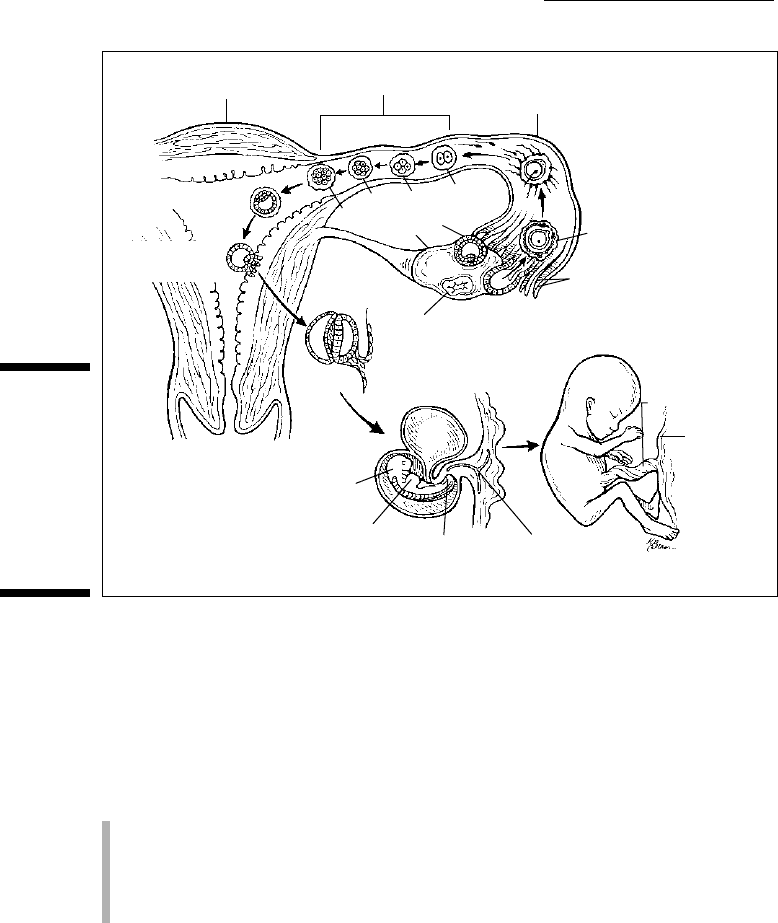
The zygote begins traveling down the fallopian tube, heading for the uterus
so it can implant in the uterine lining. As it travels, the zygote undergoes
cleavage, a rapid series of mitotic divisions that result in a multicellular
embryo (see Step 3 in Figure 19-4). The zygote divides into 2 cells, which
divide into 4 cells, which divide into 8 cells, which divide into 16 cells. At this
point, the zygote is a solid ball of cells called a morula.
26_598757-ch19.indd 30926_598757-ch19.indd 309 5/8/10 12:05 AM5/8/10 12:05 AM
310
Part IV: Systems Galore! Animal Structure and Function
Figure 19-4:
Fertilization,
conception,
and early
embryonic
and fetal
develop-
ment of
humans.
Uterus
3. Zygote divides
Fallopian tube
Oocyte
Fimbria
Oocyte is released into fallopian tube
Embryo
(25 days)
Fetus (12 weeks)
Umbilical cord
Placenta
Head
Blastocyst
Morula
8-cell
Ovary
Embroyonic
disk
14 days
after fertilization
4-cell
2. Fertilization
1. Ovulation
2-cell
Mature follicle
Corpus luteum
Heart
Tail Body stalk
(future umbilical cord)
4. Conception
(Implantation)
Cell division continues, but the morula becomes filled with liquid, which
pushes the increasing number of cells out toward the periphery of the
embryo’s membrane, forming a hollow ball of cells called a blastula. In
humans, a group of cells inside the blastula become specialized to form
the embryo, and the blastula becomes a blastocyst. Different layers of cells
become specialized within the blastocyst, taking the first step toward form-
ing specialized tissues:
✓ The flattened cells along the edge of the blastocyst form the trophoblast.
✓ The fluid-filled cavity is called the blastocoel.
✓ The sphere of larger, rounded cells that’s destined to become the
embryo is called the embryoblast.
The trophoblast cells secrete an enzyme that helps degrade the lining of the
uterus. After the blastocyst “eats” its way into the wall of the uterus, it sinks
into the wall and implants itself. Conception occurs when the blastocyst
26_598757-ch19.indd 31026_598757-ch19.indd 310 5/8/10 12:05 AM5/8/10 12:05 AM