
Samarskii A.A., Vabishchevich P.N. Numerical Methods for Solving Inverse Problems of Mathematical Physics
Подождите немного. Документ загружается.

86 Chapter 3 Boundary value problems for elliptic equations
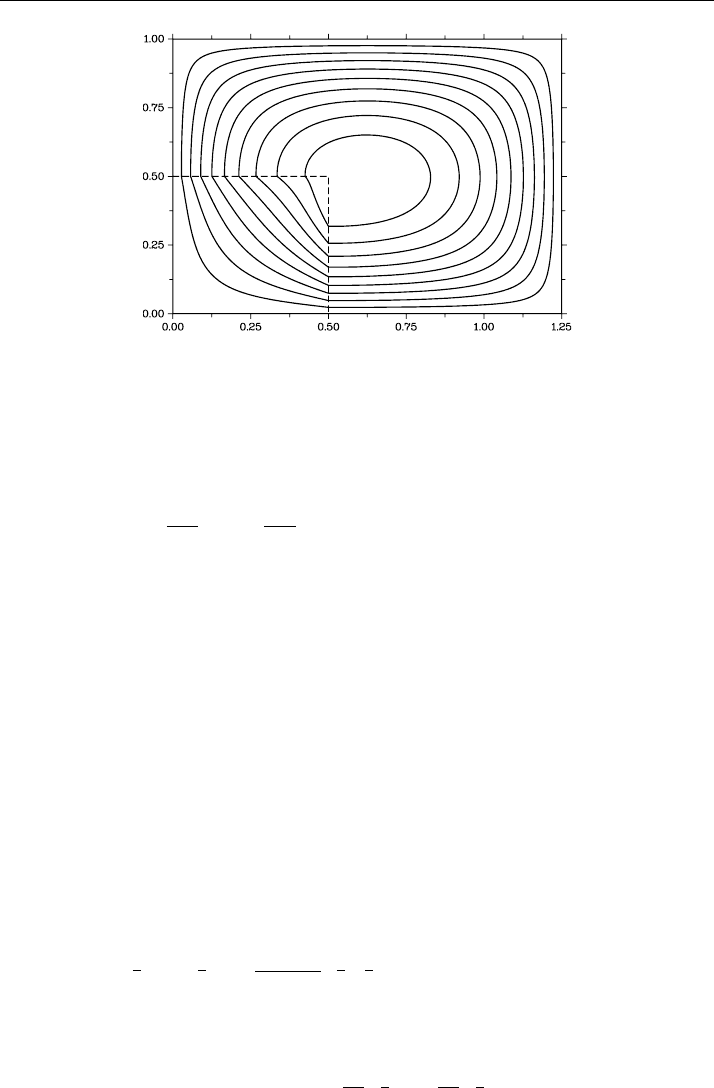
Figure 3.6 Solution obtained with κ
2
= 0.01
The calculation domain in the method of fictitious domains is dipped into the do-
main
0
. Instead of the approximate solution of problem (3.64), (3.65), we deal with
the boundary value problem
−
2
α=1
∂
∂x
α
k
ε
(x)
∂u
ε
∂x
α
+ q
ε
(x)u
ε
= f
ε
(x), x ∈
0
, (3.66)
u
ε
(x) = 0, x ∈ ∂
0
. (3.67)
Consider a method of fictitious domains with continuation over higher coefficients in
which
k
ε
(x), q
ε
(x), f
ε
(x) =
k(x), q(x), f (x), x ∈ ,
ε
−2
, 0, 0, x ∈
1
=
0
\.
Show that u
ε
(x) − u(x)
W
1
2
()
→ 0asε → 0.
Exercise 3.2 Consider a method of fictitious domains with continuation over lower
coefficients for approximate solution of problem (3.64), (3.65), when in (3.66), (3.67)
we have:
k
ε
(x), q
ε
(x), f
ε
(x) =
k(x), q(x), f (x), x ∈ ,
1,ε
−2
, 0, x ∈
1
=
0
\.
Exercise 3.3 Show that the difference scheme
−y
x
1
x
1
− y
x
1
x
1
−
h
2
1
+ h
2
2
12
y
x
1
x
1
x
2
x
2
= ϕ(x), x ∈ ω,
y(x) = μ(x), x ∈ ∂ω
with
ϕ(x) = f (x) +
h
2
1
12
f
x
1
x
1
+
h
2
2
12
f
x
2
x
2
,
approximates the boundary value problem (3.2), (3.3) accurate to the fourth order.

Section 3.5 Exercises 87
Exercise 3.4 In the numerical solution of equation (3.1), approximate the third-kind
boundary condition
−k(0, x
2
)
∂u
∂x
1
+ σ(x
2
)u(0, x
2
) = μ(x
2
),
considered on one side of a rectangle (on the other boundary segments, first-kind
boundary conditions are given).
Exercise 3.5 Construct a difference scheme for the boundary value problem (3.1),
(3.3) with the following matched conditions at x
1
= x
∗
1
:
u(x
∗
1
+ 0, x
2
) − u(x
∗
1
− 0, x
2
) = 0,
k
∂u
∂x
1
(x
∗
1
+ 0, x
2
) − k
∂u
∂x
1
(x
∗
1
− 0, x
2
) = χ(x
2
).
Exercise 3.6 Consider the approximation of the second-order elliptic equation with
mixed derivatives
−
2
α,β=1
∂
∂x
α
k
αβ
(x)
∂u
∂x
β
= f (x), x ∈ ,
in which
k
αβ
(x) = k
βα
(x), α, β = 1, 2.
Exercise 3.7 In cylindrical coordinates, the Poisson equations in a circular cylinder
can be written as
−
1
r
∂
∂r
r
∂u
∂r
−
1
r
2
∂
2
u
∂ϕ
2
−
∂
2
u
∂z
2
= f (r,ϕ,z).
Construct a difference scheme for this equation with first-kind boundary conditions on
the surface of the cylinder.
Exercise 3.8 Consider a difference scheme written as
A(x)y(x) −
ξ∈W
(x)
B(x,ξ)y(ξ ) = ϕ(x), x ∈ ω
with
A(x)>0, B(x,ξ)> 0,ξ∈ W
(x),
D(x) = A(x) −
ξ∈W
(x)
B(x,ξ)> 0, x ∈ ω.
Derive the following estimate for the solution of the problem:
y(x)
∞
≤
ϕ(x)
D(x)
∞
.

88 Chapter 3 Boundary value problems for elliptic equations
Exercise 3.9 Suppose that in the iteration method (of alternate directions)
B
y
k+1
− y
k
τ
+ Ay
k
= ϕ, k = 0, 1,...
we have
A = A
1
+ A
2
, A
1
A
2
= A
2
A
1
and, in addition,
δ
α
E ≤ A
α
≤
α
E, A
α
= A
∗
α
,δ
α
> 0,α= 1, 2.
Next, suppose that the operator B is given in the factorized form
B = (E + ν A
1
)(E + ν A
2
).
Find the optimum value of ν.
Exercise 3.10 To solve the difference problem
Ay = ϕ, A = A
∗
> 0
one uses the triangular iteration method
(D + τ A
1
)
y
k+1
− y
k
τ
+ Ay
k
= ϕ,
with D being an arbitrary self-adjoint operator and
A = A
1
+ A
2
, A
1
= A
∗
2
.
Find the optimum value of τ if a priori information is given in the form
δ D ≤ A, A
1
D
−1
A
2
≤
4
A.
Exercise 3.11 Derive the calculation formula
τ
k+1
=
(w
k
, r
k
)
(Aw
k
,w
k
)
,w
k
= B
−1
r
k
, r
k
= Ay
k
− ϕ
for the iteration parameter in the iterative steepest descend method
B
y
k+1
− y
k
τ
k+1
+ Ay
k
= ϕ, k = 0, 1,...,
A = A
∗
> 0, B = B
∗
> 0,
from the condition of minimum norm of inaccuracy in H
A
at the next iteration.
Section 3.5 Exercises 89
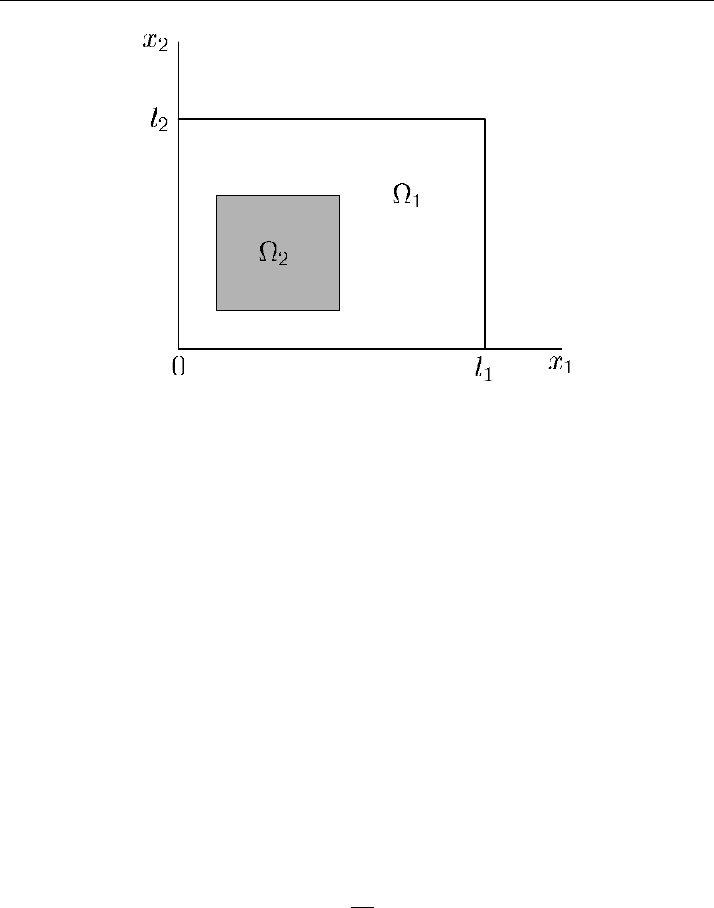
Figure 3.7 On the statement of the modified Dirichlet problem
Exercise 3.12 Using the program PROBLEM2, examine how the rate of convergence
in the used iterative process depends on the variable coefficient k(x) (or, in the simplest
case, how the number of iterations depends on κ
2
).
Exercise 3.13 Using the program PROBLEM2, perform numerical experiments on
solving the Dirichlet problem in a step domain
1
(Figure 3.3) based on the method
of fictitious domains with continuation over lower coefficients.
Exercise 3.14 Modify the program PROBLEM2 so that to solve the third boundary
value problem (boundary conditions (3.4)) for equation (3.60).
Exercise 3.15 Consider the modified Dirichlet problem for equation (3.1) in a bicon-
nected domain
1
(Figure 3.7). At the outer boundary, conditions (3.1) are given. At
the internal boundary, the solution is constant, but this solution itself must be deter-
mined from an additional integral condition:
u(x) = const, x ∈ ∂
2
,
∂
1
k(x)
∂u
∂n
dx = 0.
To approximately solve the problem, use the method of fictitious domains imple-
mented via the program PROBLEM2.
4 Boundary value problems
for parabolic equations
As a typical non-stationary mathematical physiscs problem, we consider here the
boundary value problem for the space-uniform second-order equation. On the approx-
imation over space, we arrive at a Cauchy problem for a system of ordinary differential
equations. Normally, the approximation over time in such problems can be achieved
using two time layers. Less frequently, three-layer difference schemes are used. A
theoretical consideration of the convergence of difference schemes for non-stationary
problems rests on the theory of stability (correctness) of operator-difference schemes
in Hilbert spaces of mesh functions. Conditions for stability of two- and three-layer
difference schemes under various conditions are formulated. Numerical experiments
on the approximate solution of a model boundary value problem for a one-dimensional
parabolic equation are performed.
4.1 Difference schemes
Difference schemes for a model second-order parabolic equation are constructed. The
approximation over time is performed using two and three time layers.
4.1.1 Boundary value problems
Consider a simplest boundary value problem for a one-dimensional parabolic equation.
The calculation domain is the rectangle
Q
T
= × [0, T ], ={x | 0 ≤ x ≤ l}, 0 ≤ t ≤ T .
The solution is to be found from the equation
∂u
∂t
=
∂
∂x
k(x)
∂u
∂x
+ f (x, t), 0 < x < l, 0 < t ≤ T. (4.1)
Here, the coefficient k depends just on the spatial variable and, in addition, k(x) ≥
κ>0.
We consider the first boundary value problem (with the boundary conditions as-
sumed homogeneous) in which equation (4.1) is supplemented with the conditions
u(0, t) = 0, u(l, t) = 0, 0 < t ≤ T. (4.2)
Also, the following initial conditions are considered:
u(x, 0) = u
0
(x), 0 ≤ x ≤ l. (4.3)

Section 4.1 Difference schemes 91
In a more general case, one has to use third-kind boundary conditions. In the latter
case, instead of (4.2) we have:
−k(0)
du
dx
(0, t) + σ
1
(t)u(0, t) = μ
1
(t),
k(l)
du
dx
(l, t) + σ
2
(t)u(l, t) = μ
2
(t), 0 < t ≤ T.
(4.4)
The boundary value problem (4.1)–(4.3) is considered as a Cauchy problem for the
first-order differential-operator equation in the Hilbert space H = L
2
() for functions
defined in the domain = (0, 1) and vanishing at the boundary points of the domain
(on ∂). For the norm and for the scalar product, we use the settings
(v, w) =
v(x)w(x) dx, v
2
= (v, v) =
v
2
(x) dx.
We define the operator
Au =−
∂
∂x
k(x)
∂u
∂x
, 0 < x < l, (4.5)
for functions satisfying the boundary conditions (4.2).
The boundary value problem (4.1)–(4.3) is written as a problem in which it is re-
quired to find the function u(t) ∈ H from the differential-operator equation
du
dt
+ Au = f (t), 0 < t ≤ T (4.6)
supplemented with the initial condition
u(0) = u
0
. (4.7)
The operator A is a self-adjoint operator positively defined in H, i. e.,
A
∗
= A ≥ mE, m = κπ
2
/l
2
> 0. (4.8)
With the aforesaid taken into account (see the proof of Theorem 1.2), we derive the
following a priori estimate for the solution of problem (4.6)–(4.8):
u(t)≤exp (−mt )
u
0
+
t
0
exp (mθ) f (θ)dθ
. (4.9)
A cruder estimate derived by invoking the property of non-negativeness of the op-
erator A only was obtained previously in Theorem 1.2; this estimate has the form
u(t)≤u
0
+
t
0
f (θ )dθ. (4.10)
Estimates (4.9) and (4.10) show that the solution of problem (4.6)–(4.8) is stable
with respect to initial data and right-hand side. Such fundamental properties of the
differential problem must be inherited when we pass to a discrete problem.

92 Chapter 4 Boundary value problems for parabolic equations
4.1.2 Approximation over space
As usually, we denote as ¯ω a uniform grid with stepsize h over the interval
¯
= [0, l]:
¯ω ={x | x = x
i
= ih, i = 0, 1,...,N, Nh = l}
and let ω and ∂ω be the sets of internal and boundary nodes.
At internal nodes, we approximate the differential operator (4.5), accurate to the
second order, with the difference operator
Ay =−(ay
¯x
)
x
, x ∈ ω, (4.11)
in which, for instance, a(x) = k(x − 0.5h).
In the mesh Hilbert space H , we introduce a norm defined as y=(y, y)
1/2
,
where
(y,w) =
x∈ω
y(x)w(x)h.
On the set of functions vanishing on ∂ω, for the self-adjoint operator A under the
constraints k(x) ≥ κ>0 and q(x) ≥ 0 there holds the estimate
A = A
∗
≥ κλ
0
E, (4.12)
in which
λ
0
=
4
h
2
sin
2
πh
2l
≥
8
l
2
is the minimum eigenvalue of the difference operator of second derivative on the uni-
form grid.
The approximation over space performed, we have the following problem put into
correspondence to the problem (4.6), (4.7):
dy
dt
+ Ay = f, x ∈ ω, t > 0, (4.13)
y(x, 0) = u
0
(x), x ∈ ω. (4.14)
By virtue of (4.12), for the solution of problem (4.13), (4.14) there holds the esti-
mate
y(x, t)≤exp (−κλ
0
t)
u
0
(x)+
t
0
exp (κλ
0
θ) f (x,θ)dθ
, (4.15)
consistent with estimate (4.9).

Section 4.1 Difference schemes 93
4.1.3 Approximation over time
The next step in the approximate solution of the Cauchy problem for the system of
ordinary difference equations (4.13), (4.14) is approximation over time. We define a
time-uniform grid
¯ω
τ
= ω
τ
∪{T }={t
n
= nτ, n = 0, 1,...,N
0
,τN
0
= T }.
We denote as A, B : H → H linear operators in H dependent, generally speaking,
on τ and t
n
. In the notation used below, following the manner adopted in the theory of
difference schemes, we do not use subscripts:
y = y
n
, ˆy = y
n+1
, ˇy = y
n−1
,
y
¯
t
=
y −ˇy
τ
, y
t
=
ˆy − y
τ
.
In a two-layer difference scheme used to solve a non-stationary equation, the transi-
tion to the next time layer t = t
n+1
is performed using the solution y
n
at the previous
time layer.
In the two-layer scheme, equation (4.13) is approximated with the difference equa-
tion
y
n+1
− y
n
τ
+ A(σ y
n+1
+ (1 − σ)y
n
) = ϕ
n
, n = 0, 1,...,N
0
− 1, (4.16)
where σ is a numerical parameter (weight) to be taken from the interval 0 ≤ σ ≤ 1.
For the right-hand side, one can put, for instance,
ϕ
n
= σ f
n+1
+ (1 − σ)f
n
.
Approximation of (4.14) yields
y
0
= u
0
(x), x ∈ ω. (4.17)
Scheme (4.16) is known as the weighted scheme.
For the time-approximation inaccuracy of the first derivative we have:
v
n+1
− v
n
τ
=
dv
dt
(t
∗
) + O(τ
ν
),
where ν = 2ift = t
n+1/2
; otherwise, ν = 1. As a result, we obtain the difference
equation (4.16) that approximates equation (4.13) over time accurate to the second
order in the case of σ = 0.5 and accurate to the first order in the case of σ = 0.5.
Consider also the weighted three-layer difference scheme for equation (4.13), in
which three time layers (t
n+1
, t
n
and t
n−1
) are used:
θ
y
n+1
− y
n
τ
+ (1 − θ)
y
n
− y
n−1
τ
+ A(σ
1
y
n+1
+ (1 − σ
1
− σ
2
)y
n
+ σ
2
y
n−1
) = ϕ
n
, (4.18)

94 Chapter 4 Boundary value problems for parabolic equations
n = 1, 2,...,N
0
− 1.
For the right-hand side, it would appear reasonable to use the approximations
ϕ
n
= σ
1
f
n+1
+ (1 − σ
1
− σ
2
) f
n
+ σ
2
f
n−1
.
Now, we can enter the three-layer calculation scheme with known y
0
and y
1
:
y
0
= u
0
, y
1
= u
1
. (4.19)
For y
0
, we use the initial condition (4.14). To find y
1
, we invoke a two-layer difference
scheme, for instance,
y
1
− y
0
τ
+
1
2
A(y
1
+ y
0
) =
1
2
( f
1
+ f
0
).
The difference scheme (4.18), (4.19) involves a weighting parameter θ used in the ap-
proximation of the time derivative and two weighting parameters, σ
1
and σ
2
, used in
the approximation of other terms. Let us give some typical sets of weighting parame-
ters that have found use in practical computations.
Using a greater number of layers in approximation of time-dependent equations is
aimed, first of all, at raising the approximation order. That is why in the considera-
tion of three-layer schemes (4.18), (4.19) it makes sense for us to restrict ourselves to
schemes that approximate the initial problem (4.13), (4.14) over time with an order not
less than second order.
First of all, consider a one-parametric family of symmetric schemes of the second
approximation order
y
n+1
− y
n−1
2τ
+ A(σ y
n+1
+ (1 − 2σ)y
n
+ σ y
n−1
) = ϕ
n
, (4.20)
which results from (4.18) with the settings
θ = 1/2,σ= σ
1
= σ
2
.
Particular attention should be paid to the scheme
3y
n+1
− 4y
n
+ y
n−1
2τ
+ Ay
n+1
= ϕ
n
(4.21)
that approximates equation (4.13) accurate to O(τ
2
) with properly given right-hand
side (for instance, ϕ
n
= f
n+1
). Note that if in (4.18) we choose
θ = 3/2,σ
1
= 1,σ
2
= 0,
then we arrive at scheme (4.21).

Section 4.2 Stability of two-layer difference schemes 95
4.2 Stability of two-layer difference schemes
A highly important place in the robustness study of approximate solution methods for
non-stationary problems is occupied by the stability theory. Below, we introduce key
notions in use in the theory of stability for operator-difference schemes considered in
finite-dimensional Hilbert spaces, formulate stability criteria for two-layer difference
schemes with respect to initial data, and give typical estimates of stability with respect
to initial data and right-hand side.
4.2.1 Basic notions
Stability conditions are formulated for difference schemes written in the unified gen-
eral (canonical) form. Any two-layer scheme can be written in the form
B(t
n
)
y
n+1
− y
n
τ
+ A(t
n
)y
n
= ϕ
n
, t
n
∈ ω
τ
, (4.22)
y
0
= u
0
, (4.23)
where y
n
= y(t
n
) ∈ H is the function to be found and the functions ϕ
n
, u
0
∈ H
are given functions. Notation (4.22), (4.23) is called the canonical form of two-layer
schemes.
For the Cauchy problem at the next time layer to be solvable, we assume that the
operator B
−1
does exist. Then, we can write equation (4.22) as
y
n+1
= Sy
n
+ τ ˜ϕ
n
, S = E − τ B
−1
A, ˜ϕ
n
= B
−1
ϕ
n
. (4.24)
The operator S is called the transition operator for the two-layer difference scheme
(using this operator, transitions from one time layer to the next time layer can be per-
formed).
A two-layer scheme is called stable, if there exist positive constants m
1
and m
2
,
independent of τ and, also, of u
0
and ϕ, such that for all u
0
∈ H, ϕ ∈ H, and t ∈¯ω
τ
for the solution of problem (4.22), (4.23) the following estimate is valid:
y
n+1
≤m
1
u
0
+m
2
max
0≤θ≤t
n
ϕ(θ)
∗
, t
n
∈ ω
τ
. (4.25)
Here ·and ·
∗
are some norms in the space H . Inequality (4.25) implies that the
solution of problem (4.22), (4.23) depends continuously on input data.
The difference scheme
B(t
n
)
y
n+1
− y
n
τ
+ A(t
n
)y
n
= 0, t
n
∈ ω
τ
, (4.26)
y
0
= u
0
(4.27)
is called a scheme stable with respect to initial data, if for the solution of problem
(4.26), (4.27) the following estimate holds:
y
n+1
≤m
1
u
0
, t
n
∈ ω
τ
. (4.28)