
Wai-Fah Chen.The Civil Engineering Handbook
Подождите немного. Документ загружается.

Special Concrete and Applications 42-29
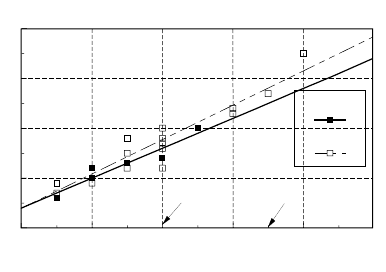
the relationship between carbonation depth and the reciprocal of the square root of compressive strength
1/sqrt F
c
of concretes proportioned without and with chemical admixture respectively.
For concretes without chemical admixture, the carbonation depth of HVFA concretes can be higher
than that of corresponding portland cement concrete as shown in Fig. 42.13. The differences in the
carbonation depth of the two concrete increases with the reduction in the strength level.
For concretes designed with a standard chemical admixture dosage, that is 400 ml of water reducer
or 1000 ml of superplasticizer per 100 kilogram of binder, the differences in the carbonation depth of
HVFA and portland cement concretes, as shown in Fig. 42.14, are not significant especially for concretes
in the grade range of 25–32 MPa. According to AS 3600, grades 25 and 32 are recommended for exposure
classification A2 and B1. These classifications cover the conditions where carbonation could pose a threat
to the durability of concrete structures.
It is noted that HVFA concretes designed with chemical admixtures are the types of structural concrete
that should be chosen for most building and civil engineering works. Based on the short-term data, these
HVFA concretes would be expected to perform as well as Portland cement concretes.
Chloride-induced corrosion — Chloride ions can penetrate into concrete through the effect of concen-
tration gradient and/or through the effect of capillary action. The mechanism of chloride penetration is
often described as diffusion. This may be an over simplification for the process. The transportation of
ionic species into a concrete medium is complicated. This is because of the possible reactions between
the chloride ions and the hydrates that constantly alter the pore system. Regardless of the mechanism of
transportation of chloride ions, it is known that when the amount of chloride ions at the steel/concrete
interface is higher than a critical concentration, steel corrosion will occur. This critical chloride concen-
tration is called the chloride threshold level. It is also known that chloride threshold level depends on
binder content and the chemistry of the pore solution.
It has been suggested that the hydroxyl concentration is the controlling factor with regard to the
chloride threshold level. A relationship, such as Cl
–
/OH
–
= 0.6, has been suggested for the estimation of
chloride threshold level. Recent work by Cao et al. [1992] indicated that this is not the case since blended
cements can have similar chloride threshold level to Portland cements despite having lower OH
–
con-
centrations in their pore solution.
When passivity of steel cannot be maintained, corrosion of steel occurs. The service life of a reinforced
concrete structure is directly related to the development of the corrosion and its rate. However, it must
be stressed that the mode of corrosion should also be considered. For example, metal loss due to pitting
corrosion may be much smaller than that of general corrosion. However, the effect of pitting corrosion
(concentrated metal loss in a small area) can be very dangerous to the integrity of the structure in terms
of loss in load carrying capacity.
The detection of corrosion and the measurement of corrosion rate of steel can be used to compare
the behavior of different binders in the initiation and propagation stages of the deterioration. One of the
FIGURE 42.14 Carbonation depth of concretes with chemical admixture after 2 years exposure in 23∞C 50% RH.
Mixes with chemical admixture
R = 95.2%
R = 95.3%
Grade 32 Grade 20
0.12 0.14 0.16 0.18 0.2 0.22
0
5
10
15
20
1/sqrt Fc
Carbonation Depths after 2 years (mm)
0%FA
40-60%FA
© 2003 by CRC Press LLC
42-30 The Civil Engineering Handbook, Second Edition
possible methods of comparatively assessing the initiation stage is by monitoring the corrosion rate of
steel embedded in concrete or mortar. The change in corrosion rate from “negligible” to “significant”
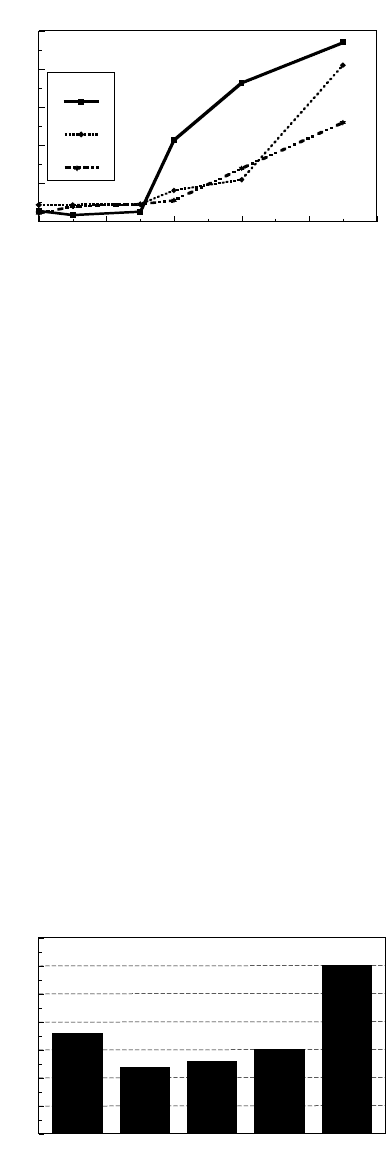
can be used to determine the effect of binder type on initiation period. These data are presented in
Fig. 42.15. The corrosion rate was determined by using polarization resistance technique. It must be
stressed that the initiation stage is controlled by the rate of chloride penetration, the chloride threshold
level, and the concrete cover thickness.
The effect of 40 wt.% fly ash binder systems on the development of corrosion of steel is shown in
Fig. 42.15. From this figure, it can be seen that the use HVFA binders leads to a similar or longer initiation
period as compared to portland cement mortar of the same W/B and with limited initial curing period
of 7 days. The cover of the mortars over steel sample in this case is about 7 mm. It can be seen that the
initiation period where the corrosion rate of steel is negligible for this configuration is about 3 months
for portland cement and about 3 to 4 months for both HVFA binders. It is expected that for a realistic
concrete cover in a marine environment, say about 50 mm, the effect of HVFA binder in terms of the
increase of the initiation period will be further magnified. This conclusion is based on better chloride
penetration resistance performance data at larger cover depths [Thomas 1991, Sirivivtnanon and Khatri
1995] and the lower W/B ratio used to produce HVFA concrete of the same strength grade as portland
cement concrete (Table 42.2). The propagation period, characterized by significant corrosion rate, is also
a very important to the maintenance-free service life. The main reason is that, for a binder system in
which a low corrosion rate can be maintained, the service life will be prolonged by an extended propa-
gation period.
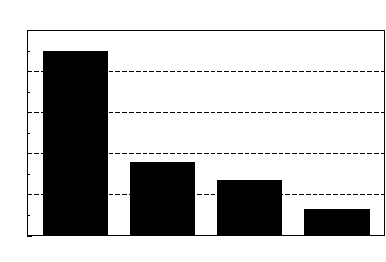
The effect of fly ash on the corrosion rate of steel embedded in mortars W/B ration of 0.4 and cured
for 7 days, is shown in Fig. 42.16. It is clear that the use of high volume fly ash binder systems can result
FIGURE 42.15 Effect of binder on the corrosion rate of steel embedded in 7-mm thick mortars.
FIGURE 42.16 Effect of binder on the corrosion rate of steel embedded in 7-mm thick mortars after 1 year of
immersion in 3% NaCl.
0610
0
0.05
0.1
0.15
0.2
0.25
Time of immersion in 3% NaCl (months)
Corrosion rate (micro A/cm2)
Type A/1
40% FA1
40% FA2
W/B = 0.6
7 d moist cured
24 8
Type A/1
40%FA1
40%FA2 40%FA3 Type A/2
0
0.05
0.1
0.15
0.2
0.25
0.3
0.35
Corrosion rate (micro A/cm
2
)
W/B = 0.4
7 d moist cured
1 year immersion
© 2003 by CRC Press LLC
Special Concrete and Applications 42-31
in reduced corrosion rate of steel in comparison to the Portland cements. The extent of the reduction
depends on the source of the fly ash.
It should be noted that the corrosion rate mentioned above is that of microcell corrosion rate where
the anode and cathode of the corrosion cell are in close proximity and sometimes are not physically
distinguishable. For most reinforced concrete applications, there are situations where the anode and
cathode of the corrosion cell can be physically separated. In such a situation, termed macrocell corrosion,
the characteristics of the concrete, such as the resistance to ionic transportation and its resistivity, will
have important influence on the corrosion rate of steel. By using fly ash blended cement, both of these
characteristics of the concrete will be improved and hence the corrosion rate will be reduced. This has
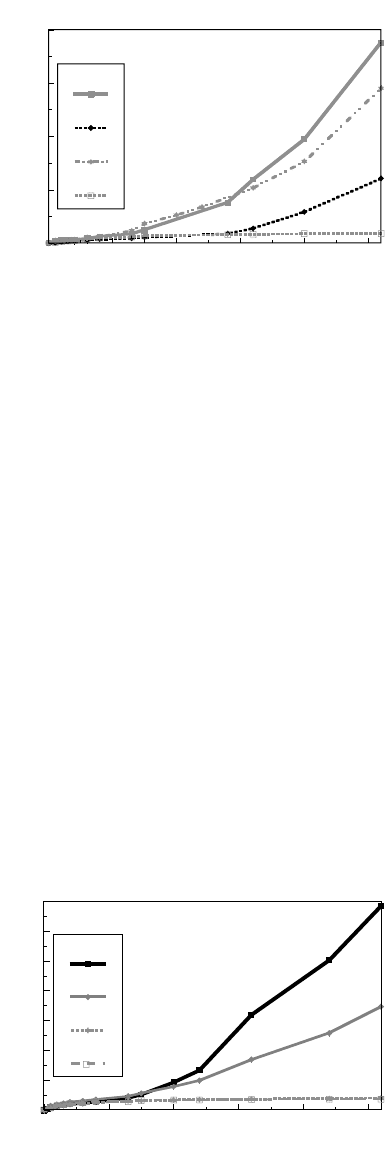
been confirmed experimentally as shown in Fig. 42.17 in which the macrocell corrosion rates were
determined using a model of equal areas of anode (chloride contaminated area) and cathode (chloride
free area) and the mortar medium was 15 mm. It can be seen that the beneficial effect of HVFA binder
systems in reducing the macrocell corrosion rate compared to Portland cement mortar of the same W/B
is very significant. The effect of increasing the fly ash proportion on the reduction of macrocell corrosion
rate is also clearly evident.
The overall conclusion is that the use of HVFA concrete can result in extended maintenance-free
service life of reinforced concrete structure in marine environments. This is based on its potential in
increasing the initiation period and reducing the corrosion rate in the propagation period of the deteri-
oration process due to chloride-induced corrosion of steel reinforcement.
Sulphate Resistance
Sulphate resistance of a cementitious material can be broadly defined as a combination of its physical
resistance to the penetration of sulphate ions from external sources and the resistance of the chemical
reactivity of its components in the matrix to the sulphate ions. Both factors are important to the overall
resistance to sulphate attack of a concrete structure. However, the chemical resistance to sulphate attack
is considered to be more critical for long-term performance. The physical resistance can be improved by
good concreting practice such as the use of concrete with low W/B, adequate compaction and extended
curing. The extent of chemical reactivity of hardened cement paste with sulphate ions, on the other hand,
depends very much on the characteristic of the binder system. It may appear obvious that for a long
service life, a good concrete is required. However, this will be better assured if the concrete is made from
a binder that has low “reactivity” with sulphate ions.
Sulphate resistance of cementitious materials can be assessed by a variety of methods. The performance
of two fly ashes and three Portland cements was examined in terms of expansion characteristic and strength
development of mortars immersed in 5% Na
2
SO
4
solution. In addition, the performance of mortars in
5% Na
2
SO
4
solution at lower pHs of 3 and 7 were determined.
All the expansion mortars were made with a fixed sand-to-binder ratio of 2.75 and variable amount
of water to give a similar flow of 110 ± 5%. In most cases, the fly ash mortars had lower W/B than
FIGURE 42.17 Effect of varying dosage of fly ash on the Macrocell corrosion rate of steel after 6 months of immersion
in 3% NaCl.
Type A/1 20% FA1 40% FA1 60% FA1
0
0.5
1
1.5
2
2.5
Macrocell corrosion rate (micro A/cm2)
W/B = 0.8
7 d moist cured
6 months immersion
© 2003 by CRC Press LLC
42-32 The Civil Engineering Handbook, Second Edition
Portland cement mortars. When a test was performed to ASTM C1012 [1989], the samples were cured
for 1 day at 35∞C and subsequently at 23∞C until they reached a compressive strength of 20 MPa before
immersion in the Na
2
SO
4
solutions. Mortars used in the evaluation of compressive strength retention
had the same sand-to-binder ratio of 2.75 and a W/B ratio of 0.6.
Apart from two fly ashes, FA1 and FA2, the three portland cements used were Type A, C and D cement
(normal, low heat and sulphate-resisting cement respectively) according the superseded AS 1315–1982.
The effect of fly ash blended cement on expansion of mortar using the ASTM C1012 procedures is
shown in Fig. 42.18. A 5% Na
2
SO
4
solution, without any control on the pH of the solution, was used in
this case.
It can be seen that the use of 40 wt.% fly ash blended cement greatly reduces the expansion of mortar.
In fact, the expansion of fly ash blended cement is much lower than that of the three Portland cements
Type A, C, and D. When all the mortars were cured for a period of 3 days, the effect of both fly ashes
on the reduction of expansion was also very clear, as shown in Fig. 42.19.
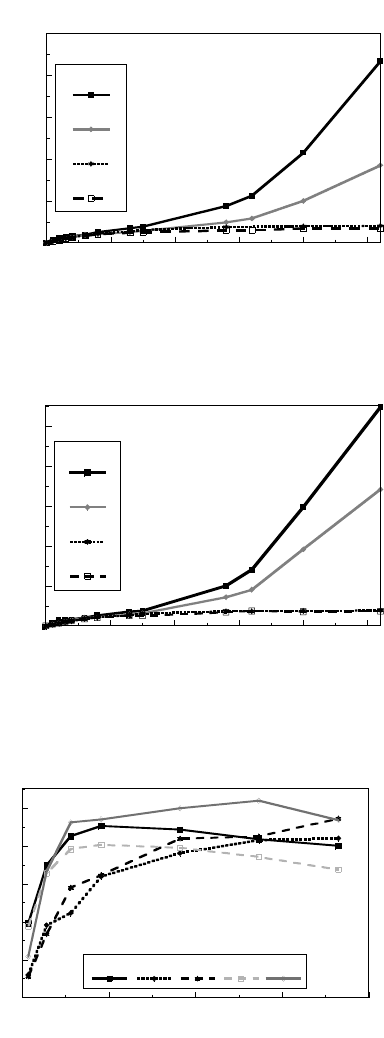
The improved expansion characteristic of fly ash blended cement mortars was maintained in sulphate
environments of low pHs as shown in Figs. 42.20 and 42.21. In fact, the same effect has been observed
for most Australian fly ashes when used at a replacement level of about 40% [1994].
Apart from a much lower expansion characteristic in sulphate environments, the use of binders with “high”
fly ash percentage leads to superior strength retention in a sulphate solution. Figure 42.22 shows that for
most Portland cements, the loss of compressive strength was observed after about 6 months in sulphate
solution. Whereas, the 40 wt.% fly ash blended cement mortars showed strength increases even after 1 year.
FIGURE 42.18 Expansion of mortar bars in 5% Na
2
SO
4
solution to ASTM C1012.
FIGURE 42.19 Expansion of mortar bars in 5% Na
2
SO
4
solution to ASTM C1012 but with 3 days moist curing.
01020304050
0
2,000
4,000
6,000
8,000
Immersion period in 5% Na2SO4 (wks)
Mortar Expansion (microstrain)
Type A/1
Type C
Type D
40%FA1
ASTM C1012
010203040
50
0
1,000
2,000
3,000
4,000
5,000
6,000
7,000
Immersion Period in 5%Na2SO4 (wks)
Expansion (microstrain)
Type A/1
Type C
40%FA1
40%FA2
3 day curing
© 2003 by CRC Press LLC
Special Concrete and Applications 42-33
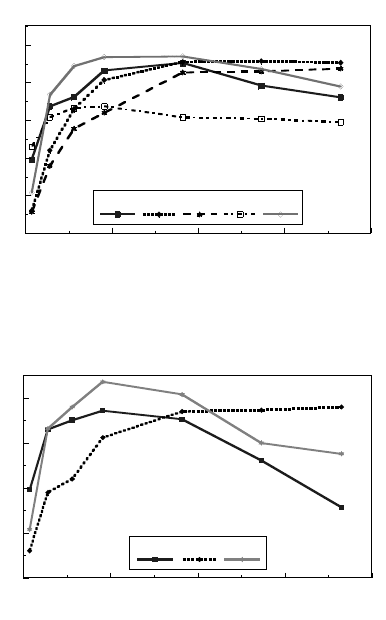
In low pH sulphate solutions, the beneficial effect of high replacement fly ash binder was even more
pronounced as shown in Figs. 42.23 and 42.24.
The results clearly indicate that for concrete application in sulphate environment, particularly in those
where the pH is low, the use of HVFA concrete has the highest probability of extending the service life.
FIGURE 42.20 Expansion of mortar bars in a 5% Na
2
SO
4
solution (low pH 7) to ASTM C1012.
FIGURE 42.21 Expansion of mortar bars in a 5% Na
2
SO
4
solution (low pH 3) to ASTM C1012.
FIGURE 42.22 Compressive strength of mortars after different periods of immersion in sulphate solution.
01020304050
0
1,000
2,000
3,000
4,000
5,000
Immersion period in pH 7 Na2SO4 (wks)
Expansion (microstrain)
Type A/1
Type C
40%FA1
40%FA2
ASTM C1012
pH 7
0102030 50
0
1,000
2,000
3,000
4,000
5,000
Immersion period in pH3 Na2SO4 (wks)
Expansion (microstrain)
Type A/1
Type C
40%FA1
40%FA2
ASTM C1012
pH 3
40
0 100 200 300 400
10
20
30
40
50
60
Time of Immersion (days)
Compressive Strength (MPa)
Type A/1 40%FA1 40%FA2 TypeA/2 TypeC
W/B = 0.6
7 d moist cured
No pH control
© 2003 by CRC Press LLC
42-34 The Civil Engineering Handbook, Second Edition
Optimum Dosage for Durability
In marine and sulphate environments, the optimum dosage of fly ash has not been strictly determined
but is expected to be around 40 wt.%. When the proportion of fly ash by weight exceed about 50%, the
lowering in compressive strength becomes significant. With the present cost structure of concreting
materials including fly ash, a HVFA concrete with 40 wt.% fly ash is marginally more expensive than
portland cement concrete of equivalent strength grade. However, with the significantly increased expected
service life, it is argued that the optimum dosage with respect to service life of HVFA concrete would be
around 40% by weight of binder.
Basis for Applications
Sufficient knowledge is now available on the design, production and properties of HVFA concrete for its
applications to be identified. The inherent properties and limitations of HVFA concrete are the keys to
its selection in suitable applications. They are given in relative terms to the properties of Portland cement
and conventional fly ash concrete as follows:
•good cohesiveness or sticky in mixes with very high binder content;
•some delay in setting times depending on the compatibility of cement, fly ash and chemical
admixture;
• slightly lower but sufficient early strength for most applications;
•comparable flexural strength and elastic modulus;
•better drying shrinkage and significantly lower creep;
FIGURE 42.23 Compressive strength of mortars after different periods of immersion in a pH 7 sulphate solution.
FIGURE 42.24 Compressive strength of mortars after different periods of immersion in a pH 3 sulphate solution.
0 100 200 300 400
10
20
30
40
50
60
Time of immersion (days)
Compressive Strength (days)
Type A/140%FA140%FA2 TypeA/2 TypeC
W/B = 0.6
7 d moist cured
pH 7
0 100 200 300 400
10
20
30
40
50
Time of Immersion (days)
Compressive Strength (MPa)
Type A/1 40%FA1 Type C
W/B = 0.6
7 d moist cured
pH 3
© 2003 by CRC Press LLC
Special Concrete and Applications 42-35
•good protection to steel reinforcement in high chloride environment;
•excellent durability in aggressive sulphate environments;
•lower heat characteristics; and
•low resistance to de-icing salt scaling [Malhotra and Ramenzanianpour 1985].
Built Structures
Examples of built structures are given in accordance with the primary basis for which HVFA concrete
was selected. It is emphasised that the fresh and mechanical properties were usually comparable to
conventional concrete it replaced unless highlighted. The economy of HVFA concrete depends on the
transport cost. This has resulted in the tendency for its popularity in locations near the supply sources.
Pioneering Firsts
High volume fly ash concretes have already found applications in major structures in many countries.
The first field application in Canada, carried out in 1987, was reported by Malhotra and Ramenzanian-
pour [1985]. This consisted of the casting of a concrete block, 9m ¥ 7m ¥ 3m, at the Communication
Research Centre in Ottawa. The block, cast indoors in permanent steel forms, is being used in vibration
testing of components for communication satellites and was required to have as few microcracks as
possible, a compressive strength of at least 40 MPa at 91 days, and a Young’s modulus of elasticity value
of at least 30 GPa. The mixture proportions are: 151 kg/m
3
Portland cement ASTM type II, 193 kg/m
3
of ASTM Class F fly ash, 1267 kg/m
3
coarse aggregate, 668 kg/m
3
fine aggregate, 125 kg/m
3
water, 5.6 kg/m
3
superplasticizer, and 680 mL/m
3
AEA. The recommended placing temperature of the concrete and
ambient temperature was 7° and 24°C, respectively. At the end of placing, the temperature was reported
to be 12°C because of delays in placing. A peak temperature of 37.5°C was reached in the block after
7 days of casting at which time the block was performing satisfactorily for the intended purposes. In
1988, Langley [1988] reported its use in the Park Lane and Purdys Wharf Development in Halifax, Nova
Scotia, Canada. It is also believed that a 40 to 50% wt. fly ash concrete was used in the construction of
the caissons of the famous Thames River Flood Barrier in London and in bridge foundations in Florida
by the Florida Department of Transportation.
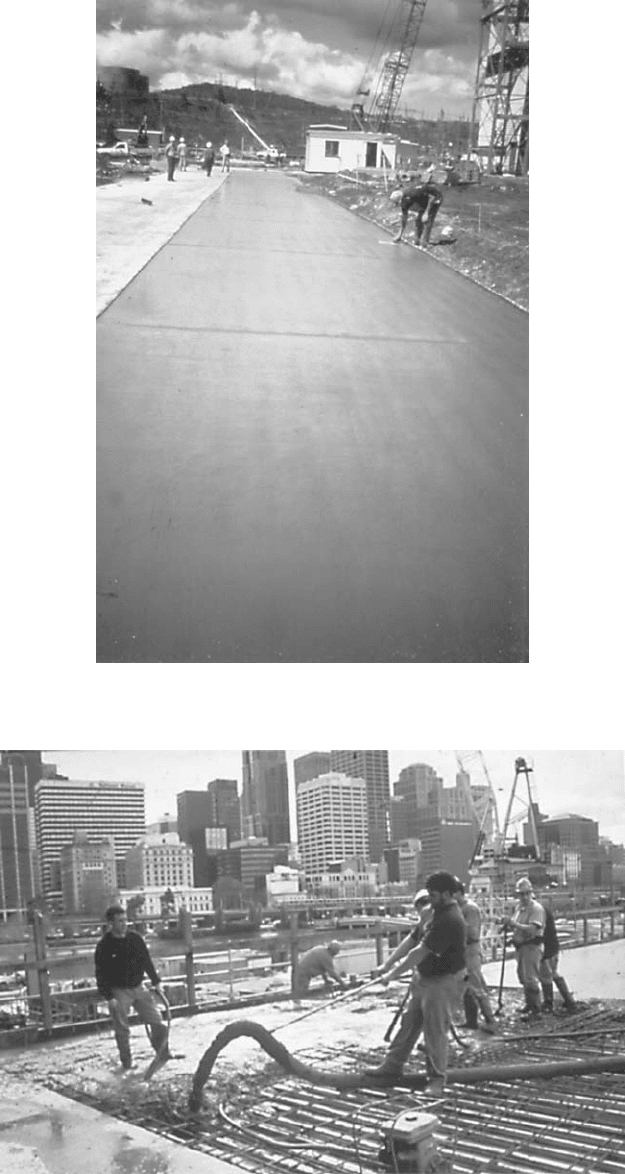
In 1992, Nelson et al. [1992] reported the application of concrete with 40% wt. fly ash in the con-
struction of sections of road pavement and an apron slab at Mount Piper Power Station in New South
Wales, Australia. The casting of the apron slab is shown in Fig. 42.25. At about the same time, Naik et al.
[1992] reported the successful use of three fly ash concrete mixtures, 20% and 50% ASTM C618 Class
C fly ash and 40% ASTM C618 Class F fly ash to pave a 1.28 km long roadway in Wisconsin.
Service Life Designs
The largest volume of HVFA concrete used in Australia was in the construction of the basement slabs
and walls of Melbourne Casino in 1995. Figure 42.26 shows concreting activities on the site. According
to Grayson (pers. Comm.), of Connell Wagner, low drying shrinkage and durable concrete was required
for the construction of the 55,000m
2
basement which was located below the water table. Saline water
was found on the site situated near the Yarra River. Slabs with an average thickness of 400 mm were
designed to withstand an uplift pressure of 45 kPa. The concrete was specified to contain at least 30 kg/m
3
of silica fume or 30 wt.% of fly ash or 60 wt.% of a combination of slag and fly ash. Drying shrinkage
within 650 microstrains was also specified. A 40 MPa HVFA concrete containing 40 wt.% fly ash was
selected for the 40,000 m
3
of concrete required for the basement. The fresh concrete was reported to
behave similarly to conventional concrete and a drying shrinkage of lesser than 500 microstrains was
achieved. In addition, a similar concrete was used in the construction of the pile caps and two raft slabs
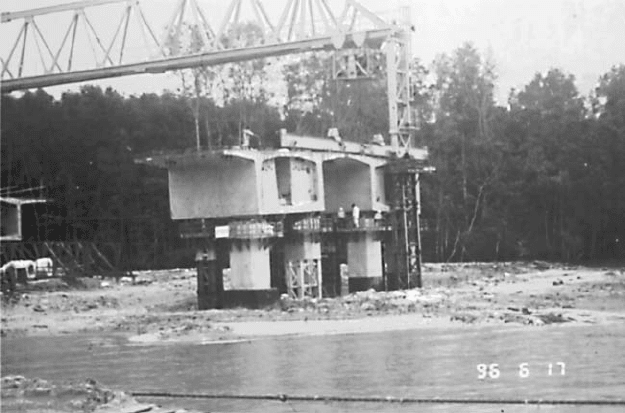
in the same project. In Malaysia, concrete containing 30 wt.% fly ash was used for the substructure and
piers of the Malaysian-built half of the Malaysia Singapore Second Crossway in 1996 (Fig. 42.27). The
HVFA concrete was chosen for its chloride and sulphate resistance [Sirivivatnanon and Kidav 1997].
Ordinary Portland cement concrete was used for the superstructure of the Crossway.
© 2003 by CRC Press LLC
42-36 The Civil Engineering Handbook, Second Edition
FIGURE 43.25 First pour of 32 MPa HVFA concrete in an apron slab at Mount Piper Power Station in New South
Wales in 1991.
FIGURE 45.26 Crown Casino under construction in Melbourne Australia.
© 2003 by CRC Press LLC
Special Concrete and Applications 42-37
One interesting application recently reported [Mehta and Langley 2001] is the use of unreinforced
HFVA concrete in the construction of the foundation of the San Marga Iraivan Temple along the Wailua
River in Kaua’i, Hawaii. This is a unique temple in the Western Hemisphere as it is constructed of hand
carved white granite stone from a quarry near Bangalore in India. The temple is constructed of highly
durable stone, which will contribute to the design service life of 1000 years. The foundation slab was
required not to settle more than approximately 3.2 mm in a distance of 3.66 meters because the free-
standing components such as columns and lintels would separate beyond safe limits. The temple foun-
dation was designed to have low shrinkage, slow strength development, low heat evolution and improved
microstructure particularly in the paste aggregate transition zone. A concrete containing a high volume
of Class F fly ash was used to meet the design criteria and emulate the ancient structures.
Construction Economy
In Perth, Western Australia, a 50 wt.% fly ash concrete has been used [Ryan and Potter 1994] for the
construction of the secant piles at Roe Street Tunnel. The ground water in the area was tested and found
to be abnormally acidic, pH = 4.0. Thus it was necessary for all piles to contain a high binder content
to limit the attack of the ground water on the concrete. A minimum binder content of 350 kg/m
3
and
W/B = 0.5 was specified. The requirements posed problems for the low early-age strength needed to
allow the soft piles to be bored. A number of trial mixtures were cast and the preferred option for the
binder was a 50:50 Portland cement fly ash blend.
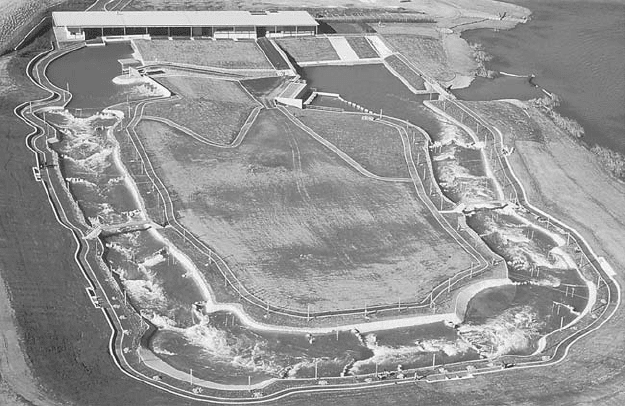
In 1990, Heeley [1999] reported the development and use of HVFA shotcrete in the construction of
the Penrith Whitewater Stadium, shown in Fig. 42.28, for the Sydney Olympic Co-ordination Authority.
The design was based on shotcrete because conventional formwork would have been prohibitive. In this
shotcrete, ultra-fine fly ash was used to replace 44 wt.% of the binder. This provides the cohesiveness
normally achieved by the use of silica fume.
Choice for Sustainability
Following the success of the use of HVFA concrete at the Liu Centre on the campus of the University of
British Columbia in Canada, a range of HVFA concrete, covered by an EcoSmart™ Concrete Project,
with FA contents ranging from 30 to 50 wt.% of binder was successfully used in a number of structures
including the Ardencraig residential development and 1540 West 2nd Avenue — an Artist Live/Work
studio near Granville Island in Vancouver, 50% in situ fly ash concrete and 30% fly ash concrete in precast
FIGURE 42.27 Construction activities at the Malaysia Singapore Second Crossway in 1996.
© 2003 by CRC Press LLC
42-38 The Civil Engineering Handbook, Second Edition
elements at the Brentwood and Gilmore SkyTrain Station, and the majority of concrete building elements
at Nicola Valley Institute of Technology/University of the Cariboo in the interior of British Columbia
[Bilodeau and Seabrook 2001].
With the emphasis on sustainability in the 2000 Sydney Olympic, a HVFA concrete containing 46 wt.%
of binder was the chosen for slab-on-grade of a number of houses in the Athletics Village. A 56-day
20 MPa specification was used and achieved.
Current Developments
While the potential applications of HVFA concrete are numerous, three recent developments are worth
noting. The first is in the use of fibre-reinforced HVFA shotcrete to cap degraded rock outcrops and to
cover mine waste dumps, the second is in High Performance Concrete for massive marine structure, and
the third is in the upgrading of dam structures.
Morgan et al. [1990] found polypropylene fiber-reinforced HVFA shotcrete to be applied satisfactorily
using conventional wet-mix shotcrete equipment and that it required a minimum amount of cementitious
material and water content of around 420 and 150 kg/m
3
, respectively. The polypropylene fiber content
required to provide a satisfactory flexural toughness index appeared to be between 4 and 6 kg/m
3
. They
suggested its use in capping rock outcrops which are susceptible to degradation and for covering mine waste
dumps. Seabrook [1992] identified the same technology to produce a lower cost shotcrete while maintaining
reasonable quality and durability for application on waste piles to prevent leaching of acids and heavy
metals. Heeley [ASTM 1989] reported the successful application of HVFA shotcrete in the construction of
the Penrith Whitewater Stadium for the Sydney Olympic Co-ordination Authority. The design was based
on shotcrete because conventional formwork would have been prohibitive. In marine and offshore structures
such as bridges, wharfs, sea walls and offshore concrete gravity structures, concretes with excellent sulphate
and chloride durability are required. Where large or long-span structural members are used, low heat
development and low creep characteristics are of vital importance. These are applications where HVFA
concretes would be considered an ideal solution. Attention would need to be given to the use of compatible
concreting materials if high early strength is required in precasting or slip forming construction.
In rehabilitation of massive concrete structures such as the raising of dam height for improved safety
and flood mitigation, new high strength and high elastic modulus concrete matching existing concrete
is often required. The new concrete must have low shrinkage to minimize the effects of the new concrete
FIGURE 42.28 Arial view of the Penrith Whitewater Stadium showing the complexity of forms, which favors the
use of shotcrete (picture courtesy of the Sydney Olympic Co-ordination Authority).
© 2003 by CRC Press LLC