
Abd-El-Barr M., El-Rewini H. Fundamentals of Computer Organization and Architecture
Подождите немного. Документ загружается.

Example Consider the division of a dividend X ¼ 8 ¼ (1000) and a divisor
D ¼ 3 ¼ (0011) using the non-restoring algorithm. The process is illustrated in
the following table.
Initially 0 0 0 0 0 1 0 0 0
9
>
>
>
=
>
>
>
;
First cycle
00011
Shift 0 0 0 0 1 0 0 0
Subtract 1 1 1 0 1
Set x
0
1110 0000
Shift 1 1 1 0 0 0 0 0
Add 00011
)
Second cycle
Set x
0
11111 0000
Shift 1 1 1 1 0 0 0 0
Add 00011
)
Third cycle
Set x
0
00001 0001
Shift 0 0 0 1 0 0 0 1
Subtract 1 1 1 0 1
)
Fourth cycle
Set x
0
11111 0010
|fflfflfflfflfflfflfflfflfflfflfflfflffl{zfflfflfflfflfflfflfflfflfflfflfflfflffl}
Quotient
Add 11111
)
Restore remainder00011
00010
Remainder
|fflfflfflfflfflfflfflfflfflfflfflfflfflfflfflfflfflffl{zfflfflfflfflfflfflfflfflfflfflfflfflfflfflfflfflfflffl}
4.3. FLOATING-POINT ARITHM ETIC
Having considered integer representation and arithmetic, we consider in this section
floating-point representation and arithmetic.
4.3.1. Floating-Point Representation (Scientific Notation)
A floating-point (FP) number can be represented in the following form: +m
b
e
,
where m, called the mantissa, represents the fraction part of the number and is
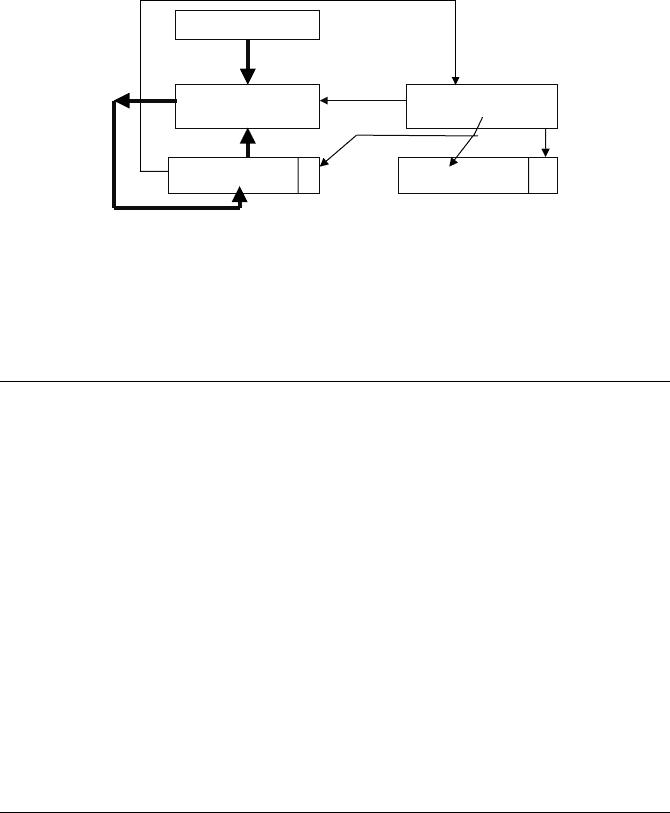
Divisor (D)
Shift Left
(n+ 1)-bit Adder
Add
Control Logic
Register A Dividend (X)
C
Figure 4.10 Binary division structure
74
COMPUTER ARITHMETIC
normally represented as a signed binary fraction, e represents the exponent, and b
represents the base (radix) of the exponent.
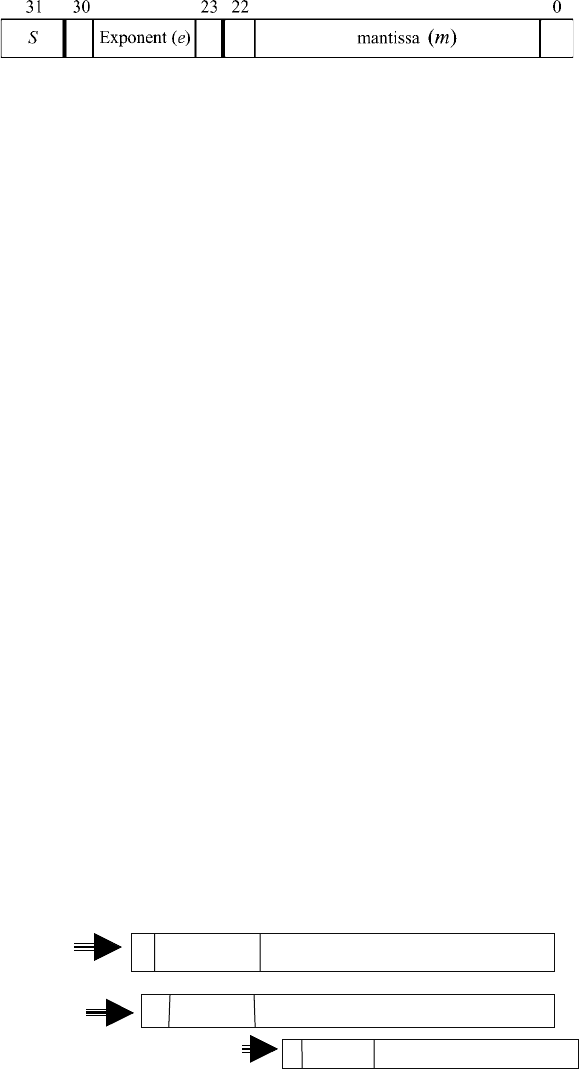
Example Figure 4.11 is a representation of a floating-point number having
m ¼ 23 bits, e ¼ 8 bits, and S (sign bit) ¼ 1 bit. If the value stored in S is 0, the
number is positive and if the value stored in S is 1, the number is negative.
The exponent in the above example, can only represent positive numbers 0
through 255. To represent both positive and negative exponents, a fixed value,
called a bias, is subtracted from the exponent field to obtain the true exponent.
Assume that in the above example a bias ¼ 128 is used, then true exponents in
the range 2128 (stored as 0 in the exponent field) to þ127 (stored as 255 in the
exponent field) can be represe nted. Based on this representation, the exponent þ4
can be represented by storing 132 in the exponent field, while the exponent 212
can be represented by storing 116 in the exponent field.
Assuming that b ¼ 2, then an FP number such as 1.75 can be represented in any
of the forms shown in Figure 4.12.
To simplify performing operations on FP numbers and to increase their precision,
they are always represented in what is called normalized forms. An FP number is
said to be normalized if the leftmost bit of the mantissa is 1. Therefore, among
the three above possibl e representations for 1.75, the first representation is normal-
ized and should be used.
Since the most significant bit (MSB) in a normalized FP number is always 1, then
this bit is often not stored and is assumed to be a hidden bit to the left of the radix
point, that is, the stored mantissa is 1.m. Therefore, a nonzero normalized number
represents the value ( 1)
s
*
(1:m)
*
2
e128
.
Floating-Point Arithmetic Addition/Subtraction The difficulty in adding
two FP numbers stems from the fact that they may have different exponents.
Therefore, before adding two FP numbers, their exponents must be equalized, that
is, the mantissa of the number that has smaller magnitude of exponent must be
aligned.
Figure 4.11 Representation of a floating-point number
+0.111*2
1
+0.0111*2
2
+0.00000000000000000000111*2
21
0
10000001
11100000000000000000000
0 10000010 01110000000000000000000
0 10010101 00000000000000000000111
Figure 4.12 Different representation of an FP number
4.3. FLOATING-POINT ARITHMETIC 75
Steps Required to Add/Subtract Two Floating-Point Numbers
1. Compare the magnitude of the two exponents and make suitable alignment to
the number with the smaller magnitude of exponent.
2. Perform the addition/subtraction.
3. Perform normalization by shifting the resulting mantissa and adjusting the
resulting exponent.
Example Consider adding the two FP numbers 1.1100
*
2
4
and 1.1000
*
2
2
.
1. Alignment: 1.1000
*
2
2
has to be aligned to 0.0110
*
2
4
2. Addition: Add the two numbers to get 10.0010
*
2
4
.
3. Normalization: The final normalized result is 0.1000
*
2
6
(assuming 4 bits
are allowed after the radix point).
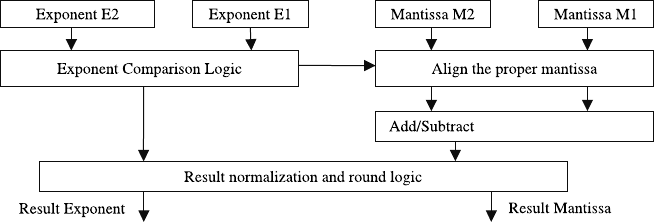
Addition/subtraction of two FP numbers can be illustrated using the schematic
shown in Figure 4.13.
Multiplication Multiplication of a pair of FP numbers X ¼ m
x
*
2
a
and Y ¼
m
y
*
2
b
is represented as X
*
Y ¼ (m
x
m
y
)
*
2
aþb
.
A general algorithm for multiplication of FP numbers consists of three basic
steps. These are:
1. Compute the exponent of the product by adding the exponents together.
2. Multiply the two mantissas.
3. Normalize and round the final product.
Example Consider multipl ying the two FP numbers X ¼ 1.000
*
2
22
and
Y ¼ 21.010
*
2
21
.
1. Add exponents: 22 þ (21) ¼ 2 3.
2. Multiply mantissas: 1.000
*
2 1.010 ¼ 21.010000.
The product is 2 1.0100
*
2
23
.
Figure 4.13 Addition/subtraction of FP numbers
76
COMPUTER ARITHMETIC
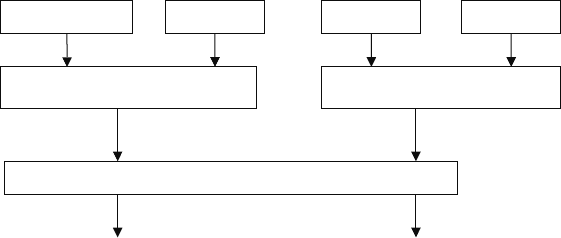
Multiplication of two FP numbers can be illustrated using the schematic shown in
Figure 4.14.
Division Division of a pair of FP numbers X ¼ m
x
*
2
a
and Y ¼ m
y
*
2
b
is
represented as X=Y ¼ (m
x
=m
y
)
*
2
ab
.
A general algorithm for division of FP numbers consists of three basic steps:
1. Compute the exponent of the result by subtracting the exponents.
2. Divide the mantissa and determine the sign of the result.
3. Normalize and round the resulting value, if necessary.
Example Consider the division of the two FP numbers X ¼ 1.0000
*
2
22
and
Y ¼ 2 1.0100
*
2
21
.
1. Subtract exponents: 22 2 (21) ¼ 21.
2. Divide the mantissas: 1.0000 421.0100 ¼ 20.1101.
3. The result is 20.1101
*
2
21
.
Division of two FP numbers can be illustrated using the schematic shown in
Figure 4.15.
4.3.3. The IEEE Floating-Point Standard
There are essentially two IEEE standard floating-point formats. These are the basic
and the extended formats. In each of these, IEEE defines two formats, that is, the
single-precision and the double-precision formats. The single-precision format is
32-bit and the double-precision is 64-bit. The single extended format should have
at least 44 bits and the double exte nded format should have at least 80 bits.
Exponent E2 Exponent E1
Add
Mantissa M2
Mantissa M1
Multiply
Result normalization and round logic
Result Exponent Result Mantissa
Figure 4.14 FP multiplication
4.3. FLOATING-POINT ARITHMETIC 77
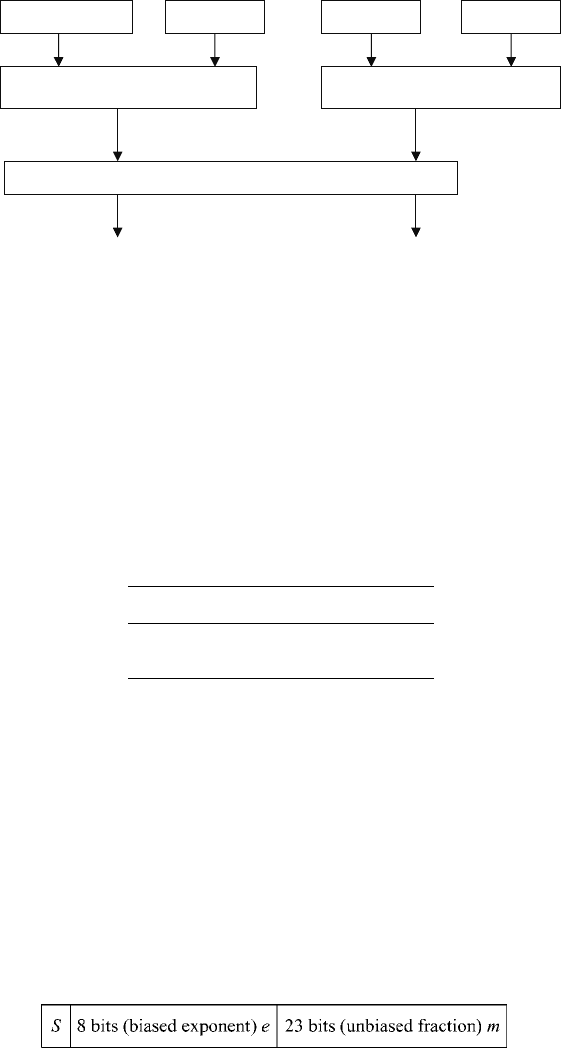
In the single-precision format, base 2 is used, thus allowing the use of a hidden
bit. The exponent field is 8 bits. The IEEE single-precision representation is shown
in Figure 4.16.
The 8-bit exponent allows for any of 256 combinations. Among these, two com-
binations are reserved for special values:
1. e ¼ 0 is reserved for zero (with fraction m ¼ 0) and denormalized numbers
(with fraction m = 0).
2. e ¼ 255 is reserved for +1 (with fraction m ¼ 0) and not a number (NaN)
(with fraction m = 0).
m ¼ 0 m = 0
e ¼ 0 0 Denormalized
e ¼ 255 +1 NaN
The single extended IEEE format extends the exponent field from 8 to 11 bits and
the mantissa field from 23þ1 to 32 or more bits (without a hidden bit). This results in
a total length of at least 44 bits. The single extended format is used in calculating
intermediate results.
4.3.4. Double-Precision IEEE Format
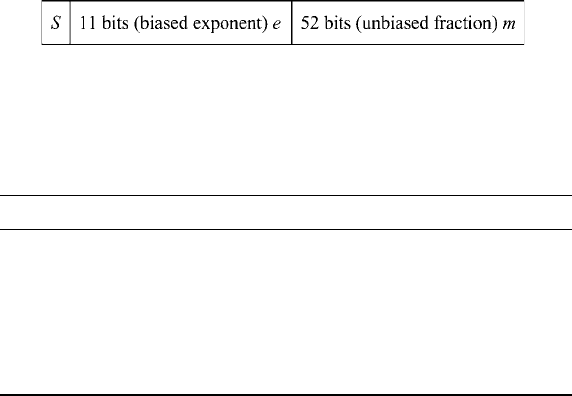
Here the exponent field is 11 bits and the significant field is 52 bits. The format is
shown in Figure 4.17.
Similar to the single-precision format, the extreme values of e (0 and 2047) are
reserved for the same purpose.
Exponent E2 Exponent E1
Subtract
Mantissa M2
Mantissa M1
Divide
Result normalization and round logic
Result Exponent Result Mantissa
Figure 4.15 FP division
Figure 4.16 IEEE single-precision representation
78
COMPUTER ARITHMETIC
A number of attributes characterizing the IEEE single- and double-precisi on
formats are summarized in Table 4.2.
4.4. SUMMARY
In this chapter, we have discussed a number of issues related to computer arithmetic.
Our discussion started with an introduction to number representation and radix con-
version techniques. We then discussed integer arithmetic and, in particular, we dis-
cussed the four main operations, that is, addition, subtraction, multiplication, and
division. In each case, we have shown basic architectures and organization. The
last topic discussed in the chapt er has been floating-point representation and arith-
metic. We have also shown the basic architectures needed to perform basic float-
ing-point operations such as addition, subtraction, multiplication, and divisi on.
We ended our discussion in the chapter with the IEEE floating-point number
representation.
EXERCISES
1. Represent the decima l values 26, 2123 as signed, 10-bit numbers using each
of the following binary formats:
(a) Sign-and-magnitude;
(b) 2’s complement.
2. Compute the decimal value of the binary number 1011 1101 0101 0110 if the
given number represents unsigned integer. Repeat if the number represents
2’s complement. Repeat if the number represents sign-magnitude integer.
Figure 4.17 Double-precision representation
TABLE 4.2 Characteristics of the IEEE Single and Double
Floating-Point Formats
Characteristic Single-precision Double-precision
Length in bits 32 64
Fraction part in bits 23 52
Hidden bits 1 1
Exponent length in bits 8 11
Bias 127 1023
Approximate range 2
128
3:8 10
38
2
1024
9:0 10
307
Smallest normalized number 2
126
10
38
2
1022
10
308
EXERCISES 79

3. Consider the binary numbers in the following addition and subtraction pro-
blems to be signed 6-bit values in the 2’s complement representation. Per-
form each of the following operations, specifying whether ov erflow occurs.
010110 011001 110111 100001 111111 011010
þ001001 þ010000 þ101011 2011101 2000111 2100010
4. Multiply each of the following pairs of signed 2’s complement numbers
using the 2-bit Booth algorithm.
M ¼ 010111 M ¼ 110011 M ¼ 110101 M ¼ 1111
Q ¼ 110110 Q ¼ 101100 Q ¼ 011011 Q ¼ 1111
5. Divide each of the following pairs of signed 2
0
s complement numbers using
both the restoring and the nonrestoring algorithms.
X ¼ 010111 X ¼ 110011 X ¼ 110101 X ¼ 1111
D ¼ 110110 D ¼ 101100 D ¼ 011011 D ¼ 1111
6. Show how to perform addition, subtraction, multiplication, and division of
the following floating numbers.
A ¼ 0 10001 011011
B ¼ 1 01111 101010
The numbers are represented in a 12-bit format using a base b ¼ 2, a 5-bit
exponent e with a bias ¼ 16, and 6-bit normalized mantissa m.
7. Show a complete design (in terms of the logic equations) for a 4-bit adder/
subtractor using carry-look-ahead technique for all carries c
1
, c
2
, c
3
, c
4
.
Assume that the two 4-bit input numbers are A ¼ a
4
a
3
a
2
a
1
and
B ¼ b
4
b
3
b
2
b
1
.
8. Design a BCD adder using a 4-bit binary adder and the least number of logic
gates. The adder should receive two 4-bit numbers A and B and should pro-
duce 4-bit sum and a carry output.
9. Show a design of a 16-bit CLA that uses the 4-bit CLA block shown in
Figure 4.5. Compute the delay and the area (in terms of the number of
logic gates required).
10. Compare the longest path delay from input to output of a 32-bit adder using
4-bit CLA adder blocks in a multilevel architecture with that of a 32-bit CRT
adder. Assume that a gate delay is given by T
g
.
11. Convert each of the following decimal numbers to their IEEE single-
precision floating-point counterparts.
(a) 276
(b) 0.92
(c) 5.3125
80 COMPUTER ARITHMETIC
(d) 20.000072
(e) 8.04 10
21
12. Convert the following IEEE single-precision floating-point numbers to their
decimal counterparts.
(a) 6589 00000
(b) 807B 00000H
(c) CDEF 0000H
13. Complete the logic design of the array multiplier shown in Figure 4.6.
14. Design the control logic shown in Figure 4.7.
15. Provide a complete logic design for the Control Logic indicated in
Figure 4.10.
REFERENCES AND FURTHER READING
C. Hamacher, Z. Vranesic and S. Zaky, Computer Organization, 5th ed., McGraw-Hill,
New York, 2002.
V. Heuring and H. Jordan, Computer Systems Design and Archiecture, Addison Wesley
Longman, NJ, USA, 1997.
K. Israel, Computer Arithmetic Algorithms, 2nd ed., A. K. Peters, Ltd., Massachusetts, 2002.
W. Stallings, Computer Organization and Architectures: Designing for Performance, 4th ed.,
Prentice-Hall, NJ, USA, 1996.
B. Wilkinson, Computer Architecture: Design and Performance, 2nd ed., Prentice-Hall,
Hertfordshire, UK, 1996.
REFERENCES AND FURTHER READING 81

&
CHAPTER 5
Processing Unit Design
In previous chapters, we studied the history of computer systems and the fundamen-
tal issues related to memory locations, addressing modes, assembly language, and
computer arithmetic. In this chapter, we focus our attention on the main component
of any computer system, the central processing unit (CPU). The primary function of
the CPU is to execu te a set of instructions stored in the computer’s memory. A
simple CPU consists of a set of registers, an arithmetic logic unit (ALU), and a con-
trol unit (CU). In what follows, the reader will be introduced to the organization and
main operations of the CPU.
5.1. CPU BASICS
A typical CPU has three major components: (1) register set, (2) arithmetic logic
unit (ALU), and (3) control unit (CU). The regist er set differs from one computer
architecture to another. It is usually a combina tion of general-purpose and special-
purpose registers. General-purpose registers are used for any purpose, hence the
name general purpose. Special-purpose registers have specific functions within
the CPU. For example, the program counter (PC) is a special-purpose register
that is used to hold the address of the instruction to be executed next. Another
example of special-purpose registers is the instruction register (IR), which is
used to hold the instruction that is currently executed. The ALU provides the cir-
cuitry needed to perform the arithmet ic, logical and shift operations demanded of
the instruction set. In Chapter 4, we have covered a number of arithmetic oper-
ations and circuits used to support computation in an ALU. The control unit is
the entity responsible for fetching the instruction to be executed from the main
memory and decoding and then executing it. Figure 5.1 shows the main com-
ponents of the CPU and its interactions with the memor y system and the input/
output devices.
The CPU fetches instructions from memory, reads and writes data from and to
memory, and transfers data from and to input/output devices. A typical and
83
Fundamentals of Computer Organization and Architecture, by M. Abd-El-Barr and H. El-Rewini
ISBN 0-471-46741-3 Copyright # 2005 John Wiley & Sons, Inc.