
Abd-El-Barr M., El-Rewini H. Fundamentals of Computer Organization and Architecture
Подождите немного. Документ загружается.

address that is divisible by n, for example, a word that has a two-byte width has to be
stored at locations having addresses divisible by two.
In assembly language programs symbols are used to represent numbers, for
example, immediate data. This is done to make the code easier to read, understand,
and debug. Symbols are translated to their corresponding numerical values by the
assembler.
The use of synthetic operations helps assembly programmers to use instructions
that are not directly suppor ted by the architecture. These are then translated by the
assembler to a set of instructions defined by the architecture. For example, assem-
blers can allow the use of (a synthetic) increment instruction on architectures for
which an increment instruction is not defined through the use of some other instruc-
tions such as the add instruction.
Assemblers usually impose some conventions in referring to hardware com-
ponents such as registers and memory locations. One such convention is the prefix-
ing of immediate values with the special characters (#) or a register name with the
character (%).
The underlying hardware in some machines cannot be accessed directly by a pro-
gram. The operating system (OS) plays the role of mediating access to resources
such as memory and I/O facilities. Interactions wi th operating systems (OS) can
take place in the form of a code that causes the execution of a function that is
part of the OS. These functions are called system calls.
3.4. ASSEMBLY AND EXECUTION OF PROGRAMS
As you know by now, a program written in assembly language needs to be trans-
lated into binary machine language before it can be executed. In this section, we
will learn how to get from the point of writing an assembly program to the
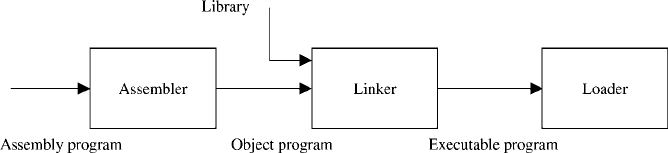
execution phase. Figure 3.3 shows three steps in the assembly and execution pro-
cess. The assembler reads the source program in assembly language and generates
the object program in binary form. The object program is passed to the linker. The
linker will check the object file for calls to procedures in the link library. The linker
will combine the required procedures from the link library with the object program
and produce the executable program. The loader loads the executable program into
memory and branches the CPU to the starting address. The program begins
execution.
Figure 3.3 Assembly and execution process
44
ASSEMBLY LANGUAGE PROGRAMMING
3.4.1. Assemblers
Assemblers are programs that generate machine code instructions from a source
code program written in assembly language. The assembler will replace symbolic
addresses by numeric addresses, replace symbolic operation codes by machin e oper-
ation codes, reserve storage for instructions and data, and translate constants into
machine representation.
The functions of the assembler can be performed by scanning the assembly pro-
gram and mapping its instructions to their machine code equivalent. Since symbols
can be used in instructions before they are defined in later ones, a single scanning of
the program might not be enough to perform the mapping. A simple assembler scans
the entire assembly program twice, where each scan is called a pass. During the first
pass, it generates a table that includes all sym bols and their binary values. This table
is called the symbol table. During the second pass, the assembler will use the symbol
table and other tables to generate the object program, and output some information
that will be needed by the linker.
3.4.2. Data Structures
The assembler uses at least three tables to perform its functions: symbol table,
opcode table, and pseudo instruction table. The symbol table, which is generated
in pass one, has an entry for every symbol in the program. Associated with each
symbol are its binary value and other information. Table 3.5 shows the symbol
table for the multiplication program segment of Example 2. We assume that the
instruction LD X is starting at location 0 in the memory. Since each instruction
takes two bytes, the value of the symbol LOOP is 4 (004 in hexadecimal).
Symbol N, for example, will be stored at decimal location 40 (028 in hexadecimal).
The values of the other symbols can be obtained in a similar way.
The opcode table provides information about the operation codes. Associated
with each symbolic opcode in the table are its numerical value and other information
about its type, its instruction length, and its operands. Table 3.6 shows the opcode
TABLE 3.5 Symbol Table for the Multiplication
Segment (Example 2)
Symbol
Value
(hexadecimal)
Other
information
Loop 004
EXIT 01E
X 020
Y 022
Z 024
ONE 026
N 028
3.4. ASSEMBLY AND EXECUTION OF PROGRAMS 45
table for the simple processor described in Section 3.1. As an example, we explain
the information associated with the opcode LD. It has one operand, which is a
memory address and its binary value is 0001. The instruction length of LD is
2 bytes and its type is memory-reference.
The entries of the pseudo instruction table are the pseudo instructions symbols.
Each entry refers the assembler to a procedure that processes the pseudo instruction
when encountered in the program. For example, if END is encoun tered, the trans-
lation process is terminated.
In order to keep track of the instruction locations, the assembler maintains a vari-
able called instruction location counter (ILC). The ILC contains the value of
memory location assigned to the instruction or operand being processed. The ILC
is initialized to 0 and is incremented after processing each instruction. The ILC is
incremented by the length of the instruction being processed, or the number of
bytes allocated as a result of a data allocation pseudo instruction.
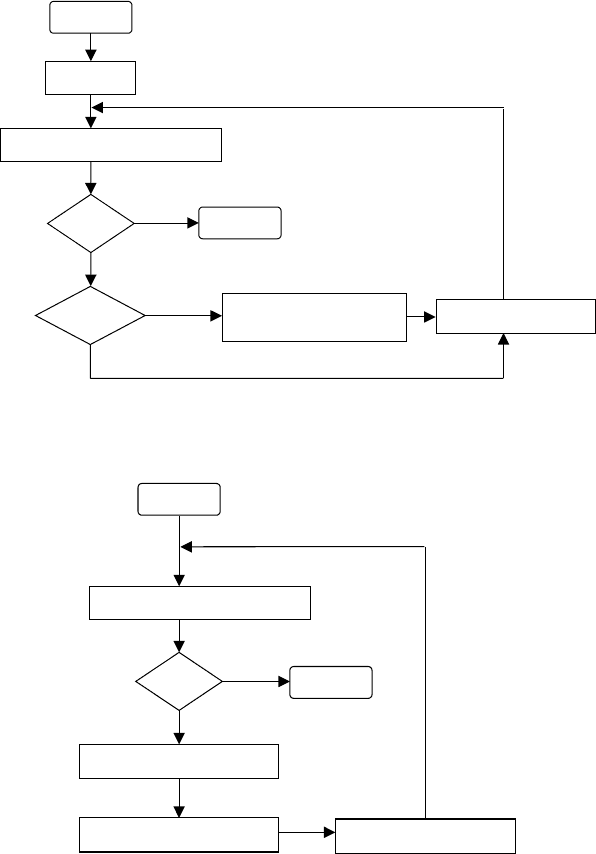
Figures 3.4 and 3.5 show simplified flowcharts of pass one and pass two in a two-
pass assembler. Remember that the main function of pass one is to build the symbol
table while pass two’s main function is to generate the object code.
3.4.3. Linker and Loader
The linker is the entity that can combine object modules that may have resulted from
assembling multiple assembly modules separately. The loader is the operating
system utility that reads the executable into memory and start execution.
In summary, after assembly modules are translated into object modules, the func-
tions of the linker and loader prepare the program for execution. These functions
include combining object modules together, resolving addresses unknown at assem-
bly time, allocating storage, and finally executing the program.
TABLE 3.6 The Opcode Table for the Assembly of our Simple Processor
Opcode Operand
Opcode value
(binary)
Instruction length
(bytes) Instruction type
STOP — 0000 2 Control
LD Mem-adr 0001 2 Memory-reference
ST Mem-adr 0010 2 Memory-reference
MOVAC — 0011 2 Register-reference
MOV — 0100 2 Register-reference
ADD — 0101 2 Register-reference
SUB — 0110 2 Register-reference
AND — 0111 2 Register-reference
NOT — 1000 2 Register-reference
BRA Mem-adr 1001 2 Control
BZ Mem-adr 1010 2 Control
46
ASSEMBLY LANGUAGE PROGRAMMING
3.5. EXAMPLE: THE X86 FAMILY
In this section, we discuss the assembly language features and use of the X86 family.
We present the basic organizational features of the system, the basic programming
model, the addressing modes, sample of the different instruction types used, and
Start
END
Process next instruction
Stop
No
Yes
Opcode Lookup
Symbol Table Lookup
Generate machine code
Figure 3.5 Simplified pass two in a two-pass assembler
Start
END
Label
ILC ← 0
Process next instruction
Increment ILC
Add to Symbol Table
with value = ILC
Pass 2
No
No
Yes
Yes
Figure 3.4 Simplified pass one in a two-pass assembler
3.5. EXAMPLE: THE X86 FAMILY 47
finally examples showing how to use the assembly language of the system in
programming sample real-life problems.
In the late 1970s, Intel introduced the 8086 as its first 16-bit microp rocessor.
This processor has a 16-bit external bus. The 8086 evolved into a series of faster
and more powerful processors starting with the 80286 and ending with the Pentium.
The latter was introduced in 1993. This Intel family of processors is usually calle d
the X86 family. Table 3.7 summarizes the main features of the main members of
such a family.
The Intel Pentium processor has about three million transistors and its compu-
tational power ranges between two and five times that of its predecessor processor,
the 80486. A number of new features were introduced in the Pentium processor,
among which is the incorporation of a dual-pipelined superscalar architecture
capable of processing more than one instruction per clock cycle.
The basic programming model of the 386, 486, and the Pentium is shown in
Figure 3.6. It consists of three register groups. These are the general purpose regis-
ters, the segment registers, and the instruction pointer (program counter) and the flag
register. The first set consists of general purpose registers A, B, C, D, SI (source
index), DI (des tination index), SP (stack pointer), and BP (base pointer). It should
be noted that in naming these registers, we used X to indicate eXtended. The
second set of registers consists of CS (code segment), SS (stack segment), and
four data segment registers DS, ES, FS, and GS. The third set of registers consists
of the instruction pointer (program counter) and the flags (st atus) register. The
latter is shown in Figure 3.7. Among the status bits shown in Figure 3.7, the first
five are identical to those bits introduced as early as in the 8085 8-bit microproces-
sor. The next 6 – 11 bits are identical to those introduced in the 8086. The flags in the
bits 12–14 were introduced in the 80286 while the 16 –17 bits were introduced in
the 80386. The flag in bit 18 was introduced in the 80486. Table 3.8 shows the mean-
ing of those flags.
In the X86 family an instruction can perform an operation on one or two oper-
ands. In two-operand instructions, the second operand can be immediate data in
TABLE 3.7 Main Features of the Intel X86 Microprocessor Family
Feature 8086 286 386 486 Pentium
Date introduced 1978 1982 1985 1991 1993
Data bus 8 bits 16 bits 32 bits 32 bits 64 bits
Address bus 20 bits 24 bits 32 bits 32 bits 32 bits
Operating speed 5,8,10 MHz 6,8,10, 12.5,
16, 20 MHz
16, 20,25, 33,
40, 50 MHz
25, 33,
50 MHz
50, 60, 66,
100 MHz
Instruction cache
size
NA NA 16 bytes 32 bytes 8 Kbytes
Data cache size NA NA 256 bytes 8 Kbytes 8 Kbytes
Physical memory 1 Mbytes 16 Mbytes 4 Gbytes 4 Gbytes 4 Gbytes
Data word size 16 bits 16 bits 16 bits 32 bits 32 bits
48 ASSEMBLY LANGUAGE PROGRAMMING
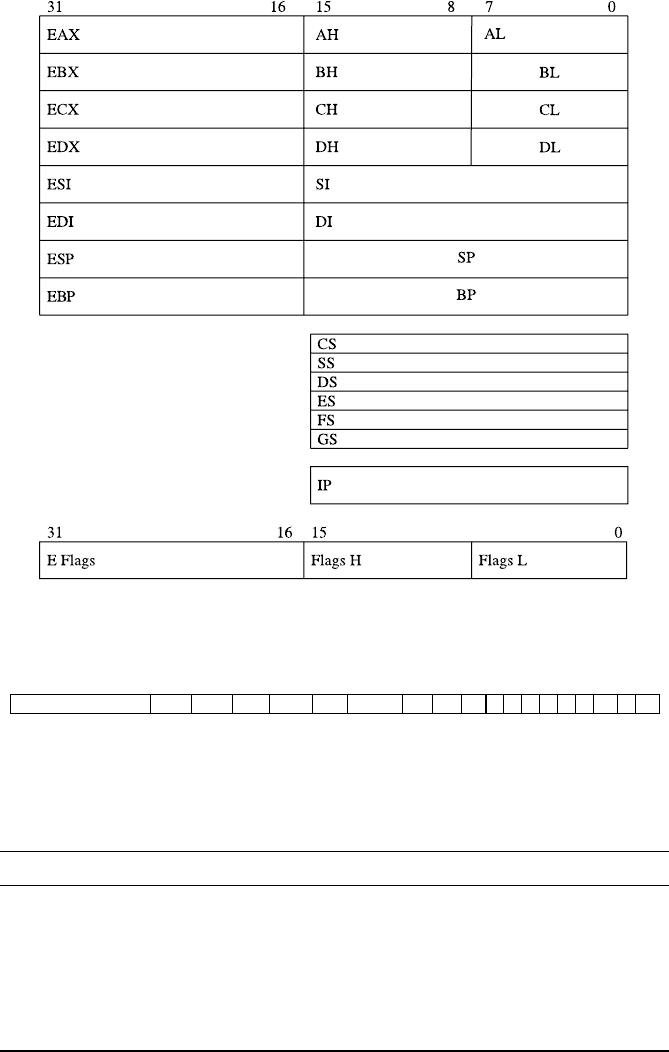
Figure 3.6 The base register sets of the X86 programming model
31 18 17 16 15 14 13 12 11 10 9 8 1
Reserved AG VM RF 0 NT IOPL
6543 2 0
ODITSZ A P C
7
Figure 3.7 The X86 flag register
TABLE 3.8 X86 Status Flags
Flag Meaning Processor Flag Meaning Processor
C Carry All P Parity All
A Auxiliary All Z Zero All
S Sign All T Trap All
I Interrupt All D Direction All
O Overflow All IOPL I/O privilege level 286
NT Nested task 286 RF Resume 386
VM Virtual mode 386 AC Alignment check 486
3.5. EXAMPLE: THE X86 FAMILY 49
2’s complement format. Data transfer, arithmetic and logical instructions can act on
immediate data, registers, or memory locations.
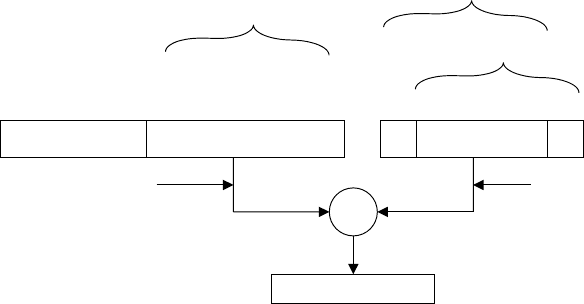
In the X86 family, direct and indirect memory addressing can be used. In direct
addressing, a displacement address consisting of a 8-, 16-, or 32-bit word is used as
the logical address. This logical address is added to the shifted contents of the seg-
ment register (segment base address) to give a physical memory address. Figure 3.8
illustrates the direct addressing process.
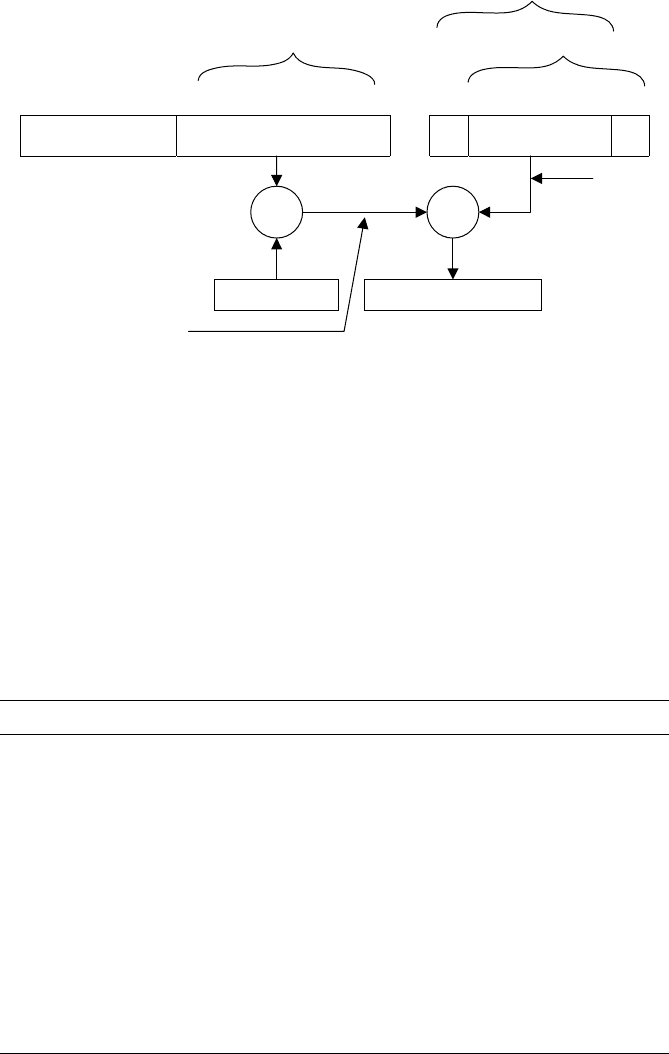
Address indirection in the X86 family can be obtained using the content of a
base pointer register (BPR), the content of an index register, or the sum of a base
register and an index register. Figure 3.9 illustrates indirect addressing using
the BPR.
The X86 family of processors defines a number of instruction types. Using the
naming convention introduced before, these instru ction types are data movement,
arithmetic and logic, and sequencing (control transfer). In addition, the X86
family defines other instruction types such as string manipulat ion, bit manipulation,
and high-level language support.
Data movement instru ctions in the X86 family include mainly four subtypes.
These are the general-purpose, accumulator-specific, address-object, and flag
instructions. A sample of these instructions is shown in Table 3.9.
Arithmetic and logic instructions in the X86 family include mainly five subtypes.
These are addition, subtraction, multiplication, division, and logic instructions.
A sample of the arithmetic instructions is shown in Table 3.10.
Logic instructions include the typical AND, OR, NOT, XOR, and TEST. The latter
performs a logic compare of the source and the destination and sets the flags accord-
ingly. In addition, the X86 family has a set of shift and rotate instructions. A sample
of these is shown in Table 3.11.
Original 16 bits
7/15/31 15 0
Op Code Address
Segment base
Address
Σ
Physical Address
Displacement from
2
nd
word of instruction
Shifted 16 bits
Logical Address
0
Figure 3.8 Direct addressing in the X86 family
50
ASSEMBLY LANGUAGE PROGRAMMING
Control transfer instructions in the X86 family include mainly four subtypes.
These are conditional, iteration, interrupt, and unconditional. A sample of these
instructions is shown in Table 3.12.
Processor control instructions in the X86 family include mainly three subtypes.
These are external synchronization, flag manipulation, and general control instruc-
tions. A sample of these instructions is shown in Table 3.13.
Having introduced the basic features of the instruction set of the X86 processor
family, we now move on to present a number of programming examples to show
Shifted 16 bits
2
nd
word of instruction
Original 16 bits
7/15/31 0 15 0
Op Code Address
Logical Address
Segment base
Address
Physical AddressBPR
å
å
Displacement from
Figure 3.9 Indirect addressing using BPR in the X86 family
TABLE 3.9 Sample of the X86 Data Movement Instructions
Mnemonic Operation Subtype
MOV Move source to destination General purpose
POP Pop source from stack General purpose
POPA Pop all General purpose
PUSH Push source onto stack General purpose
PUSHA Push all General purpose
XCHG Exchange source with destination General purpose
IN Input to accumulator Accumulator
OUT Output from accumulator Accumulator
XLAT Table lookup to translate byte Accumulator
LEA Load effective address in register Address-object
LMSW Load machine status word Address-object
SMSW Store machine status word Address-object
POPF Pop flags off stack Flag
PUSHF Push flags onto stack Flag
3.5. EXAMPLE: THE X86 FAMILY 51
how the instruction set can be used. The examples presented are the same as those
presented at the end of Chapter 2.
Example 3 Adding 100 numbers stored at consecutive memory locations starting
at location 1000, the results should be stored in memory location 2000. LIST is
TABLE 3.10 Sample of the X86 Arithmetic Instructions
Mnemonic Operation Subtype
ADD Add source to destination Addition
ADC Add source to destination with carry Addition
INC Increment operand by 1 Addition
SUB Subtract source from destination Subtraction
SBB Subtract source from destination with borrow Subtraction
DEC Decrement operand by 1 Subtraction
MUL Unsigned multiply source by destination Multiply
IMUL Signed multiply source by destination Multiply
DIV Unsigned division accumulator by source Division
IDIV Signed division accumulator by source Division
TABLE 3.11 Sample of the X86 Shift and Rotate
Instructions
Mnemonic Operation
ROR Rotate right
ROL Rotate left
RCL Rotate left through carry
RCR Rotate right through carry
SAR Arithmetic shift right
SAL Arithmetic shift left
SHR Logic shift right
SHL Logic shift left
TABLE 3.12 Sample of the X86 Control Transfer Instructions
Mnemonic Operation Subtype
SET Set byte to true or false based on condition Conditional
JS Jump if sign Conditional
LOOP Loop if CX does not equal zero Iteration
LOOPE Loop if CX does not equal zero & ZF ¼ 1 Iteration
INT Interrupt Interrupt
IRET Interrupt return Interrupt
JMP Jump unconditional Unconditional
RET Return from procedure Unconditional
52
ASSEMBLY LANGUAGE PROGRAMMING
defined as an array of N elements each of size byte. FLAG is a memory variable used
to indicate whether the list has been sorted or not. The register CX is used as a coun-
ter with the Loop instruction. The Loop instruction decrements the CX register and
branch if the result is not zero. The addressing mode used to access the array List
[BX þ 1] is called based addressing mode. It should be noted that since we are
using BX and BX þ 1 the CX counter is loaded with the value 999 in order not to
exceed the list.
MOV CX, 1000 2 1 ; Counter ¼ CX (1000 2 1)
MOV BX, Offset LIST ; BX pointer to LIST
CALL SORT
......
SORT PROC NEAR
Again: MOV FLAG, 0 ; FLAG 0
Next: MOV AL, [BX]
CMP AL, [BX þ 1] ;Compare current and next values
JLE Skip ;Branch if current , next values
XCHG AL, [BX þ 1] ;If not , Swap the contents of the
MOV [BX þ 1], AL ;current location with the next one
MOV FLAG, 1 ;Indicate the swap
Skip: INC BX ; BX BX þ 1
LOOP Next ;Go to next value
CMP FLAG, 1 ;Was there any swap
JE Again ;If yes Repeat process
RET
SORT ENDP
Example 4 Here we implement the SEARCH algorithm in the 8086 instruction
set. LIST is defined as an array of N elements each of size word. FLAG is a
memory variable used to indicate whether the list has been sorted or not. The register
CX is used as a counter with the loop instruction. The Loop instruction decrements
TABLE 3.13 Sample of the X86 Processor Control Instructions
Mnemonic Operation Subtype
HLT Halt External sync
LOCK Lock the bus External sync
CLC Clear carry flag Flag
CLI Clear interrupt flag Flag
STI Set interrupt flag Flag
INVD Invalidate data cache General control
3.5. EXAMPLE: THE X86 FAMILY 53