
Abd-El-Barr M., El-Rewini H. Fundamentals of Computer Organization and Architecture
Подождите немного. Документ загружается.

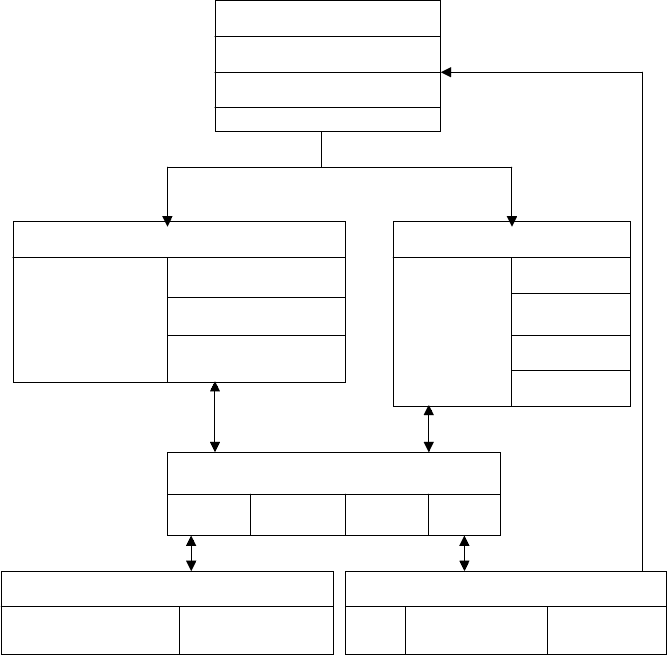
The UltraSPARC III processor uses six independent units (see Fig. 9.16).
These are:
1. The Instruction Issue Unit (IIU). This unit predicts the program flows, fetches
the predicted path from memory and directs the fetched instructions to the
execution pipeline. Instructions are forwarded to either the IEU or the FPU.
The IIU incorporates a four-way associative instruction cache, an address
translation buffer, and a 16K-entry branch predictor.
2. The Integer Execute Unit (IEU). This unit executes all integer instructions,
including the integer loading and storing, the integer arithmetic, the logic,
and the branch instructions. The IEU is capable of executing up to four integer
instructions concurrently during a cycle time.
Instruction Issue Unit (IIU)
Instruction Cache
Instruction Queue
Steering Logic
Integer Execution Unit (IEU)
Floating-Point Unit (FPU)
Dependency/Trap
FP Register File Add/Subtract
Graphics unit
Data Cache Unit (DCU)
Prefetch
Store
System Interface Unit (SIU)
External Memory Unit
Data Switch Controller Eternal Cache Tags
Integer Register File
ALU Pipe
Load/Store/Special
Divide
Multiply
Data Write
Snoop Pipe Controller SRAM DRAM
Figure 9.16 The functional units of the UltraSPARC III
204
PIPELINING DESIGN TECHNIQUES
3. The Data Cache Unit (DCU). This unit contains three different level-one (L1)
data caches and a data address translation buffer. The data caches are: a
demand fetch (a four-way associative 64KB with 32-byte block size), a pre-
fetch cache (a four-way associative 2KB with 64-byte block size), and a
write cache (a four-way associative 2KB with 64-byte bloc k size).
4. The Floating-Point Unit (FPU). This unit executes all floating-point and
graphical instructions.
5. The External Memory Unit (EMU). This unit controls access to the two off-
chip memory modules. The two off-chip modules are the level-two (L2)
data cache and the main memory.
6. The System Interface Unit (SIU). This unit provides a communication interface
between the microprocessor and the system external to it, such as the main
memory, I/O devices, and other processors in a multiprocessing configuration.
The UltraSPARC III has a 14-stage instruction pipeline. These are:
1. Address Generation Unit (A). This unit generates instruction fetch addresses.
2. Instruction Prefetch Unit (P). This unit fetches the second cycle of instruc-
tions from the cache and accesses the first cycle of branch prediction.
3. Instruction Fetch Unit (F). This unit fetches the second cycle of instructions
from the cache and accesses the second cycle of branch prediction. The F
unit also performs the virtual to physical address translation.
4. Branch Target Calculation Unit (B). This unit computes the target address of
branches and decodes the first cycle of instructions.
5. Instruction Decode Unit (I). This unit decodes the second cycle of instruc-
tions and directs them to the queue.
6. Instruction Steer Unit (J). This unit directs instructions to the appropriate
execution unit. Integer instructions are directed to the integer execution
unit while floating-point and graphical instructions are directed to the
floating-point unit.
7. Register File Read Unit (R). This unit reads the operands of the integer
register file.
8. Integer Execution Unit (E). This unit executes the integer instructions.
9. Date Cache Access Unit (C). This unit accesses the second cycle of date
cache, forwards load data for word and double word loads and executes
the first cycle of floating-point instructions.
10. Memory Bypass Unit (M). This unit loads data alignment for half word and
bytes loads and executes the second cycle of floating-point instructions.
11. Working Register File Write Unit (W). This unit performs writes to the inte-
ger register file and executes the third cycle of floating-point instructions.
12. Pipe Extend Unit (X). This unit extends the integer pipeline for precise float-
ing-point traps and executes the fourth cycle of floating-point instructions.
9.3. EXAMPLE PIPELINE PROCESSORS 205
13. Trap Unit (T). This unit repor ts traps upon their occurrences.
14. Done Unit (D). This unit writes the architectural register file.
Two main techniques are employed in the UltraSPARC III in dealing with branches.
These are explained below:
Branch Prediction The UltraSPARC III uses a branch prediction technique
that combines the static and the dynamic branch prediction techniques explained
before. In this case, branch prediction takes place in the IIU unit. It uses a
branch prediction table and a hardware implementation of a dynamic prediction
algorithm.
BRANCH PREDICTION TABLE The branch prediction table (BPT) is a hardware
implementation of a table of a two-bit finite state machine (FSM). It is a saturated
up–down counter. When a branch is encountered, the branch target address and/
or the branch history are used to find the table index of the location where the pre-
diction for the branch is found. The branch condition is predicted to be taken if it
corresponds to one of two FSM states: strong not taken or weak not taken. The
branch condition is predicted to be taken if it corresponds to one of two FSM
states: weak taken or strong taken. The counter is incremented each time a branch
is taken; otherwise it is decremented, hence the name up–down counter. If a counter
reaches the strong taken state (11- state), it stays there as long as the branch is taken
and if it reaches the strong not taken (00-state), it stays there as long as the branch is
not taken, hence the name saturation. The BPT in the UltraSPARC III consists of
16K-entry (16K 2-bit saturation up–down counters).
GLOBAL SHARE DYNAMIC PREDICTION ALGORITHM The global share (gshare)
algorithm uses two levels of branch-history information to dynamically predict
the direction of branches. The first level registers the history of the last k branches
faced. This repr esents the global branching behavior. This level is implemented by
providing a global branch history register. This is basically a shift register that enters
a 1 for every taken branch and a 0 for every untaken branch. The second level of
branch history information registers the branching of the last s occurrences of the
specific pattern of the k branches. This inform ation is kept in the branch prediction
table. The gshare algorithm works by taking the lower bits of the branch target
address and XORing them with the history register to get the index that should be
used with the prediction table.
The UltraSPARC III uses a modified version of the gshare algorithm. This modi-
fication requires that the predictor be pipelined over two stages, that is, if the original
gshare algorithm were used, the predictor would be indexed by an old copy of the
program count er (PC). With the modified gshare algorithm, each time the predictor
is accessed, eight counters are read out and the three low-order bits of the PC register
are used to select one of them at the B pipeline stage.
206 PIPELINING DESIGN TECHNIQUES
Instruction Buffer (Queues) The UltraSPARC III instruction issue unit (IIU)
incorporates two instruction buffering queues: the branch instruction queue (BIQ)
and the branch miss queue (BMQ). These are introduced below.
BRANCH INS TRUCTION QUEUE (BIQ) This is a 20-entr y queue that allows the fetch
and the execution unit to operate independently. The fetch unit predicts the
execution path and continuously fills the BIQ. When a taken branch is encountered,
two fetch cycles are lost to fill the BIQ.
BRANCH MISS QUEUE (BMQ) During the lost two cycles, the sequential instructions
that have been already accessed are buffered into a four-entry BMQ. If it is then
found that the branch has been mispredicted, the instructions from the BMQ are
directed to the execution unit directly.
9.4. INSTRUCTION-LEVEL PARALLELISM
Contrary to pipeline techniques, instruction-level parallelism (ILP) is based on the
idea of multiple issue processors (MIP). An MIP has multiple pipelined datapaths
for instruction execution. Each of these pipelines can issue and execute one instruc-
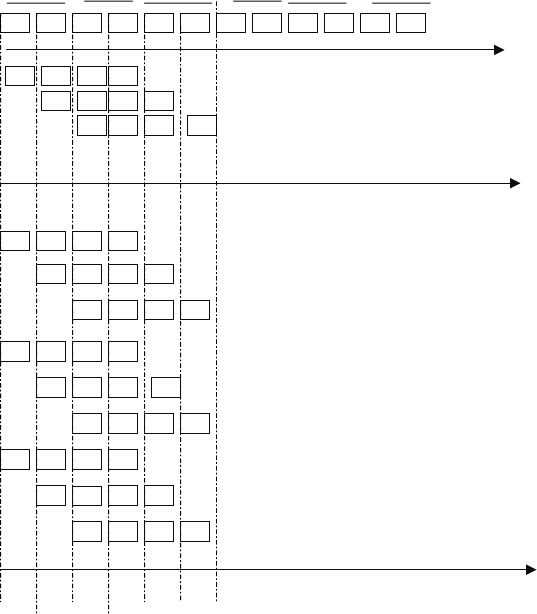
tion per cycle. Figure 9.17 shows the case of a processor having three pipes. For
comparison purposes, we also show in the same figure the sequential and the
single pipeline case. It is clear from the figure that while the limit on the number
of cycles per instruction in the case of a single pipeline is CPI ¼ 1, the MIP can
achieve CPI , 1.
In order to make full use of ILP, an analysis should be made to identify the
instruction and data dependencies that exist in a given program. This analysis
should lead to the appropriate scheduling of the group of instructions that can be
issued simultaneously while retaining the progr am correctness. Static scheduling
results in the use of very long instruction word (VLIW) architectures, while dynamic
scheduling results in the use of superscalar architectures.
In VLIW, an instruction represents a bundle of many operations to be issued sim-
ultaneously. The com piler is responsible for checking all dependencies and making
the appropriate groupings/scheduling of operations. This is in contrast with super-
scalar architectures, which rely entirely on the hardware for scheduling of
instructions.
Superscalar Architectures A scalar machine is able to perform only one arith-
metic operation at once. A superscalar architecture (SPA) is able to fetch, decode,
execute, and store results of several instructions at the same time. It does so by trans-
forming a static and sequential instruction stream into a dynamic and parallel one, in
order to execute a number of instructions simultaneously. Upon completion, the
SPA reinforces the original sequential instruction stream such that instructions
can be completed in the original order.
In an SPA instruction, processing consists of the fetch, decode, issue, and commit
stages. During the fetch stage, multiple instructions are fetched simultaneously.
9.4. INSTRUCTION-LEVEL PARALLELISM 207
Branch prediction and speculative execution are also performed during the fetch
stage. This is done in order to keep on fetching instructions beyond branch and
jump instructions.
Decoding is done in two steps. Predecoding is performed betwee n the main
memory and the cache and is responsible for identifying branch instructions.
Actual decoding is used to determine the following for each instruction: (1) the oper-
ation to be performed; (2) the location of the operands; and (3) the location where
the resu lts are to be stored. During the issue stage, those instructions among the
dispatched ones that can start execution are identified. During the commit stage,
generated values/result s are writte n into their destination registers.
The most crucial step in processing instructions in SPAs is the dependency analy-
sis. The complexity of such analysis grows quadratically with the instruction word
size. This puts a limit on the degree of parallelism that can be achieved with SPAs
such that a degree of parallelism higher than four will be impractical. Beyond this
(a) Sequential Processing
Time
F1
I
3
I
3
I
2
I
2
I
1
I
1
(b) Pipelining
Time
(c) Multiple issue
Time
F1 D1 E1
W1
D1 E1 W1
F1 D1 E1 W1
F4 D4 E4 W4
F5
D5 E5 W5
F6
D6
E6
W6
F7 D7 E7 W7
F8
D8 E8 W8
F9
D9
E9 W9
F2
F2
D2
D2
E2
E2
W2
W2
F2 D2 E2 W2
F3 D3 E3 W3
F3 D3 E3 W3
F3 D3 E3 W3
123456789101112
Figure 9.17 Multiple issue versus pipelining versus sequential processing
208
PIPELINING DESIGN TECHNIQUES
limit, the dependence analysis and scheduling must be done by the compiler. This is
the basis for the VLIW approach.
Very Long Instruction Word (VLIW ) In this approach, the compiler performs
dependency analysis and determines the appropriate groupings/scheduling of oper-
ations. Operations that can be performed simultaneously are grouped into a very
long instruction word (VLIW). Therefore, the instruction word is made long
enough in order to accommodate the maximum possible degree of parallelism.
For example, the IBM DAISY machine has an instruction word that is eight oper-
ation long, called 8-issue machine.
In VLIW, resource binding can be done by devoting each field of an instruction
word to one and only one functional unit. However, this arrangement will lead to a
limit on the mix of instructions that can be issued per cycle. A more flexib le
approach is to allow a given instruction field to be occupied by different kinds of
operations. For example, the Philips TriMedia machine, a 5-issue machine, has 27
functional units mapped to a 5-issue slot. In the IBM DAISY, every instruction
implements a multiway path selection scheme. In this case, the first 72 bits of the
VLIW is called the header and contain information on the tree form, condition
tests, and branch targets. The header is followed by eight 23-bit parcels, each encod-
ing an operation. In order to solve the problem of providing operands to a large
number of functional units, the IBM DAISY keeps eight identical copies of the
same register file, one for each of the eight functional units.
9.5. ARITHMETIC PIPELINE
The principles used in instruction pipelinin g can be used in order to improve the per-
formance of computers in performing arithmet ic operations such as add, subtract,
and multiply. In this case, these principles will be used to realize the arithmetic cir-
cuits inside the ALU. In this sect ion, we will elaborate on the use of arithmetic pipe-
line as a means to speed up arithmetic operations. We will start with fixed-point
arithmetic operations and then discuss floating- point operations.
9.5.1. Fixed-Point Arithmetic Pip elines
The basic fixed point arithmetic operation performed inside the ALU is the addition
of two n-bi t operands A ¼ a
n21
a
n22
a
2
a
1
a
0
and B ¼ b
n21
b
n22
b
2
b
1
b
0
.
Addition of thes e two operands can be performed using a number of techniques.
These techniques differ in basically two attributes: degree of complexity and
achieved speed. These two attributes are somewhat contradictory; that is, a simple
realization may lead to a slower circuit while a complex realization may lead to a
faster circuit. Consider, for example, the carry ripple through (CRTA) and a carry
look-ahead (CLAA) adders. The CRTA is simple, but slower, while the CLAA is
complex, but faster.
9.5. ARITHMETIC PIPELINE 209
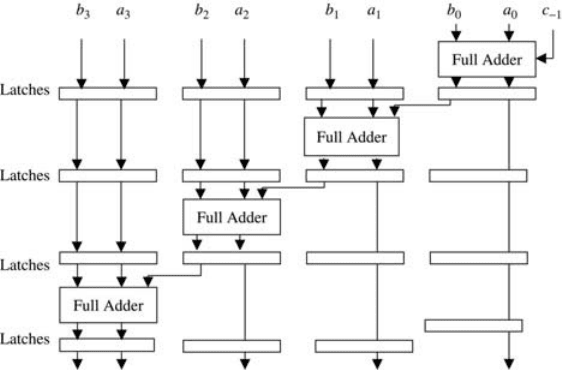
It is possible to modify the CRTA in such a way that a number of pairs of
operands are operated upon, that is, pipelined, inside the adder, thus improving
the overall speed of addition in the CRTA. Figure 9.18 shows an example of a
modified 4-bit CRTA. In this case, the two operands A and B are presented to
the CRTA through the use of synchronizing elements, such as clocked latches.
These latches will guarantee that the movement of the partial carry values within
the CRTA are synchronized at the input of the subsequent stages of the adder
with the higher order operand bits. For example, the arrival of the first carry out
(c
0
) and the second pair of bits (a
1
and b
1
) is synchronized at the input of
the second full adder (counting from low order bits to high order bits) using
a latch.
Although the operation of the modified CRTA remains in principle the same; that
is, the carry ripples through the adder, the provision of latches allows for the possi-
bility of presenting multipl e sets of pairs of operands to the adder at the same time.
Consider, for example, the case of adding M pairs of operands, whereby the oper-
ands of each pair are n-bit. The time needed to perform the addition of these M
pairs using a nonpipelined CRTA is given by T
np
¼ M n T
a
, where T
a
is the
time needed to perform single bit addition. This is to be compared to the time
needed to perform the same computation using a pipelined CTRA which is given
by T
pp
¼ (n þ M 2 1) T
a
. For example, if M ¼ 16 and n ¼ 64 bits, then we
have T
np
¼ 1024 T
a
and T
pp
¼ 79 T
a
, thus resulting in a speed-up of about
13. In the extreme case whereby it is possible to present unlimited number of
pairs of operands (M) to the CRTA at the same time, the speed up will reach 64,
the number of bits in each operand.
Figure 9.18 A modified 4-bit CRTA
210
PIPELINING DESIGN TECHNIQUES
9.5.2. Floating-Point Arithmetic Pipelines
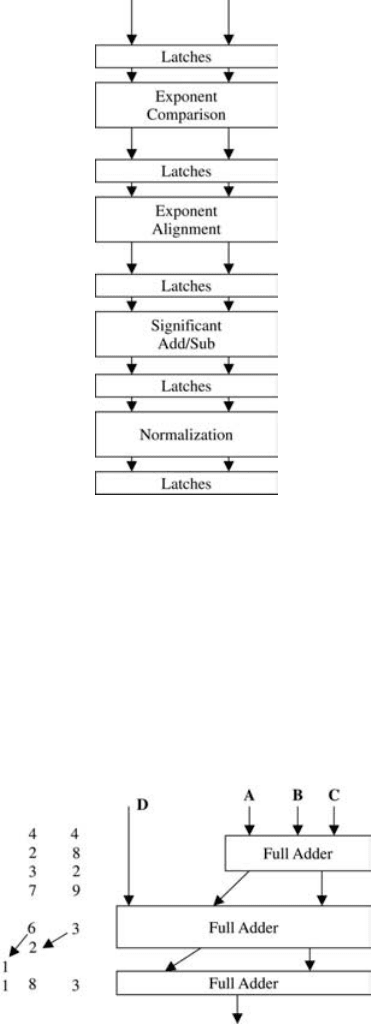
Using a similar appro ach, it is possible to pipeline floating-point (FP) addition/sub-
traction. In this case, the pipeline will have to be organize d around the operations
needed to perform FP addition. The main operations needed in FP addition are expo-
nent comparison (EC), exponent alignment (EA), addition (AD), and normalization
(NZ). Therefore, a possible pipeline organization is to have a four-stage pipeline,
Figure 9.19 A schematic for a pipeline FP adder
Figure 9.20 Carry-save addition
9.5. ARITHMETIC PIPELINE 211
each performing an operation from EC, EA, AD, and NZ. Figure 9.19 shows a sche-
matic for a pipeline FP adder. It is possible to have multiple sets of FP operands pro-
ceeding inside the adder at the same time, thus reducing the overall time needed for
FP addition. Synchronizing latches are needed, as before, in order to synchronize the
operands at the input of a given stage in the FP adder.
9.5.3. Pipelined Multiplication Using Carry-Save Addition
As indicated before, one of the main problems with addition is the fact that the carry
has to ripple through from one stage to the next. Carry rippling through stages can be
eliminated using a method called carry-save addition. Consider the case of adding
44, 28, 32, and 79. A possible way to add these without having the carry ripple
through is illustrated in Figure 9.20. The idea is to delay the addition of the carry
resulting in the intermediate stages until the last step in the addition. Only at the
last stage is a carry-ripple stage employed.
Figure 9.21 A carry-save based multiplication of two 8-bit operands M and Q
AB
Latches
Partial Product Generator Circuit
Full Adder
Full Adder
Full Adder
Full Adder
Latches
Latches
Latches
CLA
Full Adder
Figure 9.22 Carry-save addition-based multiplication scheme
212
PIPELINING DESIGN TECHNIQUES
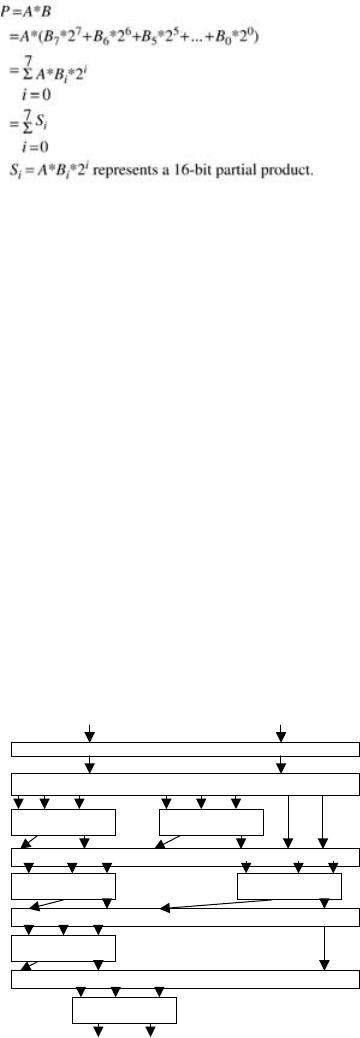
Carry-save addition can be used to realize a pipelined multiplication building
block. Consider, for example, the multiplication of two n-bit opera nds A and B.
The multiplication operation can be transformed into an addition as shown in
Figure 9.21. The figure illustrates the case of multiplying two 8-bit operands A
and B. A carry-save based multiplication scheme using the principle shown in
Figure 9.21 is shown in Figure 9.22. The scheme is based on the idea of producing
the set of partial products needed and then adding them up using a carry-save
addition scheme.
9.6. SUMMARY
In this chapter, we have considered the basic principles involved in designing pipe-
line architectures. Our coverage started with a discussion on a number of metrics
that can be used to assess the goodness of a pipeline. We then moved to present a
general discussion on the main problems that need to be considered in designing
a pipelined arch itecture. In particular we considered two main problems: instruction
and data dependency. The effect of these two problems on the perf ormance of
a pipeline has been elaborated. Some possible techniques that can be used to
reduce the effect of the instruction and data dependency have been introduced
and illustrated. Two examples of recent pipeline architectures, the ARM 11 micro-
architecture, and the UltraSPARC III Processor, have been presented. Our discus-
sion in the chapter ended up with an introdu ction of some of the ideas that can be
used in realizing pipeline arithmetic architectures.
EXERCISES
1. Consider the execution of 500 instructions on a five-stage pipeline machine.
Compute the speed-up due to the use of pipelining given that the probability
of an instruction being a branch is p ¼ 0.3? What must be the valu e of p and
the expected number of branch instructions such that a speed-up of at least 4 is
possible? What must be the value of p such that a speed-up of at least 5 is poss-
ible? Assume that each stage takes one cycle to perform its task.
2. Assume that a RISC machine executes one instruction per clock cycle if no
branches are executed. Delayed branch is used with three delay clock
cycles. Consider the execution of 1000 instructions, 30% of which are
branch instructions, on such a machine in two cases. The first case is the
use of a novice compiler that is not able to reduce the extra clock cycles
wasted due to branch instructions. In the second case, a smart compiler that
is able to utilize 85% of the extra clock cycles is used. Compute the average
number of instructions per cycle in each case. Compute also the percentage of
performance gain due to the use of the smart compiler.
EXERCISES 213