
Abd-El-Barr M., El-Rewini H. Fundamentals of Computer Organization and Architecture
Подождите немного. Документ загружается.


3. Branch & Call: JMPX COND,(R
x
)S; PC R
x
þ S;whereCOND is a condition
4. Special Instructions: GETPSW R
d
; R
d
PSW
All arithmetic and logical instructions have three operands and have the form Desti-
nation : ¼ source1 op source2 (Fig. 10.2). The LOAD and STORE instructions may use
either of the indicated formats with DST being the register to be loaded or stored. The
low order 19 bits of the instructions are used to determine the effective address.
Instructions load and store 8-, 16-, 32-, and 64-bit quantities into 32-bit registers.
Two methods are provided for calling procedures. The CALL instruction uses a
30-bit PC relative offset (Fig. 10.3).
The JMP instruction uses any of the instruction formats used for arithmetic and
logical operations and allows the return address to be put in any register.
RISC uses a three-address instruction format with the availability of some two-
and one-address instructions. There are only two addressing modes. These are
indexed mode and PC relative modes. The indexed mode can be used to synthesize
three other modes. These are base-absolute (direct), register indirect, and indexed
for linear byte array modes. RISC uses a static two-stage pipeline: fetch and execute.
The floating-point unit (FPU) contains thirty-two 32-bit registers to hold 32 single
precision (32-bit) floating-point operands, 16 double-precision (64-bit) operands, or
eight extended-precision (128-bit) operands. The FPU can execute about 20 float-
ing-point instructions most of them in single-, double-, or extended-precision using
the first instruction format used for arithmetic. In addition to instructions for loading
and storing FPUs registers, the CPU can also test FPUs registers and branch con-
ditionally on results. RISC employs a conventional MMU supporting a single
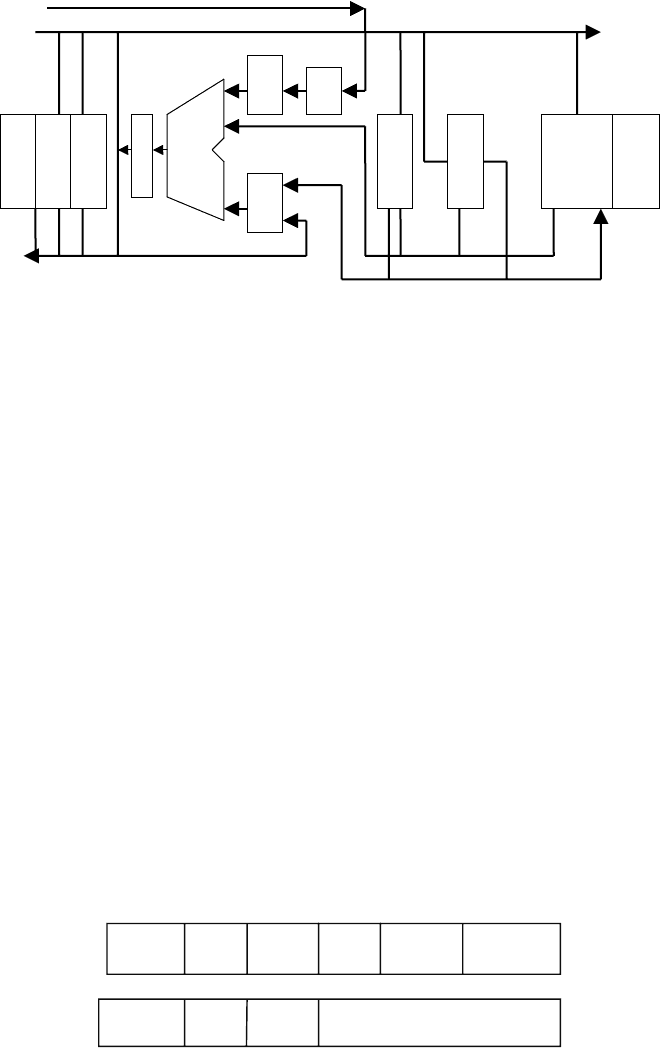
paged 32-bit address space. The RISC four-bus organization is shown in Figure 10.4.
10.5.2. Stanford MIPS (Microprocessor Without Interlock
Pipe Stages)
MIPS is a 32-bit pipelined LOAD/STORE machine. It uses a five-stage pipeline
consisting of Instruction Fetch (IF), Instruction Decode (ID), Operand Decode
Type
Type Immediate Constant
25 6 5 518
DST
Op-Code
SRC 1 0
DST Op-Code SRC 1 1
FP-OP SRC 2
Figure 10.2 Three operand instructions formats used in RISC
Type PC-Relative Displacement
230
Figure 10.3 Procedure call instruction in RISC
224
REDUCED INSTRUCTION SET COMPUTERS (RISCs)
(OD), Operand Store/Execution (OS/EX), and Operand Fetch (OF). The first three
stages perform respectively instruction fetch, instruction decode, and operand fetch.
The OS/EX stage sends operand to memory in the case of a store instruction or use
the ALU in case of instruction execution. The OF stage receives the operand in case
of a load instruction. MIPS uses a mechanism called pipeline interlock in order to
prevent an instruction from continuing until the needed operand is available.
Unlike the Berkeley RISC, MIPS has a single set of sixteen 32-bit general-
purpose registers. The MIPS compiler optimizes the use of registers in whatever
way is best for the program currently being compiled. In addition to the 16 general-
purpose registers, MIPS provided four additional registers in order to hold the four
previous PC values (to support backtracking and restart in case of a fault). A fifth reg-
ister is used to hold the future PC value (to support branch instructions).
Four addressing modes are used in MIPS. These are immediate, indexed, based
with offset, and base shifted. Four instruction groups were identified in MIPS.
These are ALU, Lo ad/Store, Control, and Special instructions. A total of 13 ALU
instructions were provided. These include all register-to-register two- or three-
operand formats (Fig. 10.5). A total of 10 LOAD/ STORE instructions were pro-
vided. They use 16 or 32 bits. In the latter case, indexed addressing is used by
adding a 16-bit signed constant to a register using the second format in
Figure 10.5. A total of six control flow instructions were provided. These include
78 × 32
Register
File
Shifter
PSW
IMM
Register
Decoder
BI AI
Next PC
PC
LST PC
Figure 10.4 RISC four-bus organization
Op-Code SRC DST Immediate Constant
Op-Code SRC 1 SRC 2 DST SHIFT Function
6
6
55
55
55 6
16
Figure 10.5 Three-operand instructions used in MIPS
10.5. PIONEER (UNIVERSITY) RISC MACHINES 225
jumps, relative jumps, and compare instructions. Only two special flow instructions
were provided. They support procedure and interrupt linkage. Some examples of
MIPS instructions are:
1. ALU: Add src
1
, src
2
, dst; dst src
1
þ src
2
2. Load/Store: Ld [src
1
þ src
2
], dst ; dst M[src
1
þ src
2
]
3. Control: Jmp dst; PC dst
4. Special Function: SavePC A; M[A] PC
MIPS does not provi de direct support for floating-point operations. Floating-
point operations are to be done by a specialized coprocessor. Surprisingly,
non-RISC instructions such as MULT and DIV were included and they use special
functional units. The contents of two registers can be multiplied or divided and the
64-bit product is kept in two special registers LO and HI.
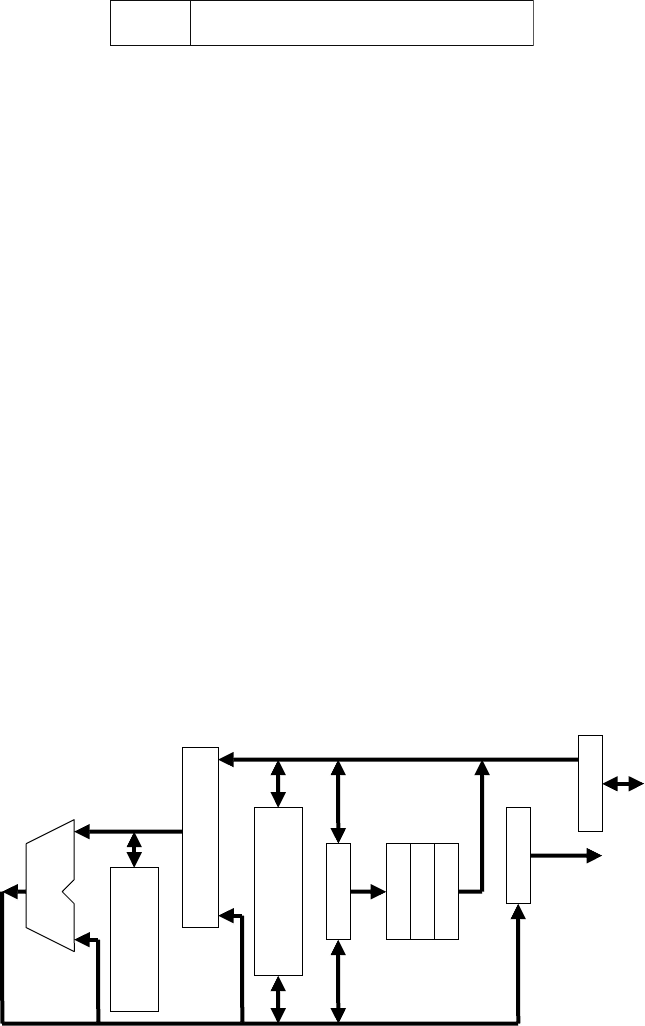
Procedure call can be made through the JUMP instruction shown in Figure 10.6.
The instruction uses a 26-bit jump target address.
The MIPS virtual address is 32 bits long, thus allowing for up to four Gwords
virtual address space. A virtual address is divided into a 20-bit virtual page
number and a 12-bit offset within the page. The actual implementation of MIPS
was restricted by packaging constraints allowing only 24 address pins; that is, the
actual physical address space is 2
24
¼ 16 Mwords (32 bits each). A support for
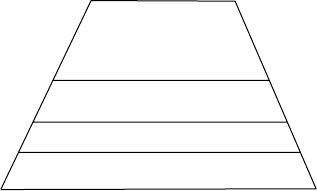
off-chip TLB for address translation is provided. The MIPS organization is shown
in Figure 10.7.
Op-Code Jump Target
626
Figure 10.6 Jump instruction format used in MIPS
MDR
MAR
PC-3
PC-2
PC-1
PC
Register File (16 × 32)
Barrel Shifter
Hi and Lo Registers
Figure 10.7 MIPS organization
226
REDUCED INSTRUCTION SET COMPUTERS (RISCs)
10.6. EXAMPLE OF ADVANCED RISC MACHINES
In this section, we introduce two representative advanced RISC machines. Our
emphasis in this coverage is on the pipeline features and the branch handling mech-
anisms used.
10.6.1. Compaq (Formerly DEC) Alpha 21264
Alpha 21264 (EV6) is a third gener ation Compaq (formerly DEC) RISC superscalar
processor. It is a full 64-bit processor. The 21264 has an 80-entry integer register file
and a 72-entry floating-point register file. It employs a two-level cache. The L1 data
and instruction caches are 64 KB each. They are organized in a two-way set-associ-
ative manner. The L2 data cache can be 1 to 16 MB (shared by instructions and data)
organized using direct-mapping. The block size is 64 bytes. The data cache can
receive any combination of two loads or stores from the integer execution pipe
every cycle. This is equivalent to having the 64 KB on-chip data cache delivering
16 bytes every cycle, hence twice the clock speed of the proce ssor. Th e 21264
memory system can support up to 32 in-flight loads, 32 in-flight stores, and 8
in-flight (64 byte) cache block fills and 8 cache misses. It has a 64 KB, two-way
set-associative cache (both instruction and data). It can also support up to two
out-of-order operations (Fig. 10.8).
10.6.2. The Alpha 21264 Pipeline
The Alpha 21264 instruction pipeline is shown in Figure 10.9. It consists of SEVEN
stages. These are the Fetch, Slot Assignment, Rename, Issue, Register Read,
Execute, and Memory stages.
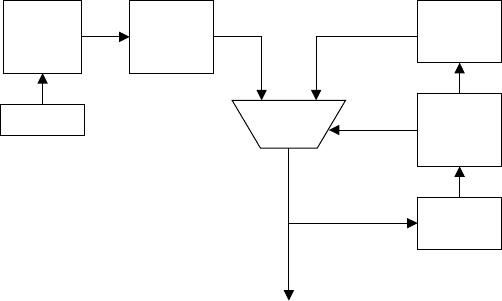
The fetch stage can fetch and execute up to four instructions per cycle. A block
diagram of the fetch stage is shown in Figure 10.10. This stage uses a unique “block
and set” predict ion technique. According to this technique, both the locations of the
next four instructions and the set (there are two sets) in which they are located, are
predicted. The “block and set” prediction technique combines the speed advantages
of a direct-mapped cache with the lower miss ratio of a two-way set-associative
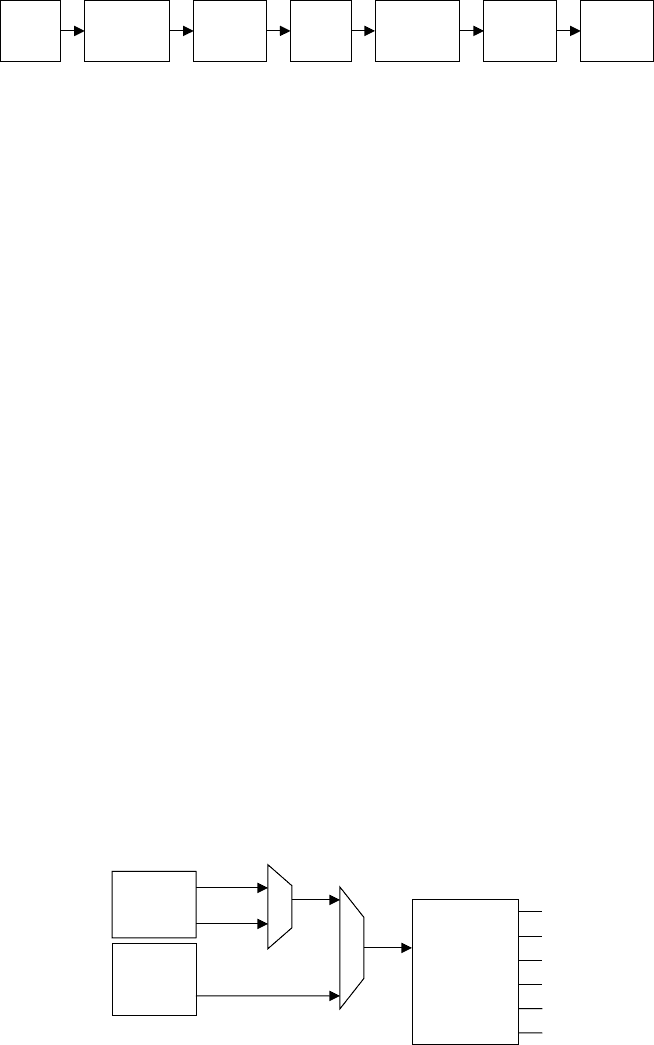
Cache L1
(Data 64 KB, 2-way)+
(Instruction 64 KB, 2-way)
(Block size is 64 Byte)
Cache L2 (off-chip)
(Data 1-16 MB, direct)
Main Memory (up to 16 GB)
Hard Disk (100s of Terabytes)
Figure 10.8 The 21264 memory hierarchy
10.6. EXAMPLE OF ADVANCED RISC MACHINES 227
cache. This technique achieves more than an 85% hit ratio. The misprediction pen-
alty is a single cycle. The 21264 uses speculative branch prediction. Branch predic-
tion in the 21264 is a two-level scheme. It is based on the observation that branches
exhibit both local and global correlation. Local correlation makes use of the
branch’s past behavior. Global correlation, on the other hand, makes use of the
past behavior of all previous branches. The combined local/global prediction
used in the 21264 correlates the branch behavior pattern with local branch history,
that is, the execution of a single branch at a unique PC location, and global branch
history, that is, the execution of all previous branches. The scheme dynamically
selects between local and global branch history (Fig. 10.11).
The local branch predictor has two tables. The first is a 102410 local history
table in which each entry holds a 10-bit local history of the selected branch over
the last executions. The local history table is indexed by the instruction address
(using the PC). The second table is a 10243 local prediction table in which each
entry has a 3-bit saturating counter to predict the branch outcome . After branches’
retirement, the 21264 updates the local history table with the true branch direction
and the referenced counter. This enhances the possibility for correct prediction and
is called predictor training.
The global branch predictor has a 40962 global prediction table in which each
entry holds a 2-bit saturating counter. It keeps track of the global history of the last
12 branches. The global branch prediction table is indexed by a 40962 choice pre-
diction table. After branches’ retirement, the 21264 updates the referenced global
prediction counter, enhancing the possibility for correct prediction.
Local prediction is useful in the case of an alternating taken/not-taken sequence
of a given branch. In this case, the local history of the branch will eventually resolve
to a pattern of ten alternating zeros and ones indicating the success, or failure, of the
branch on alternat e encounters. As the branch executes multiple times, it saturates
the prediction counters corresponding to the local history values and hence makes
the prediction correct.
Fetch
Stage
S #1
Slot
Assignment
Stage S #2
Rename
Stage
S #3
Issue
Stage
S #4
Register
Read
Stage S #5
Execute
Stage
S #6
Memory
Stage
S #7
Figure 10.9 The 21264 instruction pipeline
64 KB 2-way
Block/Set
Prediction
Global
Local
Branch
Predictor
Instruction
Cache
Figure 10.10 The 21264 fetch stage
228
REDUCED INSTRUCTION SET COMPUTERS (RISCs)
Global prediction is useful when the outcome of a branch can be inferred from the
direction of previous branches. Consider, for example, the case of repeated invoca-
tions of two branches. If the first branch that checks for a value equal to 1001 suc-
ceeds, the second branch that checks for the same value to be odd must also succeed.
The global history predictor can learn this pattern with repeated invocations of these
two branches.
The 20962 choice predictor is a table in which each entry holds a 2-bit saturat-
ing counter and is used to implement the selection (tournament) scheme. If the pre-
dictions of the local and global predictors differ, the 21264 updates the selected
choice prediction entry to support the correct predictor. The 21264 updates the
choice prediction table when a branch retires.
The slot assignment stage (S #2) simply assigns instructions to slots associated
with the integer and the floating-point queues.
The out-of-order (OOO) issue logic in the 21264 receives four fetched instruc-
tions every cycle, renames and remaps the registers (to avoid unnecessary register
dependencies), and queues the instructions until operands and/or functional units
become available. It dynamically issues up to six instructions every cycle, four inte-
ger and two floating-point instructions. Regis ter renaming means mapping instruc-
tion virtual registers to internal physical registers. There are 31 integer and 31
floating-point registers that are visible to users. These registers are renamed
during execution to internal registers . It is only when instructions are finished
(retired) that the internal registers are renamed back to visible registers. Register
renaming eliminates write-after-write and write-after-read data dependencies. How-
ever, it preserves all the read-after-write dependencies that are necessary for correct
computation.
A list of the pending instructions is maintained by the OOO queue logic. In each
cycle, both the integer and the floating-point queues select those instructions that are
ready to execute. This selection is made based on a scoreboard of the renamed reg-
isters. The scoreboard maintains the status of renamed registers by tracking the
Local
Prediction
Table
1024 × 3
Local
History
Table
1024 × 10
Branch
Prediction
Past
History
Choice
Prediction
4096 × 2
Global
Prediction
4096 × 2
PC
MUX
Figure 10.11 The 21264 selection branch predictor
10.6. EXAMPLE OF ADVANCED RISC MACHINES 229
progress of single-cycle, multiple-cycle, and variable-cycle instructions. Upon the
availability of the functional unit(s) or load data results, the scoreboard unit notifies
all instructions in the queue of the availability of the required register value. Each
queue selects the oldest data-ready and functional-unit-ready instructions for
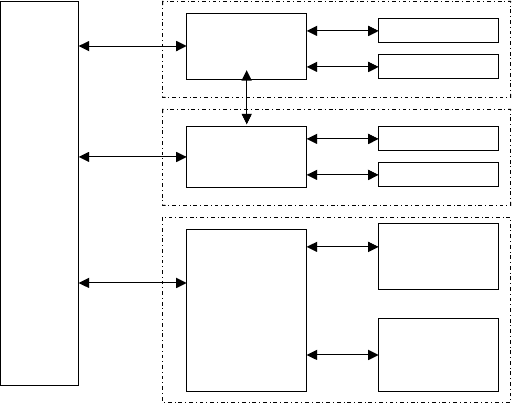
execution of each cycle. The 21264 integer queue statically assigns instructions to
two of four pipes, either the upper or the lower pipe (Fig. 10.12).
The Alpha 21264 has four integer and two floating-point pipelines. This allows
the processor to dynamically issue up to six instructions in the same cycle. The
issue (or queue) stage maintains an inventory from which it can dynamically
select to issue a maximum of six instructions. There is a 20-entry integer issue
queue and a 15-entry floating-poin t issue queue. Instruction issue reordering takes
place in the issue stage.
The 21264 uses two integer files, 80-entry each, to store a duplicate of register con-
tents. Two pipes access a single file to form a cluster. The two clusters form a four-
way integer instruction execution. Results are broadcasted from each cluster to the
other cluster. Instructions are dynamically selected by the integer issue queue to exe-
cute on a given instruction pipe. An instruction can heuristically be selected to execute
on the same cluster that produces the result. The 21264 has one 72-entry floating-point
register file. The floating-point register file, together with two instruction execution
pipes, form a cluster. Figure 10.12 shows the register read/execution pipes.
On a final note, we should indicate that the 21264 uses a write-invalidate cache
coherence mechanism in the level 2 cache to provide support for shared-memory
multiprocessing. It also supports the following cache states: modified, owned,
shared, exclusive, and invalid.
Floating-point
Multiply
Execution
Floating-point
Register File (72)
Cluster
Cluster
Cluster
Floating-point
Add, Div, SQRT
Execution
Integer Execution
Integer Execution
Integer Execution
Integer Execution
Data
Cache
64 KB
2-way
Integer Register
File (80)
Integer Register
File (80)
Figure 10.12 The 21264 execution pipes
230
REDUCED INSTRUCTION SET COMPUTERS (RISCs)

10.6.3. SUN UltraSPARC III
The UltraSPARCw III is a high-performance superscalar RISC processor that
implements the 64-bit SPARCw-V9 RISC architecture. There exist a number of
implementations of the SPARC III processor. These include the UltraSPARC IIIi
and the UltraSPARC III Cu. Our coverage in this section will be independent of
any particular implementation. We will however refer to specific implementations
whenever appropriate.
The UltraSPARC III is a third generation 64-bit SPARCw RISC microprocessor.
It supports a 64-bit virtual address space and a 43-bit physical address space. The
UltraSPARC III employs a multilevel cache architecture. For example, the Ultra-
SPARC IIIi (and the UltraSPARC III Cu) architecture has a 32 KB, four-way set-
associative L1 instruction cache, a 64 KB four-way set-associative L1 data cache,
a 2 KB prefetch cache, and a 2 KB write cache. The UltraSPARC IIIi supports a
1 MB four-way set-associative, unified instruction/data on chip L2 cache. A
cache block size of 64 bytes is used in the UltraSPARC IIIi. While the UltraSPARC
III Cu architecture supports a 1, 4, or 8 MB two-way set-associative, unified instruc-
tion/data external cache. Cache block size in the UltraSPARC III Cu varies between
64 bytes (for the 1 MB cache) to 512 bytes (for the 8 MB cache) (Fig. 10.13).
The UltraSPARC III uses two instruction TLBs that can be accessed in parallel
and three data TLBs that can be accessed in parallel. The two instruction TLBs
are organized in a 16-entry fully associative manner to hold entries for 8 KB,
64 KB, 512 KB, and 4 MB page sizes. A 128-entry two-way set-associative TLB
is used exclusively for 8 KB page sizes. The three data TLBs are organized in a
16-entry associative manner for 8 KB, 64 KB, 512 KB, and 4 MB page sizes and
two 512-entry two-way set-associative TLBs that can be programmed to hold any
one page size at a given time. The UltraSPARC III uses a write-allocate, write-
back cache write policy.
The UltraSPARC III pipeline has been covered in Chapter 9 (pages 203 –207).
On a final note, it should be mentioned that the UltraSPARC III has been
designed to support a one-to-four way multiprocessing. For this purpose, it uses
the JBus, which supports a small-scale multiprocessor system. The JBus is capable
Main Memory (up to 16 GB)
Hard Disk (100s of Terabytes)
Cache L1
(Data 64 KB) +
(Instruction 32 KB) +
(2 KB Prefetch) + (2 Kbyte Write)
Cache L2 (1-8 MB)
Figure 10.13 UltraSPARC III memory hierarchy
10.6. EXAMPLE OF ADVANCED RISC MACHINES 231
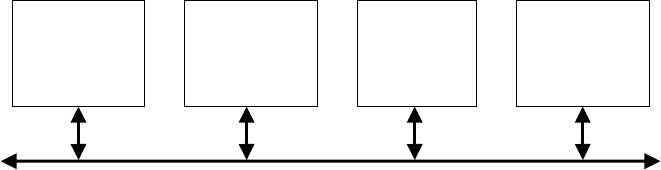
of delivering the high bandwidth needed for networking and embedded systems
applications. Through the JBus, processors can attach to a coherent shared bus
with no needed glue logic (Fig. 10.14).
10.7. SUMMARY
A RISC architecture saves the extra chip area used by CISC architectures for decod-
ing and executing complex instructions. The saved chip area is then used to provide
an on-chip instruction cache that can be used to reduce instruction traffic between
the processor and the memory. Common characteristics shared by most RISC
designs are: limited and simple instruction set, large number of general purpose reg-
isters and/or the use of compiler technology to optimize register usage, and optim-
ization of the instruction pipeline. An essential RISC philosophy is to keep the most
frequently accessed operands in registers and minimize register-memory operations.
This can be achieved using one of two approaches: Software Approach, use the com-
piler to maximize register usage by alloca ting registers to those variabl es that will be
used the most in a given time period (this is the philosophy used in Stanford MIPs
machine); or Hardware Approach, use more registers so that more variables can be
held in registers for larger periods of time (this is the philosophy used in the Berke-
ley RISC machine). Register windows are multiple small sets of registers, each
assigned to a different procedure. A procedure call automatically switches the
CPU to use a different fixed-size window of registers rather than saving registers
in memory at the call time. At any time, only ONE window of registers is visible
and is addressed as if it were the only set of registers. Window overlapping requires
that temporary registers at one level are physically the same as the parameter regis-
ters at the next level. This overlap allows parameters to be passed without the actual
movement of data.
It is worthwhile mentioning that the classification of processors as entirely pure
RISC or entirely pure CISC is becoming more and more inappropriate and may be
irrelevant. What actually counts is how much performance gain can be achieved by
including an element of a given design style. Most modern processors use a calcu-
lated combination of elements of both design styles. The decisive factor in which
element(s) of each design style to include is made based on a trade-off between
UltraSPARC III
Processor
UltraSPARC III
Processor
UltraSPARC III
Processor
UltraSPARC III
Processor
JBUS 128 bit, 200 MHz
Figure 10.14 A four-way UltraSPARC III multiprocessor configuration
232
REDUCED INSTRUCTION SET COMPUTERS (RISCs)
the required improv ement in performance and the expected added cost. A number of
processors are classified as RISC while employin g a number of CISC features, such
as integer/floating-point division instructions. Similarly, there exist processors that
are classified as CISC while employing a number of RISC features, such as
pipelining.
EXERCISES
1. What are the main principles used to construct a RISC machine?
2. Contrast the two approaches (the software and the hardware) used in RISC
machines to minimize memory operations.
3. Explain, with examples, the concept of register window and window overlap-
ping. Suggest a different approach to achieve the same results as those
achieved using register window and window overlapp ing.
4. For the purpose of this problem, you are require d to pick a recent RISC pro-
cessor of your choice. Submit a small report (no less than 5 and no more than
10 pages in length) that sum marizes the main pipe lining features used and the
main RISC featur es used. The level of your cover age should be suitable for a
senior undergraduate student. Make sure that you be precise and neat in your
coverage. Use simple examples whenever possible. Provide accurate and
meaningful figures and tables whenever possible. You are required to cover
all aspects of a p ipeline processor and all aspects of a RISC machine.
5. The controversy of RISC versus CISC never ends. Suppose that you represent
an advocate for the RISC approach; write at least a one-page critic of the CISC
approach showing its disadvantages while showing the advantages of the RISC
approach. You may want to use real-life example machine performance as a
support for your support of the RISC philosophy.
6. Repeat question 5 assuming that you are an advocate for the CISC philosophy.
REFERENCES AND FURTHER READING
An Overview of UltraSPARC III Cu, Version 1.1 September 2003, A White Paper, Sun
Microsystems, 1–18.
R. Colewell et al. Computers, complexity, and controversy, IEEE Comput., 18(9), 8–19
(1985).
Z. Cvetanovic and R. Kessler, Performance analysis of the Alpha 21264-based Compaq E40
system, Proc. 27th Annual International Symposium on Computer Architecture, Vancou-
ver, British Columbia, Canada, 192–202.
Exploring Alpha Power for Technical Computing. A Compaq Report on Compag High
Performance Technical Computing, November 1999, pp. 1 –28.
G. Goldman and P. Tirumalai, UltraSPARC-III: The advancement of ultra computing, Proc.
IEEE COMPCON’97, p. 417.
REFERENCES AND FURTHER READING 233