
Abd-El-Barr M., El-Rewini H. Fundamentals of Computer Organization and Architecture
Подождите немного. Документ загружается.

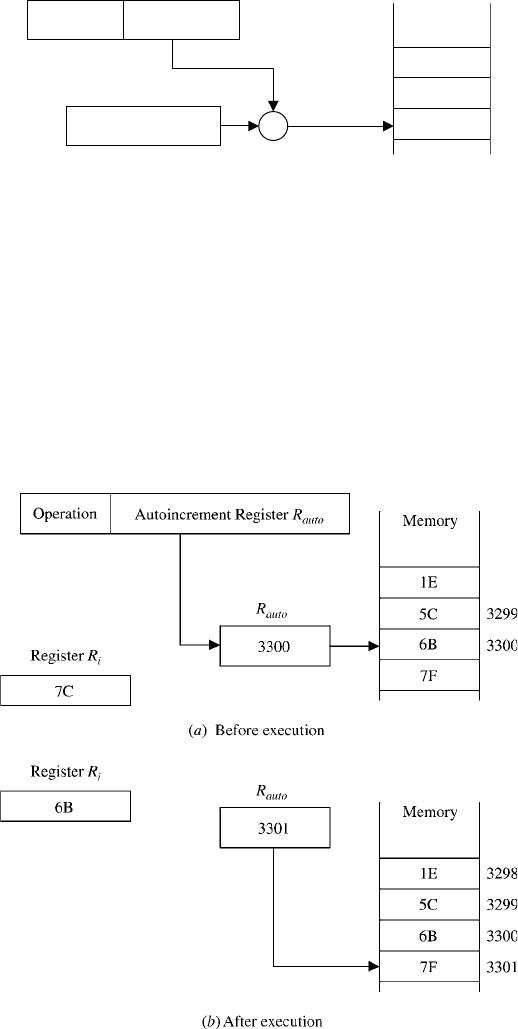
However, with autoincrement, the content of the autoincrement register is automati-
cally incremented after accessing the operand. As before, indirection is indicated by
including the autoincrement register in parentheses. The automatic increment of the
register’s content after accessing the operand is indi cated by including a (þ) after
the parentheses. Consider, for example, the instruction LOAD (R
auto
)þ, R
i
. This
instruction loads register R
i
with the operand whose address is the content of register
R
auto
. After loading the opera nd into register R
i
, the content of register R
auto
is
incremented, pointing for example to the next item in a list of items. Figure 2.10
illustrates the autoincrement addressing mode.
Memory
+
Operation Value X
operandProgram Counter (PC)
Figure 2.9 Illustration of relative addressing mode
Figure 2.10 Illustration of the autoincrement addressing mode
24
INSTRUCTION SET ARCHITECTURE AND DESIGN
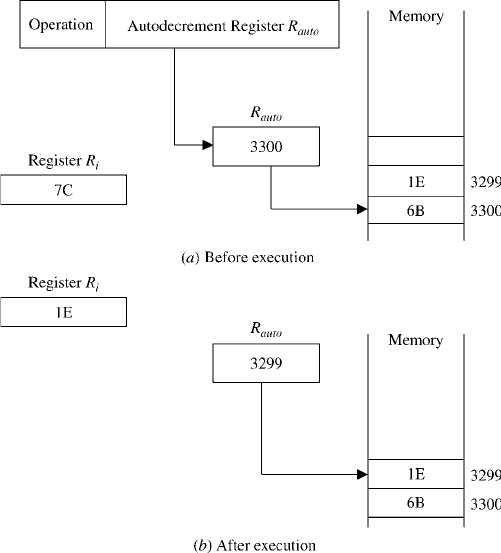
Autodecrement Mode Similar to the autoincrement, the autodecrement mode
uses a register to hold the address of the operand. However, in this case the
content of the autodecrement register is first decremented and the new content
is used as the effective address of the operand. In order to reflect the fact that the
content of the autodecrement register is decrem ented before accessing the operand,
a(2) is include d before the indirection parentheses. Consider, for example, the
instruction LOAD (R
auto
), R
i
. This instruction decrements the content of the
register R
auto
and then uses the new content as the effective address of the operand
that is to be loaded into register R
i
. Figure 2.11 illustrates the autodecrement addres-
sing mode.
The seven addressing modes presented above are summarized in Table 2.2. In
each case, the table shows the name of the addressing mode, its definition, and a gen-
eric example illustrating the use of such mode.
In presenting the different addressing modes we have used the load instruction
for illustration. However, it should be understood that there are other types of
instructions in a given machine. In the following section we elaborate on the differ-
ent types of instructions that typically constitute the instru ction set of a given
machine.
Figure 2.11 Illustration of the autodecrement addressing mode
2.2. ADDRESSING MODES 25
2.3. INSTRUCTION TYPES
The type of instructions forming the instruction set of a machine is an indication of
the power of the underlying architecture of the machine. Instructions can in general
be classified as in the following Subsections 2.3.1 to 2.3.4.
2.3.1. Data Movement Instructions
Data movement instructions are used to move data among the different units of the
machine. Most notably among these are instructions that are used to move data
among the different registers in the CPU. A simple register to register movement
of data can be made through the instruction
MOVE R
i
,R
j
TABLE 2.2 Summary of Addressing Modes
Addressing
mode Definition Example Operation
Immediate Value of operand is included in
the instruction
load #1000, R
i
R
i
1000
Direct
(Absolute)
Address of operand is included
in the instruction
load 1000, R
i
R
i
M[1000]
Register
indirect
Operand is in a memory
location whose address is in
the register specified in the
instruction
load (R
j
), R
i
R
i
M[R
j
]
Memory
indirect
Operand is in a memory
location whose address is in
the memory location
specified in the instruction
load (1000), R
i
R
i
M[1000]
Indexed Address of operand is the sum
of an index value and the
contents of an index register
load X(R
ind
), R
i
R
i
M[R
ind
þ X]
Relative Address of operand is the sum
of an index value and the
contents of the program
counter
load X(PC), R
i
R
i
M[PC þ X]
Autoincrement Address of operand is in a
register whose value is
incremented after fetching
the operand
load (R
auto
)þ, R
i
R
i
M[R
auto
]
R
auto
R
auto
þ 1
Autodecrement Address of operand is in a
register whose value is
decremented before fetching
the operand
load 2 (R
auto
), R
i
R
auto
R
auto
2 1
R
i
M[R
auto
]
26
INSTRUCTION SET ARCHITECTURE AND DESIGN
This instruction moves the content of register R
i
to register R
j
. The effect of the instruc-
tion is to override the contents of the (destination) register R
j
without changing the con-
tents of the (source) register R
i
. Data movement instructions include those used to
move data to (from) registers from (to) memory. These instructions are usually referred
to as the load and store instructions, respectively. Examples of the two instructions are
LOAD 25838, R
j
STORE R
i
, 1024
The first instruction loads the content of the memory location whose address is 25838
into the destination register R
j
. The content of the memory location is unchanged by
executing the LOAD instruction. The STORE instruction stores the content of the
source register R
i
into the memory location 1024. The content of the source register
is unchanged by executing the STORE instruction. Table 2.3 shows some common
data transfer operations and their meanings.
2.3.2. Arithmetic and Logical Instructions
Arithmetic and logical instructions are those used to perform arithmetic and logical
manipulation of registers and memory contents. Examples of arithmetic instructions
include the ADD and SUBTRACT instructions. These are
ADD R
1
,R
2
,R
0
SUBTRACT R
1
,R
2
,R
0
The first instruction adds the content s of source registers R
1
and R
2
and stores the
result in destination register R
0
. The second instruction subtracts the contents of
the source registers R
1
and R
2
and stores the result in the destination register R
0
.
The contents of the source registers are unchanged by the ADD and the SUBTRACT
instructions. In addi tion to the ADD and SUBTRACT instructions, some machines
have MULTIPLY and DIVIDE instructions. These two instructions are expensive
to implement and could be substituted by the use of repeated addition or repeated
subtraction. Therefore, most modern architectures do not have MULTIPLY or
TABLE 2.3 Some Common Data Movement Operations
Data movement
operation Meaning
MOVE Move data (a word or a block) from a given source
(a register or a memory) to a given destination
LOAD Load data from memory to a register
STORE Store data into memory from a register
PUSH Store data from a register to stack
POP Retrieve data from stack into a register
2.3. INSTRUCTION TYPES 27
DIVIDE instructions on their instruction set. Table 2.4 shows some common arith-
metic operations and their meanings.
Logical instructions are used to perform logical operations such as AND, OR,
SHIFT, COMPARE, and ROTATE . As the names indicate, these instructions per-
form, respectively, and, or, shift, compare, and rotate operations on regi ster or
memory contents. Table 2.5 presents a number of logical operations.
2.3.3. Sequencing Instructions
Control (sequencing) instructions are used to change the sequence in which
instructions are executed . They take the form of CONDITIONAL BRANCHING
(CONDITIONAL JUMP), UNCONDITIONAL BRANCHING (JUMP), or CALL
instructions. A common characteristic among these instructions is that their
execution changes the program counter (PC) value. The change made in the PC
value can be unconditional, for example, in the unconditional branching or the
jump instructions. In this case, the earlier value of the PC is lost and execution of
the program starts at a new value specified by the instruction. Consider, for example,
the instruction JUMP NEW-ADDRESS. Execution of this instruction will cause the
PC to be loaded with the memory location represented by NEW-ADDRESS
whereby the instruction stored at this new address is executed. On the other hand,
TABLE 2.4 Some Common Arithmetic Operations
Arithmetic operations Meaning
ADD Perform the arithmetic sum of two operands
SUBTRACT Perform the arithmetic difference of two operands
MULTIPLY Perform the product of two operands
DIVIDE Perform the division of two operands
INCREMENT Add one to the contents of a register
DECREMENT Subtract one from the contents of a register
TABLE 2.5 Some Common Logical Operations
Logical operation Meaning
AND Perform the logical ANDing of two operands
OR Perform the logical ORing of two operands
EXOR Perform the XORing of two operands
NOT Perform the complement of an operand
COMPARE Perform logical comparison of two operands and
set flag accordingly
SHIFT Perform logical shift (right or left) of the content
of a register
ROTATE Perform logical shift (right or left) with
wraparound of the content of a register
28
INSTRUCTION SET ARCHITECTURE AND DESIGN
the change made in the PC by the branching instruction can be conditional based on
the value of a specific flag. Examples of these flags include the Negative (N), Zero
(Z), Overflow (V), and Carry (C). These flags represent the individual bits of a
specific register, called the CONDITION CODE (CC) REGISTER. The values of
flags are set based on the results of executing different instructions. The meaning
of each of these flags is show n in Table 2.6.
Consider, for example, the following group of instructions.
LOAD # 100, R
1
Loop: ADD (R
2
) þ , R
0
DECREMENT R
1
BRANCH-IF-GREATER-THAN Loop
The fourth instruction is a conditional branch instruction, which indicates that if
the result of decrementing the contents of register R
1
is greater than zero, that is,
if the Z flag is not set, then the next instruction to be executed is that labeled by
Loop. It should be noted that conditional branch instructions could be used to exe-
cute program loops (as shown above).
The CALL instructions are used to cause execution of the program to transfer to a
subroutine. A CALL instruction has the same effect as that of the JUMP in terms of
loading the PC with a new value from which the next instruction is to be executed.
However, with the CALL instruction the incremented value of the PC (to point to the
next instruction in sequence) is pushed onto the stack. Execution of a RETURN
instruction in the subroutine will load the PC with the popped value from the
stack. This has the effect of resuming program execution from the point where
branching to the subroutine has occurred.
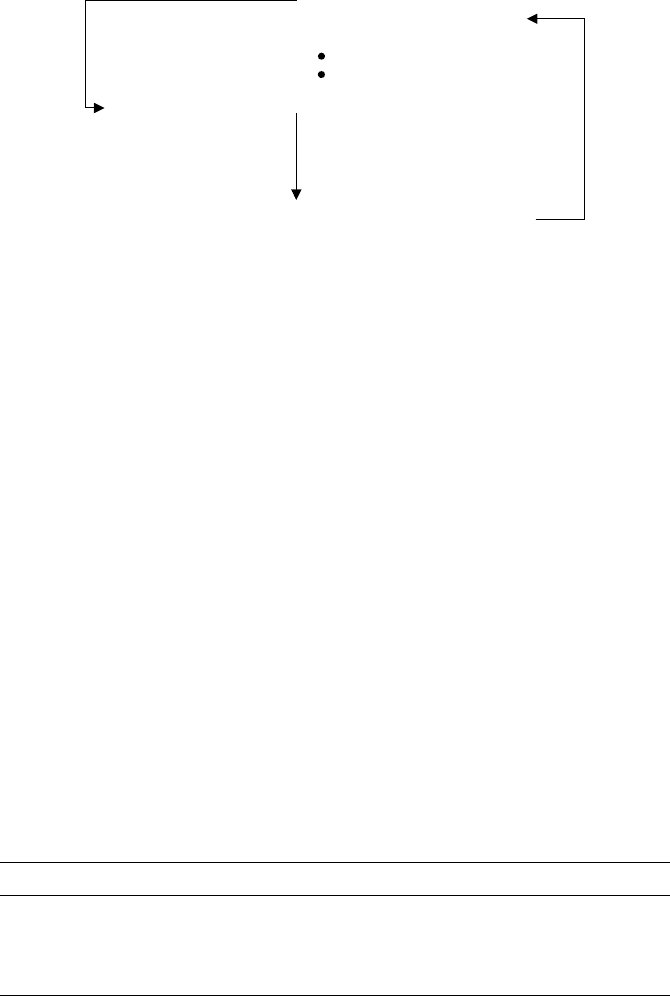
Figure 2.12 shows a program segment that uses the CALL instruction. This pro-
gram segment sums up a number of values, N, and stores the result into memory
location SUM. The values to be added are stored in N consecutive memory locations
starting at NUM. The subroutine, called ADDITION, is used to perform the actual
addition of values while the main program stores the results in SUM.
Table 2.7 presents some common transfer of control operations.
TABLE 2.6 Examples of Condition Flags
Flag name Meaning
Negative (N) Set to 1 if the result of the most recent operation
is negative, it is 0 otherwise
Zero (Z) Set to 1 if the result of the most recent operation
is 0, it is 0 otherwise
Overflow (V) Set to 1 if the result of the most recent operation
causes an overflow, it is 0 otherwise
Carry (C) Set to 1 if the most recent operation results in a
carry, it is 0 otherwise
2.3. INSTRUCTION TYPES 29
2.3.4. Input/Output Instructions
Input and output instructions (I/ O instructions) are used to transfer data between the
computer and peripheral devices. The two basic I/O instructions used are the INPUT
and OUTPUT instructions. The INPUT instruction is used to transfer data from an
input device to the processor. Examples of input devices include a keybo ard or a
mouse. Input devices are interfaced with a computer through dedicated input
ports. Computer s can use dedicated addresses to address these ports. Suppose that
the input port through which a keyboard is connected to a compute r carries the
unique address 1000. Therefore, execution of the instruction INPUT 1000 will
cause the data stored in a specific register in the interface between the keyboard
and the computer, call it the input data register, to be moved into a specific register
(called the accumulator) in the computer. Similarly, the execution of the instruction
OUTPUT 2000 causes the data stored in the accumulator to be moved to the data
output register in the outpu t device whose address is 2000. Alternatively, the com-
puter can address these ports in the usual way of addressing memory locations. In
this case, the computer can input data from an input device by executing an instruc-
tion such as MOVE R
in
, R
0
. This instruction moves the content of the register R
in
into the register R
0
. Similarly, the instruction MOVE R
0
, R
in
moves the contents
of register R
0
into the register R
in
, that is, performs an output operation. This
CLEAR R
0
MOVE N,R
1
MOVE #NUM,R
2
CALL SUBROUTINE ADDITION
MOVE R
0
, SUM
SUBROUTINE ADDITION
Loop:
ADD (R
2
)+,R
0
DEC R
1
BRANCH-IF-GREATER Loop
RETURN ADDITION
Figure 2.12 A program segment using a subroutine
TABLE 2.7 Some Transfer of Control Operations
Transfer of control operation Meaning
BRANCH-IF-CONDITION Transfer of control to a new address if condition is true
JUMP Unconditional transfer of control
CALL Transfer of control to a subroutine
RETURN Transfer of control to the caller routine
30
INSTRUCTION SET ARCHITECTURE AND DESIGN
latter scheme is called memory-mapped Input/Output. Among the advantages of
memory-mapped I/O is the ability to execute a number of memory-dedicated
instructions on the registers in the I/O devices in addition to the elimination of
the need for dedicated I/O instru ctions. Its main disadvantage is the need to dedicate
part of the memory address space for I/O devices.
2.4. PROGRAMMING EXAMPLES
Having introdu ced addressing modes and instruction types, we now move on to
illustrate the use of these concepts through a number of programming examples.
In presenting these examples, generic mnemonics will be used. This is done in
order to emphasize the understanding of how to use different addressing modes in
performing different operations independent of the machine used. Applications of
similar principles using real-life machine examples are presented in Chapter 3.
Example 1 In this example, we would like to show a program segment that can be
used to perform the task of adding 100 numbers stored at consecutive memory loca-
tions starting at location 1000. The results should be stored in memory location 2000.
CLEAR R
0
; R
0
0
MOVE # 100, R
1
; R
1
100
CLEAR R
2
; R
2
0
LOOP: ADD 1000(R
2
), R
0
; R
0
R
0
þ M (1000 þ R
2
)
INCREMENT R
2
; R
2
R
2
þ 1
DECREMENT R
1
; R
1
R
1
1
BRANCH-IF . 0LOOP; GO TO LOOP if contents of R
1
. 0
STORE R
0
, 2000; M(2000) R
0
In this example, use has been made of immediate (MOVE #100, R
1
)andindexed(ADD
1000(R
2
), R
0
) addressing.
Example 2 In this example autoincrement addressing will be used to perform the
same task performed in Example 1.
CLEAR R
0
; R
0
0
MOVE #100, R
1
; R
1
100
CLEAR R
2
; R
2
0
LOOP: ADD 1000(R
2
)þ, R
0
; R
0
R
0
þ M (1000 þ R
2
) & R
2
R
2
þ 1
DECREMENT R
1
; R
1
R
1
1
BRANCH-IF . 0 LOOP; GO TO LOOP if contents of R
1
. 0
STORE R
0
, 2000; M(2000) R
0
As can be seen, a given task can be performed using more than one programming
methodology. The method used by the programmer depends on his/her experience
2.4. PROGRAMMING EXAMPLES 31
as well as the richness of the instruction set of the machine used. Note also that the
use of the autoincrement addressing in Example 2 has led to a decrease in the
number of instructions used to perform the same task.
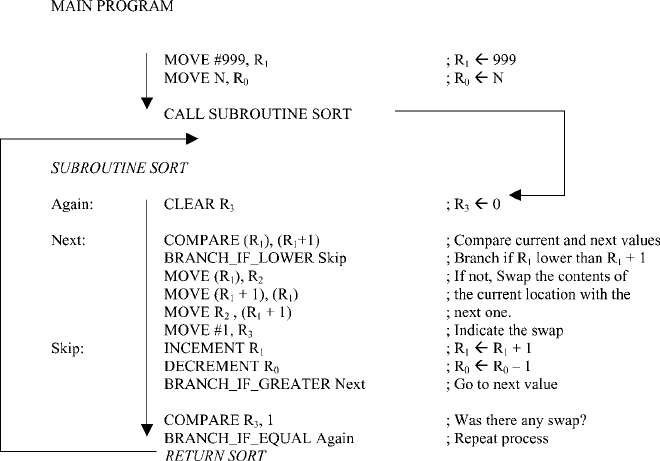
Example 3 This example illustrates the use of a subroutine, SORT, to sort
N values in ascending order (Fig. 2.13). The numbers are originally stored in a
list starting at location 1000. The sorted values are also stored in the same list
and again starting at location 1000. The subroutine sorts the data using the well-
known “B ubble Sort” technique. The content of register R
3
is checked at the end
of every loop to find out whether the list is sorted or not.
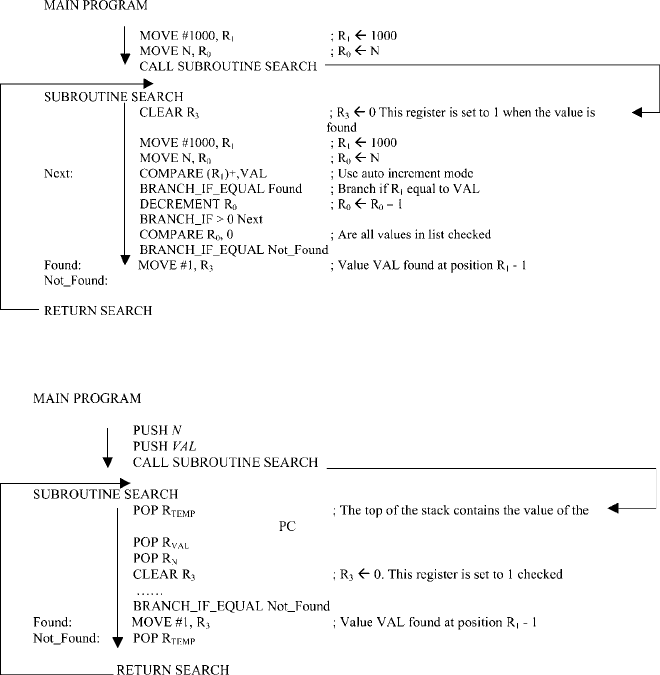
Example 4 This exam ple illustrates the use of a subroutine, SEARCH, to search
for a value VAL in a list of N values (Fig. 2.14). We assume that the list is not orig-
inally sorted and therefore a brute force search is used. In this search, the value VAL
is compared with every element in the list from top to bottom. The content of register
R
3
is used to indicate whether VAL was found. The first element of the list is located
at address 1000.
Example 5 This exam ple illustrates the use of a subroutine, SEARCH, to search
for a value VAL in a list of N values (as in Example 4) (Fig. 2.15). Here, we make use
of the stack to send the parameters VAL and N .
Figure 2.13 SORT subroutine
32
INSTRUCTION SET ARCHITECTURE AND DESIGN
2.5. SUMMARY
In this chapter we considered the main issues relating to instruction set design and
characteristics. We presented a model of the main memory in which the memory is
abstracted as a sequence of cells, each capable of storing n bits. A number of addressing
modes were presented. These include immediate, direct, indirect, indexed, autoincre-
ment, and autodecrement. Examples showing how to use these addressing modes
were then presented. We also presented a discussion on instruction types, which include
data movement, arithmetic/logical, instruction sequencing, and Input/Output. Our dis-
cussion concluded with a presentation of a number of examples showing how to use the
principles and concepts discussed in the chapter in programming the solution of a
number of sample problems. In the next chapter, we will introduce the concepts involved
in programming the solution of real-life problems using assembly language.
Figure 2.14 SEARCH subroutine
Figure 2.15 Subroutine SEARCH using stack to send parameters VAL and N
2.5. SUMMARY 33