
Ahmed S.N. Physics and Engineering of Radiation Detection
Подождите немного. Документ загружается.

366 Chapter 6. Scintillation Detectors and Photodetectors
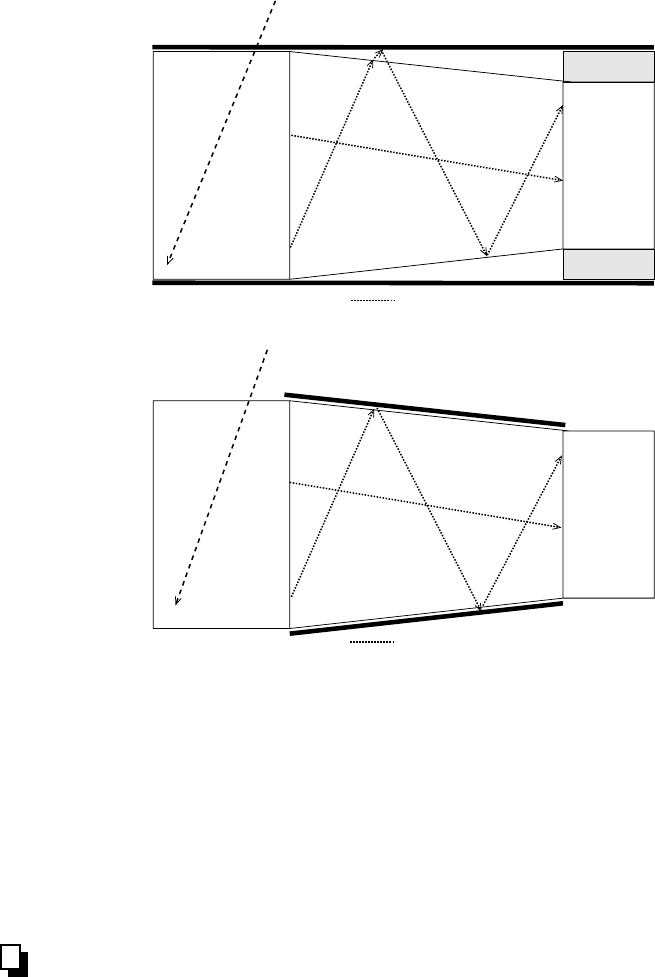
the outer surface of the fish-tail light guide as shown in Fig.6.4.3(b). However one
could also opt for enclosing the fish-tail light guide in a separate reflecting enclosure
as depicted in Fig. 6.4.3(a).
Radiation
Incident
Scintillation Photons
Scintillation Photons
Radiation
Incident
Reflecting Surface
Light Guide
(b)
(a)
Photodetector
Light Guide
Photodetector
Scintillator
Scintillator
Reflecting Surface
Figure 6.4.3: Two types of hybrid light guides. (a) A fish-tail
light guide is enclosed in a container having highly polished
reflecting inner surface. (b) The outer surface of a fish-tail
light guide has been covered with a reflecting paint.
The surface of the reflecting part of a hybrid light guide must be extremely
smooth and highly polished. Although the absorption of photons in such a surface
can not be totally avoided but careful construction can help minimize the loss.
6.5 Photodetectors
The photons produced by scintillators can be detected by a number of means, the
most notable of which are photomultiplier tubes (PMTs) and photodiodes (PDs).

6.5. Photodetectors 367
Both of these detector types have their own pros and cons. for example photo-
multiplier tubes have sensitive mechanical structures that are prone to damage in
mechanically unstable environments while the photodiodes are made of semiconduc-
tor materials and are therefore mechanically stable. On the other hand the response
time of PMTs is much smaller than photodiodes and are therefore preferred in timing
applications. Of course these are only two parameters and the choice of a photode-
tector is in reality a compromise between a number of factors including cost. We will
learn about these factors as we discuss these two types of detectors in the following
sections.
6.5.A Photomultiplier Tubes
Photomultiplier tubes are sensitive devices that are capable of converting light pho-
tons into a very large number of electrons. The basic building blocks of a com-
plete PMT are a photocathode, an electron multiplication structure, and a readout
electrode. The photons incident on the photocathode get converted into electrons
through the process of photoelectric effect. The electron is then made to acceler-
ate and strike a metallic structure called dynode, which results in the emission of
more electrons. The newly produced electrons are again accelerated towards another
dynode, where even more electrons are produced. This process of electron multi-
plication continues until the electrons reach the last dynode where the resulting
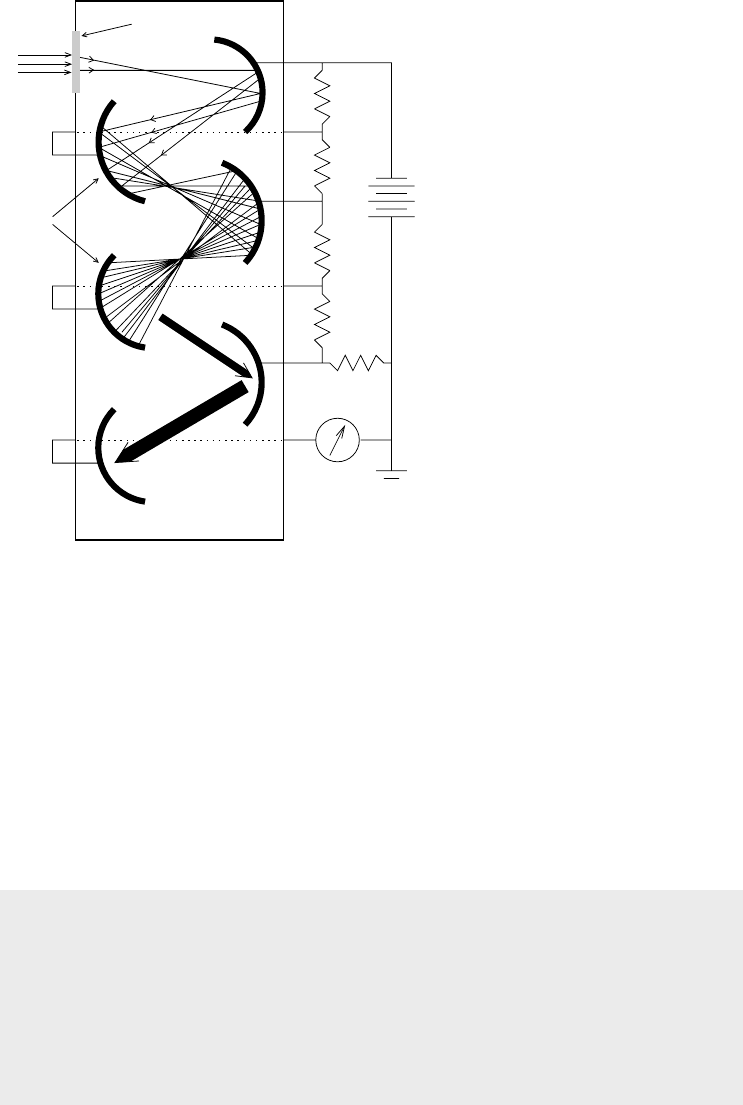
current is measured by some electronic device. This process is graphically sketched
in Fig.6.5.1.
Before we go on to the discussion of individual components of a PMT, let us
have a look at the characteristics that make PMT based photodetectors desirable
for radiation detection. The most important of these characteristics are listed below.
High sensitivity.
Good signal-to-noise ratio.
Fast time response.
Large photosensitive area.
The reader should bear in mind that here we are not comparing PMTs with pho-
todiodes. With rapidly developing technology, new photodiode detectors are now
being developed that match or even surpass these and other properties.
A.1 Photocathode
We learned about the process of photoelectric effect in Chapter 2 and saw that some
particular materials emit electrons when they absorb photons of energy above a
certain threshold. This threshold energy is called work function and is characteristic
of the material. The material itself is called photocathode. If we assume that no
energy is lost during this process then the energy of the emitted photon would simply
be equal to the difference between the photon energy and the work function of the
material, that is
E
e
=
hc
λ
− Φ, (6.5.1)
368 Chapter 6. Scintillation Detectors and Photodetectors
Dynode
Vacuumed Enclosure
Photons
Photocathode
Electrons
1R
1R
1R
1R
1R
HV
Figure 6.5.1: Working principle
of a typical side-on type PMT.
The light photons (e.g. com-
ing from a scintillator) produce
electrons through the photoe-
mission process in the photo-
cathode. These electrons are
focused on to the first dynode
where they produce secondary
electrons, which then move to-
wards the second dynode and
produce more secondary elec-
trons and so on. An actual
PMT may contain 10 or more
such dynodes. The amplified
signal is measured at the final
dynode or anode.
where λ is the wavelength of the incident light and Φ is the energy threshold or
work function of the material. For a given material, this expression can be used to
determine the maximum detectable wavelength (see example below).
Example:
A material having a work function of 2 eV is used to convert photons into
electrons, which are then detected by a photomultiplier tube. Compute the
maximum wavelength of the photons it can convert into electrons.
Solution:
The maximum wavelength can be obtained by setting E
e
=0inequation
6.5.1, which simply means that all of the incident energy has been used in the
conversion process and the electron has not taken away any of the photon’s

6.5. Photodetectors 369
energy. Hence we have
0=
hc
λ
max
−Φ
⇒ λ
max
=
hc
Φ
=
6.63 × 10
−34
2.99 × 10
8
2 × 1.602 × 10
−19
=6.187 × 10
−7
m
= 618.7 nm.
Looking at equation 6.5.1 it is apparent that choosing a material with low work
function is advantageous in terms of delivering energy to the outgoing electrons.
However this is not the only criterion for selecting a photocathode for use in a
PMT. for example if the PMT is to be used to detect scintillation photons then
the most important factor is the conversion efficiency of the material at the most
probably wavelength of the scintillation light. If the material does not have high
enough efficiency at that wavelength then even a very low work function would not
matter much. Since the realization of this problem, a number of extensive stud-
ies have been carried out to find the optimum photocathode materials at different
scintillation wavelengths. Most of these efforts have gone into understanding the
spectral response of the materials. By spectral response we mean the efficiency of
the production of photoelectrons as a function of light wavelength. This efficiency
is generally referred to as photocathode quantum efficiency and is simply defined as
the ratio of the number of emitted photoelectrons to the number of incident photons,
that is
QE =
N
e
N
γ
, (6.5.2)
where N
e
is the number of electrons emitted and N
γ
is the number of incident
photons. Quantum efficiency can also be expressed in terms of more convenient
quantities, such as incident power and photoelectric current. To do that we first
note that the incident power can be defined as
P
γ
= n
γ
hν, (6.5.3)
where n
γ
represents the number of photons of frequency ν incident on the detector
per unit time. The expression for quantum efficiency can then be written as
QE =
n
e
P
γ
/hν
=
I
pe
hν
eP
γ
. (6.5.4)
Here n
e
is the number of photoelectrons ejected per unit time and I
pe
= en
e
is the
photoelectric current. This equation can be used to determine the photoelectric
current for a particular value of the incident power (see example below).

370 Chapter 6. Scintillation Detectors and Photodetectors
Example:
A photocathode produces a current of 20 nA when exposed to light of
wavelength 510 nm. Determine the photoelectric current if the wavelength
of light is changed to 475 nm such that the incident power remains the
same. Assume that the material has the same quantum efficiency at the two
wavelengths.
Solution:
Equation 6.5.4 for photoelectric current can be written as
I
pe
=(QE)
eP
γ
hc
λ
= Kλ,
where λ is the wavelength of the incident light and we have lumped together
all the constant terms into one parameter K. This constant can be eliminated
by writing the above equation for the two wavelengths and then dividing one
with the other. Hence the required current is
I
pe,2
= I
pe,1
λ
2
λ
1
=20
475
510
=18.6 nA. (6.5.5)
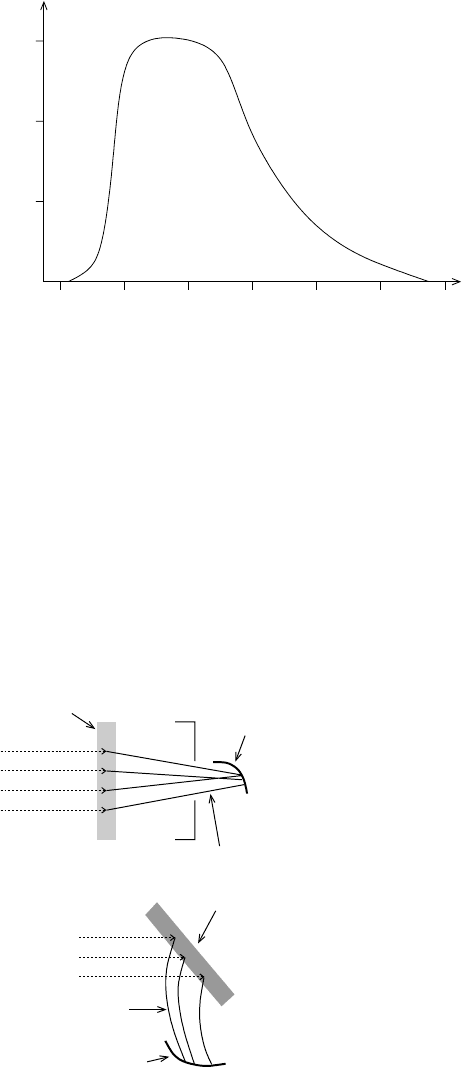
Fig.6.5.2 shows a typical spectral response curve of a photocathode. Here the
quantum efficiency of the photocathode is plotted against wavelength of incident
light. The interesting thing to note here is that the curve has a plateau where the
variation in efficiency is not very large. As soon as one goes beyond this plateau on
either side, the efficiency decreases rapidly. Therefore to build a good scintillation
detector with a PMT, one should ensure that the spectrum of scintillation light has
a peak somewhere in the middle of this plateau. There are some materials that have
very short plateaus as well and using those in PMTs is generally not a good idea
unless the scintillation spectrum is also narrow and has clearly defined peak that
occurs at or near the peak of the spectral response curve.
As noted above the particular requirements of the system drive the choice of a
photocathode in a PMT. Since there are a host of scintillation materials available
having their unique scintillation spectra, therefore efficient detection of those pho-
tons with a PMT would require the use of photocathode materials with matching
spectral response characteristics. Then there are also applications where the photons
to be detected are not coming from a scintillator. That is, a PMT is a photodetec-
tor that can be used to detect photons no matter from where they are coming. for
example the use of PMTs for detecting Cherenkov photons has recently gotten a lot
of attention in highly sensitive large scale neutrino detectors. In essence, a PMT is a
versatile photodetector that can be used to detect photons in virtually any environ-
ment provided it is equipped with a photocathode having the appropriate spectral
response.
6.5. Photodetectors 371
Wavelength ( )nm
300
200
400 500 600 700
800
10
20
30
QE (%)
Figure 6.5.2: Quantum ef-
ficiency of a typical pho-
tocathode as a function of
wavelength of incident pho-
tons.
Photocathodes can be used in essentially two different modes: transmission and
reflection. In transmission mode the photocathode is semitransparent to allow trans-
mission of photoelectrons (see Fig.6.5.3(a)). Such a photocathode is constructed by
depositing a very thin layer of the material on the inside of the photon entrance
window. Since most of the photoelectrons are emitted in the direction of travel of
the incident photons therefore it is called transmission photocathode. Most PMTs
are constructed with this type of photocathodes. There are also some photocathode
materials that have high quantum efficiencies but very poor transmission properties.
These opaque materials are used to construct the so called reflection photocathodes
as shown in Fig.6.5.3(b). A reflection photocathode is made by depositing a thin
layer of the material on a metal electrode inside the PMT.
Photocathode
Photons
Dynode
Dynode
Photoelectrons
Photoelectrons
Photons
Photocathode
(a)
(b)
Figure 6.5.3: (a) Semitransparent photocathode
used as a transmission photoemission device in
a head-on type PMT. (b) Reflection type photo-
cathode. Such photocathodes are generally used
in circular type PMTs.
372 Chapter 6. Scintillation Detectors and Photodetectors
A host of photocathode materials have been identified with varying characteristics
and spectral responses, some of which are listed below.
AgOCs: This is one of the most widely used photocathode materials. It has a
photoemission threshold of 1100 nm and a peak quantum efficiency at around
800 nm. The working range of this material is in the near infrared range of the
photon spectrum. The main disadvantage of AgOCs is its very low quantum
efficiency, which has a peak of less than 1%. It is mainly used as a transmission
photocathode.
GaAs(Cs): This material has a spectral response that ranges from ultraviolet
to 930 nm. This broadband response makes it suitable for used with a wide
range of scintillators without the need of a wavelength shifter. In most instances
it is used in the transmission mode. Since the quantum efficiency of GaAs(Cs)
is temperature dependent with a peak at very low temperatures, it is sometimes
operated at very low temperatures.
InGaAs(Cs): This material has greater sensitivity in the infrared range and
higher signal-to-noise ratio in 900-1000 nm range than GaAs(Cs).
SbCs
3
: This is one of the earliest used photocathode materials. It is still very
popular amongst manufacturers as its spectral response ranges from ultravio-
let to the visible region with a peak quantum efficiency of around 20%. The
photoemission threshold of SbCs
3
lies at around 700 nm and has a peak at ap-
proximately 400 nm. Since it has very poor transmission capabilities therefore
it is generally used as a reflection photocathode.
Bialkali Materials: The bialkali materials such as SbRbCs and SbKCs are
the most widely used of all photocathode materials due to their high sensitiv-
ities to blue light generated by NaI scintillators. The reader might recall that
NaI is the most popular scintillator for radiation detection. The sensitivity
to blue light is not the only reason for their popularity, though. These ma-
terials also have high quantum efficiencies with peaks of just less than 30%.
Another advantage is their good stability at elevated temperatures. Some bial-
kali materials can be used at a temperature as high as 175
0
C. A common
bialkali material SbKCs has a photoemission threshold of about 700 nm and
maximum quantum efficiency of 28% at around 400 nm.
Multialkali Materials: These materials have very wide spectral response ranging
from ultraviolet to near infrared, making them highly suitable to be used with
a number of different scintillators. Their main disadvantage is high thermionic
emission of electrons even at room temperature and therefore external cooling
is generally required. NaKSbCs is a common multialkali.
CsTe, CsI: These materials are sensitive to photons in ultraviolet region only
and are therefore not very widely used.
A.2 Electron Focusing Structure
Since photocathodes have low quantum efficiencies therefore each electron produced
is important and should be collected by the first dynode. This requires the use of an
6.5. Photodetectors 373
electron focusing structure to guide the photoelectrons to the dynode. The reason
is that the photoelectrons are produced in all directions with varying energies and
can easily go astray if they are not directed properly. An ideal electron focusing
structure has the following two distinct characteristics.
It directs the electrons from the photocathode to the first dynode such that
all of them have the same transit time regardless of their initial energy. This
is a very important requirement specially for tubes that are to be used in fast
timing applications.
It is able to focus all the photoelectrons produced in the photocathode.
Of course such strict requirements can be fulfilled only by an ideal focusing structure.
However with a carefully designed structure one can achieve an electron collection
efficiency of 80% or better. One thing that should be pointed out here is that not
all PMTs have very stringent focusing requirements. Some PMT structures, as we
will see later, have large first dynodes and are therefore able to collect most of the
photoelectrons even without a focusing structure.
Focusing of electrons on to the first dynode depends on two factors: the geometry
of the focusing structure and the electric field intensity in the space between the
photocathode and the first dynode. The field intensity is generally made non-uniform
and has a higher value near the photocathode to minimize the dependence of electron
transit time on the initial electron velocity.
A.3 Electron Multiplication Structure
Earlier we saw that the quantum efficiency of a typical photocathode ranges between
10% and 30%. An efficiency of 10% means that for every 10 photons only one photo-
electron is getting out of the photocathode. For low to moderate photon fluxes this is
a problem since the resulting electron flux may not be sufficient to constitute a mea-
surable current (see Example below). Hence to obtain a measurable signal and good
signal-to-noise ratio the electron yield must somehow be increased. Now since the
photocathode materials have their own physical and engineering limitations and can
not be made more efficient, therefore the electron yield must be increased by some
other process. This is accomplished in a PMT through the electron multiplication
structure. The basic idea is to utilize the process of electron ejection from certain
metals when they are bombarded by electrons. Such metals eject more electrons
than the incident electrons provided the incident electrons have high enough energy.
This implies that the electrons must first be accelerated as well. This may sound
complicated but in actuality it can be done through a simple structure as shown in
Fig.6.5.1. This PMT has 5 dynodes and a readout electrode. Each of these dynodes
is kept at a higher potential than the preceding dynode to direct and accelerate the
electrons towards itself. The result of these successive accelerations and secondary
emissions is a cascade of electrons flowing down the dynode chain. Consequently
the initial small number of photelectrons gets multiplied into a very large number
at the final electrode. To collect these electrons another metallic structure called
anode is placed near the final dynode. The electron current at the anode is passed
on to the associated electronics for further processing.

374 Chapter 6. Scintillation Detectors and Photodetectors
Example:
A NaI scintillator is bombarded by ionizing radiation that results in the
deposition of 1.5 MeV of energy per second. The scintillation photons thus
produced are detected by a PMT. Determine the current at the first dynode
of this PMT. Assume that 15% of photons are lost before reaching the
photocathode, which itself has a quantum efficiency of 20%. NaI produces
about 40,000 photons per MeV.
Solution:
The number of electrons produced by the photocathode per unit time can be
estimated from
N
e
=(N
s
)(η)(QE),
where N
s
represents the number of scintillation photons produced per unit
time, η is the efficiency of the process of transfer of photons to the photocath-
ode, and QE is the quantum efficiency of the photocathode. The number of
photons being produced per second in NaI is
N
s
=(40, 000)(1.5) = 60, 000 s
−1
.
Hence the number of photoelectrons being produced per second is
N
e
=(60, 000)(0.15)(0.2)
=1, 800 s
−1
.
Since each electron carries a unit electrical charge, the current at the first
dynode is given by
I =(1, 800)
1.6 × 10
−19
Cs
−1
=2.9 × 10
−15
A. (6.5.6)
It is evident that it will be quite a difficult to measure this current of about
0.3 fA and also have a good signal-to-noise ratio. The reader should note
that even when we started with a scintillator that had one of the highest light
yields, the current at the first dynode turned out to be extremely small. Of
course in this case the incident photon flux was also very low, which refers to
the operation of the detector in low radiation fields. In high radiation fields
the photoelectric current could be several tens of nanoseconds. In very low
radiation fields, obtaining a measurable requires that the signal multiplication
structure of the PMT has a high enough gain. for example a PMT having a
gain of 10
4
would amplify the 0.3 fA signal to about 3 pA, which may still be
too low for reliable measurements.
Every dynode in the electron multiplication structure does not have the same
shape. for example the first dynode is specially designed to maximize the collection
of photoelectrons that are already low in numbers. The structure of other dynodes
depends on their particular locations. The focusing requirements for dynodes are
also very stringent to avoid unnecessary loss of electrons. These requirements include
not only proper designing of the dynodes but also their placement. Due to these
6.5. Photodetectors 375
issues the performance of a PMT is susceptible to mechanical jitters, which may
lower the ability of one or more dynodes to focus or direct the electrons. Loss of
electrons leads to signal deterioration and possibly non-linearity and therefore the
sensitive mechanical structure of a PMT is one of its major disadvantages. However,
as we will see later, some PMT designs are less prone to mechanical instabilities and
should therefore be preferred if the environment is mechanically unstable.
The electron multiplication structure shown in Fig.6.5.1 is by no means a standard
for PMTs. In fact, PMTs are manufactured in many different geometries. The
choice of the geometry is mainly application dependent. In the following we will
look at the most common of the PMT geometries and discuss their advantages and
disadvantages.
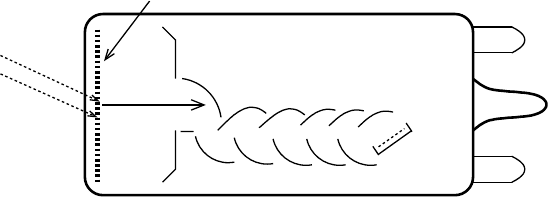
Linear Focused Type: This is perhaps the most famous type of electron
multiplication structure (see Fig.6.5.4). Generally it is used in the head-on
type of PMT. The distinguishing feature of this design is its extremely fast
time response, which is achieved by positioning the dynodes to minimize the
electron transit times. At each multiplication stage the electrons are focused
by high electric field between the carefully placed dynodes, leading to a very
fast response time. This design is susceptible to external magnetic field.
Incident
Photons
P
h
otocat
h
o
d
e
Dynode Chain
Vacuu
m
ed
G
l
ass
En
c
l
osu
r
e
Focussing Structure
Electrons
Anode
Figure 6.5.4: Linear focused type PMT.
BoxandGridType: This is a somewhat simplified version of the linear
focused type PMT. Such a structure is made of several quarter cylindrical
dynodes installed in succession as shown in Fig.6.5.5. Since the collection area
of the first dynode is larger than in the linear focused type therefore its focusing
requirements are a bit relaxed. Although this simple design looks identical to
the linear focused type but it lacks the progressive focusing of electrons between
the dynodes. Hence it has slower response time and is therefore not a popular
choice for most applications. Like linear focused type, this design also suffers
from magnetic field dependent sensitivity.
Circular Cage Type: This is a very compact structure with dynodes arranged
in a circular fashion (see Fig.6.5.6). This type of PMT has a fast response time
and is therefore suitable for use in timing applications. Although most of
the circular cage type PMTs have side-on type structure but this geometry
can be used to construct head-on type PMTs as well. The compactness of