
Alkauskas A., Deak P., Neugebauer J., Pasquarello A., Van de Walle Ch.G. (Eds.) Advanced Calculations for Defects in Materials: Electronic Structure Methods
Подождите немного. Документ загружается.

similar effects on the defect geometry and the localization of the acceptor state [21, 24]
of Li
Zn
.
By phasing in the on-site correction for O-p orbitals, we found in Ref. [19] that the
geometry, the wavefunction localization, and the local magnetic moment exhibit
an almost digital behavior, i.e., the change from the situation of Figure 11.1a to that
of Figure 11.1b occurs abruptly above a critical value of the on-site potential and then
changes very little when further increasing the potential strength parameter. Sim-
ilarly, hybrid-functional calculations of the Al
Si
center in SiO
2
using the B3LYP
functional [39] with 20% Fock exchange did not restore the localization of the hole on
a single oxygen site [17, 18], but the localization kicks in when the fraction of Fock
exchange is increased [23]. Therefore, a guiding principle is desired that helps to
determine appropriate parameters for such methods. Whereas the correct descrip-
tion of the structural and magnetic properties mostly require that the parameterized
DFA correction (U, V
hs
, Fock-exchange, etc.) is sufficient to stabilize the localized
solution above the critical threshold, an accurate determination of these parameters
is even more important when one is interested in energy differences between the
localized and delocalized states to determine, for instance, acceptor binding energies
in oxides, because these change continuously with the strength of the parameterized
correction, e.g., the on-site potential V
hs
[19]. Indeed, different parameterizations
of hybrid-functionals have also led to rather different ionization energies for Li in
ZnO [21, 24]. We now formulate a generalized Koopmans condition [19] that can
serve as such a guiding principle to determine appropriate parameters for DFA
corrections.
11.2
The Generalized Koopmans Condition
The Hohenberg–Kohn theorem [4] of DFT can be extended to fractional electron
numbers N, describing a separated open system with fluctuating electrons [42, 43].
The exact total energy is then a piecewise linear function E(N) with a discontinuous
slope at integer N. In DFA, however, E(N) is generally a convex function [43, 44], due
to the approximate nature of the local density formalism. In order to relate the
curvature of E(N) to the behavior of Kohn–Sham (KS) single particle energy e
i
when
changing the occupation 0 n
i
< 1 of the state i, we employ Janaks theorem [45, 46],
dEðn
i
Þ=dn
i
¼ e
i
; ð11:1Þ
and find that the convexity of E(N) is caused by a shift of e
i
to higher energies during
the occupation of state i in DFA, i.e.,
d
2
E ðn
i
Þ=dn
2
i
> 0; or
de
i
ðn
i
Þ=dn
i
> 0;
ð11:2Þ
(Note that we assume that the density functional does not have an explicit discon-
tinuity [47, 48], which is the case for all methods considered here).
11.2 The Generalized Koopmans Condition
j
185
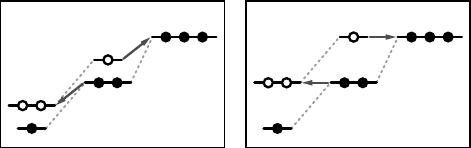
For illustration, Figure 11.2 shows the single particle energy scheme for electron
removal from or electron addition into a partially occupied state. This situation
occurs, e.g., in case of the p
5
configuration of the isolated F atom [43, 49], where the
three F-p (say, p
x
, p
y
, and p
z
) orbitals of the spin-down channel are occupied by only
two electrons. As illustrated in Figure 11.2a, the energy gap between the occupied and
the unoccupied orbitals is usually rather small (or even vanishes) in DFA. For
example, we obtained a gap of only 0.7 eV for the F-atom in its non-spherical,
symmetry-broken DFA ground state [49]. When an electron is added, the energy of all
three states increases, and the gap closes due to energetic degeneracy when all states
are occupied (Figure 11.2a). Conversely, when an electron is removed, the energy of
all states is lowered. Whereas the change of the single particle energy of one state due
to the electron addition into another state reflects simply the increased Coulomb
repulsion, the energy change of the highest state i following the change of its own
occupation reflects a spurious self-interaction effect of DFA, which gives rise to
erroneous convexity of E(N), cf. Eq. (11.2). Indeed, the correct situation that leads to
the linearity of E(N),
d
2
Eðn
i
Þ=dn
2
i
¼ 0; or
de
i
ðn
i
Þ=dn
i
¼ 0;
ð11:3Þ
requires that the energy of the state i (i.e., the one whose occupation changes) remains
constant during electron addition or removal, as shown in Figure 11.2b. If the DFA is
corrected such to fulfill this requirement, we obtain for the electron addition energy
(negative of the electron affinity A)
EðN þ 1ÞEðNÞ¼e
i
ðNÞ; ð11:4Þ
by integration of Janaks theorem, or, equivalently,
EðN1ÞEðNÞ¼e
i
ðNÞ; ð11:5Þ
for the electron removal energy (ionization potential I). In this case, the KS
eigenvalue e
i
of the state i acquires the meaning of a quasi-particle energy. Since,
the index i refers to the state whose occupancy changes, e
i
(N) is either the lowest
unoccupied state of the N electron system in case of electron addition [Eq. (11.4)], or it
N
-
1 N
-
1 N
+1
N
+1
NN
(b) Koopmans corrected (a) DFA
Figure 11.2 (online colour at: www.pss-b.
com) Schematic illustration of the single
particle energy shifts upon electron
addition or removal in DFA (a) and after
enforcing the generalized Koopmans
condition (b). In (b), the state whose
occupancy is changed (red arrows) maintains
a constant energy.
186
j
11 Predicting Polaronic Defect States by Means of Generalized Koopmans Density
is the highest occupied state system of the N electron system in case of electron
removal [Eq. (11.5)] (see Figure 11.2). Thus, if the conditions (4) and (5) are met, the
single-particle gap equals the quasi-particle gap I A, which, e.g ., in case of the above
mentioned example of the F-atom is 14 eV, much larger than the 0.7 eVsingle-particle
energy gap in DFA [49] (cf. Figures 11.2a and b).
Equation (11.4) [and the equivalent Eq. (11.5)] resembles the Koopmans theorem
which states an approximate equality in HF theory [50]. We emphasize, however, that
here it has instead the meaning of a condition that has to be made fulfilled for
parameterized corrections of DFA, such as the on-site potentials defined in Ref. [19],
or the appropriate fraction of Fock-exchange in hybrid-functionals (see below). To
clarify the relation between Eq. (11.4) and the Koopmans theorem, we consider that
the electron addition energy – for a fixed structural geometry – can be expressed
as [45, 51]
EðN þ1ÞEðNÞ¼e
i
ðNÞþP
i
þS
i
: ð11:6Þ
Here, P
i
is the SI energy after electron addition to the orbital i under the constraint of
the wave-functions being fixed at the initial-state, and S
i
is the energy contribution
arising due to wave-function relaxation. The original Koopmans theorem [50] was
formulated for HF theory, where P
i
: 0 holds rigorously, as an approximation which
is good only when relaxation effects are small. In solids, however, the (negative)
relaxation energy S
i
< 0 is usually not negligible, in particular because dielectric
screening leads to a significant charge rearrangement (requiring wave-function
relaxation) following the electron addition into the state e
i
. Indeed, by comparing
Eqs. (11.4) and (11.6) we see that due to S
i
< 0, the HF eigenenergy e
i
(N) of the initially
unoccupied state is higher than the electron addition energy, just opposite to the
situation in DFA. Accordingly, HF calculations exhibit the well-known [43, 44]
concave behavior d
2
Eðn
i
Þ=ðn
i
Þdn
2
i
< 0, opposite to the convex behavior of DFA.
The correct linearity of E(N) [Eq. (11.3)] is obtained in between the DFA and HF
limits, when the SI energy P
i
and the relaxation energy S
i
cancel each other, i.e.,
P
i
þS
i
¼ 0.
11.3
Adjusting the Koopmans Condition using Parameterized On-Site Functionals
By avoiding the necessity to evaluate linearity of the function E(N) explicitly, the
generalized Koopmans condition, Eqs. (11.4) and (11.5) serve as a convenient tool to
restore the correct behavior of the functional upon variation of the occupation. In
order to compensate for the convex shape of E(N) in DFA, one needs a suitable,
parameterized perturbation of the DFA Hamiltonian that allows to make Eqs. (11.4)
or (11.5) satisfied by adjustment of the parameter. Based on the observation that
DFA and HF theory show opposite curvatures of E(N), one obvious possibility is mix
DFA and the Fock exchange in hybrid-functionals, so to balance the two opposite
behaviors. A computationally less expensive method is DFA þ U [52], which has
indeed been successful in restoring the correct localization of the Al
Si
defect in
11.3 Adjusting the Koopmans Condition using Parameterized On-Site Functionals
j
187

SiO
2
[27]. However, the application of DFA þ U to anion-p states, as needed for
the treatment of, e.g., O-localized holes (cf. Figure 11.1b), is somewhat problematic:
the DFA þ U potential, e.g., in its simplified form of Ref. [53],
V
U
¼ðUJÞ
1
2
n
m;s
; ð11:7Þ
depends on the atomic orbital projected occupancy n
m
,
s
for the m-sublevels of spin s.
On the other hand, the anion-p states are generally much less localized than d-states
on which DFA þ U is typically applied, and the respective occupancy, e.g., of an O-site
in defect free environment of a pure oxide host is therefore considerably smaller than
the nominal full occupancy n
m
,
s
¼1 expected for O(II) anions, and it depends on
the integration radius used for DFA þ U. For example, we found [19] for the O-p
occupancy in pure, defect-free ZnO, n
m
,
s
¼0.4–0.7 depending on the size of the
integration radius associated with different pseudopotentials. Considering the form
of the DFA þ U potential, Eq. (11.7), we see that DFA þ U for O-p has a rather
uncontrolled effect on the O-p host states, creating either an attractive (if n
m
,
s
> 0.5)
or a repulsive (if n
m
,
s
< 0.5) potential causing a significant and uncontrolled
distortion of the band structure of the pure oxide, even in the absence of any defect
or impurity. For example, application of DFT þ U to the defect-free oxide would
decrease or increase the band gap (by shifting the O-p states down or up) depending
on the choice of the pseudopotential.
In order to avoid the uncontrolled sid e ef fects of DFA þ U ,wedefined in
Ref. [49, 54] a hole-state potential of the form
V
hs
¼ l
hs
ð1n
m;s
=n
host
Þ; ð11:8Þ
which can be created by superposition of the occupation dependent DFA þ U
potential, Eq. (11.7), and the occupation-independent non-local external potential of
Ref. [55]. Here, the reference occupation n
host
is taken as the occupancy in the defect-
free oxide host, so that the V
hs
vanishes for all normally occupied O-p orbitals in the
pure host. The parameter l
hs
controls the strength of the hole-state potential and will
be adjusted so to match the Koopmans condition. If now a hole polaron is trapped at an
O-site, this will cause a much lower occupancy n
m
,
s
for the sublevelhosting the hole (e.
g., the O-p
z
orbital shown in Figure 11.1b), creating a repulsive potential for this level,
and therefore stabilizing the localized hole. The effect of V
hs
is illustrated schemat-
ically in Figure 11.3, showing for the Li acceptor in ZnO the O-p orbital energies
(minority-spin, s ¼#) for the O neighbor that has the hole trapped. Since these O-p
orbitals occur as resonant states centered at energies below the VBM, the small
splitting between the occupied and unoccupied sub-levels in DFA (cf. Figure 11.2) is
not enough to lift the unoccupied level into the gap. Consequently, the hole relaxes to
the VBM, and occupies the shallow effective-mass like level, as shown in Figure 11.1a.
The increased splitting between the occupied and unoccupied sublevels due to the
hole-state potential V
hs
moves the localized hole state into the gap, thereby creating an
acceptor state that is localized on a single O-atom (Figure 11.1b).
From the level diagram shown in Figure 11.3, one can expect that a minimum
strength of V
hs
[controlled via the strength parameter l
hs
, see Eq. (11.8)] is needed to
188
j
11 Predicting Polaronic Defect States by Means of Generalized Koopmans Density
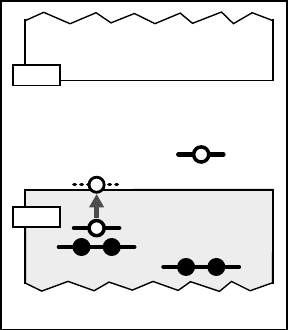
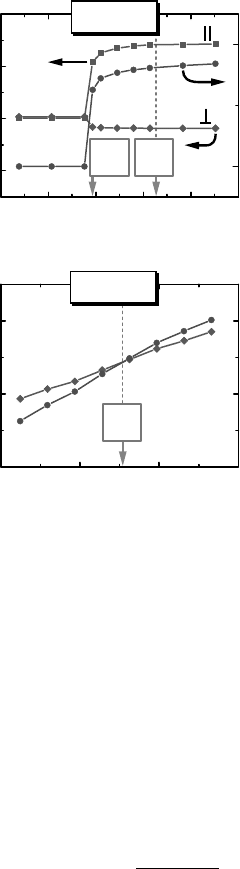
lift the unoccupied O-p state into the gap and to stabilize the polaronic hole state.
Indeed, when we phase-in V
hs
, we observe that beyond a critical value l
hs
> l
cr
hs
of the
hole state potential, the symmetry breaking occurs and a strong local magnetic
moment develops at the O-site at which the hole is localized, as shown in
Figure 11.4a. In this calculation, in which we used the exchange-correlation func-
tional of Ref. [11] for the underlying DFA, the condition Eq. (11.4) is fulfilled
for l
lin
hs
¼4.3 eV [19] (see Figure 11.4b), at which point the correct linear behavior
[cf. Eq. (11.3)] is recovered. Since, l
lin
hs
lies well above the critical value l
cr
hs
required to
stabilize the polaronic state (see Figure 11.4b), the polaron state is predicted to be the
physically correct state. Note that when Eqs. (11.4) or (11.5) are employed to
determine the appropriate value for the parameterized functional ( e.g., l
hs
for the
on-site potential V
hs
), one has to correct for supercell finite-size effects that affect both
total energies E(N) (see Refs. [49, 54]) and single-particle energies e(N) [56] in case the
electron number N corresponds to a charged defect state.
11.4
Koopmans Behavior in Hybrid-functionals: The Nitrogen Acceptor in ZnO
While HF theory was successful in describing qualitatively correctly the localization
of holes on single oxygen sites, e.g., for the Al
Si
defect in SiO
2
(smoky quartz) [17, 18],
or Li
Mg
in MgO [22], it does not provide a quantitative description: e.g., it predicts
much too large band gaps and exceedingly large hole binding energies, e.g., the hole
state bound at an O-neighbor of Li
Mg
in MgO was found roughly 10 eV above the
valence band in Ref. [22]. Accordingly HF predicts often polaronic carrier trapping
CBM
VBM
ZnO:Li
Zn
shallow
deep
DFA DFA+V
hs
Figure 11.3 (online colour at: www.pss-b.
com) Schematic illustration of the occupied and
unoccupied single particle energies for the
oxygen hole due to Li
Zn
in ZnO. In DFA (left), the
localized hole at the O-site is unstable and
relaxes into the shallow effective-mass state
just above the VBM. Applying the hole-state
potential V
hs
(right) increases the splitting
which stabilizes the localization of the hole
in one O-p sub-orbital (cf. Figure 11.1).
11.4 Koopmans Behavior in Hybrid-functionals: The Nitrogen Acceptor in ZnO
j
189
even in cases where it should not [57]. However, a reasonable compromise may be
achieved by mixing only a fraction of the non-local Fock exchange into the DFA
Hamiltonian. The non-local exchange potential in such hybrid-functionals has the
general form
V
nl
x
ðr; r
0
Þ¼a
X
i
y
i
ðr
0
Þy
i
ðrÞ
jrr
0
j
f ðjrr
0
jÞ; ð11:9Þ
where the parameter a and the attenuation function f vary among different formula-
tions of hybrid-functionals, e.g., B3LYP [39] (a ¼0.2, f ¼1), PBEh [40] (a ¼0.25, f ¼1),
HSE [41] [a ¼0.25, f ¼erfc(m|r r
0
|)], or screened exchange [58–60] [a ¼1, f ¼exp
(k
TF
|r r
0
|)]. For suitable parameters, such hybrid-functional calculations give
reasonable band gaps, and therefore are increasingly applied for the prediction of
defects in semiconductors [61–64]. (Note that the mentioned functionals further
differ in the amount of semi-local gradient corrections for exchange and correlation,
Energy wrt VBM (eV)
(b)
(a)
E
add
ΖnΟ:Li
3.0
2.5
2.0
1.5
1.5
1.0
1
1234
3.5 4.0 4.5 5.0
56
0
λ
hs
(eV)
λ
hs
(eV)
O
-
I
local moment (µB)
Li-O distance (Å)
d
d
e
i
(N)
λ
hs
lin
λ
hs
cr
m
ΖnΟ:Li
λ
hs
lin
Figure 11.4 (online colour at: www.pss-b
.com) (from Ref. [19]). (a) Structural and
magnetic properties of the Li
Zn
impurity in ZnO,
as a function of the hole-state potential
strength l
hs
. The polaronic state is stable
above a critical value l
hs
> l
cr
hs
. The distance d
jj
between Li and the O atom with the trapped
hole becomes larger than the distance d
?
between Li and the O atoms in the basal
plane. (cf. Figure 11.1b), and a strong local
magnetic moment m occurs. (b) The
electron addition energy E
add
¼E(N þ 1) E
(N) and the energy eigenvalue e
i
(N) of the
initially unoccupied acceptor state of Li. l
lin
hs
marks the value of l
hs
for which Eq. (11.4)
is satisfied.
190
j
11 Predicting Polaronic Defect States by Means of Generalized Koopmans Density
which has, however, only minor effects on the band-structure properties). Hybrid-
functionals have also been used to describe anion-localized hole states for defects in
various oxides, i.e., those cases where standard DFA fails even qualitatively, like Al
Si
in SiO
2
[23], Al
Ti
in TiO
2
[65], and Li
Zn
in ZnO [21, 24].
Since, as discussed above, HF theory exhibits the opposite E(N) non-linearity
(concave) of DFA (convex), the mixture of DFA and Fock exchange can in principle
also be used to cancel the non-linearity of E(N), i.e., to make the generalized
Koopmans condition, Eq. (11.4), fulfilled. Typically, however, hybrid-functional
parameters are either taken from the pre-defined standards of the respective
hybrid-functional formulation [21, 66] or are adjusted to match the experimental
band gap [24, 64], and neither choice guarantees that the cancellation of non-linearity
is complete. Indeed, some previous hybrid-functional calculations showed deviation
from experimentally established facts, either quantitatively (ZnO:Li, Ref. [21]) or even
qualitatively (SiO
2
:Al, Refs. [17, 18]). The ability of hybrid-functionals to match the
generalized Koopmans condition was recently addressed for defects in elemental
semiconductors [67], and for the case of the N
O
acceptor in ZnO [68].
Acceptor-doping of ZnO with nitrogen is subject of a controversy in the exper-
imental literature [69]. While substitutional N
O
dopants are often considered as being
shallow acceptors, magnetic resonance experiments found a strongly localized hole-
wavefunction [70, 71] that is inconsistent with the picture of a shallow effective-mass
acceptor.
As shown in Figure 11.5a, the N
O
acceptor state is already at the DFA level more
localized than an effective-mass state, in contrast to Li
Zn
(Figure 11.1). In DFA, the
hole-state has p
xy
character (p-orbitals perpendicular to the crystal c-axis), stemming
from a half-occupied e
g
symmetric state. As seen in Table 11.1, the all four NZn
nearest neighbor distances are almost identical. When applying the on-site potential
V
hs
to N-p orbitals (in addition to V
hs
for the O-p orbitals as above), using a parameter
l
hs
such to satisfy the Koopmans condition, Eq. (11.4), [72] the hole becomes largely
localized within a single N-p
z
orbital, stemming from an unoccupied a
1
symmetric
state. The nearest neighbor distances are now strongly anisotropic, the Zn atom along
the c-axis having an 0.2 A
larger distance from N than the Zn atoms in the basal
plane (Table 11.1). Thus, in Koopmans-corrected DFT the partial occupancy is lifted,
which leads to a Jahn–Teller relaxation, in accord with experimental interpreta-
tions [70, 71]. Comparing the effect of non-local Fock exchange with that of the on-site
potential V
hs
, we see that both methods predict very similar acceptor wave-functions
(Figure 11.5) and defect geometries (Table 11.1).
Whereas the structural properties and the wavefunction localization of ZnO:Li
showed an almost digital switching between the symmetric delocalized and the
symmetry-broken localized configurations with variation of the potential strength
parameter l
hs
(Figure 11.4a) the vertical acceptor ionization energy showed a more
continuous variation with l
hs
(Figure 11.4b). A similar sensitivity on the details of the
parameterized functional can be expected for the thermal (relaxed) acceptor ioniza-
tion energy. Therefore, we examined the relation between the Koopmans behavior
and the depth of the N
O
acceptor level [68]: standard DFA calculations predicted
the acceptor level 0.4 eVabove the VBM [36]. When we apply DFA þ U to account for
11.4 Koopmans Behavior in Hybrid-functionals: The Nitrogen Acceptor in ZnO
j
191
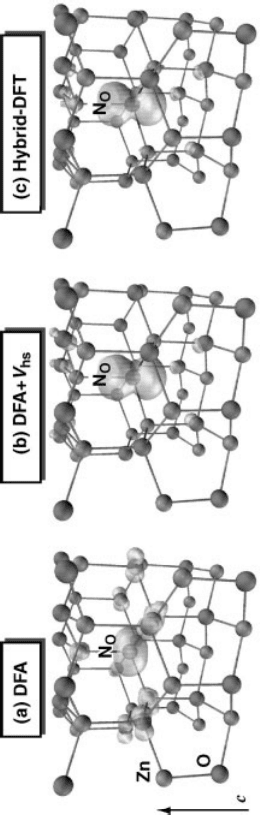
Figure 11.5 (online colour at: www.pss-b.com) (modified from Ref. [68]). Calculated spin–density (green: isosurface of 0.03 m
B
/A
3
) of the neutral N
0
O
acceptor
state in (a) standard DFA, (b) in Koopmans-corrected DFA with the onsite potential V
hs
, and (c) in the HSE hybrid-functional. The arrow indicates the c-axis
of the Wurtzite crystal.
192
j
11 Predicting Polaronic Defect States by Means of Generalized Koopmans Density
the too high Zn-d orbital energy and the resulting exaggerated p–d repulsion [49], we
get already a quite deep acceptor level at 0.7 eV above the VBM (see Table 11.1). This,
however does not yet address the Koopmans behavior of the N–p like hole state.
Indeed, when we calculate the non-Koopmans energy D
nK
¼E(N þ 1) E(N) e
i
(N)
[cf. Eq. (11.4)], we find a large positive value D
nK
¼þ0.6 eV (Table 11.1) [72]
originating from the convex E(N) behavior of DFA. When the generalized Koopmans
condition D
nK
¼0 is restored by means of the on-site potential V
hs
, the acceptor level
lies even much deeper at 1.6 eV above the VBM.
We further tested the Koopmans behavior of N
O
in the HSE hybrid functional,
comparing two different values for the parameter a [see Eq. (11.9)], i.e., the standard
value a ¼0.25 [40, 41], and an increased fraction of Fock exchange a ¼0.38, chosen
such to reproduce the experimental band gap of ZnO [63]. We find that for a ¼0.25
the Koopmans condition is quite well fulfilled, although the band gap is still
underestimated by about 1 eV. The acceptor level at 1.4 eV is close to the prediction
with the on-site potential V
hs
. A similar acceptor level was also found in a recent
hybrid-functional study [64], although for a rather different parameter a ¼0.36. For
the gap-corrected value a ¼0.38, we find a negative value D
nK
¼0.4 eV (Table 11.1),
indicating concave E(N) behavior, i.e., overcorrection relative to the underlying DFA.
Therefore, the corresponding acceptor level at 2.1 eV is most likely unrealistically
deep. From the cancellation of the E(N) non-linearity in different functional, as
summarized in Table 11.1, we can conclude on theoretical grounds that shallow
acceptor states that have been reported in ZnO [74–76] cannot originate from
substitutional N
O
impurities, and must have other causes. One recent suggestion
is that the shallow levels are related to stacking faults, possibly decorated with
additional defects or impurities [77].
11.5
The Balance Between Localization and Delocalization
In Ref. [78], we described two fundamentally different behaviors an electrically active
defect (i.e., a donor or an acceptor) can assume: (i) the primary defect-localized state
(DLS), which results from the atomic orbital interaction between the defect atom and
Table 11.1 Properties of the neutral N
O
acceptor in ZnO in different methods: the nearest neighbor
N–Zn distances d
||
and d
?
(cf. Figure 11.1), the acceptor level e(0/1 ), and the non-Koopmans
energy D
nK
.
d
||
/d
?
(A
) e(0/1 ) (eV) D
nK
(eV)
DFA
a)
1.93/1.95 E
V
þ 0.74 þ0.62
DFA
a)
þ V
hs
2.18/1.94 E
V
þ 1.62 0
HSE (a ¼0.25) 2.16/1.96 E
V
þ 1.40 0.05
HSE (a ¼0.38) 2.16/1.96 E
V
þ 2.05 0.40
a) see Ref. [73].
11.5 The Balance Between Localization and Delocalization
j
193
its ligands, forms a resonance inside the continuum of host bands. In this case of
a shallow defect, the carriers (electrons or holes) occupy a secondary perturbed host
state (PHS) with a delocalized, band-like wavefunction and an energy close to the
band edge. (ii) The DLS lies inside the band gap. This is the signature of a deep defect
state, and the wavefunction is usually localized at the site of the defect and its ligands.
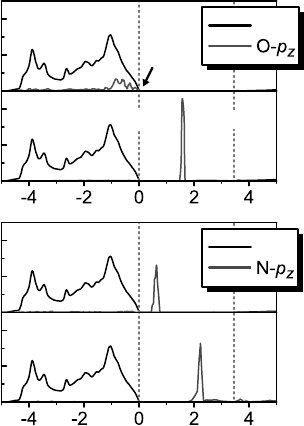
Even though Li is clearly a deep acceptor in ZnO on account of its large ionization
energy and the localized nature of the bound hole [19], it is an interesting observation
that the charged Li
Zn
acceptor does not show a quasi-particle energy state inside the
band gap, as shown in Figure 11.6a, and therefore shows the signature of the case (i)
of a shallow state. In its equilibrium structure, the ionized Li acceptor exhibits no
symmetry breaking, and all nearest neighbor are practically equal (d
Li–O
¼2.0 A
)as
expected from the approximate local T
d
symmetry in the wurtzite lattice [79]. The
large anisotropy in the NN-distances (cf. Figure 11.4a) occurs only after a hole is
bound on one of the four initially equivalent O neighbors. One can, therefore, raise
the Chicken or egg like question whether the hole localization causes the symmetry
breaking of the atomic structure, or whether the symmetry breaking drives the hole
localization. The answer to this question depends on whether the hole localizes on
a single O-site even in the absence of the lattice distortion, or, in other words, whether
there exists an energy barrier in the configuration coordinate diagram that causes
(b) Li
0
Zn
DOS DOS
E
-
E
V
(eV)
E
C
E
V
ZnO
ZnO
(a) Li
Zn
-
(c) N
-
O
(d) N
0
O
PHS
DLS
DLS
DLS
Figure 11.6 (online colour at: www.pss-b
.com) Density of states (DOS) for the ionized
and charge-neutral Li
Zn
and N
O
acceptor states
in ZnO, calculated in DFA þ V
hs
(see Ref. [73]).
The local DOS is projected on the O- p
z
and N-p
z
orbitals which host the bound hole in case of the
charge-neutral acceptors (cf. Figures 11.1b
and 11.5b, respectively).
194
j
11 Predicting Polaronic Defect States by Means of Generalized Koopmans Density