
API RP 2T-2010 Planning, Designing, and Constructing Tension Leg Platforms
Подождите немного. Документ загружается.


PLANNING, DESIGNING, AND CONSTRUCTING TENSION LEG PLATFORMS 71
7.8.4.3 The designer may consider directional distributions of environmental conditions. The assumption of
collinear wind, wave, and current is appropriate in the absence of more detailed data. If enough information is
available, use of appropriate noncollinear environments may be used and can result in a reduced estimate of
maximum offset.
7.8.5 Environmental Forces Contributing to Offset
7.8.5.1 General
The environmental forces of interest can be classified by their frequency content as:
— steady or mean forces,
— wave frequency forces, and
— low-frequency forces.
The steady or mean forces result in a mean offset of the platform. The low-frequency forces excite motion
which is below wave frequencies and predominately at frequencies near the surge, sway, or yaw natural
frequencies of the platform. The wave frequency forces result in wave frequency surge, and sway motions.
7.8.5.2 Mean or Steady Forces
The following steady forces should be considered.
a) Mean wind forces (see 6.2, 7.5.8 and 7.6.6)—The wind speed used should be an average wind speed for
an extended period (approximately one hour) based on the appropriate environmental conditions (return
period).
b) Current force (see 6.3.2, 7.5.8, and 7.6.6)—The drag contribution due to tendons and risers should be
included in estimating the total force.
c) Steady wave drift—Steady wave-drift forces result from wave diffraction and from second-order viscous
effects. The interaction between waves and current can also result in steady forces which should be
considered. See 7.5.8 and 7.6.6 for a discussion of these forces.
7.8.5.3 Wave Frequency Forces
The wave frequency forces are dominated by first-order drag and inertial wave loads on the platform. These
forces are discussed in 6.5, 7.5.7, 7.6.5, and 7.6.6.
7.8.5.4 Low-frequency Forces
The following forces contribute significantly to low-frequency motion and should be considered:
a) Wind forces—The wind gust spectrum (see 6.2, 7.5.8, and 7.6.6) should be used to model the wind
speed variation from the average wind speed. The mean wind speed which is used as a parameter in
most gust spectrum models should be the same as the wind speed used to estimate the mean wind force.
Simiu and Leigh (1983)
[222]
discuss the calculation of time varying forces on the platform from the wind
gust spectrum.
b) Wave/Current forces—A force spectrum for slowly varying (low frequency) wave-drift forces should be
estimated for the appropriate wave conditions (see 7.5.8 and 7.6.6).
Copyright American Petroleum Institute
Provided by IHS under license with API
Licensee=Shell Global Solutions International B.V. Main/5924979112, User=Low, Ko
Not for Resale, 01/31/2011 00:10:44 MST
No reproduction or networking permitted without license from IHS
--``,`,```,,,``,`,``,,,,,,,,,,`-`-`,,`,,`,`,,`---

72 API RECOMMENDED PRACTICE 2T
7.8.5.5 Force Spectrum
Pinkster (1980)
[210]
gives a method to estimate the force spectrum from second-order potential wave drift
given the steady wave-drift forces vs. wave frequency and the appropriate wave spectrum. It may also be
appropriate to consider contributions from viscous wave-drift and wave/current interactions. Burns (1983)
[110]
gives an approximate method to estimate the effects of wave/current interactions.
7.8.6 Offset Components
7.8.6.1 The TLP horizontal motions can be conveniently divided into three contributions corresponding to
the classification of forces discussed in 7.8.4.
a) Mean offset—The mean vessel offset can be estimated by developing a restoring force vs. offset function
and applying the estimated mean force to give an estimate of mean offset. The restoring force function
depends on setdown, tendon stretch, catenary effects, and the effect of time varying tendon tension.
b) Wave frequency motions—The wave frequency horizontal motions can be modeled by using either the
frequency or time domain techniques discussed in 7.5 and 7.6.
c) Low-frequency motions—The low-frequency motions can also be modeled using either time or frequency
domain techniques.
7.8.6.2 For frequency domain modeling, the force spectrum for wave drift (or total low-frequency wave
forces) can be combined with the wind force spectrum to give a total low-frequency force spectrum (see 7.5.8
and 7.6.6). Assuming that the low-frequency wind and wave forces are independent, the total low-frequency
force spectrum is given by the sum of the low-frequency wave force spectrum and the low-frequency wind
force spectrum.
7.8.6.3 This total force spectrum can then be multiplied by the appropriate motion transfer function to
obtain the desired horizontal motion. Time domain simulation can also be used to obtain the low-frequency
motion. However, because the low-frequency motions are dominated by the surge, sway and yaw resonances
with natural periods of approximately 60 to 150 seconds, a long time simulation is required to include a
sufficient number of cycles for developing an accurate estimate of the statistical extreme. Modeling of the time
series should be done carefully. The use of discrete frequencies is discussed by Tucker, et al. 1984
[235]
.
Other classic works in wave group spectra (e.g. Funke and Mansard, 1979
[144]
), are relevant in developing
time domain analysis and model test wave time series. For time simulation a time history of low-frequency
forces is generated from wind and wave force spectra or directly from wind velocity and wave profile time
histories.
7.8.6.4 The estimation of damping is important because low-frequency motion is dominated by a resonant
response. Further discussion of damping is provided in 6.5.5.2, 7.5.7, and 7.6.5.
7.8.7 Estimating Extreme Offset for Design
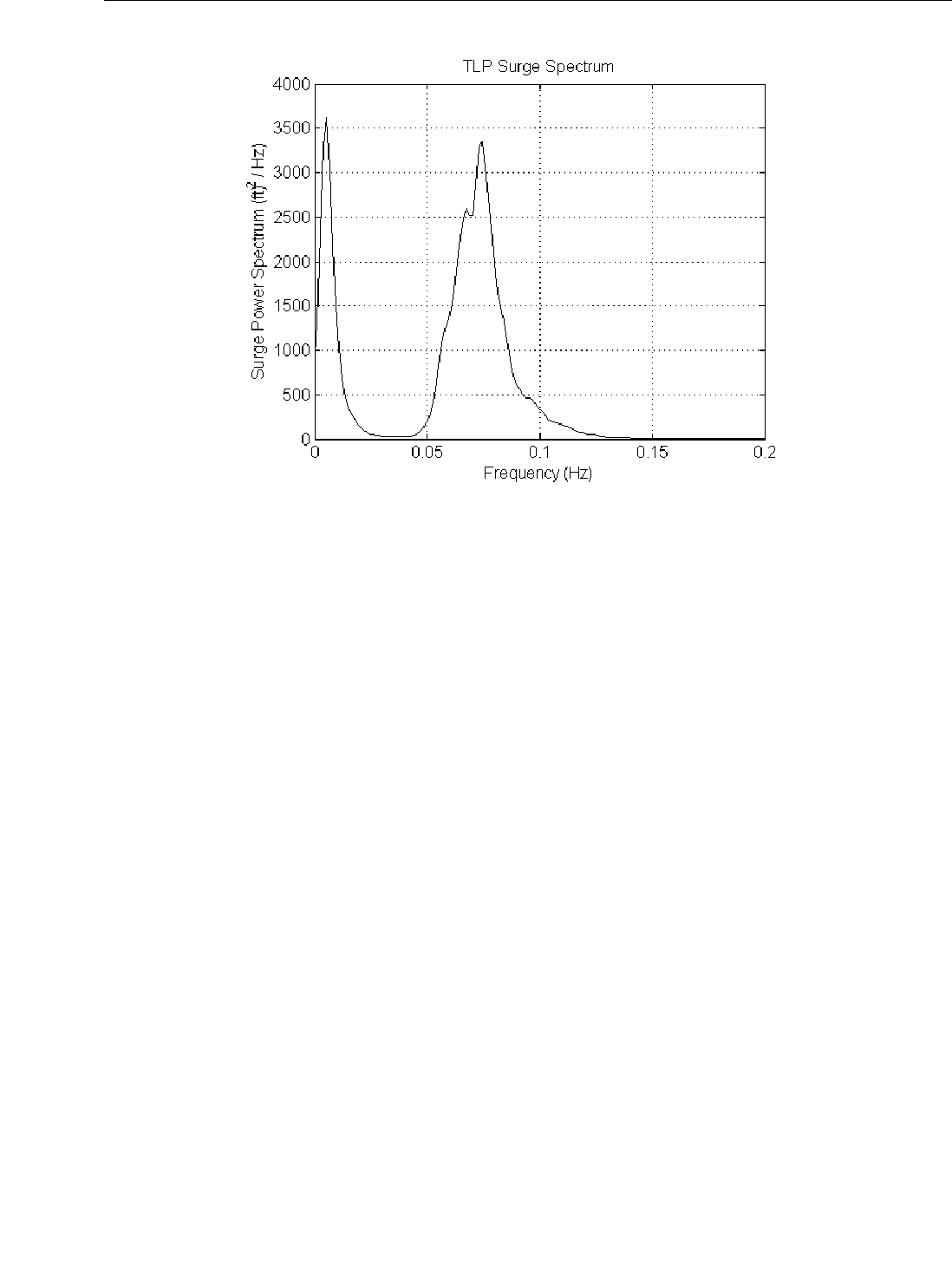
Due to the contribution of the low-frequency resonance, the resulting motion (combined low and wave
frequency motion) is broad banded. Figure 7 shows an example surge motion spectrum for a TLP in an
extreme storm.
The estimation of the extreme value of offset should consider the wide band nature of the process and be
based on wide band statistical methods.
Copyright American Petroleum Institute
Provided by IHS under license with API
Licensee=Shell Global Solutions International B.V. Main/5924979112, User=Low, Ko
Not for Resale, 01/31/2011 00:10:44 MST
No reproduction or networking permitted without license from IHS
--``,`,```,,,``,`,``,,,,,,,,,,`-`-`,,`,,`,`,,`---
PLANNING, DESIGNING, AND CONSTRUCTING TENSION LEG PLATFORMS 73
Figure 7—Surge Motion Spectrum
7.8.8 Maximum Offset Simplified Code Equation
7.8.8.1 Maximum offset has been formulated differently by various designers, while still achieving acceptable
safety in design. One simple formulation that has been used in both preliminary and final design is given by:
max mean slow drift + wave frequency
=+xxx
(26)
where
x
mean
is the offset due to current, one-minute wind, and steady wave-drift forces;
x
slow drift + wave frequency
is the maximum dynamic offset derived from spectral combination of wave
frequency motion and slow drift resonant offset.
7.8.8.2 It is noted that the dynamic extreme of combined low and wave frequency responses is typically
non-Gaussian, and requires use of statistical factors established by means such as model tests or nonlinear
simulations.
7.8.8.3 Other formulations which define other combinations of response and which can be shown to give
reasonable estimates of the expected maximum offset are also acceptable for design. The use of full
simulations that include all major contributors to offset variation are also acceptable for predicting design
values of maximum offset.
7.8.9 Maximum Yaw
The prediction of maximum yaw is important for predicting the maximum rotation of riser and tendon top
terminations and for the yaw contribution to horizontal excursions. The prediction of maximum yaw is similar
to predicting maximum offsets. The methods of 7.8.3 through 7.8.7 apply to yaw prediction except that
moments on the vessel shall be modeled instead of forces. This section will discuss only considerations
specific to yaw which are not identified in 7.8.3 through 7.8.7.
Copyright American Petroleum Institute
Provided by IHS under license with API
Licensee=Shell Global Solutions International B.V. Main/5924979112, User=Low, Ko
Not for Resale, 01/31/2011 00:10:44 MST
No reproduction or networking permitted without license from IHS
--``,`,```,,,``,`,``,,,,,,,,,,`-`-`,,`,,`,`,,`---

74 API RECOMMENDED PRACTICE 2T
7.8.10 Environmental Forces Contributing to Yaw
7.8.10.1 In modeling the environmental forces contributing to yaw, the designer should consider the likely
conditions and environmental directions that would result in extreme yaw. For example, the wind directions
resulting in the greatest steady and oscillating moments on the vessel should be considered. Modeling of
wind-induced moments is particularly difficult. Consideration should be given to moments induced by spatial
variability.
7.8.10.2 Noncentral center of gravity and eccentricity of the resultant horizontal environmental forces will
increase yaw responses to waves. Any likely loading conditions such as nonsymmetric placement of drilling
rigs or nonsymmetrical riser installations should also be considered. Checking of various wave headings may
be required because symmetric wave loadings will minimize the yaw response to waves. Multi-directional
seas tend to excite yaw more than uni-directional seas
7.8.10.3 Another source of yaw excitation can be vortex shedding from the columns in a steady current.
Resonant coupling between the vortex shedding and yaw motion has been shown to occur in model tests,
and should be checked for in high current areas (see 6.3.3 and A.1).
7.8.11 Estimating Yaw Responses
The yaw response can be estimated using the same techniques outlined for offset in 7.8.6. The modeling of
damping is also important in estimating yaw response.
7.8.12 Maximum Tendon Tension
7.8.12.1 Minimum and maximum tension calculations start with the vertical weight-buoyancy balance
given by Equation (13). The actual weight of the platform and the mean tension in the tendons and risers will
vary by load case depending on the load case weight condition, numbers of risers, etc. Extreme tension
calculations add or subtract tension variations caused by weight change and environmental response to
predict design values for minimum and maximum tension.
7.8.12.2 Maximum tension is governed both by environmental conditions and by the weight and
displacement of the platform (i.e. the mean pretension). The mean pretension is composed of a design value
pretension (T
o
), and operational variations (live load tension effects) about this design pretension. The live
load variations are to some extent controllable, and the value used in design load cases should reflect the
degree to which the designer/operator chooses to control the weight of the TLP. The environmental response
is composed of terms that are reasonably predictable, and some terms that cannot be easily predicted even
by state-of-the-art analysis techniques.
7.8.12.3 The nominal pretension is selected in order to control minimum tension, or to limit maximum
offset. The components shown in Table 6 should be considered for maximum tendon tension determination.
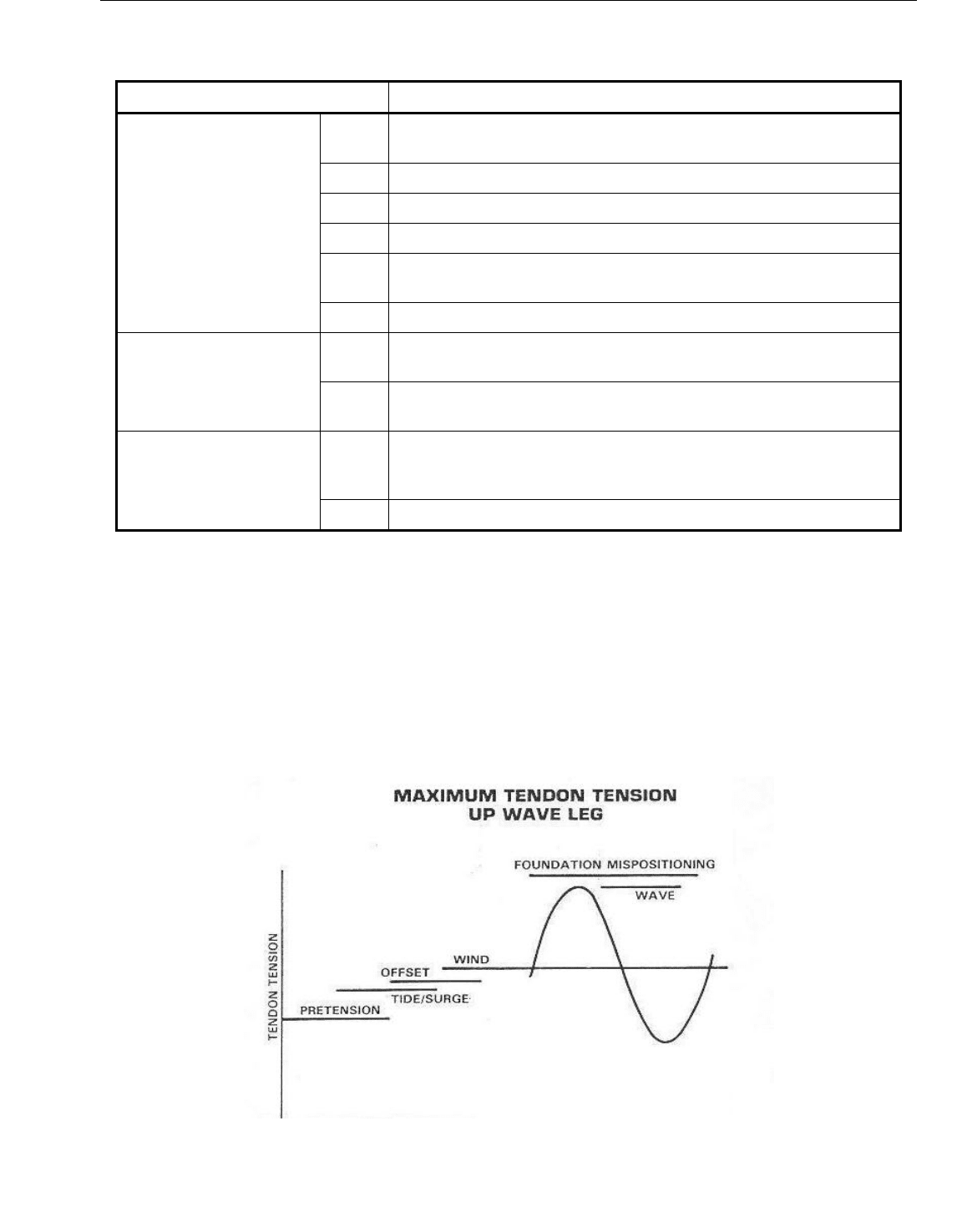
7.8.12.4 Maximum tendon tension may be estimated using a linear superposition incorporating the effects
discussed above:
max o t l m s w f r i v
+++++++++T TTTTTTTTTT=
(27)
The total wave-induced tension T
w
+ T
r
may be calculated using a design recipe as described in A.2.8.
Figure 8 illustrates the superposition of these tension contributions. This approach is adequate if a maximum
design condition can be determined that accounts for the statistical characteristics of the random sea
condition. The value of T
max
should correspond to the maximum expected tension over the design return
period. This should be determined from a statistical evaluation of the components of Equation (26), including
their joint probabilities of occurrence.
Copyright American Petroleum Institute
Provided by IHS under license with API
Licensee=Shell Global Solutions International B.V. Main/5924979112, User=Low, Ko
Not for Resale, 01/31/2011 00:10:44 MST
No reproduction or networking permitted without license from IHS
--``,`,```,,,``,`,``,,,,,,,,,,`-`-`,,`,,`,`,,`---
PLANNING, DESIGNING, AND CONSTRUCTING TENSION LEG PLATFORMS 75
Table 6—Components for Maximum Tension Determination
Tension Type Tension Component
Quasistatic
T
o
Design pretension (at the critical tendon section, including tendon weight)
at mean water level (mean tide)
T
t
Tide/storm surge water level variation loads
T
l
Load and ballast condition/weight variations/design margin
T
m
Tension due to overturning moment from wind and current forces
T
s
Tension caused by setdown due to static and slowly varying offset (wind,
wave drift, and current)
T
f
Tendon loads from foundation mispositioning at maximum platform offset
Wave-induced tension
T
w
Tension variation from wave forces and wave-induced vessel motion
about the mean offset (including any coupled tendon responses)
T
r
Loading due to heave, pitch, and roll oscillations at their natural frequency
(ringing and springing, including possible underdeck slamming loads)
Individual tendon effects
T
i
Individual tendon load sharing differential (one of a group of tendons
generally carries a greater share of the load because of anchor template
rotational tolerances, vessel yaw, initial setting tolerances, etc.)
T
v
Tension induced by vortex shedding responses of an individual tendon
7.8.12.5 When calculating the maximum stresses in the tendons, there are other stresses and loads that
sometimes have to be included. For example, if the tendons contain fluid at a temperature other than
seawater temperature, then thermal stresses should be considered.
7.8.12.6 If all of the terms in Equation (26) are taken to be extreme or maximum values, the resulting
estimate of tension will be very conservative, with a much lower probability of occurrence than the return
period of any one of the terms. In order to calculate a reasonable design value for maximum tension, the joint
statistics of the driving functions should be considered. The joint statistics of wind, wave, current, and
tide/surge can be used with the vessel response functions to estimate a tension corresponding to the design
return period (see Forristall, et al. 1991
[141]
and Leverette, et al. 1982
[177]
).
Figure 8—Maximum Tension Components
Copyright American Petroleum Institute
Provided by IHS under license with API
Licensee=Shell Global Solutions International B.V. Main/5924979112, User=Low, Ko
Not for Resale, 01/31/2011 00:10:44 MST
No reproduction or networking permitted without license from IHS
--``,`,```,,,``,`,``,,,,,,,,,,`-`-`,,`,,`,`,,`---

76 API RECOMMENDED PRACTICE 2T
7.8.13 Maximum Tension Simplified Code Equation
7.8.13.1 Maximum tension has been formulated differently by various designers, while still achieving
acceptable safety in design. One simple formulation which has been used in both preliminary and final design
is given by:
max o setdown
wind, wave drift, current moments
wave + springing + ringing
() ( )T T at HDWL T at max drift offset
T
T
=+
+
+
(28)
where
max drift offset is the (offset due to current, one-minute wind, and steady wave drift) + (significant value
of wave and wind slow drift) and the significant value is twice the standard deviation.
7.8.13.2 Equation (28) is generally applied to the most sensitive upwave tendon. If the dynamic terms in
the downwave tendon are sufficiently large to overcome the moment effects in the upwave tendon, then the
downwave tendon should be used to determine maximum tension.
7.8.13.3 Other formulations that define reasonable combinations of response and that can be shown to
give reasonable estimates of the expected maximum tension are also acceptable for design. The use of full
simulations that include all major contributors to tension variation is also acceptable for predicting design
values of maximum tension.
7.8.14 Minimum Tension
7.8.14.1 Similar to maximum tension, the minimum tension is governed both by environmental conditions
and by the weight and mean tension condition of the platform. Mean tension is composed of a design value
pretension (T
0
), and operational variations (live load tension effects) about this design pretension. The live
load variations are to some extent controllable, and the value used in design load cases should reflect the
degree to which the operator chooses to control the weight of the TLP. The environmental response is
composed of terms that are reasonably predictable, and some terms that cannot be easily predicted by state-
of-the-art analysis techniques.
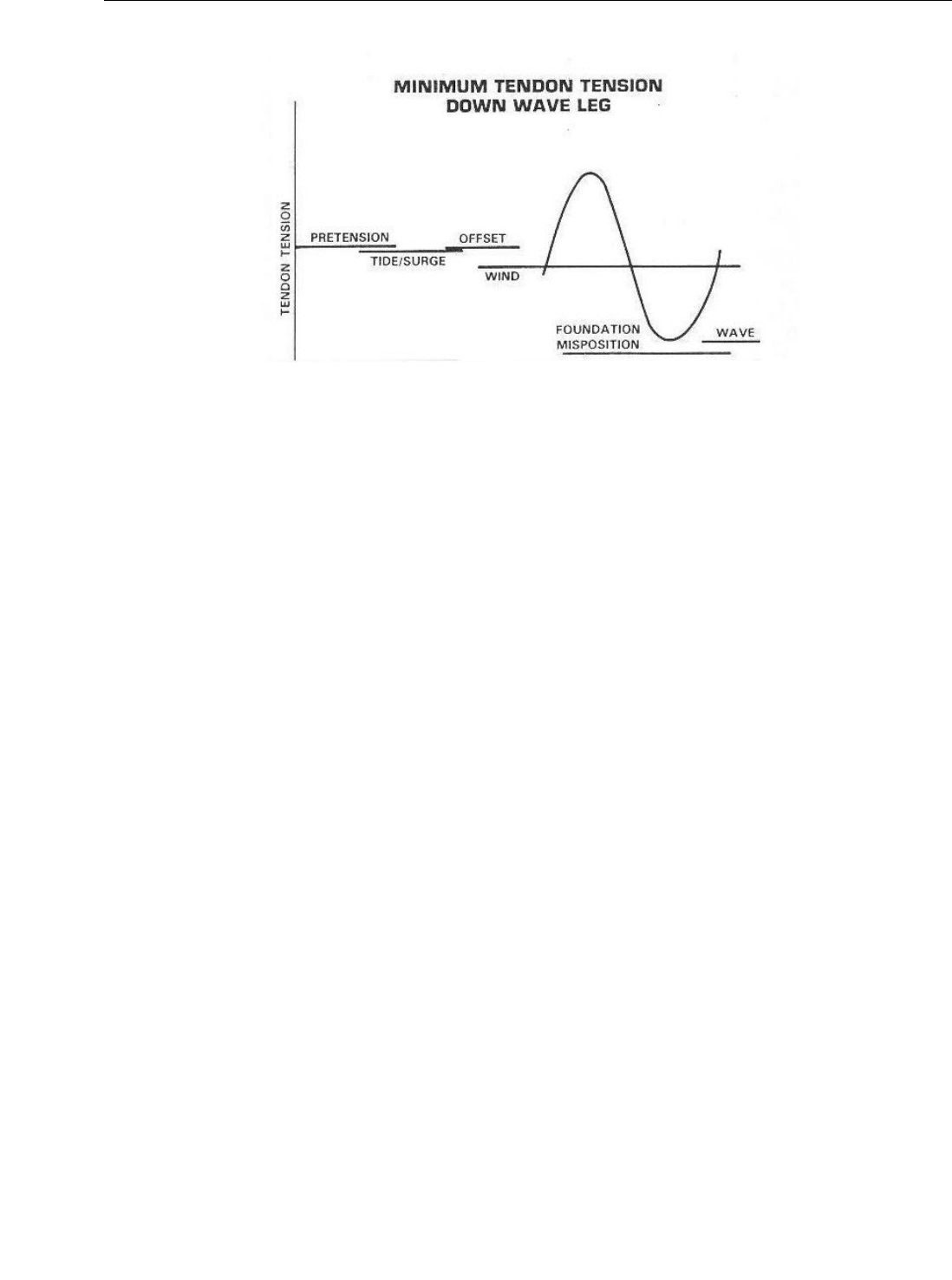
7.8.14.2 The minimum tension is determined by superposition of pretension and environmental effects as
shown in Equation (29).
min os tlmwf ri
++ ++ + +++T TTTTTTTTT=
⎡⎤
⎣⎦
(29)
NOTE The terms included in brackets generally are negative signed.
7.8.14.3 The minimum tension calculation in Equation (28) is illustrated in Figure 9. Although the form of
this equation is similar to Equation (26), the values of the terms may be different. In particular, the loading
condition and configuration corresponding to the most probable minimum tension conditions are different than
those corresponding to the maximum tension conditions. For example, the positive tide and surge term will be
different from the negative term, and the minimum tension will generally come from the minimum rather than
maximum slowly varying offset which is associated with an extreme wave event.
7.8.14.4 The combinations of wind, wave, and current that yield conservative estimates of maximum
tendon tension may not produce conservative estimates of minimum tendon tension. For example, strong
currents aligned with severe wind and waves may generate the largest tendon tensions. However the
smallest tendon tensions may be generated by severe wind and waves combined with weak currents or with
currents that have a heading that is orthogonal to the wind and waves (Forristall, Larrabee, and Mercier, 1991
[141]
). See A.3 for a discussion of long-term response analysis and the implementation of response-based
design criteria.
Copyright American Petroleum Institute
Provided by IHS under license with API
Licensee=Shell Global Solutions International B.V. Main/5924979112, User=Low, Ko
Not for Resale, 01/31/2011 00:10:44 MST
No reproduction or networking permitted without license from IHS
--``,`,```,,,``,`,``,,,,,,,,,,`-`-`,,`,,`,`,,`---
PLANNING, DESIGNING, AND CONSTRUCTING TENSION LEG PLATFORMS 77
Figure 9—Minimum Tension Components
7.8.14.5 For tendons with positive wet weight, the minimum tension occurs near the lower tendon
connection; hence the tendon weight (in water) needs to be subtracted from the minimum tension at the upper
flex element. Otherwise, the tension components may be evaluated by a method similar to those described
above for maximum tensions.
7.8.15 Minimum Tension Simplified Code Equation
Minimum tension has been formulated differently by various designers, while still achieving acceptable safety
in design. One simple formulation which has been used in both preliminary and final design is shown in
Equation (30).
min o setdown
wind, wave drift, current moments
wave + springing + ringing
() ( )T T at LDWL T at min drift offset
T
T
=+
+
+
(30)
where
the last two terms in Equation (30) are negative valued; and
min drift offset is the (offset due to current, one-hour wind, and steady wave drift) − (significant value of
wave and wind slow drift).
NOTE The minimum tension can occur in up-wave or down-wave tendons, depending on the system configuration.
Other formulations which define reasonable combinations of response and which can be shown to give
reasonable estimates of the expected minimum tension are also acceptable for design. The use of full
simulations which include all major contributors to tension variation is also acceptable for predicting design
values of minimum tension.
7.8.16 Minimum Tension Criteria
7.8.16.1 The design check for minimum tension is intended to ensure that there is sufficient tension to
maintain the structural integrity and restraint to motions that are provided by the tendon system to the TLP.
7.8.16.2 The fundamental design philosophy in today’s TLP concepts is that the tendon system provides
deterministic structural restraint of the structure in heave, pitch, and roll. The objective is to prevent
Copyright American Petroleum Institute
Provided by IHS under license with API
Licensee=Shell Global Solutions International B.V. Main/5924979112, User=Low, Ko
Not for Resale, 01/31/2011 00:10:44 MST
No reproduction or networking permitted without license from IHS
--``,`,```,,,``,`,``,,,,,,,,,,`-`-`,,`,,`,`,,`---

78 API RECOMMENDED PRACTICE 2T
unrestrained motions which may lead to tendon disconnect or excessive loads in the structure or tendon
system. This implies, for some systems, that individual tendons may go slack.
7.8.16.3 Because the sensitivity of a given configuration to the environment may vary from configuration to
configuration, or from environment to environment, limiting minimum tension response is best evaluated at a
survival level environment.
7.8.16.4 For Category A and Category B, the minimum tendon tension in at least one tendon per corner
should remain non-negative. For Category S, minimum tension in at least three corner groups of tendons
shall maintain non-negative tension in the survival environment.
7.8.16.5 For Category S, if non-negative tension is not maintained in all corner groups in the survival
environment, then a comprehensive coupled analysis of the tendon system performance under loss of tension
shall be performed to demonstrate proper reengagement of the bottom connector with the foundation
receptacle and adequate robustness against subsequent snatch loading. The analysis shall examine detailed
load sequences induced in all components (top and bottom) on all tendons to ensure load capacities are not
exceeded and components function as intended in order to prevent tendon disconnect. See Section 9 for
detailed guidance.
7.8.17 Tendon Angle
7.8.17.1 Maximum tendon angle at the upper and lower flex assemblies is closely tied to maximum surge
and yaw, with the addition of any tendon motion effects. Accuracy of fabrication and of foundation installation
should also be considered. The maximum value is used for design of the flex assembly, for hull and
foundation clearance allowance, and for calculating bending stresses in the tendon.
7.8.17.1 The maximum angles may be calculated using the maximum surge and yaw calculation methods
together to predict a maximum excursion for the upper flex joint. This can be used as input to an analysis of
the tendon motion response that provides the angle responses. Due consideration of the consequences of
exceeding the predicted extreme should be included when calculating the response.
7.8.17.3 In addition to maximum angle, the flex joint designers generally require the envelope of load range
and angle for completing the flex joint design. Minimum load at high angles is likely to be of as much concern
as maximum load. Joint statistics of wind, wave, and current are needed to properly estimate the load/angle
envelope. Frequency domain methods can be used if phase information between offset and tension is
retained. Time domain and model test methods are also suitable.
7.8.18 Minimum Deck Clearance
7.8.18.1 The minimum deck clearance for a TLP is governed by a combination of increasing water level and
decreasing deck height. The increasing water level is caused by incident wave elevation, tide, storm surge,
and radiation/diffraction effects from the platform. In very steep sea conditions, the diffraction effects can be
considerable. The decreasing deck elevation is caused by platform setdown with offset. Platform setdown
increases nonlinearly at high offsets, leading to a rapid decrease of clearance with increasing environmental
severity.
7.8.18.2 The radiated or diffracted waves generally cause the wave to impact the deck locally. In some
cases, local impacts may be accounted for in design, and may result in both local stiffening and increased
weight of the deck as well as tendon ringing, which affects the peak loads in the tendons and porch structure.
Increased tendon load response will also affect the minimum tension, which will in turn affect the design
pretension.
7.8.18.3 The deck height has a significant effect on the vertical position of the center of gravity and, in
turn, on the maximum and minimum tendon tensions. The deck elevation also affects the wind load and wind
overturning moments. In general, a higher deck has adverse effects on tendon tension responses. However,
large tendon tension variations may result if the deck is too low and waves strike the lower deck.
Copyright American Petroleum Institute
Provided by IHS under license with API
Licensee=Shell Global Solutions International B.V. Main/5924979112, User=Low, Ko
Not for Resale, 01/31/2011 00:10:44 MST
No reproduction or networking permitted without license from IHS
--``,`,```,,,``,`,``,,,,,,,,,,`-`-`,,`,,`,`,,`---

PLANNING, DESIGNING, AND CONSTRUCTING TENSION LEG PLATFORMS 79
7.8.18.4 In determining the deck clearance, one should consider the following:
a) wave crest elevation,
b) storm and astronomical tides,
c) platform setdown due to platform offset and yaw,
d) local wave modifications due to the presence of the hull,
e) dynamic vertical motion of platform,
f) air gap,
g) phase angle between wave crest and platform position.
7.8.19 Minimum Deck Clearance Criteria
7.8.19.1 The design check for minimum deck clearance is intended to ensure that there is sufficient deck
height to prevent inundation of the deck by wave crests, thereby preventing damage to equipment and
preventing excessive loads to the deck and total TLP system.
7.8.19.2 The deck clearance criteria apply to deck structure that is not intended to be immersed. There have
been concepts proposed, such as bare wellhead support structures, where the deck is intended to be
inundated by wave crests in extreme conditions, and in which the deck and overall TLP system are designed
for such occurrences to “extreme” load safety factors. The minimum airgap criteria do not apply to such
structures.
7.8.19.3 Because of the increased setdown with storm severity, traditional design approaches such as the
specification of a nominal clearance in the design level 100-year storm may not be adequate. The designer
should consider both the consequences of deck impact, and the rapidity with which clearance is being
diminished.
7.8.19.4 The recommended minimum deck clearance criteria requires a 1.5 m (5 ft) clearance to main steel
in extreme conditions (100-year return period), combined with zero or greater clearance in survival (1000-year
minimum return period) conditions with no margins. Local wave effects in these conditions can be dealt with
by local strength design.
7.8.19.5 If the designer chooses to design for deck impact rather than ensure sufficient clearance to avoid
impact, the TLP system, including deck, hull, tendons, and foundations should be designed for the anticipated
local and global wave forces (including slamming) and resulting responses.
7.8.19.6 Given recent Gulf of Mexico large storm observations, it may be good practice to provide tripping
brackets on major deck girders even with designs meeting the criteria described in this section.
7.8.20 Maximum Acceleration
7.8.20.1 The lateral accelerations of the platform are used in the design of the structure and in the design of
equipment and equipment supports. In addition to the in-service condition, other conditions during fabrication,
transportation, and installation phases of the platform life should be considered. The response of interest is
generally the extreme horizontal acceleration, although operating condition accelerations may be important in
the design of process equipment and deck drainage systems.
7.8.20.2 Global lateral accelerations are governed by the dynamic horizontal offset forces acting on the
platform. These are dominated by first-order wave forces and nonlinear high-frequency wave forces, but may
also include wind and wave-drift components. Local lateral accelerations are also produced by the rotational
responses of pitch, roll and yaw.
Copyright American Petroleum Institute
Provided by IHS under license with API
Licensee=Shell Global Solutions International B.V. Main/5924979112, User=Low, Ko
Not for Resale, 01/31/2011 00:10:44 MST
No reproduction or networking permitted without license from IHS
--``,`,```,,,``,`,``,,,,,,,,,,`-`-`,,`,,`,`,,`---

80 API RECOMMENDED PRACTICE 2T
7.8.20.3 The wave frequency and high-frequency motions and accelerations are estimated by frequency or
time domain solutions to the equations of motion supplemented by model tests. Deterministic or short term
probabilistic methods can be used to predict the maximum acceleration response.
7.9 Responses for Fatigue Analysis
7.9.1 Introduction
This section provides guidance in the prediction of the response histories for fatigue calculations. The
prediction of fatigue life or damage is by nature a statistical procedure. Historically, the standard procedure for
fatigue calculations involved deterministic analysis with high safety factors. However numerous investigators
have developed more accurate probabilistic approaches (see Wirsching, 1983
[249]
). These methods
inherently furnish the designer with more information on the fatigue properties, but the probabilistic approach
requires more input data than is often available. The three methods described in 7.9.1 through 7.9.1.3 are in
order of increasing complexity and data requirements.
7.9.1.1 Method 1—Discrete Wave Height and Period
The joint frequency statistics of wave height and wave period (as described in a wave scatter diagram) are
operated on by appropriate transfer functions to produce corresponding force and motion statistics. Due to the
sensitivity to wave period, traditional methods using a mean period for each wave height are not applicable.
Wave-drift, wind, and current response statistics can be estimated using similar methods.
7.9.1.2 Method 2—Frequency Domain
The joint (H
S
, T
P
) wave spectrum statistics are operated on by appropriate response amplitude operators
(RAOs) to produce corresponding force and motion spectra statistics. The response statistics to wave-drift
force, current, wind, and platform loadings are estimated using Method 1. The RAOs can be generated on the
basis of regular wave or random sea inputs, and with frequency or time domain simulations. Regular wave or
random sea model tests can also be used to generate the RAOs.
7.9.1.3 Method 3—Random Time Domain
A time domain simulation is performed for each sea state in the wave scatter diagram. The response statistics
generated from each time domain simulation are combined with the corresponding frequency of occurrence of
that sea state to generate the force and motion statistics.
7.9.2 Tendon and Foundation Loads
The tendon and foundation loads can be calculated using one of the above methods. However the results
should be modified to include the following effects, if present:
a) springing and ringing;
b) wave slamming on the deck, if this will be permitted;
c) setdown caused by surge, sway and yaw, the tides, and the platform loading.
7.9.3 Surge Offset/Tendon Flex Joint
The offset/tendon angle can be calculated using one of the above methods. The effect of the tide, storm
surge, and platform loading on the offset should be considered.
Copyright American Petroleum Institute
Provided by IHS under license with API
Licensee=Shell Global Solutions International B.V. Main/5924979112, User=Low, Ko
Not for Resale, 01/31/2011 00:10:44 MST
No reproduction or networking permitted without license from IHS
--``,`,```,,,``,`,``,,,,,,,,,,`-`-`,,`,,`,`,,`---