
API RP 2T-2010 Planning, Designing, and Constructing Tension Leg Platforms
Подождите немного. Документ загружается.


PLANNING, DESIGNING, AND CONSTRUCTING TENSION LEG PLATFORMS 101
8.6.7 Design for Accidental Loads
8.6.7.1 General
Structural design should consider the possibility of accidental events. The term “accidental event” is a
collective term for exceptional conditions, such as collisions, dropped objects, fire, explosion, or flooding.
8.6.7.2 Design Philosophy
Satisfactory protection against accidental damage can be obtained by a combination of two means:
— low damage probability,
— acceptable damage consequences.
8.6.7.3 Energy Absorption Capability
The structure should behave in a ductile manner to absorb energy caused by impact loads. Measures to
obtain adequate ductility are:
a) make the strength of connections greater than the strength of the members;
b) provide redundancy in the structure, so that alternate load redistribution paths may be developed;
c) avoid dependence on energy absorption in slender struts with a limited degree of postbuckling reserve
strength;
d) avoid pronounced weak sections and abrupt changes in strength or stiffness;
e) use materials that are ductile in the operating temperature range.
8.6.7.4 Damage Tolerance
A damaged platform should resist functional and reduced extreme environmental loads (see 5.6). This implies
that the platform should maintain its structural integrity and be stable with no immediate need for conducting
repairs. The residual strength of a damaged member may be included provided its magnitude can be
assessed by rational analysis or tests. If such residual member strength is not proven, damaged members
should not be considered effective.
8.7 Fabrication Tolerances
Guidance on fabrication tolerances is given in Section 14. Any change in these tolerances as a consequence
of specific fabrication methods should be considered in the design. Structural configuration and details should
be developed to avoid fabrication complications so that tolerance requirements can be achieved and the
residual stresses limited.
8.8 Structural Materials
8.8.1 General
8.8.1.1 Purpose and Scope
The purpose of this section is to define materials appropriate for use in design and construction of TLPs.
Material selection should be done in conjunction with consistent requirements for performance, welding and
inspection. Steels are covered in some depth; cement grout, concrete, and elastomers are discussed in less
Copyright American Petroleum Institute
Provided by IHS under license with API
Licensee=Shell Global Solutions International B.V. Main/5924979112, User=Low, Ko
Not for Resale, 01/31/2011 00:10:44 MST
No reproduction or networking permitted without license from IHS
--``,`,```,,,``,`,``,,,,,,,,,,`-`-`,,`,,`,`,,`---

102 API RECOMMENDED PRACTICE 2T
detail. Fracture and fatigue considerations are indicated for all critical components with yield strength of 50 ksi
(345 MPa) or greater. Also refer to API 2A-WSD.
8.8.1.2 Specifications
Steel should conform to a definite specification and to the minimum strength level, group, and class in
accordance with the design. In situations where an appropriate ASTM, API, or class society specification does
not exist, a material specification should be developed, subject to reproduction qualification (see API 2Z) and
used as appropriate for each situation.
Certified mill test reports or certified reports of tests made by the fabricator or a testing laboratory in
accordance with ASTM A6, ASTM A450, or equivalent constitutes evidence of conformity with the
specification.
8.8.2 Manufactured Steel
8.8.2.1 Structural Shape and Plate Specifications
Unless otherwise specified by the designer, structural shapes and plates should conform to one of the
specifications listed in API 2A-WSD, Table 8.2.1-1. Steels above the thickness limits stated may be used,
provided applicable provisions are considered by the designer. In situations where an appropriate ASTM or
API specification does not exist, a materials specification should be developed, qualified, and used for each
situation.
8.8.2.2 Structural Steel Pipe
8.8.2.2.1 Specifications
Unless otherwise specified, seamless or welded pipe should conform to one of the specifications listed in the
in API 2A-WSD, Table 8.2.1-1.
Structural pipe should be fabricated in accordance with API 2B, ASTM A139, ASTM A381, or ASTM A671
using grades of structural plate listed in the API 2A-WSD, Table 8.1.4-1, except that hydrostatic testing may
be omitted. Refer to API 2A-WSD.
8.8.2.2.2 Selection for Service
Consideration should be given to the selection of steels with toughness characteristics suitable for the
conditions of service. For tubes cold formed to D/t less than 30, and not subsequently heat treated, due
allowance should be made for possible degradation of notch toughness, e.g. by specifying a higher class of
steel or by specifying notch toughness tests run at reduced temperature.
8.8.2.2.3 Steel Forgings and Castings
In situations where an appropriate ASTM specification does not exist, a detailed specification should be
developed and qualified for the specific application. Certified mill test reports and mechanical property tests
should be in conformance with the appropriate ASTM A6 or ASTM A370 specifications.
8.8.3 Special Applications for Steel
8.8.3.1 Tubular Nodes
Welded tubular joint intersections are subject to local stress concentrations that may lead to local yielding and
plastic strains at the design load. During the service life, cyclic loading may initiate fatigue cracks, making
additional demands on the ductility of the steel, particularly under dynamic loads. These demands are
particularly severe in heavy wall joint cans designed for high brace loads.
Copyright American Petroleum Institute
Provided by IHS under license with API
Licensee=Shell Global Solutions International B.V. Main/5924979112, User=Low, Ko
Not for Resale, 01/31/2011 00:10:44 MST
No reproduction or networking permitted without license from IHS
--``,`,```,,,``,`,``,,,,,,,,,,`-`-`,,`,,`,`,,`---

PLANNING, DESIGNING, AND CONSTRUCTING TENSION LEG PLATFORMS 103
8.8.3.2 Underwater Joints
Group I and Group II steels for underwater joints, such as tubular joint cans or through members in
overlapping joints, should meet the criteria provided in API 2A-WSD. Guidance on toughness selection for
Group III and Group IV steels is given in 8.8.4.
8.8.3.3 Abovewater Joints
For abovewater joints exposed to lower temperatures and possible impact from boats or dropped objects and
for critical connections at any location in which brittle fractures are to be prevented, the tougher Class A steels
should be considered, e.g. API 2H. Special attention should be given in developing welding procedures for
higher strength steels to ensure that the required mechanical and toughness properties are maintained
throughout the welded joint. Additional guidance for Group III and Group IV steels is given in 8.8.4.
8.8.3.4 Brace End
Although the brace ends at tubular connections are also subject to stress concentration, the conditions of
service are not quite as severe as for joint cans. For critical braces, for which brittle fracture would be
catastrophic, consideration should be given to the use of stub ends in the braces having the same class as
the joint can, or one class lower. Similar considerations may apply where stress risers are encountered along
the member between joints.
8.8.3.5 Critical Joints and Plate Intersections
Joints formed by the intersection of stiffened plates may form areas of high restraint, through-thickness
shrinkage strains, and high residual stresses and may be subjected to through-thickness tensile loads in-
service. Special care should be given to the design of stiffened intersections or terminations to minimize or
avoid the formation of stress intensifiers, notches, etc. For these and other highly restrained critical joints,
consideration should be given to the use of castings, forgings, or steel having improved through-thickness (Z-
direction) properties.
8.8.4 Fracture and Fatigue Considerations
8.8.4.1 Group I and Group II Steels
The recommendations in API 2A-WSD should be followed for these steels.
8.8.4.2 Group III and Group IV Steels
The operator should select materials and fabrication processes that lead to adequate levels of toughness and
fatigue properties under service conditions. Fatigue properties of tendon materials should be defined with
appropriate mean tensile stress.
8.8.4.3 Toughness Testing
8.8.4.3.1 General
The materials and fabrication methods used should have sufficient toughness to avoid brittle failure. For
Group I and II materials, this can be achieved by specification of Charpy V-notch toughness requirements at
prescribed temperatures. Steel with increased thickness or increased strength may require alternate means
for assessing toughness requirements.
8.8.4.3.2 Crack Tip Opening Displacement (CTOD)
Testing together with rational target toughness values may be used. This approach involves testing of
specimens of full thickness in the parent plate, heat affected zone (HAZ) and weld metal. The target value of
CTOD should ensure that readily detectable (and rejectable) fabrication flaws will not propagate unstably
Copyright American Petroleum Institute
Provided by IHS under license with API
Licensee=Shell Global Solutions International B.V. Main/5924979112, User=Low, Ko
Not for Resale, 01/31/2011 00:10:44 MST
No reproduction or networking permitted without license from IHS
--``,`,```,,,``,`,``,,,,,,,,,,`-`-`,,`,,`,`,,`---

104 API RECOMMENDED PRACTICE 2T
under service conditions. Effects of stress (or strain) concentration, residual stress, and loading rate should
be incorporated into the selection of target values. See API 2Z for prequalification requirements for
CTOD-qualified steels.
Application specific threshold thicknesses for requiring CTOD properties and the target levels should be
selected by the designer.
Charpy V-notch impact values achieved on procedures passing the CTOD requirements can be used as a
quality control indicator in production plate testing and routine qualifications.
8.8.4.4 Fatigue Resistance
This publication recommends fatigue analysis based either on the Palmgren-Miner S-N approach or the
fracture mechanics approach. API 2A-WSD provides recommended fatigue S-N curves that may be applied
when utilizing materials specified therein. However, when moving to higher strength material it is
recommended that sound justification be established before accepting an S-N curve for design purposes.
Such curves should be based on tests carried out on specimens of the appropriate material having
microstructures and weld profiles or notch effects (where appropriate) that model the general characteristics
to be found in prototype components. Testing should be carried out under conditions consistent with the
actual prototype operating environment with respect to loading frequency, area of application (in air, splash
zone, submerged), level of cathodic protection, temperature, bioorganic environment, and stress level. Curves
should cover the range of variables where they have significance to design.
The fracture mechanics approach to fatigue analysis should have reliable and pertinent fatigue crack growth
data. As with S-N curves, the data should be gathered from the tests appropriate to the design situation on
specimens having similar
— material chemistry and microstructure,
— environment,
— loading frequency,
— cathodic protection,
— temperature, and
— mean stress.
In particular, data should be collected at cyclic stress intensity levels pertinent to design. Testing should be
carried out on specimens with known KI calibrations. Standard compact and three-point bend specimens
should be considered.
8.8.5 Structural Welding
8.8.5.1 General
Welding should be done in accordance with applicable provisions of API 2A-WSD, the AWS D1.1, and other
applicable AWS documents, and shall be consistent with the requirements in 8.8.4 and the general provisions
in Section 14. Supplementary requirements, as outlined in these codes and otherwise, shall be specified for
the effects of dynamic loading on the structural welding requirements.
8.8.5.2 Inspection
The degree of inspection required should be specified by the designers to be consistent with service
requirements and material selection. As a minimum, inspection requirements of welded joints should conform
to the appropriate requirements of Section 14, API 2A-WSD, and AWS D1.1. Supplementary requirements for
Copyright American Petroleum Institute
Provided by IHS under license with API
Licensee=Shell Global Solutions International B.V. Main/5924979112, User=Low, Ko
Not for Resale, 01/31/2011 00:10:44 MST
No reproduction or networking permitted without license from IHS
--``,`,```,,,``,`,``,,,,,,,,,,`-`-`,,`,,`,`,,`---

PLANNING, DESIGNING, AND CONSTRUCTING TENSION LEG PLATFORMS 105
inspection, as outlined in these codes and otherwise, shall be specified for the effects of dynamic loading on
the structural requirements. Every effort during design should be made to ensure that all welds are easily
inspectable. Welds that are difficult to inspect may have been as difficult to weld properly. The use of 3D
modeling in the design phase is recommended for this review.
8.8.6 Elastomeric Materials
Deck structures may be designed as structurally independent modules supported by elastomeric bearing
pads. These pads effectively isolate the deck modules from wave loads acting on the hull while adequately
restraining the modules from platform lateral accelerations and wind loads.
Elastomeric bearings should function normally while experiencing design vertical and horizontal loads
simultaneously. Bearing design should include rotations due to all applicable service loads and movements,
maximum rotations caused by fabrication and installation tolerances, and allowances for uncertainty. Special
consideration should be given for tension conditions since bearings are free to separate under tension loads.
Tensions ties that do not restrict the movements and rotations should be added for tension conditions. Local
damage without catastrophic failure may be acceptable for certain survival loading conditions.
Steel rotational elements (e.g. pots and pistons) should be machined from single pieces of steel. The pot
should be deep enough to permit the seal and piston rim to remain in full contact with the vertical face of the
pot wall under all design loads, movements, and rotations. Contact between metal components shall not
prevent further displacements or rotation. The pot walls should be designed to withstand both the internal
pressures caused by vertical loads (considering the elastomer behaves as a fluid) and horizontal loads.
Guide bars for directional bearing pads should be welded to the slide plates. Bolted connection should not be
permitted. Guide bars should be designed to the specified horizontal loads, but not less than 10% of the
vertical capacity of the bearing. Guided bearing pads should have their contact area within the guide bars for
all operating conditions.
Elastomeric pads (typically neoprene) should be individually molded in one piece. The elastomer should be
plain and not laminated or fiber reinforced. No layering or stacking should be permitted. Cuts, gouges, or
nicks from machine cutting or flash trimming are cause for rejection. Sealing grooves should be molded
integral to the pad and should be square to the pad top surface.
Each elastomeric bearing should be sampled, tested, and inspected to determine the following.
a) The bearing should be loaded to 100 % of its design vertical load and simultaneously cycled to its design
displacement by means of a horizontally placed actuator. Coefficient of friction values should be
determined from measurements taken on the first and last cycles.
b) The bearing should be cycled between 50 % and 150 % of its design vertical load while simultaneously
under maximum design rotation. The bearing should then be loaded to 150 % of its design vertical load
and held for a duration of at least 30 minutes. The bearing should be inspected for evidence of proper
elastomer performance (e.g. no leakage). The bearing should be disassembled after the test for
inspection of all inner components.
c) The bearing should be loaded to 100 % of its design vertical load and 125 % of its design horizontal load.
Guided bearings should be loaded such that the guide bar is situated perpendicular to the direction of
load application. The bearing and guide bar should be inspected for proper performance. The bearing
should be disassembled for inspection of the pot wall and piston face.
d) Installation procedures should include an allowance for tops of columns being slightly out of level and
flatness. This may be compensated by injecting epoxy between the bottom plate of the elastomeric
bearing and the top of column.
Copyright American Petroleum Institute
Provided by IHS under license with API
Licensee=Shell Global Solutions International B.V. Main/5924979112, User=Low, Ko
Not for Resale, 01/31/2011 00:10:44 MST
No reproduction or networking permitted without license from IHS
--``,`,```,,,``,`,``,,,,,,,,,,`-`-`,,`,,`,`,,`---

106 API RECOMMENDED PRACTICE 2T
9 Tendon System Design
9.1 General
9.1.1 Purpose and Scope
This section addresses the analysis and design of TLP tendon systems. Discussions of fabrication,
transportation, installation, materials, inspection, maintenance, and operational considerations are included.
The tendon system consists of the entire vertical mooring system between (and including) the top connection
to the platform and the bottom connection to the foundation.
Determination of tendon tensile loads induced by platform motions is addressed in Section 7 with references
and further description in this section. Determination of tendon bending loads induced by platform motions
and by direct hydrodynamic forces is addressed in this section. Additional information on tendon system
design can be found in Annex C.
9.1.2 Description of Tendons
An individual tendon is composed of three major parts: an interface at the platform, an interface at the
seafloor, and a main body that links between the two. Each part may contain several components, with each
component taking a variety of forms depending on the specific design. Specific designs may require individual
pieces of equipment for each function or combine two or more functions into one unit. The functions of the
three major parts are described below:
9.1.2.1 Platform Interface
Components at the platform interface shall perform the following functions:
a) apply and adjust a prescribed level of pretension to the top of a tendon,
b) connect a tensioned tendon to the platform,
c) react lateral loads and control the bending stresses of a tensioned tendon.
9.1.2.2 Foundation Interface
Components at the seafloor interface shall perform the following functions:
a) provide a structural connection between the tendon and foundation,
b) react side loads and control the bending stresses of a tensioned tendon.
9.1.2.3 Main Body
The main body of a tendon may take a variety of forms including tubulars; solid rods or bar shapes; stranded
construction such as parallel or helical wire rope; or any other configuration that meets the tendon service
requirements. In the case of tubular tendons, the bore may be considered for use in routing umbilicals
between the seafloor and surface, or as a fluid flow conduit.
To date, steel tubulars have been the preferred material for tendons. Nonmetallic materials and composites,
such as aramid or graphite fibers in a composite matrix, have been proposed and may be considered as a
tendon material.
Regardless of material or configuration, all tendons will have top and bottom terminations. In most cases,
tendons will have intermediate connections along their length. Tendon connections may take the form of
Copyright American Petroleum Institute
Provided by IHS under license with API
Licensee=Shell Global Solutions International B.V. Main/5924979112, User=Low, Ko
Not for Resale, 01/31/2011 00:10:44 MST
No reproduction or networking permitted without license from IHS
--``,`,```,,,``,`,``,,,,,,,,,,`-`-`,,`,,`,`,,`---

PLANNING, DESIGNING, AND CONSTRUCTING TENSION LEG PLATFORMS 107
mechanical couplings (threads, clamps, bolted flange, etc.), girth welded joints, or any other type of structural
connection meeting the service requirements.
9.1.2.4 Specialized Components
The tendon design may incorporate specialized components, such as the following:
a) corrosion protection system components, which may include coatings, sacrificial anodes, elements of an
impressed current system, or combinations of any of these;
b) buoyancy devices such as air cans or foam modules to offset a portion of the tendon’s submerged weight;
c) devices intended to suppress vortex induced vibrations and/or reduce hydrodynamic drag;
d) sensors, tattletales, or other forms of instrumentation intended to provide information about the
performance or condition of the tendons;
e) auxiliary lines, umbilicals, or similar conduits, for tendon service requirements, or for some function not
related to the tendons;
f) ancillary parts for the tendons to be used as guidance structures for running other tendons, or equipment
packages to be used in support of other operations;
g) elastomeric elements, as described in 9.3.4.
9.2 General Design
9.2.1 Tendon Removal
Tendons may be designed either to be permanent or to be removable for maintenance and/or inspection.
Regardless of whether the tendon is permanent or not, the tendon system should be designed for the
possibility of one tendon removed. The allowable stresses recommended in 9.6 should not be exceeded when
one tendon is missing. An appropriate environmental condition should be selected taking into account the
expected frequency of tendon removal and the length of time for which one tendon is likely to be out of
service.
9.2.2 Service Life
The tendon system should have a specified service life. The nominal tendon life should meet or exceed the
design life of the platform. Cost or risk incentives may extend or shorten the tendon design service life criteria
depending on factors such as initial tendon cost; the cost of tendon replacement; the ability to inspect the
tendon in-place; and the risks associated with tendon retrieval and reinstallation.
9.2.3 Design Procedure
A tendon design procedure should be developed to ensure that a tendon system satisfies operational,
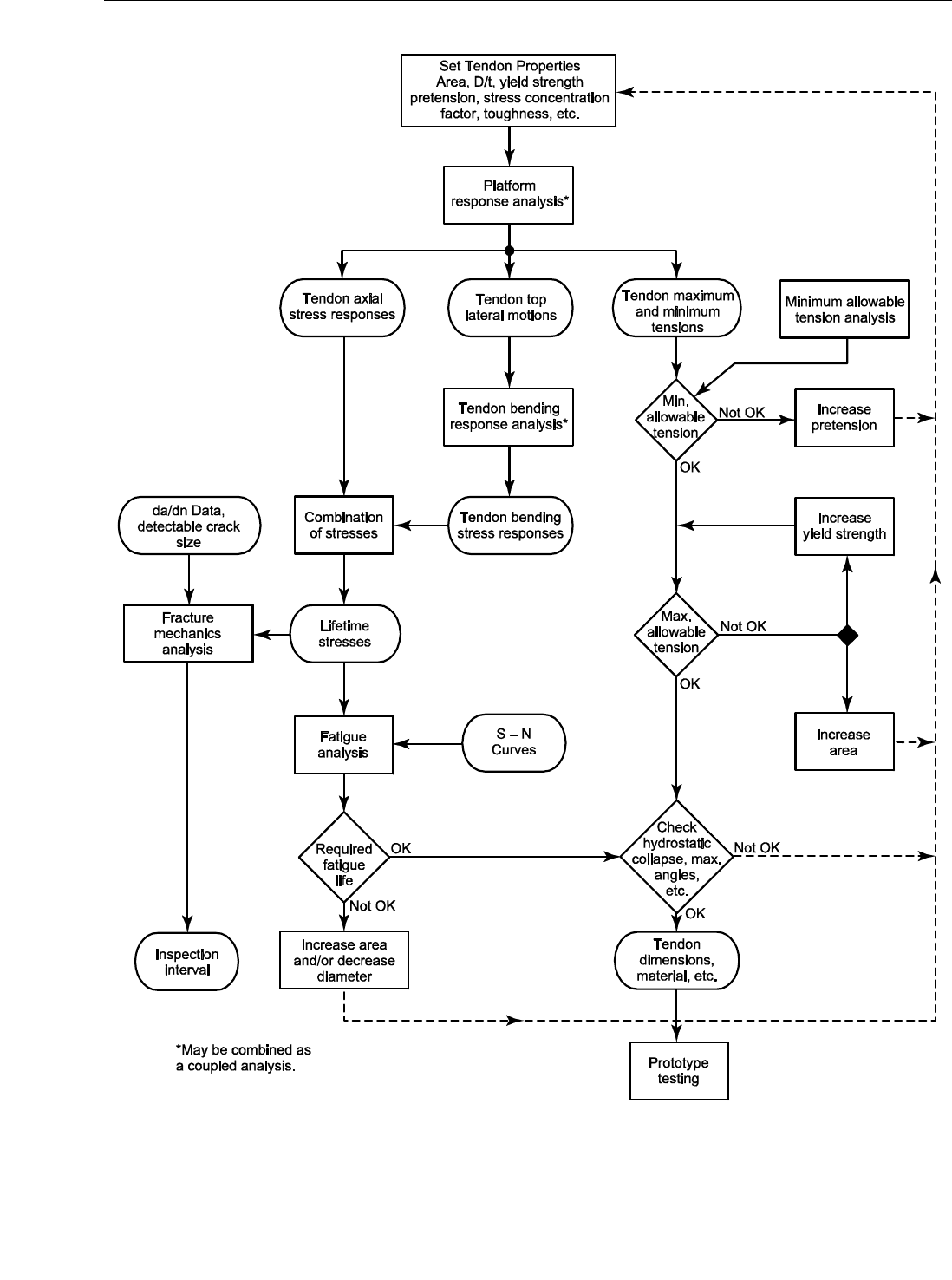
installation, material, inspection, stress and fatigue requirements. An example of these steps is shown in the
form of a flow chart in Figure 10. In general, the sequence of major activities in the design process is as
follows.
a) Platform Sizing—Determine overall TLP configuration.
b) Preliminary Tendon Design—Estimate pretension and other input required for platform sizing.
c) Coupled Analysis Check—Determine whether a coupled response analysis is necessary.
Copyright American Petroleum Institute
Provided by IHS under license with API
Licensee=Shell Global Solutions International B.V. Main/5924979112, User=Low, Ko
Not for Resale, 01/31/2011 00:10:44 MST
No reproduction or networking permitted without license from IHS
--``,`,```,,,``,`,``,,,,,,,,,,`-`-`,,`,,`,`,,`---

108 API RECOMMENDED PRACTICE 2T
d) Response Analysis—Develop vessel motions and maximum and minimum tendon loads.
e) Tendon Horizontal Response—Calculate tendon bending loads and horizontal motions.
f) Minimum Tension—Establish minimum allowable tendon tension.
g) Preliminary Stress Analysis—Check preliminary maximum stress level, fatigue life, and hydrostatic
collapse.
h) Operational Limits Check—Check for acceptable vessel offsets, tendon motions and displacements.
i) Fatigue Life—Calculate fatigue life under combined axial and bending loading.
j) Final Design Check—Check for maximum stress; minimum tension; fatigue life; fracture mechanics and
inspection replacement strategy; hydrostatic collapse; and VIVs.
k) Model Test (Optional)—Verify tendon motions and loads.
Procedures for tendon installation, including special equipment requirements and limiting environmental
conditions, shall be developed. These generally follow selection of the final platform and tendon design
configurations. Depending on the type of tendon and tendon top attachment, the installation requirements
could influence the platform and tendon design. It may be advisable to develop the tendon installation design,
including some tendon analysis, in parallel with the platform/tendon design procedure.
The flow chart in Figure 10 illustrates the iterative interaction between the platform sizing, global response
analysis (see Section 7) and the tendon design analysis. Tendon loads and maximum angles also influence
the design of the foundation (see Section 10).
9.2.4 Design Data Requirements
9.2.4.1 Environmental Data
The tendon loads depend on platform response to wind, waves, current, and tide, and possibly to marine
fouling, seismic activity, floating ice, and platform snow or ice accumulation. The extreme environmental
conditions as well as other return period conditions might be pertinent for damage conditions, for less than a
full complement of tendons, during installation, or for other specified operational events. Wind and wave
spectra and directionality data are valuable for assessing tendon fatigue. Current profiles, sea state
probabilities, and weather persistence data help establish the design of equipment and the techniques
needed for tendon installation and retrieval. Water temperature, salinity, and oxygen content can be used to
establish cathodic protection requirements. See 5.5 for a more complete discussion of environmental data
requirements.
Copyright American Petroleum Institute
Provided by IHS under license with API
Licensee=Shell Global Solutions International B.V. Main/5924979112, User=Low, Ko
Not for Resale, 01/31/2011 00:10:44 MST
No reproduction or networking permitted without license from IHS
--``,`,```,,,``,`,``,,,,,,,,,,`-`-`,,`,,`,`,,`---
PLANNING, DESIGNING, AND CONSTRUCTING TENSION LEG PLATFORMS 109
Figure 10—Tendon Design Flow Chart
Copyright American Petroleum Institute
Provided by IHS under license with API
Licensee=Shell Global Solutions International B.V. Main/5924979112, User=Low, Ko
Not for Resale, 01/31/2011 00:10:44 MST
No reproduction or networking permitted without license from IHS
--``,`,```,,,``,`,``,,,,,,,,,,`-`-`,,`,,`,`,,`---

110 API RECOMMENDED PRACTICE 2T
9.2.4.2 Platform, Tendon, and Foundation Characteristics
The properties of the tendons affect platform displacement and response, and vice versa.
Tendon pretension (tension in still water) is established to satisfy the maximum platform offset limit and to
control minimum tendon tension. Tendon pretension has a direct effect on platform displacement and tendon
maximum tension.
Tendon cross-sectional area establishes tendon axial stiffness that is a major factor in the platform natural
periods of heave, pitch and roll vibration. These periods should be kept low enough to limit fatigue damage
due to wave excitation.
The diameter-to-thickness ratio for air-filled tendons is also important because it establishes the tendon
weight in water that, in turn, establishes the difference between the top and bottom tensions in the tendons.
These tensions influence platform displacement and offset.
The number of tendons, their pattern and their loading also affects the foundation system design. If separate
foundations are used, the tendon load is affected by the placement accuracy of the foundation system.
The size of the platform’s columns determines the space available for handling and installing tendons. The
number of tendons per corner might be determined in part by this available space. The column structural
arrangement should accommodate the localized tendon loads and the possible presence of tendon access
tubes.
9.2.4.3 Operating Limits and Other Design Considerations
Other limits that may be imposed on the tendon design include the following.
a) Flexure Limits—The flex element shall accommodate the maximum tendon angles at top and bottom due
to platform surge/sway motions.
b) Interference—Interference between tendons and platform or foundation template structure is governed by
flex element angle and the height of the flex elements above or below the platform keel or foundation top
of steel.
c) Tendon Centerline Spacing—Minimum spacing is set by equipment space requirements, by possible
interference among tendons during deployment, by column fabrication space requirements and potentially
by tendon foundation interaction. Large spacing may cause differences in loading among tendons at a
corner due to pitch/roll platform motions.
9.2.5 Fatigue Design
9.2.5.1 Safety Factors
Tendon fatigue safety factors shall be selected to be commensurate with the service life, in-service inspection
plans, analytical methods, quality of data for S-N curves, quality of data for environmental loading, unique
properties of the component, or unique characteristics to the anticipated loading.
In general, tendon components that will not be regularly inspected, or for which repair is difficult or impractical,
a minimum safety factor of 10 should be applied to the design service life. For components that cannot be
inspected, higher safety factors should be considered. For components that will be regularly inspected and
are repairable or replaceable, a lower factor of safety may be considered.
Additional guidance on selection of safety factors for specific tendon components is provided in 9.6.
Copyright American Petroleum Institute
Provided by IHS under license with API
Licensee=Shell Global Solutions International B.V. Main/5924979112, User=Low, Ko
Not for Resale, 01/31/2011 00:10:44 MST
No reproduction or networking permitted without license from IHS
--``,`,```,,,``,`,``,,,,,,,,,,`-`-`,,`,,`,`,,`---