
Engelbrecht Andries P. Computational Intelligence: An Introduction
Подождите немного. Документ загружается.


368 17. Ant Algorithms
cooperative behavior that emerges from the simple behaviors of individual ants: each
ant chooses the next link of its path based on information provided by other ants,
in the form of pheromone deposits. This again refers to the autocatalytic behavior
exhibited by forager ants. It is also important to note that the information used to
aid in the decision making process is limited to the local environment of the ant.
In their experiments, Dorigo and Di Caro found that [212, 217]
• SACO works well for very simple graphs, with the shortest path being selected
most often;
• for larger graphs, performance deteriorates with the algorithm becoming less
stable and more sensitive to parameter choices;
• convergence to the shortest path is good for a small number of ants, while too
many ants cause non-convergent behavior;
• evaporation becomes more important for more complex graphs. If ρ = 0, i.e.
no evaporation, the algorithm does not converge. If pheromone evaporates too
much (a large ρ is used), the algorithm often converged to sub-optimal solutions
for complex problems;
• for smaller α, the algorithm generally converges to the shortest path. For com-
plex problems, large values of α result in worse convergence behavior.
From these studies of the simple ACO algorithm, the importance of the exploration–
exploitation trade-off becomes evident. Care should be taken to employ mechanisms
to ensure that ants do not exploit pheromone concentrations such that the algorithm
prematurely stagnates on sub-optimal solutions, but that ants are forced to explore
alternative paths. In the sections (and chapters) that follow, different mechanisms are
discussed to balance exploitation and exploration.
The simple ACO algorithm discussed in the previous section has shown some success
in finding the shortest paths in graphs. The performance of the algorithm can be im-
proved significantly by very simple changes to Algorithm 17.2. These changes include
addition of heuristic information to determine the probability of selecting a link, mem-
ory to prevent cycles, and different pheromone update rules using local and/or global
information about the environment. The next sections provide an overview of the
early ant algorithms which are based on such changes of the simple ACO algorithm.
17.1.4 Ant System
The first ant algorithm was developed by Dorigo [208], referred to as ant system (AS)
[4, 77, 216]. AS improves on SACO by changing the transition probability, p
k
ij
,to
include heuristic information, and by adding a memory capability by the inclusion of
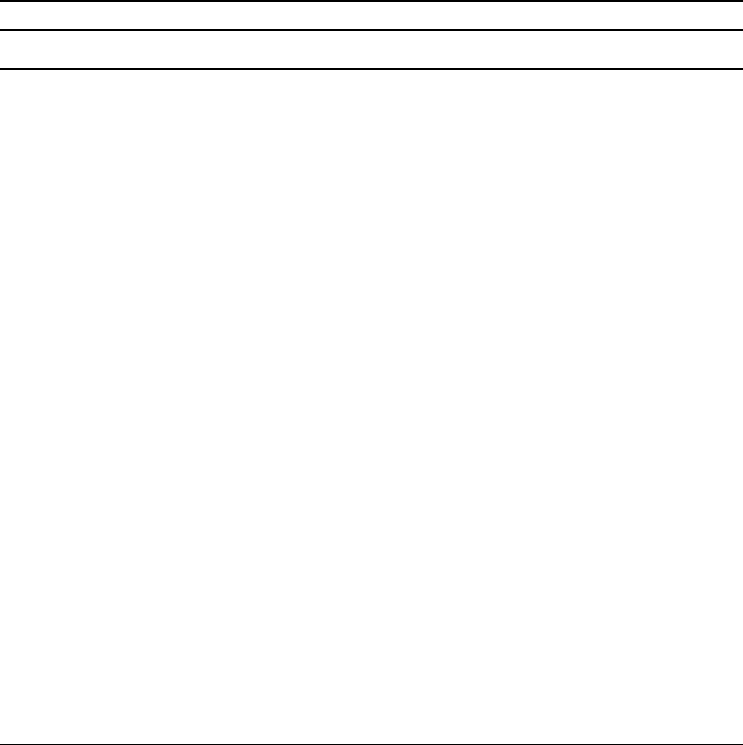
a tabu list. In AS, the probability of moving from node i to node j is given as
p
k
ij
(t)=
τ
α
ij
(t)η
β
ij
(t)
u∈N
k
i
(t)
τ
α
iu
(t)η
β
iu
(t)
if j ∈N
k
i
(t)
0ifj ∈N
k
i
(t)
(17.6)

17.1 Ant Colony Optimization Meta-Heuristic 369
where τ
ij
represents the a posteriori effectiveness of the move from node i to node j,as
expressed in the pheromone intensity of the corresponding link, (i, j); η
ij
represents the
apriorieffectiveness of the move from i to j (i.e. the attractiveness, or desirability,
of the move), computed using some heuristic. The pheromone concentrations, τ
ij
,
indicate how profitable it has been in the past to make a move from i to j,servingas
a memory of previous best moves.
The transition probability in equation (17.6) differs from that of SACO in equation
(17.2) on two aspects:
• The transition probability used by AS is a balance between pheromone intensity
(i.e. history of previous successful moves), τ
ij
, and heuristic information (ex-
pressing desirability of the move), η
ij
. This effectively balances the exploration–
exploitation trade-off. The search process favors actions that it has found in the
past and which proved to be effective, thereby exploiting knowledge obtained
about the search space. On the other hand, in order to discover such actions,
the search has to investigate previously unseen actions, thereby exploring the
search space. The best balance between exploration and exploitation is achieved
through proper selection of the parameters α and β.Ifα = 0, no pheromone
information is used, i.e. previous search experience is neglected. The search then
degrades to a stochastic greedy search. If β = 0, the attractiveness (or potential
benefit) of moves is neglected and the search algorithm is similar to SACO with
its associated problems.
The heuristic information adds an explicit bias towards the most attractive solu-
tions, and is therefore a problem-dependent function. For example, for problems
where the distance (or cost) of a path needs to be minimized,
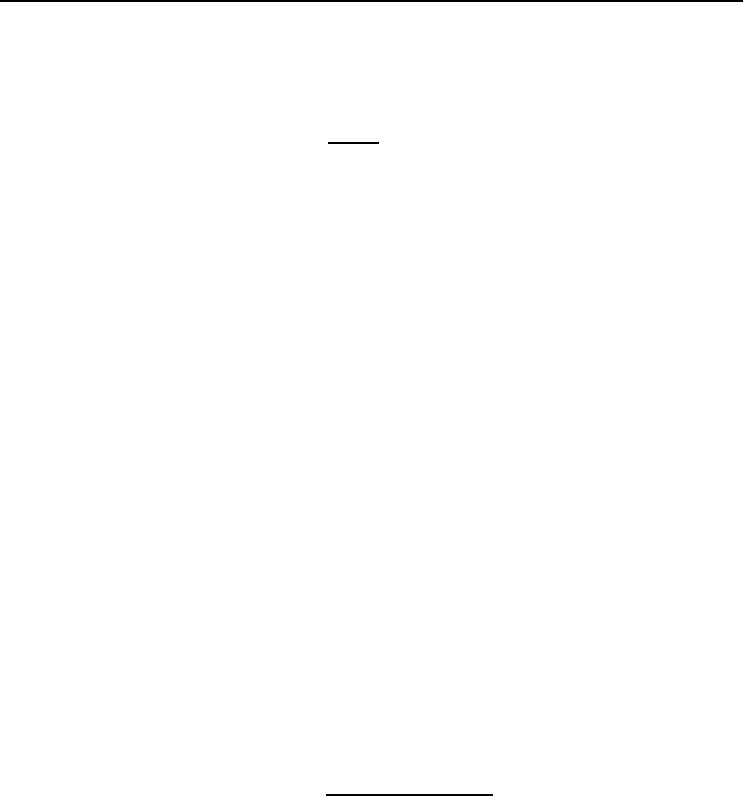
η
ij
=
1
d
ij
(17.7)
where d
ij
is the distance (or cost) between the nodes i and j.
• The set, N
k
i
, defines the set of feasible nodes for ant k when located on node i.
The set of feasible nodes may include only the immediate neighbors of node i.
Alternatively, to prevent loops, N
k
i
may include all nodes not yet visited by ant
k. For this purpose, a tabu list is usually maintained for each ant. As an ant
visits a new node, that node is added to the ant’s tabu list. Nodes in the tabu
list are removed from N
k
i
, ensuring that no node is visited more than once.
Maniezzo and Colorni used a different formulation of the probability used to determine
the next node [557]:
p
k
ij
(t)=
#
ατ
ij
(t)+(1−α)η
ij
u∈N
k
i
(t)
(ατ
iu
(t)+(1−α)η
iu
(t))
if j ∈N
k
i
(t)
0otherwise
(17.8)
Parameter α defines a relative importance of the pheromone concentration τ
ij
(t)with
respect to the desirability, η
ij
(t), of link (i, j). The probability p
k
ij
expresses a com-
promise between exploiting desirability (for small α), and pheromone intensity. This
formulation removes the need for the parameter β.

370 17. Ant Algorithms
Pheromone evaporation is implemented as given in equation (17.5). After completion
of a path by each ant, the pheromone on each link is updated as
τ
ij
(t +1)=τ
ij
(t)+∆τ
ij
(t) (17.9)
with
∆τ
ij
(t)=
n
k
k=1
∆τ
k
ij
(t) (17.10)
where ∆τ
k
ij
(t) is the amount of pheromone deposited by ant k on link (i, j)andk at
time step t. Dorigo et al. [216] developed three variations of AS, each differing in the
way that ∆τ
k
ij
is calculated (assuming a minimization problem):
• Ant-cycle AS:
∆τ
k
ij
(t)=
Q
f(x
k
(t))
if link (i, j) occurs in path x
k
(t)
0otherwise
(17.11)
For the ant-cycle implementation, pheromone deposits are inversely proportional
to the quality, f(x
k
(t)), of the complete path constructed by the ant. Global in-
formation is therefore used to update pheromone concentrations. Q is a positive
constant.
For maximization tasks,
∆τ
k
ij
(t)=
Qf(x
k
(t)) if link (i, j) occurs in path x
k
(t)
0otherwise
(17.12)
• Ant-density AS:
∆τ
k
ij
(t)=
Q if link (i, j) occurs in path x
k
(t)
0otherwise
(17.13)
Each ant deposits the same amount of pheromone on each link of its constructed
path. This approach essentially counts the number of ants that followed link
(i, j). The higher the density of the traffic on the link, the more desirable that
link becomes as component of the final solution.
• Ant-quantity AS:
∆τ
k
ij
(t)=
#
Q
d
ij
if link (i, j) occurs in path x
k
(t)
0otherwise
(17.14)
In this case, only local information, d
ij
, is used to update pheromone concentra-
tions. Lower cost links are made more desirable. If d
ij
represents the distance
between links, then ant-quantity AS prefers selection of the shortest links.
The AS algorithm is summarized in Algorithm 17.3. During the initialization step,
placement of ants is dictated by the problem being solved. If the objective is to find the
shortest path between a given source and destination node, then all n
k
ants are placed
17.1 Ant Colony Optimization Meta-Heuristic 371
Algorithm 17.3 Ant System Algorithm
t =0;
Initialize all parameters, i.e. α, β, ρ, Q, n
k
,τ
0
;
Place all ants, k =1,...,n
k
;
for each link (i, j) do
τ
ij
(t) ∼ U(0,τ
0
);
end
repeat
for each ant k =1,...,n
k
do
x
k
(t)=∅;
repeat
From current node i, select next node j with probability as defined in
equation (17.6);
x
k
(t)=x
k
(t) ∪{(i, j)};
until full path has been constructed;
Compute f(x
k
(t));
end
for each link (i, j) do
Apply evaporation using equation (17.5);
Calculate ∆τ
ij
(t) using equation (17.10);
Update pheromone using equation (17.4);
end
for each link (i, j) do
τ
ij
(t +1)=τ
ij
(t);
end
t = t +1;
until stopping condition is true;
Return x
k
(t):f(x
k
(t)) = min
k
=1,...,n
k
{f(x
k
(t))};
at the source node. On the other hand, if the objective is to construct the shortest
Hamiltonian path (i.e. a path that connects all nodes, once only), then the n
k
ants
are randomly distributed over the entire graph. By placing ants on randomly selected
nodes, the exploration ability of the search algorithm is improved. Pheromones are
either initialized to a constant value, τ
0
, or to small random values in the range [0,τ
0
].
Using Algorithm 17.3 as a skeleton, Dorigo et al. [216] experimented with the three
versions of AS. From the experiments, which focused on solving the traveling salesman
problem (both the symmetric and asymmetric versions) and the quadratic assignment
problem, it was concluded that the ant-cycle AS performs best, since global informa-
tion about the quality of solutions is used to determine the amount of pheromones to
deposit. For the ant-density and ant-quantity models, the search is not directed by
any measure of quality of the solutions.
Dorigo et al. [216] also introduced an elitist strategy where, in addition to the re-
inforcement of pheromones based on equation (17.4), an amount proportional to the
length of the best path is added to the pheromones on all the links that form part of
372 17. Ant Algorithms
the best path [216]. The pheromone update equation changes to
τ
ij
(t +1)=τ
ij
(t)+∆τ
ij
(t)+n
e
∆τ
e
ij
(t) (17.15)
where
∆τ
e
ij
(t)=
Q
f(˜x(t))
if (i, j) ∈ ˜x(t)
0otherwise
(17.16)
and e is the number of elite ants. In equation (17.16), ˜x(t) is the current best route,
with f(˜x(t)) = min
k=1,...,n
k
{f(x
k
(t))}. The elitist strategy has as its objective direct-
ing the search of all ants to construct a solution to contain links of the current best
route.
17.1.5 Ant Colony System
The ant colony system (ACS) was developed by Gambardella and Dorigo to improve
the performance of AS [77, 215, 301]. ACS differs from AS in four aspects: (1) a
different transition rule is used, (2) a different pheromone update rule is defined, (3)
local pheromone updates are introduced, and (4) candidate lists are used to favor
specific nodes. Each of these modifications is discussed next.
The ACS transition rule, also referred to as a pseudo-random-proportional action rule
[301], was developed to explicitly balance the exploration and exploitation abilities of
the algorithm. Ant k, currently located at node i, selects the next node j to move to
using the rule,
j =
arg max
u∈N
k
i
(t)
{τ
iu
(t)η
β
iu
(t)} if r ≤ r
0
J if r>r
0
(17.17)
where r ∼ U (0, 1), and r
0
∈ [0, 1] is a user-specified parameter; J ∈N
k
i
(t) is a node
randomly selected according to probability
p
k
iJ
(t)=
τ
iJ
(t)η
β
iJ
(t)
u∈N
k
i
τ
iu
(t)η
β
iu
(t)
(17.18)
N
k
i
(t) is a set of valid nodes to visit.
The transition rule in equation (17.17) creates a bias towards nodes connected by short
links and with a large amount of pheromone. The parameter r
0
is used to balance
exploration and exploitation: if r ≤ r
0
, the algorithm exploits by favoring the best
edge; if r>r
0
, the algorithm explores. Therefore, the smaller the value of r
0
,theless
best links are exploited, while exploration is emphasized more. It is important to note
that the transition rule is the same as that of AS when r>r
0
. Also note that the
ACS transition rule uses α = 1, and is therefore omitted from equation (17.18).
Unlike AS, only the globally best ant (e.g. the ant that constructed the shortest
path, x
+
(t)) is allowed to reinforce pheromone concentrations on the links of the
corresponding best path. Pheromone is updated using the global update rule,
τ
ij
(t +1)=(1− ρ
1
)τ
ij
(t)+ρ
1
∆τ
ij
(t) (17.19)

17.1 Ant Colony Optimization Meta-Heuristic 373
where
∆τ
ij
(t)=
1
f(x
+
(t))
if (i, j) ∈ x
+
(t)
0otherwise
(17.20)
with f(x
+
)(t)=|x
+
(t)|, in the case of finding shortest paths.
The ACS global update rule causes the search to be more directed, by encouraging
ants to search in the vicinity of the best solution found thus far. This strategy favors
exploitation, and is applied after all ants have constructed a solution.
Gambardella and Dorigo [215, 301] implemented two methods of selecting the path,
x
+
(t), namely
• iteration-best,wherex
+
(t) represents the best path found during the current
iteration, t, denoted as ˜x(t), and
• global-best,wherex
+
(t) represents the best path found from the first iteration
of the algorithm, denoted as ˆx(t).
For the global-best strategy, the search process exploits more by using more global
information.
Pheromone evaporation is also treated slightly differently to that of AS. Referring
to equation (17.19), for small values of ρ
1
, the existing pheromone concentrations on
links evaporate slowly, while the influence of the best route is dampened. On the
other hand, for large values of ρ
1
, previous pheromone deposits evaporate rapidly, but
the influence of the best path is emphasized. The effect of large ρ
1
is that previous
experience is neglected in favor of more recent experiences. Exploration is emphasized.
While the value of ρ
1
is usually fixed, a strategy where ρ
1
is adjusted dynamically from
large to small values will favor exploration in the initial iterations of the search, while
focusing on exploiting the best found paths in the later iterations.
In addition to the global updating rule, ACS uses the local updating rule,
τ
ij
(t)=(1− ρ
2
)τ
ij
(t)+ρ
2
τ
0
(17.21)
with ρ
2
also in (0, 1), and τ
0
is a small positive constant. Experimental results on
different TSPs showed that τ
0
=(n
G
L)
−1
provided good results [215]; n
G
is the
number of nodes in graph G,andL is the length of a tour produced by a nearest-
neighbor heuristic for TSPs [737] (L can be any rough approximation to the optimal
tour length [215]).
ACS also redefines the meaning of the neighborhood set from which next nodes are
selected. The set of nodes, N
k
i
(t), is organized to contain a list of candidate nodes.
These candidate nodes are preferred nodes, to be visited first. Let n
l
< |N
k
i
(t)| denote
the number of nodes in the candidate list. The n
l
nodes closest (in distance or cost)
to node i are included in the candidate list and ordered by increasing distance. When
a next node is selected, the best node in the candidate list is selected. If the candidate
list is empty, then node j is selected from the remainder of N
k
i
(t). Selection of a
non-candidate node can be based on equation (17.18), or alternatively the closest
non-candidate j ∈N
k
i
(t) can be selected.

374 17. Ant Algorithms
Algorithm 17.4 Ant Colony System Algorithm
t = 0; Initialize parameters β,ρ
1
,ρ
2
,r
0
,τ
0
,n
k
;
Place all ants, k =1,...,n
k
;
for each link (i, j) do
τ
ij
(t) ∼ U(0,τ
0
);
end
ˆx(t)=∅;
f(ˆx(t)) = 0;
repeat
for each ant k =1,...,n
k
do
x
k
(t)=∅;
repeat
if ∃j ∈ candidate list then
Choose j ∈N
k
i
(t) from candidate list using equations (17.17) and
(17.18);
end
else
Choose non-candidate j ∈N
k
i
(t);
end
x
k
(t)=x
k
(t) ∪{(i, j)};
Apply local update using equation (17.21);
until full path has been constructed;
Compute f(x
k
(t));
end
x = x
k
(t):f(x
k
(t)) = min
k
=1,...,n
k
{f(x
k
(t))};
Compute f(x);
if f(x) <f(ˆx(t)) then
ˆx(t)=x;
f(ˆx(t)) = f(x);
end
for each link (i, j) ∈ ˆx(t) do
Apply global update using equation (17.19);
end
for each link (i, j) do
τ
ij
(t +1)=τ
ij
(t);
end
ˆx(t +1)=ˆx(t);
f(ˆx(t +1))=f (ˆx(t));
t = t +1;
until stopping condition is true;
Return ˆx(t) as the solution;

17.1 Ant Colony Optimization Meta-Heuristic 375
ACS is summarized in Algorithm 17.4.
In order to apply ACS to large, complex problems, Dorigo and Gambardella added a
local search procedure to iteratively improve solutions [215].
17.1.6 Max-Min Ant System
AS was shown to prematurely stagnate for complex problems. Here, stagnation means
that all ants follow exactly the same path, and premature stagnation occurs when ants
explore little and too rapidly exploit the highest pheromone concentrations. St¨utzle
and Hoos have introduced the max-min ant system (MMAS) to address the premature
stagnation problem of AS [815, 816]. The main difference between MMAS and AS is
that pheromone intensities are restricted within given intervals. Additional differences
are that only the best ant may reinforce pheromones, initial pheromones are set to the
max allowed value, and a pheromone smoothing mechanism is used.
The pheromone global update is similar to that of ACS, in equation (17.19), where
∆τ
ij
(t) is calculated on the basis either of the global-best path or of the iteration-
best path. The first version of MMAS focused on the iteration-best path, where ˜x(t)
represents the best path found during the current iteration [815]. Later versions also
included the global-best path, ˆx(t), using different strategies [816]:
• Using only the global-best path to determine ∆τ
ij
(t), in which case ˆx(t)isthe
best overall path found from the first iteration. Using only the global best path
may concentrate the search too quickly around the global best solution, thus
limiting exploration. This problem is reduced if the iteration-best path is used,
since best paths may differ considerably from one iteration to the next, thereby
allowing more exploration.
• Use mixed strategies, where both the iteration-best and the global-best paths
are used to update pheromone concentrations. As default, the iteration-best
path is used to favor exploration with the global-best path used periodically.
Alternatively, the frequency at which the global-best path is used to update
pheromones is increased over time.
• At the point of stagnation, all pheromone concentrations, τ
ij
, are reinitialized
to the maximum allowed value, after which only the iteration-best path is used
for a limited number of iterations.
The λ-branching factor, with λ =0.05, is used to determine the point of stagna-
tion. Gambardella and Dorigo defined the mean λ-branching factor as an indica-
tion of the dimension of the search space [300]. Over time the mean λ-branching
factor decreases to a small value at point of stagnation. The λ
i
-branching fac-
tor is defined as the number of links leaving node i with τ
ij
-values greater than
λδ
i
+ τ
i,min
; δ
i
= τ
i,max
− τ
i,min
,where
τ
i,min
=min
jN
i
{τ
ij
} (17.22)
τ
i,max
=max
jN
i
{τ
ij
} (17.23)
376 17. Ant Algorithms
and N
i
is the set of all nodes connected to node i.If
i∈V
λ
i
n
G
< (17.24)
where is a small positive value, it is assumed that the search process stagnated.
Throughout execution of the MMAS algorithm, all τ
ij
are restricted within predefined
ranges. For the first MMAS version, τ
ij
∈ [τ
min
,τ
max
] for all links (i, j), where both
τ
min
and τ
max
were problem-dependent static parameters [815]. If after application
of the global update rule τ
ij
(t +1)>τ
max
, τ
ij
(t + 1) is explicitly set equal to τ
max
.
On the other hand, if τ
ij
(t +1) <τ
min
, τ
ij
(t +1) is set to τ
min
. Using an upper
bound for pheromone concentrations helps to avoid stagnation behavior: pheromone
concentrations are prevented from growing excessively, which limits the probability of
rapidly converging to the best path. Having a lower limit, τ
min
> 0, has the advantage
that all links have a nonzero probability of being included in a solution. In fact, if
τ
min
> 0andη
ij
< ∞, the probability of choosing a specific link as part of a solution
is never zero. The positive lower bound therefore facilitates better exploration.
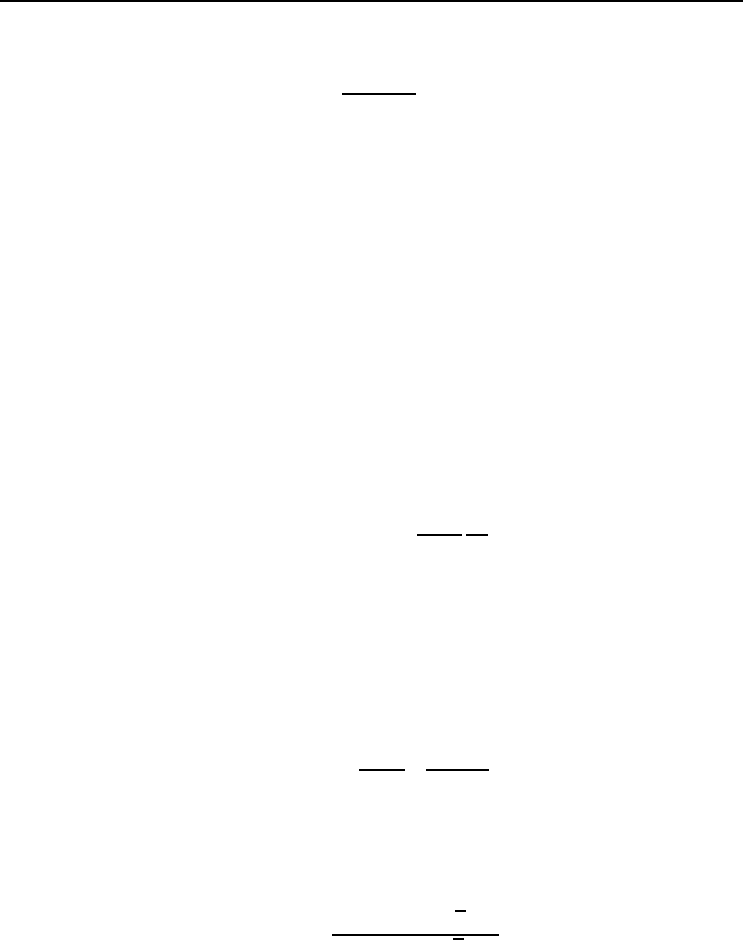
St¨utzle and Hoos [816] formally derived that the maximum pheromone concentration
is asymptotically bounded. That is, for any τ
ij
it holds that
lim
t→∞
τ
ij
(t)=τ
ij
≤
1
1 − ρ
1
f
∗
(17.25)
where f
∗
is the cost (e.g. length) of the theoretical optimum solution.
This provides a theoretical value for the upper bound, τ
max
. Since the optimal solution
is generally not known, and therefore f
∗
is an unknown value, MMAS initializes to an
estimate of f
∗
, by setting f
∗
= f(ˆx(t)), where f (ˆx(t)) is the cost of the global-best
path. This means that the maximum value for pheromone concentrations changes as
soon as a new global-best position is found. The pheromone upper bound,
τ
max
(t)=
1
1 − ρ
1
f(ˆx(t))
(17.26)
is therefore time-dependent.
St¨utzle and Hoos [816] derive formally that sensible values for the lower bound on
pheromone concentrations can be calculated using
τ
min
(t)=
τ
max
(t)(1 −
√
ˆpn
G
)
(n
G
/2 − 1)
√
ˆpn
G
(17.27)
where ˆp is the probability at which the best solution is constructed. Note that ˆp<1
to ensure that τ
min
(t) > 0. Also note that if ˆp is too small, then τ
min
(t) >τ
max
(t). In
such cases, MMAS sets τ
min
(t)=τ
max
(t), which has the effect that only the heuristic
information, η
ij
, is used. The value of ˆp is a user-defined parameter that needs to be
optimized for each new application.
During the initialization step of the MMAS algorithm (refer to Algorithm 17.5), all
pheromone concentrations are initialized to the maximum allowed value, τ
max
(0) =
τ
max
.

17.1 Ant Colony Optimization Meta-Heuristic 377
Algorithm 17.5 MMAS Algorithm with Periodic Use of the Global-Best Path
Initialize parameters α, β, ρ, n
k
, ˆp, τ
min
,τ
max
,f
λ
;
t =0,τ
max
(0) = τ
max
,τ
min
(0) = τ
min
;
Place all ants, k =1,...,n
k
;
τ
ij
(t)=τ
max
(0), for all links (i, j);
x
+
(t)=∅, f(x
+
(t)) = 0;
repeat
if stagnation point then
for each link (i, j) do
Calculate ∆τ
ij
(t) using equation (17.28);
τ
ij
(t +1)=τ
ij
(t)+∆τ
ij
(t);
end
end
for each ant k =1,...,n
k
do
x
k
(t)=∅;
repeat
Select next node j with probability defined in equation (17.6);
x
k
(t)=x
k
(t) ∪{(i, j)};
until full path has been constructed;
Compute f(x
k
(t));
end
(t mod f
λ
= 0) ? (Iteration Best = false) : (Iteration Best = true);
if Iteration Best = true then
Find iteration-best: x
+
(t)=x
k
(t):f(x
k
(t)) = min
k
=1,...,n
k
{f(x
k
(t))};
Compute f(x
+
(t));
end
else
Find global-best: x = x
k
(t):f(x
k
(t)) = min
k
=1,...,n
k
{f(x
k
(t))};
Compute f(x);
if f(x) <f(x
+
(t)) then
x
+
(t)=x;
f(x
+
(t)) = f(x);
end
end
for each link (i, j) ∈ x
+
(t) do
Apply global update using equation (17.19);
end
Constrict τ
ij
(t)tobein[τ
min
(t),τ
max
(t)] for all (i, j);
x
+
(t +1)=x
+
(t);
f(x
+
(t +1))=f(x
+
(t));
t = t +1;
Update τ
max
(t) using equation (17.26);
Update τ
min
(t) using equation (17.27);
until stopping condition is true;
Return x
+
(t) as the solution;