
Engelbrecht Andries P. Computational Intelligence: An Introduction
Подождите немного. Документ загружается.


378 17. Ant Algorithms
The max-min approach was also applied to ACS, referred to as MMACS. In this
case, the larger the value of r
0
(refer to equation (17.17)), the tighter the pheromone
concentration limits have to be chosen. A lower τ
max
/τ
min
ratio has to be used
for larger r
0
to prevent ants from too often preferring links with high pheromone
concentrations.
Even though pheromone concentrations are clamped within a defined range, stagna-
tion still occurred, although less than for AS. To address this problem, a pheromone
smoothing strategy is used to reduce the differences between high and low pheromone
concentrations. At the point of stagnation, all pheromone concentrations are increased
proportional to the difference with the maximum bound, i.e.
∆τ
ij
(t) ∝ (τ
max
(t) − τ
ij
(t)) (17.28)
Using this smoothing strategy, stronger pheromone concentrations are proportionally
less reinforced than weaker concentrations. This increases the chances of links with
low pheromone intensity to be selected as part of a path, and thereby increases the
exploration abilities of the algorithm.
Algorithm 17.5 summarizes MMAS, where the iteration-best path is used as default
to update pheromones and the global-best is used periodically at frequency f
λ
.
17.1.7 Ant-Q
Gambardella and Dorigo [213, 300] developed a variant of ACS in which the local
update rule was inspired by Q-learning [891] (also refer to Chapter 6). In Ant-Q, the
pheromone notion is dropped to be replaced by Ant-Q value (or AQ-value). The goal
of Ant-Q is to learn AQ-values such that the discovery of good solutions is favored in
probability.
Let µ
ij
(t) denote the AQ-value on the link between nodes i and j at time step t.Then
the transition rule (action choice rule) is given by (similarly to equation (17.17))
j =
arg max
u∈N
k
i
(t)
{µ
α
iu
(t)η
β
iu
(t)} if r ≤ r
0
J otherwise
(17.29)
The parameters α and β weigh the importance of the learned AQ-values, µ
ij
,and
the heuristic information, η
ij
. The AQ-values express how useful it is to move to
node j from the current node i. In equation (17.29), J is a random variable selected
according to a probability distribution given by a function of the AQ-values, µ
ij
,and
the heuristic values η
ij
.
Three different rules have been proposed to select a value for the random variable, J:
• For the pseudo-random action choice rule, J is a node randomly selected from
the set N
k
i
(t) according to the uniform distribution.

17.1 Ant Colony Optimization Meta-Heuristic 379
• For the pseudo-random-proportional action choice rule, J ∈ V is selected accord-
ing to the distribution,
p
k
ij
(t)=
µ
α
ij
(t)η
β
ij
(t)
u∈N
k
i
(t)
µ
α
iu
(t)η
β
iu
(t)
if j ∈N
k
i
(t)
0otherwise
(17.30)
• For the random-proportional action choice rule, r
0
= 0 in equation (17.29). The
next node is therefore always selected randomly based on the distribution given
by equation (17.30).
Gambardella and Dorigo show that the pseudo-random-proportional action choice rule
is best for Ant-Q (considering the traveling salesman problem (TSP)).
AQ-values are learned using the updating rule (very similar to that of Q-learning),
µ
ij
(t +1)=(1− ρ)µ
ij
(t)+ρ
∆µ
ij
(t)+γ max
u∈N
k
j
(t)
{µ
ju
(t)}
(17.31)
where ρ is referred to as the discount factor (by analogy with pheromone evaporation)
and γ is the learning step size. Note that if γ = 0, then equation (17.31) reduces to
the global update equation of ACS (refer to equation (17.19)).
In Ant-Q, update equation (17.31) is applied for each ant k after each new node j has
been selected, but with ∆µ
ij
(t) = 0. The effect is that the AQ-value associated with
link (i, j) is reduced by a factor of (1 − ρ) each time that the link is selected to form
part of a candidate solution. At the same time the AQ-value is reinforced with an
amount proportional to the AQ-value of the best link, (j, u), leaving node j such that
the future desirability of link (j, u) is increased. The update according to equation
(17.31) can be seen as the local update rule, similar to equation (17.21) of ACS.
In addition to the above local update, a delayed reinforcement is used, similar to
the global update rule of ACS (refer to equation (17.19)). After all paths have been
constructed, one for each ant, AQ-values are updated using equation (17.31), where
∆µ
ij
(t) is calculated using equation (17.20) with x
+
(t) either the global-best or the
iteration-best path. Gambardella and Dorigo found from their experimental results
(with respect to the TSP), that the iteration-best approach is less sensitive to changes
in parameter γ, and is faster in locating solutions of the same quality as the global-best
approach.
17.1.8 Fast Ant System
Taillard and Gambardella [831, 832] developed the fast ant system (FANT), specifi-
cally to solve the quadratic assignment problem (QAP). The main differences between
FANT and the other ACO algorithms discussed so far are that (1) FANT uses only
one ant, and (2) a different pheromone update rule is applied which does not make
use of any evaporation.
380 17. Ant Algorithms
The use of only one ant significantly reduces the computational complexity. FANT
uses as transition rule equation (17.6), but with β = 0. No heuristic information is
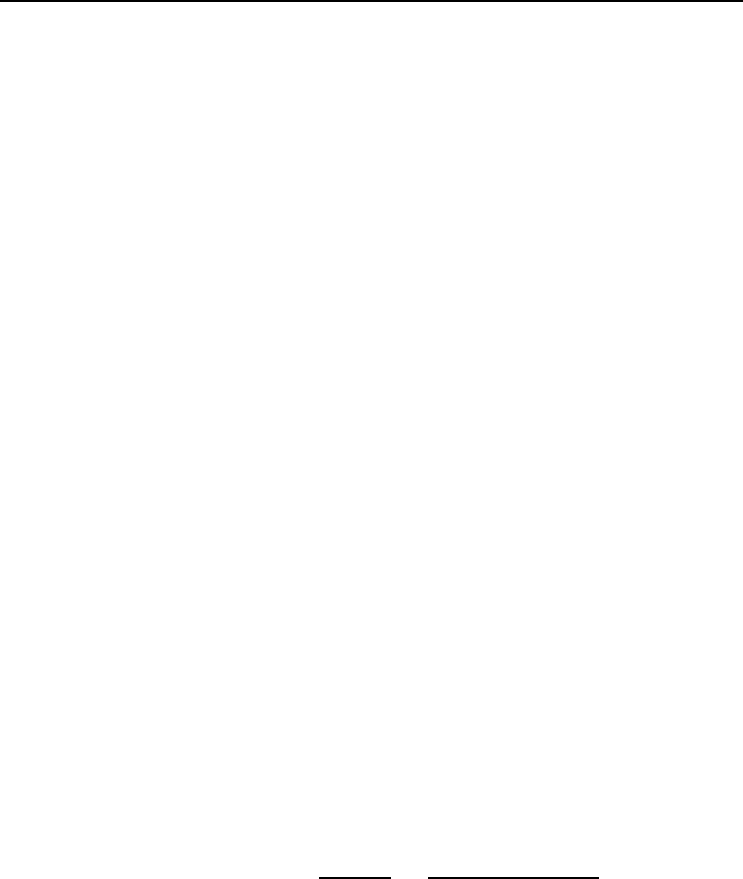
used. The pheromone update rule is defined as
τ
ij
(t +1)=τ
ij
(t)+w
1
∆˜τ
ij
(t)+w
2
∆ˆτ
+
ij
(t) (17.32)
where w
1
and w
2
are parameters to determine the relative reinforcement provided
by the current solution at iteration t and the best solution found so far. The added
pheromones are calculated as
∆˜τ
ij
(t)=
1if(i, j) ∈ ˜x(t)
0otherwise
(17.33)
and
∆ˆτ
ij
(t)=
1if(i, j) ∈ ˆx(t)
0otherwise
(17.34)
where ˜x(t)andˆx(t) are respectively the best paths found in iteration t and the global-
best path found from the start of the search.
Pheromones are initialized to τ
ij
(0) = 1. As soon as a new ˆx(t) is obtained, all
pheromones are reinitialized to τ
ij
(0) = 1. This step exploits the search area around
the global best path, ˆx(t). If, at time step t, the same solution is found as the
current global best solution, the value of w
1
is increased by one. This step facilitates
exploration by decreasing the contribution, ∆ˆτ
ij
(t), associated with the global best
path.
17.1.9 Antabu
Roux et al. [743, 744] and Kaji [433] adapted AS to include a local search using tabu
search (refer to Section A.5.2) to refine solutions constructed by each iteration of AS.
In addition to using tabu search as local search procedure, the global update rule is
changed such that each ant’s pheromone deposit on each link of its constructed path
is proportional to the quality of the path. Each ant, k, updates pheromones using
τ
ij
(t +1)=(1− ρ)τ
ij
(t)+
ρ
f(x
k
(t))
f(x
−
(t)) − f(x
k
(t))
f(ˆx(t))
(17.35)
where f(x
−
(t)) is the cost of the worst path found so far, f (ˆx(t)) is the cost of the
best path found so far, and f(x
k
(t)) is the cost of the path found by ant k. Equation
(17.35) is applied for each ant k for each link (i, j) ∈ x
k
(t).
17.1.10 AS-rank
Bullnheimer et al. [94] proposed a modification of AS to: (1) allow only the best ant
to update pheromone concentrations on the links of the global-best path, (2) to use
17.1 Ant Colony Optimization Meta-Heuristic 381
elitist ants, and (3) to let ants update pheromone on the basis of a ranking of the ants.
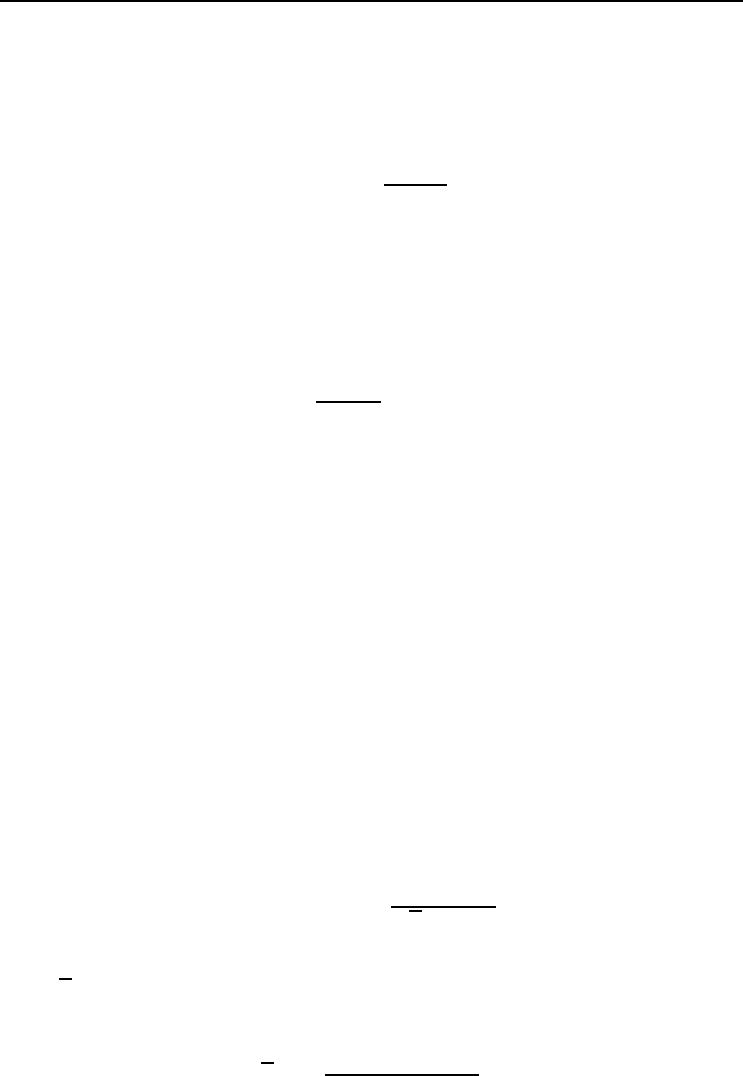
For AS-rank, the global update rule changes to
τ
ij
(t +1)=(1− ρ)τ
ij
(t)+n
e
∆ˆτ
ij
(t)+∆τ
r
ij
(t) (17.36)
where
∆ˆτ
ij
(t)=
Q
f(ˆx(t))
(17.37)
with ˆx(t) the best path constructed so far. If n
e
elite ants are used, and the n
k
ants
are sorted such that f(x
1
(t)) ≤ f(x
2
(t)) ≤ ...≤ f(x
n
k
(t)), then
∆τ
r
ij
(t)=
n
e
σ=1
∆τ
σ
ij
(t) (17.38)
where
∆τ
σ
ij
(t)=
#
(n
e
−σ)Q
f(x
σ
(t))
if (i, j) ∈ x
σ
(t)
0otherwise
(17.39)
with σ indicating the rank of the corresponding ant. This elitist strategy differs from
that implemented in AS (refer to Section 17.1.4) in that the contribution of an elite
ant to pheromone concentrations is directly proportional to its performance ranking:
the better the ranking (i.e. small σ) the more the contribution.
17.1.11 ANTS
Approximated non-deterministic tree search (ANTS) was developed by Maniezzo and
Carbonaro [555, 556] as an extension of AS. ANTS differs from AS in: (1) the transition
probability calculation, (2) the global update rule, and (3) the approach to avoid
stagnation.
ANTS uses the transition probability as defined in equation (17.8). The set N
k
i
con-
tains all feasible moves from the current node i. Pheromone intensities are updated
after all ants have completed construction of their paths. Pheromones are updated
using equations (17.5) and (17.10), but with
∆τ
k
ij
(t)=τ
0
1 −
f(x
k
(t)) −
f(t) −
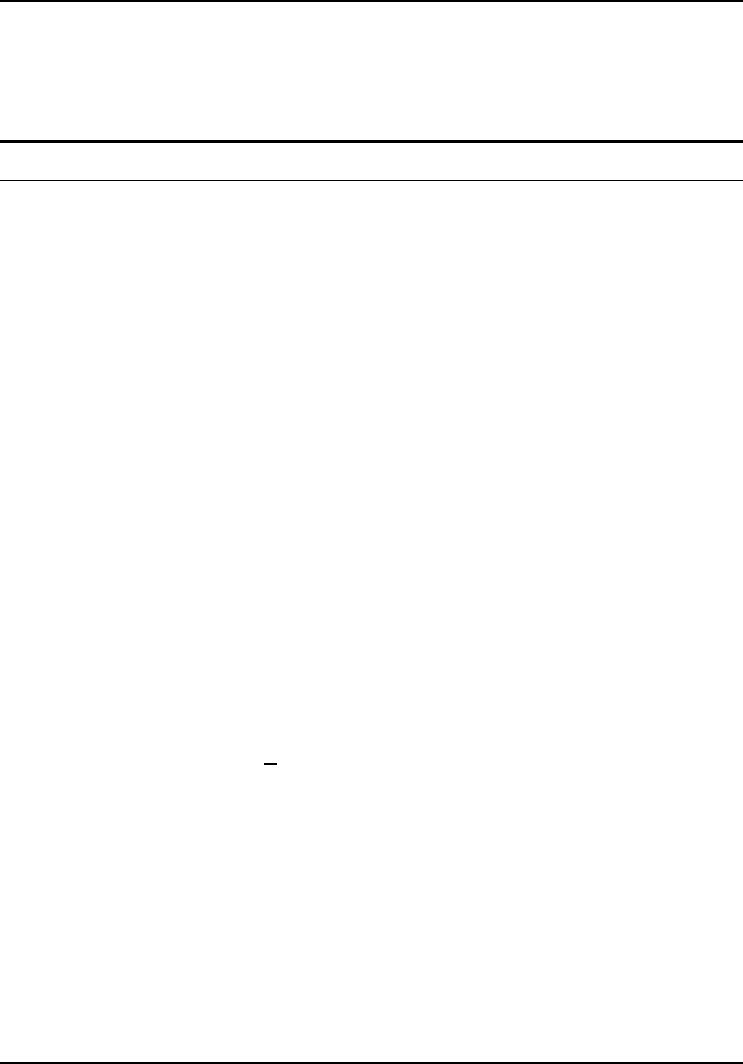
(17.40)
where f(x
k
(t)) represents the cost of the corresponding path, x
k
(t), of ant k at iteration
t,and
f(t) is a moving average on the cost of the last ˆn
t
global-best solutions found
by the algorithm. If f(ˆx(t)) denotes the cost of the global-best solution at iteration t,
then
f(t)=
t
t
=t−ˆn
t
f(ˆx(t
))
ˆn
t
(17.41)
If t<ˆn
t
, the moving average is calculated over the available t best solutions. In
equation (17.40), is a lower bound to the cost of the optimal solution.
382 17. Ant Algorithms
Algorithm 17.6 ANTS Algorithm
t =0;
Initialize parameters α, β, ρ, Q, n
k
,τ
0
, ˆn
t
,;
Place all ants, k =1,...,n
k
;
for each link (i, j) do
τ
ij
(t)=τ
0
;
end
ˆx(t)=∅;
f(ˆx(t)=0;
repeat
for each ant k =1,...,n
k
do
x
k
(t)=∅;
repeat
Select next node j with probability defined in equation (17.8);
x
k
(t)=x
k
(t) ∪{(i, j)};
until full path has been constructed;
Compute f(x
k
(t));
end
x = x
k
(t):f(x
k
(t)) = min
k
=1,...,n
k
{f(x
k
(t))};
Compute f(x);
if f(x) <f(ˆx(t)) then
ˆx(t)=x;
f(ˆx(t)) = f(x);
end
ˆn
t
=min{t, ˆn
t
};
Calculate moving average,
f(t), using equation (17.41);
for each link (i, j) do
Apply global update using equations (17.5), (17.10) and (17.40);
end
for each link (i, j) do
τ
ij
(t +1)=τ
ij
(t);
end
ˆx(t +1)=ˆx(t);
f(ˆx(t +1))=f (ˆx(t));
t = t +1;
until stopping condition is true;
Return ˆx(t) as the solution;
17.1 Ant Colony Optimization Meta-Heuristic 383
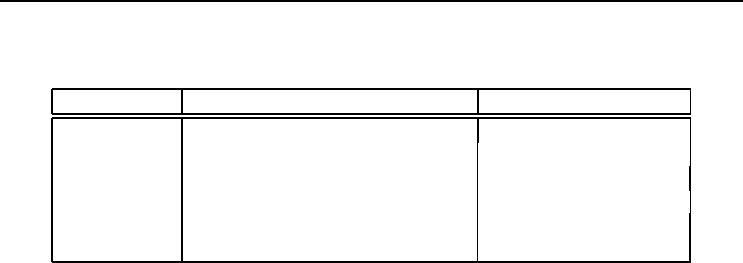
Table 17.1 General ACO Algorithm Parameters
Parameter Meaning Comment
n
k
Number of ants
n
t
Maximum number of iterations
τ
0
Initial pheromone amount not for MMAS
ρ Pheromone persistence ρ
1
,ρ
2
for ACS
α Pheromone intensification α =1forACS
β Heuristic intensification not for SACO, ANTS
The calculation of the amount of pheromone, ∆τ
k
ij
, deposited by each ant effectively
avoids premature stagnation: pheromone concentrations are reduced if the cost of an
ant’s solution is lower than the moving average; otherwise, pheromone concentrations
are increased. The update mechanism makes it possible to discriminate small achieve-
ments in the final iterations of the search algorithm, and avoids exploitation in the
early iterations.
ANTS is summarized in Algorithm 17.6.
17.1.12 Parameter Settings
Each of the algorithms discussed thus far uses a number of control parameters that
influence the performance of the algorithms (refer to Table 17.1). Here performance
refers to the quality of solutions found (if any is found) and the time to reach these
solutions.
The following parameters are common to most ACO algorithms:
• n
k
, the number of ants: From the first studies of ACO algorithms, the influence
of the number of ants on performance has been studied [215, 216]. An obvious
influence of the number of ants relates to computational complexity. The more
ants used, the more paths have to be constructed, and the more pheromone
deposits calculated. As an example, the computational complexity of AS is
O(n
c
n
2
G
n
k
), where n
c
= n
t
n
k
is the total number of cycles, n
t
is the total
number of iterations, and n
G
is the number of nodes in the solutions (assuming
that all solutions have the same number of nodes).
The success of ACO algorithms is in the cooperative behavior of multiple ants.
Through the deposited pheromones, ants communicate their experience and
knowledge about the search space to other ants. The fewer ants used, the less
the exploration ability of the algorithm, and consequently the less information
about the search space is available to all ants. Small values of n
k
may then cause
sub-optimal solutions to be found, or early stagnation. Too many ants are not
necessarily beneficial (as has been shown, for example, with SACO). With large
values of n
k
, it may take significantly longer for pheromone intensities on good
links to increase to higher levels than they do on bad links.

384 17. Ant Algorithms
For solving the TSP, Dorigo et al. [216] found that n
k
≈ n
G
worked well. For
ACS, Dorigo and Gambardella [215] formally derived that the optimal number
of ants can be calculated using
n
k
=
log(φ
1
− 1) − log(φ
2
− 2)
r
0
log(1 − ρ
2
)
(17.42)
where φ
1
τ
0
is the average pheromone concentration on the edges of the last best
path before the global update, and φ
2
τ
0
after the global update. Unfortunately,
the optimal values of φ
1
and φ
2
are not known. Again for the TSP, empirical
analyses showed that ACS worked best when (φ
1
−1)/(φ
2
−1) ≈ 0.4, which gives
n
k
= 10 [215].
It is important to note that the above is for a specific algorithm, used to solve a
specific class of problems. The value of n
k
should rather be optimized for each
different algorithm and problem.
• n
t
, maximum number of iterations: It is easy to see that n
t
plays an important
role in ensuring quality solutions. If n
t
is too small, ants may not have enough
time to explore and to settle on a single path. If n
t
is too large, unnecessary
computations may be done.
• τ
0
, initial pheromone: During the initialization step, all pheromones are either
initialized to a constant value, τ
0
(for MMAS, τ
0
= τ
max
), or to random values in
the range [0,τ
0
]. In the case of random values, τ
0
is selected to be a small positive
value. If a large value is selected for τ
0
, and random values are selected from
the uniform distribution, then pheromone concentrations may differ significantly.
This may cause a bias towards the links with large initial concentrations, with
links that have small pheromone values being neglected as components of the
final solution.
There is no easy answer to the very important question of how to select the best values
for the control parameters. While many empirical studies have investigated these
parameters, suggested values and heuristics to calculate values should be considered
with care. These are given for specific algorithms and specific problems, and should
not be accepted in general. To maximize the efficiency of any of the algorithms, the
values of the relevant control parameters have to be optimized for the specific problem
being solved. This can be done through elaborate empirical analyses. Alternatively,
an additional algorithm can be used to “learn” the best values of the parameters for
the given algorithm and problem [4, 80].
17.2 Cemetery Organization and Brood Care
Many ant species, for example Lasius niger and Pheidole pallidula, exhibit the behavior
of clustering corpses to form cemeteries [127] (cited in [77]). Each ant seems to behave
individually, moving randomly in space while picking up or depositing (dropping)
corpses. The decision to pick up or drop a corpse is based on local information of
the ant’s current position. This very simple behavior of individual ants results in the
17.2 Cemetery Organization and Brood Care 385
emergence of a more complex behavior of cluster formation. It was further observed
that cemeteries are sited around spatial heterogeneities [77, 563].
A similar behavior is observed in many ant species, such as Leptothorax unifasciatus,
in the way that the colony cares for the brood [77, 912, 913]. Larvae are sorted in such
a way that different brood stages are arranged in concentric rings. Smaller larvae are
located in the center, with larger larvae on the periphery. The concentric clusters are
organized in such a way that small larvae receive little individual space, while large
larvae receive more space.
While these behaviors are still not fully understood, a number of studies have resulted
in mathematical models to simulate the clustering and sorting behaviors. Based on
these simulations, algorithms have been implemented to cluster data, to draw graphs,
and to develop robot swarms with the ability to sort objects. This section discusses
these mathematical models and algorithms. Section 17.2.1 discusses the basic ant
colony clustering (ACC) model, and a generalization of this model is given in Sec-
tion 17.2.2. A minimal ACC approach is summarized in Section 17.2.3.
17.2.1 Basic Ant Colony Clustering Model
The first algorithmic implementations that simulate cemetery formation were inspired
by the studies of Chr´etien of the ants Lasius niger [127]. Based on physical experi-
ments, Chr´etien derived the probability of an ant dropping a corpse next to an n-cluster
as being proportional to 1 − (1 − p)
n
for n ≤ 30, where p is a fitting parameter [78].
Ants cannot, however, precisely determine the size of clusters. Instead, the size of
clusters is determined by the effort to transport the corpse (the corpse may catch on
other items, making the walk more difficult). It is likely that the corpse is deposited
when the effort becomes too great.
On the basis of of Chr´etien’s observations, Deneubourg et al. [200] developed a model
to describe the simple behavior of ants. The main idea is that items in less dense areas
should be picked up and dropped at a different location where more of the same type
exist. The resulting model is referred to as the basic model.
Assuming only one type of item, all items are randomly distributed on a two-
dimensional grid, or lattice. Each grid-point contains only one item. Ants are placed
randomly on the lattice, and move in random directions one cell at a time. After each
move, an unladen ant decides to pick up an item (if the corresponding cell has an
item) based on the probability
P
p
=
γ
1
γ
1
+ λ
2
(17.43)
where λ is the fraction of items the ant perceives in its neighborhood, and γ
1
> 0.
When there are only a few items in the ant’s neighborhood, that is λ<<γ
1
,thenP
p
approaches 1; hence, objects have a high probability of being picked up. On the other
hand, if the ant observes many objects, that is λ>>γ
1
, P
p
approaches 0, and the
probability that the ant will pick up an object is small.

386 17. Ant Algorithms
Each loaded ant has a probability of dropping the carried object, given by
P
d
=
λ
γ
2
+ λ
2
(17.44)
provided that the corresponding cell is empty; γ
2
> 0. If a large number of items is
observed in the neighborhood, i.e. λ>>γ
2
,thenP
d
approaches 1, and the probability
of dropping the item is high. If λ<<γ
2
,thenP
d
approaches 0.
The fraction of items, λ, is calculated by making use of a short-term memory for each
ant. Each ant keeps track of the last T time steps, and λ is simply the number of
items observed during these T time steps, divided by the largest number of items that
can be observed during the last T time steps. If only one item can be observed during
each time step, λ = n
λ
/T ,wheren
λ
is the number of encountered items.
The basic model is easily expanded to more than one type of item. Let A and B
denote two types of items. Then equations (17.43) and (17.44) are used as is, but with
λ replaced by λ
A
or λ
B
depending on the type of item encountered.
17.2.2 Generalized Ant Colony Clustering Model
Lumer and Faieta [540] generalized the basic model of Deneubourg et al. (refer to
Section 17.2.1) to cluster data vectors with real-valued elements for exploratory data
analysis applications. This section presents the original Lumer–Faieta algorithm and
discusses extensions and modifications to improve the quality of solutions and to speed
up the clustering process.
Lumer--Faieta Algorithm
The first problem to solve, in applying the basic model to real-valued vectors, is to
define a distance, or dissimilarity, d(y
a
, y
b
), between data vectors y
a
and y
b
,using
any applicable norm. For real-valued vectors, the Euclidean distance between the two
vectors has been used most frequently to quantify dissimilarity. The next problem
is to determine how these dissimilarity measures should be used to group together
similar data vectors, in such a way that
• intra-cluster distances are minimized; that is, the distances between data vectors
within a cluster should be small to form a compact, condensed cluster.
• inter-cluster distances are maximized; that is, the different clusters should be
well separated.
As for the basic model, data vectors are placed randomly on a two-dimensional grid.
Ants move randomly around on the grid, while observing the surrounding area of n
2
N
sites, referred to as the n
N
-patch. The surrounding area is simply a square neighbor-
hood, N
n
N
×n
N
(i), of the n
N
× n
N
sites surrounding the current position, i,ofthe
ant. Assume that an ant is on site i at time t, and finds data vector y
a
. The “local”
17.2 Cemetery Organization and Brood Care 387
density, λ(y
a
), of data vector y
a
within the ant’s neighborhood is then given as
λ(y
a
)=max
0,
1
n
2
N
y
b
∈N
n
N
×n
N
(i)
1 −
d(y
a
, y
b
)
γ
(17.45)
where γ>0 defines the scale of dissimilarity between items y
a
and y
b
. The constant
γ determines when two items should, or should not be located next to each other. If
γ is too large, it results in the fusion of individual clusters, clustering items together
that do not belong together. If γ is too small, many small clusters are formed. Items
that belong together are not clustered together. It is thus clear that γ has a direct
influence on the number of clusters formed. The dissimilarity constant also has an
influence on the speed of the clustering process. The larger γ, the faster the process
is.
Using the measure of similarity, λ(y
a
), the picking up and dropping probabilities are
defined as [540]
P
p
(y
a
)=
γ
1
γ
1
+ λ(y
a
)
2
(17.46)
P
d
(y
a
)=
2λ(y
a
)ifλ(y
a
) <γ
2
1ifλ(y
a
) ≥ γ
2
(17.47)
A summary of the Lumer–Faieta ant colony clustering algorithm is given in Algo-
rithm 17.7.
The following aspects of Algorithm 17.7 need clarification:
• n
t
is the maximum number of iterations.
• The grid size: There should be more sites than data vectors, since items are
not stacked. Each site may contain only one item. If the number of sites is
approximately the same as the number of items, there are not enough free cells
available for ants to move to. Large clusters are formed with a high classification
error. On the other hand, if there are many more sites than items, many small
clusters may be formed. Also, clustering takes long due to the large distances
that items need to be transported.
• The number of ants: There should be fewer ants than data vectors. If there
are too many ants, it may happen that most of the items are carried by ants.
Consequently, density calculation results in close to zero values of λ(y
a
). Drop-
ping probabilities are then small, and most ants keep carrying their load without
depositing it. Clusters may never be formed. On the other hand, if there are
too few ants, it takes longer to form clusters.
• Local density: Consider that an ant carries item y
a
.Ifthen
2
N
neighboring
sites have items similar to y
a
, λ(y
a
) ≈ 1. Item y
a
is then dropped with high
probability (assuming that the site is empty). On the other hand, if the items
are very dissimilar from y
a
, λ(y
a
) ≈ 0, and the item has a very low probability
of being dropped. In the case of an unladen ant, the pick-up probability is large.