
Engelbrecht Andries P. Computational Intelligence: An Introduction
Подождите немного. Документ загружается.


558 A. Optimization Theory
Algorithm A.2 summarizes the SA algorithm. The algorithm requires specification of
the following components:
• A representation of possible solutions, which is usually a vector of floating-
point values.
• A mechanism to generate new solutions by adding small random changes
to current solutions. For example, for continuous-valued vectors,
x(t +1)=x(t)+D(t)r(t)(A.6)
where r(t) ∼ U (−1, 1)
n
x
,andD is a diagonal matrix that defines the maximum
change allowed in each variable. When an improved solution is found,
D(t +1)=(1− α)D(t)+αωR(t)(A.7)
where R(t) is a diagonal matrix whose elements are the magnitudes of the suc-
cessful changes made to each variable, and α and ω are constants.
For integer problems,
x(t +1)=x(t)+r(t)(A.8)
where each element of r(t) is randomly selected from the set {−1, 0, 1}.
• A method to evaluate solutions, which is usually just the objective function
in the case of unconstrained problems.
• An annealing schedule, which consists of an initial temperature and rules for
lowering the temperature with increase in number of iterations. The annealing
schedule determines the degree of uphill movement (objective function increase)
allowed during the search. An initial high temperature is selected, which is then
incrementally reduced using, for example,
– Exponential cooling: T (t +1)=αT (t), where α ∈ (0, 1).
– Linear cooling: T (t+1) = T (t)−∆T ,where,e.g. ∆T =(T (0)−T (n
t
))/n
t
;
T (0) is the initial large temperature, and T (n
t
) is the final temperature at
the last iteration, n
t
.
Algorithm A.2 Simulated Annealing Algorithm
Create initial solution, x(0);
Set initial temperature, T (0);
t =0;
repeat
Generate new solution, x;
Determine quality, f(x);
Calculate acceptance probability using equation (A.5);
if U(0, 1) ≤ acceptance probability then
x(t)=x;
end
until stopping condition is true;
Return x(t) as the solution;

A.5 Unconstrained Optimization 559
LeapFrog Algorithm
LeapFrog is an optimization approach based on the physical problem of the motion
of a particle of unit mass in an n
x
-dimensional conservative force field [799, 800]. For
more detail refer to Section 3.2.4.
A.5.3 Example Benchmark Problems
This section lists a number of the classical benchmark functions used to evaluate the
performance of optimization algorithms for unconstrained optimization. The purpose
of the section is not to provide an extensive list of example problems, but to provide
a list that can be used as a good starting point when analyzing the performance of
optimization methods.
Spherical:
f(x)=
n
x
j=1
x
2
j
(A.9)
with x
j
∈ [−100, 100] and f
∗
(x)=0.0.
Quadric:
f(x)=
n
x
j=1
j
k=1
x
j
2
(A.10)
with x
j
∈ [−100, 100] and f
∗
(x)=0.0.
Ackley:
f(x)=−20e
−0.2
1
n
x
n
x
j=1
x
2
j
−e
1
n
x
n
x
j=1
cos(2πx
j
)
+20+e (A.11)
with x
j
∈ [−30, 30] and f
∗
(x)=0.0.
Bohachevsky 1:
f(x
1
,x
2
)=x
2
1
+2x
2
2
− 0.3cos(3πx
1
) − 0.4cos(4πx
2
)+0.7 (A.12)
with x
1
,x
2
∈ [−50, 50] and f
∗
(x
1
,x
2
)=0.0.
Colville:
f(x
1
,x
2
,x
3
,x
4
) = 100(x
2
− x
2
1
)
2
+(1− x
1
)
2
+ 90(x
4
− x
2
3
)
2
+(1 − x
3
)
2
+10.1((x
2
− 1)
2
+(x
4
− 1)
2
)
+19.8(x
2
− 1)(x
4
− 1) (A.13)
with x
1
,x
2
,x
3
,x
4
∈ [−10, 10] and f
∗
(x
1
,x
2
,x
3
,x
4
)=0.0.
Easom:
f(x
1
,x
2
)=−cos(x
1
) cos(x
2
)e
−(x
1
−π)
2
−(x
2
−π)
2
(A.14)
with x
1
,x
2
∈ [−100, 100] and f
∗
(x
1
,x
2
)=−1.0.

560 A. Optimization Theory
Griewank:
f(x)=1+
1
4000
n
x
j=1
x
2
j
−
n
x
j=1
cos
x
j
√
j
(A.15)
with x
j
∈ [−600, 600] and f
∗
(x)=0.0.
Hyperellipsoid:
f(x)=
n
x
j=1
j
2
x
2
j
(A.16)
with x
j
∈ [−1, 1] and f
∗
(x)=0.0.
Rastrigin:
f(x)=
n
x
j=1
(x
2
j
− 10 cos(2πx
j
) + 10) (A.17)
with x
j
∈ [−5.12, 5.12] and f
∗
(x)=0.0.
Rosenbrock:
f(x)=
n
x
/2
j=1
[100(x
2j
− x
2
2j−1
)
2
+(1− x
2j−1
)
2
] (A.18)
with x
j
∈ [−2.048, 2.048] and f
∗
(x)=0.0.
Schwefel:
f(x)=
n
x
j=1
x
j
sin
|x
j
|
+ 418.9829n
x
(A.19)
with x
j
∈ [−500, 500] and f
∗
(x)=0.0.
A.6 Constrained Optimization
Many real-world optimization problems are solved subject to sets of constraints. Con-
straints place restrictions on the search space, specifying regions of the space that are
infeasible. Optimization algorithms have to find solutions that do not lie in infeasi-
ble regions. That is, solutions have to satisfy all specified constraints. This chapter
provides a mathematical definition of the constrained optimization problem in Sec-
tion A.6.1. An overview of constraint handling methods is given in Section A.6.2.
Section A.6.3 provides a list of benchmark functions.
A.6.1 Problem Definition
Assuming a minimization problem, the general constrained problem is defined as:

A.6 Constrained Optimization 561
Definition A.5 Constrained optimization problem:
minimize f(x), x =(x
1
,...,x
n
x
)
subject to g
m
(x) ≤ 0,m=1,...,n
g
h
m
(x)=0,m= n
g
+1,...,n
g
+ n
h
x
j
∈ dom(x
j
) (A.20)
where n
g
and n
h
are the number of inequality and equality constraints respectively,
and dom(x
j
) is as defined in Section A.5.1.
A special instance of the constrained optimization problem is defined below, where
only linear equality constraints of the form Ax = b are defined:
Definition A.6 Constrained optimization with linear equality constraints:
minimize f(x), x =(x
1
,...,x
n
x
)
subject to Ax = b (A.21)
where A ∈ R
n
h
×n
x
and b ∈ R
n
h
.
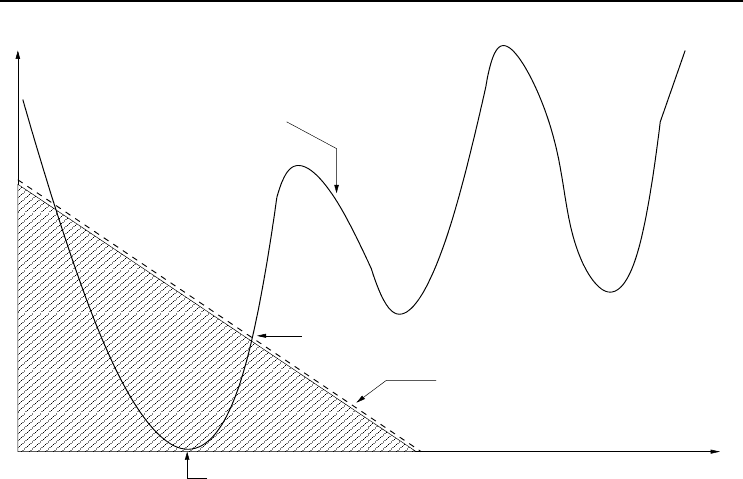
Figure A.3 illustrates the effect of constraints. The shaded area indicates the infea-
sible region of the search space. Note how the global optimum for the unconstrained
function is no longer the global optimum for the constrained problem. Instead, the
best solution is an extremum (not called an optimum, since the derivative of the best
solution is not zero).
A.6.2 Constraint Handling Methods
The following types of constraints can be found:
• Boundary constraints, which basically define the borders of the search space.
Upper and lower bounds on each dimension of the search space define the hy-
percube in which solutions must be found. While boundaries are usually defined
by specifying upper and lower bounds on variables, such box constraints are not
the only way in which boundaries are specified. The boundary of a search space
can, for example, be on the circumference of a hypersphere. It is also the case
that a problem can be unbounded.
• Equality constraints specify that a function of the variables of the problem
must be equal to a constant.
• Inequality constraints specify that a function of the variables must be less
than or equal to (or, greater than or equal to) a constant.
Constraints can be linear or nonlinear.
Constraint handling methods have to consider a number of important questions, which
relate mainly to the trade-off between feasible and infeasible solutions:
562 A. Optimization Theory
Infeasible space
Feasible space
U
n
co
n
st
r
a
in
ed G
l
oba
l Minim
u
m
Objective function
Extremum
Inequality constraint
f(x)
x
Figure A.3 Constrained Problem Illustration
• How should two feasible solutions be compared? The answer to this question is
somewhat obvious: the solution with the better objective function value should
be preferred.
• How should two infeasible solutions be compared? In this case the answer is not
at all obvious, and is usually problem-dependent. The issues to consider are:
– should the infeasible solution with the best objective function value be
preferred?
– should the solution with the least number of constraint violations or lowest
degree of violation be preferred?
– should a balance be found between best objective function value and degree
of violation?
• Should it be assumed that any feasible solution is better than any unfeasible
solution? Alternatively, can objective function value and degree of violation
be optimally balanced? Again, the answer to this problem may be problem-
dependent. In financial-critical, or life-critical problems, the first strategy should
be preferred to ensure no financial loss, or loss of life. Less critical problems,
such as time-tabling, may consider solutions where less severe constraints are
violated.
Research in constraint handling methods are numerous in the evolutionary computa-
tion (EC) and swarm intelligence (SI) paradigms. Based on these research efforts, con-
straint handling methods have been categorized in a number of classes [140, 487, 584]:

A.6 Constrained Optimization 563
• Reject infeasible solutions, where solutions are not constrained to the feasible
space. Solutions that find themselves in infeasible space are simply rejected or
ignored.
• Penalty function methods, which add a penalty to the objective function to
discourage search in infeasible areas of the search space.
• Convert the constrained problem to an unconstrained problem,then
solve the unconstrained problem.
• Preserving feasibility methods, which assumes that solutions are initialized
in feasible space, and applies specialized operators to transform feasible solutions
to new, feasible solutions. These methods constrict solutions to move only in
feasible space, where all constraints are satisfied at all times.
• Pareto ranking methods, which use concepts from multi-objective optimiza-
tion, such as non-dominance (refer to Section A.8), to rank solutions based on
degree of violation.
• Repair methods, which apply special operators or actions to infeasible solu-
tions to facilitate changing infeasible solutions to feasible solutions.
The rest of this section provides a short definition and discussion of two of these
approaches.
Penalty Methods
Penalty methods add a function to the objective function to penalize vectors that rep-
resent infeasible solutions. Assuming a constrained minimization problem as defined
in Definition A.5,
Definition A.7 Penalty method:
minimize F (x,t)=f(x,t)+λp(x,t) (A.22)
where λ is the penalty coefficient and p(x,t) is the (possibly) time-dependent penalty
function.
A major problem of penalty-based methods is due to the added penalty function, which
changes the shape of the objective function. While the change in objective function is
necessary to increase the slope of the function in the infeasible areas (assuming min-
imization), the penalty function may introduce false minima into the original search
space as defined by the unpenalized function. These false minima may trap search
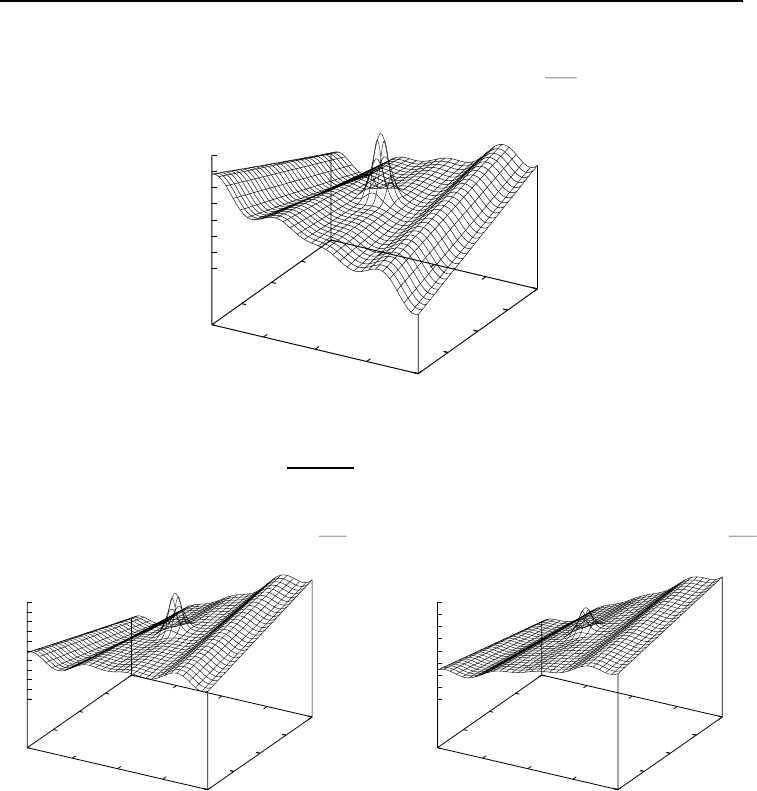
algorithms. Figure A.4 illustrates the effect of penalty functions. Figure A.4(a) illus-
trates the function
f(x
1
,x
2
)=
x
1
cos(x
1
)
20
+2e
−x
2
1
−(x
2
−1)
2
+0.01x
1
x
2
(A.23)
with one clear maximum at x
∗
=(0.0, 0.0). Figure A.4(b) illustrates the penalized
objective,
F (x
1
,x
2
)=f(x
1
,x
2
)+λp(x
1
,x
2
) (A.24)
564 A. Optimization Theory
f(x1,x2)
-10
-5
0
5
10
x1
-10
-5
0
5
10
x2
-1.5
-1
-0.5
0
0.5
1
1.5
2
f(x1,x2)
(a) f(x
1
,x
2
)=
x
1
cos(x
1
)
20
+2e
−x
2
1
−(x
2
−1)
2
+0.01x
1
x
2
-10
-5
0
5
10
-10
-5
0
5
10
-2.5
-2
-1.5
-1
-0.5
0
0.5
1
1.5
2
2.5
f(x1,x2)
F(x1,x2)
x1
x2
f(x1,x2)
(b) With penalty p(x
1
,x
2
)=3x
1
and λ =0.05
-10
-5
0
5
10
-10
-5
0
5
10
-4
-3
-2
-1
0
1
2
3
4
f(x1,x2)
F(x1,x2)
x1
x2
f(x1,x2)
(c) With penalty p(x
1
,x
2
)=3x
1
and λ =0.1
Figure A.4 Illustration of the Effect of Penalty Functions
where λ =0.05 and p(x
1
,x
2
)=3x
1
. Notice how the penalty causes the slope of the
function to increase for large x
1
and x
2
values, with function values exceeding that
of the maximum of the original function f(x
1
,x
2
). This effect is for a low penalty
coefficient of λ =0.05. For larger values, the slope increases even more as illustrated
in Figure A.4(c) for λ =0.1.
The penalty function is usually constructed from a set of functions, one for each of the
constraints, quantifying the degree to which a solution violates the constraint. That

A.6 Constrained Optimization 565
is,
p(x
i
,t)=
n
g
+n
h
m=1
λ
m
(t)p
m
(x
i
) (A.25)
where
p
m
(x
i
)=
max{0,g
m
(x
i
)
α
} if m ∈ [1,...,n
g
] (inequality)
|h
m
(x
i
)|
α
if m ∈ [n
g
+1,...,n
g
+ n
h
] (equality)
(A.26)
with α a positive constant, representing the power of the penalty. In equation (A.25),
λ
m
(t) represents a time-varying degree to which violation of the m-th constraint con-
tributes to the overall penalty. More emphasis can therefore be given to crucial con-
straints. The constraint penalty coefficient can of course be static, i.e. λ
m
(t)=λ
m
.
Convert Constrained to Unconstrained Problem
A constrained problem can be converted to an unconstrained problem by defining
the Lagrangian for the constrained problem, and then by maximizing the Lagrangian.
Consider the standard constrained optimization problem as defined in Definition A.5,
referred to as the primal problem. The constraints in equation (A.20) can be introduced
into the objective function, f , by augmenting it with a weighted sum of the constraint
functions. Let λ
g
∈ R
n
g
be the weights associated with the n
g
inequality constraints,
and λ
h
∈ R
n
h
be the weights associated with the n
h
equality constraints.
These vectors, referred to as the Lagrange multiplier vectors, define the Lagrangian,
L : R
n
x
× R
n
g
× R
n
h
,
L(x,λ
g
,λ
h
)=f(x)+
n
g
m=1
λ
gm
g
m
(x)+
n
g
+n
h
m=n
g
+1
λ
hm
h
m
(x) (A.27)
The dual problem associated with the primal problem in equation (A.20) is then
defined as
Definition A.8 Dual problem:
maximize
λ
g
,λ
h
L(x,λ
g
,λ
h
)
subject to λ
gm
≥ 0,m=1,...,n
g
+ n
h
(A.28)
If the primal problem is convex over the search space S, then the solution to the
primal problem is the vector x
∗
of the saddle point, (x
∗
,λ
∗
g
,λ
∗
h
), of the Lagrangian in
equation (A.27), such that
L(x
∗
,λ
g
,λ
h
) ≤ L(x
∗
,λ
∗
g
,λ
∗
h
) ≤ L(x,λ
∗
g
,λ
∗
h
) (A.29)
The vector x
∗
that solves the primal problem, as well as the Lagrange multiplier
vectors, λ
∗
g
and λ
∗
h
, can be found by solving the min-max problem,
min
x
max
λ
g
,λ
h
L(x,λ
g
,λ
h
) (A.30)

566 A. Optimization Theory
For non-convex problems, the solution of the dual problem does not coincide with the
solution of the primal problem. For non-convex problems, the Lagrangian is augmented
by adding a penalty term, i.e.
L
(x,λ
g
,λ
h
)=L(x,λ
g
,λ
h
)+λp(x,t) (A.31)
where λ>0, L(x,λ
g
,λ
h
) is as defined in equation (A.27), and the penalty p(x,t)is
as defined in equations (A.25) and (A.26) with λ
m
(t)=1andα =2.
A.6.3 Example Benchmark Problems
A number of benchmark functions for constrained optimization are listed in this sec-
tion. Again, the list is not intended to be complete. The objective is to provide a list
of constrained problems as a starting point in evaluating algorithms for constrained
optimization.
Constrained problem 1: Minimize the function
f(x) = 100(x
2
− x
2
1
)
2
+(1− x
1
)
2
(A.32)
subject to the nonlinear constraints,
x
1
+ x
2
2
≥ 0
x
2
1
+ x
2
≥ 0
with x
1
∈ [−0.5, 0.5] and x
2
≤ 1.0. The global optimum is x
∗
=(0.5, 0.25), with
f(x
∗
)=0.25.
Constrained problem 2: Minimize the function
f(x)=(x
1
− 2)
2
− (x
2
− 1)
2
(A.33)
subject to the nonlinear constraint
−x
2
1
+ x
2
≥ 0
and the linear constraint
x
1
+ x
2
≤ 2
with x
∗
=(1, 1) and f(x
∗
)=1.
Constrained problem 3: Minimize the function
f(x)=5x
1
+5x
2
+5x
3
+5x
4
− 5
4
j=1
x
2
j
−
13
j=5
x
j
(A.34)
subject to the constraints
2x
1
+2x
2
+ x
10
+ x
11
≤ 10 2x
1
+2x
3
+ x
10
+ x
12
≤ 10
2x
2
+2x
3
+ x
11
+ x
12
≤ 10 −8x1+x
10
≤ 0
−8x
2
+ x
11
≤ 0 −8x
3
+ x
12
≤ 0
−2x
4
− x
5
+ x
1
0 ≤ 0 −2x
6
− x
7
+ x
11
≤ 0
−2x
8
− x
9
+ x
12
≤ 0

A.7 Multi-Solution Problems 567
with x
j
∈ [0, 1] for j =1,...,9, x
j
∈ [0, 100] for j =10, 11, 12, and x
13
∈ [0, 1].
The solution is x
∗
=(1, 1, 1, 1, 1, 1, 1, 1, 1, 3, 3, 3, 1), with f(x
∗
)=−15.
Constrained problem 4: Maximize the function
f(x)=(
√
n
x
)
n
x
n
x
j=1
x
j
(A.35)
subject to the equality constraint,
n
x
j=1
x
2
j
=1
with x
j
∈ [0, 1]. The solution is x
∗
=(
1
√
n
x
,...,
1
√
n
x
), with f(x
∗
)=1.
Constrained problem 5: Minimize the function
−10.5x
1
− 7.5x
2
− 3.5x
3
− 2.5x
4
− 1.5x
5
− 10x
6
− 0.5
5
j=1
x
2
j
(A.36)
subject to the constraints
6x
1
+3x
2
+3x
3
+2x
4
+ x
5
− 6.5 ≤ 0
10x
1
+10x
3
+ x
6
≤ 20
with x
j
∈ [0, 1] for j =1,...,5, and x
6
≥ 0. The best known solution is
f(x)=−213.0.
A.7 Multi-Solution Problems
Multi-solution problems are multi-modal, containing many optima. These optima
may include more than one global optimum and a number of local minima, or just
one global optimum together with more than one local optimum. The objective of
multi-solution optimization methods is to locate as many as possible of these optima.
A formal definition is given in Section A.7.1, with different algorithm categories listed
in Section A.7.2. Example benchmark problems are given in Section A.7.3.
A.7.1 Problem Definition
A multi-solution problem is formally defined as follows (assuming minimization):
Definition A.9 Multi-solution problem: Find a set of solutions, X =
{x
∗
1
, x
∗
2
,...,x
∗
n
X
}, such that each x
∗
∈Xis a minimum of the general optimization
problem as defined in Definition A.5. That is, for each x
∗
∈X,
||f
(x
∗
)|| ≤ (1 + |f (x
∗
)|) (A.37)
where is, for example, the square root of machine precision.