
Engelbrecht Andries P. Computational Intelligence: An Introduction
Подождите немного. Документ загружается.


568 A. Optimization Theory
In the evolutionary computation literature, multi-solution algorithms are referred to
as niching or speciation algorithms.
A.7.2 Niching Algorithm Categories
Niching algorithms can be categorized based on the way that niches are located. Three
categories are identified:
• Sequential niching (or temporal niching) develops niches over time. The pro-
cess iteratively locates a niche (or optimum), and removes any references to it
from the search space. Removal of references to niches usually involves mod-
ification of the search space. The search for, and removal of niches continues
sequentially until a convergence criterion is met, for example, no more niches
can be obtained over a number of generations.
• Parallel niching locates all niches in parallel. Individuals dynamically self-
organize, or speciate, on the locations of optima. In addition to locating niches,
parallel niching algorithms need to organize individuals such that they maintain
their positions around optimal locations over time. That is, once a niche is
found, individuals should keep grouping around the niche.
• Quasi-sequential niching locates niches sequentially, but does not change the
search space to remove the niche. Instead, the search for a new niche continues,
while the found niches are refined and maintained in parallel.
Regardless of the way in which niches are located, a further categorization of niching
algorithms can be made according to speciation behavior [553]:
• Sympatric speciation, where individuals form species that coexist in the same
search space, but evolve to exploit different resources. For example, different
kinds of fish feed on different food sources in the same environment.
• Allopatric speciation, where differentiation between individuals is based on
spatial isolation in the search space. There is no interspecies communication,
and subspecies can develop only through deviation from the available genetic
information (triggered by mutation). As an example, consider different fish
species that live and play around their food sources, with no concern about the
existence of other species living in different areas.
• Parapatric speciation, where development of new species is evolved as a result
of segregated species sharing a common border. Communication between the
original species may not have been encouraged or intended. For example, new
fish species may evolve based on the interaction with a small percentage of
different schools of fish. The new species may have different food requirements
and may eventually upset the environment’s stability.

A.8 Multi-Objective Optimization 569
A.7.3 Example Benchmark Problems
This section lists five easy functions to test niching algorithms. In addition to these,
any of the multi-modal functions listed in the previous chapters can be used.
Niching problem 1: Maximize
f(x)=sin
6
(5πx) (A.38)
for x ∈ [0, 1]. The solutions are located at x =0.1,x=0.3,x=0.5,x=0.7and
x =0.9.
Niching problem 2: Maximize
f(x)=
e
−2 log(2)×
(
x−0.1
0.8
)
2
× sin
6
(5πx) (A.39)
for x ∈ [0, 1]. The solutions are located at x =0.08,x=0.25,x=0.45,x=0.68
and x =0.93.
Niching problem 3: Maximize
f(x)=sin
6
(5π(x
3/4
− 0.05)) (A.40)
for x ∈ [0, 1]. The solutions are located at x =0.1,x=0.3,x=0.5,x=0.7and
x =0.9.
Niching problem 4: Maximize
f(x)=
e
−2 log(2)×
(
x−0.08
0.854
)
2
× sin
6
(5π(x
3/4
− 0.05)) (A.41)
for x ∈ [0, 1]. The solutions are located at x =0.08,x=0.25,x=0.45,x=0.68
and x =0.93.
Niching problem 5 (modified Himmelblau function): Maximize
f(x
1
,x
2
) = 200 − (x
2
1
+ x
2
− 11)
2
− (x
1
+ x
2
2
− 7)
2
(A.42)
with x
1
,x
2
∈ [−5, 5]. Maxima are located at (−2.81, 3.13), (3.0, 2.0),
(3.58, −1.85) and (−3.78, −3.28).
A.8 Multi-Objective Optimization
Many real-world problems require the simultaneous optimization of a number of ob-
jective functions. Some of these objectives may be in conflict with one another. For
example, consider finding optimal routes in data communications networks, where the
objectives may include to minimize routing cost, to minimize route length, to mini-
mize congestion, and to maximize utilization of physical infrastructure. There is an
important trade-off between the last two objectives: minimization of congestion is

570 A. Optimization Theory
achieved by reducing the utilization of links. A reduction in utilization, on the other
hand, means that infrastructure, for which high installation and maintenance costs
are incurred, is under-utilized.
This chapter provides a theoretical overview of multi-objective optimization (MOO),
focusing on definitions that are needed in later chapters. The objective of this chapter
is by no means to give a complete treatment of MOO. The reader can find more
in-depth treatments in [150, 195]. Section A.8.1 defines the multi-objective problem
(MOP), and discusses the meaning of an optimum in terms of MOO. Section A.8.2
summarizes weight aggregation approaches to solve MOPs. Section A.8.3 provides
definitions of Pareto-optimality and dominance, and a lists a few example problems.
A.8.1 Multi-objective Problem
Let S⊆R
n
x
denote the n
x
-dimensional search space, and F⊆Sthe feasible space.
With no constraints, the feasible space is the same as the search space. Let x =
(x
1
,x
2
,...,x
n
x
) ∈S, referred to as a decision vector. A single objective function,
f
k
(x), is defined as f
k
: R
n
x
→ R.Letf(x)=(f
1
(x),f
2
(x),...,f
n
k
(x)) ∈O⊆R
n
k
be an objective vector containing n
k
objective function evaluations; O is referred to as
the objective space. The search space, S is also referred to as the decision space.
Using the notation above, the multi-objective optimization problem is defined as:
Definition A.10 Multi-objective problem:
minimize f(x )
subject to g
m
(x) ≤ 0,m=1,...,n
g
h
m
(x)=0,m= n
g
+1,...,n
g
+ n
h
x ∈ [x
min
, x
max
]
n
x
(A.43)
In equation (A.43), g
m
and h
m
are respectively the inequality and equality constraints,
while x ∈ [x
min
, x
max
] represents the boundary constraints. Solutions, x
∗
,totheMOP
are in the feasible space, i.e. all x
∗
∈F.
The meaning of an “optimum” has to be redefined for MOO. In terms of uni-objective
optimization (UOO) where only one objective is optimized, a local optimum and global
optimum is as defined in Section A.3. In terms of MOO, the definition of optimality
is not that simple. The main problem is the presence of conflicting objectives, where
improvement in one objective may cause a deterioration in another objective. For
example, maximization of the structural stability of a mechanical structure may cause
an increase in costs, working against the additional objective to minimize costs. Trade-
offs exist between such conflicting objectives, and the task is to find solutions that
balance these trade-offs. Such a balance is achieved when a solution cannot improve
any objective without degrading one or more of the other objectives. These solutions
are referred to as non-dominated solutions, of which many may exist.

A.8 Multi-Objective Optimization 571
The objective when solving a MOP is therefore to produce a set of good compromises,
instead of a single solution. This set of solutions is referred to as the non-dominated
set,orthePareto-optimal set. The corresponding objective vectors in objective space
are referred to as the Pareto front. The concepts of dominance and Pareto-optimality
are defined in the next section.
A.8.2 Weighted Aggregation Methods
One of the simplest approaches to deal with MOPs, is to define an aggregate objective
function as a weighted sum of the objectives. Uni-objective optimization algorithms
can then be applied, without any changes to the algorithm, to find optimum solutions.
For aggregation methods, the MOP is redefined as
minimize
n
k
k=1
ω
k
f
k
(x)
subject to g
m
(x) ≤ 0,m=1,...,n
g
h
m
(x)=0,m= n
g
+1,...,n
g
+ n
h
x ∈ [x
min
, x
max
]
n
x
ω
k
≥ 0,k =1,...,n
k
(A.44)
It is also usually assumed that
n
k
k=1
ω
k
=1.
The aggregation approach does, however, have a number of problems:
• The algorithm has to be applied repeatedly to find different solutions if a single-
solution PSO is used. However, even for repeated applications, there is no guar-
antee that different solutions will be found. Alternatively, a niching strategy can
be used to find multiple solutions.
• Itisdifficulttogetthebestweightvalues,ω
k
, since these are problem-dependent.
• Aggregation methods can only be applied to generate members of the Pareto-
optimal set when the Pareto front is concave, regardless of the values of ω
k
[174, 422].
The second problem can be addressed by not using fixed values, but to have these
weights change dynamically. The following two schemes can be used to dynamically
adjust the weights for two-objective problems [664, 665]:
• Bang-bang weighted aggregation:
ω
1
(t) = sign(sin(2πt/τ))
ω
2
(t)=1− ω
1
(t) (A.45)
where τ is the weights’ change frequency. Weights are changed abruptly due to
the use of sign in equation (A.45).
• Dynamic weighted aggregation:
ω
1
(t)=|sin(2πt/τ)|
ω
2
(t)=1− ω
1
(t) (A.46)
With this approach, weights change more gradually.
572 A. Optimization Theory
f
2
f
2
(x)
f
1
f
1
(x)
Dominated by f
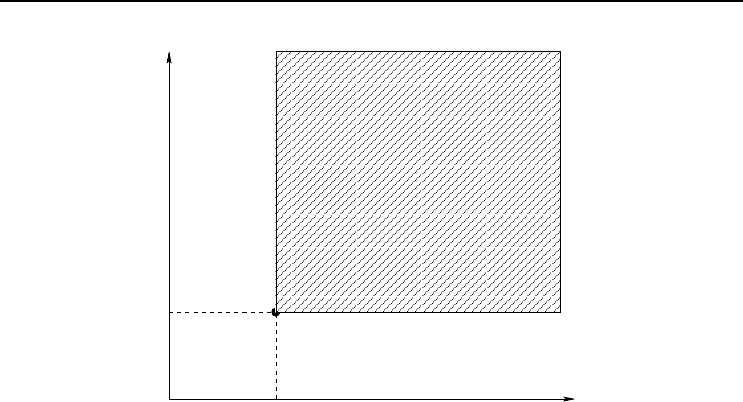
Figure A.5 Illustration of Dominance
A.8.3 Pareto-Optimality
This section provides a number of definitions that are needed when talking about
MOO. Definitions include dominance, Pareto-optimal, Pareto-optimal front, and oth-
ers. These definitions assume minimization.
Definition A.11 Domination: A decision vector, x
1
dominates a decision vector,
x
2
(denoted by x
1
≺ x
2
), if and only if
• x
1
is not worse than x
2
in all objectives, i.e. f
k
(x
1
) ≤ f
k
(x
2
), ∀k =1,...,n
k
,
and
• x
1
is strictly better than x
2
in at least one objective, i.e. ∃k =1,...,n
k
: f
k
(x
1
) <
f
k
(x
2
).
Similarly, an objective vector, f
1
, dominates another objective vector, f
2
,iff
1
is not
worse than f
2
in all objective values, and f
1
is better than f
2
in at least one of the
objective values. Objective vector dominance is denoted by f
1
≺ f
2
.
From Definition A.11, solution x
1
is better than solution x
2
if x
1
≺ x
2
(i.e. x
1
dominates x
2
), which happens when f
1
≺ f
2
.
The concept of dominance is illustrated in Figure A.5, for a two-objective function,
f(x)=(f
1
(x),f
2
(x)). The striped area denotes the area of objective vectors dominated
by f.
Definition A.12 Weak domination: A decision vector, x
1
, weakly dominates a
decision vector, x
2
(denoted by x
1
x
2
), if and only if

A.8 Multi-Objective Optimization 573
• x
1
is not worse that x
2
in all objectives, i.e. f
k
(x
1
) ≤ f
k
(x
2
), ∀k =1,...,n
k
.
Definition A.13 Pareto-optimal: A decision vector, x
∗
∈Fis Pareto-optimal
if there does not exist a decision vector, x = x
∗
∈Fthat dominates it. That is,
k : f
k
(x) <f
k
(x
∗
). An objective vector, f
∗
(x), is Pareto-optimal if x is Pareto-
optimal.
The concept of Pareto-optimality is named after the mathematician Vilfredo Pareto,
who generalized this concept, first introduced by Francis Ysidro Edgeworth.
Definition A.14 Pareto-optimal set: The set of all Pareto-optimal decision vectors
form the Pareto-optimal set, P
∗
. That is,
P
∗
= {x
∗
∈F| ∃x ∈F: x ≺ x
∗
} (A.47)
The Pareto-optimal set therefore contains the set of solutions, or balanced trade-offs,
for the MOP. The corresponding objective vectors are referred to as the Pareto-optimal
front:
Definition A.15 Pareto-optimal front: Given the objective vector, f(x),andthe
Pareto-optimal solution set, P
∗
, then the Pareto-optimal front, PF
∗
⊆O, is defined
as
PF
∗
= {f =(f
1
(x
∗
),f
2
(x
∗
),...,f
k
(x
∗
))|x
∗
∈P} (A.48)
The Pareto front therefore contains all the objective vectors corresponding to decision
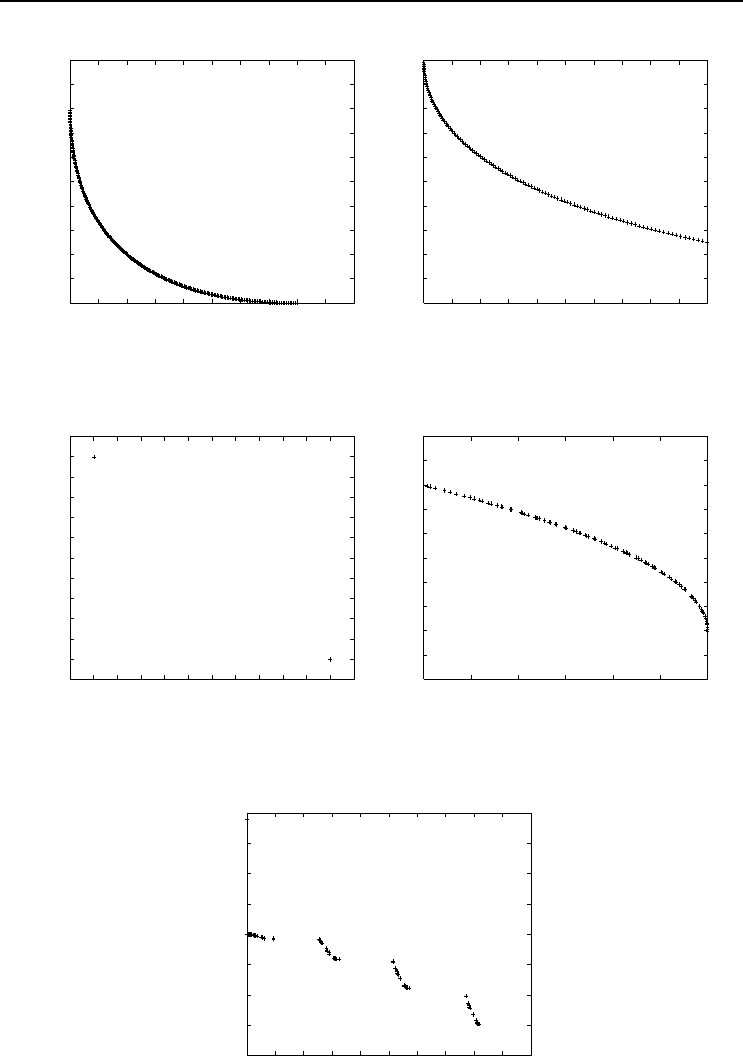
vectors that are not dominated by any other decision vector. An example Pareto front
is illustrated for the following functions in Figure A.6 [664, 665]:
• The convex, uniform Pareto front in Figure A.6(a) for MOP
f(x)=(f
1
(x),f
2
(x)) (A.49)
f
1
(x)=
1
n
x
n
x
j=1
x
2
j
f
2
(x)=
1
n
x
n
x
j=1
(x
j
− 2)
2
• The convex, non-uniform Pareto front in Figure A.6(b) for MOP
f(x)=(f
1
(x),f
2
(x)) (A.50)
f
1
(x)=x
1
f
2
(x)=g(x)(1 −
&
f
1
(x)/g(x))
where
g(x)=1+
9
n
x
− 1
n
x
j=2
x
j
574 A. Optimization Theory
0
0.5
1
1.5
2
2.5
3
3.5
4
4.5
5
0 0.5 1 1.5 2 2.5 3 3.5 4 4.5 5
f2
f1
(a) Convex, Uniform Front for Equation
(A.49)
0
0.1
0.2
0.3
0.4
0.5
0.6
0.7
0.8
0.9
1
0 0.1 0.2 0.3 0.4 0.5 0.6 0.7 0.8 0.9 1
f2
f1
(b) Convex, Non-uniform Front for Equa-
tion (A.50)
-0.1
0
0.1
0.2
0.3
0.4
0.5
0.6
0.7
0.8
0.9
1
1.1
-0.1 0 0.1 0.2 0.3 0.4 0.5 0.6 0.7 0.8 0.9 1 1.1
f2
f1
(c) Concave Front for Equation (A.51)
0
0.5
1
1.5
2
2.5
3
3.5
4
4.5
5
-36 -30 -24 -18 -12 -6 0
f2
f1
(d) Partially Convex, Partially Concave
Front for Equation (A.52)
-1
-0.5
0
0.5
1
1.5
2
2.5
3
0 0.1 0.2 0.3 0.4 0.5 0.6 0.7 0.8 0.9 1
f2
f1
(e) Discrete Convex Front for Equation
(A.53)
Figure A.6 Example Pareto-Optimal Fronts
A.9 Dynamic Optimization Problems 575
• The concave Pareto front in Figure A.6(c) for the MOP of Figure A.6(b), but
with
f
2
(x)=g(x)(1 − (f
1
(x)/g(x))
2
) (A.51)
• The partially concave and partially convex Pareto front in Figure A.6(d) for the
MOP of Figure A.6(b), but with
f
2
(x)=g(x)(1 −
4
&
f
1
(x)/g(x) −(f
1
(x)/g(x))
4
) (A.52)
• The discrete, convex Pareto front in Figure A.6(e) for the MOP of Figure A.6(b),
but with
f
2
(x)=g(x)(1 −
&
f
1
(x)/g(x) − (f
1
(x)/g(x)) sin(10πf
1
(x))) (A.53)
The objective when solving a MOP is to approximate the true Pareto-optimal front,
and then to select the solution that represents the best trade-off (for problems which,
in the end, require only one solution). To find the exact true Pareto-optimal front (i.e.
to find all the Pareto-optimal solutions in F) is usually computationally prohibitive.
The task is therefore reduced to finding an approximation to the true Pareto front
such that
• the distance to the Pareto front is minimized,
• the set of non-dominated solutions, i.e. the Pareto-optimal set, is as diverse as
possible, and
• already found non-dominated solutions are maintained.
The task of finding an approximation to the true Pareto front is therefore in itself a
MOP, where the first objective ensures an accurate approximation, and the second
objective ensures that the entire Pareto front is covered.
A.9 Dynamic Optimization Problems
Dynamic optimization problems have objective functions that change over time. Such
changes in objective function cause changes in the position of optima, and the char-
acteristics of the search space. Existing optima may disappear while new optima
may appear. This chapter provides a formal definition of a dynamic problem in Sec-
tion A.9.1, and lists different types of dynamic problems in Section A.9.2. Example
benchmark problems are given in Section A.9.3.
A.9.1 Definition
A dynamic optimization problem is formally defined as

576 A. Optimization Theory
Definition A.16 Dynamic optimization problem:
minimize f(x,(t)), x =(x
1
,...,x
n
x
),(t)=(
1
(t),...,
n
)
subject to g
m
(x) ≤ 0,m=1,...,n
g
h
m
(x)=0,m= n
g
+1,...,n
g
+ n
h
x
j
∈ dom(x
j
) (A.54)
where (t) is a vector of time-dependent objective function control parameters. The
objective is to find
x
∗
(t)=min
x
f(x,(t)) (A.55)
where x
∗
(t) is the optimum found at time step t.
The goal of an optimization algorithm for dynamic environments is then to locate an
optimum and to track its trajectory as closely as possible.
A.9.2 Dynamic Environment Types
In order to track the optimum over time, the optimization algorithm needs to detect
and track changes. The environment may change on any timescale, referred to as
temporal severity. Changes can be continuously spread over time, at irregular time
intervals or periodically. Due to these changes, the position of an optimum may change
by any amount, referred to as spatial severity.
Eberhart et al. defines three types of dynamic environments [228, 385]:
• Type I environments, where the location of the optimum in problem space
is subject to change. The change in the optimum, x
∗
(t) is quantified by the
severity parameter, ζ, which measures the jump in location of the optimum.
• Type II environments, where the location of the optimum remains the same,
but the value, f(x
∗
(t)), of the optimum changes.
• Type III environments, where both the location of the optimum and its value
changes.
The changes in the environment, as caused by the control parameters, can be in one
or more of the dimensions of the problem. If the change is in all the dimensions, then
for type I environments, the change in optimum is quantified by ζI,whereI is the
unit vector.
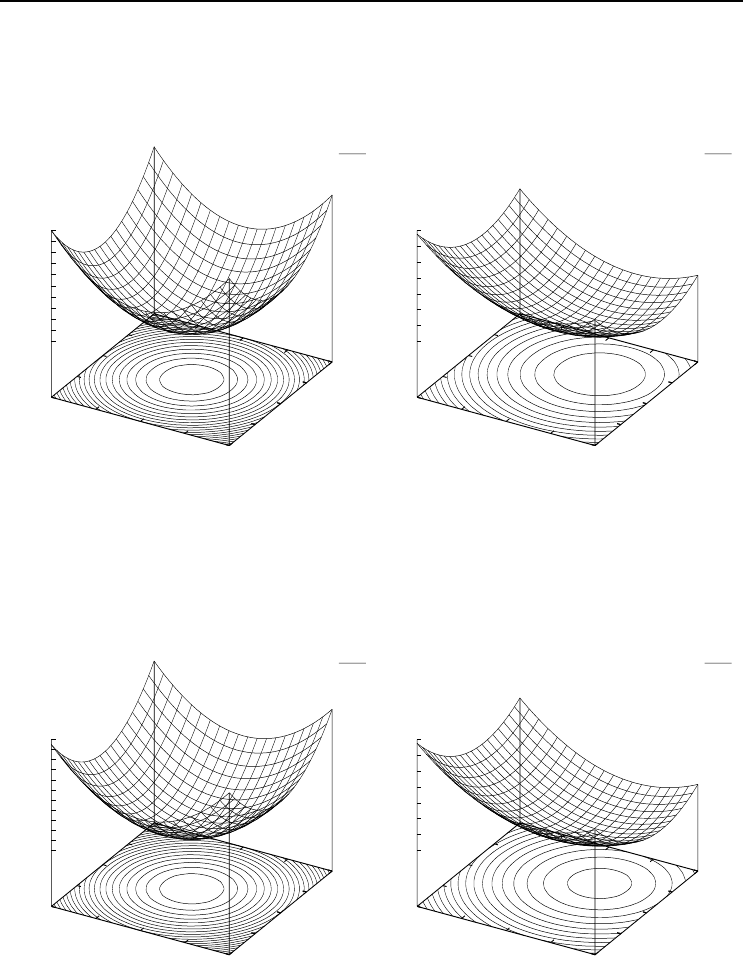
Examples of these types of dynamic environments are illustrated in Figures A.7 and
A.8. Figure A.7 illustrates the dynamic function,
f(x,(t)) =
n
x
j=1
(x
j
−
1
(t))
2
+
2
(t) (A.56)
for n
x
= 2. Figure A.7(a) illustrates the static function with both control parameters
set to zero. A type I environment is illustrated in A.7(b) with
1
=3and
2
=0.
A.9 Dynamic Optimization Problems 577
f(x1,x2)
-10
-5
0
5
10
x1
-10
-5
0
5
10
x2
0
20
40
60
80
100
120
140
160
180
200
f(x1,x2)
(a) Static function,
1
=
2
=0
f(x1,x2)
-10
-5
0
5
10
x1
-10
-5
0
5
10
x2
0
50
100
150
200
250
300
350
f(x1,x2)
(b) Type I environment,
1
=3,
2
=0
f(x1,x2)
-10
-5
0
5
10
x1
-10
-5
0
5
10
x2
40
60
80
100
120
140
160
180
200
220
240
260
f(x1,x2)
(c) Type II environment,
1
=0,
2
=50
f(x1,x2)
-10
-5
0
5
10
x1
-10
-5
0
5
10
x2
50
100
150
200
250
300
350
400
f(x1,x2)
(d) Type III environment,
1
=3,
2
=50
Figure A.7 Dynamic Parabola Objective Function