
Freiling G., Yurko V. Lectures on Differential Equations of Mathematical Physics: A First Course
Подождите немного. Документ загружается.


282 G.
Freiling and V. Yurko
4. The change
of variables
ξ = y −3x, η = 3y −x
reduces the equation to the canonical form
32u
ξη
+ u
ξ
−u
η
−
v
32
−(3ξ −η)e
xp
µ
ξ −η
32

= 0.
The
replacement
u
(ξ,η) = exp
µ
ξ −η
32

v(ξ,η)
yields
32w
ξη
−3ξ + η = 0.
Inte
grating
the equation we get
u(x,y) =
µ
f (y −3x) + g(3y −x) −
1
8
x(y −3x)(3y −x)

×e
xp
µ
−
(x + y
)
16

.
5. u(x,y)
= 2
e
x
+ e
(x+2y)/2
( f (x) + g(x + 2y));
6. u(x,y) = e
x+y/2
((2x + y)e
4x+y
= f (2x + y) + g(4x + y));
7. u(x,y) = f (y + 2x + sinx) + e
−(y+2x+sinx)/4
g(y −2x + sin x);
8. u(x,y) = e
y
(e
2y
−e
2x
) + f (e
y
+ e
x
) + g(e
y
−e
x
);
9. Denote v = u
y
. By differentiation we get the following equation with respect to
v(x,y) :
v
xy
+ yv
y
= 0.
The general solution of this equation is
v(x,y) = g(x) +
y
0
f (η)e
−ηx
dη,
where f and g are arbitrary smooth functions. Hence
u(x,y) = yg(x) + g
0
(x)
y
0
(y −η) f (η)e
−ηx
dη.
6.2.1.
1. u(x,t) = sin x cost;
2. u(x,t) =
A
a
sinx sin a
t;
Exercises 283
3. u(x,t)
=
1
2
[ϕ(x + a(t −t
0
))
+ ϕ
(x −a(t −t
0
))]
+
1
2a
x+a(t−t
0
)
x−a(t−t
0
)
ψ(ξ)dξ;
4. u(x,t)
=
(x + t)
2
+ 2xt.
In problems 6.2.2-6.2.5 reduce the equations to the canonical forms.
6.2.2. u(x,y) = 3x
2
+ y
2
;
6.2.3. u(x,y) = ϕ
0
(x −
2
3
y
3
)
+
1
2
x+2y
x−
2
3
y
3
ϕ
1
(x)d
x;
6.2.4.
u
(x,y) =
ϕ
0
(x −sinx +y) + ϕ
0
(x + sinx −y)
2
+
1
2
x−sinx+y
x+sinx−y
ϕ
1
(z)d
z
;
6.2.5. u(x,y) =
1
2
( f (x −2
√
−y)
+ f (x + 2
√
y)); (y < 0).
6.2.6.
1. u(x,t)
=
(x + 2t)
2
;
2. u(x,t) = x +
xt
3
6
+ sin xsint;
3. u(x,t)
= sin x;
4. u
(x,t) = (1 −cost) sin x;
5. u(x,t) = x(t −sint) + sin(x +t);
6. u(x,t) = sin(x +t) + xt −(1 −cht)e
x
;
7. u(x,t) = t + e
−t
−1 + sin(x + t).
6.2.7.
1. Extend ϕ(x) and ψ(x) on the half-line −∞ < x < 0 as even functions.
2. u(x,t) = ψ(x + at)−ψ(x −at), where
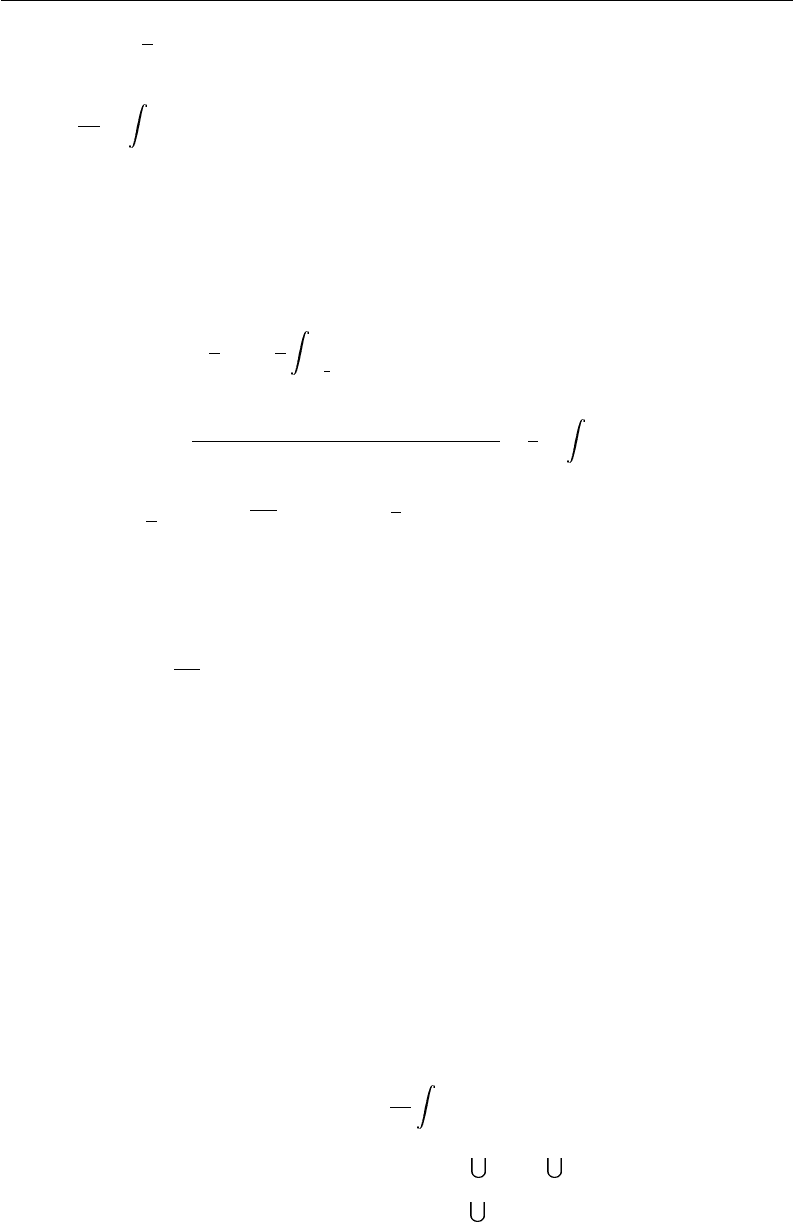
ψ(z) =
1
2a
z
−2l
ϕ(ξ)dξ,
ϕ(z)
=
(
0
, z ∈[(−∞; −2l) (−l;l) (2l;∞)],
v
0
, z ∈[(−2l;−l) (l; 2l)];

284 G.
Freiling and V. Yurko
3. The boundary
condition causes a wave propagating from x = 0 in the direction of
the x -axis; hence we seek a solution of the problem in the form u(x,t) = f (x −at) ;
u(x,t) =
0 for t <
x
a
,
Asin ω
³
t −
x
a
´
for t >
x
a
.
6.2.9. W
e
use the reflection method and seek the solution in the form (2.1.13), where Φ
and Ψ should be constructed. The initial conditions define these functions in the interval
(0,l). We extend Φ and Ψ as odd functions with respect to the points x = 0 and x = l :
Φ(x) = −Φ(−x), Φ(x) = −Φ(2l −x),
Ψ(x) = −Ψ(−x), Ψ(x) = −Ψ(2l −x),
i.e.
Φ(−x) = Φ(2l −x), Ψ(−x) = Ψ(2l −x),
hence Φ(x) and Ψ(x) are 2l - periodic functions.
6.2.10.
1. u(x,t) = A sin
πx
l
cos
πa
t
l
(0 < x < l, t > 0);
2. u(x,t)
=
ϕ(
x −at) + ϕ(x + at)
2
(0 < x < l, t > 0);
where
ϕ(z)
=
½
Az for −l < z < l,
A
(2l −z) for l < z < 3l,
ϕ(z) = ϕ(z + 4l), −∞ < z < ∞.
6.2.11.
2. λ
n
=
³
nπ
l
´
2
, y
n
(x)
= cos
n
π
l
x, n = 0,1,2,
.
.. ;
3. λ
n
=
µ
(2n + 1)π
2l

2
, y
n
(x)
= sin
(2
n + 1)π
2l
x, n = 0,1,2,
.
.. ;
4. λ
n
=
µ
(2n + 1)π
2l

2
, y
n
(x)
= cos
(
2n + 1)π
2l
x, n = 0,1,2,
.
.. ;
5. y
n
(x) = cos ρ
n
x, where ρ
n
are roots of the equation ρsin ρl −h cos ρl = 0.
6.2.12.
1. λ
n
=
³
nπ
l
´
2
+ γ, y
n
(x)
= sin
n
π
l
x, n = 1,2,
.
.. ;

Exercises 285
2. λ
n
=
³
nπ
l
´
2
+ γ, y
n
(x)
= cos
n
π
l
x, n = 0,1,2,
.
.. ;
3. λ
n
=
µ
(2n + 1)π
2l

2
+ γ, y
n
(x)
= sin
(2
n + 1)π
2l
x, n = 0,1,2,
.
.. ;
4. λ
n
=
³
nπ
l
´
2
+ γ +
η
2
4
, y
n
(x)
= e
ηx
2
sin
nπ
l
x, n = 1,2,
.
.. .
6.2.13. Apply the method of separation of variables to the equation u
tt
= a
2
u
xx
with the
boundary conditions u(0,t) = u(l,t) = 0. The corresponding Sturm-Liouville problem is
solved in Problem 6.2.11,1.
6.2.14. Apply the method of separation of variables to the equation u
tt
= a
2
u
xx
with the
boundary conditions u
x
(0,t) = u
x
(l,t) = 0. The corresponding Sturm-Liouville problem is
solved in Problem 6.2.11:2.
6.2.15. Solve the equation u
tt
= a
2
u
xx
with the given initial and boundary conditions. The
corresponding Sturm-Liouville problems are solved in Problems 6.2.11: 3-5.
6.2.16.
6.
u(x,t) =
∞
∑
n=1
¡
lJ
2
1
(µ
n
)
¢
−1
J
0
µ
µ
n
r
x
l

cos
µ
n
a
t
2
√
l
l
0
ϕ(ξ)J
0
Ã
µ
n
r
ξ
l
!
dξ,
where J
p
are
the Bessel function, and µ
1
,µ
2
,µ
3
,. .. are the positive roots of the equation
J
0
(µ) = 0.
6.2.17. The problem is reduced to the solution of the equation u
tt
= a
2
u
xx
+ Asin ωt with
the boundary conditions u(0,t) = u(l,t) = 0 and with zero initial conditions. A resonance
appears for ω =
anπ
l
, n = 1,2,
.
.. .
6.2.18. Solve the equation u
tt
= a
2
u
xx
+ f (x,t) with the initial conditions u(x,0) =
u
t
(x,0) = 0 and with the given boundary conditions.
6.2.19. The problem is reduced to the solution of the equation u
tt
= a
2
u
xx
with the bound-
ary conditions u(0,t) = 0 , u(l,t) = A sin ωt and with zero initial conditions.
6.2.20. Solve the equation u
tt
= a
2
u
xx
+ f (x,t) with the given conditions.
6.2.21. Solve the problem u
tt
+ 2αu
t
= a
2
u
xx
(α > 0) , u(x, 0) = ϕ(x) , u
t
(x,0) = ψ(x) ,
u(0,t) = u(l,t) = 0.
6.2.22.
3. By the replacement
u(x,t) = e
−
t
2
(v(x,t)
+
(1 −x)t),
Problem 3 is reduced to the following problem for the function v(x,t) :
v
tt
= v
xx
+
1
4
v +
(x −1
)e
−
t
2
,

286 G.
Freiling and V. Yurko
v(0,t) = v
t
(0
,t) = 0, v(x,t) = v(1,t) = 0.
We seek the solution in the form
v(x,t) =
∞
∑
n=1
T
n
(t)y
n
(x),
where the functions y
n
(x) are the eigenfunctions of problem:
y
00
+
µ
λ +
1
4

y = 0, y(0)
= y
(l) = 0,
and the functions T
n
(t) are the solutions of the Cauchy problem
T
00
n
+ λ
n
T
n
=
1
πn
e
−
t
2
, T
n
(0)
= T
0
n
(0
) = 0.
Solving the spectral problem we get:
y
n
(x) = sin πnx, λ
n
= (πn)
2
−
1
4
, n ≥1.
Solving
the
Cauchy problem we obtain
T
n
(t) =
1
πn
√
λ
n
(1 −4λ
n
)
³
2
sin
p
λ
n
t + 4
p
λ
n
e
−
t
2
−4
p
λ
n
cos
p
λ
n
t
´
.
Then
the
solution of Problem 3 has the form:
u(x,t) = e
−
t
2
³
∞
∑
n=1
1
πn
√
λ
n
(1 −4λ
n
)
³
2
sin
p
λ
n
t
+4
p
λ
n
e
−
t
2
−4
p
λ
n
cos
p
λ
n
t
´
sinπnx +
(1 −x)t
´
.
6.2.23.
2. u = sinx cost + x
2
t +
t
3
3
−t
2
;
3. u = xcht +
(t +1
)sht −
t
2
2
e
x
;
Hint. Mak
e
the substitution u(x,t) = e
−x
v(x,t) .
4. u = e
t
µ
x −xt −
t
2
2

.
Hint. Mak
e
the substitution u(x,t) = e
−x
v(x,t) .

Exercises 287
6.2.24.
u(x,t) =
ϕ
(x −at) + ϕ(x + at)
2
+
1
2a
x+a
t
x−a
t
ψ(z)dz
+
1
2a
t
0
dτ
x+a(t−τ)
x−a(t−τ)
f (z, τ)d
z.
6.2.25.
u
(x,y) =
1
2
ϕ(x,y)
+
y
2
ϕ(
x
y
)
+
√
x
y
y
x
y
x
y
ϕ(
z)
z
3/2
d
z −
√
x
y
2
x
y
x
y
ψ
(z)
z
3/2
d
z
.
6.3.1.
1. (1 + t)
−1/2
exp
µ
2x −x
2
+t
t + 1

;
2. (1 + t)
−1/2
sin
x
1 + t
e
xp
µ
−
4
x
2
+t
4(1 +t)

;
3. x(1 +4t)
−3/2
e
xp
µ
−
x
2
1 + 4t

.
6.3.3.
1. 1 + e
t
+
1
2
t
2
;
2. t
3
+ e
−t
sinx;
3. (1 + t)e
−t
cosx;
4. cht sin x;
5. 1 −cost +
(1 + 4t)
−1/2
e
xp
µ
−
x
2
1 + 4t

.
6.3.4. Apply
the
method of separation of variables to the equation u
t
= a
2
u
xx
with the
boundary conditions u(0,t) = u(l,t) = 0 and with the given initial conditions. The corre-
sponding Sturm-Liouville problem is solved in Problem 6.2.11:1.
6.3.5. Solve the equation u
t
= a
2
u
xx
with the boundary conditions u
x
(0,t) = u
x
(l,t) = 0
and with the given initial conditions.
6.3.7. Solve the equation u
t
= a
2
u
xx
with the given conditions.
6.3.8. Solve the equation u
t
= a
2
u
xx
−b
2
u with the given conditions.
In Problems 6.4.2: 2-4 and 6.4.3: 2-3 the Laplace equation is reduced to an ordinary
differential equation, if we use the cartesian coordinates in 6.4.2: 1-2 and 6.4.3: 1, the polar
coordinates in 6.4.2: 3-4, and the spherical coordinates in 6.4.3: 2-3.

288 G.
Freiling and V. Yurko
6.4.2.
1. u(x
1
,x
2
) = a
(x
2
1
−x
2
2
) + bx
1
x
2
+ cx
1
+ dx
2
+ e , where a,b,c,d,e are constants.
2. u(x) = ax
1
+ b;
3. u(ρ) = a ln
1
ρ
+ b or u(x
1
,x
2
)
= a ln
1
(x
2
1
+ x
2
2
)
1/2
+ b;
4. u(ϕ)
= a
ϕ + b or u(x
1
,x
2
) = a arctan
x
2
x
1
+ b.
6.4.3.
1. u(x
1
,x
2
,x
3
)
= ax
2
1
+ bx
2
2
+ cx
2
3
+ p
(x
1
,x
2
,x
3
), where a, b,c are constants such
that a + b + c = 0 , and p(x
1
,x
2
,x
3
) is a linear combination of x
1
x
2
,x
1
x
3
,x
1
,
x
2
,x
3
,1;
2. u(r) =
a
r
+ b or u(x
1
,x
2
,x
3
)
=
a
(x
2
1
+ x
2
2
+ x
2
3
)
1/2
+ b;
3. u(θ)
= a ln
tan
θ
2
+ b or
u(x
1
,x
2
,x
3
)
= a ln
tan
Ã
(x
2
1
+ x
2
2
)
1/2
x
3
+
(x
2
1
+ x
2
2
+ x
2
3
)
1/2
!
+ b.
6.4.4.
1. k = −3;
2. k = ±2
i, and ch ky = cos 2y;
3. k = ±3.
6.4.5.
1. yes;
2. no;
3. yes.
6.4.6.
1. yes;
2. yes;
3. no.

Exercises 289
6.4.8. Use the
Cauchy-Riemann differential equations.
6.4.9. Calculate Re
1
f (z)
, where f (z) is
defined
in 6.4.8.
6.4.10.
1. f (z) = x
3
1
−3x
1
x
2
2
+ i(3x
2
1
x
2
−x
3
2
) + i(−3y
2
1
y
2
+ y
3
2
+C);
3. f (z) = sin x
1
chx
2
+ i cosx
1
shx
2
+ i(−cosy
1
shy
2
+C);
4. f (z) = z
2
;
5. f (z) =
z
2
2i
+
(1 −i
)z + iC.
For solving Problems 4 and 5 the Goursat formula (6.4.2) is used.
6.4.12.
1. 2πu(0,0), use Problem 6.4.10: 4;
2. 2πu(0,0), use Problem 6.4.10: 3.
6.4.13.
1) u(x
1
,x
2
) = a;
2) u(x
1
,x
2
) = ax
1
+ bx
2
;
3) u(x
1
,x
2
) = x
1
x
2
;
5) u(x
1
,x
2
) =
a + b
2
+
b −a
2
(x
2
1
−x
2
2
) or
u(ρ,ϕ)
=
a
2
µ
1 −
ρ
2
l
2
cos
2
ϕ

+
b
2
µ
1 +
ρ
2
l
2
cos
2
ϕ

.
6.4.14.
1) u(ρ,ϕ) = a;
3) u(ρ,ϕ) =
1
2
l
4
ρ
2
sin
2
ϕ;
4) u(ρ,ϕ) = a +
bl
ρ
sinϕ;
5) u(ρ,ϕ)
=
a + b
2
−
a −b
2
l
2
ρ
2
cos
2
ϕ.

290 G.
Freiling and V. Yurko
6.4.15. u(ρ)
= a +
(b −a)
lnρ/l
1
lnρ/l
2
. The
function u depends
only on ρ since the boundary
condition does not depend on ϕ.
6.4.16. u(ρ) =
1
4
(ρ
2
−l
2
).
6.4.17. u(x
1
,x
2
,x
3
)
= a .
6.4.18. u
(x
1
,x
2
,x
3
) =
la
ρ
.
6.4.19.
1)
The
problem has no solutions;
3) u(x
1
,x
2
) =
al
2
(x
2
1
−x
2
2
)
+C or u
(ρ,ϕ) =
al
2
ρ
2
cos
2
ϕ +C ;
4) The problem has no solutions;
5) u(ρ,ϕ) =
µ
a +
3
4
b

sinϕ −
b
12l
2
sin
3
ϕ +C or
u(x
1
,x
2
) =
µ
a +
3
4
b

x
2
−
b
12l
2
(3(x
2
1
+ x
2
2
)x
2
−4x
3
2
)
+C.
6.4.20.
2) G
(x,y) =
1
2π
ln
1
|x −y|
−
1
2π
ln
R
|x|
·
1
|x −y
1
|
, y
1
= y
R
2
|y|
2
.
6.4.21.
1) G(x,y)
=
1
4π
1
|x −y|
−
1
4π
1
|x −y
1
|
, y
1
=
(y
1
,y
2
,2
l −y
3
).
6.4.22.
1) G(x,y) =
1
4π
1
∑
n,k=0
(−1)
k+n
|x −y
n,k
|
,
y
00
= y =
(y
1
,y
2
,y
3
), y
n,k
=
(y
1
,(−1)
n
y
2
,(−1)
k
y
3
);
2) G(x,y) =
1
4π
n−1
∑
k=0
µ
1
|x −y
k
|
−
1
|x − ˜y
k
|

, x =
(ρ
,ϕ, z) ,
y
0
= y = (µ,ψ,z), y
k
=
µ
µ,
2πk
n
+ ψ,z

,
˜y
k
=
µ
µ,
2πk
n
−ψ,z

;
3) G(x,y)
=
1
4π
1
∑
m,n,k=0
(−1)
m+n+k
1
|x −y
m,n,k
|
,
y
m,n,k
=
((−1
)
m
y
1
,(−1)
n
y
2
,(−1)
k
y
3
);

Exercises 291
4) G(x,y)
=
1
4π
1
∑
k=0
µ
1
|x − ˜y
k
|
−
R
|˜y
k
||x −y
0
k
|

,
˜y
0
= y =
(y
1
,y
2
,y
3
), ˜y
1
=
(y
1
,y
2
,y
3
), y
0
k
= ˜y
k
R
2
|˜y
k
|
2
;
5) G(x,y)
=
1
4π
1
∑
n,k=0
(−1)
n+k
Ã
1
|x −y
n,k
|
−
R
|y
n,k
||x −y
0
n,k
|
!
,
y
00
= y =
(y
1
,y
2
,y
3
), y
n,k
=
(y
1
,(−1)
n
y
2
,(−1)
k
y
3
),
y
0
n,k
= y
n,k
R
2
|y
n,k
|
2
;
7) for
the
construction of the Green’s function make the reflections with respect to the
planes x
3
= 0 and x
3
= l ;
G(x,y) =
1
4π
∞
∑
n=−∞
µ
1
|x −y
n
|
−
1
|x − ˜y
n
|

,
y
n
=
(y
1
,y
2
,2
nl + y
3
), ˜y
n
= (y
1
,y
2
,2nl −y
3
);
8) G(x,y) =
1
4π
∞
∑
n=−∞
1
∑
k=0
µ
1
|x −y
n,k
|
−
1
|x − ˜y
n,k
|

,
y
n,k
=
((−1
)
k
y
1
,y
2
,2nl + y
3
), ˜y
n,k
= ((−1)
k
y
1
,y
2
,2nl −y
3
).
6.4.23.
1) G(x,y) =
1
2π
1
∑
n,k=0
(−1)
n+k
ln
1
|x −y
n,k
|
,
y
n,k
=
((−1
)
n
y
1
,(−1)
k
y
2
);
3) G(x,y) =
1
2π
1
∑
k=0
³
ln
1
|x −y
k
|
−ln
R
|y
n
||x −y
0
k
|
´
,
y
k
=
(y
1
,(−1
)
k
y
2
), y
0
k
= y
k
R
2
|y
k
|
;
4) G(x,y)
=
1
2π
1
∑
n,k=0
(−1)
n+k
³
ln
1
|x −y
n,k
|
−ln
R
|y
n,k
|
|x −y
n,k
|
´
,
y
n,k
=
((−1)
n
y
1
,(−1)
k
y
2
), y
0
n,k
= y
n,k
R
2
|y
n,k
|
2
;