
Freiling G., Yurko V. Lectures on Differential Equations of Mathematical Physics: A First Course
Подождите немного. Документ загружается.


232 G.
Freiling and V. Yurko
3. u
tt
= a
2
u
x
x
, u(0,t) = A sin ωt, u(x,0) = 0, u
t
(x,0) = 0.
6.2.8. A semi-infinite homogeneous string ( x ≥ 0 ) with the fixed end-point x = 0 is
perturbed by the initial displacement
u(x,0) =
0, 0 ≤x ≤e,
−sin
πx
e
, e ≤x ≤ 2e,
0, 2e ≤x < ∞.
Find
the
form of the string at
t =
e
4a
,
e
a
,
5e
4a
,
3e
a
,
7e
a
,
pro
vided
that the initial velocity is equal to zero, i.e. u
t
(x,0) = 0.
6.2.9. A homogeneous string of length l ( 0 ≤ x ≤ l ) is fixed at the ends x = 0 and
x = l. At initial time t = 0 the string is deviated at the point x = l/3 to the distance h
from the axis Ox, and then is released without initial velocity. Show that for 0 ≤ t ≤
1
3a
the
form
of the string is expressed by the formula
u(x,t) =
3hx
l
, for 0 < x ≤
l
3
−a
t,
3
h
4l
x +
9h
4l
(
l
3
−a
t), for
l
3
−a
t < x ≤
l
3
+ a
t,
3
h
2l
(l −x), for
l
3
+ a
t < x < l.
6.2.10. Solv
e the following problems in the domain 0 ≤x ≤l, t > a :
1. u
xx
=
1
a
2
u
t
t
,
u
(0,t) = 0, u(l,t) = 0, t > 0,
u(x,0) = A sin
πx
l
, u
t
(x,0)
= 0
, 0 ≤x ≤l ;
2. u
xx
=
1
a
2
u
t
t
,
u
(0,t) = 0, u
x
(l,t) = 0, t > 0,
u(x,0) = Ax, u
t
(x,0) = 0, 0 ≤ x ≤l.
Solution of Problem 1. Consider the following Cauchy problem
u
xx
=
1
a
2
u
t
t
, −∞ < x < ∞, t > 0
,
u(x,0) = A sin
πx
l
, u
t
(x,0)
= 0
.
Exercises 233
According to
the d’Alambert’s formula (2.1.4), the solution of this Cauchy problem has the
form
u(x,t) = A sin
πx
l
cos
aπt
l
.
It
is
easy to check that this function also is the solution of problem 6.2.10:1.
6.2.11. Solve the following problem in the domain −∞ < x < ∞, t ≥ 0 :
u
tt
= a
2
u
xx
, u(x,0) = f (x), u
t
(x,0) = −a f
0
(x),
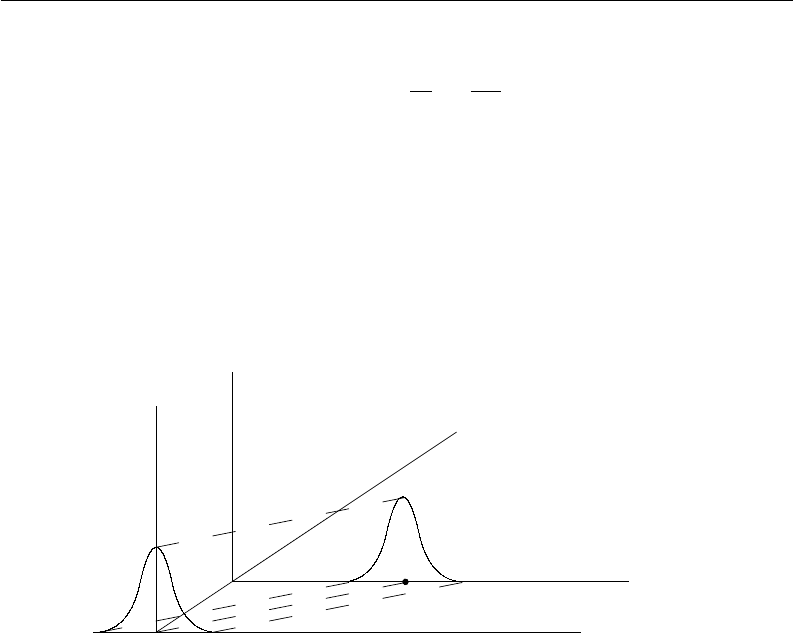
where f is a smooth function (see fig. 6.2.1).
6
-
6
-
3
u
x
u
x
t
u(x,t)
= f (
x −at)
Figure
6.2.1.
2.
Method of separation of variables
Sturm-Liouville problem. Consider the following boundary value problem L
−(k(x)y
0
(x))
0
+ q(x)y(x) = λρ(x)y(x), 0 ≤x ≤l,
h
1
y
0
(0) + hy(0) = H
1
y
0
(l) + Hy(l) = 0,
which is called the Sturm-Liouville problem. Here λ is the spectral parameter, k,q, ρ
are real-valued functions, and h
1
,h, H
1
,H are real numbers. We assume that ρ(x),k(x) ∈
W
1
2
[0,l] (i.e. ρ(x),k(x),ρ
0
(x),k
0
(x) are absolutely continuous functions), q(x) ∈ L(0,l) ,
ρ(x) > 0, k(x) > 0 , and |h
1
|+ |h| > 0 , |H
1
|+ |H| > 0 . We are interested in non-trivial
solutions of the boundary value problem L .
The values of the parameter λ for which L has nonzero solutions are called eigenval-
ues, and the corresponding nontrivial solutions are called eigenfunctions.
It is known that L has a countable set of eigenvalues {λ
n
}
n≥0
, and λ
n
= O(n
2
) as
n → ∞ . For each of these eigenvalues λ
n
there exists only one eigenfunction (up to a

234 G.
Freiling and V. Yurko
multiplicativ
e constant) y
n
(x) . The set of eigenfunctions {y
n
(x)}
n≥0
form a complete and
orthonormal system in L
2
[0,l] with the weight r(x) , i.e.:
l
0
ρ(x)y
n
(x)y
m
(x)dx =
½
0, n 6= m,
1, n = m,
If f (x) is a twice continuously differentiable function satisfying boundary conditions, then
f (x) can be expanded into the uniformly convergent series:
f (x) =
∞
∑
n=1
a
n
y
n
(x),
where
a
n
=
l
0
ρ(x) f (x)y
n
(x)dx.
Note that for the case h
1
H
1
6= 0 , these facts were proved in section 2.2 (see Theorem 2.2.8).
Other cases can be treated similarly.
6.2.11. Find eigenvalues and eigenfunctions of the boundary value problems for the
equation y
00
+ λy = 0 ( 0 < x < l ) with the following boundary conditions:
1. y(0) = y(l) = 0;
2. y
0
(0) = y
0
(l) = 0;
3. y(0) = y
0
(l) = 0;
4. y
0
(0) = y(l) = 0;
5. y
0
(0) = y
0
(l) + hy(l) = 0.
Solution of Problem 1. Let λ = ρ
2
. The general solution of the equation y
00
+ λy = 0
has the form
y(x) = C
1
sinρx
ρ
+C
2
cosρx.
Using
the
boundary condition y(0) = 0, we get C
2
= 0. The second boundary condition
y(l) = 0 gives us the equation that must be satisfied by the eigenvalues:
sinρl
ρ
= 0.
Hence,
the
eigenvalues and the eigenfunctions of Problem 1 have the form
λ
n
=
³
nπ
l
´
2
, y
n
(x)
= sin
n
π
l
x, n = 1,2,
.
..
6.2.12. Find eigenvalues and eigenfunctions of the following boundary value problems
(0 < x < l) :
1. −y
00
+ γy = λy, y(0) = y(l) = 0;

Exercises 235
2. −y
00
+ γy = λy, y
0
(0) = y
0
(l)
= 0;
3. −y
00
+ γy = λy, y(0) = y
0
(l) = 0;
4. −y
00
+ ηy
0
+ γy = λy, y(0) = y(l) = 0.
Solution of Problem 4. The replacement
y(x) = exp
³
ηx
2
´
Y (x)
yields
y
0
(x)
= e
xp
³
ηx
2
´
³
Y
0
(x)
+
η
2
Y (x)
´
,
y
00
(x)
= e
xp
³
ηx
2
´
µ
Y
00
(x)
+ ηY
0
(x)
+
η
2
4
Y (x)

,
and
consequently
,
Y
00
(x) + µY (x) = 0, Y (0) = Y (l) = 0,
where µ = λ −
η
2
4
−γ. The
eigen
values and the eigenfunctions of this boundary value
problem are
µ
n
=
³
nπ
l
´
2
, Y
n
(x)
= sin
n
π
l
x, n ≥1
(see
Problem
6.2.11). Therefore, the eigenvalues and the eigenfunctions of Problem 4 have
the form
λ
n
=
³
nπ
l
´
2
+
η
2
4
+ γ, y
n
(x)
= e
xp
³
ηx
2
´
sin
nπ
l
x, n ≥1.
Let
us
briefly present the scheme of the method of separation of variables for solving
the mixed problem for a vibrating string. Consider the following mixed problem for the
equation
ρ(x)u
tt
= (k(x)u
x
)
x
−q(x)u, 0 ≤ x ≤l, t ≥0 (6.2.1)
with the initial conditions
u(x,0) = ϕ(x), u
t
(x,0) = ψ(x) (6.2.2)
and with the boundary conditions
(h
1
u
x
+ hu)|
x=0
= (H
1
u
x
+ Hu)|
x=l
= 0. (6.2.3)
First we consider the following auxiliary problem. We will seek nontrivial (i.e. not
identically zero) particular solutions of equation (6.2.1) such that they satisfy the boundary
conditions (6.2.3) and admit separation of variables, i.e. they have the form
u(x,t) = T (t)y(x). (6.2.4)
Substituting (6.2.4) into (6.2.1) and (6.2.3), we get the Sturm-Liouville problem L for the
function y(x), and the equation T
00
(t) + λT (t) = 0 for the function T (t).

236 G.
Freiling and V. Yurko
Let λ
n
,y
n
(x) (n = 0
,1, 2,. ..) be the eigenvalues and the eigenfunctions of the problem
L . Then the functions
u
n
(x,t) =
µ
A
n
cos
p
λ
n
t + B
n
sin
√
λ
n
t
√
λ
n

y
n
(x)
(6
.2.5)
satisfy the equation (6.2.1) and the boundary conditions (6.2.3) for any A
n
and B
n
. The
solutions of the form (6.2.5) are called standing waves (normal modes of vibrations).
We will seek the solution of the mixed problem (6.2.1)-(6.2.3) by superposition of
standing waves (6.2.5):
u(x,t) =
∞
∑
n=0
µ
A
n
cos
p
λ
n
t + B
n
sin
√
λ
n
t
√
λ
n

y
n
(x). (6.2.6)
Ne
xt
we use the initial conditions (6.2.2) for finding the coefficients A
n
and B
n
. For this
purpose we substitute (6.2.6) into (6.2.2) and calculate
ϕ(x) =
∞
∑
n=0
A
n
y
n
(x), ψ(x) =
∞
∑
n=0
B
n
y
n
(x).
Then the coefficients A
n
and B
n
are given by the formulae
A
n
=
l
0
ρ(x)ϕ(x)y
n
(x)dx, B
n
=
l
0
ρ(x)ψ(x)y
n
(x)dx.
6.2.13. Solve the following problems of oscillations of a homogeneous string (0 < x <
l) with fixed end-points if the initial displacement u(x,0) and the initial velocities u
t
(x,0)
have the form:
1. u(x,0) = A sin
πx
l
, u
t
(x,0)
= 0;
2. u
(x,0) =
h
l
2
x(l −x), u
t
(x,0)
= 0;
3. u
(x,0) =
hx
l
(0 ≤ x ≤C), u(x,0)
=
h
(l −x)
l −C
(C ≤ x ≤l),
u
t
(x,0)
= 0;
4. u
(x,0) = 0, u
t
(x,0) = v
0
−const;
5. u(x,0) = 0,
u
t
(x,0) = v
0
(α ≤ x ≤β), u
t
(x,0) = 0 (x /∈ [α, β]);
6. u(x,0) = 0, u
t
(x,0) = sin
2π
l
x.

Exercises 237
Solution of
Problem 1. We have to solve the following mixed problem
u
tt
= a
2
u
xx
, 0 < x < l, t > 0,
u
|x=0
= u
|x=l
= 0,
u
|t=0
= A sin
π
l
x, u
t|t=0
= 0.
This
problem
is a particular case of the mixed problem (2.2.1)-(2.2.3) when ϕ(x) =
Asin
π
l
x , ψ(x)
= 0
. According to (2.2.17)-(2.2.18) the solution has the form
u(x,t) =
∞
∑
n=1
³
A
n
sin
anπ
l
t + B
n
cos
anπ
l
t
´
sin
nπ
l
x ,
where
A
n
= 0, B
n
=
2
l
l
0
Asin
π
l
x sin
nπ
l
x
d
x.
Clearly, B
1
= A and B
n
= 0 for n ≥2, and consequently,
u(x,t) = A cos
aπ
l
t sin
π
l
x .
6.2.14. Solv
e
the following problems of oscillations of a homogeneous string (0 < x <
l) with free end-points if the initial displacement u(x,0) and the initial velocities u
t
(x,0)
have the form:
1. u(x,0) = 1, u
t
(x,0) = 0;
2. u(x,0) = x, u
t
(x,0) = 1;
3. u(x,0) = cos
πx
l
, u
t
(x,0)
= 0;
4. u
(x,0) = 0, u
t
(x,0) = v
0
(α ≤ x ≤β), u
t
(x,0) = 0 (x /∈ [α, β]).
Solution of Problem 2. We have to solve the following mixed problem
u
tt
= a
2
u
xx
, 0 < x < l, t > 0,
u
x|x=0
= u
x|x=l
= 0,
u
|t=0
= x, u
t|t=0
= 1.
First we seek nontrivial particular solutions of the equation of the form u(x,t) = Y (x)T (t),
which satisfy the boundary conditions. Repeating the arguments from section 2.2 we obtain
for the function T (t) the ordinary differential equation
¨
T (t) + a
2
λT (t) = 0,

238 G.
Freiling and V. Yurko
and for
the function Y (x) we get the Sturm-Liouville boundary value problem
Y
00
(x) + λY (x) = 0, Y
0
(0) = Y
0
(l) = 0.
Here λ is the spectral parameter. The eigenvalues and the eigenfunctions of this boundary
value problem are
λ
n
=
³
nπ
l
´
2
, Y
n
(x)
= cos
n
π
l
x, n ≥0.
The
corresponding
equations
¨
T
n
(t) + a
2
λ
n
T
n
(t) = 0, ,n ≥0,
have the general solutions
T
0
(t) = A
0
t + B
0
, T
n
(t) = A
n
sin
anπ
l
t + B
n
cos
anπ
l
t, n ≥1,
where A
n
and B
n
are
arbitrary
constants. Hence,
u
0
(x,t) = A
0
t + B
0
,
u
n
(x,t) =
³
A
n
sin
anπ
l
t + B
n
cos
anπ
l
t
´
cos
nπ
l
x, n ≥1.
W
e
seek the solution of the mixed problem of the form
u(x,t) = A
0
t + B
0
+
∞
∑
n=1
³
A
n
sin
anπ
l
t + B
n
cos
anπ
l
t
´
cos
nπ
l
x ,
and
we
find A
n
and B
n
from the initial conditions:
x = B
0
+
∞
∑
n=1
B
n
cos
nπ
l
x ,
1 = A
0
+
∞
∑
n=1
anπ
l
A
n
cos
nπ
l
x ,
and
hence
B
0
=
1
l
l
0
x
d
x =
l
2
, A
0
=
1
l
l
0
d
x = 1
,
B
n
=
2
l
l
0
x cos
nπ
l
x
d
x =
2l
n
2
π
2
(
(−1
)
n
−1), n ≥1,
A
n
=
2
anπ
l
0
cos
nπ
l
x
d
x = 0, n ≥1.
This yields
u(x,t) = t +
l
2
+
∞
∑
n=1
2l
n
2
π
2
((−1)
n
−1)cos
anπ
l
t cos
nπ
l
x .
6.2.15. Solv
e
the following problems of oscillations of a homogeneous string (0 < x <
l) if the initial and boundary conditions have the form:

Exercises 239
1. u(x,0) = x, u
t
(
x,0) = sin
π
2l
x, u(0,t)
= u
x
(l,t)
= 0;
2. u(x,0) = cos
π
2l
x, u
t
(x,0)
= 0
, u
x
(0,t) = u(l,t) = 0;
3. u(x,0) = 0, u
t
(x,0) = 1, u
x
(0,t) = u
x
(l,t) + hu(l,t) = 0;
4. u(x,0) = sin
3π
2l
x, u
t
(x,0)
= cos
π
2l
x, u(0,t)
= u
x
(l,t)
= 0.
Solution of Problem 2. We have to solve the following mixed problem
u
tt
= a
2
u
xx
, 0 < x < l, t > 0,
u
x|x=0
= u
|x=l
= 0,
u
|t=0
= cos
π
2l
x, u
t|t=0
= 0.
First
we
seek nontrivial particular solutions of the equation of the form u(x,t) = Y (x)T (t),
which satisfy the boundary conditions. Repeating the arguments from section 2.2 we obtain
for the function T (t) the ordinary differential equation
¨
T (t) + a
2
λT (t) = 0,
and for the function Y(x) we get the Sturm-Liouville boundary value problem
Y
00
(x) + λY (x) = 0, Y
0
(0) = Y (l) = 0.
The eigenvalues and the eigenfunctions of this boundary value problem are
λ
n
=
µ
(2n + 1)π
2l

2
, Y
n
(x)
= cos
(2
n + 1)π
2l
x, n ≥0.
The
corresponding
equations
¨
T
n
(t) + a
2
λ
n
T
n
(t) = 0, ,n ≥0,
have the general solutions
T
n
(t) = A
n
sin
a(2n + 1)π
2l
t + B
n
cos
a(2n + 1)π
2l
t, n ≥0,
where A
n
and B
n
are
arbitrary
constants. Hence,
u
n
(x,t) =
µ
A
n
sin
a(2n + 1)π
2l
t + B
n
cos
a(2n + 1)π
2l
t

cos
(2n + 1)π
2l
x .
W
e
seek the solution of the mixed problem of the form
u(x,t) =
∞
∑
n=0
µ
A
n
sin
a(2n + 1)π
2l
t + B
n
cos
a(2n + 1)π
2l
t

cos
(2n + 1)π
2l
x ,

240 G.
Freiling and V. Yurko
and we
find A
n
and B
n
from the initial conditions:
cos
π
2l
x =
∞
∑
n=0
B
n
cos
(2n + 1)π
2l
x ,
0 =
∞
∑
n=0
a(2n + 1)π
2l
A
n
cos
(2n + 1)π
2l
x ,
and
hence
B
0
= 1
, B
n
= 0, n ≥ 1, A
n
= 0, n ≥0.
This yields
u(x,t) = cos
aπ
2l
t cos
π
2l
x .
6.2.16. Solv
e
the following mixed problems applying the method of separation of vari-
ables:
1. u
tt
= u
xx
−4u, 0 < x < 1,
u(x,0) = x
2
−x, u
t
(x,0) = 0, u(0,t) = u(1,t) = 0;
2. u
tt
= u
xx
+ u, 0 < x < π,
u(x,0) = 0, u
t
(x,0) = 1, u
x
(0,t) = u
x
(π,t) = 0;
3. u
tt
= t
α
u
xx
, (α > −1), 0 < x < l,
u(x,0) = ϕ(x), u
t
(x,0) = 0, u(0,t) = u(l,t) = 0;
4. u
tt
+ 2u
t
= u
xx
−u, 0 < x < π,
u(x,0) = πx
2
−x
2
, u
t
(x,0) = 0, u(0,t) = u(π,t) = 0;
5. u
tt
+ 2u
t
= u
xx
−u, 0 < x < π,
u(x,0) = 0, u
t
(x,0) = x, u
x
(0,t) = u(π,t) = 0;
6. u
tt
= a
2
(xu
x
)
x
, 0 < x < l,
u(x,0) = ϕ(x), u
t
(x,0) = 0, |u(0,t)| < ∞, u(l,t) = 0.
Solution of Problem 1. First we seek nontrivial particular solutions of the equation of
the form u(x,t) = Y (x)T (t), which satisfy the boundary conditions. We obtain for the
function T (t) the differential equation
¨
T (t) + λT (t) = 0,
and for the function Y(x) we get the Sturm-Liouville boundary value problem
Y
00
(x) + (λ −4)Y (x) = 0, Y (0) = Y (l) = 0.
The eigenvalues and the eigenfunctions of this boundary value problem are
λ
n
= (nπ)
2
+ 4, Y
n
(x) = sin nπx, n ≥1.

Exercises 241
The corresponding
equations
¨
T
n
(t) + λ
n
T
n
(t) = 0, n ≥ 1,
have the general solutions
T
n
(t) = A
n
cosρ
n
t + B
n
sin
ρ
n
t
ρ
n
, n ≥1,
where A
n
and B
n
are
arbitrary
constants, and ρ
n
=
p
(nπ)
2
+ 4 .
Hence,
u
n
(x,t)
=
µ
A
n
cosρ
n
t + B
n
sin
ρ
n
t
ρ
n

sinnπx, n ≥ 1.
W
e
seek the solution of the mixed problem of the form
u(x,t) =
∞
∑
n=1
µ
A
n
cosρ
n
t + B
n
sin
ρ
n
t
ρ
n

sinnπx,
and
we
find A
n
and B
n
from the initial conditions:
x
2
−x =
∞
∑
n=1
A
n
sinnπx, 0 =
∞
∑
n=1
B
n
sinnπx,
and hence
A
n
= 2
1
0
(x
2
−x)sinnπx dx =
4
n
3
π
3
((−1)
n
−1), B
n
= 0, n ≥1.
This
yields
u
(x,t) =
∞
∑
n=1
4
n
3
π
3
(
(−1
)
n
−1)cos(
p
n
2
π
2
+ 4t)sin nπx.
Solution
of
Problem 5. First we seek nontrivial particular solutions of the equation of
the form u(x,t) = Y (x)T (t), which satisfy the boundary conditions. We obtain for the
function T (t) the differential equation
¨
T (t) + 2
˙
T (t) + λT (t) = 0,
and for the function Y(x) we get the Sturm-Liouville boundary value problem
Y
00
(x) + (λ −1)Y (x) = 0, Y
0
(0) = Y (π) = 0.
The eigenvalues and the eigenfunctions of this boundary value problem are
λ
n
=
µ
n +
1
2

2
+ 1, Y
n
(x)
= cos
µ
n +
1
2

x, n ≥0.
The
corresponding
equations
¨
T
n
(t) +
˙
T
n
(t) + λ
n
T
n
(t) = 0, n ≥ 1,