
Gao R.X., Yan R. Wavelets: Theory and Applications for Manufacturing
Подождите немного. Документ загружается.

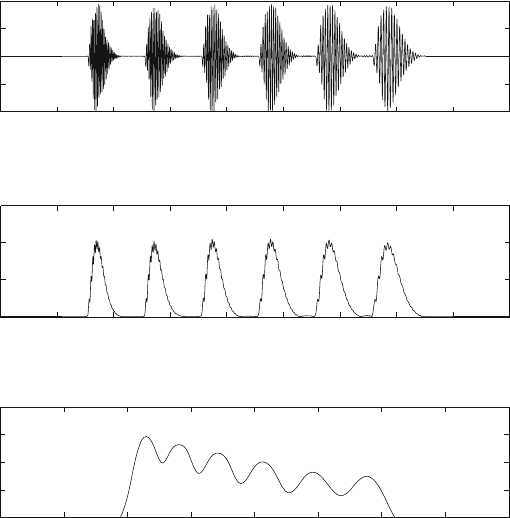
The limitation of such a 1D enveloping technique is illustrated in Fig. 6.4, which
illustrates a total of six ultrasonic pulse trains generated by six transmitters, with the
center frequencies being 2,210, 2,480, 2,785, 3,140, 3,530, and 3,980 kHz, respec-
tively. Each pulse train is related to the crossin g of the melt pressure of a threshold
level at a specific location along the cavity. The envelope of the signal is given in
Fig. 6.4b. By thresholding the enveloped signal, the time of arrival of each pulse
train can be determined. However, as the difference in frequency of the pulse trains
cannot be accurately resolved, the spectrum of the multiple pulse trains appears in
Fig. 6.4c as a lumped group, giving the appearance as if they were generated by a
single transmitter.
Such a problem can be solved by using the multiscale enveloping technique
introduced in this chapter, which decomposes the pulse trains into individual
frequency subbands and extracts the respective envelope from the pulse trains in
each subband. Multiplying the number of crossings by the envelope with each
0 10 20 30 40 50 60 70 80 90
-1
-0.5
0
0.5
1
Time (µSec)
Amplitude (V)
a
b
c
Original signal consisting of six ultrasonic pulse trains of different center frequencies.
0 102030405060708090
0
0.5
1
1.5
Time (µSec)
Amplitude (V)
Envelope of the original signal.
Spectrum of the original signal.
1000 1500 2000 2500 3000 3500 4000 4500 5000
Frequency (kHz)
10
20
30
40
50
Magnitude
Fig. 6.4 Limitation of 1D enveloping technique. (a) Original signal consisting of six ultrasonic
pulse trains of different center frequencies, (b) envelope of the original signal, and (c) spectrum of
the original signal
6.3 Application of Multiscale Enveloping 89
respective threshold value, the cavity pressure profile can be reconstructed. This is
illustrated in the following sections, through both simulation and experiments.
6.3.1.1 Simulation
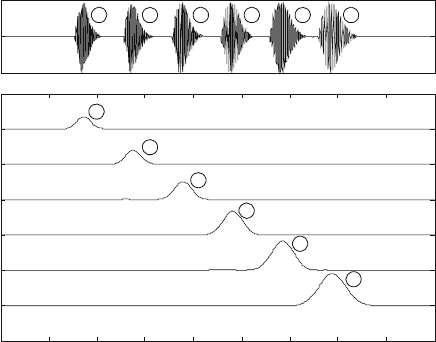
The performanc e of the multiscale enveloping for pulse detection on a sensor
matrix consisting of six spatially distributed ultrasonic transmitters is evaluated
first by means of a computer simulation. The six spectrally adjacent ultrasonic pulse
trains are centered at 2,210, 2,480, 2,785, 3,14 0, 3,530, and 3,980 kHz, respectively,
labeled as ① through ⑥ in Fig. 6.5. The pulses are separated by an interval of 10 ms
from one another, simulating the flow of polymer melt over the sensor matrix
sequentially at a constant speed. As shown in Fig. 6.5, the six pulses could be
detected and well separated into six levels (each level corresponds to a specific
scale calcul ated on the basis of ultrasonic pulse center frequency) through a
wavelet-based multiscale enveloping process.
In another simulation, the multiscale enveloping technique is applied to decom-
posing an ultrasonic signal consisting of two different types of ultrasound pulse
trains:
1. spectrally identical (with the same center frequency of 3,980 kHz) and timely
adjacent (5 ms apart), as labeled ① and ② in Fig. 6.6a
2. timely overlapped and spectrally adja cent (with center frequencies of 2,210 and
2,785 kHz, resp ectively) as labeled ③ and ④ in Fig. 6.6a.
As shown in Fig. 6.6b, pulses ① and ② are successfully differentiated both
spectrally (at the same level 6, because of their identical center frequency) and
-1
0
1
Amplitude
0 10 20 30 40 50 60 70 80 90
1
2
3
4
5
6
Time (µSec)
Level
1
2
3 4
5
6
1
2
3
4
5
6
Fig. 6.5 Detection and differentiation of six spectrally adjacent pulse trains
90 6 Wavelet Based Multiscale Enveloping
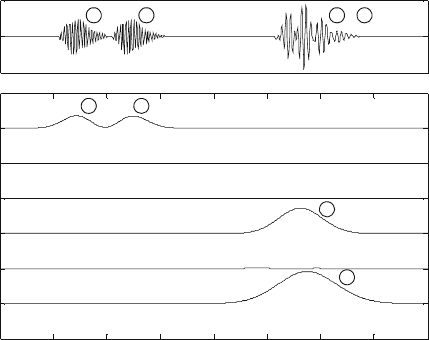
temporally (successive along the time axis, with 5 ms separation). Similarly, the two
pulses ③ and ④ are well separated into the first and third levels, reflecting on the
different center frequencies that they contain.
6.3.1.2 Experimental Study
To experimentally verify the performance of the developed multiscale enveloping
technique for ultrasonic pulse detection, three ultrasonic transmitters were designed
and prototyped, with the center frequencies being 2,480, 2,785, and 3,140 kHz,
respectively. An electrical pulser (model C-101-HV from PAC company) was used
to electrically excite the transmitters. Ultrasonic pulses generated were then trans-
mitted through a steel block of 6 cm thickness, which represents a realistic injection
mold. The pulses were received by an ultrasonic receiver located on the opposite
side of the steel block. The received ultrasonic pulses were measured and recorded
using a digital oscilloscope (model TDS 3012B from Tektronix).
In the first experiment, a single transmitter (center frequency 3,140 kHz) was
excited repetitively at 10 kHz. As a result, a series of pulses were generated with
two adjacent pulses being timely separated by 100 ms, as shown in Fig. 6.7a. For
each train of pulses generated (by each excitation), the first arrived pulse with the
highest amplitude, plus two reflections with decaying amplitudes were clearly
observed. The rece ived pulses were processed using the multiscale enveloping
technique, and their corresponding envelopes were extracted. As shown in
Fig. 6.7a, the first arrival and the first two reflections were clearly differentiated
at level 4. As the reflections have much lower amplitude than the first arrival, they
−2
0
2
Amplitude
0 5 10 15 20 25 30 35 40
1
2
3
4
5
6
Time (µSec)
Level
1 2 3 4
1 2
3
4
+
Fig. 6.6 Detection and differentiation of two pulse trains that are timely overlapped and spectrally
adjacent and two pulse trains that are timely adjacent but spectrally identical
6.3 Application of Multiscale Enveloping 91
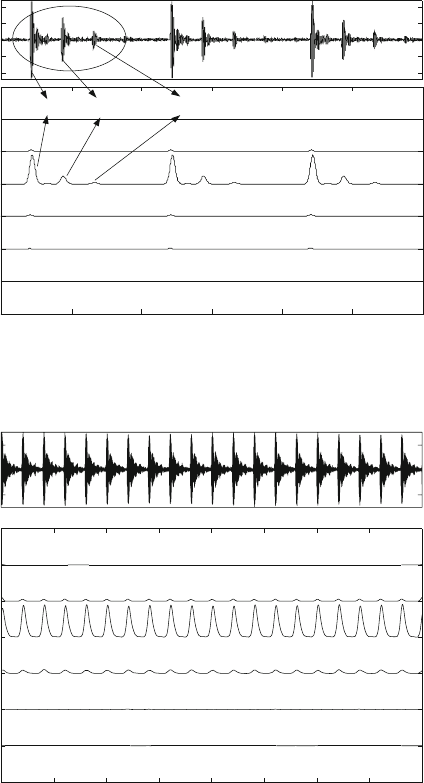
can be readily eliminated through thresholding from the extracted envelope. In the
second experiment, the pulse repetition frequency was increased to 50 kHz, result-
ing in a temporal separation of 20 ms between the adjacent pulses. As shown in
Amplitude (V)
0 50 100 150 200 250 300
1
2
3
4
5
6
Level
a
−0.4
−0.2
0
0.2
0.4
1st arrival 2nd reflection1st reflection
Time (µSec)
Single transmitter with a temporal pulse separation of 100 µs.
b
Time (µSec)
Single transmitter with a temporal pulse separation of 20 µs.
−0.2
0
0.2
Amplitude (V)
0 50 100 150 200 250 300 350 400
1
2
3
4
5
6
Level
Fig. 6.7 Experimental detection of ultrasonic pulse trains having the same center frequency.
(a) Single transmitter with a temporal pulse separation of 100 ms and (b) single transmitter with a
temporal pulse separation of 20 ms
92 6 Wavelet Based Multiscale Enveloping
Fig. 6.7b, the reflections wer e buried under the first arrivals; therefore, they did not
affect the puls e detection.
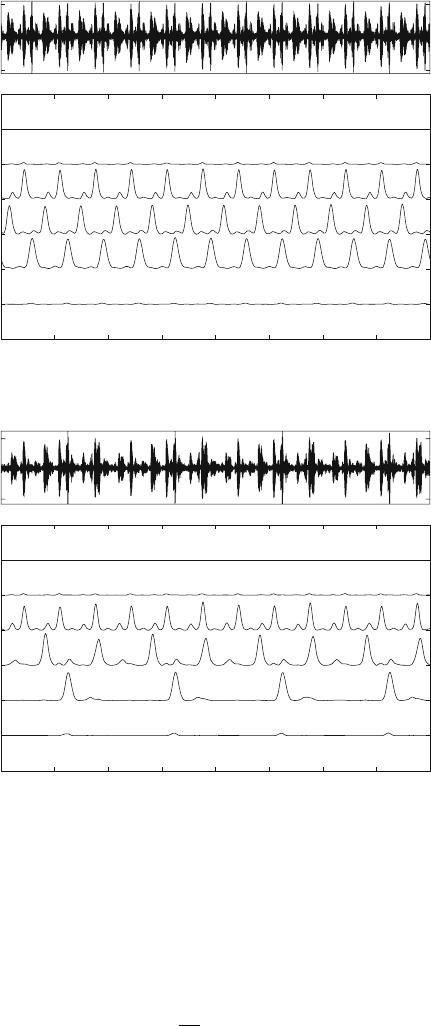
To evaluate the pulse detector’s ability in differentiating spectrally adjacent
pulses in the frequency domain, the three transmitters (of center frequencies
2,480, 2,785, and 3,140 kHz) were placed side-by-side on one side of the steel
block and excited simultaneously, with the excitation repetition frequency being
30 kHz (corresponding to 33 ms pulse separation). The pulses received by the
ultrasonic receiver are shown in the upper portion of Fig. 6.8a, where temporal
overlap of the three transmitters cannot be differentiated in the time domain.
Applying the multiscale enveloping technique, the envelopes of the three pulse
trains were successfully extracted and differentiated in levels 2, 3, and 4, respec-
tively, as shown in Fig. 6.8b.
To examine the robustness of the multiscale enveloping technique, repetition
frequency of the excitation input to the transmitters was varied to be 30, 20,
and 10 kHz for the three transmitters, resulting in a pulse separation of 33, 50,
and 100 m s, respectively. As shown in Fig. 6.8b, the pulse trains were again
successfully detected and differentiated, with the corresponding envelopes sepa-
rated into levels 2, 3, and 4, respectively.
6.3.2 Bearing Defect Diagnosis in Rotary Machine
A large number of applications in machine condition monitoring involve rotary
machine components, for example, bearings, spindles, and gearboxes (K iral and
Karag
€
ulle 2003; Wu et al. 2004; Choy et al. 2005). To detect structural defects that
may occur in these machine components, spectral analysis of the signal’s envelope
has been widely employed (McFadden and Smith 1984; Ho and Randall 2000). This
is based on the consideration that structural impacts induced by a localized defect
often excite one or more resonance modes of the structure and generate impulsive
vibrations in a repetitive and periodic way. Frequencies related to such resonance
modes are often located in higher frequency regions than those caused by machine-
borne vibrations, and are characterized by an energy concentration within a rela-
tively narrow band centered at one of the harmonics of the resonance frequency. By
utilizing the effect of mechanical amplification provided by structural resonances,
defect-induced vibration features can be separated from the background noise and
interference for diagnosis purpose. However, as different resonance modes can be
excited under varying machine operating conditions, consistent results are not
guaranteed by simply applying the traditional enveloping spectral analysis.
Research has found that complementing the wavelet-based multiscale enveloping
with spectral analy sis by means of the multiscale enveloping spectrogram
(MuSEnS) technique could significantly enhance the effectiveness of bearing defect
diagnosis (Yan and Gao 2005b). Basically, the MuSEnS starts with a signal’s
envelope extraction by using the developed wavelet-based multiscale enveloping
technique; Fourier transform is then performed repetitively on the extracted
6.3 Application of Multiscale Enveloping 93
envelope signal env
wt
ðs; tÞ at each scale s, resulting in an “envelop spectrum” of the
original signal at the various scales. Such envelop spectra can be expressed as
ENV
wt
ðs; f Þ¼F½env
wt
ðs; tÞ ¼
1
2p
Z
1
1
wt
c
ðs; tÞ
kk
e
i2pf t
dt (6.16)
−0.5
0
0.5
a
b
Amplitude (V)
0 50 100 150 200 250 300 350 400
1
2
3
4
5
6
Time (µSec)
Level
−0.5
0
0.5
1
2
3
4
5
6
Level
Three transmitters with pulse separation of 33
µ
s.
Time (µSec)
Three transmitters with pulse separation of 33, 50, and 100
µ
s.
Amplitude (V)
0 50 100 150 200 250 300 350 400
Fig. 6.8 Experimental detection and differentiation of temporally overlapped and spectrally
adjacent ultrasonic pulse trains generated by three transmitters. (a) Three transmitters with pulse
separation of 33 ms and (b) three transmitters with pulse separation of 33, 50, and 100 ms
94 6 Wavelet Based Multiscale Enveloping
where the envelope signal env
wt
ðs; tÞ is obtained using (6.15), and calculated
directly from the modulus of the wavelet coefficients
wt
c
ðs; tÞ
kk
of the ori ginal signal: The result of the ENV
wt
ðs; f Þ operation is a 2D
matrix, with each of its rows corresponding to the envelop spectrum of the vibration
signal at a specified scale s, and each of its colu mns corresponding to a specific
frequency component of the envelope spectrum across all the scales. By looking at
the square of the magnitude of ENV
wt
ðs; f Þ, as seen in
Eðs; f Þ¼ ENV
wt
ðs; f Þ
jj
2
(6.17)
which is termed as the energy spectrum, the final output Eðs; f Þ of the MuSEnS is
obtained. The energy spectrum indicates how the energy content is distributed in
the scale-frequency plane. For the purpose of visualization, such a result can be
illustrated in a 3D scale-frequency-energy map, which can indicate the intensity
and location of the defect-related frequency lines. The applications of the MuSEnS
technique to bearing defect diagnosis are introduced in the next section.
6.3.2.1 Numerical Simulation Using the MuSEn S Algorithm
A synthetic signal that consists of different signal components for simulating
vibration signal from the rolling element bearing is first constructed to quantita-
tively evaluate the MuSEnS technique. Generally, vibration signals from a bearing
may include the following constituent components:
1. vibration caused by bearing imbalance with a characteristic frequency of f
u
,
equal to the bearing rotational speed, which occurs when the gravitational center
of the bearing does not coincide with its rotational center
2. vibration caused by bearing misalignment at frequency f
m
, equal to twice the
shaft speed, which occurs when the two raceways of the bearing (inner and
outer) fall out of the same plane, resulting in a raceway axis that is no longer
parallel to the axis of the rotating shaft
3. vibration due to rolling elements periodically passing over a fixed reference
position on the outer raceway, at the frequency f
BPFO
4. structure-borne vibration attributed by other components, which is broadband in
nature, and can be modeled as white noise.
When a loca lized structural defect occurs on the surface of the bearing raceways
(inner or outer), a series of impacts will be generated every time the rolling
elements interact with the defects, subsequently exciting the bearing system.
Such forced vibration is represented by high-frequency resonances that are ampli-
tude modulated at the repetition frequency of the impacts.
For the numerical simulation, only defect-induced resonant vibration and
structure-borne vibration are considered in the synthetic signal, as other vibration
components can be filtered out through data preprocessing. The simulated resonant
6.3 Application of Multiscale Enveloping 95
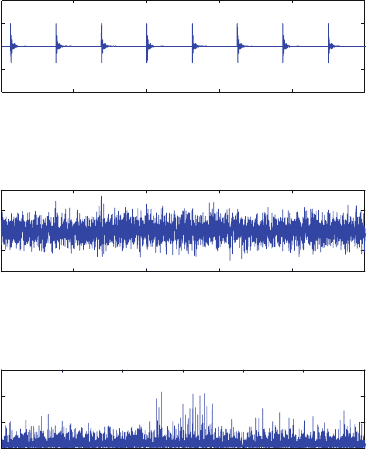
vibration is obtaine d experimentally from the measured impulse response of a
ball bearing (model 2214). This bearing has 17 rol ling elements. When it rotates at
300 rpm, a total of eight impacts will be generated per bearing revolution, because of
the ball de fect interactions. This translates into an impact interval of 25 ms or a
40-Hz signal repetition frequency. Figure 6.9a illustrates such a series of impact-
related vibrations. By adding white noise to these vibrations, a synthetic signal is
then generated to simulate the actual bearing vibrations due to a localized outer
raceway defect. The signal-to-noise ratio (SNR) of the synthetic syst em is set at
12 dB. The synthetic signal with its time and frequency domain waveform is
shown in Fig. 6.9b, c. Because of the noise corruption, no apparent signal feature
could be identified, except for the relatively dominant spectral components ranging
from 2,500 to 3,500 Hz.
The synthetic signal is analyzed using the wavelet-based MuSEnS technique,
where the complex Morlet wavelet is used as the base wavelet for defect char acter-
istic extraction. A series of equally spaced scales ranging from 1 to 6 (with an
increment of s
I
) were chosen to stretch the complex Morlet wavelet for extracting
the defect-related feature embedded in the synthetic signal. The lower and upper
limits of the scales correspond to the wavelet center frequency at 10,000 and
0 40 80 120 160 200
0.2
a
0.1
0
−0.1
−0.2
Signal (V)
Time (ms)
Impulsive vibrations
0 40 80 120 160 200
0.2
b
0.1
0
−0.1
−0.2
Signal (V)
Time (ms)
The synthetic signal in time domain
0 1000 2000 3000 4000 60005000
0.03
c
0.02
0.01
0
Power (Watt)
Frequency (Hz)
The s
y
nthetic si
g
nal in fre
q
uenc
y
domain
Fig. 6.9 The series of impulsive vibrations, the synthetic signal (signal to noise ratio (SNR)
12 dB), and its spectrum. (a) Impulsive vibrations, (b) the synthetic signal in time domain, and
(c) the synthetic signal in frequency domain
96 6 Wavelet Based Multiscale Enveloping
1,667 Hz, respectively. This ensures that the defect-induced resonant vibration
component can be fully covered by the wavelet transformation. To increase the
possibility of matching the center frequency of a scaled wavelet with the frequency
of the defect-induced resonant vibration, a small-scale interval is preferred. How-
ever, a small-scale interval leads to increased computational load, as more scales
will be involved in the signal decomposition. A trade-off must therefore be made
between the accuracy and computational time. On the basis of preliminary studies,
an increment of s
I
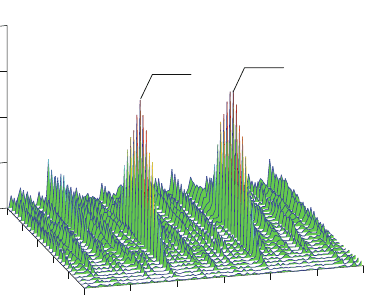
¼ 0:2 was employed in this study. As the MuSEnS shown in
Fig. 6.10, high-energy concentration can be identified at the 40-Hz frequency line,
which corresponds to the defect-related repetition frequency. Also strongly repre-
sented in the spectrogram is the harmon ics of the defect-related frequency at 80 Hz.
This result demonstrates the effectiveness of the MuSEnS algorithm in identifying
defect features hidden in bearing vibration signals.
6.3.2.2 Case Study
The first experimental case study of using MuSEnS algorithm to diagnose bearing
defects is conducted on a roller bearing. A seeded defect in the form of 0.1 mm
diameter hole is made in the outer raceway. The bearing is subject to a 3,665-N
radial load, and the shaft rotational speed is 1,200 rpm (or a 20-Hz rot ational
frequency). On the basis of the geometrical parameters of the bearing and the
rotational speed, a defect-related repetitive frequency of (f
BPFO
¼ 5.25f
rpm
)or
105 Hz can be analytically determined (Harris 1991). Figure 6.11 shows the bearing
vibration signal acquired under the sampling frequency of 25 kHz. From its
corresponding power spectrum, it is evident that frequency component related to
bearing rotation is dominant in the frequency region of [0, 150] Hz. However,
20
40
60
80
100
120
1
2
3
4
5
6
0
0.005
0.01
0.015
0.02
Frequency (Hz)
Scale
Power (Watt)
80 Hz
40 Hz
Fig. 6.10 Defect repetition frequency detection on the synthetic signal using multiscale envelop
ing spectrogram (MuSEnS) technique
6.3 Application of Multiscale Enveloping 97
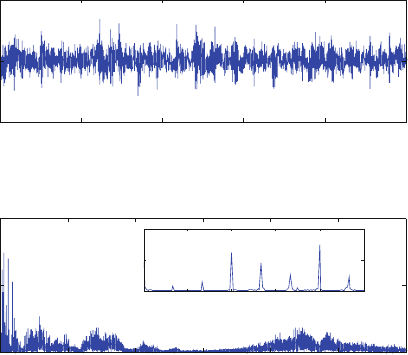
defect-related frequency component of 105 Hz is submerged in the spectrum and
therefore, cannot be identified.
The MuSEnS algorithm is then applied to decompose the bearing signal. The
scales used are between 1 and 8, with an increment 0.2. These scales cover the
frequency range of 1.56 12.5 kHz. The corresponding MuSEnS of the bearing
vibration signal is shown in Fig. 6.12. Two major peaks are clearly shown at 20 and
105 Hz frequency lines, respectively. The 20-Hz component runs across the entire
scale region, and is related to the bearing rotating speed. The 105-Hz component is
identified at the scales of 1 2.4, and represents the repetitive frequency of the
bearing due to the structural defect on the outer raceway. This demonstrates that the
MuSEnS is able to clearly identify the existence of the structural defect, and
pinpoint its location on the outer raceway for diagnosis purpose.
The second experimental case study of using the MuSEnS algorithm for diagno-
sis of bearing inner raceway defect is investigated on a ball bearing of model SKF
6220. The defect-related repetitive frequency is calculated to be (f
BPFI
¼ 5.9f
rpm
)or
59 Hz, basedon the bearing geometry and rotational speed (600 rpm) (Harris 1991).
A radial load of 10,000 N is applied to the bearing. As shown in Fig. 6.13, while
frequency components related to the shaft speed and ball rotation are shown in the
power spectrum, the defect-re lated repetitive frequency is not identified.
The MuSEnS algo rithm is then applied to the same signal, with the decomposi-
tion scales chosen to be 2 10 at an increment of 0.2. The scales cover the
frequency range from 500 to 2,500 Hz. As shown in Fig. 6.14 , besides frequency
components related to the shaft frequency and its harmonics, an appreciable peak
can be seen at 59 Hz, which is the inner raceway defect-related repetitive frequency.
This indicates that a structural defect exists on the inner raceway of the ball bearing.
The peaks at 49 and 69 Hz frequency lines are attributed to the combined effect of
0 40 80 120 160 200
−0.2
0
0.2
a
b
Time (ms)
Signal (V)
0 2000 4000 6000 8000 10000 12000
0
50
100
Frequency (Hz)
Power (Watts)
0 30 60 90 120 150
0
50
100
Frequency (Hz)
Power (Watts)
f
rpm
2¬f
rpm
3¬f
rpm
4¬f
rpm
5¬f
rpm
6¬f
rpm
7¬f
rpm
Fig. 6.11 Signal measured from a roller bearing and its power spectrum
98 6 Wavelet Based Multiscale Enveloping