
Gao R.X., Yan R. Wavelets: Theory and Applications for Manufacturing
Подождите немного. Документ загружается.

transform and other commonly used techniques, in terms of the choice of the
template functions fc
n
ðtÞg
n2z
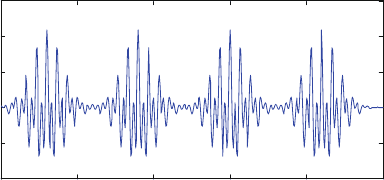
. To illustrate the p oint, a nonstationary signal
as shown in Fig. 2.1 is used as an example. The signal consists of four groups
of impulsive signal trains, each containing two transient elements of different
center frequencies at 1,500 and 650 Hz, respectively. The four groups are separated
from one another by a 12-ms time interval. Within each group, the two transient
elements are time-overlapped. The sampling frequency used to captu re the signal
is 10 kHz.
2.1 Fourier Transform
The Fourier transform is probably the most widely applied signal processing tool
in science and engineering. It reve als the frequency composition of a time series
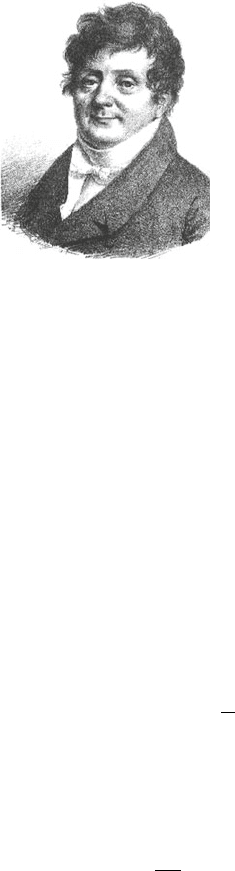
xðtÞ by transforming it from the time domain into the frequency domain. In 1807,
the French mathematician Joseph Fourier (Fig. 2.2) found that any periodic signal
can be presented by a weighted sum of a series of sine and cosine functions.
However, because of the uncompromising objections from some of his contempor-
aries such as J. L. Lagrange (Herivel 1975), his paper on this finding never
got published, until some 15 years later, when Fourier wrote his own book, The
Analytical Theory of Heat (Fourier 1822). In that book, Fourier extended his
finding to aperiodic signals, stating that an aperiodic signal can be represented by
a weighted integral of a series of sine and cosine functions. Such an integral is
termed the Fourier transform.
Using the notation of inner product, the Fourier transform of a signal xðtÞ can be
expressed as
Xðf Þ¼hx; e
i2pft
i¼
Z
1
1
xðtÞe
i2pft
dt (2.4)
0 10 20 30 40 50
−2
−1
0
1
2
3
Time (ms)
Signal (V)
Fig. 2.1 A nonstationary signal x(t)
18 2 From Fourier Transform to Wavelet Transform: A Historical Perspective
Assuming that the signal has finite energy,
Z
1
1
jxðtÞj
2
dt<1
Accordingly, the inverse Fourier transform of the signal xðtÞ can be expressed as
xðtÞ¼
Z
1
1
Xðf Þe
i2pft
df (2.5)
Signals obtained experiment ally through a data acquisition system are generally
sampled at discrete time intervals DT, instead of continuously, within a total
measurement time T. Such a signal, defined as x
k
, can be transformed into the
frequency domain by using the discrete Fourier transform (DFT), defined as
DFTðf
n
Þ¼
1
N
X
N 1
k¼0
x
k
e
i2pf
n
kDT
(2.6)
where N ¼ T=DT is the number of samples, and f
n
¼ n=T; n ¼ 0; 1; 2; ...; N 1
are the discrete frequency components. The inverse DFT can then be expressed as
x
k
¼
1
DT
X
ðN 1Þ=T
f
n
¼0
DFTðf
n
Þe
i2pf
n
kDT
(2.7)
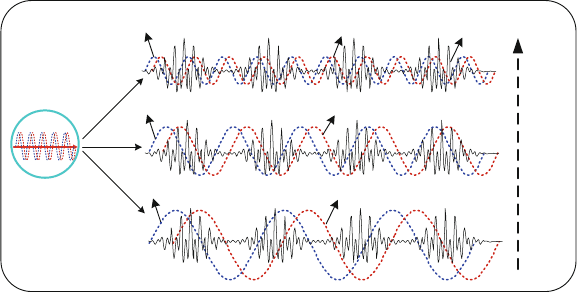
Equations (2.4) and (2.6) indicate that the Fourier transform is essentially a
convolution between the time series xðtÞ or x
k
and a series of sine and cosine
functions that can be viewed as template functions. The operation measures the
similarity betwee n xðtÞ or x
k
and the template functions, and expresses the average
frequency information during the entire p eriod of the signal analyzed. In Fig. 2.3,
such an operation is graphically illustrated.
“An arbitrary function,
continuous or with
discontinuities, defined in a finite
interval by an arbitrarily
capricious graph can always be
expressed as a sum of sinusoids”
J.B.J. Fourier
Fig. 2.2 Jean B. Joseph Fourier (1768 1830)
2.1 Fourier Transform 19
To compute the DFT of a signal with N samples, multiplication of an N N
matrix that contains the primitive nth root of unity e
i2p=N
by the signal is needed.
Such an operation takes a total of arithmetic operations on the order of N
2
to
complete. The computational time increases quickly as the number of the samples
increases. For exampl e, a time series of N ¼ 256 (i.e., 2
8
) samples takes 65,536
operational steps to complete, whereas for N ¼ 4,096 (i.e., 2
12
), a total of
16,777,216 steps will be needed to compute its DFT. The high computational
cost limited the widespread application of the DFT in its early stage, until a more
efficient algorithm, called the Cooley Tukey algorithm, was introduced in 1965
(Cooley and Tukey 1965). This algorithm is also called the fast Fourier transform
(FFT), and what it does is to recursively break down a DFT of a large data sample
(i.e., a large N) into a series of smaller DFTs of smaller samples by dividing the
transform with size N into two pieces of size N/2 at each step, and reduce the
arithmetic operations to a total of N logðNÞ. Comparing to the N
2
operations
required for DFT, this represents a time reduction of up to 96%, when, for example,
the data sample number N is 256.
In practice, the phenomena of leakage and aliasing can happen during the
calculation of DFT (Ko
¨
rner 1988). Leakage is caused by the discon tinuities
involved when a signal is extended periodically for performing the DFT. Applying
a window to the signal to force it to contain a full period can prevent leakage from
happening. However, the window itself may contribute frequency information to
the signal. Aliasing occurs when the Shannon’s sampling theorem is violated,
(Bracewell 1999) causing the actual frequency component to appear at different
locations in the frequenc y spectrum. This can be solved by ensuring the sampling
frequency to be at least twice as large as the maximum frequency component
contained in the signal (Bracewell 1999). This requires, however, that the maxi-
mum frequency component is known a priori.
The Fourier transform of the signal shown in Fig. 2.1 is illustrated in Fig. 2.4.
The figure shows two major fre quency peaks at 650 and 1,500 Hz, respectively.
e
j2π
ft
cos(2p f
n
t)
sin(2p f
n
t)
sin(2p f
2
t)
sin(2p f
1
t)
cos(2p f
1
t)
cos(2p f
2
t)
f
n
f
2
f
1
f
•
•
•
x(t)
Fig. 2.3 Illustration of the Fourier transform of a continuous signal x(t)
20 2 From Fourier Transform to Wavelet Transform: A Historical Perspective
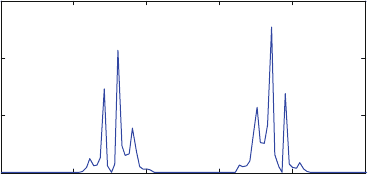
However, it does not reveal how the signal’s frequenc y contents vary with time;
that is, the figure does not reveal if the two frequency components are continuously
present throughout the time of observation or only at certain intervals, as is
implicitly shown in the time-domain representation. Because the temporal structure
of the signal is not reve aled, the merit of the Fourier transform is limited; specifi-
cally, it is not suited for analyzing nonstationary sign als. On the other hand, as
signals encountered in manufacturing are generally nonstationary in nature (e.g.,
subtle, time-localized changes caused by structural defects are typically seen in
vibration signals measured from rotary machines), a new signal processing tech-
nique that is able to handle the nonstationarity of a signal is needed.
2.2 Short-Time Fourier Transform
A straightforward solution to overcoming the limitations of the Fourier transform is
to introduce an analysis window of certain length that glides through the signal
along the time axis to perform a “time-localized” Fourier transform. Such a concept
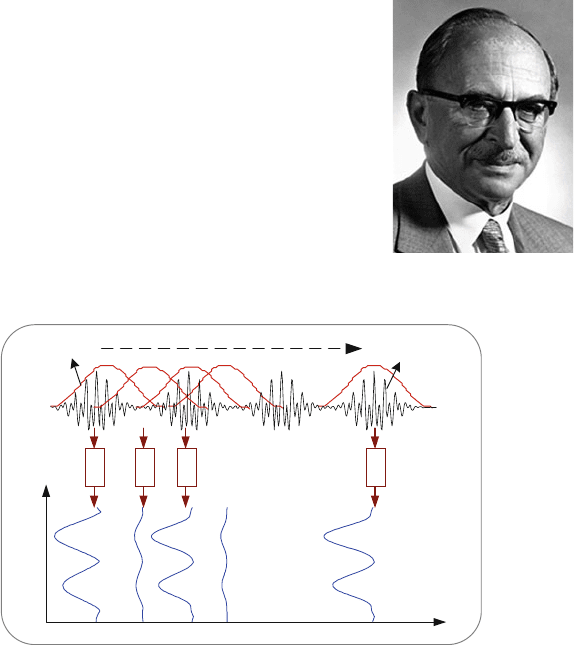
led to the short-time Fourier transform (STFT), introduced by Dennis Gabor
(Fig. 2.5) in his paper titled “Theory of communication,” published in 1946
(Gabor 1946).
As shown in Fig. 2.6, the STFT emp loys a slidi ng window function g(t)
that is centered at time t. For each specific t, a time-localized Fourier transform
is performed on the signal x(t) within the window. Subsequently, the window
is moved by t along the time line, and another Fourier transform is performed.
Through such consecutive operations, Fourier transform of the entire signal can
be performed. The signal segment within the window function is assumed to
be approximately stationary. As a result, the STFT decomposes a time domain
signal into a 2D time-frequency representation, and variations of the frequenc y
content of that signal within the window function are revealed, as illustrated in
Fig. 2.6.
0 400 800 1200 1600 2000
0
50
100
150
Frequency (Hz)
Magnitude
f
1
=650 Hz
f
2
=1500 Hz
Fig. 2.4 Fourier transform results of the signal x(t)
2.2 Short Time Fourier Transform 21
Using the inner product notation as before, the STFT can be expressed as
STFTð t ; f Þ¼hx; g
t; f
i¼
Z
xðtÞg
t; f
ðtÞdt ¼
Z
xðtÞgðt tÞe
j2pft
dt (2.8)
Equation (2.8) can also be viewed as a measure of “similarity” between the signal
xðtÞ and the time-shifted and frequency-modulated window function gðtÞ. Over the
past few decades, various types of window functions have been developed (Oppen-
heim et al. 1999), and each of them is specifically tailored toward a particular type
of appl ication. For example, the Gaussian window designed for analyzing transient
signals, and the Hamming and Hann windows are appl icable to narrowband,
random signals, and the Kaiser-Bessel window is better suited for separating two
signal components with frequencies very close to each other but with widely
differing amplitudes. It should be noted that the choice of the window function
Time Shift
g(t)
Time
Frequency
FFT
FFT
FFT
FFT
•
•
•
•
•
•
•
•
•
τ
2t
3t
4t
nt
x(t)
t
Fig. 2.6 Illustration of short time Fourier transform on the test signal x( t)
Fig. 2.5 Dennis Gabor
(1900 1979)
22 2 From Fourier Transform to Wavelet Transform: A Historical Perspective
directly affects the time and frequency resolutions of the analysis result. While
higher resolution in general provides better separation of the constituent compo-
nents within a signal, the time and frequency resolutions of the STFT technique
cannot be chosen arbitrarily at the same time, according to the uncertainty principle
(Cohen 1989). Specifically, the product of the time and frequency resolutions is
lower bounded by
Dt Df
1
4p
(2.9)
where Dt and Df denote the time and frequency resolutions, respectively. Analyti-
cally, the time resolution Dt is measured by the root-mean-square time width of the
window function, defined as
Dt
2
¼
R
t
2
jgðtÞj
2
dt
R
jgðtÞj
2
dt
(2.10)
Similarly, the frequency resolution Df is measured by the root-mean-square band-
width of the window function, and is defined as (Rioul and Vetterli 1991)
Df
2
¼
R
f
2
jGðf Þj
2
df
R
jGðf Þj
2
df
(2.11)
In (2.11), Gð f Þ is the Fourier transform of the window function g(t). As
an example, the Gaussian window function gðtÞ¼e
at
2
t
2
(with a being a constant
and t controlling the window width) has the time and frequency resolutions of
Dt ¼ t=ð2 a
p
Þ and Df ¼ a
p
=ðt 2 pÞ, respectively. As a result, the time-frequency
resolution provided by the Gaussian window when analyzing a signal x(t)
is Dt Df ¼ 1=4p. As the time and frequency resolutions of a window function
are dependent on the parameter t only, once the window function is chosen,
the time and frequency resolutions over the entire time-frequency plane are
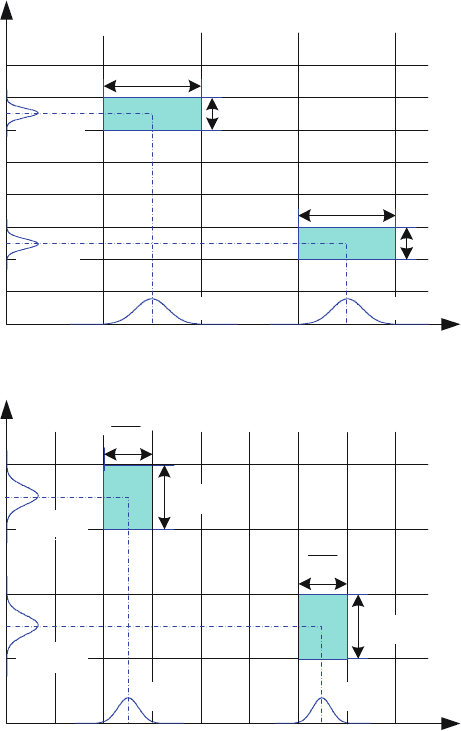
fixed. Illustrated in Fig. 2.7 are two scenarios where the products of the time and
frequency resolutions of the window function (i.e., the area defined by the
product of Dt Df ) are the same, regardless of the actual window size (t or t=2)
employed.
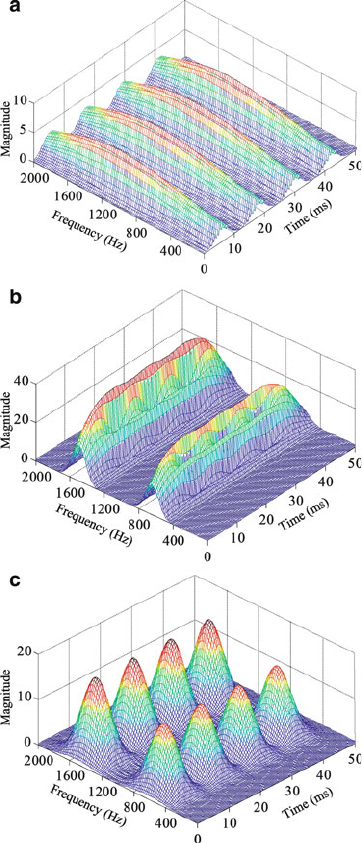
The effect of the window size t on the time and frequency resolution s is
illustrated in Fig. 2.8, where STFT with the Gaussian window was performed
on the signal show n in Fig. 2.1. Altogether three different window sizes (i.e., 1.6,
6.4, and 25.6 ms) were chosen. While the smallest window width of 1.6 ms
has provided high time resolution in separating the four pulse trains contained
in the signal, as illustrated in Fig. 2.8 a, its frequency resolution was too low
to differentiate the two time-overlapped transient elements within each group.
As a result, the frequency ele ments 1,500 and 650 Hz are displayed as one
lumped group on the time-frequency plane. In contrast, the largest window width
2.2 Short Time Fourier Transform 23
of 25.6 ms provided good frequency resolutio n to illustrate the two frequency
components in Fig. 2.8b. However, the time-resolution was insufficient to differen-
tiate the four pulse trains that are timely separated with a 12-ms interval. The
best overall performance is given by the window width of 6.4 ms, shown in
Fig. 2.8c, which allowed for all of the transients to be adequately differentiated
on the time -frequency plane. Given that the specific frequency content of an
τ
f
f
2
f
4
f
3
f
1
2
τ
Δ
t
1
Δf
2
2Δf
2
2Δ
1
Δ
t
2
Δ
f
1
a
b
f
2
Δt
1
Δt
2
2
f
|G
t
1
, f
2
( f )|
|G
t
3
, f
4
( f )|
|G
t
4
, f
3
( f )|
|G
t
2
, f
1
( f )|
|g
t
1
, f
2
(t)|
|g
t
3
, f
4
(t)|
|g
t
4
, f
3
(t)|
|g
t
2
, f
1
(t)|
Window size: t
Window size: t /2
t
1
t
3 t
4
t
Fig. 2.7 Time frequency resolutions associated with the STFT technique. (a) Window size t and
(b) window size t/2
24 2 From Fourier Transform to Wavelet Transform: A Historical Perspective
experimentally measured signal is generally not known a priori, selection of
a suitable window size for effective signal decomposition using the STFT technique
is not guaranteed. The inherent drawback of the STFT motivates researchers
to look for other techniques that are better suited for proce ssing nonstationary
signals. One of such techniques, which is the focus of this book, is the wavelet
transform.
Fig. 2.8 Results of the STFT
of the signal using three
different window sizes.
(a) Window size 1.6 ms,
(b) window size 25.6 ms, and
(c) window size 6.4 ms
2.2 Short Time Fourier Transform 25
2.3 Wavelet Transform
From a historical point of view, the first reference to the wavelet goes back to
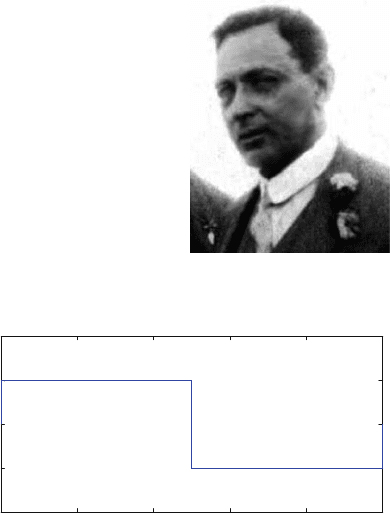
the early twentieth century when Alfred Haar (Fig. 2.9) wrote his dissertation titled
“On the theory of the orthogonal function systems” in 1909 to obtain his doctoral
degree at the University of Go
¨
ttingen. His research on orthogonal systems of
functions led to the development of a set of rectangular basis functions (Haar
1910), as illustrated in Fig. 2.10. Later, an entire wavelet family, the Haar wavelet,
was named on the basi s of this set of functions, and it is also the simplest wavelet
family developed till this date.
Essentially, Haar’s basis function consists of a short positive pu lse followed by
a short negative pulse, and it was used to illustrate a countable orthonormal system
for the space of square-integrable functions on the real line (Haar 1910). Later, the
Haar basis function was applied to compress images (DeVore et al. 1992).
Little advancement in the field of wavelets was reported after Haar’s work, until
a physicist, Paul Levy (Fig. 2.11), investigated the Brownian motion in the 1930s.
He discovered that the scale-varying function, that is, the Haar basis function,
was better suited than the Fourier basis functions for studying subtle details in
the Brownian motion. In addition, the Haar basis function can be scaled into
different intervals, such as the interval [0, 1] or the intervals [0, 1/2] and [1/2, 1],
thereby providing higher precision when modeling a function than that provided by
the Fourier basis function, as it can only have one interval [ 1, 1].
Fig. 2.9 Alfred Haar
(1885 1933)
0 0.2 0.4 0.6 0.8 1
-2
-1
0
1
2
Time (ms)
Amplitude
Fig. 2.10 The rectangular
basis function
26 2 From Fourier Transform to Wavelet Transform: A Historical Perspective
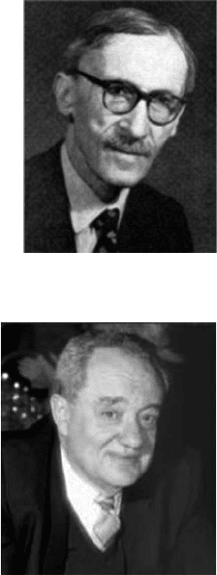
While several individual s, such as John Littlewood, Richard Paley (Littlewood
and Paley 1931), Elias M. Stein (Jaffard et al. 2001), and Norman H. Ricker
(Ricker 1953) have contributed, from the 1930s to the 1970s, to advancing
the state of research in wavelets as it is called today, major advancement in the
field was attributed to Jean Morlet (Fig. 2.12) who developed and implemented
the technique of scaling and shifting of the anal ysis window functions in analyz-
ing acoustic echoes while working for an oil company in the mid 1970s (Mackenzie
2001). By sending acoustic impulses into the ground and analy zing the
received echoes, the existence of oil beneath the earth crust as well as the thickness
of the oil layer can be identified. When Morlet first used the STFT to analyze
these echoes, he found that keepi ng the width of the window function fixed
did not work. As a solution to the problem, he experimented with keeping
the frequency of the window function constant while changing the width of the
window by stretching or squeezing the window function (Mackenzie 2001). The
resulting waveforms of varying widths were called by Morlet the “Wavele t”, and
this marked the beginning of the era of wavelet research. As a matter of fact,
the approach that Morlet used was similar to what Haar did before, but the
theoretical formation of the wavelet transform was first proposed only after
Jean Morlet teamed up with Alex Grossmann to work out the idea that a signal
could be transformed into the form of a wavelet and then transformed back into its
original form without any information loss (Grossmann and Morlet 1984).
Fig. 2.11 Paul Levy
(1886 1971)
Fig. 2.12 Jean Morlet
(1931 2007)
2.3 Wavelet Transform 27