
Gao R.X., Yan R. Wavelets: Theory and Applications for Manufacturing
Подождите немного. Документ загружается.


C
s;t
ðf Þ¼ s
p
C
ðsf Þe
j2pf t
(3.18b)
By incorporating (3.18b) into (3.17) and utilizing the following integral relation,
Z
e
j 2pðf f
0
Þt
dt ¼ 2pdðf f
0
Þ (3.19)
the left side of (3.15) can be expanded as
hwt
x
ðs; tÞ; wt
y
ðs; tÞi ¼
s
2p
ZZ
ds
s
2
Xðf ÞY
ðf ÞCðsf ÞC
ðsf Þdf
¼
1
2p
ZZ
Cðsf Þ
jj
2
s
ds
"#
Xðf ÞY
ðf Þdf
(3.20)
As
R
Cðsf Þ
jj
2
s
ds ¼
R
Cðsf Þ
jj
2
sf
dðsf Þ¼
R
Cðf
0
Þ
jj
2
f
0
dðf
0
Þ¼C
c
,(3.20) can be expressed as
hwt
x
ðs; tÞ; wt
y
ðs; tÞi ¼ C
c
1
2p
Z
Xðf ÞY
ðf Þdf ¼ C
c
hxðtÞ; yðtÞi (3.21)
This proves the existence of Moyal principle for CWT. It is noted that C
c
is
actually the admissibility condition of the wavelet. Only when this condition is
satisfied can the Moyal principle exist. Furthermore, if xðtÞ¼yðtÞ, then (3.15)
becomes
Z
1
0
ds
s
2
Z
1
1
wt
x
ðs; tÞ
2
dt ¼ C
c
Z
1
1
xðtÞ
jj
2
dt (3.22)
This means that the integral of the square of wavelet coefficients is proportional
to the energy of the signal.
3.2 Inverse Continuous Wavelet Transform
A transformation is considered to be meaningful in practice only when its
corresponding inverse transformation exists. The same principle applies to the
CWT. It can be shown that, as long as the wavelet satisfies the admission condition
as defined in (3.1), the inverse CWT will exist. This means that a signal can be
perfectly reconstructed from its corresponding wavelet coefficients, which can be
written as
38 3 Continuous Wavelet Transform

xðtÞ¼
1
C
c
Z
1
0
ds
s
2
Z
1
1
wt
x
ðs; tÞc
s;t
ðtÞdt
¼
1
C
c
Z
1
0
ds
s
2
Z
1
1
wt
x
ðs; tÞ
1
s
p
c
t t
s
dt
(3.23)
where C
c
¼
R
1
0
Cðf Þjj
2
f
df <1 is the admission condition of the wavelet cðtÞ.
The proof of (3.23) is shown below:
Proof Assume that x
1
ðtÞ¼xðtÞ, and x
2
ðtÞ¼dðt t
0
Þ.AshxðtÞ; dðt t
0
Þi ¼ xðt
0
Þ,
C
c
xðt
0
Þ¼C
c
hxðtÞ; dðt t
0
Þi (3.24)
According to the Mayol principle shown in (3.15), (3.24) can be further written as
C
c
xðt
0
Þ¼hwt
x
ðs; tÞ; wt
dðt t
0
Þ
ðs; tÞi
¼
Z
1
0
ds
s
2
Z
wt
x
ðs; tÞwt
dðt t
0
Þ
ðs; tÞdt
¼
Z
1
0
ds
s
2
Z
wt
x
ðs; tÞhc
s;t
ðtÞ; dðt t
0
Þi
dt
¼
Z
1
0
ds
s
2
Z
wt
x
ðs; tÞhc
s;t
ðtÞ; dðt t
0
Þidt
¼
Z
1
0
ds
s
2
Z
wt
x
ðs; tÞc
s;t
ðt
0
Þdt
¼
1
s
p
Z
1
0
ds
s
2
Z
wt
x
ðs; tÞc
t
0
t
s
dt
(3.25)
This illustrates that the inverse CWT exists.
3.3 Implementation of Continuous Wavelet Transform
To implement the CWT, two approaches can be taken. The first approach is to
obtain the wavelet coefficients directly from (3.7). The computation procedure is as
follows:
1. The wavelet is placed at the beginning of the signal, and set s ¼ 1 (the original,
base wavelet).
2. The wavelet function at scale “1” is multiplied by the signal, integrated over all
times, and then multiplied by 1= s
p
.
3. Shift the wavelet to t ¼ t, and get the transform value at t ¼ t and s ¼ 1.
4. Repeat the procedure until the wavelet reaches the end of the signal.
5. Scale s is increased by a given value, and the above procedure is repeated for all s.
6. Each computation for a given s fills the single row of the time-scale plane.
7. Wavelet transform is obtained if all s are calculated.
3.3 Implementation of Continuous Wavelet Transform 39
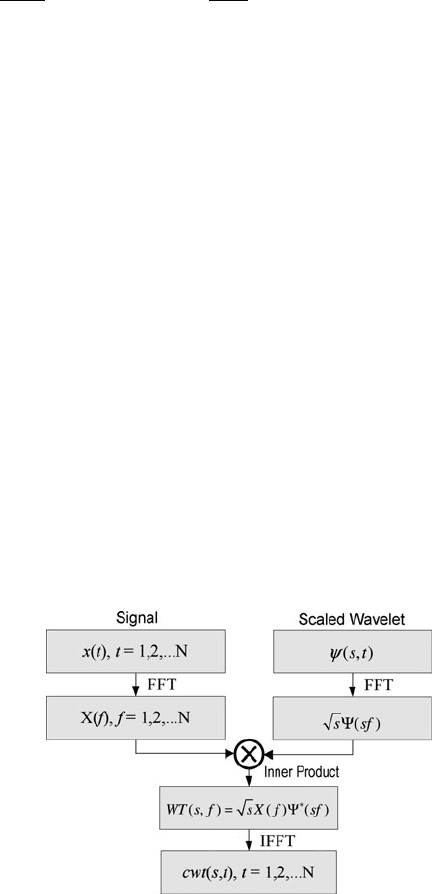
The second approach to implementing the CWT is on the basis of the convolu-
tion theorem, which states that the Fourier transform of the convolution operation
on two functions in the time domain is the product of the respective Fourier
transforms of these two functions in the frequency domain (Bracewell 1999). The
Fourier transform of (3.7) is expressed as
WTðs; f Þ¼Ffwtðs; tÞg ¼
1
2p s
p
Z
1
1
Z
1
1
xðtÞc
t t
s
dt
e
j2pf t
dt (3.26)
Applying the convolution theorem to (3.26) leads to
WTðs; f Þ¼ s
p
Xðf ÞC
ðsf Þ (3.27)
where X ðf Þ denotes the Fourier transform of xðtÞ and C
ðÞ denotes the Fourier
transform of c
ðÞ. By taking the inverse Fourier transform, (3.27) is converted
back into the time domain as
wtðs; tÞ¼F
1
fWTðs; f Þg ¼ s
p
F
1
fXðf ÞC
ðsf Þg (3.28)
where the symbol F
1
½ denotes the operator of inverse Fourier transform. There-
fore, the implementation of the CWT can be realized through a pair of Fourier and
inverse Fourier transforms.
Figure 3.3 illustrates the procedure for impleme nting the CWT. After taking the
Fourier transform of the signal x(t) and the scaled base wavelet cðs; tÞ to obtain
their frequency information Xðf Þ and Cðsf Þ, respectively, the inner product
between Xðf Þ and complex conjugat e of Cðsf Þ is calculated. Next, the CWT of
the signal x (t), denoted as cwtðs; tÞ, is obtained by taking the inverse Fourier
transform on the inner product of WTðs; f Þ.
Fig. 3.3 Procedure for
implementing the continuous
wavelet transform
40 3 Continuous Wavelet Transform
3.4 Some Commonly Used Wavelets
This section introduces several commonly used wavelets for performing the CWT.
3.4.1 Mexican Hat Wavelets
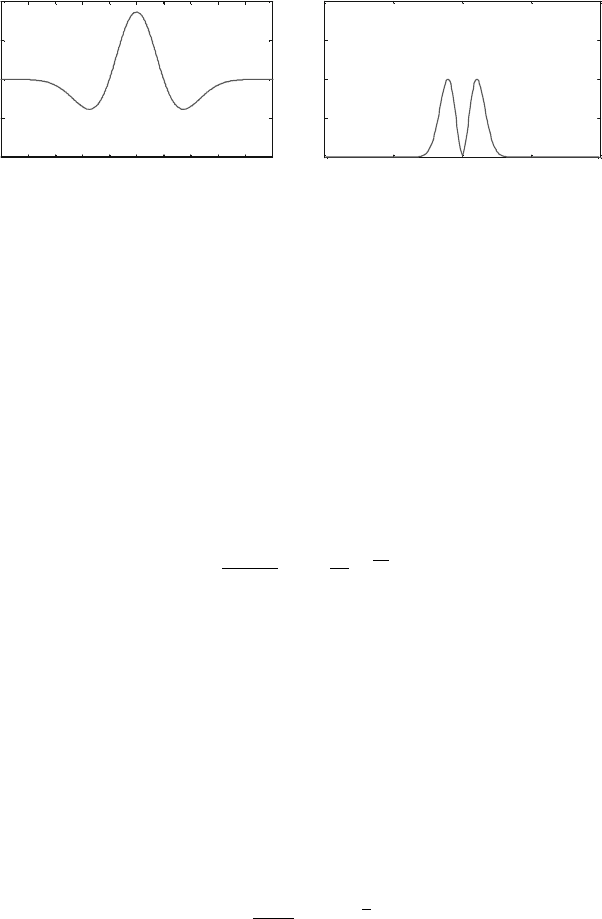
The Mexican hat wavelet is a normalized, second derivative of a Gaussian function,
which is mathematically defined as (Mallat 1998)
cðtÞ¼
1
2p
p
s
3
1
s
2
t
2
e
t
2
2s
2
(3.29)
Figure 3.4 illustrates the Mexican hat wavelet and its associated magnitude
spectrum. The Mexican hat wavelet is often called the Ricker wavelet in geophys-
ics, where it is frequently employed to model seismic data (Zhou and Adeli 2003;
Erlebacher and Yuen 2004).
3.4.2 Morlet Wavelet
The Morlet wavelet is defined as (Grossmann and Morlet 1984; Teolis 1998)
c
M
ðtÞ¼
1
pf
b
p
e
j2pf
c
t
e
t
2
f
b
(3.30)
where f
b
is the bandwidth parameter and f
c
denotes the wavelet center frequency. As
an example, Fig. 3.5 illustrates the complex Morlet wavelet function and its
corresponding magnitude spectrum when f
b
¼ 1 Hz and f
c
¼ 1 Hz. The Morlet
wavelet has been widely used for iden tifying transient components embedded in a
−5 −4 −3 −2 −1012345
−2 −10 1 2
0
0.5
1
1.5
2
Amplitude
Magnitude
−1
−0.5
0
0.5
1
Time (ms) Frequency (Hz)
Fig. 3.4 Mexican hat wavelet (left) and its magnitude spectrum (right)
3.4 Some Commonly Used Wavelets 41
signal, for example, bearing defect-induced vibration (Lin and Qu 2000; Nikolaou
and Antoniadis 2002; Yan and Gao 2009).
3.4.3 Gaussian Wavelet
Mathematically, a Gaussian function is expressed as (Teolis 1998)
f ðtÞ¼e
jt
e
t
2
(3.31)
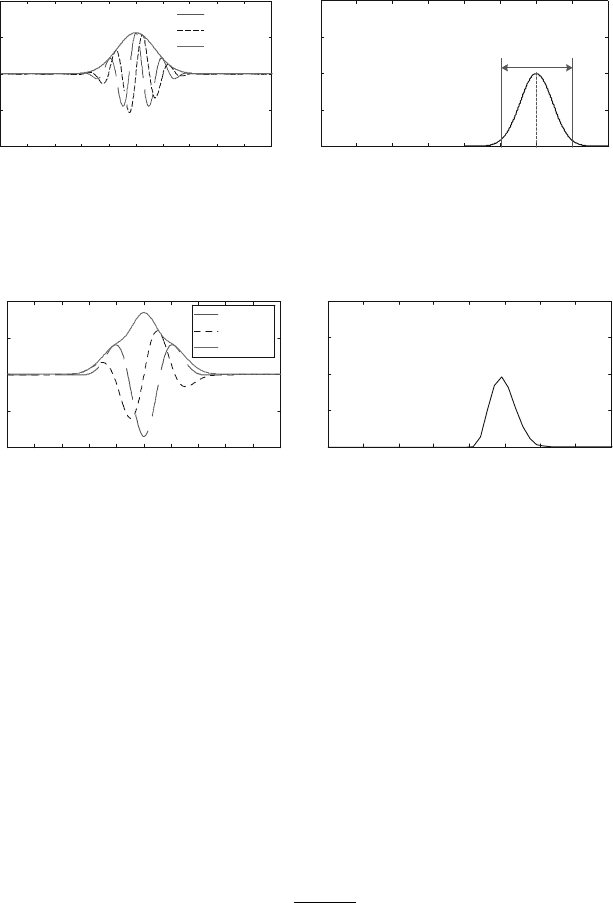
Taking the Nth derivative of this function yields the Gaussian wavelet as
c
G
ðtÞ¼c
N
d
ðNÞ
f ðtÞ
dt
N
; (3.32)
where N is an integer parameter ð
r1Þand denot es the order of the wavelet, and c
N
is
a constant introdu ced to ensure that kf
ðNÞ
ðtÞk
2
¼ 1. Figure 3.6 illustrates the
Gaussian function with its magnitude spectrum for the case of N ¼ 2. The Gaussian
wavelet is often used for characterizing singularity that exists in a signal (Mallat
and Hwang 1992; Sun and Tang 2002).
−5 −4 −3 −2 −1
0 1 2 3 4 5
−1
−0.5
0
0.5
1
Time (Sec)
Amplitude
Real
Imaginary
Envelope
−2 −1.5 −1 −0.5
0 0.5 1 1.5 2
0
0.5
1
1.5
2
Frequency (Hz)
f
c
f
b
Magnitude
Fig. 3.5 Morlet wavelet (left) and its magnitude spectrum (right): f
b
1 Hz and f
c
1Hz
−5 −4 −3 −2 −1 0 1 2 3 4 5
−1
−0.5
0
0.5
1
Time (Sec)
Amplitude
Real
Imaginary
Envelope
−2 −1.5 −1 −0.5 0 0.5 1 1.5 2
0
0.5
1
1.5
2
Frequency (Hz)
Magnitude
Fig. 3.6 Gaussian wavelet (left) and its magnitude spectrum (right): N 2
42 3 Continuous Wavelet Transform
3.4.4 Frequency B-Spline Wavelet
A frequency B-spline wavelet is defined as (Teolis 1998)
c
B
ðtÞ¼ f
b
p
sin c
f
b
t
p
p
e
j2pf
c
t
(3.33)
where f
b
is the bandwidth parameter, f
c
denotes the wavelet center frequenc y, and
p is an integer parameter ð
r2Þ. The notation of sin cðÞ is a sin c function, which is
defined as
sin cðxÞ¼
1 x ¼ 0
sin x
x
otherwise
(3.34)
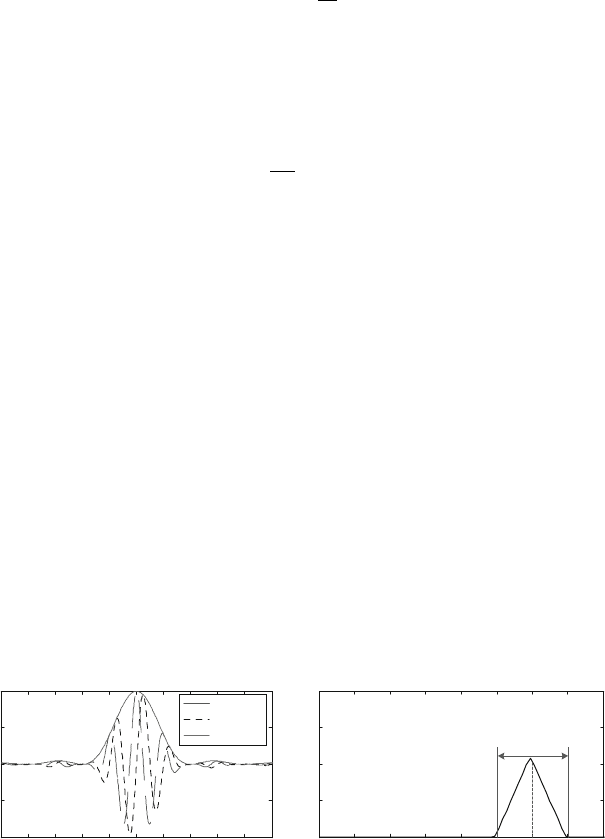
As an example, a B-spline wavelet for the case of f
b
¼ 1 Hz, f
c
¼ 1 Hz, and p ¼ 2
together with its corresponding magnitude function is shown in Fig. 3.7. The appli-
cation of the frequency B-spline wavelet has been seen in biomedical signal anal ysis
(Moga et al. 2005; Fard et al. 2007).
3.4.5 Shannon Wavelet
The Shannon wavelet is a special case of the frequency B-spline wavelet for p ¼ 1:
c
S
ðtÞ¼ f
b
p
sin cðf
b
tÞe
j2pf
c
t
(3.35)
where f
b
is the bandwidth parameter and f
c
denotes the wavelet center frequenc y.
The notation of sin cðÞ is a sin c function and defined in (3.34). Figure 3.8
illustrates the Shannon wavelet for the case of f
b
¼ 1 Hz and f
c
¼ 1 Hz, with its
corresponding magnitude spectrum. The Shannon wavelet has been shown for the
analysis and synthesis of the 1/f processes (Shusterman and Feder 1998).
−5 −4 −3 −2 −1 0 1 2 3 4 5
−1
−0.5
0
0.5
1
Time (Sec)
Amplitude
Real
Imaginary
Envelope
−2 −1.5 −1 −0.5 0 0.5 1 1.5 2
0
0.5
1
1.5
2
Frequency (Hz)
Magnitude
f
b
f
c
Fig. 3.7 Frequency B spline wavelet (left) and its corresponding magnitude spectrum (right):
p 2, f
b
1 Hz, and f
c
1Hz
3.4 Some Commonly Used Wavelets 43
3.4.6 Harmonic Wavelet
The harmonic wavelet is defined in the frequency domain as (Newland 1994a, b;
Yan and Gao 2005)
C
m;n
ðf Þ¼
1
n m
mbf bn
0 elsewhere
(3.36)
where the symbo ls m and n are the scale parameters. These parameters are real but
not necessarily integers. Furthermore, the bandwidth f
b
and center frequency f
c
are
determined by the scale parameter as
f
b
¼ n m; f
c
¼
n þ m
2
(3.37)
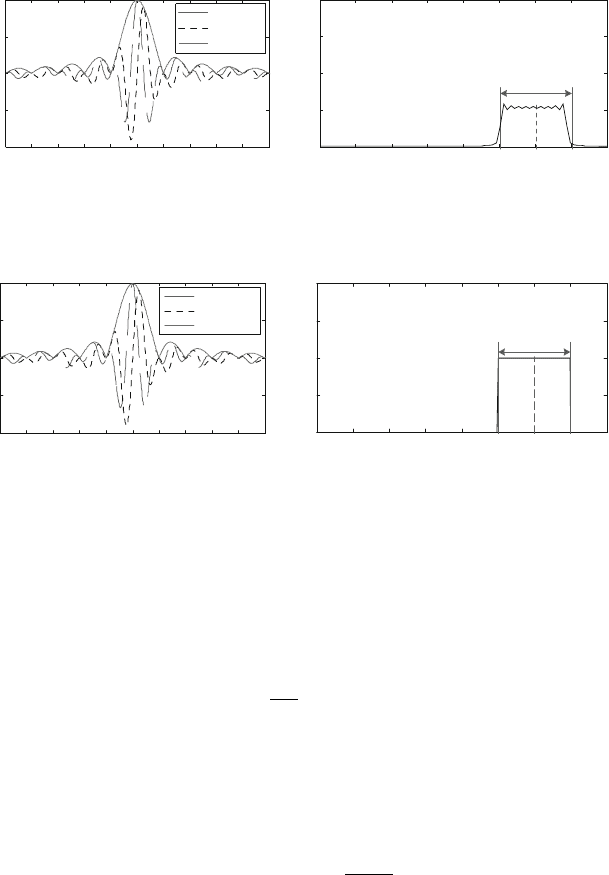
As an exampl e, Fig. 3.9 show s t he harmonic wavele t f unc ti on a nd i ts
corresponding magnitude spectrum for the case of m ¼ 0.5 and n ¼ 1. 5 . The
harmonic wavelet was first designed by Newland for anal yzing vibration signals
(Newland 1993). Later, the application of harmonic wavelet has been extended to
heart rate variability analysis (Bates et al. 1997) and image den oi si ng (If te kha r-
uddin 2002).
−5 −4 −3 −2 −1
0 1 2 3 4 5
−1
−0.5
0
0.5
1
Time (Sec)
Amplitude
Real
Imaginary
Envelope
−2 −1.5 −1 −0.5
0 0.5 1 1.5 2
0
0.5
1
1.5
2
Frequency (Hz)
Magnitude
f
b
f
c
Fig. 3.9 Harmonic wavelet (left) and its magnitude spectrum ( right ): m 0.5 Hz and n 1.5 Hz
−5 −4 −3 −2 −1 0 1 2 3 4 5
−1
−0.5
0
0.5
1
Time (Sec)
Amplitude
Real
Imaginary
Envelope
−2 −1.5 −1 −0.5 0 0.5 1 1.5 2
0
0.5
1
1.5
2
Frequency (Hz)
Magnitude
f
b
f
c
Fig. 3.8 Shannon wavelet (left) and its corresponding magnitude spectrum (right): f
b
1 Hz and
f
c
1Hz
44 3 Continuous Wavelet Transform
3.5 CWT of Representative Signals
Using the wavelets introduced in Sect. 3.4, the CWT is applied to several typical
signals, as described below.
3.5.1 CWT of Sinusoidal Function
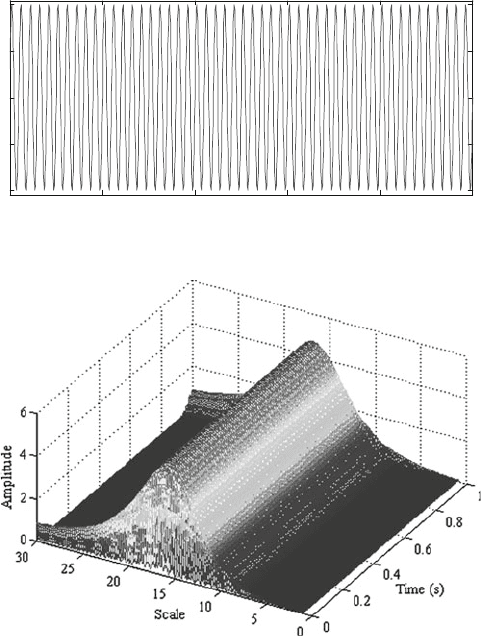
The first signal analyzed is a pure sinusoidal function. Figure 3.10a illustrates a 50 Hz
sinusoidal signal, and Fig. 3.10b illustrates the CWT results of the signal. It is seen that
the 50 Hz component is present all the time throughout the analysis duration.
0 0.2 0.4 0.6 0.8 1
−1
−0.5
0
0.5
1
Time (s)
Amplitude
a
b
Time domain waveform of a sinusoidal function
CWT results of the sinusoidal function
Fig. 3.10 A sinusoidal function (a) time domain waveform (b) CWT results
3.5 CWT of Representative Signals 45
3.5.2 CWT of Gaussian Pulse Function
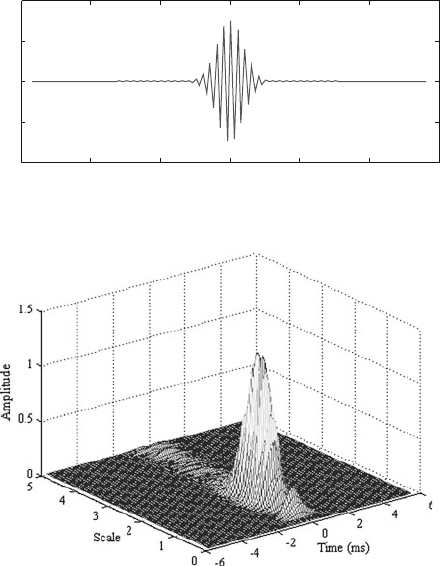
The second signal is a Gaussian pulse function. Figure 3.11a shows a Gaussian pulse
signal with 10 kHz center frequency. Figure 3.11b illustrates the CWT results of the
Gaussian pulse signal, which is identified in the time-scale domain at around 0 s.
3.5.3 CWT of Chirp Func tion
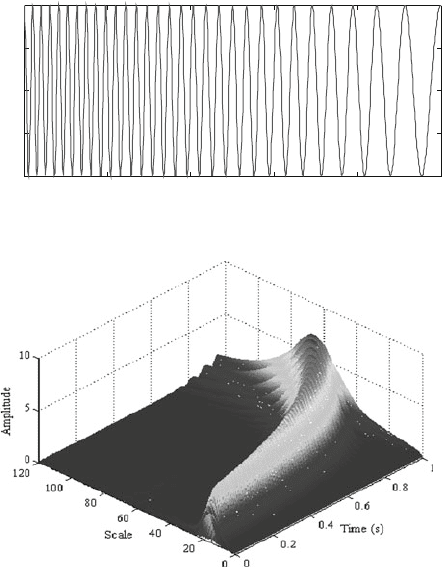
The last signal is a chirp function. Figure 3.12a shows an example of a chirp signal.
It is a linear swept-frequency signal with the instantaneous frequency being 50 Hz
at time zero. The instantane ous frequency 10 Hz is achieved after 1 s. Figure 3.12b
illustrates the CWT results of the chirp signal, and the change of frequency along
with time can be clearly seen.
−
6
−
4
−
2 0 2 4 6
−
1
−
0.5
0
0.5
1
Time (ms)
Amplitude
a
b
Time domain waveform of a Gaussian pulse function
CWT results of the Gaussian pulse function
Fig. 3.11 A Gaussian pulse function (a) time domain waveform (b) CWT results
46 3 Continuous Wavelet Transform
3.6 Summary
This chapter begins with definition of a wavelet, where the admissibility condi tion
that a wavelet should satisfy is emphasized. The CWT and its related properties
are then introduced. Two approaches for implementing the CWT are discussed
in Sect. 3.3, followed by the introduction of some commonly used wavelets in
Sect. 3.4. Typical signals are analyzed using the CWT and the results are shown
in Sect. 3.5.
3.7 References
Bates RA, Hilton MF, Godfrey KR, Chappell MJ (1997) Autonomic function assessment using
analysis of heart rate variability. Control Eng Pract 5(12):1731 1737
Bracewell R (1999) The Fourier transform and its applications. 3rd edn. McGraw Hill, New York
Chui CK (1992) An introduction to wavelets. Academic, New York
0 0.2 0.4 0.6 0.8 1
−
1
−
0.5
0
0.5
1
Time (s)
Amplitude
b
a
Time domain waveform of a chirp function
CWT results of the chir
p
function
Fig. 3.12 A chirp function (a) time domain waveform (b) CWT results
3.7 References 47