
Health and Safety Executive. Guidelines for use of statistics for analysis of sample inspection of corrosion
Подождите немного. Документ загружается.

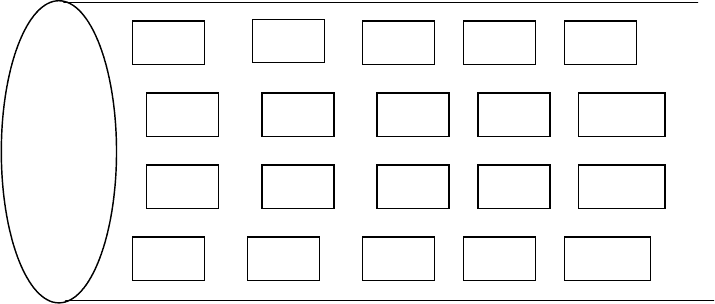
5.1
4.9
5.1
4.9
5.2
5.0
5.0
4.8
4.7
4.9
5.0
5.0
5.1
5.0
4.9
5.1
5.3
5.0
4.8
5.2
Figure 2
Example Readings from Pressure Vessel/Pipe
When ordered the data becomes:
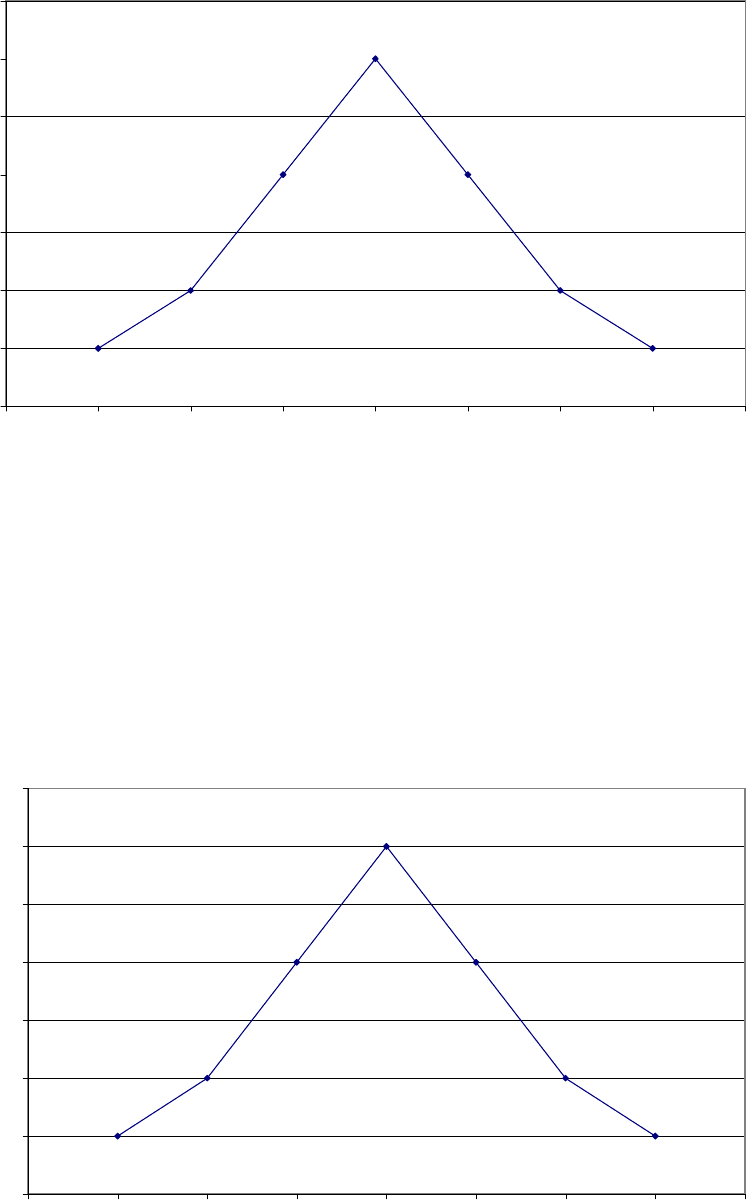
4.7, 4.8, 4.8, 4.9, 4.9, 4.9, 4.9, 5, 5, 5, 5, 5, 5, 5.1, 5.1, 5.1, 5.1, 5.2, 5.2, 5.3
The values are grouped in intervals as tabulated below:
Wall Thickness Frequency
4.7 1
4.8 2
4.9 4
5 6
5.1 4
5.2 2
5.3 1
The frequency distribution is a plot of the data in this table as Figure 3.
4
0
1
2
3
4
5
6
7
No of readings
4.6 4.7 4.8 4.9 5 5.1 5.2 5.3
Wall Thickness
Figure 3
Frequency Distribution
This frequency distribution appears to be symmetrical and the central tendency is 5.0.
In order to make use of this pattern in the data it is necessary to convert it into a mathematical
form. The mathematical form must describe the data in Figure 3 or must be a close fit.
Usually one step in this process is to normalise the data by dividing the frequency by the total
number of readings (Figure 4). This is called a normalised frequency distribution (frequency
being the number of readings). Basically the process of fitting the data is one of trial and
error, although tools are available to assist in this process as described below.
0
0.05
0.1
0.15
0.2
0.25
0.3
0.35
No of readings/total readings
4.6 4.7 4.8 4.9 5 5.1 5.2 5.3
Wall Thickness (mm)
Figure 4
Normalised Frequency Distribution
5
5.4
5.4
No of readings/total readings
0.35
0.3
0.25
0.2
0.15
0.1
0.05
0
4.6 4.7 4.8 4.9 5 5.1 5.2 5.3
Wall Thickness (mm)
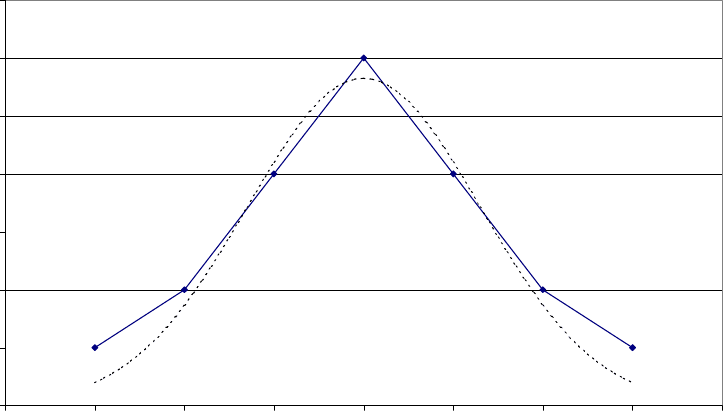
Figure 5
Fitting a Curve (in this case a normal distribution)
There are a number of standard forms of frequency distribution. These have mathematical
equations to describe them, but for the purposes of this document only the general shapes and
the graphical display will be considered. A frequency distribution also has associated with it a
cumulative distribution, which is the sum of the number of readings up to a certain point and
is equivalent to the area under the frequency distribution curve.
Figure 5 shows a normal distribution with a mean of 5.0 and standard deviation of 0.13
adjusted to fit the same scale as the previous frequency distribution. If we believe that this fit
is good enough it is possible to make calculations on the data, for example to estimate the
proportion of the vessel with a wall thickness less than 4.7mm. This is calculated from the
area of the frequency distribution below 4.7mm. This is more easily calculated from the value
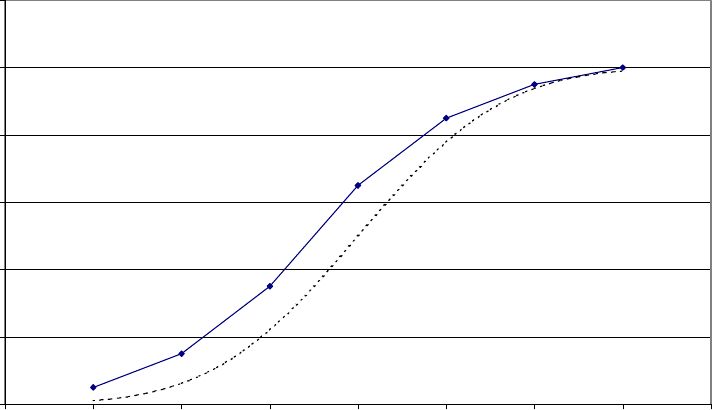
of the cumulative distribution at this point. The cumulative distribution is plotted by
successively adding in the number of points/total number. It always reaches a maximum of 1,
for the largest measurement in the data set.
6
5.4
1.2
Number of Readings up to thickness/Total Numbe
r
of Readings
1
0.8
0.6
0.4
0.2
0
4.6 4.7 4.8 4.9 5 5.1 5.2 5.3
Thickness Reading (mm)
Figure 6
Cumulative Distribution of data and normal distribution curve
The proportion of the wall thickness less than 4.7mm (for example) can be read directly from
this graph.
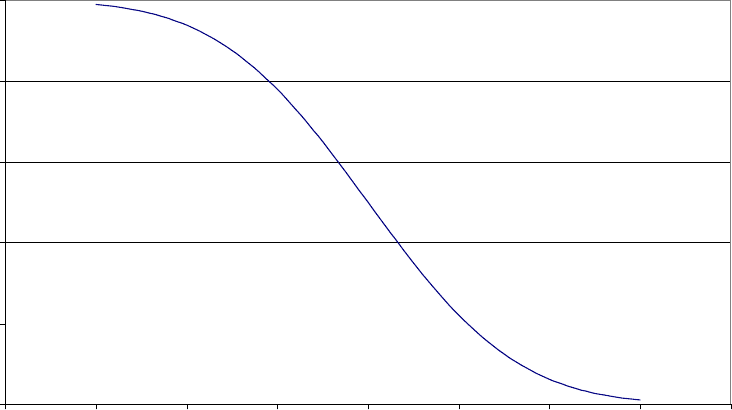
A function derived from the cumulative distribution that will be used in later analyses is
called the survivor function. This is simply the cumulative distribution subtracted from 1.
Figure 7 shows the survivor function for the above normal distribution.
7
5.4
1
Proportion of readings greater than given thicknes
s
0.8
0.6
0.4
0.2
0
4.6 4.7 4.8 4.9 5 5.1 5.2 5.3
Wall Thickness (mm)
Figure 7
Survivor Function for Normal Distribution
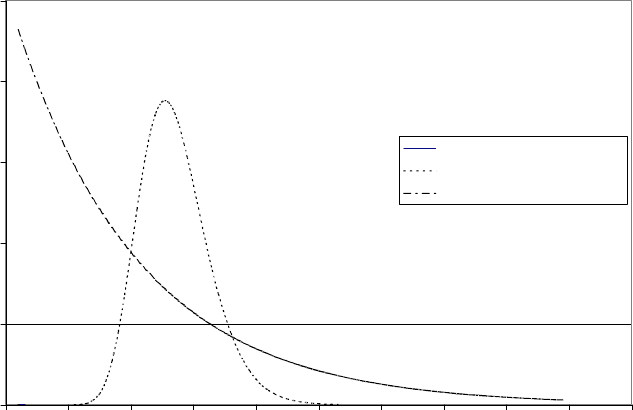
The choice of distribution for the calculations is crucial. Each distribution has a different
shape and the wrong choice can lead to erroneous conclusions. For example two shapes which
may represent certain corrosion types are the lognormal and exponential distributions. The
basic shapes of the frequency distributions for these are given in Figure 8. It is also important
to note that the accuracy of the parameters of the distribution, and the confidence limits
eventually produced, depend on the number of data points used.
When an entire population of a defect is available, for example given a detailed (100%)
surface scan covering an entire vessel, then statistical analyses of the data generally produce a
fundamental or underlying distribution pattern. In this case all data values are fully defined.
Typical fundamental distribution patterns include those shown in Figure 8, but could also
include Poisson or Gaussian distributions.
In practice complete data population sets rarely occur. For example 100% scanning of a
vessel would be considered impractical. Accordingly statistical treatments and procedures
have arisen over the years to allow predictions to be made on the basis of limited sample
information, where the sample is used to infer the greater population behaviour. N.B. A
statistical sample which contains less than an entire population of data may follow the
distribution of its parent population and this may be a fundamental distribution.
8
5.4
0
0.5
1
1.5
2
2.5
0 0.5 1 1.5 2 2.5 3 3.5 4 4.5 5
Frequency
Normal Distribution
Lognormal distribution
Exponential Distribution
Value of Distribution
Figure 8
Different Distribution Shapes
One special example that is important in the context of inspection is the family of extreme
value distributions. Instead of being constructed from all the readings taken, they are
constructed from the extreme values of groups of the data. Usually for inspection the data
will be grouped in areas. So for example if the results from Figure 2 are in circumferential
bands, the lower extreme values will be 4.9, 4.8, 4.7, 4.9, 4.8 and these will form a
distribution of their own called an extreme value distribution.
4.1.1 Extreme Value Distribution
The methodology that underpins the extreme value statistical analysis of measurements of
NDT inspection is defined fully in Kowaka (9). For the purposes of explanation the
following text refers to damage due to corrosion. However the technique has applicability to
the analysis of pitting defects resulting from some other factors.
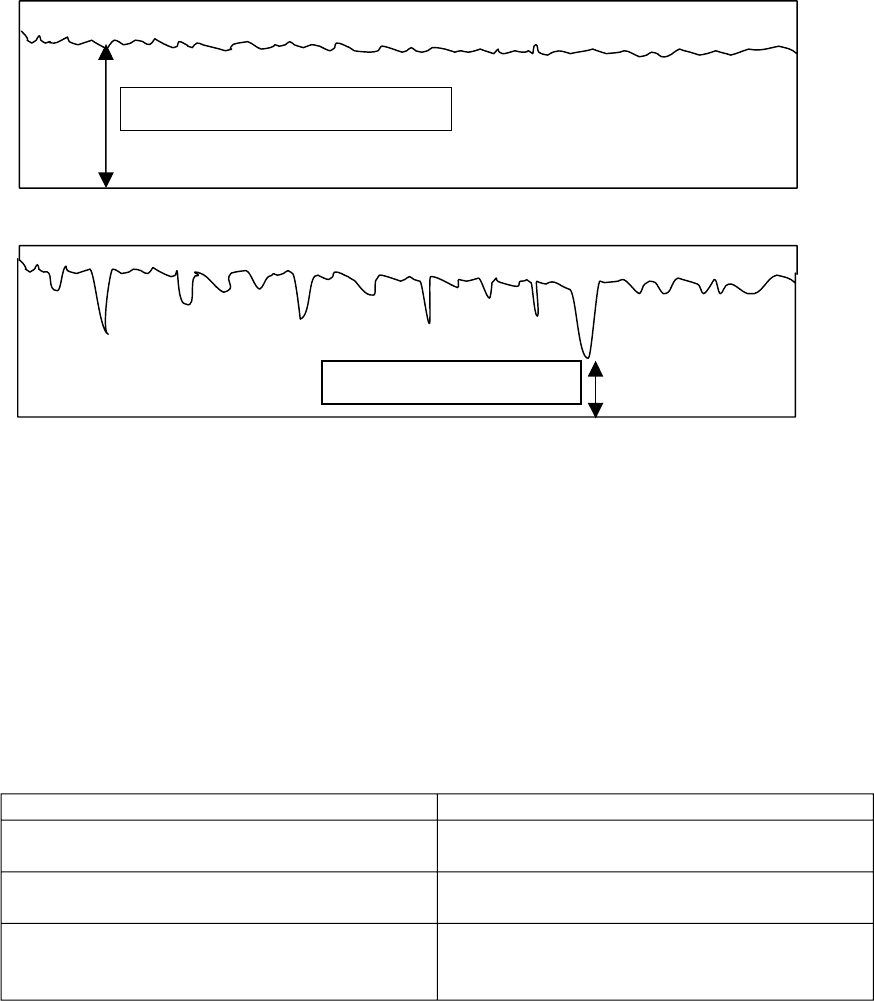
Corrosion damage may be classified according to their morphologies to be uniform (general)
corrosion or non-uniform (pitting) corrosion. When a material deteriorates with uniform
corrosion its life may be defined as the point at which the average thickness reaches a
minimum allowable threshold (see Figure 9).
The upper example in Figure 9 shows an example of uniform corrosion. Due to the
uniformity of the defect, fundamental statistical distributions can be used to predict the
average wall thickness loss.
The lower surface in Figure 9 shows an example of non-uniform corrosion displaying more
localised defect penetrations. In this case considerations of the average pit depth are
inappropriate since loss of containment will result as soon as one extreme defect perforates
the material. Fundamental statistical distributions are not suitable for analysis of such cases,
and extreme value calculations are required in order to predict a maximum expected pit depth
from what will generally be sample information. The need for the use of the extreme value
distribution will be evident when the NDT data is analysed.
9
Extreme value data sampling differs from fundamental data sampling in that the former only
considers a set of extreme values extracted from a larger sample (as described above for each
circular ring above). Statistically the effect of this filtering (i.e. using only part of the
distribution) allows the tail of the resulting distribution to more accurately model the potential
defect extremes which may exist in the material. In practice to allow statistical integrity each
extreme value must be collected from a subset of a larger sample which in itself (i.e. the
subset) contains sufficient data to infer a parent fundamental distribution population.
Effective Thickness
Effective Thickness
Figure 9
Top: uniform corrosion, Bottom: non-uniform corrosion
Kowaka (9) has attempted to fit several types of corrosion data to different distributions, some
examples of which are in Table 1. However in most inspection situations there is little prior
knowledge of the distribution type, and therefore a full fitting operation is needed prior to any
assumptions about the distribution.
Table 1
Types of Distribution for Corrosion (from Kowaka)
Corrosion Type Distribution
Pit Depth for Carbon Steel fresh water supply Normal
pipe
Maximum Pit Depth for Petroleum Tank Extreme Value (Type 1)
Bottom Plate
Maximum Corrosion Depth beneath corrosion Extreme Value (Type 1)
product layer for carbon steel tubing for
mineral dressing slurry
10
4.2 DETERMINATION OF DISTRIBUTION (UNKNOWN CORROSION)
4.2.1 Collecting and Sampling the Data
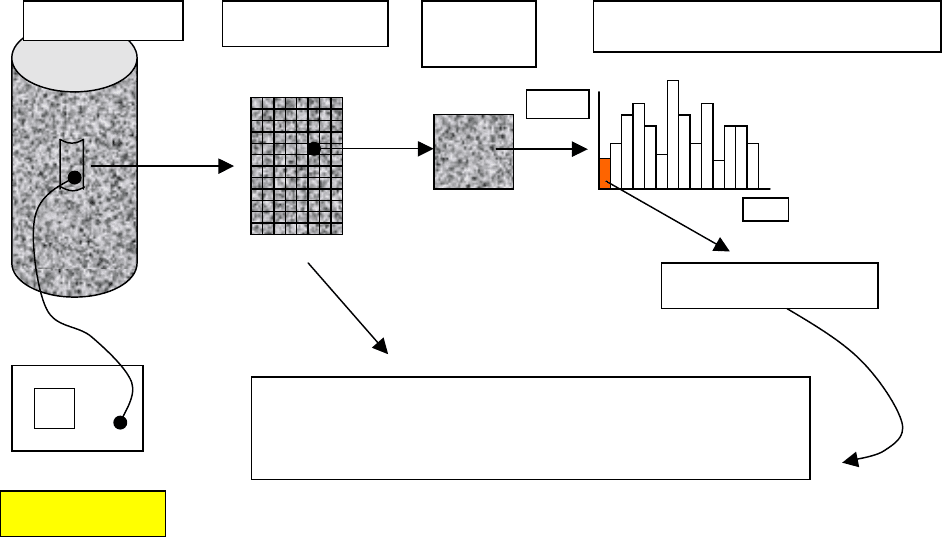
The manner in which data is collected and later analysed is represented in Figure 10. The
vessel/pipe is first divided into sample areas for inspection (often determined by the
inspection device scanner). An individual sample area (known sometimes as a patch)
contains a number of individual values of thickness or pit depth taken by the NDT device.
1 2
0.5 1.2
(patch)
WT
N
o
Patch 3……..
Max Pit Depth 0.6……
Extreme Values
Vessel/Pipe Sample Areas
Sample
Pit Depth or Wall thickness values
N
DT Scanne
r
Figure 10
Data Collection from a vessel/pipe to produce extreme values
4.2.2 Identifying homogeneity within the vessel/pipework
As an initial step, the homogenous areas (i.e. those with similar corrosion properties) must be
identified. Statistical treatment, such as extrapolation, can only be applied with integrity to
samples which are considered to be representative of the parent populations (i.e. a larger
area). Accordingly this may result in several analyses being conducted for the vessel as a
whole.
Scanning Method
Data collection is typically (though not always) performed in a uniform manner, typically as
equally spaced measurements on a grid as depicted in the schematic below. It is important to
draw the distinction between the sample area represented by a patch of data and the effective
area scanned by the NDT probe. The sample area can be defined as the surface area of that
portion of the vessel under examination. The effective scanned area is the sum of all the areas
actually covered by the probe within the boundary of the sample area. If calculations such as
extrapolation are carried out, then the effective area should be used.
11
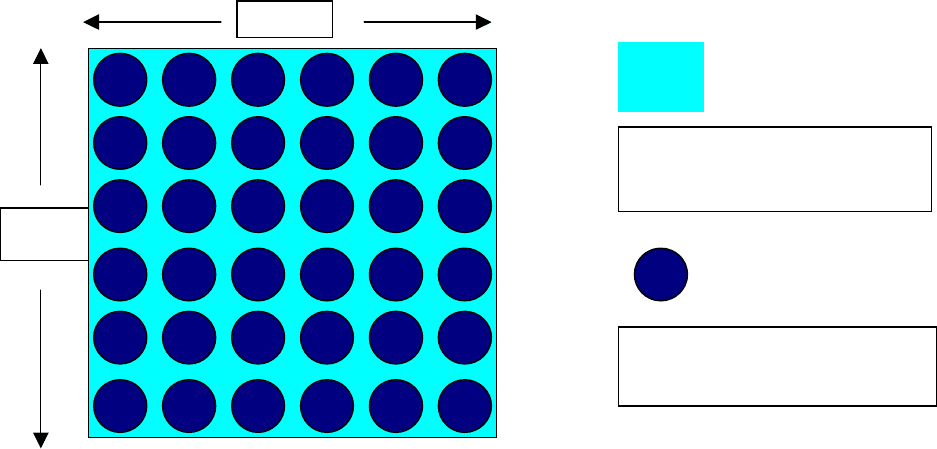
Clearly there is a direct relationship between the effective scanned area, the scan mechanism
and the resulting number of data points. By way of illustrating the relationship, Figure 11
shows a sample area of approximately 56 cm
2
in which 36 spot data points have been
collected using a probe of 1cm diameter. The resulting effective area scanned is about 28cm
2
representing about 50% of the patch area
7.5cm
7.5c
m
2
(
2
p
(0.5)
2 2
Sample (patch) area = 6 1.25 x
1.25)=56.25cm
Effective scanned area=6 x6 x
=28.27cm
Figure 11
Effective scanning Area
4.2.3 Extracting Extreme Values
Based on the NDT Equipment, its resolution (i.e. the effective area actually scanned in one
measurement recorded by the probe) and ideally, the confidence level required by the analyst,
a set of sample areas is defined and scanned. Often, in practice, this may be all of the
accessible areas, in which case the confidence level is set by the number of data points which
can be taken. The measurements are then recorded and analysed. An example of extreme
value selection of the data (which may be undertaken if prior knowledge of the corrosion
indicates pitting) is shown in Figure 10 selected from each patch. When attempting to use
extreme value analysis, it is imperative that each patch of data complies with the following
criteria:
· Each individual patch contains sufficient measurements within itself to reflect a
representative sample from the fundamental distribution. This is necessary to support the
selection of an extreme value from that patch. Literature indicates that at least 5 readings
are needed.
· the total number of extreme values that result across all patches (i.e. making up the
extreme value data as a whole) are sufficient to enable a doubly exponential (or other
extreme value) distribution to be adequately defined.
To fit distributions by matching the inspection data plotted as frequency or cumulative
distributions to the mathematical plots by trial and error (as described in 4.1) could be
extremely time consuming, and the task can be made much easier by the use of probability
12
13
plots. These are specially designed graphs which have an ordinate scale from 0 to 1, but the
intervals on the scale depend on the distribution function. If the data matches a distribution
then it will appear as a straight line. To use this method, the first step is to order the data as
above (Section 4.1). The next step is to insert this data directly on to the probability plot.
Many statistical packages have probability plots for a range of distributions included as
standard.
When the data is plotted, a best fit regression line of the data is also plotted. If the two
correspond, then the data matches the distribution described by the probability plot. If it
doesn’t fit then another distribution must be tried. The parameters of the distribution (i.e.
those numbers which represent the spread and location, or central tendency) are determined
from the slope of the line and its intercept with the horizontal axis.
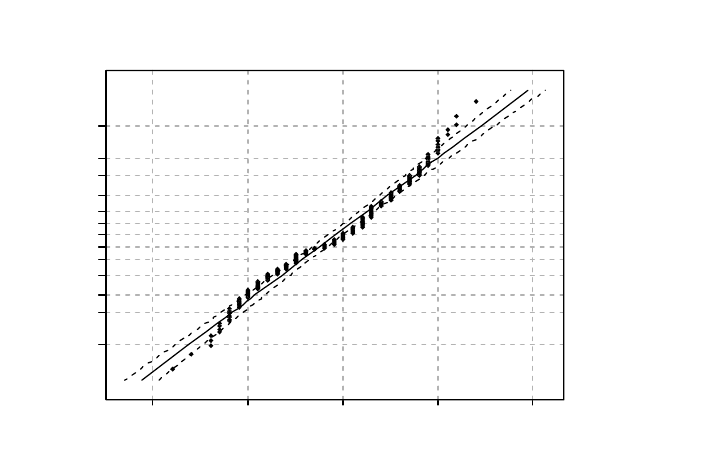
Figure 12
Probability Plot showing fit to Normal Distribution
An immediate application of the plot is to estimate the proportion of the plant below a certain
thickness. In the probability plot this is simply read off the horizontal axis (for Figure 12, 1%
of vessel is below about 24mm thick)
23.5 24.5 25.5 26.5 27.5
1
5
10
20
30
40
50
60
70
80
90
95
99
Data
Percent
Max. Likelihood
Estimates:-
Mean:
StDev:
25.4mm
0.66mm