
Kasper C., van Griensven M., P?rtner R. (Eds.) Bioreactor Systems for Tissue Engineering II: Strategies for the Expansion and Directed Differentiation of Stem Cells
Подождите немного. Документ загружается.

centrifugation fraction is the so-called “stromal-vascular fraction” (SVF), as the
stromal and vascular tissues show nearly identical centrifugation properties. The
SVF contains a heterogenous cell population composed of circulating blood cells,
fibroblasts, pericytes, endothelial cells, and multipotent stem cells.
Over the past few years, several nomenclatures for these multipotent cells have
been used, e.g., processed lipoaspirate, adipose tissue-derived stromal cells, or
adipose-derived mesenchymal stem cells, but in this chapter we will use the term
“adipose-derived stem cells” (ASC), based on a consensus reached by the Second
Annual Meeting of the International Fat Applied Technology Society in Pittsburgh,
PA, in 2004, and which is also favored in the literature.
In recent years, research interest in plastic and reconstructive surgery has focused
on characterization and tissue engineering approaches of ASC, since these cells are
easily and frequently harvested during lipoforming procedures [19–21]. In the
following chapter on ASC we would like to define the term “ASC” and its origin.
Furthermore, we want to cover the surgical procedures and isolation techniques for
ASC from fat tissue. In addition, we want to display the characterization of ASC via
surface markers and their differentiation capabilities into different cell lines, e.g.,
adipocytes, chondrocytes, osteoblasts, myocytes [16], endothelial cells [22], neuron-
like cells [23–26], hepatocytes [27, 28], pancreatic cells [29], and hematopoietic
supporting cells [30, 31], together with the underlying signal cascades. This will be
followed by a short overview of the application of ASC in tissue engineering and in
clinical medicine, using the angiogenic, antiapoptotic, hematopoietic, and anti-
inflammatory cytokine profile secreted by ASC [31, 32].
2 Isolation of ASC
Due to the easy accessible anatomical location and the abundant existence of
subcutaneous adipose tissue, ASC hold the advantage of a simple and above all
less invasive harvesting technique. Thus, adipose tissue might be considered as a
rich source of stem cells, especially with the increased incidence of obesity in
modern populations. In general, adipose tissue can be harvested by liposuction,
lipoplasty, or lipectomy procedures. Minimal-invasive procedures such as liposuc-
tion or lipoplasty have the advantage of a reduced patient discomfort and lower
donor site morbidity compared to lipectomy.
To avoid risks of general anesthesia, small amo unts of adipose tissue (100–
200 mL) can be obtained under local anesthesia by liposuction procedures. Note-
worthy, these “small amo unts” are still bigger volumes than those yielded by bone
marrow aspiration. In comparison, 1 g of adipose tissue yields approximately
5 10
3
stem cells [33], which is 500-fold greater than the number of MSCs in
1 g o f bone marrow [34].
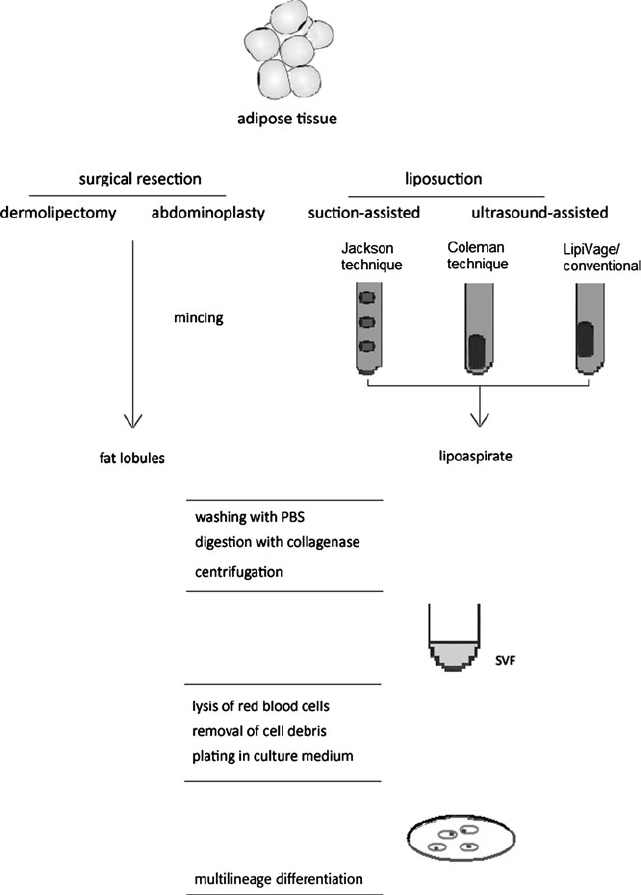
For a complete overview of the harvesting and isolation process, see Fig. 1.
Isolation, Characterization, Differentiation, and Application of Adipose-Derived Stem Cells 57
2.1 Influence of Donor Site and Age
Several studies have compared the impact of the isolation procedure via aspiration
liposuction, ultrasound-assisted liposuction, or lipectomy on the yield of ASC.
Fig. 1 Flowchart of fat harvesting and ASC isolation process. Note the different cannulas used for
the different techniques of fat harvesting
58 J.W. Kuhbier et al.
Furthermore, different donor sites such as fat derived from abdominal tissue, hips,
or thighs have been compared regarding cell yield, cell viability, and cell dif-
ferentiating capacity. Intere stingly, neither the type of surgical procedure nor the
anatomical site of the adipose tissue affects the total numb er of viable cells that can
be obtained from the stromal-vascular cell fraction [33, 34]. However, there is
increasing evidence that both the cellular composition and the differentiation
capacity display heterogeneity according to the localization of the adipose tissue,
at least in the murine model [ 35 ].
Since different anatomical localizations of fat tissues have their own metabolic
characteristics, such as lipolytic activity, fatty acid composition, and gene expres-
sion profile, the source of subcutaneous adipose tissue grafts might influence the
long-term characteristics of the fat graft. In rabbits, the osteogenic potential of ASC
from the visceral adipose tissue is described to be more effective than those of the
subcutaneous adipose tissue [36].
In humans , data fr om literat ure are ambivalent; w hilst most studies show no
difference in the p roliferation r ate, i.e., the culture doubling time [37–43], there is
one study that measured faster proliferation rates in preadipocytes from subcuta-
neous vs omental adipose tissue (doubling time 4 1daysvs5 1days)[44].
This study also found a higher number of endothelial cells in the harvested SVF
in agreement with the finding that endothelial cells from adipose tissue were
recentlydescribedtopromotepreadipocyte proliferation [45]. Another study
describes differences in the frequency of ASC in the adipose tissue from abdomi-
nal subcutaneous tissue and from the hip/thigh region with abdominal tissue
having superior frequencies, though the absolute cell number was the same
[46]. While few studies found attachm ent and proliferation ratios to be more
pronounced in ASC derived from younger donors c ompared with older donors
[40], others fo und no difference in pr olife rative capacity concerning the age [41,
42, 44, 45, 47, 48].
Noteworthy, in the study by Zhu et al. [43], though the authors stated ACS from
younger donors to be faster proliferating, the difference between young and old
donors was slight and not statistically significant.
In addition, the studies mentioned above also examined the differentiation
capacity of ASC. Whereas one study examined the adipogenic and osteogenic
potential [24], othe rs focused merely on the adipogenic [8, 40, 41, 44, 49]or
osteogenic capacity [42, 47, 48, 50]. Interestingly, while some stud ies found no
difference in adipogenesis with regard either to the region [40, 44] or to the age
[41], other studies found the potential for adipogenic differentiation elevated in
older donors [
40, 43].
In contrast, in two studies, differences related to the donor site could be found
regarding the adipogenic capacity [8, 49]. Tchkonia et al. compared the differenti-
ation into adipocytes of ASC harvested in abdominal subcutaneous, mesenteric, and
omental adipose tissue and observed the highest adipogenic capacity in abdominal
subcutaneous adipose tissue, followed by intermediate capacity in mesenteric
adipose tissue, and lowest capacity in omental adip ose tissue [ 51 ]. Hauner and
Entenmann found a significantly higher metabolic activity in differentiated
Isolation, Characterization, Differentiation, and Application of Adipose-Derived Stem Cells 59
adipocytes derived from ASC, which were harvested from the abdominal subcuta-
neous adipose tissue compared to ASC obtained from the femoral adipose tissue in
obese women [52].
Concerning osteogenesis, the findings were also ambivalent; some studies found
no difference in osteogenic capacity [41, 47, 48, 50], others found higher osteogenic
differentiation rates in younger donors [43]. The finding that osteogenic capacity is
preserved during aging stands in contrast to current clinical experience, where time
for fracture healing is enhanced in the elderly or osteoporotic bones compared to the
skeleton of younger people. Hence, Khan et al. concede that the donors examined in
their study were in their later life (ranging from 57–86) and suffered from osteoar-
thritis [47].
In summary, general scientific opinion negates any age-dependant effect on ASC
proliferation, whereas the influence of age on the differentiation capacity of ASC
remains debatable.
2.2 Techniques of Harvesting Fat
Techniques of fat harvesting include direct excision such as dermolipectomy,
abdominoplasty, or removal by less or minimal-invasive procedures, such as
liposuction. Dermolipectomy comprises the surgical removal of excessive skin
and fat tissue from various body locations. The different techniques of abdomino-
plasty originated from variation in abdominal wall incision for repair of large
umbilical hernias in the early 1900s [53]. The modern abdominoplasty as a distinct
procedure with umbilical transposition and musculoaponeurotic plication was
described by Vernon in the early 1960s and was further refined by others such as
Pitanguy, Regnault, and Psillakis [54–59].
After preparation of a whole flap of skin and fat, fat lobules of approximately
0.5–1 cm
3
are separated from the dermo-epidermal layer and minced by repeated
cutting with scissors until reaching a paste-like/mushy/pappy appearance. Here-
after, the processing is the same as in liposuction.
Independent of or in combination with an abdominoplasty, the body shape can
be modeled by liposuction. Technical aspects of liposuction/lipoplasty include
different cannula sizes and shapes, and the use of a wetting tumescent solution,
which can drastically reduce blood loss compared to the original dry techniques or
ultrasound-assisted devices, which can be advantageous by removing fat tissue
from fibrous or scarred areas. Besides ultra-sound-assisted liposuction, which offers
very good results concerning body sculpturing but should not be used for harvesting
fat due to poor yields of viable cells [60], there are currently four common methods
in use for liposuction/lipofilling purposes: conventional liposuction, the method
described by Coleman, [61–64], the alternative method developed by Jackson et al.
[65, 66], and the LipiVage
TM
syringe combination.
Whereas liposuction intends to remove fat tissue, devices for lipofilling combine
gentle removal of fat with internal processing for reinjection of a viable cell fraction
60 J.W. Kuhbier et al.
with the Coleman method being the first and probably best described technique, the
Jackson method as a mostly experimentally used technique, and the LipiVage
syringe combination as the newest technique.
Conventional liposuction, also called suction-assisted lipectomy, is performed as
follows. The patient is brought to a supine position and local, regional, epidural, or
general anesthesia is used, depending on the patient’s preference or anesthetic risk.
A small skin incision with a length of approximately 1 cm is made in the lower
abdomen to infiltrate a mixed solution with a blunt Lamis infiltrator. For local
anesthesia, the solution contains lactated Ringer’s solution with 0.5% lidocaine
with 1:200,000 of epinephrine for local hemostasis via vasoconstriction. During
epidural or general anesthesia, 1:400,000 epinephrine in Ringer’s lactate helps to
maintain hemostasis. By using epin ephrine, blood loss and contaminati on of the
harvested fat with blood cells is minimized. The solutions are infiltrated at a ratio of
1 cc of solution per cubic centimeter of fat graft to be harvested. An aspiration
cannula, 3–4 mm in diameter and 15 or 23 cm in length with a hollow blunt tip, is
then connected to a liposuction machine with the negative pressure of the machine
being set up at a pressure no greater than 20 cm H
2
O (Fig. 1). Fat is harvested
through the same incision previously made for infiltrat ion, moving the cannula
forward and backwards, disrupting adipose cells mechanically from the surround-
ing tissue. The adipose aspirate is collected in a sterile bottle; further processing is
identical to those of the other methods.
Conventional liposuction is well-tried for the aspiration of fat in the sense of not
processing or injecting it thereafter. Many adipocytes are destroyed due to rough
mechanical disruption, indicating that other cell types like stromal cells and ASC
are also damaged. Thus, the more gentle technique developed by Coleman is widely
used for fat transplantation purposes, e.g., body sculpturing or rejuvenation tech-
niques, which is well described and standardized [61–64, 67].
The anesthesia and infiltration technique is the same as described above whi le,
for the harvesting, a different cannula is used. Though it is also 3 mm in diameter
and 15 or 23 cm in length, the blunt tip is slightly different. The two distal openings
positioned extremely close to the end give the tip a shape reminiscent of a bucket
handle (Fig. 1). Also, the harvesting cannula is connected to a 10-cc Luer- Lok
syringe instead of using a high-pressure vacuum suction machine. Gently pulling
back the plunger of a 10-cc syringe provides a light negative pressure while the
cannula is advanced and retracted through the harvest site. Alternative devices that
lock the plunger of syringes into place should be avoided, as they can create higher
negative pressures that may damage the fragile tissue.
For the technique by Jackson et al. [65, 66], a fine needle apparatus is used
together with a 20-cc syringe. The needle for harvest is that used by veterinarians to
inject antibiotics into the udders of cows, and it is fitted to a 20-cc syringe. With a
diameter of 2 mm and a length of 7 cm, it has a wide bore with a blunt tip and
several side holes (Fig. 1). Harvesting is performed as in the other two techniques
with forward and backwards motion and intermittent aspiration.
According to recent studies, the technique by Jackson should be favored, as it
was superior to the Coleman method in the yield of viable cells in total and ASC in
Isolation, Characterization, Differentiation, and Application of Adipose-Derived Stem Cells 61
particular [65], while, in the study by Pu et al. [64], the Coleman method was
superior to conventional liposuction although only the yield of adipocytes was
measured. Declaring adipocyte viability as a marker for general cellular viability
in a fat graft, the chemical effect of epinephrine/lidocaine infiltration remains
unnoteworthy, because studies done in the 1990s showed that no chemical damage
occurred during liposuction concerning viability of adipocytes [60, 68, 69]. At least,
investigations about the influence of infiltration on ASC yield are lacking as yet.
Another promising technique is the LipiVage
TM
-System, quite a new fat harvest,
wash, and transfer system which also uses very slight negative pressure, though
connected to a vacuum system [49]. While first results revealed superior numbers of
viable adipocytes, no data exist for the harvest of ASC at present [49].
In summary, for fat grafting, no matter if intended either for fat transpl antation
or yield of ASC, conventional liposuction should not be used due to the harsh
movements that cause damage to the cells. In contrast, one of the gentle liposuction
methods is recommended for harvesting since it has the advantage of a less invasive
procedure compared to an abdominoplasty, but regarding the yield of adipocytes,
no difference has been found so far between the described techniques [ 35 ].
2.3 Isolation of ASC from Fat Grafts
As mentioned before, the isolation processing for the yield of ASC from fat grafts is
identical for abdominoplasty- or liposuction-harvested grafts. Most publications
use the protocol by Zuk et al. [16], though actually Rodbell pioneered in centrifu-
gation and digestion of fat to identify different fractions in 1966 [70–72]. However,
the identification of the SVF was just a secon dary product of his work focusing on
the metabolism of isolated fat cells, and therefore Zuk et al. are usually referred to
as the prime investigators.
After transferring the lipoaspirate or the dissected lobules into a laboratory under
sterile conditions following good manufacturing practice (GMP), they are exten-
sively washed in equal volumes of sterile phosphate-buffered saline (PBS). The
extracellular matrix (ECM) is digested at 37
C for 30 min with 0.075% collagenase
in PBS [73] under permanent shaking. Thereafter, enzyme activity is neutralized
with Dulbecco’s modified Eagle’s medium (DMEM), containing 10% fetal bovine
serum (FBS) and centrifuged at 1,200g for 10 min to obtain a high-density pellet
of the SVF. The pellet is resuspended in 160 mM NH
4
Cl and incubated at
room temperature for 10 min to lyse contaminating red blood cells. The SVF was
collected by centrifugation, as detailed above, filtered through a 100-mm nylon
mesh to remove cellular debris and incubated overnight at 37
C/5% CO
2
at a
density of approximately 150,000 cm
in control medium (DMEM containing
10% FBS and 1% antibiotic/antimycotic solution, for example penicillin/strepto-
mycin). Following incubation, the plates were washed extensively with PBS to
remove residual nonadherent blood cells. Further cultivation can be done for up to
15 passages before cells become senescent if cells are separated at approximately
62 J.W. Kuhbier et al.
60–70% confluen ce to avoid differentiation due to contact inhibition. A remarkable
finding was described by Zhu et al. who passaged ASC cultures up to 25 passages
and studied the growth kinetics and differentiation potential [74]. Interestingly,
ASC showed several logarithmic growth periods, e.g., the first between the 4th and
7th day of culture, the second between 9th and 10th day, though they allowed cells
to reach 90% confluence. While morphology and surface marker did not change
between earlier passages and the 25th, multilineage differentiation potential was
declined in the 25th passage [75].
Lee et al. observed the greatest numbers of cells obtained from cultures plated
at low density [76], s o not more than 4 10
3
cells cm
2
should be plated per
passage. However, before the next passage, a phenotype characterization, for best
results with a flow c ytometry cell sorter, should follow to cultivate as pure cultures
of AS C as possible. Handling these small num bers of cells while culturing, it is
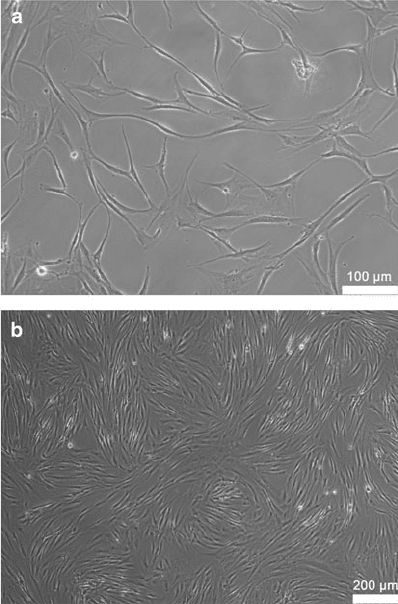
noteworthy that cryopreservation is also suitable [77]. ASC appear to be fibro-
blast-like shaped, expand easily in even FBS-free cul ture media [78]andcanbe
passaged with Trypsin/ethylene-di-amine -tet ra-a cetic acid (EDTA) (Fig. 2). The
medium should be changed every 2 or 3 days, and passage time is usually about
1 week, depending on the density of plated cells.
Fig. 2 Isolated ASC in
monolayer culture. (a) The
cells (Passage 0) are seeded
to allow cell–cell contacts.
Magnification 100, scale bar
represents 100 mm. (b)Ata
higher density the cells begin to
form characteristic structures.
Magnification 40, scale bar
represents 200 mm
Isolation, Characterization, Differentiation, and Application of Adipose-Derived Stem Cells 63
There are slight differences in the isolation process of some authors, mostly
concerning the concentration of collagenase or the buffer used [15, 65, 74, 79, 80].
Here, some auth ors favor longer digestion periods ranging from 30–90 min
[15], higher collagenase concentration ranging from 0.05 to 0.15% [15, 77, 79,
80], different collagenases, e.g., collagenase H (1 mg mL
1
+ 2% bovin e serum
albumin (BSA)) [65], a different buffer for dissolving the collagenase, e.g., Krebs–
Ringer solution (pH 7.4) buffered with 25 mM hydroxyehtyl-piperazine-ethane-
sulfonic acid (HEPES) containing 20 mg mL
1
BSA [15], or addition of BSA
(1–2%) [48, 74]. If dissected lobules instead of lipoaspirates were harvested,
Zhu et al. preferred Hank’s buffer instead of PBS for washing, while their digestion
buffer comprised 0.1% collagenase and 0.25% trypsin in Hank’s buffer [74].
Galie
´
et al. compared different centrifugation speeds concerning the yield of
ASC and found the best results at 1,200g [81], like in the original protocol. Kim
et al. filtered the supernatant through a 70-mm nylon mesh [82–86], while Martinez-
Lorenzo et al. preferred the use of first a 100-mm and then a 40-mm nylon mesh [87];
the group around Gonzalez used just a 40-mm nylon mesh [88, 89].
After filtering, Kim et al. used histopaque-1077 as Ficoll gradient in centrifu-
gation [78, 79, 90 , 91]. Histopaque-1077 is an inexpensive polysaccharide solu-
tion mixed with a radiopaque contrast medium with a density if 1.077 g mL
1
which forms a distinct opaque layer. Thus, different fractions of a lipoaspirate can
be identified very easily. However, since most other research groups performed
isolation of ASC lacking this solution, it may not be necessary for identifying
the SVF.
Nagakami et al. used another slightly different protocol [92, 93] developed
in 1978 by Bjo
¨
rntorp et al. [94], which used a digesting solution containing 0.1 M
(HEPES) buffer, 0.12 M NaCl, 0.05 M KCl, 0.001 M CaCl
2
, 0.005 M glucose,
and 1.5% (w/v) BSA with 0.2% (w/v) collagenase at a pH of 7.4 and a tempera-
ture of 37
C for 30 min. Filtration was with a 250-mm nylon mesh and after that
fat cells were allowed to float to the surface for 15 min. The infranatant was
aspired and filtered through a 25-mm nylon mes h and the passing cells were
cultured.
Recent studies showed that the growth kinetics of ASC can be influenced by
several exogenous supplements. Iwashima et al. displayed that addition of fibro-
blast growth factor 2 (FGF2) significantly increased proliferation speed of ASC via
the FGF-receptor 2 compared with nonsupplemented control medium [95], but
FGF-2 also increases chondrogenic differentiation [96].
Proliferation can also be stimulated by exogenous supplementation of sphingo-
sylphosphorylcholine via the activation of c-jun N-terminal kinase (JNK), platelet-
derived growth factor (PD GF) via JNK-activation, and oncostatin N via activation
of the microtubule-associated protein kinase (MEK)/extracellular signal-regulated
kinase (ERK) and the JAK3/STAT1-pathway [97–99].
We would recommend use of the original protocol and modification of
some parameters by demand to improve A SC yield. To stimulate prolifera tion,
it may be advisable to add FGF-2 or one of the other mentioned exogenous
supplements.
64 J.W. Kuhbier et al.
3 Characterization of ASC
Due to the fact that during the isolation process of ASC by stepwise centrifugation
and digestion only the SVF can be obtained and this fraction contains a mixture of
several cell types, there is a need for further characterization of ASC. In early
studies ASC were defined by their ability to differentiate into the adipogenic,
osteogenic, and chondrogenic pathway. Nowadays the populations of ASC can be
further characterized and sorted by their surface markers using flow cytometry,
which is an elegant way to derive pure cell populations from a cell mixture.
Thus, several surface markers have been described to characterize whether a cell
is an ASC or not, while some markers have also been found just in subpopulations
of ASC.
In the next paragraphs, first specific surface markers are displayed and also gene
expression patterns of several proteins typical for ASC are listed. Second, we are
going to explain, differentiation pathways and mechani sms of ASC as far as they
are revealed.
3.1 Characterization via Surface Marker and Gene Expression
The first publication by Zuk et al. defined the stem cell characteristics of ASC by
their ability to differentiate into several mesenchymal cell lineages, such as the
adipogenic, osterogenic, chondrogenic, and myogenic lineage [16 ].
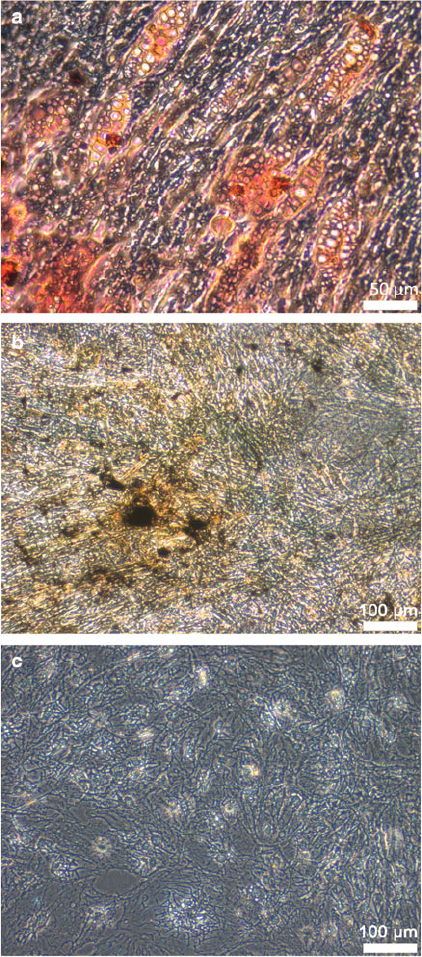
With the following lineage-specific determinants and the matching histological
and immunohistochemical assays, the differentiation was proven: Adipogenic differ-
entiation was defined by lipid accumulation (monitored with Oil Red-O stain),
osteogenic differentiation by alkaline phosphatase (AP) activity (AP-stain) and calci-
fied matrix production (Von Kossa stain), chondrogenic differentiation by sulfated
proteoglycan-rich matrix (Alcian Blue (pH 1.0) stain) and Collagen II synthesis
(Collagen II-specific monoclonal antibody), and myogenic differentiation by multi-
nucleation (phase contrast microscopy) and skeletal muscle myosin heavy-chain and
MyoD1 expression (Myosin- and MyoD1-specific monoclonal antibodies (Fig. 3).
One year later, the same working group published another study in which they
characterized ASC by flow cytometry analysis and made a comparison with BSC
[21]. Both populations expressed CD13, CD29, CD44, CD71, CD90, and CD105/
SH2 and SH3, which together with SH2 is considered a marker for MSCs [100]. In
addition, both ASC and BSC expressed STRO-1, a marker for multilineage pro-
genitors from bone marrow [101]. In contrast, no expression of the hematopoietic
lineage markers CD31, CD34, and CD45 as well as absence of CD14, CD16, CD56,
CD61, CD62E, and CD104 were observed in either of the cultures. Interestingly,
there was a difference between both stem cell lines for the expression of CD49d,
which was expressed by ASC but not BSC, and CD106 for which it was vice versa.
A recent study by McIntosh et al. investigated the temporal changes of marker
expression on ASC [102]. Hence, markers seem to underlie progression or depression
Isolation, Characterization, Differentiation, and Application of Adipose-Derived Stem Cells 65
by ongoing passaging, showing a passage-dependent decrease of CD11a, CD13,
CD45, CD86, and histocompatibility locus of antigen (H LA)-DR. Instead, CD40,
CD54, and HLA-ABC increased during passaging, while CD80 showed growing
expression until passage 1 and 2, and then decreased.
Fig. 3 Histologic staining of
differentiated ASC. (a)
Adipogenic lineage stained
with Oil Red-O staining. (b)
Osteogenic lineage stained with
Von Kossa staining. (c)
Chondrogenic lineage stained
with Alcian blue staining. For
(a) magnification 200, scale
bar represents 50 mm, for (b,c)
magnification 100, scale bar
represents 100 mm
66 J.W. Kuhbier et al.