
Kaynar D.K., Lynch N., Segala R., Vaandrage F. The Theory of Timed I-O Automata
Подождите немного. Документ загружается.


P1: IML/FFX P2: IML/FFX QC: IML/FFX T1: IML
MOBK015-04 MOBK015-Lynch.cls April 1, 2006 17:45
TIMED AUTOMATA 49
automaton A automaton B
signature signature
external a external a
states states
init: Bool := true, init: Bool := true,
now: Real := 0 now: Real := 0
transitions transitions
external a external a
pre pre
init ∧ rational(now) init ∧ integer(now)
eff eff
init := false init := false
trajectories trajectories
evolve evolve
d(now) = 1 d(now) > 0
FIGURE 4.10: The power of forward simulations
It is easy to check that the predicate
natural(B.now) ∧ A.init = B.init
determines a forward simulation from A to B. However, there does not exists a timed automaton
C with a history relation from A to C and a refinement from C to B. The proof is by contradiction:
suppose
C is such a timed automaton. Let x
0
be a start state of C, let F be a history relation from
A to C, and let R be a refinement from C to B. Then, by the start condition of a history relation,
the start state (0,
true)ofA is related to x
0
by F. By the start condition of a refinement, R maps
x
0
to the start state (0, true)ofB. Since in A there is a trajectory with limit time 1 from (0, true)
to (1,
true), the transfer property for F gives that in C there is a trajectory τ with limit time 1
from x
0
to some state x
1
that is related by F to (1, true). Next, the transfer property for R gives
that in
B there is a trajectory with limit time 1 from (0, true) to state R(x
1
) = (t, true), for
some t > 0. Since state (1,
true)inA enables an a-action, x
1
enables an execution fragment in
which an
a-action takes place within 0 time. Since x
1
is mapped by R to (t, true), it follows by
the transfer property for R that t in fact equals some natural number n > 0. By Axioms T1 and
T2, we can write τ as the concatenation τ
0
τ
1
···τ
n
of n + 1 trajectories that all have limit time
1/(n + 1). Using the fact that F is a history relation and the limit times of the trajectories τ
i
are rational, we may infer that the last state of each trajectory τ
i
enables an execution fragment
in which an
a-action takes place within 0 time. Using the fact that R is a refinement, we may
infer that there is a trajectory in
B from (0, true)to(n, true) on which there are at least n + 2
states (including the first and last state) in which an
a-action is enabled. This contradicts the

P1: IML/FFX P2: IML/FFX QC: IML/FFX T1: IML
MOBK015-04 MOBK015-Lynch.cls April 1, 2006 17:45
50 THEORY OF TIMED I/O AUTOMATA
fact that in B actions a are only enabled at integer times, which implies that there are only n + 1
such states on any trajectory from (0,
true)to(n, true).
4.5.5 Prophecy Relations
A relation R ⊆ Q
A
× Q
B
is a prophecy relation from A to B if R is a backward simulation from
A to B and R
−1
is a refinement from B to A. Prophecy relations induce a preorder between
timed automata.
An automaton B is obtained from an automaton A by adding prophecy variables if there
exists a set of variables X such that
1. X
B
= X
A
∪ X and X
A
∩ X =∅,
2. Q
B
X
A
⊆ Q
A
, and
3. relation {(x, y) | y ∈ Q
B
and y X
A
= x} is a prophecy relation from A to B.
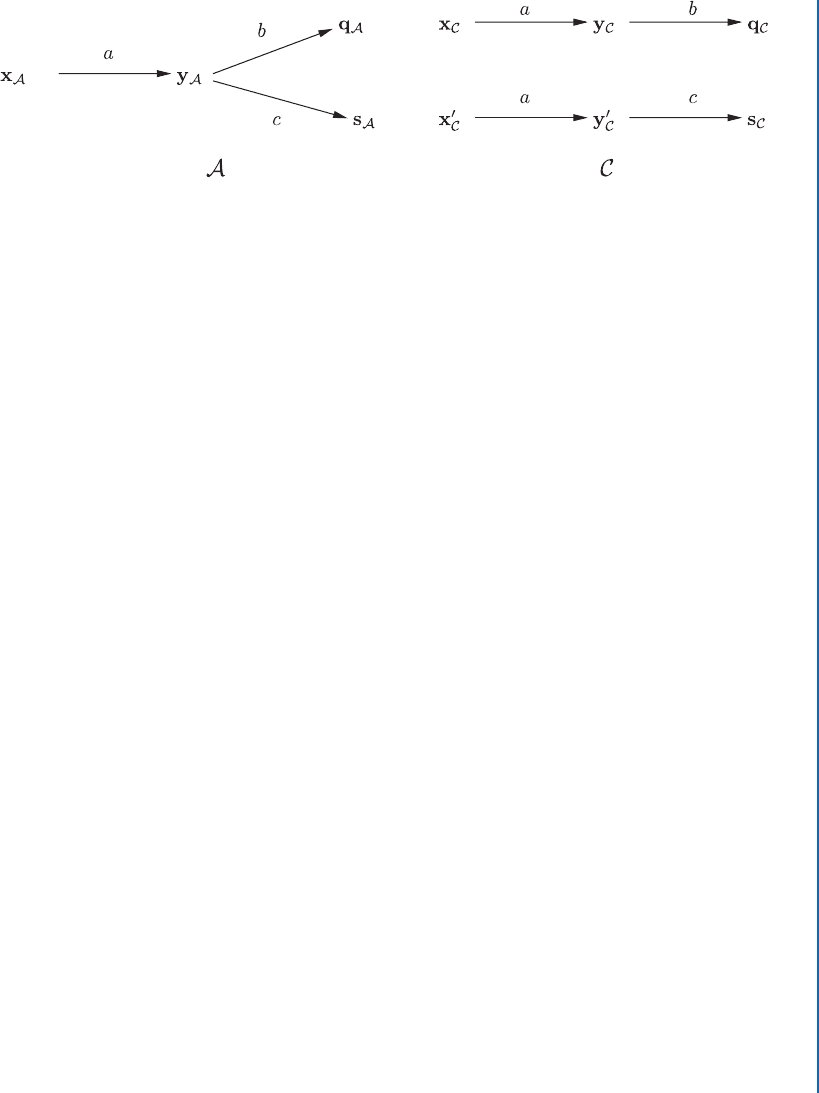
Example 4.38 (Adding prophecy variables to obtain a refinement). We consider adding a
prophecy variable to the automaton A from Example 4.34. Let C be the automaton defined as
follows:
•
X
C
= X
A
∪{v}, where v is a discrete variable with type(v) ={b, c }.
•
Q
C
={x
C
, x
C
, y
C
, y
C
, q
C
, s
C
} such that
x
C
X
A
= x
A
and x
C
(v) = b
x
C
X
A
= x
A
and x
C
(v) = c
y
C
X
A
= y
A
and y
C
(v) = b
y
C
X
A
= y
A
and y
C
(v) = c
q
C
X
A
= q
A
and q
C
(v) = b
s
C
X
A
= s
A
and s
C
(v) = c
•
C
={x
C
, x
C
}.
•
E
C
={a, b, c } and H
C
=∅.
•
D
C
={(x
C
, a, y
C
), (x
C
, a, y
C
), (y
C
, b, q
C
), (y
C
, c , s
C
)}.
•
T
C
={℘(v) | v ∈ Q
C
}.
Fig. 4.11 displays automata A and C as directed multipgraphs.
Relation R ={(x
A
, x
C
), (x
A
, x
C
), (y
A
, y
C
), (y
A
, y
C
), (q
A
, q
C
), (s
A
, s
C
)}is a backward sim-
ulation from A to C and R
−1
is a refinement. Therefore, C is obtained by adding a prophecy
variable to A. Note that there is no refinement from Ato B defined in Example 4.34. However,
relation F ={(x
C
, x
B
), (x
C
, x
B
), (y
C
, y
B
), (y
C
, y
B
), (q
C
, q
B
), (s
C
, s
B
)}is a refinement from C to B.
P1: IML/FFX P2: IML/FFX QC: IML/FFX T1: IML
MOBK015-04 MOBK015-Lynch.cls April 1, 2006 17:45
TIMED AUTOMATA 51
FIGURE 4.11: Prophecy variable
Theorem 4.39 Let Aand B be two comparable TAs such that V
A
and V
B
are disjoint. Suppose that
there is a prophecy relation from A to B. Then, there exists an automaton C that is isomorphic to B
and is obtained from Aby adding prophecy variables.
Proof: The proof is analogous to the proof of Theorem 4.36. We assume a backward simu-
lation relation R instead of a forward simulation relation. We construct the automaton C as in
Theorem 4.36 and verify that it is obtained from A by adding a prophecy variable.
P1: IML/FFX P2: IML/FFX QC: IML/FFX T1: IML
MOBK015-04 MOBK015-Lynch.cls April 1, 2006 17:45
52

P1: IML
MOBK015-05 MOBK015-Lynch.cls April 1, 2006 17:2
53
CHAPTER 5
Operations on Timed Automata
In this chapter we introduce three kinds of operations on timed automata: parallel composition,
hiding, and adding lower and upper bounds for tasks.
5.1 COMPOSITION
The composition operation for timed automata allows an automaton representing a complex
system to be constructed by composing automata representing individual system components.
Our composition operation identifies external actions with the same name in different compo-
nent automata. When any component automaton performs a discrete step involving an action
a, so do all component automata that have a as an external action. The composition operator
for timed automata is simpler than it is for general hybrid automata since all the variables in a
timed automaton are internal.
2
All the proofs of this section are as in [6], with simplifications
due to the absence of external variables.
5.1.1 Definitions and Basic Results
Formally, we say that timed automata A
1
and A
2
are compatible if H
1
∩ A
2
= H
2
∩ A
1
=∅
and X
1
∩ X
2
=∅.IfA
1
and A
2
are compatible, then their composition A
1
A
2
is defined to be
the structure A = (X, Q,,E, H, D, T ) where
•
X = X
1
∪ X
2
.
•
Q ={x ∈ val(X) | x X
i
∈ Q
i
, i ∈{1, 2}}.
•
={x ∈ Q | x X
i
∈
i
, i ∈{1, 2}}.
•
E = E
1
∪ E
2
and H = H
1
∪ H
2
.
•
For each x, x
∈ Q and each a ∈ A, x
a
→
A
x
iff for i ∈{1, 2}, either a ∈ A
i
and
x X
i
a
→
i
x
X
i
or a ∈ A
i
and x X
i
= x
X
i
.
•
T ⊆ trajs(Q) is given by τ ∈ T ⇔ τ ↓ X
i
∈ T
i
, i ∈{1, 2}.
2
The composition operation for general hybrid automata requires external variables to be identified as well as external
actions. When any component automaton follows a particular trajectory for an external variable v, then so do all
component automata of which v is an external variable.

P1: IML
MOBK015-05 MOBK015-Lynch.cls April 1, 2006 17:2
54 THEORY OF TIMED I/O AUTOMATA
Theorem 5.1 If A
1
and A
2
are timed automata, then A
1
A
2
is a timed automaton.
The following “projection lemma” says that execution fragments of a composition of timed
automata project to give executions fragments of the component automata. Moreover, certain
properties of the fragments of the composition imply, or are implied by, similar properties for
the component fragments.
Lemma 5.2 Let A = A
1
A
2
and let α be an execution fragment of A. Then α (A
1
, X
1
) and
α (A
2
, X
2
) are execution fragments of A
1
and A
2
, respectively. Furthermore,
1. α is time bounded iff both α (A
1
, X
1
) and α (A
2
, X
2
) are time bounded.
2. α is admissible iff both α (A
1
, X
1
) and α (A
2
, X
2
) are admissible.
3. α is closed iff both α (A
1
, X
1
) and α (A
2
, X
2
) are closed.
4. α is non-Zeno iff both α (A
1
, X
1
) and α (A
2
, X
2
) are non-Zeno.
5. α is an execution iff both α (A
1
, X
1
) and α (A
2
, X
2
) are executions.
The following lemma says that we obtain the same result for an execution fragment α of
a composition if we first extract the trace and then restrict to one of the components, or if we
first restrict to the component and then take the trace.
Lemma 5.3 Let A = A
1
A
2
and let α be an execution fragment of A. Then, for i = 1, 2,
trace(α) (E
i
, ∅) = trace(α (A
i
, X
i
)).
The following theorem is a fundamental result that relates the set of traces of a composed
automaton to the sets of traces of its components. Set inclusion in one direction expresses the
idea that a trace of a composition “projects” to yield traces of the components. Set inclusion in
the other direction expresses the idea that traces of components can be “pasted” to yield a trace
of the composition.
Theorem5.4 LetA = A
1
A
2
.Thentraces
A
isexactlythe set of (E, ∅)-sequenceswhoserestrictions
to A
1
and A
2
are traces of A
1
and A
2
, respectively.
That is,
traces
A
={β | β is an (E, ∅)-sequence and β (E
i
, ∅) ∈ traces
A
i
, i ∈{1, 2}}.
Notation: The compatibility conditions for composition require the set of internal variables
of each automaton to be disjoint from the set of internal variables of all the other automata in
the composition. We use a general scheme to disambiguate the internal variables of components
in order to avoid possible name clashes that can violate the compatibility conditions. If A is the
name of an automaton and v is an internal variable of A, then we refer to this variable as A.v
in the composite automaton. But if no confusion is possible, we write v rather than A.v.

P1: IML
MOBK015-05 MOBK015-Lynch.cls April 1, 2006 17:2
OPERATIONS ON TIMED AUTOMATA 55
Example 5.5 (Periodic sending process with timeouts). Let C be the composition of three
automata from Examples 4.1, 4.2, and 4.4:
C =
PeriodicSend(u1, M) TimedChannel(b, M) Timeout(u2, M)
where M ={m1,...,mn} and b + u1 < u2. In a setting where
b < u1, the following sequence
is a trace of C:
α =
u1 send(m1) b receive(m1) u1 − b send(m2) b receive(m2) u1 − b ···
where
t denotes the trace with as domain [0, t] and as range the set consisting of the function
with the empty domain. The following invariant states that C never performs a
timeout action.
Invariant 1: In any reachable state x of C, x(
suspected) = false.
In order to prove this invariant we can use auxiliary invariants for the component au-
tomata, such as the one established in Example 4.11, and an auxiliary global invariant such as
the one below, which establishes the fact that every message is delivered before the variable
Timeout.clock reaches the point at which a timeout action occurs.
Invariant 2: In any reachable state x of C,
1. if x(
queue) is not empty then there is a packet p such that
p ∈ x(queue) and p.deadline − x(now) < u2 − x(Timeout.clock).
2. if x(
queue) is empty then
u1 − x(PeriodicSend.clock) + b < u2 − x(Timeout.clock).
Example 5.6 (Periodic sending process with failures and timeouts). In this example, we
consider a composite automaton defined exactly like the one in Example 5.5 except that
the automaton
PeriodicSend(ul,M) is replaced with PeriodicSend(ul,M), the periodic
sending process with failures. Let C =
PeriodicSend2(ul,M) TimedChannel(b,M)
Timeout(u2,M). The following sequence is a trace of C:
u1 send(m1) b receive(m1) b fail u2 − b timeout ∞.
According to this sample trace, the first message sent by the periodic sending process is received
exactly
b time units after it is sent. The periodic sending process fails 2 × b time units after
sending its first message. The timeout process performs a
timeout since no second message
arrives within the next
u2 time units after the receipt of the first message.
The following invariant states that a
timeout performed by C can be used to conclude
that the sender process has failed. We again assume that
b+u1<u2.
P1: IML
MOBK015-05 MOBK015-Lynch.cls April 1, 2006 17:2
56 THEORY OF TIMED I/O AUTOMATA
Invariant 1: In any reachable state x of C,
x(
Timeout.suspected) ⇒ x(PeriodicSend2.failed).
The automaton C is guaranteed to perform a
timeout to signal the failure of a process,
within a specified amount of time after the occurrence of a fail event. The following is a formal
statement of this property.
Let α be an admissible execution of C in which a
fail event occurs. Let t be the point
in time at which the first
fail event occurs in α. Then a timeout event occurs in α in the
interval [
t+u2-u1, t+b+u2].
Example 5.7 (Clock synchronization). In this example we consider the composition of three
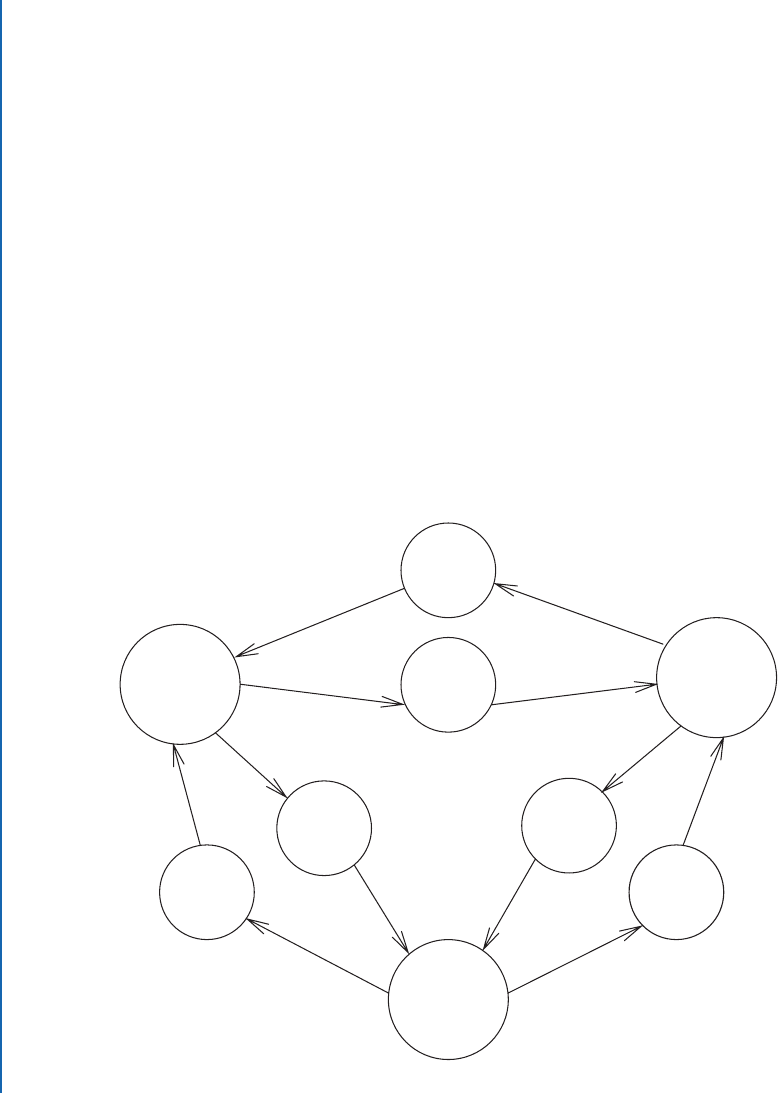
clock synchronization automata with six time-bounded channel automata. A graphical repre-
sentation of the composite automaton is given in Fig. 5.1. The abbreviation
CS
i
represents the
automaton
ClockSync from Example 4.6. The abbreviation TC
i, j
represents the automaton
TimedChannel from Example 4.1, the time-bounded channel with maximum delay b, but
with the
send(m) and receive(m) actions renamed to send(m,i) and receive(m,i,j),
CS
2
TC
1,3
TC
3,1
TC
2,3
CS
3
TC
3,2
CS
1
TC
1,2
TC
2,1
receive(m)
2,1
send(m)
2
send(m)
1
receive(m)
1,2
send(m)
1
send(m)
2
receive(m)
3,1
receive(m)
3,2
receive(m)
2,3
receive(m)
1,3
send(m)
3
send(m)
3
FIGURE 5.1: Clock synchronization network.

P1: IML
MOBK015-05 MOBK015-Lynch.cls April 1, 2006 17:2
OPERATIONS ON TIMED AUTOMATA 57
respectively, to enable communication of real-valued messages from ClockSync to ClockSync.
Let
C =
CS
1
CS
2
CS
3
TC
1,2
TC
2,1
TC
1,3
TC
3,1
TC
2,3
TC
3,2
.
A physical clock diverges from real time at the largest rate when it evolves with rate (
1+r)or
(
1-r). For example, if a physical clock evolves with rate 1+r, then at time t, its value is t
×
(1+r). Hence, the largest possible difference between a physical clock and the real time
is (t ×
r). This property is stated by the following invariant.
Invariant 1: In any reachable state x of C, at any time t ∈ T, for any i ∈{1, 2, 3},
|x(
CS
i
.physclock) − t|≤t ×r.
Two physical clocks in C diverge at the largest rate when one evolves with rate (
1+r)
and the other with (
1-r). It follows from Invariant 1 that at any time t the largest possible
difference between the physical clock values for two processes is 2 × t ×
r. This property is
formalized by the following invariant.
Invariant 2: In any reachable state x of C, at any time t ∈ T, for any i, j ∈{1, 2, 3},
|x(
CS
i
.physclock) − x(CS
j
.physclock)|≤2 × t ×r.
The following invariant states that in any reachable state there exists a process j such that
the logical clock of each process in the system is smaller than or equal to the physical clock of j.
Thisfollowsfrom thedefinition of alogical clock andthe factthat physical clocksalways increase.
Invariant3: In any reachablestate x of C, thereexists j ∈{1, 2, 3}suchthat for all i ∈{1, 2, 3},
x(
CS
i
.logclock) ≤ x(CS
j
.physclock).
The following invariant states that in any reachable state there exists a process j such that
the logical clock of each process in the system is larger than or equal to the physical clock of j.
This follows from the definition of a logical clock.
Invariant4: In any reachablestate x of C, thereexists j ∈{1, 2, 3}suchthat for all i ∈{1, 2, 3},
x(
CS
i
.logclock) ≥ x(CS
j
.physclock).
Invariants 3 and 4 together are called validity properties. They express the condition
that all the logical clocks remain in an envelope bounded by the maximum and minimum
physical clock values in the system. The following invariant formalizes the property that all the
logical clocks at a given time lie within the envelope formed by the largest and the smallest
physical clock values in the system. It follows from Invariants 1, 3, and 4 that any point in this
envelope can diverge from real time t by at most t ×
r time units.

P1: IML
MOBK015-05 MOBK015-Lynch.cls April 1, 2006 17:2
58 THEORY OF TIMED I/O AUTOMATA
Invariant 5: In any reachable state x of C, at any time t ∈ T, for any i ∈{1, 2, 3},
|x(
CS
i
.logclock) − t|≤t ×r.
Finally, we state a property about the agreement of logical clocks in C. It says that the
difference between two logical clocks is always bounded by a constant (which depends on the
message-sending interval and the bounds on clock drift and message delay).
Invariant 6: In any reachable state x of C, for all i, j ∈{1, 2, 3},
|x(
CS
i
.logclock) − x(CS
j
.logclock)|≤u + (b × (1 +r)).
To see why Invariant 6 holds, fix j to be a process with the largest physical clock in x,
and fix i to be any other process. Let v
j
, v
i
be the logical clock values of j and i respectively
in state x. Note that v
j
is also the physical clock value of j in x. By Invariant 3, we know that
v
i
≤ v
j
. To show Invariant 6, it suffices to show that v
j
− v
i
≤ u + (b × (1 + r)).
Let α be a finite execution that leads to state x. There are two cases to consider.
1. Some message sent by j arrives at i in α. Consider the last such message and let v
1
be the
value that it contains. Let v
2
be the newly adjusted logical clock value of i immediately
after the message arrives. We know that v
i
≥ v
2
≥ v
1
.
If j sends a later message to i in α, then it sends the next later message when
its physical clock has value v
1
+ u. By assumption, this message does not arrive at i.
Therefore, the real time that elapses after sending it must be at most
b. It follows that
the physical clock increase of j since sending this message is at most
b × (1 + r) and
so v
j
≤ v
1
+ u + b × (1 + r). On the other hand, if j does not send a later message
to i in α, then v
j
≤ v
1
+ u. In either case, we have v
j
≤ v
1
+ u + b × (1 + r). Since
v
i
≥ v
1
, we have v
j
− v
i
≤ u + b × (1 + r), as needed for Invariant 6.
2. No message sent by j arrives at i in α. Since the first send occurs at time 0 and
b
is the largest possible communication delay, the fact that i has not received the first
message sent by j at time 0 implies that t ≤
b. Since both clocks start at 0, we have
v
j
≤ b × (1 + r) and v
i
≥ 0. Therefore, v
j
− v
i
≤ u + b × (1 + r), which suffices for
Invariant 6.
5.1.2 Substitutivity Results
Theorem 5.4, which relates the set of traces of a composed automaton to the set of traces of
component automata, is fundamental for compositional reasoning. We now introduce another
important class of results, substitutivity results, that are useful for decomposing verification of
composite automata. These results are best understood by viewing one of the components of a
composition as the system and the other as the environment with which the system interacts.