
Kaynar D.K., Lynch N., Segala R., Vaandrage F. The Theory of Timed I-O Automata
Подождите немного. Документ загружается.


P1: IML/FFX P2: IML/FFX QC: IML/FFX T1: IML
MOBK015-04 MOBK015-Lynch.cls April 1, 2006 17:45
TIMED AUTOMATA 39
Clearly, β.fstate = x
B
. By Lemma 3.9, trace(β) = trace(α). Thus β has the required
properties.
2. α is a finite sequence ending with a closed trajectory. Similar to the first case.
3. α is a finite sequence ending with an open trajectory. Similar to the first case, using
Lemma 4.21.
The nextcorollary states that forward simulations constitute asound technique for proving
trace inclusion between timed automata.
Corollary 4.23 Let A and B be comparable TAs and let R be a forward simulation from A to B.
Then A ≤ B.
Proof: Suppose β ∈
traces
A
. Then β ∈ tracefrags
A
(x
A
) for some start state x
A
of A. Property
1 of the definition of simulation implies the existence of a start state x
B
of B such that x
A
R x
B
.
Then Theorem 4.22 implies that β ∈
tracefrags
B
(x
B
). Since x
B
is a start state of B, this implies
that β ∈
traces
B
, as needed.
Example 4.24 (Time-bounded channels). Consider two instances of the specification in
Fig. 4.1,
TimedChannel(b1, M) and TimedChannel(b2, M), where b1 ≤ b2. We define
a forward simulation R from
TimedChannel(b1, M) to TimedChannel(b2, M) below. If x
is a state of
TimedChannel(b1, M) and y is a state of TimedChannel(b2, M), then x R y
provided that the following conditions are satisfied:
1. x(
now) = y(now).
2. |x(
queue)|=|y(queue)|. We use |q| to denote the length of an object q of type queue.
3. ∀i. 1 ≤ i ≤|x(
queue)|,ifx(queue)(i) = [m,u1] then y(queue)(i) = [m,u2], for
some
u2 with u1 ≤ u2.
We can prove that R is a forward simulation from the automaton
TimedChannel(b1, M) to
the automaton
TimedChannel(b2, M) by showing that R satisfies each of the three properties
in the definition of a forward simulation relation. In each automaton there is a unique initial
state that maps the variable
now to 0 and queue to the empty sequence. It is obvious that the
initial states, which are identical, are related by R and so the first property is satisfied.
For the rest of the proof, we let x and y be, respectively, states of
TimedChannel(b1,
M)
and TimedChannel(b2, M) such that x R y. In order to show that the second property is
satisfied, we need to consider two cases, one for each discrete action that may be performed by
TimedChannel(b1, M).

P1: IML/FFX P2: IML/FFX QC: IML/FFX T1: IML
MOBK015-04 MOBK015-Lynch.cls April 1, 2006 17:45
40 THEORY OF TIMED I/O AUTOMATA
If TimedChannel(b1, M) performs a send(m) action and the state changes from x to
x
, then we need to find an execution fragment β of TimedChannel(b2,M) from y ending
in y
, such that x
R y
and trace(β) is the same as the trace of ℘(x) send(m) ℘(x
). The
execution fragment β = ℘(y)
send(m) ℘(y
) satisfies the required conditions. This follows
from the hypothesis that x R y and the definition of R, using the fact that the effect of a
send(m) action of TimedChannel(b1, M), TimedChannel(b2, M) are, respectively, adding
the entry
[m,now + b1] to x(queue), and [m,now + b2] to y(queue) where b1 ≤ b2.
If
TimedChannel(b1, M) performs a receive(m) action and the state changes from x
to x
, then we need to show that receive(m) is also enabled in y and that there is an execution
fragment with the required properties that ends in a state y
such that x
R y
. In order to
show that
receive(m) is enabled in y, we use the hypothesis that x R y, which implies that
the first element of y(
queue) is of the form [m,u] for some u. The execution fragment ℘(y)
receive(m) ℘(y
)ofTimedChannel(b1, M) can be shown to satisfy the required conditions.
For the third property, we consider a closed trajectory τ of
TimedChannel(b1, M)
with τ.fstate = x and show that there exists a closed execution fragment β of the automaton
TimedChannel(b2, M) with β.fstate = y, trace(β) = trace(τ ), and τ.lstate = β.lstate.Itis
easyto check that thetrajectory τ
ofTimedChannel(b2, M) with τ
.fstate = y and τ
.ltime =
τ.
ltime satisfies the required conditions.
Example 4.25 (Time-bounded channel that keeps all messages). In this example we define
a variant of
TimedChannel from Example 4.1 called TimedChannel2. The main difference
between
TimedChannel and TimedChannel2 is that the message queue in TimedChannel2 is
implemented using a finite sequence of (message, delivery deadline) pairs
queue and a pointer
ptr that points to the next element that is to be delivered. Hence, the internal variables of
TimedChannel2 consist of queue, now, and ptr. The variable ptr initially has value 1, which
indicates that it is pointing to the first element in the sequence. A
send(m) action causes
messages and deadlines to be added to the sequence as in
TimedChannel.Areceive(m)
causes ptr to be incremented to make it point to the next element in the sequence instead of
removing the first element. This stops when predicate tests if there is a packet in the queue with
index greater than or equal to
ptr and deadline equal to now. The automaton TimedChannel
can be viewed as an optimized implementation of TimedChannel2.
We define below a forward simulation R from
TimedChannel to TimedChannel2.Ifx
is a state of
TimedChannel and y is a state of TimedChannel2, then x R y provided that the
following conditions are satisfied:
1. x(
now) = y(now).
2. x(
queue) = y(queue)(y(ptr) ···|y(queue)|).

P1: IML/FFX P2: IML/FFX QC: IML/FFX T1: IML
MOBK015-04 MOBK015-Lynch.cls April 1, 2006 17:45
TIMED AUTOMATA 41
automaton SendVal(u,r: Real, i: Index) where u > 0 ∧ (0 ≤ r < 1)
signature
external send(m: Real),
receive(m:Real, j: Index, const i: Index) where j = i
states
counter: discrete Real := 0,
now: Real := 0,
transitions
external send(m,i)
pre
m = counter * u ∧ counter * u / (1 + r) ≤ now
eff
counter := counter + 1
external receive(m,j,i)
trajectories
stop when
now = counter * u / (1 - r)
evolve
d(now) = 1
FIGURE 4.8: Clock synchronization
Here, we assume the sequence representation of queues and use the subsequence notation from
Chapter 2 to denote the part of the queue that starts with the index
ptr and ends with the
index y(
queue).
Example 4.26 (Clock synchronization). In this example, we define a forward simulation from
ClockSync(u, r, i) of Fig. 4.7 to an automaton that sends multiples of u. The specification of
this automaton, which is called
SendVal(u, r, i) is given in Fig. 4.8. We assume that the Index
types in both automata are identical. The variable counter keeps track of which multiple of u
is to be sent next, and variable now contains the current time. The automaton parameter r is
used in the precondition of the
send and the stopping condition of the trajectory definition to
enforce bounds on the times of occurrence of
send.
The following predicate defines a forward simulation R from automaton
ClockSync
(
u, r, i) to automaton SendVal(u, r, i):
now ∗ (1 − r) ≤ physclock ≤ now ∗ (1 +r) ∧ counter ∗ u = nextsend ≥ physclock.
While automaton
ClockSync is more intuitive as a specification, automaton SendVal is easier
for analysis purposes, since its continuous dynamics is simpler.

P1: IML/FFX P2: IML/FFX QC: IML/FFX T1: IML
MOBK015-04 MOBK015-Lynch.cls April 1, 2006 17:45
42 THEORY OF TIMED I/O AUTOMATA
4.5.2 Refinements
A refinement is a simple, special case of a forward simulation, often used in practice (see for
instance [42,43]), in which the relation between states of A and B is a partial function.
Let A and B be comparable TAs. A refinement from A to B is a partial function F from
Q
A
to Q
B
, satisfying the following conditions, for all states x
A
and x
B
of A and B, respectively:
1. If x
A
∈
A
, then x
A
∈ dom(F) and F(x
A
) ∈
B
.
2. If α is an execution fragment of A consisting of one action surrounded by two point
trajectories and α.
fstate ∈ dom(F), then α.lstate ∈
dom(F) and B has a closed exe-
cution fragment β with β.
fstate = F(α.fstate), trace(β) = trace(α), and β.lstate =
F(α.
lstate).
3. If α is an execution fragment of A consisting of a single closed trajectory and
α.
fstate ∈ dom(F), then α.lstate ∈ dom(F) and B has a closed execution fragment β
with β.
fstate = F(α.fstate), trace(β) = trace(α), and β.lstate = F(α.lstate).
Note that, by a trivial inductive argument, the set of states for which F is defined contains all
the reachable states of A (and is thus an invariant of this automaton).
Theorem 4.27 Let Aand B be two TAs and suppose R ⊆ Q
A
× Q
B
. Then R is a refinement from
A to B iff R is a forward simulation from Ato B and R is a partial function.
The following theorem states a basic sanity property of refinements, namely closure under
composition.
Theorem 4.28 Let A, B, and C be comparable TAs. If R
1
is a refinement from A to B and R
2
is a
refinement from B to C, then R
2
◦ R
1
is a refinement from A to C.
A weak isomorphism from A to B is a refinement F from A to B such that F
−1
is a
refinement from B to A. We say that two automata A and B are weakly isomorphic, if there
exists an isomorphism from A to B (or, equivalently from B to A).
Example 4.29 (Refinements). In Example 4.24 we established a forward simulation between
two instances of the TA in Fig. 4.1,
TimedChannel(b1, M) and TimedChannel(b2, M) with
b1 ≤ b2. It is not hard see that there also exists a refinement from TimedChannel(b1, M) to
TimedChannel(b2, M): just add b2 − b1 to the deadline of each packet in the queue.
In Example 4.26 we defined a forward simulation from automaton
ClockSync to au-
tomaton
SendVal. In this case, however, there does not exist a refinement from ClockSync
to SendVal if r > 0. The proof is by contradiction. Suppose that F is a refinement from
ClockSync to SendVal. Then F maps the initial state of ClockSync to the initial state of

P1: IML/FFX P2: IML/FFX QC: IML/FFX T1: IML
MOBK015-04 MOBK015-Lynch.cls April 1, 2006 17:45
TIMED AUTOMATA 43
SendVal. Since send actions can be simulated, the state s0 of ClockSync with nextsend = u
and physclock = 0 is mapped by F to the state of SendVal with counter = 1 and now = 0.
Consider an outgoing trajectory of
s0 with positive limit time to a state s1 in which the physical
clock runs maximally fast, and a trajectory with the same limit time to a state
s2 in which the
physical clock runs maximally slow. Since
r > 0, s1 and s2 are distinct. By the transfer prop-
erty for trajectories, both
s1 and s2 are mapped onto the same state of SendVal. Now observe
that there exists a trajectory with positive limite time from
s2 to s1. This trajectory cannot be
simulated in
SendVal, since in this automaton there are no nontrivial trajectories from a state
to itself. Contradiction.
4.5.3 Backward Simulations
Let A and B be comparable TAs. A backward simulation from A to B is a total relation R⊆
Q
A
× Q
B
satisfying the following conditions, for all states x
A
and x
B
of Aand B, respectively:
1. If x
A
∈
A
and x
A
R x
B
, then x
B
∈
B
.
2. If x
A
R x
B
and α is an execution fragment of A with α.lstate = x
A
, consisting of one
discrete action surrounded by two point trajectories, then B has a closed execution
fragment β with β.
lstate = x
B
, trace(β) = trace(α), and α.fstate R β.fstate.
3. If x
A
R x
B
and α is an execution fragment of A with α.lstate = x
A
, consisting of one
trajectory, then B has a closed execution fragment β with β.
lstate = x
B
, trace(β) =
trace(α), and α.fstate R β.fstate.
Backward simulations are closed under relational composition, and hence induce a pre-
order between timed automata.
Theorem 4.30 Let A, B, and C be comparable TAs. If R
1
is a backward simulation from A to B
and R
2
is a backward simulation B to C, then R
2
◦ R
1
is a backward simulation from A to C.
Theorem 4.31 Let A and B be comparable TAs and let R be a backward simulation from A to B.
Let x
A
and x
B
be states of A and B, respectively, such that x
A
R x
B
. Let β be the trace of a closed
execution fragment of A from y
A
with last state x
A
. Then there exists y
B
such that β is also the trace
of a closed execution fragment of B from y
B
with last state x
B
and y
A
R y
B
.
Proof: Fix some R, x
A
, x
B
, and β satisfying the conditions in the statement of the theorem. Let
α ∈
frags
A
(y
A
) for some state y
A
of A with trace(α) = β and α.lstate = x
A
. By using Axioms
T1 and T2, we can write α as the concatenation of a sequence of closed execution fragments,
α = α
0
α
1
···α
n
, where each α
i
is either a closed trajectory or an action surrounded by two
point trajectories, α
i
.lstate = α
i+1
.fstate, for 0 ≤ i ≤ n − 1, and α
n
.lstate = x
A
.

P1: IML/FFX P2: IML/FFX QC: IML/FFX T1: IML
MOBK015-04 MOBK015-Lynch.cls April 1, 2006 17:45
44 THEORY OF TIMED I/O AUTOMATA
By using the definition of a backward simulation, working backwards from α
n
,wecan
construct an execution fragment α
= α
0
α
1
···α
n
from a state y
B
of B such that (a)
α
.lstate = x
B
, (b) for all i,0≤ i ≤ n, α
i
.fstate R α
i
.fstate and trace(α
i
) = trace(α
i
), and
(c) for all i,0≤ i ≤ n − 1, α
i
.lstate = α
i+1
.fstate. Using Lemma 4.7, we can see that α
is an
execution fragment of B. By Lemma 3.9,
trace(α) = trace(α
) as needed.
The next corollary states that backward simulations constitute a sound technique for
proving inclusion of closed traces between timed automata.
Corollary 4.32 Let A and B be comparable TAs and let R be a backward simulation from A to B.
Then every closed trace of A is a trace of B.
Proof: Suppose R is a backward simulation from A to B and β is a closed trace of A. Then
β =
trace(α) for some closed execution α of A.Letx
A
and y
A
be the first and last states of α,
respectively. By the totality of relation R, there exists some state y
B
of B such that y
A
R y
B
.By
Theorem 4.31, there exists x
B
of B such that β is the trace of a closed execution fragment of B
from x
B
with last state y
B
and x
A
R x
B
. Property 1 of the definition of a backward simulation
relation implies that x
B
is a start state of B. It follows that β ∈ traces
B
, as needed.
Image-finite backward simulations constitute a sound technique for proving inclusion of
(all) traces between timed automata.
Theorem 4.33 Let A and B be comparable TAs and let R be an image-finite backward simulation
from A to B. Then
traces
A
⊆ traces
B
.
Proof: Let β ∈
traces
A
.Ifβ is closed, then Corollary 4.32 implies that β is a trace of B.From
now on we assume β is not closed.
Let α ∈
execs
A
with trace(α) = β. Note that any such α is either an infinite sequence
τ
0
a
1
τ
1
··· or a finite sequence τ
0
a
1
τ
1
···τ
n
, where the final trajectory τ
n
is right open. In
either case, using Axioms T1 and T2, we can construct an infinite sequence α
0
α
1
··· of closed
execution fragments such that α = α
0
α
1
···, where α
0
is a point trajectory, each α
i
is either
a closed trajectory or an action surrounded by two point trajectories, and α
i
.lstate = α
i+1
.fstate
for each i,0≤ i.
We construct a directed graph G whose nodes are pairs (x, i) consisting of a state of B
and an index such that (α
i
.lstate, x) ∈R.InG, there is an edge from (x, i)to(x
, j) exactly if
j = i + 1 and there is an α
∈ frags
B
(x) with trace(α
) = trace(α
i+1
) such that α
.lstate = x
.
By image-finiteness of R and the definition of the edge set, each node has finite outdegree. By
using the definition of a backward simulation and the edge set of G, we can show that each node

P1: IML/FFX P2: IML/FFX QC: IML/FFX T1: IML
MOBK015-04 MOBK015-Lynch.cls April 1, 2006 17:45
TIMED AUTOMATA 45
(x, i) is reachable from some root node (z, 0) for some start state z of B. Since R is image-finite
there are finitely many roots of G.
The directed graph G satisfies the hypotheses of Lemma 2.3, which implies that there
is an infinite path in G starting from a root. An edge from a node (x, i)to(x
, i + 1) along
this infinite path corresponds to a closed execution fragment γ
i+1
of B for i,0≤ i, such
that γ
i+1
.fstate = x, γ
i+1
.lstate = x
and trace(γ
i+1
) = trace(α
i+1
). By Lemma 4.7, γ = γ
1
γ
2
··· is an execution of B and by Lemma 3.9, trace(γ ) = trace(γ
1
)
trace(γ
2
) ···. Since
trace(γ
i+1
) = trace(α
i+1
) for all i,0≤ i, and α
0
is a point trajectory, by Lemma 3.9, we get
trace(γ ) = trace(α) = β.
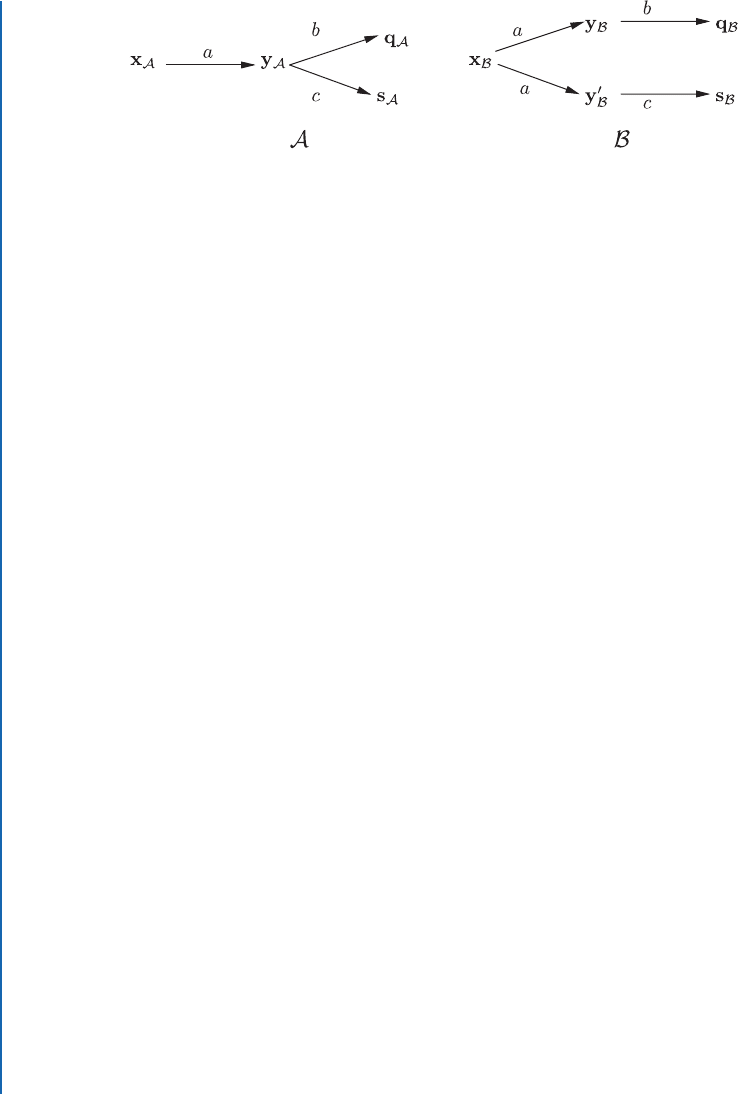
Example 4.34 (A backward simulation relation). This example illustrates the difference be-
tween forward and backward simulations. We consider two automata A and B and show that
a forward simulation from A to B does not exist while we exhibit a backward simulation from
A to B.
Let Aand B be two comparable automata specified below. The trajectories consist of a set
of point trajectories. This implies that the automaton does not allow time to pass—everything
happens at time 0.
•
X
A
={stateA} and X
B
={stateB}, where stateA is a discrete variable with
type(stateA) ={x
A
, y
A
, q
A
, s
A
}and stateB is a discrete variable with type(stateB) =
{x
B
, y
B
, y
B
, q
B
, s
B
}.
•
Q
A
= val(X
A
) and Q
B
= val(X
B
). We write x
A
for the valuation that maps stateA
to x
A
, y
A
for the valuation that maps
stateA to y
A
, etc. Similarly, we write x
B
for the
valuation that maps
stateB to x
B
, y
B
for the valuation that maps stateB to y
B
, etc.
•
A
={x
A
} and
B
={x
B
}.
•
E
A
= E
B
={a, b, c } and H
A
= H
B
=∅.
•
D
A
={(x
A
, a, y
A
), (y
A
, b, q
A
), (y
A
, c , s
A
)} and D
B
={(x
B
, a, y
B
), (x
B
, a, y
B
),
(y
B
, b, q
B
), (y
B
, c , s
B
)}.
•
T
A
={℘(v) | v ∈ Q
A
} and T
B
={℘(v) | v ∈ Q
B
}.
Fig. 4.9 displays automata A and B as directed multigraphs. The nodes in the graph represent
states and the edges represent discrete transitions where a label on an edge stands for the action
involved in the transition.
An obvious candidate for a forward simulation from A to B is the relation
R ={(x
A
, x
B
), (y
A
, y
B
), (y
A
, y
B
), (q
A
, q
B
), (s
A
, s
B
)}.
P1: IML/FFX P2: IML/FFX QC: IML/FFX T1: IML
MOBK015-04 MOBK015-Lynch.cls April 1, 2006 17:45
46 THEORY OF TIMED I/O AUTOMATA
FIGURE 4.9: Difference between forward and backward simulations
However, observe that even though y
A
and y
B
are related by R, the execution fragment
℘(y
A
) c ℘(s
A
)ofA cannot be matched by any execution fragment of B starting with state
y
B
. Similarly, even though y
A
and y
B
are related by R, the execution fragment ℘(y
A
) b ℘(q
A
)
of A cannot be matched by any execution fragment of B starting with y
B
. Therefore, R is not
a forward simulation. In fact, there is no forward simulation relation from A to B: there are
finitely many possibilities for forward simulations from Ato B and we see that none of them is
a forward simulation by examining all the possibilities. The main reason for this is that while
A makes the nondeterministic choice between performing b or c after performing a, B makes
its choice earlier at the same time it performs a.
There is, however, a backward simulation from A to B: the relation R defined above is a
backward simulation.
4.5.4 History Relations
A relation R ⊆ Q
A
× Q
B
is a history relation from A to B if R is a forward simulation from A
to B and R
−1
is a refinement from B to A. History relations induce a preorder between timed
automata.
An automaton B is obtained from an automaton A by adding history variables if there
exists a set of variables X such that
1. X
B
= X
A
∪ X and X
A
∩ X =∅,
2. Q
B
X
A
⊆ Q
A
, and
3. relation {(x, y) | y ∈ Q
B
and y X
A
= x} is a history relation from A to B.
The method of adding history variables is typically used to make it possible to establish an
implementation relationship using a refinement. If a refinement does not exist from a low-level
automaton to a high-level one, it can often be made to exist by adding history variables to the
low-level automaton.
Example 4.35 (Adding history variables to obtain a refinement). We cannot show that
TimedChannel is an implementation of TimedChannel2 from Example 4.25 by using a

P1: IML/FFX P2: IML/FFX QC: IML/FFX T1: IML
MOBK015-04 MOBK015-Lynch.cls April 1, 2006 17:45
TIMED AUTOMATA 47
refinement. This is because we have no way of specifying what the subsequence before the
pointer should be in
TimedChannel2 when relating the states of the two automata. This ex-
ample shows how we can add history variables to
TimedChannel (actually, we add just one
variable) to obtain a new automaton that is related to
TimedChannel2 by a refinement.
Let
log be a discrete variable whose static type is the same as the static type of queue
in TimedChannel and let the initial value of log be the empty sequence. We define a new
automaton
TimedChannelH whose set of variables consists of the variables of TimedChannel
and thevariable log. Therest of the definitionof TimedChannelH is the same asTimedChannel
except for the transition definition for receive(m).Areceive(m) event in TimedChannelH
not only removes the first message from the message queue but also appends this message to
the sequence contained in
log.
Let X
1
, X
2
be the set of variables and Q
1
, Q
2
be the set of states of TimedChannel
and TimedChannelH, respectively. It is easy to verify that the relation {(x, y) | y ∈
Q
2
and y X
1
= x} is a history relation from TimedChannel to TimedChannelH. This means
that
TimedChannelH is obtained from TimedChannel by adding a history variable.
We now define a refinement F from
TimedChannelH to TimedChannel2 as follows: In
our definition we assume the following conventions. Concatenation on the left corresponds to
putting anelement on the frontof a queue. Recall also that we usejuxtaposition for concatenation
of sequences. If x isa state of
TimedChannelH and y is a state of TimedChannel2, then F(x) = y
where
1. y(
now) = x(now).
2. y(
queue) = x(log)
x(queue).
3. y(
ptr) =|x(log)|+1.
Whenever an automaton B is obtained from A by adding history variables, then there
exists a history relation from A to B by definition. Theorem 4.36 states that the converse also
holds, if weakly isomorphic automata are considered.
Theorem 4.36 Let A and B be two comparable TAs. Suppose that there is a history relation from
A to B. Then, there exists a TA C that is weakly isomorphic to B and is obtained from A by adding
history variables.
Proof: Assume, without loss of generality, that X
A
and X
B
are disjoint. Let R be a history
relation from A to B. Define automaton C as follows:
•
X
C
= X
A
∪ X
B
.
•
Q
C
={x ∈ val(X
C
) | (x X
A
, x X
B
) ∈ R}.

P1: IML/FFX P2: IML/FFX QC: IML/FFX T1: IML
MOBK015-04 MOBK015-Lynch.cls April 1, 2006 17:45
48 THEORY OF TIMED I/O AUTOMATA
•
C
={x ∈ Q
C
| x X
B
∈
B
}.
•
E
C
= E
B
and H
C
= H
B
.
•
x
a
→
C
y iff x X
B
a
→
B
y X
B
.
•
T
C
={τ ∈ trajs(Q
C
) | τ X
B
∈ T
B
}.
Let F : Q
C
→ Q
B
be the projection function such that F(x) = x X
B
for all x ∈ Q
C
.
It is easy to check that F is a weak isomorphism from C to B. We verify that C is obtained
from A by adding history variables. Let X
B
be the variable set X required in the definition of
a history variable and let R
={(x, y) | y ∈ Q
C
∧ y X
A
= x}. We need to show that R
is a
history relation from A to C.
1. R
is a forward simulation from A to C. By definitions of the relations F, R
, and the
automaton C, R
= F
−1
◦ R. Since F
−1
is a refinement from B to C, by Theorem 4.27,
we know that it is a forward simulation from B to C. Since R is a forward simulation
from A to B, by Theorem 4.20 we have R
is a forward simulation from A to C,as
needed.
2. R
−1
is a refinement from C to A. We use that R
−1
= R
−1
◦ F. Since F is a refinement
from C to B and R
−1
is a refinement from B to A, by Theorem 4.28, we have R
−1
is
a refinement from C to A, as needed.
In the untimed case, forward simulations are essentially the same as history relations
(or variables) combined with refinements [44, Th. 5.8]. Clearly, since history relations and
refinements are both special cases of forward simulations, and forward simulations compose,
forward simulations are at least as powerful as arbitrary combinations of history relations and
refinements. Conversely, if there is a forward simulation from A to B, then there exists an
automaton C with a history relation from A to C and a refinement from C to B. In [9] a
corresponding result is claimed for timed automata (Theorem 7.8), but the proof turns out to
be flawed. Example 7.13 of [9] constitutes a counterexample to Theorem 7.8 of [9]. Below, we
have translated the example to conform to this chapter.
Example 4.37 (Forward simulations more powerful than combination history relations and
refinements). Consider the automata
A and B specified in Fig. 4.10. The two automaton
definitions are very similar. While in
A an a-action is enabled when init = true and the value
of
now is a rational number, in B an a-action is enabled when init = true and the value of
now is an integer. While automaton A has a perfect clock with rate 1, automaton B measures
time with a clock that may run either too slow or too fast, in an arbitrary fashion.