
Kenneth E. Gonsalves, Craig R. Halberstadt, Cato T. Laurencin, Lakshmi S. Nair. Biomedical Nanostructures
Подождите немного. Документ загружается.

Recently, polymer-based DGDSs with critical structural features at the
nanometer scale have attracted immense interest. Polymers are macromole-
cules composed of a large number of identical or similar repeating units
organized in a chain-like molecular architecture. They exhibit a wide diversity
of compo sitions, structures, and properties. Some characteristics of polymers,
such as biocompatibility, biodegradability, a broad range of mechanical
properties, and ease of processing, make them extensively useful in drug
delivery. Besides material, size is another determining factor for a DGDS. A
cell can be regarded as a combination of numerous nanomachines such as ion
channels and ribosomes, and a majority of drugs/genes fall into the nanometer
range in terms of molecular size. It is obvious that a DGDS with nanoscale-
sized features would have better potential to be more effective in interacting
with both the biological systems and the drugs/genes. Such a system therefore
would be more likely to achieve controlled drug/gene delivery. In this chapter,
three types of polymeric nanostructures for drug/gene delivery are described,
including particulate nanostructures or nanoparticles (NPs), nanopore
membranes, and fibrous nanostructures or nano fibers. Fabrication of these
polymeric nanostructures and their applications in drug/gene delivery will be
introduced first, followed by a brief discussion on the future trends in this
dynamic field.
6.2 NANOPARTICLES FOR DRUG/GENE DELIVERY
NPs have been widely studied for drug/gene delivery, and some products such
as Doxil
1
and Abraxane
1
, have reached clinics. A very important factor of
drug/gene delivery NPs is their nanometer size. In the following section, we will
first discuss why the size of NPs is critical in drug/gene delivery. Different types
of polymeric NPs will then be introduced. Because drug delivery polymeric
NPs are used in biological fluids and most of the NPs are produced in the
presence of water, the water solubility of polymers plays a major role in the
fabrication, structures, properties, and functions of the NPs. We therefore
classify NPs based on the water solubility of the polymers used. In some cases,
different types of polymers are used together to manufacture NPs. The polymer
that plays a major role in determining the preparation method and properties
of the NPs is taken as a standard for classification.
6.2.1 Why is Size Important for NPs in Drug/Gene Delivery?
Drugs are conventionally administered in the form of free, unassociated
molecules. This strategy is simple, but it is becoming increasingly limited in
many conditions, especially in those involv ing the use of highly cytotoxic
chemotherapeutics and environmentally sensitive biopharmaceutics. In recent
decades, particulate systems at the micrometer scale, or microparticles (MPs),
have been under active study for controlled drug/gene delivery. For example,
116 BIOMEDICAL NANOSTRUCTURES
porous MPs of 20 mm diameter were used for deep lung drug delivery via
inhalation [2] and particles larger than 40 mm for embolization therapy [3].
Between free drug molecules and MPs lie particles between 10 and 1000 nm in
size. This size range offers co nsiderable advantages over free drugs and MPs in
view of drug/gene protection, delivery of poorly soluble drugs, sustained
release, blood circulation time, organ/tissue/cell targeting, cellular uptake, and
barrier penetration. These benefits are discussed in the following sections.
6.2.1.1 Drug/Gene Protection For optimum therapeutic efficacy and
patient compliance, drug/gene release from NPs over a sustained period of
time is often desired. Many drugs, especially protein, peptide, and nucleic acid
based agents, however, are subject to rapid clearance and degradation in the
body. Protection of these drugs from degradation and unwanted interactions
is thus needed before they are released. Protection is also necessary for
targeted delivery through intravascular or oral routes because the drug/gene
must pass a series of biological and physiological barriers before reaching its
target.
6.2.1.2 Delivery of Poorly Soluble Drugs Many potent drugs are poorly
soluble in water, resulting in either low bioavailability or a need for a dosage
form causing significant adverse side effects. One such example is paclitaxel, a
widely used anticancer drug with very low water solubility. It is currently
delivered with Cremophor EL, a solvent associated with acute hypersensitivity
reactions. In addition, a large number of potent candidate drugs are discarded
during drug discovery process because of their low water solubility, resulting in
significant waste of efforts [4]. Polymeric NPs may represent a general and
simple solution to this problem.
6.2.1.3 Sustained Release Sustained drug release is desired in many
conditions to achieve optimized therapeutic outcomes and improved patient
compliance. An in vivo study on diabetic rats showed that subcutaneously
injected insulin-loaded polymeric NPs of 85185 nm exerted a much longer
hypoglycemic effect than free insulin [5]. In another study, intramuscularly
delivered 600 nm PLGA NPs loaded with plasmid DNA showed sustained
gene expression [6]. Although MPs may also offer sustained release, only NPs
can be used as circulation depot [7].
6.2.1.4 Extended Blood Circulation For intravenously administered
NPs, long circulation time is a prerequisite for targeted drug deliv ery and
sustained drug release in blood. The smallest capillaries set the upper limit for
the size of circulating rigid particles at approximately 5 mm. However, particles
at the micron scale are rapidly taken up by the reticuloendothelial system
(RES), while particles less than 200 nm in size with appropriate surface
properties have significantly low RES uptake and can circulate in blood for
considerably prolonged periods of time [7, 8].
POLYMERIC NANOPARTICLES AND NANOPORE MEMBRANES 117
6.2.1.5 Targeted Delivery Targeted delivery is one of the most pursued
goals in drug/gene therapy. NPs are capable of targeting at many different
levels, from organs, to tissues and cells, to even subcellular compartments.
Organ and tissue targeting can be achieved because vasculatures of differen t
organs and tissues have fenestrations of different sizes. For example, blood
vessels in the liver contain fenestration s of approximately 106175 nm [9].
These organs can thus be selectively targeted by controlling the size and surface
properties of the NPs. Many types of tumors are characterized by porous
blood vessels. The pore cutoff size is between 380 and 780 nm. Circulating NPs
between 100 and 300 nm would thus leak through the nanopores and
accumulate in the tumor because of the enhanced permeation and retention
(EPR) effect [10]. Moreover, by attaching ligands, NPs can actively target
virtually any type of accessible cells with identified cellular receptors.
6.2.1.6 Enhanced Cellular Uptake While phagocytic cells can take up
micron-sized particles more efficiently, nonphagocytic cellsthe targets of
most therapiespreferentially internalize particles at the nanometer scale. One
study showed that NPs of 100 nm were taken up at 2.5-fold and 6-fold greater
rates than 1 and 10 mm particles, respectively, in a Caco-2 cell line [11]. Similar
results have been observed with other cell lines [12]. A gene transfection study
also showed that DNA-loaded particles of less than 100 nm size had 27-fold
greater transfection than particles larger than 100 nm in a COS-7 cell line [13].
The size of the NPs affected the pathway of particle internalization as well [14],
implying that the intracellular fate of NPs can be controlled. This is
particularly important for drugs or genes that need to function in specific
cellular compartments.
6.2.1.7 Barrier Penetration The extremely smal l size of NPs facilitates
their penetration across various biological barriers for drug delivery. Oral
administration is generally the most preferred drug delivery method, but it is
not applicable to many drugs because of their susceptibility to degradation in
the GI tract and low permeability through the intestinal barrier. Polymeric NPs
can not only protect the encapsulated drugs from degradation and prolong the
residence time of drugs in the absorption site of the GI tract but also efficiently
penetrate the mucosal layer covering the intestinal lumen [15]. As a result,
increased bioavailabilities of drugs such as heparin, insulin, peptides, and
paclitaxel have been obtained [5, 16 18]. The blood/brain barrier (BBB) is
another formidable barrier for drug delivery. It is formed by tight junctions
between the capillary endothelial cells and protects the central nervous system
(CNS) from harmful agents in the blood. A large number of drugs are
precluded from entering the CNS. Overcoming the BBB is thus a major
challenge for treating many devastating brain diseases such as brain tumors.
Studies have shown that NPs could efficiently cross the BBB [19] and a recent
study concluded that NPs less than 100 nm in diameter crossed the BBB much
more efficiently than larger NPs [20].
118 BIOMEDICAL NANOSTRUCTURES
6.2.2 NPs Prepared from Water-Insoluble Polymers
NPs made of water-insoluble polymers can be prepared from either preformed
polymers or monomers. Poly(lactic acid) (PLA) and poly(lactic-co-glycolic
acid) (PLGA) are the most widely used hydrophobic polyme rs for this
application because they are biocompatible, biodegradable, and approved by
the US Food and Drug Administration (FDA) for internal use in humans. To
render NPs’ desired surface properties which are critical in determining their
interactions with biological systems and performance as drug/gene carriers,
amphiphilic copolymers are commonly incorporated into them. Poly(ethylene
glycol) (PE G), a hydrophilic polymer extensively used in drug delivery has been
coupled with various hydrophobic polymers to form amphiphilic block
copolymers, for example, PLA PEG and PLGAPEG. They are commonly
used for the preparation of PEG-coated NPs. NPs are also prepared from
many other hydrophobic polymers and their derivatives, such as polycapro-
lactone (PCL) and polyalkylcyanoacrylate (PACA). A number of methods
have been developed to fabricate NPs from these hydrophobic polymers, and
they are introduced in this section.
6.2.2.1 NPs Prepared by Precipitation of Polymers
Emulsion/Solvent Evaporation In this method, the polymer is dissolved in a
water-immiscible organic solvent like dichloromethane, chloroform, or ethyl
acetate. The drug is also dissolved or dispersed in the polymer solution. When this
solution is added to a large amount of aqueous solution and homogenized, small
droplets of the polymer solution form in the water, resulting in a system termed
oil-in-water emulsion. Surfactants such as poly(vinyl alcohol) (PVA) are
commonly used as emulsifying agents to stabilize the droplets. Solid polymeric
NPs form after the organic solvent evaporates. To encapsulate a water-soluble
drug, the drug is usually dissolved in water and emulsified in an oil phase, forming
a water-in-oil emulsion. This water-in-oil emulsion is then emulsified again in
water, forming a water-in-oil-in-water emulsion [21]. PEG-coated PLGA NPs of
200 nm size were prepared using this method to encapsulate protein and peptide
drugs [7]. The formation of a nanosized emulsion usually requires sonication or
high speed homogenization. In a modified emulsion/solvent evaporation method,
a semipolar water-miscible solvent such as acetone was added in the organic phase.
Pouring this organic phase into water resulted in the spontaneous formation of
nanosized droplets, probably caused by the decreased interfacial tension between
the organic and the aqueous phases and interfacial turbulence induced by the
rapid diffusion of acetone into water. PLGA NPs of 200300 nm size
incorporating 5-FU were produced using this method [22].
Solvent Displacement In contrast with the emulsion/solvent evaporation
method, a water-miscible solvent such as acetone or ethanol is used to dissolve
the polymer and the drug in this method. The drug needs to be insoluble or only
POLYMERIC NANOPARTICLES AND NANOPORE MEMBRANES 119
slightly soluble in water. By pouring the solution into an aqueous solution, rapid
diffusion of the organic solvent into the aqueous phase leads to the precipitation
of the polymer and the drug as NPs. A surfactant like poloxamer 188, a triblock
copolymer of poly(ethylene oxide)poly(propylene oxide)poly(ethylene
oxide), and soy lecithin may be used to facilitate the formation and stabilization
of NPs [23]. One example of applying this approach is the production of 100 nm
PLGA NPs incorporating a model drug of coumarin-6 [24]. To increase the
loading capacity for a lipophilic drug, an oil solvent for the drug can be included
in the organic phase. The resulting NPs have an oily core surrounded by a
polymer coat and are thus called nanocapsules. PLA nanocapsules of 180 nm
diameter containing halofantrine were prepared using this method [23].
Salting Out In this method, a solution of a polymer and a drug in a water-
miscible solvent, for example, acetone, is added to an aqueous phase
containing PVA and saturated salt such as magnesium chloride or magnesium
acetate [25]. Although acetone is miscible in water, an oil-in-water emulsion
forms under mechanical stirrin g because of the salting out of the organic
solvent induced by the salt. By adding pure water to the system, acetone
diffuses out of the oil phase into the aqueous phase and solid polymeric NPs
form. Using this method, drug-loaded PLA NPs ranging from 230 to 730 nm
were produced [25]. In another study, PLA and PLGA NPs with a mean size
below 200 nm were formed [26].
Supercritical Fluid CO
2
Technology Supercritical carbon dioxide (scCO
2
)is
attracting considerable interest for producing particulate drug delivery systems
because it is nontoxic, nonflammable, inexpensive, and biologically and
environmentally benign [27]. ScCO
2
has been used as a solvent to dissolve
drugs and polymers together. When such a solution is atomized through a
nozzle into a low pressure chamber, drug-loaded polymeric microparticles are
formed [28]. This technique is attractive because of the complete elimination of
organic solvents, but it is significantly limited by the low solubility of high
molecular weight polymers in scCO
2
. On the contrary, the low solubility of
scCO
2
for polymers can be utilized in another particle manufacturing method
called supercritical antisolvent precipitation (SAS). In SAS, a drug and
polymer solution in an organic solvent is atomized into scCO
2
. Rapid
extraction of the organic solvent into the scCO
2
phase leads to the precipitation
of drug-loaded polymeric NPs [29].
6.2.2.2 NPs Prepared by Polymerization of Monomers PACA NPs
are prepared using this method. PACA is a biodegradable polymer used as
tissue adhesive in surgery. Thus, this polymer attracts great interest for drug
delivery applications. To prepare PACA NPs, an alkylcyanoacrylic monomer
such as isobutylcyanoacrylate (IBCA) or isohexylcyanoacrylate (IHCA) is
added to an acidic aqueous solution to form an emulsion via vigorous
mechanical stirrin g. This is followed by polymerization. Surfactants such as
120 BIOMEDICAL NANOSTRUCTURES
Dextran 70 or polysorbates may be used as a colloidal stabilizer. The produced
NPs are approximately 70350 nm in size [5,20,30]. Many drugs have
been incorporated with PACA NPs. They can be added either during or after
the polymerization process. Encouraging results have been obtained with
PACA-NP-based drug delivery systems. Doxorubicin-loaded PACA NPs were
shown to be able to overcome cancer’s multidrug resistance (MDR), which is
responsible for a significant portion of the failure of chemotherapy [30,31].
Insulin-loaded PACA NPs also showed both a sustained hypoglycemic effect
when delivered via subcutaneous injection and enhanced absorption via oral
administration compared with free insulin [5]. When formulated with PACA
NPs, the antitumor effect of antisense oligonucleotides was also significantly
enhanced [32].
6.2.3 NPs Prepared from Water-Soluble Polymers
Like water-insoluble polymers, water-soluble polymers are also widely used to
prepare NPs for drug/gene delivery. These polymers are of either natural or
synthetic origin and include highly engineered copolymers. The water solubility
of polymers offers the potential to produce NPs in water without the need of
organic solvents, which are toxic and can denature labile macrobiomolecules such
as proteins. Many hydrophilic polymers are charged in water. They can interact
with ionic drugs, allowing controlled association and release of the drugs. Many
of these polymers also carry reactive groups, permitting the modification and
grafting of functional molecules. On the contrary, because of their water
solubility, the polymer chains need to be associated with one another to maintain
distinct NPs in water. Based on whether preformed polymers or monomers are
used as precursors and the fabrication methods, NPs prepared from water-
soluble polymers are divided into three groups: cross-linked preformed polymers,
self-assembled block copolymers, and polymerized monomers.
6.2.3.1 NPs Prepared by Cross-Linking of Polymers A variety of
hydrophilic polymers have been used to prepare drug/gene delivery NPs by
cross-linking of polymer chains. Production processes usually start with
dissolving the polymers in water and are followed by forming an intermediate
distinct phase via various approaches such as ionic gelation, emulsification,
solvent displacement, complex coacervation, or salt-induced desolvation. Cross-
linking is then carried out to form NPs. In some cases, the intermediate step is
skipped, and the polymers dissolved in water are cross-linked directly to generate
NPs. The cross-links can be either chemical bonds or physical interactions.
Chemical-bond-based cross-linking has been used to generate gelatin and
polyethylenimine (PEI) NPs for drug/gene delivery. Gelatin is a protein product
traditionally obtained by the partial hydrolysis of collagen. It is a ‘‘generally
regarded as safe (GRAS)’’ material and has a long history of safe use in
pharmaceuticals and food. Gelatin is a polyampholyte and is positively charged
at an acidic pH. To form NPs, the distinct phase is often formed in the first step
POLYMERIC NANOPARTICLES AND NANOPORE MEMBRANES 121
by water-in-oil emulsification, solvent displacement, complex coacervation, or
salt-induced desolvation. It is followed by the chemical cross-linking of gelatin
with various agents such as glutaraldehyde and glyoxal. Anticancer drugs such
as doxorubicin [33], paclitaxel [34], cytarabine [35], and methotrexate [36], and
ophthalmic drugs such as pilocarpine HCl and hydrocortisone [37] have been
incorporated into the gelatin NPs, and the biodistribution of the paclitaxel-
loaded NPs in the body has been studied [34]. Plasmid DNA was also
incorporated into gelatin NPs using this method [38, 39]. In one study, gene-
loaded gelatin and pegylated gelatin NPs with an average size of 200 nm were
delivered through both intravenous and intratumoral routes into mice, which
showed significant expression of the reporter gene [39]. Recently, gelatin NPs
conjugated with the antibody for targeting human T-cell leukemia cells and
primary T-lymphocytes have been produced, showing promise for using gelatin
NPs for delivering drugs and genes to specific cell types [40, 41]. PEI NPs were
produced by covalently cross-linking PEI with poly(ethylene oxide) (PEO) in a
water-in-oil emulsion system [42]. The formed NPs, called nanogels, had
diameters of 20220 nm and were slightly positively charged at pH 7 before the
drug was loaded [43]. The cationic nature of the nanogel was utilized to form
complexes with negatively charged drugs such as retinoic acid, indomethacin,
oligonucleotides, and nucleoside analogs [4245]. Ligands such as folate,
transferrin, or insulin have been conjugated to the nanogels to achieve
receptor-mediated delivery [44, 45]. Drug-loaded nanogel particles were found
to transport across polarized monolayers of human intestinal epithelial cells and
bovine brain microvessel endothelial cells through transcellular pathways. An
in vivo study also showed substantially enhanced brain accumulation of
oligonucleotides carried by nanogel compared with free oligonucleotides
following intravenous injection to mice [45]. These results indicate the potential
use of nanogels for delivering poorly soluble and high molecular weight drugs
through oral routes and across the BBB.
Since many water-soluble polymers are polyelectrolytes, ionic interaction is
widely used for cross-linking the polymers. Alginate NPs were prepared by
cross-linking anionic sodium alginate with cationic calcium ions and/or
polymers such as chitosan or poly-
L-lysine. In one study, alginate NPs
measuring approximately 235 nm in diameter and encapsulating several
antitubercular drugs were produced and administered to guinea pigs through
the pulmonary route [46]. They showed significantly higher bioavailabilities
and much longer efficacy than the orally administered free drugs. Plasmid
DNA and oligonucleotides were also encapsulated into alginate NPs by this
method [4749]. This method has also been applied to chitosan, an in-
expensive, biodegradable, biocomptatible, and bioadhesive polysaccharide
carrying a high density of posit ively charged primary amino groups in water at
an acidic pH. Calvo et al. produced chitosan NPs by using tripolyphosphate
anions as cross-linking agents [50]. These NPs had high loading capacity for
proteins like bovine serum albumin [51], tetanus toxoid, diptaheria toxoid [50,
52], and insulin [53, 54]. An immunosuppressant drug, cyclosporin A [55], and
122 BIOMEDICAL NANOSTRUCTURES
an anticancer drug, doxorubicin [56], have also been formulated into chitosan
NPs using this method. Encouraging results were obtaine d using these NPs in
nasal and ocular drug delivery [53, 55].
Plasmid DNA is a large polymer carrying a high density of negative charges
in water. It can act as both a therapeutic agent in gene delivery and a cross-
linking agent for polycations such as chitosan and PEI. Leong et al. prepared
DNAchitosan NPs by simply mixing DNA and chitosan solutions in the
presence of sodium sulfate [57]. The NPs formed spontaneously in water and
were generally 100300 nm in diameter with a narrow size distribution. Oral
administration of the chitosan NPs containing an allergen gene to mice showed
a substantial immunization effect compared with the treatment with naked
DNA [58]. In another study, chitosanDNA NPs were delivered to the livers
of rats through bile duct and portal vein infusions. A relatively high level of
gene expression was observed with low toxicity [59].
Perhaps, the most extensively and intensively investigated polymer for
nonviral gene delivery is PEI. PEI is highly positively charged at a neutral
pH. It therefore binds DNA in water, forming PEIDNA complexes. The
morphology of the complexes is highly dependent on the charge ratio of PEI
to DNA, which, in turn, is equivalent to the ratio of the nitrogen atoms of
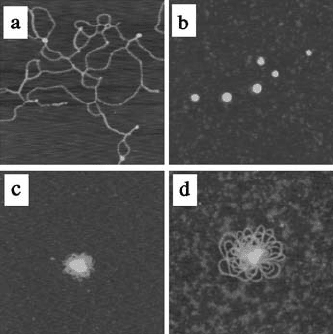
PEI to the phosphates of DNA (N/P ratio), as shown in F ig. 6.1. Compact
PEIDNA NPs called polyplexes form within an appropriate range of the
N/P ratio, generally from 3 to 20. These NPs are preferred for gene
transfection. Besides primary amines, PE I also has a large amount of
secondary and tertiary amines. Following the cellular uptake of the NPs via
FIGURE 6.1 Atomic force microscopy (ambient tapping mode) images of complexes
formed by branched 25 kDa PEI and l-DNA in water at N/P ratios of (a) 1:10, (b) 3:1,
(c) 30:1, and (d) 300:1. Highly compact PEIDNA NPs form at an N/P ratio of 3:1.
Scan areas = 1mm 1 mm.
POLYMERIC NANOPARTICLES AND NANOPORE MEMBRANES 123
endocytosis, theses amines can probably act as a ‘‘proton sponge,’’
eventually leading to the escape of the NPs from the endosomes and
subsequent lysosomal degradation [60, 61]. Besides the intrinsic capabilities
for DNA condensation and endosomal escape, PEI has been modified with
additional features for enhanced biocompatibility and transfection efficiency
[62, 63]. For in vivo gene delivery, PEG has been coupled with PEI to achieve
improved water solubility, reduced immunogenicity, and extended circula-
tion time. A number of ligands such as galactose [64], folate [65], tranferrin
[66], and antibody [67] have been conjugated to PEI to attain receptor-
mediated targeting. PEIDNA NPs have shown therapeutic promise in
many animal studies. Significant transgene expressions in the lung have been
observed following delivery of PEIDNA NPs via various routes, including
intravenous delivery [68], nasal instillation [69], intratracheal instillation [70],
and pulmonary delivery [71], indicating a great potential of PEIDNA NPs
for treating lung diseases such as cystic fibrosis. The expression of the
therapeutic bcl-2 gene in CNS neurons was also achieved by the peripheral
intramuscular injection of PEIDNA NPs [72]. In addition, the intravenous
delivery of transferrin-coated PEIDNA NPs into mice bearing tumors
resulted in preferential transgene expression in distant tumors as compared
with the major organs [73]. Tumor-preferential transgene expression was
also observed following the intraperitoneal injection of PEIDNA
complexes [74].
6.2.3.2 NPs Prepared by Self-Assembling of Block Copolymers
Block copolymers can form polymeric micelles with coreshell architecture by
self-assembly in water. Such copolymers must contain a hydrophilic segment
that forms the outer shell. PEG or PEO is the most commonly used polymer for
this purpose. When administered into the blood circulation, the outer shell
provides steric repulsion against adsorption of plasma proteins and avoids rapid
clearance by the RES. The other segment(s) of the copolymer must be able to
segregate in water as the solid core. It can be made from various types of
polymers, such as PLA, PLGA, PCL, poly(glutamic acid), PEI, and poly(benzyl
aspartate). The core formation can be driven and stabilized by different
interactions, including electrostatic attraction, hydrophobic interaction, chemi-
cal bonds, and polymermetal complexation [75]. The chemical composition,
molecular size, and block lengths of the copolymers can be changed easily,
allowing versatile manipulation of the structure and properties of polymeric
micelles. More importantly, ligands can be easily conjugated to the end of the
outer hydrophilic segment of the copolymers to provide an active targeting
capability [76].
Polymeric micelles are usually between 10 and 50 nm in diameter [77].
This size range is generally smaller than other drug delivery NPs. Because of
their small size, polymeric micelles are less likely to be recognized and taken
up by the RES compared with larger NPs. Moreover, they may be
124 BIOMEDICAL NANOSTRUCTURES
particularly suitable for passive targeting of tumors with a small vasculature
cutoff size [10]. Polymeric micelles also have a narrow size distribution,
which is desirable for controlling their distribution and drug release rate in
the body. Drug molecules are entrapped in the core of the micelles and are
protected from hydrolytic and enzymatic degradation. A wide variety of
drugs with diverse characteristics have been formulated with polymeric
micelles and tested in vitro and in vivo. Enhanced antitumor activity was
observed with different anticancer drugs, including doxorubicin [76],
cisplatin [75], paclitaxel [78], and camptothecin [79]. Polymeric micelles
were also found to be able to cross the intestinal barrier and release poorly
soluble drugs over a sustained period of time [80]. In addition encouraging
results have been obtained when polymeric micelles were used to deliver
oligonucleotides [81].
6.2.3.3 NPs Prepared by Polymerization of Monomers Peppas et al.
developed a free-radical precipitation/dispersion method to synthesize
hydrogel NPs of cross-linked methacrylic acid (MAA) grafted with PEG.
Since poly(methacrylic acid) and poly(acrylic acid) are pH-sensitive
polymers, the produced poly(MAA-g-PEG) and poly(AA-g-PEG) NPs
exhibited a considerable change in size, upon a change in pH ranging in
diameter from 200 nm (pH 2.0) to 2 mm (pH 6.0) [82, 83]. The poly(MAA-
g-PEG) hydrogel NPs were tested for oral delivery of insulin. Insulin was
loaded into the NPs by expanding the polymer network at a high pH.
While in the stomach, which is characterized by a low pH because of the
gastric acid, the NPs shrank and the insulin was physically entrapped and
protected from the acid. As the NPs entered the intestinethe major site
for drug and nutrient absorptionthe pH increased up to 8.0. As a result,
the NPs swelled and insulin was released. A significant reduction of serum
glucose compared with that of control animals was observed after the
insulin-loaded poly (MAA-g-PEG) hydrogel NPs were delivered orally to
diabetic rats [83].
6.3 NANOPORE MEMBRANES FOR DRUG DELIVERY
6.3.1 Overview of Nanopore-Based Devices
for Sustained Drug Delivery
Depot systems for sustained drug delivery have gained interest in recent
years. Polymer-based formulations such as Lupron Depot
1
and Gliadel
1
Wafer are in clinical use for cancer treatment. Many other technologies are
currently under development. Notable examples are chip-based devices
containing well-defined reservoirs for the controlled release of multiple drugs
[84, 85]. Another promising technique for this application is nanopore-
mediated drug release. Silicon-based membranes containing arrays of
POLYMERIC NANOPARTICLES AND NANOPORE MEMBRANES 125