
Kenneth E. Gonsalves, Craig R. Halberstadt, Cato T. Laurencin, Lakshmi S. Nair. Biomedical Nanostructures
Подождите немного. Документ загружается.

biodegradability, biocompatibility, and easy processability offered by many
polymers, a variety of polymers in the form of nanofibers have been widely
investigated for drug delivery applications [96]. Hence, the present discussion
focuses on the methods of synthesis, and drug and gene delivery applications of
polymeric nanofibers.
7.4.1 Fabrication
Nanofibers can be fabricated by a variety of methods such as drawing [97, 98],
template synthesis [99102], self-assembly [103107], phase separat ion [108],
and electrospinning [109112]. Of these methods, electrospinning has been
found to be the most suitable method for the synthesis of nanofibers to be used
in drug delivery applications. Therefore, in this section, the discussion on
synthesis is limited to electrospinning. However, for an elaborate discussion on
other techniques, the reader is directed to some excellent reviews [96, 113, 114].
Electrospinning is relatively versatile, straightforward, cost-effective, and fast
technique [110]. Depending on the bioactive agent to be encapsulated (small
drug molecules or macromolecules like proteins and nucleic acids), suitable
polymers from a variety of synthetic and natural polymers can be chosen to
synthesize nanofibers by electrospinning [109]. Moreover, it seems to be the
only method, which can be further developed for large-scale production of
nanofibers for industrial applications [113]. The above advantages offered by
electrospinning make it a very attractive technique for the synthesis of
nanofibers for drug delivery applications.
7.4.1.1 Electrospinning An electrospinning system comprises a polymer
solution, contained in a syringe with a connected needle [109]. The polymer
solution is usually provided a charge using a high voltage power source. The
positive output of the power supply unit is connected to the needle of syringe
containing the polymer solution, whereas the negative output is connected to a
grounded plate [109]. In the process, a high voltage electric field is applied to the
tip of the needle connected to the syringe containing the polymer solution.
During this process, the polymer droplet gets charged and mutual charge
repulsion within the droplet gives rise to a force that opposes the surface tension
at the tip of the needle. At a critical voltage, the droplet elongates to form a cone
at the tip of the needle known as the ‘‘Taylor cone’’ [110]. When the applied
voltage exceeds a critical voltage, the electrical force within the liquid overcomes
the surface tension and a fine jet of polymer emerges from the cone. The charged
polymer jet is directed to the grounded collector. It has been reported that the
path taken by the jet to the grounded electrode is not straight, but undergoes
whipping motion/bending instabilities resulting in a progressive decrease in the
diameter of the jet [109]. As the jet travels in air, the solvent evaporates, resulting
in formation of polymer fibers, which are collected as a nonwoven fiber mesh on
the grounded collector. The viscosity of the polymer solution/melt plays a very
crucial role in producing nanofibers from the emerging jet [112]. In case of
146 BIOMEDICAL NANOSTRUCTURES
solutions with low viscosity, the jet breaks into droplets and the process is called
electrospraying [115]. Polymer solutions with higher viscosity and long-chain
molecules are required to obtain continuous fibers [113]. The parameters that
affect electrospinning can be classified into three categories: (i) solution
parameters such as viscosity, conductivity/polarity, and surface tension,
(ii) process parameters such as applied electric voltage, tip-to-collector distance,
diameter of the needle tip, feed rate, and the hydrostatic pressure applied to the
polymer solution, and (iii) ambient parameters such as temperature, air velocity,
and humidity of the electrospinning chamber [116].
A more detailed understanding of the electrospinning process and the
influence of different fabrication parameters on the properties of polymeric
nanofibers can be found in the reports by Frenot and Chronakis [109], Zong
et al. [116], and Huang et al. [117].
7.4.1.2 Applications of Nanofibers Polymeric nanofibers have been
used in a wide variety of applications, inc luding industrial air filtration [118],
protective clothing with a desired pore size [119], biomedical and pharma-
ceutical applications such as tissue engineering [96], and drug and gene
delivery [98, 111]. The potential medical application of nonwoven polymeric
nanofibers in the area of tissue engineering is to act as a scaffold for cells to
attach and organize into tissue. The ideal tissue engineering scaffold should
mimic the extracellular matrix, the natural abode of cells. The structure and
morphology of nonwoven nanofibers can be manipulated to match the
components of the extracellular matrix of natural tissues [96]. Previous studies
have demonstrated that cells seeded on biodegradable polymeric nanofibers,
when supplied with suitable nutrients and growth factors, can attach,
proliferate, and maintain their phenotypic expression [120]. Electrospun
nanofibrous scaffolds can also be used as carriers for hydrophilic and
hydrophobic drugs and large molecules like DNA and proteins, and the
release profile can be finely controlled by the modulation of the scaffold’s
morphology, porosity, and composition [113]. Due to their small diameter,
nanofibers have a very high surface area to volume ratio. An advantage of the
delivery of bioactive agents via polymer nanofibers is that the dissolution rate
of the agent increases with increasing surface area of the corresponding carrier
[117]. The large surface area also makes nanofibers amenable to surface
functionalization with cell-specific ligands and antibodies. Thus, nanofibers
with the encapsulated bioactive agent can be used for active targeting to
specific cells and tissues for therapeutic applications [121]. In this section, the
applications of polymeric nanofibrous matrices as delivery vehicles for
bioactive agents are divided into two parts (low molecular weight drugs and
macromolecules) based on the class of the therapeutic agent used.
Drug Delivery from Nanofiber s Polymeric nanofibers have been widely
reported for their use in the delivery of smal l drug molecules. The variety of
advantages offered by electrospun nanofibers as discussed in the previous
DEVELOPMENT OF NANOSTRUCTURES FOR DRUG DELIVERY APPLICATIONS 147
sections have been exploited in a number to studies to investigate the
application of nanofibers as drug carriers.
Kenawy et al. [122] reported electrospun nanofibers (as drug delivery
vehicles) made from PLA and poly(ethylene-co-vinyl acetate) (PEVA). In these
studies, the antibiotic tetracycline hydrochloride was used as a model drug. It
was found that electrospun PEVA showed a higher drug release rate in Tris
buffer than the fibers derived from 50/50 PLA/PEVA or pure PLA. This is due
to the partial crystallinity of PLA, which limits the diffusion of the drug from
the fibers. Similarly, Zeng et al. [123] studied the preparation of PLA
nanofibers containing antituberculosis drug rifampin. The effect of ionic and
nonionic surfactants on the properties of nanofibers and drug release kinetics
in Tris buffer were investigated. The drug was perfectly included in the fibe rs
and no burst release of the drug was observed. The release was attributed
mainly to PLA degradation in the medium containing proteinase K, which
degrades PLA, and not to the diffusion or permeation of drug through PLA
carrier. Zong et al. [114] reported the formation of PLA nanofiber meshes
containing a hydrophilic antibiotic, mefoxin, which is commonly used for the
prevention of infections after surgery. The drug was completely released from
the matrix wi thin 48 h, with a burst release in the first 3 h. In a similar study,
Kim et al. [122] prepared nanofibrous scaffolds made of PLGA containing
mefoxin. Due to limited physical interactions between mefoxin and PLGA
matrix, the majority of the drug localized on the surface of the nanofibers.
Hence, the drug molecules on the fiber surfa ce were easily washed away in
aqueous solutions, resulting in a large initial burst and minimum sustained
release for prolonged time. In order to achieve sustained drug release,
amphiphilic PEG-b-PLA block copolymer was added to the existing
drugpolymer solution. In this case, some drug molecules were encapsulated
within the hydrophilic block of PEG-b-PLA and the initial burst release was
reduced. The functionality of the released drug was investigated using
Staphylococcus aureus bacteria inhibition. The antibiotic released from these
electrospun scaffolds was effective inhibiting bacterial growth. The influence of
fiber diameter and the initial drug loading on the release profiles of drug-loaded
electrospun PLA nanofibers was studied by Cui et al. [123]. Paracetamol, an
analgetic drug, was chosen as a model drug. The results demonstrated that the
release profiles of the electrospun meshes were biphasic, with an initial burst
release followed by a constant release of the drug. The pores formed after the
diffusion of drug molecules from the outer layer led to the subsequent constant
release of the drug from the inner part. It was found that the initial burst
release increased with the amount of drug loaded in the fibers. In case of fibers
with lower drug entrapment, the lower porosity of fibers created by initial
diffusion of the drug led to slower release in late r stages. This study
demonstrated the ability to modulate the kinetics of drug release from
electrospun fiber for their applications as drug delivery systems. In yet another
study, Katti et al. [124] reported the encapsulation of a broad-spectrum
antibiotic, cefazolin, in PLGA nanofibers. They investigated the influence of
148 BIOMEDICAL NANOSTRUCTURES
electrospinning fabrication parameters on the morphology and diameter of
drug-loaded nanofibers. The study demonstrated the feasibil ity of incorporat-
ing different concentrations of cefazolin in PLGA nanofibrous matrices.
Verreck et al. [125] studied the formation of electrospun nanofibers made of
polyurethane in which water-insoluble drugs were incorporated in an
amorphous state. Itraconazole and ke tanserin were chosen as the model
drugs. The effect of drug/polymer ratio and polymer concentration on fiber
morphology was investigated. Fiber diameter decreased with increasing drug/
polymer ratio and decreasing polymer concentration. Itraconazole was released
without an initial burst. The release time for higher drug loading was greater
and the mechanism of drug release was diffusion from the polymer matrix.
Ketanserin release showed a biphasic profi le with a faster initial release rate
compared to itraconazole. The differences in the rate of release between the
two drugs were due to different solubility and diffusivity of drugs in the
polymer. Rosen et al. [126] studied the formation of bioerodible nanofibrous
matrices made from poly[bis(carboxyphenoxy)methane] (PCPM) by phase
separation with a steroid as model drug. The drug release was characterized by
an initial induction period where no erosion occurred and was follo wed by a
near linear drug release. It was found that PCPM completely degraded into its
monomer under physiological conditions and the drug was released at the rates
useful for therapeutic applications. The study suggested the use of PCPM as a
prototype polyanhydride for use in bioerodible drug delivery systems. In
another study, Taep aiboon et al. [127] synthesized drug-loaded PVA
nanofibrous matrices by electrospinning. Four model drugs with different
degrees of solubility in the polymer were used in this study. The properties
of the drug influ enced both the morphology of the nanofibers and release
kinetics of encapsulated drugs from the nanofibers. The results demonstrated
that the release rate and the amount of drug released were mainly governed by
the molecular weight of the drugs, with both parameters (release rate and the
amount of drug released) decreasing with increasing molecular weight.
In a novel method reported by Huang et al. [128], PCL nanofibers
containing drugs were synthesized using a coaxial/coreshell electrospinning
process [129], wherein the core consisted of a drug solution and the shell
consisted of a polymer solution. Resverat rol (an antioxidant) and gentamicin
sulfate (an antibiotic) were used as model drugs. The morphology of the
electrospun fibers was influenced by the concentration of the encapsulated drug
and its interaction with the polymer. The results demonstrated that the drug
release from the fibers was smooth with no burst release, indicating a perfect
inclusion of dru gs inside the fibrous matrix. The release kinetics mainly
depended on the degradation of the PCL carrier and not on the diffusion of the
drug through the carrier. Therefore, this study demonstrated the feasibility of
synthesizing coreshell-type nanofibers using the electrospinning technique
and the possibility of using the same for drug delivery applications.
In a recent study by Jiang et al. [130], polyethylene glycol-grafted chitosan
(PEG-g-CS) and PLGA were electrospun to form nanofibrous scaffolds and
DEVELOPMENT OF NANOSTRUCTURES FOR DRUG DELIVERY APPLICATIONS 149
their potential as drug delivery carrier was investigated. Ibuprofen was used as
a model drug and the effect of interaction between the drug and the polymer on
the drug release was studied. The drug was loaded by two methods, co valent
conjugation to PEG-g-CS component or by the electrostatic interaction
between the charged carboxylic acid group of ibuprofen and amino groups of
chitosan. Drug-loaded PLGA fibers showed burst release, whereas the (PEG-g-
CS)/PLGA nanofibers containing drug showed a slower and sustained release.
The reason for this observation was attributed to the electrostatic or covalent
interaction between the drug and the polymer in (PEG-g-CS)/PLGA
nanofibers, which limited the diffusion of the drug from the matrix.
Macromolecular Delivery from Nanofibers The high surface area and high
permeability with interconnected pores make nanofibers promising candidates
to provide local and sustained delivery of macromolecules like proteins,
enzymes, growth factors, and DNA. In the construction of nanofibrous
matrices as macromolecule carriers, properties such as structural stability and
biochemical activity of the bioactive agent need to be engineered into the
design. Nanofibrous meshes designed as scaffolds for drug delivery should be
able to offer site-specific delivery of bioactive macromolecules in a controllable
and sustainable manner [119]. Additionally, the scaffold should be able to
protect the active agent from the biological system until it is released. Various
studies have shown the possibility of several polymers to be processed
into nanofibrous scaffolds for macromolecular delivery using electrospinning
[131138]. The retention of the bioactivity of released agents and their cell
transfection capability has been confirmed by these studies. Some of these have
been discussed in this section.
In a study conducted by Luu et al. [131], nanofibrous matrix composed of
PLGA and PLAPEGPLA triblock copolymer were evaluated for DNA
encapsulation. The results of their study demonstrated that an increase in the
concentration of the amphiphilic copolymer lead to an increase in the thickness
of the nanofibers, and as a consequence, slower release of DNA. The structural
integrity of the DNA encapsulated was found to be intact after the
electrospinning. The transfection efficiency of released DNA was accessed
using preosteoblastic cells. Their results indicated that pCMVb plasmid
released from the fibers was taken up by the cells, and subsequently, the b-gal
gene was successfully expressed and translated into protein b-galactosidase by
the cells. In a similar study by Liang et al. [132], pCMVb plasmid DNA was
formulated in a coreshell structure. The DNA was condensed in dimethyl-
formamide, with subsequent encapsulation of the condensed DNA globule in
PLAPEGPLA triblock copolymer and PLGA was used in the shell. The
mixture of encapsulated DNA and PLGA was electrospun to form a
nanofibrous scaffold. The polylactide shell protected the encapsulated DNA
from degradation during electrospinning. The bioactive plasmid DNA was
found to exhibit a controlled release rate and could transfect preosteoblastic
cells in vitro .
150 BIOMEDICAL NANOSTRUCTURES
In a recent study, Zeng et al. [133] investigated the release kinetics of a
model protein from nanofibrous scaffolds made of PVA (containing bovine
serum albumin (BSA)). A hydrophobic coat of poly(p-xylene) (PPX) was
applied to the electrospun fibers to control the protein release rate from the
fibers. The authors observed that PPX-coated na nofibers exhibited a
significantly retarded release of BSA, depending on the coating thickness of
PPX, in contrast to the burst release of BSA from uncoated PVA nanofibers. In
the same study, luciferase was used as a model enzyme to assess the activity of
enzymes after their release from the fibers. Continuous release of the enzyme
from nanofibers was observed and its structure was found to be intact as
determined by gel electrophoresis. In another study, Jiang et al. [134] reported
coreshell nanofibers made of PCL as the shell and PEG as the core
containing BSA and lysozyme for their application in protein delivery. The
fibers were synthesized by coaxial electrospinning in which the two polymers
were simultaneously spun to form the coaxial fibers. The size of the core and
shell and the protein release rate were controlled by the feed rate of the
solution. The electrospinning process did not affect the structure and stability
of the proteins. In a similar study by the same group [135], nanofibrous meshes
of dextran were evaluated for macromolecular deliv ery. Uniform nanofibers of
dextran were formed with the use of various solvents like water, dimethylsulf-
oxide, and dimethylformamide, and appropriate process conditions. The
structure and activity of the bioactive agents used (BSA and lysozyme) were
retained postelectrospinning. Thus, the results of the above studies demon-
strated the potential of encapsulating water-soluble macromolecules in
nanofibrous matrices for macromolecular delivery applications.
Proteins such as growth factors are often the most important biochemical
signals for tissue engineering applications. Growth factors are important for
controlling cellular activities of growth and proliferation and stimulating tissue
formation. They can be delivered directly in their original form, or their
expression can be induced through gene delivery. Growth factors often have
short half-lives an d are rapidly degraded or cleared, thereby minimizing their
biological effect [136]. Numerous studies have investigated the feasibility of
developing nanofibrous scaffolds loaded with growth factors and the results
have demonstrated their potential as delivery vehicles with retained bioactivity
of the agent [137149]. In one of the studies aimed to assess the potential of
delivering growth factors for therapeutic a pplications in nervous syst em, a
copolymer of caprolactone and ethyl ethylene phosphate (PCLEEP) was
electrospun to obtain fibrous scaffolds [137]. Human nerve growth factor
(NGF) was encapsulated in the fiber and its sustained release via diffusion was
observed for 3 months. Their results demonstrated that NGF relea sed
stimulated the growth of neurons in vitro. Therefore, such a sustained release
system for NGF would be useful, as NGF is known to have a short half-life in
vivo [137]. In a similar study, Beaty et al. [138] investigated the delivery of NGF
from PEVA nanofibrous matrix. The dynamics and bioactivity of NGF
released from the polymer matrix were studied using mammalian cells. The
DEVELOPMENT OF NANOSTRUCTURES FOR DRUG DELIVERY APPLICATIONS 151
results of their in vitro cell culture studies demonstrated that the released NGF
stimulated the growth of neurons. In another study by Elbert et al., fibrin
matrices were studied as NGF delivery systems [139, 140]. Their results
suggested that these nanofiber matrices could enhance peripheral nerve
regeneration, thereby indicating that fibrin nanofiber-based carrier devices
for NGF delivery hold promise for therapeutic applications in central nervous
system disorders like Alzheimer’s disease and Parkinson’s disease [141].
Delivery of grow th factors required for bone repair and regeneration from
nanofibrous matrices has also been studied [142148]. Some of the growth
factors that are important in the process of bone regeneration are beta
transforming growth factor (TGF-b), platelet-derived growth factor (PDGF),
and vascular endothelial growth factor (VEGF) [142]. Delivery of TGF- b
[143, 144], PDGF [145147], and VEGF [148, 149] from polymeric nanofi-
brous scaffolds has been investigated and the results of these studies
demonstrated the controlled release of the growth factors from the nanofibrous
scaffolds, and hence suggest their potential use as carriers of growth factors
required for bone growth and regeneration.
The results of the aforementione d studies on the use of nanofibrous
scaffolds as delivery vehicles for biological agents seem promising and pave the
way for the investigations to be conducted so as to develop nanofibers as
carriers of therapeutic agents for the treatment of various diseases.
7.5 DENDRIMERS
Dendrimers are highly branched, globular, macromolecules possessing a three-
dimensional architecture [150, 151]. The term dendrimers originated from the
Greek words dendron and mers, where ‘‘dendron’’ means tree and ‘‘mers’’
means part. Therefore, dendrimers would mean part of a tree and relates to the
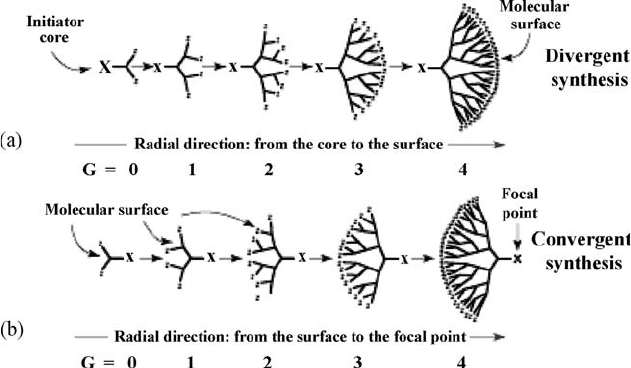
symmetrical branch-like structure of these polymers (Fig. 7.1). Technically, a
dendrimer is a polymer, which is a large molecule consisting of many smaller
chemical units linked together. There are two major strategies that are
available for the synthesis of dendrimers. The first, introduced by Tomalia, was
the ‘‘divergent method,’’ wherein the growth of a dendron originates from a
central core. This approach involves assembling monomeric modules in a
radial, branch-upon-branch motif [152]. The second method, pioneered by
Hawker and Frchet, follows a ‘‘convergent growth process’’ [153]. It proceeds
inward from what will become the dendrimer surface to a reactive focal point,
leading to the formation of a single reactive dendron. The convergent approach
is particularly well suited for the preparation of dendrimers to be used as
building blocks for larger functional nanostructures as it provides access to
dendritic ‘‘wedges’’ with differentiated reactivity at their focal point and chain
ends. Fig. 7.1 provides a schematic representation of the synthetic route
followed in the above two methods [154]. Dendrimers can be synthesized in a
stepwise manner, which allows controlling their size by manipulating the
152 BIOMEDICAL NANOSTRUCTURES
monomer concentration used for its synthesis [150]. In this way, dendrimers
with well-defined size in nanoscale from 70 to 300 nm can be synthesized
[151154].
7.5.1 Properties of Dendrimers
Dendrimers possess unique properties such as high degree of branching,
multivalency, globular architecture, and well- defined molecular weight
[155,156]. Appropriate manipulation of these properties allows for the design
of reproducible and effective drug delivery systems [157,158]. The stepwise
synthesis of dendrimers affords molecules with a highly regular branching
pattern, a low polydispersity index, and control over the number of peripheral
groups. Therefore, dendrimers resulting from stepwise synthetic processes are
distinct with perfect bran ching as compared to the more readily accessed
dendrimers obtained by polymerization processes that are often less well-
defined hyperbranched polymers with irregular branching. The dendrimer
structure/architecture also possesses some interesting properties [159]. Cavities
in the core structure and folding of the branches create cages and channels that
may be either hydrophilic or hydrophobic in nature depending on the chemical
nature of the monomeric units. Specific binding sites may also be incorporated
during synthesis. The surface groups of dendrimers are amenable to
modification and can be customized for specific applications. Therefore, the
FIGURE 7.1 Schematic representation of the two methods for synthesizing dendritic
macromolecules (dendrons): (a) the divergent method, in which the synthesis begins
from a polyfunctional core and continues radially outward by successive stepwise
activation and condensation, and (b) the convergent method in which the synthesis
begins at what will be the periphery of the final macromolecule and proceeds inward.
(Reprinted from Reference [154], with permission from Elsevier.)
DEVELOPMENT OF NANOSTRUCTURES FOR DRUG DELIVERY APPLICATIONS 153
choice of the method of den drimer synthesis and the monomers used in its
synthesis permit control over properties such as shape, size, density, polarity,
reactivity, and solubility.
7.5.2 Applications of Dendrimers in Drug Delivery
Structures based on dendrimers have made a significant impact in the area of
nanotechnology as they provide for well-controlled functional building blocks.
They can be used for a wid e variety of applications [155,160,161] ranging from
unimolecular devices or nanoreactors to sensors to medical technology
including targeted drug and gene delivery. Many potential applications of
dendrimers are based on their unparalleled molecular uniformity, multi-
functional surface, and presence of internal cavities. These specific properties
make dendrimers ideal carriers in biomedical applications such as drug delivery
and gene transfection. The bioactive agents may either be encapsulated into the
interior of the dendrimers or they may be chemically attached or physically
adsorbed onto the dendrimer surface. The surface, interior, and core of the
carrier can be tailored for the specific needs of the active material and its
therapeutic applications.
There are now more than 50 families of dendrimers [162], with each family
possessing unique properties. Poly(amidoamine) (PAMAM) dendrimers are
the first complete dendrimer family to be synthesized, characterized, and
commercialized [154]. The internal tertiary amines of PAMAM dendrimers
are available for acid base interactions and hydrogen bonding as well as for
other noncovalent interactions with encapsulated guest molecules, thus
making the polymers effective agents for encapsulating various drugs [163].
Patri et al. [164] investigated the drug delivery potential of PAMAM
dendrimers to reduce toxicity and to increase aqueous solubility. The
dendrimer surface was functionalized with hydroxyl groups to obtain highly
soluble dendrimers. The drug methotrexate was covalently conjugated to the
dendrimer. The drug inclusion complex, in which the drug was entrapped in
the cage of the dendrimer core by noncovalent interaction, was also evaluated
for its release kinetics. The results of this study demonstrated that
methotrexate was immediately released from the inclusion complex as
opposed to the methotrexatedendrimer conjugates, which were stable in
both water and PBS buffer solution. Therefore, this study indicated that a
cleavable, covalently linked drugdendrimer conjugate is probably more
appropriate for drug delivery as it does not release the drug prematurely in
biological conditions.
One of the simplest ways to construct dendrimerdrug conjugates is to
couple drug molecules directly to the surface of the dendrimer. Because of its
multiple surface functionalities, one dendrimer molecule has the capacity to
carry multiple drug molecules. The number of drug molecules per conjugate
can be varied by changing the coupling conditions. There are several reports on
the preparation of dendrimerdr ug conjugates via the covalent attachment of
154 BIOMEDICAL NANOSTRUCTURES
drugs to the dendrimer surface [165, 166]. In a study by Malik et al. [165], a
PAMAM dendrimerplatinate conjugate was examined for its antitumor
activity. The results of the study demonstrated that the conjugate showed
antitumor activity in all the tumor models tested, including a platinum-
resistant tumor model. In another study, Zhuo et al. [166] prepared PAMAM
dendrimers and attached 5-fluorouracil to the dendrimers to form co njugates.
Their results demonstrated hydrolysis of the conjugates in a phosphate buffer
solution and the consequent release of free 5-fluorouracil.
Nonsteroidal antiinflammatory drugs (NSAIDs) are among the most
frequently used drugs in the world, especially for symptoms associated with
osteoarthritis and other chronic musculoskeletal conditions [167]. Some of the
NSAIDs widely used are ketoprofen, ibuprof en, diflunisal, and naproxen.
NSAIDs cause a wide variety of reported adverse effects, including renal
dysfunction, gastrointestinal hemorrhage, and hypersensitivity reactions [168].
These undesired effects have limited the use of NSAIDs. Drug conjugation,
cellular transport, and cellular therapeutic activity of NSAIDs-based
dendrimer conjugates as drug delivery vehicles have been widely investiga ted
[169171]. Denis et al. [168] studied the aqueous solubility of NSAIDs
ketoprofen, ibuprofen, diflunisal, and naproxen in the presence of the
ethylenediamine (EDA) core PAMAM dendrimers. The study demonstrated
that PAMAM dendrimers have the potential to significantly enhance the
solubility of NSAIDs. The results also demonstrated that the solubility of
NSAIDs in the dendrimer solutions increased in an approximately linear
manner with an increase in dendrimer concentration. The authors also proved
that the bioavailability of the drugs increased with an increase of drug
solubility. The reason for the enhancement of solubility of NSAIDs is believed
to be an electrostatic interaction and hydrogen bond formations between the
surface amine groups on the dendrimer molecule and the carboxyl group of
NSAIDs. In another study, Kolhe et al. [169] reported the synthesis and
evaluation of hydroxylated PAMAM dendrimeribuprofen conjugates with a
high drug payload to improve intracellular delivery and to minimize systemic
side effects. The study demonstrated the potential of drugdendrimer
conjugates to enter lung epithelial cell lines rapidly and localize predominantly
in the cytoplasm. The high drug payload den dritic nanodevices translate into
rapid pharmacological response with improved efficacy. Future studies are
warranted to evaluate the pharmacokinetic and pharmacodynamic aspects of
these nanomaterials in animal models . In yet another study, Na et al. [172]
investigated the potential of polyamidoamine (PAMAM) dendrimers as
carriers of ketoprofen. Their results demonstrated that the in vitro release of
ketoprofen from the drugdendrimer complex is significantly slower compared
to pure ketoprofen. The blood distribution studies were conducted with mice
and the results demonstrated a prolonged pharmacodynami c behavior for the
ketoprofenPAMAM dendrimer complex. Therefore, this study indicated that
PAMAM dendrimers might be considered as potential drug carriers with the
capability to provide a sustained release along with reduced side effects.
DEVELOPMENT OF NANOSTRUCTURES FOR DRUG DELIVERY APPLICATIONS 155