
Kenneth E. Gonsalves, Craig R. Halberstadt, Cato T. Laurencin, Lakshmi S. Nair. Biomedical Nanostructures
Подождите немного. Документ загружается.

nanospheres are then collected by evaporating the solvent (this may be done
with mixing) or dilution with water.
Drugs and growth factors may be added to the organic or aqueous phase in
order to incorporate them into the nanospheres. Scanning electron micro-
scopy is used for nanosphere characterization. The size and density of the
spheres can be altered by changing the amount of polymer added to the
surfactant or stabilizer solution and the speed with which the solution is
agitate d .
1.7 CARBON NANOTUBES
Carbon is the building block for all organic life. It is found in a variety of
structures that display vastly different properties. In nature, pure carbon is found
in a variety of forms from the soft, flexible, and conductive graphite to the hard,
inflexible insulating diamond. The properties of these materials stem from the
arrangement of their carbon atoms. In graphite, the carbon atoms are arranged
into sheets of honeycomb-shaped matrices; these matrices are held together by
covalent bonds between the carbon atoms. The sheets are held to one another by
weak van der Waals forces; this allows graphite to flake off into layers (sheets of
carbon atoms slide over one another when force is applied) making graphite a
good lubricant. In contrast, the carbon atoms in a diamond are arranged into a
tetrahedral pattern. This arrangement makes diamonds hard and prevents them
from flaking like graphite. Similarly, it is the arrangement of their atoms and
their nanoscale size that give carbon nanotubes their mechanical, chemical, and
electrical properties.
Carbon nano tubes (CNTs) are fullerenes that are structurally similar to long
rolls of graphite. Fullerenes are molecules composed entirely of carbon that
exist as hollow objects (spheres, ellipsoids, or tubes); they are named after
Buckminster Fuller, an American architect, designer, and author known for his
work on geodesic domes.
CNTs are created as single-walled nanotubes (SWNTs) or multiwalled
nanotubes (MWNTs). SWNTs have only one wall whereas MWNTs have
many walls formed around one another. The walls of MWNTs are held to one
another by van der Waals forces. The properties of CNTs depend on their
length, diameter, and chirality (the direction in which the graphite sheet is
rolled up).
Carbon filaments were first noticed under gaseous conditions in the presence
of metal catalysts in the 1950s after the development of the electron
microscope. Carbon filaments up to several hundred nanometers long were
noticed extending from catalytic particles of transition metals [27]. Tibbetts
was the first to docu ment these structures and speculate about their growth
mechanism [27]. In the 1990s, Iijima observed the form ation of MWNTs
through the electric arc discharge method and later documented the synthesis
of SWNTs via laser ablation [28].
16 BIOMEDICAL NANOSTRUCTURES
SWNTs are very strong and very stiff because of the strength of the
carboncarbon bond and the seamless structure of the nanotube; the modulus
of an SWNT has been calculated as 0.64 TPa with an ultimate tensile stress of
approximately 37 GPa [29]. The electrical properties of SWNTs can range from
metallic to semiconducting with various band gaps depending on the chirality
and diameter of the tube [29]. CNTs have been used in a variety of applications
including increasing mechanical properties of polymers through composite
reinforcement, use in nanosensing devices, and in bioimaging.
CNTs have been made using a varie ty of fabrication methods; some of the
more common methods will be mentioned in this section. These methods
include electric arc discharge, laser ablation of carbon, and chemical vapor
deposition, techniques that are also used to create thin films, as mentioned in
an earlier section.
1.7.1 Electric Arc Discharge
The electric arc discharge method was one of the first methods used to fabricate
CNTs [30]. An electric arc is a discharge of current that occurs when a current
jumps between two electrodes or a gap in a circuit; to form CNTs, high purity
carbon electrodes are used. During this process, the anode, the source of the
carbon, is consumed throughout the process. As the nanotubes are formed from
the material in the anode, they are deposited onto the cathode. The composition
of the electrodes affects the type of CNTs produced. MWNTs are produced
when pure carbon electrodes are used. To produce SWNTs, a small hole is drilled
into the anode and filled with metallic catalyst particles and graphite powder.
Mixtures of Ni and Y have been shown to produce high quality SWNTs [31].
1.7.2 Laser Ablation
Ablation is the melting or vaporizing of a substance; in laser ablation for the
fabrication of CNTs, a graphite target is subjected to a laser at high tempera-
tures. The graphite target is ablated with a powerful laser in the presence of an
inert gas. The gas collects the ablated carbon powder and deposits it onto a
cooled substrate. The powder consists of CNTs and onion-like structures [30].
Similar to the electric arc discharge method, MWNTs are produced when pure
carbon (graphite) is used and SWNTs are produced when the target is mixed with
catalyst metals (<1%) such as CoNi powder [30].
1.7.3 Chemical Vapor Deposition
Unlike the previously mentioned techniques for CNT production (electric arc
discharge and laser ablation), chemical vapor deposition allows the user to
deposit the CNTs directly onto a substrate. Chemical vapor de position is
commonly used in the manufacturing of metals and ceramics [27]. This
technique can produce CNTs at a continuous rate and is easily scalable to
NANOFABRICATION TECHNIQUES 17
produce large amounts of CNTs for commercial distribution [30]. By changing
growth conditions such as growth temperature, carbon source, catalyst,
catalyst-to-carbon ratio, and type of substrate, CNTs can grow in a variety of
ways, including randomly oriented and aligned.
There are several ways to perform chemical vapor deposition, including hot-
wall chemical vapor deposition, cold-wall chemical vapor deposition, high
pressure CO conversion (HiPCO) chemical vapor deposition, and laser-assisted
chemical vapor deposition; both hot-wall and cold-wall chemical vapor
deposition are forms of thermal chemical vapor deposition. In hot-wall chemical
vapor deposition processes, such as thermal chemical vapor deposition, the
process takes place in a high temperature tube furnace. The substrate that the
CNTs will be deposited on is placed inside of the tube and the entire tube is
heated (heating the substrate to the growth temperature). A hydrocarbon source,
such as benzene, xylene, or hexane, is also introduced into the tube. Once in the
tube, it decomposes and deposits onto the substrate. In cold-wall chemical vapor
deposition processes, including plasma-enhanced chemical vapor deposition, the
temperature of the sample holder is raised and the rest of the system is left at a
lower temperature. In HiPCO chemical vapor deposition, high pressure carbon
monoxide is fed into the system and used as the carbon source.
Laser-assisted chemical vapor deposition is a technique that is used for thin
film deposition and can be adopted to produce films of CNTs. In laser-assisted
chemical vapor deposition, the global energy source that warms the furnace is
replaced by a localized energy source, the laser. In this method, the source of
the energy on the substrate is localized, so the growth of the CNTs can be
limited to the area over which the laser passes.
Laser-assisted chemical vapor depos ition is controlled by two mechanisms:
photolytic laser-assisted chemical vap or deposition and pyroly tic laser-
assisted chemical vapor deposition. Depending on the conditions, such as
temperature and position of the laser beam, both mechanisms can take place
simultane ously. In such cases, one mechanism for CNT deposition may
dominate the othe r. Only the photoly tic process can occur at low
temperatures, but at high temperatures both the phot olytic and pyrolytic
processes can occur simultaneou sly [32]. Py rolytic or photolytic reactions are
caus ed by the laser radiation wavelength, precurso r compounds used, and
chosen substrate material [33].
1.7.4 Photolytic Laser-Assisted Chemical Vapor Deposition
Photolytic laser-assisted chemical vapor deposition can be performed at low
wavelengths and with short pulse durations. This combination of conditions
creates a low temperature during processing, eliminating damage that can be
caused by thermal reactions with the substrate, such as recrystallization,
oxidation, and crack formation. This allows for exact processing of materials
for use in microelectronics [34]. Since it does not produce high temperatures,
photolytic laser-assisted chemical vapor deposition is used in conjunction with
18 BIOMEDICAL NANOSTRUCTURES
temperature-sensitive substrates. Lasers or lamps can be used as a source for
photons, but the increased power densities of lasers lead to a 100-fold increase
in growth rate when compared to lamps [35].
Resonant absorption of the laser radiation by the precursor causes bonds in
the precursor molecules to break freeing them for deposition onto the substrate
[30]. In photolytic laser-assisted chemical vapor deposition, the laser beam is
parallel to the substrate and passes just above it. The photons from the laser
are absorbed by the gas phase starting the reaction [36]. This arrangement
allows for the control of the substrate temperature independent from the laser
radiation [30]. Photolytic laser-assisted chemical vapor deposition may also
occur in a perpendicular lasersubstrate arrangement, but this geometry also
introduces pyrolytic laser-assisted chemical vapor deposition [33].
1.7.5 Pyrolytic Laser-Assisted Chemical Vapor Deposition
In pyrolytic laser-assisted chemical vapor deposition, the thermal energy
produced by the laser causes molecules of the reagent to disassociate and
deposit as CNTs on the substrate. The laser beam strikes the substrate at
perpendicular incidence and the chemical reaction is driven thermally by the
local heating of the substrate by the laser radiation. If the substrate is moved
throughout the process, single-step patterns can be made. If the substrate is
stationary, this process can produce three-dimensional structures [33]. Since this
method is essentially a type of thermal chemical vapor deposition, the same
conditions used for thermal chemical vapor deposition can be used with pyrolytic
chemical vapor deposition. The major difference is the heat source; the use of a
localized heat source (the laser) changes the reaction kinetics. This improves the
deposition rate and allows three-dimensional objects to be produced [37].
Pyrolytic laser-assisted chemical vapor depo sition was first performed by
Lydtin in 1972 [33] using an IR laser to deposit carbon onto aluminum
substrates. Now any commercially available laser can be used as a radiation
source for this technique. Typically, argon and krypton lasers are used for
submicron-sized patterns (necessary for nanofabrication an d microelectronics)
[30]. Otherwise, other types of lasers, such as CO
2
lasers, can be used since most
gases do not absorb the infrared or visible wavelengths emitted.
Pyrolytic laser-assisted chemical vapor deposition can also be performed
with an IR laser through vibration excitation. In this technique, the gas phase
is excited through collisional and vibrational relaxation processes. This heats
up the gas phase and the substrate, leading to the de position of the film.
Examples of laser and gas phase systems used in this technique include CO
2
lasers and BCl
3
, SiH
4
,orNH
3
gas [33].
1.7.6 Substrate-Site-Selective Growth
There are other techniques that can deposit CNTs into precise shapes and
patterns. One of these techniques is substrate-site-selective growth. This
NANOFABRICATION TECHNIQUES 19
procedure combines lithography with ch emical vapor deposition to achieve
targeted nanotube deposition for pattern production. In this process, a pattern
is placed onto the substrate using lithography; Wei and colleagues developed a
pattern of SiO
2
on top of a silicon substrate [30]. After the pattern has been laid
down, the nanotubes are deposited using a chemical vapor deposition
technique. In previous work, Wei and colleagues used a conventional tube
furnace with ferrocene (Fe(C
5
H
5
)
2
) as the nanotube nucleation initiator and
xylene as the carbon source [30]. The furnace was gradu ally heated to 800
C
and the ferrocenexylene solution was fed into the reactor at 150
C. The
choice of precursors is extremely important because it dictates the length of the
nanotubes deposited onto the substrate. The combination of ferrocene and
xylene produced vertically aligned MWCNTs that were 2030 mm in length
onto the SiO
2
pattern; there was no CNT deposition on the silicon surface [30].
This techni que has great potential for the design of mesoscale systems similar
to those in MEMS [30].
1.8 SELF-ASSEMBLED NANOSTRUCTURES
The self-assembly of molecules into structures is a phenomena seen frequently
in nature; type I collagen molecules are examples of molecules that can orient
and arrange themselves to form two-dimensional and three-dimensional
structures. Among the nanofabrication methods discussed in this chapter,
self-assembly of molecules is one of the most promising ways to form a large
variety of nanostructures [38]. This technique relies on the noncovalent
interactions between molecules (electrostatic, van der Waals, hydrogen
bonding, pp interactions, and capillary force) to organize grou ps of
molecules into larger, regular structures [38].
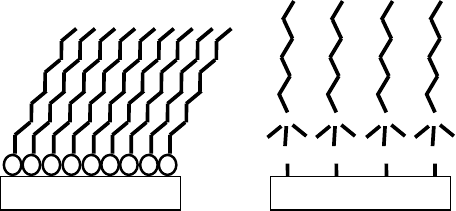
Self-assembled monolayers are among the most commonly studied self-
assembled structures. SAMs are surfaces covered by a thin film consisting of a
single layer of molecules. Typically, they are formed when surfactant molecules
are absorbed onto a substrate as a monomolecular layer. Among the most
common and widely studied SAM systems are goldalkylthiolate (CH
3
(CH
2
)
n
S)
and silicon oxidealkylsilane monolayer systems (Fig. 1.6).
In typical SAM fabrication, a group with a strong attraction to a particular
substrate is attached to the head of a long molecule, an alkane chain with about
1020 methylene units. The head group absorbs easily onto the substrate surface,
creating a monolayer with the tails pointing away from the substrate surface [39].
An example of this is the goldthiol SAM; thiol (SH) head groups in solution
absorb readily onto gold. In work with methyl-terminated thiols, Krishnan and
colleagues first cleaned the substrate, silicon wafers, in hot 1:4 H
2
O
2
(30%)/
H
2
SO
4
andthenrinsedthemindistilleddeionized water and absolute alcohol.
Next, a layer of gold was added in order to allow the thiol groups to bind. The
wafers were covered in gold using vapor deposition of chromium and gold from
heated tungsten boats in a cryogenically pumped deposition chamber [39].
20 BIOMEDICAL NANOSTRUCTURES
The layer of chromium was deposited before the layer of gold to enhance
adhesion to the substrate. The gold-coated samples were removed and placed
into 1 mM solutions of 1-hexadecanethiol in ethanol, contained at ambient
temperature, for 3 days. Afterward, the wafers were placed into the thiol
solution. Before experimental use, they were rinsed with ethanol and air dried
[39]. In this method, the thiol heads form a dense layer (1 molecule thick) on
the gold surface whereas the tails of the molecules point outward forming
another layer covering the substrate surface.
By changing the group attached to the tail of the absorbed molecules (or
using different molecules), you can tailor the functionality of the new surface.
Functionality can also be added to that tail groups after the SAM is formed. The
tail groups and molecules can be selected to form SAMs for specific appli-
cations. Adding short oligomers of ethylene glycol groups to the tail decreases
protein adhesion [40]. Methyl-terminated groups can increase plasma and
protein binding [39], which could increase the biocompatibility of the substrate.
Creating a monolayer of fluoroalkylsilane (FAS) onto silicon surfaces reduces
neural cell growth [41]. The use of 1-octadecanethiol, 1-dodecanethiol, and
1-hexanethiol groups protects copper from corrosion [42]. Absorbing a layer of
octadecyltrichlorosilane (OTS) increases wear resistance of polysilicon, a
technique that may increase the durability of MEMS or NEMS [43].
1.9 CONCLUSIONS
Nanotechnology is an exciting field that has seen tremen dous growth and has
advanced into the biomedical and electronics arena. Nanotechnology has
become an integrated part of our everyday lives. From medicine, to clothing, to
electronics, breakthroughs in nanofabrication have lead to new products.
There are a plethora of techniques for creating nanoscaled devices for
biomedical engineering. Many of these, such as lithography-based techniques,
S
X
S
X
S
X
S
X
S
X
S
X
S
X
S
X
S
X
Si
O OH
O
X
Si
O
O
X
Si
O
O
X
Si
HO
O
X
Gol
d
Silicon oxide
(a)
(b)
FIGURE 1.6 A diagram of (a) goldalkylthiolate and (b) silicon oxidealkylsilane
SAMs.
NANOFABRICATION TECHNIQUES 21
are applications of older techniques with more modern and powerful
equipment. All of these techniques produce patterns, structures, and surface
morphologies at the nanoscale that lead to devices and materials with unique
surface properties and functionality. These techniques impart unique chemical,
mechanical, electrical, and optical properties to materials for use in electronics,
materials science, and medicine. Nanofabrication has lead to major advances
in these fields and holds promise for the creation of new technologies.
REFERENCES
1. Urban GA, Prohaska O, Olcaytug F. In: Urban GA, editor. BioMEMS. Dordrecht,
The Netherlands: Springer; 2006. p 114.
2. Henshaw M. First impressions: the early history of lithographya comparative
survey. Artonview 2003;(33):33 38.
3. Mack CA. Optical lithography modeling. In: Sheats JR, Smith BW, editors.
Microlithography Science and Technology. New York: Marcel Dekker, Inc.; 2006.
109170.
4. Xia YN and Whitesides GM. Soft lithography. Annu Rev Mater Sci 1998;28:
158184.
5. Madou MJ. Fundamentals of Microfabrication: The Science of Miniaturization.
Boca Raton, FL: CRC Press LLC; 2002.
6. Atkinson GA and Ounaies Z. Polymer systems: materials and fabrication. In: Gad-
el-Hak M, editor. MEMS Design and Fabrication. Boca Raton, FL: Taylor &
Francis;2006. p 9-19-39.
7. Ding L, Li Y, Chu HB, Li XM, Liu J. Creation of cadmium sulfide nanostructures
using AFM dip-pen nanolithography. J Phys Chem B 2005;109:2233722340.
8. Jaschke M and Butt HJ. Deposition of organic material by the tip of a scanning
force microscope. Langmuir 1995;11:10611064.
9. Lee KB, Lim JH, Mirkin CA. Protein nanostructures formed via direct-write dip-
pen nanolithography. J Am Chem Soc 2003;125:55885589.
10. Becker EW, Ehrfeld W, Hagmann P, Maner A, Mu
¨
nchmeyer D. Fabrication of
microstructures with high aspect ratios and great structural heights by synchrotron
radiation lithography, galvanoforming, and plastic moulding (LIGA process).
Microelectron Eng 1986;4:3536.
11. Kathuria YP. L
3
: laser, LIGA and lithography in microstructuring. Indian Inst Sci J
2004;84:7787.
12. Menz W, Mohr J, Paul O. The LIGA process. In: Menz W, Mohr J, Paul O,
editors. Microsystem Technology. Wiley-VCH; 2001. p 285350.
13. Randhawa H. Review of plasma-assisted deposition processes. Thin Solid Films
1991;196:329349.
14. Yamada I and Toyoda N. Recent advances in R&D of gas cluster ion beam
processes and equipment. Nucl Instrum Methods Phys Res B: Beam Interact Mater
Atoms 2005;241:589593.
15. Ota Y. Silicon molecular beam epitaxy. Thin Solid Films 1983;106:1136.
22
BIOMEDICAL NANOSTRUCTURES
16. Brodsky MH. Plasma preparations of amorphous silicon films. Thin Solid Films
1978;50:5767.
17. Zeleny J. Electric discharge from points. Phys Rev 1917;9:562563.
18. Yarin AL, Koombhongse S, Reneker DH. Taylor cone and jetting from liquid
droplets in electrospinning of nanofibers. J Appl Phys 2001;90:48364846.
19. Reneker DH, Yarin AL, Fong H, Koombhongse S. Bending instability of
electrically charged liquid jets of polymer solutions in electrospinning. J Appl
Phys 2000;87:45314547.
20. Huang ZM, Zhang YZ, Koraki M, Ramakrishna S. A review on polymer
nanofibers by electrospinning and their applications in nanocomposites.
Composites Sci Technol 2003;63:22232253.
21. Formhals A. Apparatus for producing artificial filaments from material such as
cellulose acetate. US patent 1,975,504. 1934.
22. Ramakrishna S, Fujihara K, Teo W, Lim T, Ma Z. An introduction to
electrospinning and nanofibers. Singapore: World Scientific Publishing Co.
23. Buchko CJ, Chen LC, Shen Y, Martin DC. Processing and microstructural
characterization of porous biocompatible protein polymer thin films. In: 1999.
p 73977407.
24. Fong H and Reneker DH. Elastomeric nanofibers of styrene-butadiene-styrene
triblock copolymer. Journal of polymer science. Part B-Polymer Physics
1999;37:34883493.
25. Baumgarten PK. Electrostatic spinning of acrylic microfibers. Journal of colloid
and interface science 1971;36:7179.
26. Deitzel JM, Kleinmeyer J, Harris D, Tan NCB. The effect of processing variables on
the morphology of electrospun nanofibers and textiles. Polymer. 2001;42:261272.
27. Tibbetts GG. Why are carbon filaments tubular. J Crystal Growth
1984;66:632638.
28. Iijima S. Helical microtubules of graphitic carbon. Nature 1991;354:5658.
29. Baughman RH, Zakhidov AA, de Heer WA. Carbon nanotubesthe route toward
applications. Science 2002;297:787792.
30. Wei B, Vajtai R, Ajayan PM. Synthetic approaches for carbon nanotubes. In:
Kumar CSSR, Hormes J, Leuschner C, editors. Nanofabrication Towards
Biomedical Application Techniques, Tools, Applications and Impact. Weinheim:
Wiley-VCH; 2005. p 3355.
31. Journet C, et al. Nature 1997;388:756758.
32. Mogyorosi P and Carlsson JO. Growth characteristics of photolytic laser-induced
chemical vapor-deposition of tungsten from WF6. J Vac Sci Technol A: Vac Surf
Films 1992;10:31313135.
33. Conde O and Silvestre AJ. Laser-assisted deposition of thin films from photoexcited
vapour phases. App Phys A: Mater Sci Process 2004;79:489497.
34. Jantunen H. Electronics materials, packing and reliability techniques (EMPART).
INFOTECH OULU Annual Report; 2005. p 1624.
35. Gonzales P, et al. Photo-induced chemical vapour deposition of silicon oxide thin
films. Thin Solid films 1992;218:170181.
NANOFABRICATION TECHNIQUES 23
36. Heszler P, Landstrom L, Lindstam M, Carlsson JO. Light emission from tungsten
nanoparticles during laser-assisted chemical vapor deposition of tungsten. J Appl
Phys 2001;89:39673970.
37. Lehmann O and Stuke M. 3-Dimensional laser direct writing of electrically
conducting and isolating microstructures. Mater Lett 1994;21:131136.
38. Wei B, Vajtai R, Ajayan PM. Molecular Biomimetics: Building Materials Nature’s
Way, One Molecule at a time. In: Kumar CSSR, Hormes J, Leuschner C, editors.
Nanofabrication Towards Biomedical Applications Techniques, Tools,
Applications, and Impact. Weinheim: Wiley-VCH; 2005, p 119134.
39. Krishnan A, Cha P, Liu YH, Allara D, Vogler EA. Interfacial energetics of blood
plasma and serum adsorption to a hydrophobic self-assembled monolayer surface.
Biomaterials 2006;27:31873194.
40. Senaratne W, Andruzzi L, Ober CK. Self-assembled monolayers and polymer
brushes in biotechnology: current applications and future perspectives. Bio-
macromolecules 2005;6:24272448.
41. Patel KR, et al. Evaluation of polymer and self-assembled monolayer-coated
silicone surfaces to reduce neural cell growth. Biomaterials 2006;27:15191526.
42. Li G, Ma H, Jiao Y, Chen S. An impedance investigation of corrosion protection of
copper by self-assembled monolayers of alkanethiols in aqueous solution. J Serb
Chem Soc 2004;69:791805.
43. Baker MA and Li J. The influence of an OTS self-assembled monolayer on the
wear-resistant properties of polysilicon based MEMS. Surf Interface Anal
2006;38:863867.
24
BIOMEDICAL NANOSTRUCTURES

CHAPTER 2
Micro/Nanomachining and
Fabrication of Materials for
Biomedical Applications
WEI HE, KENNETH E. GONSALVES, and CRAIG R. HALBERSTADT
2.1 INTRODUCTION
In 1965, Intel cofounder Gordon Moore observed that innovations in
technology would allow a doubling of the number of trans istors on a chip
about every 2 years [1]. The reality of Moore’s prediction, popularly known as
Moore’s law, is being driven into the futur e, thanks to the advances in
technologies such as lithography. Apart from traditional optical lithography,
intense interest has been devoted to what is considered next generation
lithography (NGL), that is, extre me UV (EUV), X-ray, electron, and ion beam
lithographies, to produce sub-100 nm features. Advances in the lithographic
process have not only impacted the semiconductor manufacturing industry,
but also provide excellent tools/resources for the growth of the exciting
interdisciplinary field of biomedical engineering.
One of the most widely known applications of lithography in the biomed ical
field is micro/nanofabrication of biomaterials. Biomaterials are a class of
materials intended to interface with biological systems to evaluate, treat,
augment, or replace any tissue, organ, or function of the body [2]. In general,
biomaterials can be divided into the following categories: polymers, metals,
ceramics, composites, and natural materials. One of the key factors in
determining the successful performance of materials in biomedical applications
is the property of the surface, where the material and the biological system
meet and interact. Intense effort has been invested into engineering the
biomaterial surface to achieve the optimum and desired interactions between
cells and materials, while keeping intact the materials bulk properties. For
BiomedicalNanostructures, Editedby KennethE.Gonsalves,CraigR.Halberstadt,CatoT.Laurencin,
and Lakshmi S. Nair
Copyright # 2008 John Wiley & Sons, Inc.
25