
Korn G.A. Advanced Dynamic-system Simulation: Model-replication Techniques and Monte Carlo Simulation
Подождите немного. Документ загружается.


NEURAL-NETWORK TRAINING: PATTERN CLASSIFICATION
AND ASSOCIATIVE MEMORY
6-8. Linear Pattern Classifiers
An
nx-dimensional linear neural-network layer
Vector y = W * x (6-17)
can classify
N
<
–
nx prototype vectors s
(i)
if they are linearly independent, that
is, if
a
1
s
(1)
+ a
2
s
(2)
+ ··· + a
N
s(N)
= 0 implies a
1
= a
2
= ··· = a
N
= 0. This is true in
many applications, for example, for almost all image-pattern prototypes.
6
The desired optimal connection-weight matrix W can be computed explic-
itly if each classifier input
x is simply one of N linearly independent proto-
type patterns
s
(i)
with additive zero-mean noise. W is then the Penrose
pseudoinverse of the
nx × N pattern matrix X
T
whose N columns are the given
nx-dimensional prototype vectors.
7
But the successive-approximation tech-
nique described below is simpler, and it is not restricted to additive noise.
6-9. The LMS Algorithm
We start with random connection weights
W[i, k] and feed our one-layer net-
work (6-17) successive noise-perturbed prototype patterns, say
x = s + a *
ran(). To reduce the error measure (6-16) at each step, Widrow’s LMS algo-
rithm (least-mean-squares algorithm) or delta rule [8,9] repeatedly moves each
connection weight
W[i, k] in the negative-derivative direction by assigning
W[i, k] = W[i, k] –
ᎏ
1
2
ᎏ
lrate
∂
g/
∂
W[i, k] (i = 1, 2, ..., N; k = 1, 2, ..., nx) (6-18)
where
g=
N
i
=
1
n
x
j=1
W[i, j]x(r)[j] – S[i]
(6-19)
ᎏ
1
1
2
ᎏ
ᎏ
∂
W
∂
[
g
i, k]
ᎏ
=
nx
j=1
(W[i, j ]x(r)[r] – S[i ]x(k))
(i = 1, 2,
…
, N; k = 1,2,
…
, nx) (6-20)
132 Vector Models of Neural Networks
6
Often, prototype vectors can be made linearly independent by adding the same constant
vector to every prototype, or by using more pattern components (e.g., by adjoining an extra
constant component to every pattern
x).
7
Pseudoinverses, and the Greville and Gram–Schmidt algorithms used to compute them, are
treated in References [33, 34].
The LMS algorithm (6-18) simplifies computations by using derivatives of g
itself instead of derivatives of its sample average. In effect, the LMS algo-
rithm approximates each derivative of the sample average by accumulating
many small steps.
The choice of the optimization gain
lrate is a trial-and-error compromise
between computing speed and stable convergence. Successive values of
lrate
must decrease to avoid overshooting the optimal connection weights. More
specifically, if the sum of all successive squares
lrate
2
has a finite limit, then
the LMS algorithm converges with probability 1 to at least a local minimum
of the expected value
E{g} (the theoretical risk, as in Section 6-7), assuming
that such a minimum exists [8,9]. The algorithm should then approximately
minimize measured sample averages of
g (the empirical risk). In any case,
results must be checked with multiple samples.
DESIRE’s computer-readable vector/matrix language represents the
N × nx
matrix (6-20) neatly as the outer product (W * x – S) * x of the N-dimensional
vector
W * x – S and the nx-dimensional vector x (Section 3-10). We start the
connection weights
W[i, k] with random values and implement the LMS
algorithm (6-18) with the matrix difference equation
MATRIX W = W – lrate * (W * x – S) * x
or, more simply,
DELTA W = lrate * (S – W * x) (6-21)
6-10. A Softmax Image Classifier
(a) Problem Statement and Experiment-protocol Script
The program in Figure 6-2 models an effective classifier network for 5 × 5-
pixel image patterns representing the
N = 26 letters of the alphabet. Each let-
ter image is an instance of the vector
input, whose nx = 5 × 5 = 25
components are pixel-intensity values. We simply used the values –1 for
blank pixels and +1 for black or colored pixels. Each actual network input
x
is such a letter pattern perturbed by additive noise, that is,
x[i] = input[i] + Tnoise * ran() (i = 1, 2, …, nx)
The experiment protocol declares a pattern-row matrix INPUT (Section 6-5b)
with
N = 26 rows of nx = 25 pixel values, one row for each letter of the
Neural-network Training: Pattern Classification and Associative Memory 133
alphabet. A single data/read assignment fills this matrix with successive
pixel values arranged in 26 groups of 5 5-pixel lines:
-- A
data 1,1,1,1,1
data 1,-1,-1,-1,1
data 1,1,1,1,1
data 1,-1,-1,-1,1
data 1,-1,-1,-1,1
-- B
data 1,1,1,1,1
data 1,-1,-1,-1,1
data 1,1,1,1,-1
data 1,-1,-1,-1,1
data 1,1,1,1,1
--
.................etc. for C, D, …
read INPUT
The corresponding 26 binary selector patterns S = (1, 0, 0, …), (0, 1, 0, …), …
similarly form the rows of an N × N row-pattern matrix TARGET. This is sim-
ply the
N × N unit matrix defined by the DESIRE script line TARGET = 1. A
double experiment-protocol script loop
for i = 1 to N | for k = 1 to nx+1 | W[i, k] = ran() | next | next
starts the unknown connection weights with random values.
(b) Network Model and Training
Instead of a simple linear network layer, we use a softmax layer (Section 6-3),
whose contrast-enhanced output activations are especially suitable for match-
ing binary-selector patterns. Referring to Sections 6-3 and 6-5b, the
DYNAMIC program segment in Figure 6-2 represents the complete neural
network with
DYNAMIC
------------------------------------------------------------------------------------------
iRow = t | Vector x = INPUT# + Tnoise * ran() | -- read one row
Vector v = exp(c * W * x) | DOT vsum = v * 1 | -- softmax
Vector v = v/vsum
When the network is trained, the normalized softmax output activations v[i]
estimate the a posteriori probabilities of the 26 alphabet-letter patterns
(Section 6-10c).
134 Vector Models of Neural Networks
Neural-network Training: Pattern Classification and Associative Memory 135
--
SOFTMAX PATTERN CLASSIFIER
-- estimates a posteriori probabilities …
-- … and implements associative memory
------------------------------------------------------------------
nx = 25 | N = 26
ARRAY input[nx], x[nx]
ARRAY INPUT[N, nx], TARGET[N, N], W[N, nx]
ARRAY v[N], q[N], y[nx], error[N], Yerror[nx]
--
for i = 1 to N | for k = 1 to nx | -- initialize W
W[i,k] = ran() | next | next
--
---------------------------- input-pattern rows
-- A
data 1,1,1,1,1
data 1,-1,-1,-1,1
data 1,1,1,1,1
data 1,-1,-1,-1,1
data 1,-1,-1,-1,1
-- B
data 1,1,1,1,1
data 1,-1,-1,-1,1
data 1,1,1,1,-1
data 1,-1,-1,-1,1
data 1,1,1,1,1
................. etc. for C, D, …
read INPUT
MATRIX TARGET = 1 | -- binary-classifier rows
lrate = 0.05 | Tnoise = 0.5 | Rnoise = 0.9 | c = 0.1
NN=20000
--------------------------------------------------------
drun
write 'type go for successive recall runs' | STOP
----------
display F | -- clear the display
t = 1 | NN = 2 | restore | -- reset the read pointer
label recall
for I = 1 to N
read input | drun RECALL
write v | -- show all 26 probabilities
write 'type go for successive recall runs' | STOP
next
restore | go to recall
FIGURE 6-2
a
. This experiment-protocol script for the pattern classifier trains the network
with
NN = 20,000 noise-perturbed patterns and then calls a second DYNAMIC program seg-
ment for successive tests with each pattern. Each test estimates the a posteriori probabilities
and displays the actual patterns
input, x, yy, and y (Fig. 6-2b). Try this program with different
noise levels
Tnoise, Rnoise.
With iRow = t = 1, 2, …, our neural network is repeatedly fed all N succes-
sive pattern rows, for a total of
NN training steps. We define error = S – W * x
rather than W * x – S as the pattern-matching-error vector, because this saves
programming a possibly large number of leading minus signs. We then
implement the LMS algorithm with
Vector error = TARGET# - v
DELTA W = lrate * error * x
136
Vector Models of Neural Networks
------------------------------------------------------------------
DYNAMIC
------------------------------------------------------------------
iRow = t | Vector x = INPUT# + Tnoise * ran()
Vector v = exp(c * W * x) | DOT vsum = v * 1
Vector v = v/vsum | -- probability estimate
------------------------------------------------
Vector error = TARGET# - v
DELTA W = lrate * error * x | -- LMS algorithm
DOT enormsq = error * error
--
dispt enormsq
------------------------------------------------
label RECALL
--
Vector x = input + Rnoise * ran()
Vector v = exp(c * W * x) | DOT vsum = v * 1
Vector v = v/vsum | -- probability estimate
Vector q^ = v | Vector q = swtch(q) | -- binary selector
Vector yy = INPUT% * v
Vector y = INPUT% * q | -- associative memory
--
----------------------------------------------------------- pattern outputs
Vector input = cc * input | Vector x = cc * x
Vector yy = cc * yy | Vector y = cc * y
SHOW | SHOW input, 5 | SHOW x, 5 | SHOW yy, 5 |
SHOW y, 5
FIGURE 6-2
b
. DYNAMIC program segments for training and testing the pattern classifier.
The test segment computes the a posteriori probabilities
p for the current pattern input and
also produces associative-memory outputs
yy and y. Statements such as SHOW x, 5 display a
pattern as 5 rows of 5 pixels.
cc is a color value.
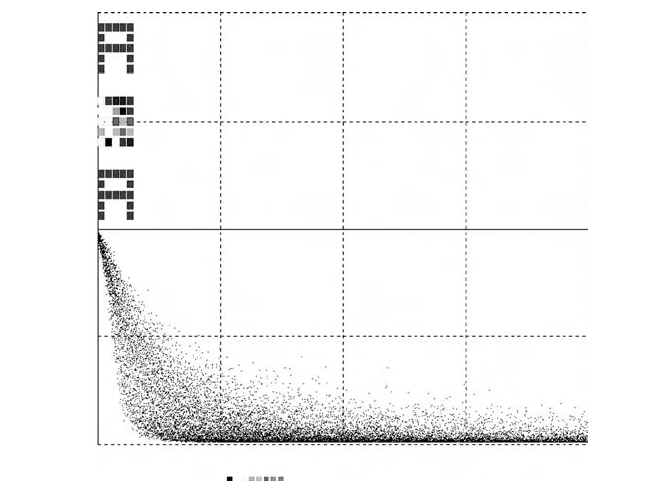
As training proceeds, the program also computes and displays the squared
pattern-matching error
g = enormsq as a function of the trial number t
(Fig. 6-3), with
DOT enormsq = error * error | dispt enormsq
(c) Test Runs and A Posteriori Probabilities
To test the classifier, our experiment protocol restores the data/read pointer
and uses
data/read assignments to feed one pattern at a time directly to the
neural-network input vector
input. No pattern matrix is needed. A second
DYNAMIC program segment labeled
RECALL then runs the neural network
once (
NN = 2) to compute and list the 26 a posteriori probability estimates
p[i] for the first alphabet-letter pattern (Fig. 6-3). Test runs are repeated for
the other letter patterns.
Neural-network Training: Pattern Classification and Associative Memory 137
+
0
–
1 1e+04 → 2e+04
scale = 1 ENORMSQ vs. t
FIGURE 6-3. Referring to the softmax pattern-classifier program in Figure 6-2, the bottom
of the display shows superimposed time histories of the squared binary-selector-matching
error
enormsq for all 26 noisy alphabet-letter patterns. The top of the display shows the actual
prototype pattern
input, the noise-corrupted pattern x, and the clean associative-memory out-
put
y for the letter “A”.

6-11. Associative Memory
The
RECALL program segment in Figure 6-2b also computes and displays
the
nx-dimensional pattern yy defined by
Vector yy = INPUT% * p (6-22)
Since
p approximates a binary-selector pattern, yy approximates the prototype
pattern associated with the noise-perturbed input
x (associative memory). Our
RECALL segment also implements a normalized maximum-selecting layer
(Section 6-3)
Vector q^ = v | Vector q = swtch(q) (6-23)
q is necessarily an exact binary-selector pattern, so that the associative-mem-
ory output
Vector y = INPUT% * q (6-24)
reproduces a prototype pattern exactly. Strong noise would cause the selec-
tion of a wrong prototype, but the system is an effective nonlinear noise fil-
ter. Figure 6-3 shows actual patterns
input, x, yy, and y obtained with
moderate noise in the training and recall runs.
NONLINEAR MULTILAYER NETWORKS
6-12. Backpropagation Networks
(a) The Backpropagation Algorithm
We now turn to nonlinear multilayer networks, say a two-layer network
8
defined by
Vector v1 = tanh(W1 * x)
Vector y = tanh(W2 * v1) (6-25)
The
v1 layer is a hidden layer. For mean-square regression (Section 6-6),
9
we are given a training sample of paired of nx-dimensional patterns x and
138 Vector Models of Neural Networks
8
Three layers if the input buffer is counted as an extra layer, as many textbooks do.
9
Backpropagation networks can also serve as pattern classifiers with a softmax output layer in
the manner of Section 6-10 (Example
ex6-1.lst in the book CD).
ny-dimensional “target” patterns Y. We want to generate ny-dimensional out-
put patterns
y = y(x) that minimize the sample average of
g = ||y(x) –Y||
2
≡
ny
k=1
(y[k] – Y[k])
2
(6-26)
Pattern classification can be programmed as mean-square regression on
binary selector patterns, with a softmax output layer as in Section 6-10
(example
bpsoft7.lst in the book CD).
To minimize the mean-square regression error, we update the connection
weights
W1[i, k] and W2[i, k] with a generalized version of the LMS algo-
rithm (6-18), the generalized delta rule
W1[i, k] = W1[i, k] –
ᎏ
1
2
ᎏ
lrate1
∂
g/
∂
W1[i, k]
(i = 1, 2, ..., nv1; k = 1, 2, ..., nx)
W2[i, k] = W2[i, k] –
ᎏᎏ
1
2
ᎏ
lrate2
∂
g/
∂
W2[i, k]
(i = 1, 2, ..., ny; k = 1, 2, ..., nv1) (6-27)
This is a system of difference equations similar to those in Section 3-1; the
connection weights are difference-equation state variables. The right-hand
side of each difference equation (6-27) is a function of the current values of
the connection weights and defined variables (6-25).
We first compute these defined variables. The derivatives in Eq. (6-27) are
then evaluated by the chain rule. This rather lengthy derivation [7,8] is sim-
plified if we specify intermediate results in terms of three new defined-vari-
able vectors
error, delta1, and delta2 declared with
ARRAY error[ny], delta1[nv1], delta2[ny]
In the DYNAMIC program segment, we program
Vector error = Y – y
Vector delta2 = error * (1 – y^2)
Vector delta1 = W2% * delta2 * (1 – v1^2) (6-28)
in that order (note that
error is defined as in Section 6-10), and then update
the connection-weight matrices with
DELTA W1 = lrate1 * delta1 * x
DELTA W2 = lrate2 * delta2 * v1
(6-29)
Nonlinear Multilayer Networks 139

lrate1 and lrate2 are positive, suitably decreasing learning rates similar to
lrate in Section 6-9. Reference [7] suggests lrate1 = r * lrate2 with r between
2 and 5. Generalization to three or more layers is not difficult.
10
Most
backpropagation networks have only two layers, and the output layer is often
simply a linear layer.
11
Neuron layers can be given bias inputs in the manner
of Section 6-2.
Note that
A% denotes the transpose of a matrix A (Section 3-3), products
of two vectors represent matrices (Section 3-10), and the function
1 – Q
2
is
the derivative of the neuron activation function
Q = tanh(q).
Interestingly, one can consider the defined-variable assignments (6-28) as
the definition of a neural network that “backpropagates” output-error effects
to the connection weights in each layer of the original neural network.
(b) Discussion
With enough neurons in the first layer, even a two-layer network is theoreti-
cally a “universal approximator,” that is, an output activation
y[i] can
approximate any desired continuous function of the inputs
x[k] [7,8].
Typically, there is more than one optimal set of connection weights. If too
many hidden-layer neurons are used, one might match the training-sample
pairs accurately but make matches for new test samples worse (“overtrain-
ing” hurts “generalization”). This problem is treated in substantial detail in
References [11] and [32].
Unfortunately, backpropagation training is often slowed by flat spots and/or
stopped by local minima in the mean-square error function. A frequently use-
ful partial fix (momentum learning) declares two extra state-variable matrices
140 Vector Models of Neural Networks
10
The way to add more layers can be seen from the program for a three-layer network with two
hidden layers:
Vector v1 = tanh(W1 * x)
Vector v2 = tanh(W2 * v1)
Vector y = tanh(W3 * v2)
Vector error = Y – y
Vector delta3 = error * (1 – y^2)
Vector delta2 = W3% * delta3 * (1 – v2^2)
Vector delta1 = W2% * delta2 * (1 – v1^2)
DELTA W1 = lrate1 * delta1 * x
DELTA W2 = lrate2 * delta2 * v1
DELTA W3 = lrate3 * delta3 * v2
Example bptest2.lst in the book CD shows the time histories of some hidden neurons in a
three-layer backpropagation network.
11
In this case, the activation-function derivative factor (1 – y^2) in Eq. (6-28) is omitted, since
all its vector components equal 1.
Dw1, Dw2 and replaces the two matrix difference equations (6-29) with four
difference equations
MATRIX Dw1 = lrate1 * delta1 * x + mom1 * Dw1
MATRIX Dw2 = lrate2 * delta2 * v1 + mom2 * Dw2
DELTA W1 = Dw1 | W2 = Dw2 (6-30)
which make the connection-weight adjustments favor the directions of past
successes. The optimization parameters
mom1, mom2 must be found by trial
and error and are typically between 0.1 and 0.9. There are literally hundreds
of papers and several books [6–9,12–18] describing other improved back-
propagation algorithms, but none work every time. References [2–5] describe
more advanced numerical function-optimization schemes applicable to mul-
tilayer networks. In practice, the best algorithm for a specific application
must be selected (and possibly redesigned) by trial and error. The
Levenberg–Marquart algorithm [5,7] is often a good compromise.
(c) Examples and Neural-network Submodels
Backpropagation regression networks with a few inputs and one or more out-
puts are used to model empirical relations. As a simple example, the program
in Figure 6-4a trains a two-layer regression network to produce a very accu-
rate sine function; Figure 6-4b shows results. We have defined the two-layer
neural network as a reusable submodel (Section 3-17) in the experiment-
protocol script. The same submodel is then invoked in two separate
DYNAMIC program segments, one for training and one for recall tests. Our
submodel could also be stored and used in another program, say, in a control-
system simulation.
Figure 6-4c shows the squared-error time histories for 32 output activa-
tions of a two-layer, 32-input backpropagation network with
nv = 9 hidden-
layer neurons during a successful training run of
NN = 200,000 steps. A
2.4-GHz personal computer trained 585 connection and bias weights to pro-
duce this display in 7.3 s. The same run took 5.5 s with the display turned off.
6-13. Radial-basis-function Networks
(a) Basis-function Expansion and Linear Optimization
Given a sample of corresponding measurements x, Y, traditional statistical
regression methods have long approximated mean-square regression func-
tions
y(x) (Section 6-6) with weighted sums y(x) = W1 f1(x) + W2 f2(x) + …+
Wn fn(x)
of conveniently chosen basis functions f1(x), f2(x), …, fn(x).One
Nonlinear Multilayer Networks 141