
Korn G.A. Advanced Dynamic-system Simulation: Model-replication Techniques and Monte Carlo Simulation
Подождите немного. Документ загружается.

The DYNAMIC-segment operation
14
CLEARN v = W(x) lrate, crit (6-43)
with
crit > 0 implements ART functionality for the common special case of in-
turn pattern learning with low noise [28]. The program is outlined in the
Appendix. This classifier will not let successive prototypes “steal” committed
templates and learns
n = N noise-free prototype patterns flawlessly one after
another (
iRow = t/m). The algorithm also tolerates a small amount of additive
noise (Fig. 6-7b); with too much noise, the process runs out of templates and
returns an error message. As in classical ART [24], a fast-learn mode for
noise-free patterns simply sets
W
(I)
= x instead of gradual updating when you
replace
crit in statement (6-43) with crit #.
152 Vector Models of Neural Networks
+
0
–
–1.0
scale = 1 w[1],w[2],×[1],×[2]
–0.5 0.0 0.5 1.0
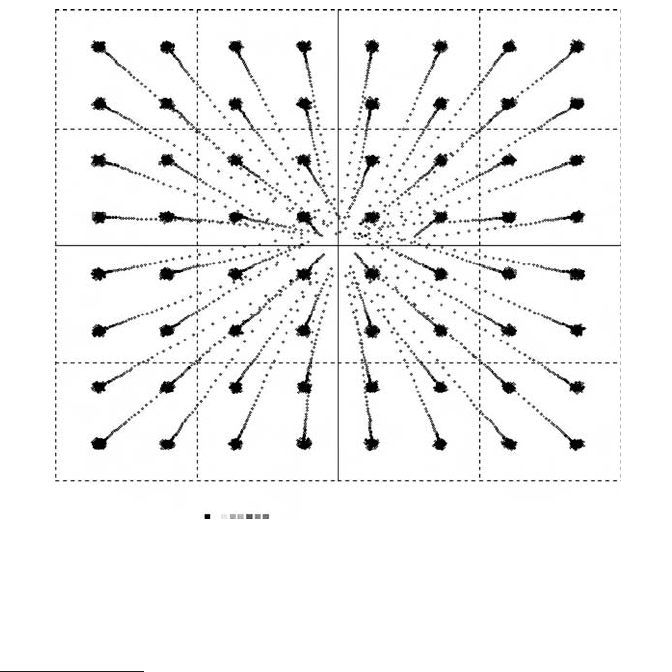
FIGURE 6-7
a
. Competitive template matching of N = 64 noisy patterns x
≡
(x[1], x[2]) with
the pseudo-adaptive resonance scheme of Section 6-17 (
crit = 0.015). Note that pattern clus-
ters do not “steal” each other’s templates. Repeated presentation of the 64 noise-corrupted pro-
totype patterns in turn (
iRow = t/m with m = 200) produced flawless template matching, but
only with low noise levels. The original display was in color.
14
Note that the DESIRE CLEARN operation is different from the CLEARN operation used
with the early version of DESIRE described in Reference [17]. (See also Section A-3.)
6-18. Biologically Plausible Competition: Correlation Matching
The abstract
CLEARN routines in Sections 6-16a, b, and 6-18 (see also the
DESIRE Manual in the book CD) simplify programming, but we may want
to see how biologically more plausible neural networks might model pattern-
matching competition. Specifically, such models ought to relate pattern
matching and contrast enhancement to connection weights that represent
physical synapses. Newer biological models use pulsed-neuron replication
(Sections 6-24 and 6-25) [29,31].
For Euclidean-normalized patterns
x (Section 6-3), minimizing the sample
average of the squared template-matching error (6-38) is equivalent to corre-
lation matching, which maximizes the sample average of
g1=
nx
j=1
W[i, j]x[ j] (6-44)
Competitive-layer Pattern Classification 153
+
0
–
–1.0
scale = 1
w[1],w[2],×[1],×[2]
–0.5 0.0
0.5
1.0
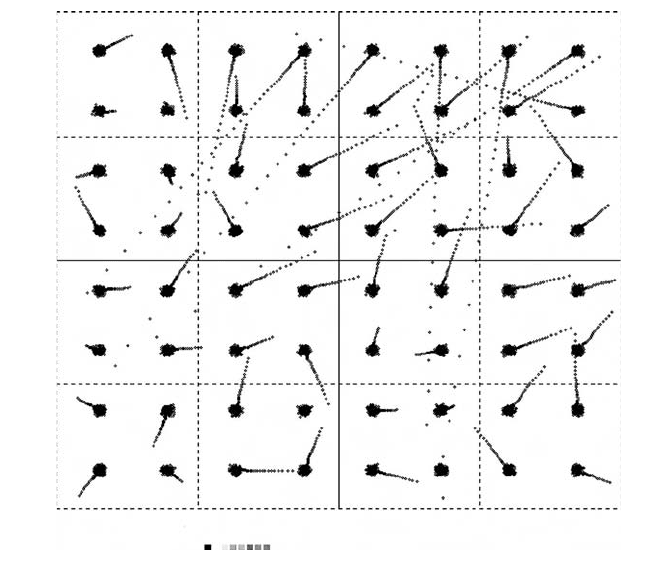
FIGURE 6-7
b
. The same experiment with larger initial random template-vector values.
We had to increase the number
n of available templates from 64 to 70 to match all N = 64
patterns.

A contrast-enhancing neural-network layer (Section 6-3) represented by
Vector v^ = W * x | Vector v = swtch(v)
not only computes the correlation function (6-44) but also generates binary-
selector patterns
v that identify the best-matching template-row, that is, the
template with the largest correlation function. What is more, the template-
vector components to be adjusted now appear as synapse-modeling neuron
connection weights.
The template-updating operations (6-39) can be written as a matrix differ-
ence equation (Section 3-10), and the entire correlation-matching operation
is represented by
15
DOT xnormsq = x * x | xnn = 1/sqrt(xnormsq) | Vector x = xnn * x
Vector v^ = W * x | Vector v = swtch(v)
Vector w = W% * v | -- reconstruct templates
e = x - w -- template-matching error
DELTA W = lrate * v * e | -- update
Note that we implemented the normalization and contrast-enhancing layers
with simple assignments, as in Section 6-3. Biologically even more plausible
models learn these features gradually as training proceeds, using special non-
linear neurons for normalization and lateral feedback between adjacent neu-
rons for contrast enhancement [15, 17, 20, 22]. Such programs can be made
to work, but they are complicated especially when more than a few neural-
network layers are needed. Abstract operations such as
CLEARN v = W(x)
lrate, crit are easier to program.
SUPERVISED COMPETITIVE LEARNING
Competitive-layer classifiers also work with supervised training for pattern
classification, regression, and associative memory. Such neural networks
may converge more easily than backpropagation networks.
6-19. Supervised Competitive Classifiers:The LVQ Algorithm
Kohonen’s LVQ (learning vector quantization) algorithm [8,15] modifies
the competitive-classifier updating rule (6-39) for supervised competitive learn-
ing. Each training-sample input
x is presented together with its known associ-
ated binary-selector pattern
S, as in Section 6-10. If the competitive-layer
154 Vector Models of Neural Networks
15
Example nquant.lst in the book CD shows a complete program that also computes
statistical relative frequencies for each template pattern.
selector output v does not match S, the sign of the learning rate lrate in Eq.
(6-39) is reversed.
6-20. Counterpropagation Networks
Hecht-Nielsen’s counterpropagation network (Fig. 6-5; [21]) feeds the
binary-selector output
v of a competitive-layer classifier to an “outstar” layer
programmed with
Vector y = U * v
U may be known from a separate computation, or it can be LMS-trained to
associate a desired output vector
y = target with each pattern input x. U can
be trained during or after the competitive learning process.
Counterpropagation networks usually approximate regression more
quickly than backpropagation networks. But the resulting approximation
y is
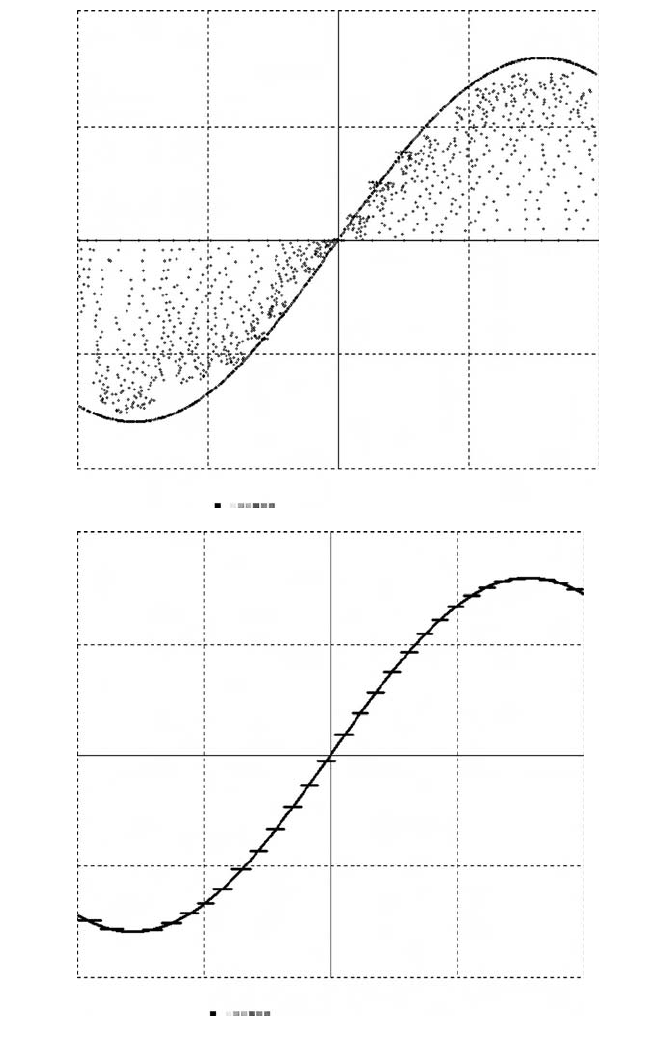
not continuous:
y can take only n different values, where n is the chosen
number of template vectors. These values will be spaced most closely in
regions corresponding to frequent inputs (Fig. 6-8). Radial-basis-function
networks (Section 6-13b) with competitive basis-center learning are, in
effect, counterpropagation networks with built-in interpolation. Reference
[17] shows some examples.
NEURAL NETWORKS WITH MEMORY
6-21. Neural Networks and Memory
With all connection-weight values set, the neural networks programmed in
Sections 6-1 to 6-20 are static function generators. A time series
x = x(t) of
input patterns produces corresponding output patterns
y = y(t) without mem-
ory of past inputs or outputs. Neural-network training or adaptation to chang-
ing patterns, though, implies memory, as the network output feeds back to the
connection weights. Such adaptation is normally slow relative to input-signal
changes (low values of
lrate for stable learning, Section 6-9), and this type of
neural-network memory is referred to as long-term memory.
Short-term memory converts some neuron activations into state variables
related to past values of inputs or other neuron activations. Such neural
networks are not static function generators; they are dynamic systems (filters).
Their connection weights can learn to recognize pattern sequences, or learn to
Neural Networks with Memory 155
156 Vector Models of Neural Networks
+
0
–
–1.0
scale = 1 x[1],y[1],target
–0.5 0.0 0.5 1.0
+
0
–
–1.0
scale = 1 x[1],y[1],target
–0.5 0.0 0.5 1.0
FIGURE 6-8. Counterpropagation learning of a sine-wave input. Note that the output is a
step function.
match the outputs of a dynamic (state-equation) model fed a given sample of
input signals (model matching, a generalization of regression).
Short-term memory takes different forms, which can also be combined:
• tapped delay lines (shift registers) feeding neuron layers or individual
neurons
• neurons modeled by difference-equation systems or differential-equa-
tion systems
• feedback to preceding neuron layers (recurrent neural networks)
Much of this large subject is still in the research stage [7,14,36]. As before,
we present no exhaustive treatment but point out examples where our com-
pact vector models can be helpful.
6-22. Networks with a Delay-line Input Layer
(a) Vector Model of a Tapped Delay Line
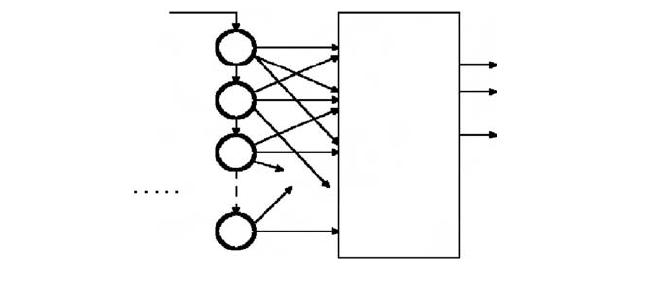
In Figure 6-9, a static neural network reads the activations x[1], x[2], …, x[nx]
of a tapped-delay-line layer fed with a scalar function s(t) of the trial number t.
To implement the
nx-stage delay line, we declare an nx-dimensional vector x
in the experiment protocol and program the DYNAMIC-segment assignments
Vector x = x{–1} | x[1] = s(t) (6-45)
The order of these two assignments is significant. The current value of the
input signal
s(t) is read after the index-shift operation (Section 3-6) has
Neural Networks with Memory 157
s(t)
x[1]
x[2]
x[3]
x[nx]
static
y = y(t)
neural
network
FIGURE 6-9. A delay-line layer feeding a static neural network. Either a simple tapped delay
line or a gamma delay line can be used.

shifted earlier samples of s(t) into successive delay-line neurons,
16
so that
(Fig. 6-10)
x[1] = s(t), x[2] = s(t – COMINT), x[3] = s(t – 2 COMINT), …
As noted in Section 6-5, COMINT = TMAX/(NN – 1) automatically defaults to
1 and
t = 1, 2, … if t0 and TMAX are not specified.
(b) Simple Linear Filters
In Figure 6-9, the neural network connected to the delay line is a static neu-
ral network and can be trained as in the preceding sections. The simplest such
network just computes a weighted sum
y(t) = w1 x[1] + w2 x[2] + … + wn x[n]
≡
w1 s(t – COMINT) + w2 s(t – 2 COMINT) + …
+ wn s(t – nx COMINT) (6-46a)
with
DOT y = w * x (6-46b)
158 Vector Models of Neural Networks
FIGURE 6-10. This small program illustrates the operation of a tapped delay line by listing
x[1], x[2], … at successive sampling times t = 1, 2, …. Note that each new value of the input is
read after the line shifts.
NN=5
ARRAY x[4]
drun
------------------------------------------
DYNAMIC
------------------------------------------
Vector x = x{-1} | x[1] = t
type x[1], x[2], x[3], x[4]
t x[1] x[2] x[3] x[4]
1.00000e+00 1.00000e+00 0.00000e+00 0.00000e+00 0.00000e+00
2.00000e+00 2.00000e+00 1.00000e+00 0.00000e+00 0.00000e+00
3.00000e+00 3.00000e+00 2.00000e+00 1.00000e+00 0.00000e+00
4.00000e+00 4.00000e+00 3.00000e+00 2.00000e+00 1.00000e+00
5.00000e+00 5.00000e+00 4.00000e+00 3.00000e+00 2.00000e+00
16
Note that shifting in the opposite direction would require an auxiliary vector to avoid illegal
recursion (Section 3-6) [17].
This creates a linear finite-impulse response (FIR) digital filter defined by the
connection-weight vector
w ≡ (w1, w2, …). The design of such filters is dis-
cussed in References [7] and [30]. Widrow’s LMS algorithm (Section 6-9)
was, in fact, first developed to optimize such filters [7].
(c) Linear Matched Filters, Signal Classifiers, and Model Matching
More generally, we can program an ny-dimensional linear neuron layer
Vector y = W * x (6-47)
to implement
ny linear filters such as matching filters for ny different input
signals
s(t) [7] . We can also use the softmax-classifier layer described in
Section 6-10 to classify temporal signal patterns shifted into our tapped delay
line [7]. Last, but not least, note that the single DESIRE program line
Vector x = x{–1} | x[1] = s(t) | Vector y = W * x
combines a tapped delay line and a linear neuron layer into a general linear-
system model; the connection weights
W[i, k] can even be given functions of
the time
t. Such models can be used to approximate the input/output behav-
ior of real systems such as process plants [7].
(d) A Nonlinear Predictor Trained with Backpropagation
Linear filters have long been used for prediction, but a nonlinear neural net-
work can do better [7]. The program of Figure 6-11 feeds the delay-line acti-
vations
x[k] to the hidden layer of a simple two-layer network (Section 6-12)
Vector vv = tanh(WW1 * xx)
Vector y = WW * vv
xx and vv are bias-augmented vectors declared with
ARRAY x[nx] + x0[1] = xx | x0[1] = 1 | -- delay line
ARRAY v[nv] + v0[1] = vv | v0[1] = 1 | -- hidden layer
as shown in Footnote 3.
The output vector
y is one-dimensional, and S(t) = y[1] is the predictor
output signal. Assuming that the statistical properties of our signals do not
change with time, the program in Figure 6-11 generates training samples of
the “future” signal
sTRUE(t) and delays sTRUE by the prediction time
m COMINT = m with another delay line
Vector signal = signal{-1} | signal[1]=sTRUE
Neural Networks with Memory 159
160 Vector Models of Neural Networks
-- NONLINEAR ADAPTIVE PREDICTOR
-- predicts Mackay-Glass chaos generator
--------------------------------------------------------------------
display N1 | display C8 | scale = 3
irule 1 | -- Euler integration for McKay-Glass
TMAX = 500 | DT = 0.04 | NN = TMAX/DT
a = 0.2 | b = 0.1 | c = 10 | -- for Mackay-Glass
tau = 25
--
ARRAY DD[1000] | -- time-delay buffer
sTRUE = 10 | - initialize time-delay buffer
for i = 1 to 1000 | DD[i] = sTRUE | next
--------------------------------------------------------------------
m = 20 | -- predictor delay
nx = 50 | -- number of predictor neurons
nv = 13 | -- number of hidden-layer neurons
--
ARRAY signal[m], y[1], error[1]
ARRAY x[nx] + x0[1] = xx | x0[1] = 1 | -- delay line
ARRAY v[nv] + v0[1] = vv | v0[1] = 1 | -- hidden layer
ARRAY vdelta[nv] + v0delta[1] = vvdelta | v0delta[1] = 1
ARRAY WW1[nv+1, nx+1], WW2[1, nv+1]
--
for i = 1 to nv+1 | for k = 1 to nx+1 | -- initialize
WW1[i, k] = 0.1 * ran()
next | next
---------------------------------------------------------
WW1gain = 0.06 | WW2gain = 0.006
--
N = 20
for i = 1 to N | drun | next | -- N training runs
write 'type go for prediction tests' | STOP
WW1gain = 0 | WW2gain = 0 | drun | drun | -- test runs
----------------------------------------------------------------------------
DYNAMIC
------------------------------------------------------------------------------------
tdelay Sd = DD, sTRUE, tau | -- McKay-Glass time series
sTRUEdot = a * Sd/(1 + Sd^c) - b * sTRUE
d/dt sTRUE = sTRUEdot
------------------------------------------------------------------------------------
-- delay "future" signal sTRUE, shift resulting signal into x
--
-- OUT is not needed with Euler integration
FIGURE 6-11. Complete program for the nonlinear predictor.

to produce the current predictor input s(t) = signal[m]. The simulated pre-
dictor then tries to predict
sTRUE(t) by minimizing the sample average of
g = (y – sTRUE)
2
with the backpropagation algorithm of Section 6-12a.
Prediction results necessarily depend on the frequency content of the input
signal.
To provide a fairly difficult prediction task,
sTRUE = sTRUE(t) is the
Mackay–Glass “chaotic” time series [17] defined by
17
Sd(t) = sTRUE(t – tau)
(d/dt) sTRUE = a Sd/(1 + Sd
c
) – b sTRUE
Figure 6-12 shows the “future” signal value sTRUE, the predictor output y, and
the prediction error
sTRUE – y during training and recall. We used 20 training
runs with a total of 250,000 training steps to learn prediction
m = 20 steps
ahead.
Neural Networks with Memory 161
FIGURE 6-11. (Continued).
Vector signal = signal{-1} | signal[1] = sTRUE
Vector x = x{-1} | x[1] = signal[m]
-------------
Vector vv = tanh(WW1 * xx) | -- note bias
Vector y = WW2 * vv | -- no limiter needed on output!
--
Vector error = sTRUE - y | -- backpropagation
Vector vvdelta = WW2% * error * (1 - vv^2)
DELTA WW1 = WW1gain * vvdelta * xx
DELTA WW2 = WW2gain * error * vv
-----------------------------------------------------------
ERRORx5 = 5 * error[1] - 0.5 * scale
dispt y[1], ERRORx5, sTRUE
17
In Figure 6-11, this is programmed with
tdelay Sd = DD, sTRUE, tau
sTRUEdot = a * Sd/(1 + Sd^c) - b * sTRUE
d/dt sTRUE = sTRUEdot
where tdelay is a library time-delay routine that implements Sd(t) = sTRUE(t – tau) by storing
samples of its input
sTRUE in an array DD declared in the experiment protocol; one sample
for each
DT step of the simple Euler integration routine (Section 1-7a) used here. The exam-
ple
mglass.lst in the book CD lets you experiment with the generator.