
Kratz R.F., Siegfried D.R. Biology For Dummies
Подождите немного. Документ загружается.


41
Chapter 3: The Chemistry of Life
tissue, and even the cornea of the eye. It provides support in the body,
and it has a great capability to be flexible and resistant to stretching.
✓ Transport proteins move materials around cells and around the body.
Hemoglobin is a transport protein found in red blood cells that carries
oxygen around the body. A hemoglobin molecule is shaped kind of like a
three-dimensional four-leaf clover without a stem. Each leaf of the clover
is a separate polypeptide chain. In the center of the clover, but touch-
ing each polypeptide chain, is a heme group with an atom of iron at its
center. When gas exchange occurs between the lungs and a blood cell
(for more on respiration and circulation, see Chapter 15), the iron atom
attaches to the oxygen. Then, the iron-oxygen complex releases from the
hemoglobin molecule in the red blood cell so the oxygen can cross cell
membranes and get inside any cell of the body.
Drawing the cellular road map:
Nucleic acids
Until as recently as the 1940s, scientists thought that genetic information was
carried in the proteins of the body. They thought nucleic acids, a new dis-
covery at the time, were too small to be significant. That all changed in 1953
when James Watson and Francis Crick figured out the structure of a nucleic
acid, proving things were the other way around: Nucleic acids created the
proteins!
Nucleic acids are large molecules that carry tons of small details, specifically
all the genetic information for an organism. Nucleic acids are found in every
living thing — plants, animals, bacteria, and fungi. Just think about that fact
for a moment. People may look different than fungi, and plants may behave
differently than bacteria, but deep down all living things contain the same
chemical “ingredients” making up very similar genetic material.
Nucleic acids are made up of strands of nucleotides. Each nucleotide has three
components of its own:
✓ A nitrogen-containing base called a nitrogenous base
✓ A sugar that contains five-carbon molecules
✓ A phosphate group
That’s it. Your entire genetic composition, personality, and maybe even
your intelligence hinge on molecules containing a nitrogen compound, some
sugar, and a phosphate. The following sections introduce you to the two
types of nucleic acids.
07_598757-ch03.indd 4107_598757-ch03.indd 41 5/7/10 11:43 PM5/7/10 11:43 PM
42
Part I: Biology Basics
Deoxyribonucleic acid (DNA)
You may have heard DNA (short for deoxyribonucleic acid) referred to as
“the double helix.” That’s because DNA contains two strands of nucleotides
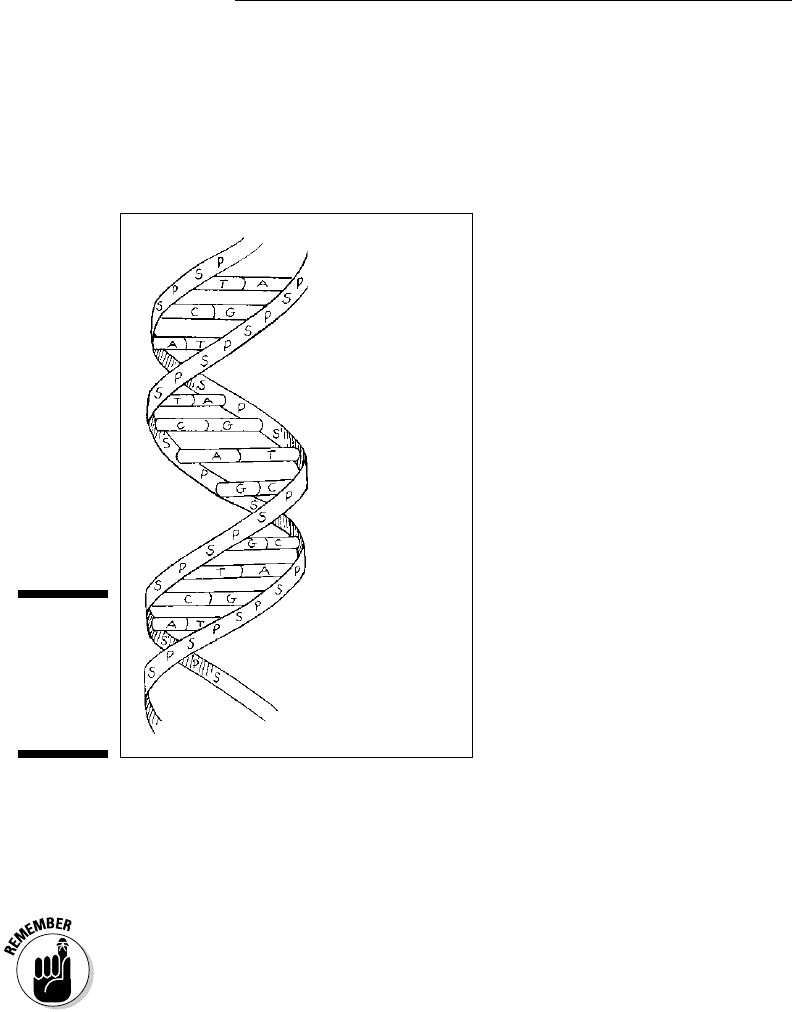
arranged in a way that makes it look like a twisted ladder. See for yourself in
Figure 3-5.
Figure 3-5:
The twisted-
ladder
model of a
DNA double
helix.
P = phosphate
S = sugar
A = adenine
T = thymine
C = cytosine
G = guanine
The sides of the ladder are made up of sugar and phosphate molecules,
hence the nickname “sugar-phosphate backbone.” (The name of the sugar in
DNA is deoxyribose.) The “rungs” on the ladder of DNA are made from pairs
of nitrogenous bases from the two strands.
The nitrogenous bases that DNA builds its double helix upon are adenine (A),
guanine (G), cytosine (C), and thymine (T). The order of these chemical letters
spells out your genetic code. Oddly enough, the bases always pair in a certain
way: Adenine always goes with thymine (A-T), and guanine always links up
with cytosine (G-C). These particular base pairs line up just right chemically so
that hydrogen bonds can form between them.
Certain sections of nitrogenous bases along a strand of DNA form a gene. A
gene is a unit that contains the genetic information or codes for a particular
07_598757-ch03.indd 4207_598757-ch03.indd 42 5/7/10 11:43 PM5/7/10 11:43 PM

43
Chapter 3: The Chemistry of Life
protein and transmits hereditary information to the next generation. Whenever
a new cell is made in an organism, the genetic material is reproduced and put
into the new cell. (You can find details about this in Chapter 6.) The new cell
can then create proteins and also pass on the genetic information to the next
new cell.
But genes aren’t found only in reproductive cells. Every cell in an organism
contains DNA (and therefore genes) because every cell needs to make pro-
teins. Proteins control function and provide structure. Therefore, the blue-
prints of life are stored in each and every cell.
The order of the nitrogenous bases on a strand of DNA (or in a section of the
DNA that makes up a gene) determines the order in which amino acids are
strung together to make a protein. Which protein is produced determines
which structural element is produced within your body (such as muscle
tissue, skin, or hair) or what function can be performed (such as the trans-
portation of oxygen to all the cells).
Every cellular process and every aspect of metabolism is based on genetic
information stored in DNA and thus the production of the proper proteins. If
the wrong protein is produced (as in the case of cancer), then disease occurs.
Ribonucleic acid (RNA)
RNA, short for ribonucleic acid, is a chain of nucleotides that serves as an
important information molecule. It plays an important role in the creation of
new proteins (which we cover in Chapter 8). The structure of RNA is slightly
different from that of DNA.
✓ RNA molecules have only one strand of nucleotides.
✓ The nitrogenous bases used are adenine, guanine, cytosine, and uracil
(rather than thymine).
✓ The sugar in RNA is ribose (not deoxyribose).
Supplying structure, energy,
and more: Lipids
In addition to carbohydrates, proteins, and nucleic acids, your body needs
one more type of large molecule to survive. Yet, if you’re like most people,
you try to avoid too much of it in your diet. We’re talking about fats, which
can be both a blessing and a curse because of their incredible energy density
(the ability to store lots of calories in a small space). The energy density of
fats makes them a highly efficient way for living things to store energy — very
useful when food isn’t always available. But that same energy density makes
it really easy to pack in the calories when you eat fatty foods!
07_598757-ch03.indd 4307_598757-ch03.indd 43 5/7/10 11:43 PM5/7/10 11:43 PM

44
Part I: Biology Basics
Fats are an example of a type of molecule called lipids. Lipids are hydrophobic
molecules, meaning they don’t mix well with water. You’ve probably heard
the saying that “oil and water don’t mix.” Well, oil is a liquid lipid, so the old
saying is true; it really doesn’t mix with water. Butter and lard are examples
of solid lipids, as are waxes, which are valued for their water-repellent prop-
erties on snowboards, skis, and automobiles.
Three major types of lipid molecules exist:
✓ Phospholipids: These lipids, made up of two fatty acids and a phosphate
group, have an important structural function for living things because
they’re part of the membranes of cells (see Chapter 4 for more on cell
membranes). Phospholipids aren’t the type of lipid floating around the
bloodstream clogging arteries.
✓ Steroids: These lipid compounds, consisting of four connecting carbon
rings and a functional group that determines the steroid, generally
create hormones. Cholesterol is a steroid molecule used to make tes-
tosterone and estrogen; it’s also found in the membranes of cells. The
downside to cholesterol is that it’s transported around the body by
other lipids. If you have too much cholesterol floating in your blood-
stream, then you have an excess of fats carrying it through your blood-
stream. This situation is troubling because the fats and cholesterol
molecules can get stuck in your blood vessels, leading to blockages that
cause heart attacks or strokes.
✓ Triglycerides: These fats and oils, which are made up of three fatty acid
molecules and a glycerol molecule, are important for energy storage and
insulation. In people, fats form from an excess of glucose. After the liver
stores all the glucose it can as glycogen, whatever remains is turned into
triglycerides. (Both sugars and fats are made of carbon, hydrogen, and
oxygen, so your cells just rearrange the atoms to convert from one to
another.) The triglycerides float through your bloodstream on their way
to be deposited into adipose tissue — the soft, squishy fat you can see
on your body. Adipose tissue is made up of many, many molecules of fat.
The more fat molecules that are added to the adipose tissue, the bigger
the adipose tissue (and the place on your body that contains it) gets.
Whether a triglyceride is a fat or an oil depends on the bonds between
the carbon and hydrogen atoms.
• Fats contain lots of single bonds between their carbon atoms.
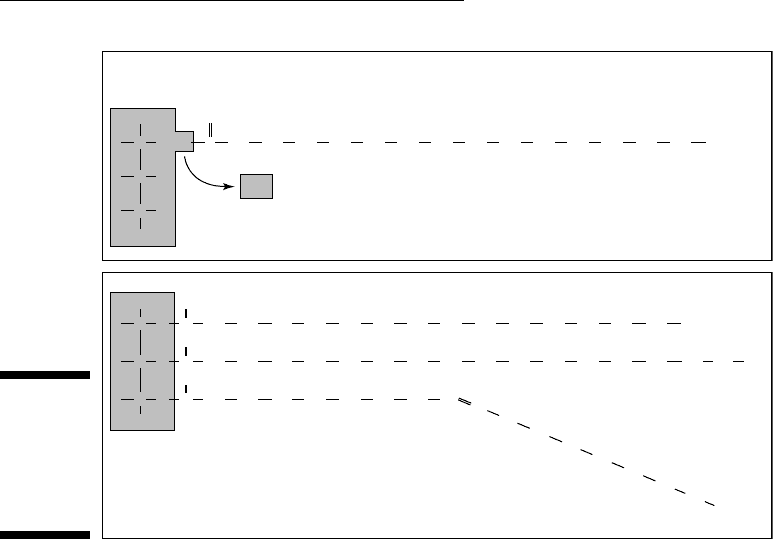
These saturated bonds pack tightly (see Figure 3-6), so fats are solid
at room temperature.
• Oils contain lots of double bonds between their carbon atoms.
These unsaturated bonds don’t pack tightly (see Figure 3-6), so oils
are liquid at room temperature.
07_598757-ch03.indd 4407_598757-ch03.indd 44 5/7/10 11:43 PM5/7/10 11:43 PM
45
Chapter 3: The Chemistry of Life
Figure 3-6:
Saturated
and unsatu-
rated bonds
in a typical
triglyceride.
Glycerol Fatty acid
H C OH HO C CH
2
CH
2
CH
2
CH
2
CH
2
CH
2
CH
2
CH
2
CH
2
CH
2
CH
2
CH
2
CH
2
CH
2
CH
3
H C OH
H C OH
H
H
H
2
O
O
H C O C CH
2
CH
2
CH
2
CH
2
CH
2
CH
2
CH
2
CH
2
CH
2
CH
2
CH
2
CH
2
CH
2
CH
2
CH
3
H
H
O
O
H C O C CH
2
CH
2
CH
2
CH
2
CH
2
CH
2
CH
2
CH
2
CH
2
CH
2
CH
2
CH
2
CH
2
CH
2
CH
2
CH
2
CH
3
O
H C O C CH
2
CH
2
CH
2
CH
2
CH
2
CH
2
CH
2
CH
CH CH
2
CH
2
CH
2
CH
2
CH
2
CH
2
CH
2
CH
3
Fat provides an energy reserve to your body. When you use up all of your
stored glucose (which doesn’t take long because sugars “burn” quickly in
aerobic conditions), your body starts breaking down glycogen, which is
stored primarily in the liver and muscle. Liver glycogen stores can typically
last 12 or more hours. After that, your body starts breaking down adipose
tissue to retrieve some stored energy. That’s why aerobic exercise, so long as
it’s enough to use up more calories than you took in that day, is the best way
to lose fat. (Notice we didn’t say “pounds” here. Pounds measure everything
in your body’s composition: fat tissue, muscle tissue, and bone, along with
water, your organs, skin, and some incidental stuff.)
07_598757-ch03.indd 4507_598757-ch03.indd 45 5/7/10 11:43 PM5/7/10 11:43 PM

46
Part I: Biology Basics
07_598757-ch03.indd 4607_598757-ch03.indd 46 5/7/10 11:43 PM5/7/10 11:43 PM

Chapter 4
The Living Cell
In This Chapter
▶ Finding out what makes cells the basic units of life
▶ Taking a look at the structure of prokaryotic and eukaryotic cells
▶ Discovering how enzymes accelerate reactions
E
very living thing has cells. The smallest creatures have only one, yet
they’re as alive as you are. What exactly is a cell? In plain and simple
terms, it’s the smallest living piece of an organism — including you. Without
cells, you’d be a disorganized blob of chemicals that’d just ooze out into the
environment. And that is why the cell is the fundamental unit of life.
You get to explore the purpose and structure of cells in this chapter. And
because cells rely on chemical reactions to make things happen, you also
find out all about enzymes, which are proteins that help speed up the pace of
chemical reactions.
An Overview of Cells
Cells are sacs of fluid that are reinforced by proteins and surrounded by
membranes. Inside the fluid float chemicals and organelles, structures inside
cells that are used during metabolic processes. (Yes, an organism contains
parts that are smaller than a cell, but these structures can’t perform all the
functions of life on their own, so they aren’t considered to be alive.)
A cell is the smallest part of an organism that retains characteristics of the
entire organism. For example, a cell can take in fuel, convert it to energy, and
eliminate wastes, just like the organism as a whole can. Because cells can per-
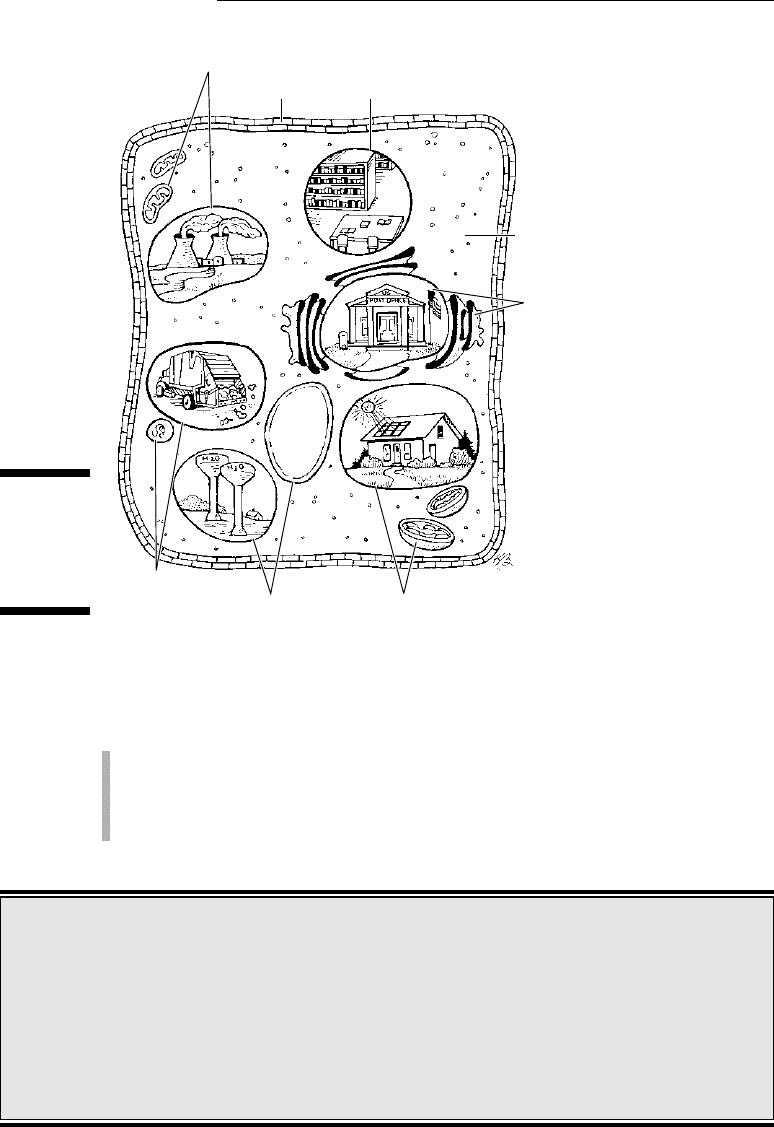
form all the functions of life (as shown in Figure 4-1), the cell is the smallest
unit of life.
08_598757-ch04.indd 4708_598757-ch04.indd 47 5/7/10 11:43 PM5/7/10 11:43 PM
48
Part I: Biology Basics
Figure 4-1:
Cells per-
form all the
functions
of life.
Nucleus
Cytoplasm
Cell wall
Mitochondria
Golgi
apparatus
Chloroplasts
Vacuoles
Lysosomes
Cells can be categorized in different ways, according to structure or function,
or in terms of their evolutionary relationships. In terms of structure, scien-
tists categorize cells based on their internal organization:
✓ Prokaryotes don’t have a “true” nucleus in their cells. Nor do they have
organelles. Bacteria and archaea are all prokaryotes.
✓ Eukaryotes have a nucleus in their cells that houses their genetic material.
They also have organelles. Plants, animals, algae, and fungi are all eukaryotes.
Viruses versus bacteria
Viruses (like those that cause the flu, a cold, or
AIDS) aren’t made of cells. Although viruses
make you sick, just like bacteria do, viruses and
bacteria are actually quite different. Viruses
are simpler than bacteria and are made of just
a few molecules. In fact, viruses have so few
parts that they can’t even grow and divide by
themselves (so they’re not considered to be
alive). Viruses can only reproduce if they take
over a host cell and steal its energy and materi-
als (head to Chapter 17 for the details of how
viruses attack cells).
08_598757-ch04.indd 4808_598757-ch04.indd 48 5/7/10 11:43 PM5/7/10 11:43 PM

49
Chapter 4: The Living Cell
Peeking at Prokaryotes
Prokaryotes include cells you’ve probably heard of, such as the bacteria E.
coli and Streptococcus (which causes strep throat), the blue-green algae that
occasionally cause lake closures, and the live cultures of bacteria in yogurt,
as well as some cells you may never have heard of, called archaeans (see
Chapter 10 for more on archaeans).
Whether you’ve heard of a specific prokaryote or not, you’re likely well aware
that bacteria have a pretty bad rap. They seem to make the papers only when
they’re causing problems, such as disease. Behind the scenes, though, bacte-
ria are quietly performing many beneficial tasks for people and the rest of life
on planet Earth. Why, if bacteria could get some good headlines, those head-
lines might read a little something like this:
✓ Bacteria are used in human food production! Yogurt and cheese are
quite tasty, humans say.
✓ Bacteria can clean up our messes! Oil-eating bacteria help save
beaches, and other bacteria help clean up our sewage.
✓ Normal body bacteria help prevent disease! Bacteria living on the body
can prevent disease-causing bacteria from moving in.
✓ Bacteria are nature’s recyclers! Bacteria release nutrients from dead
matter during decomposition.
✓ Bacteria help plants grow! Nitrogen-fixing bacteria can pull nitrogen out
of the air and convert it to a form that plants can use.
The cells of prokaryotes are fairly simple in terms of structure because they
don’t have internal membranes or organelles like eukaryotic cells do (we
cover all the structures present in eukaryotic cells later in this chapter).
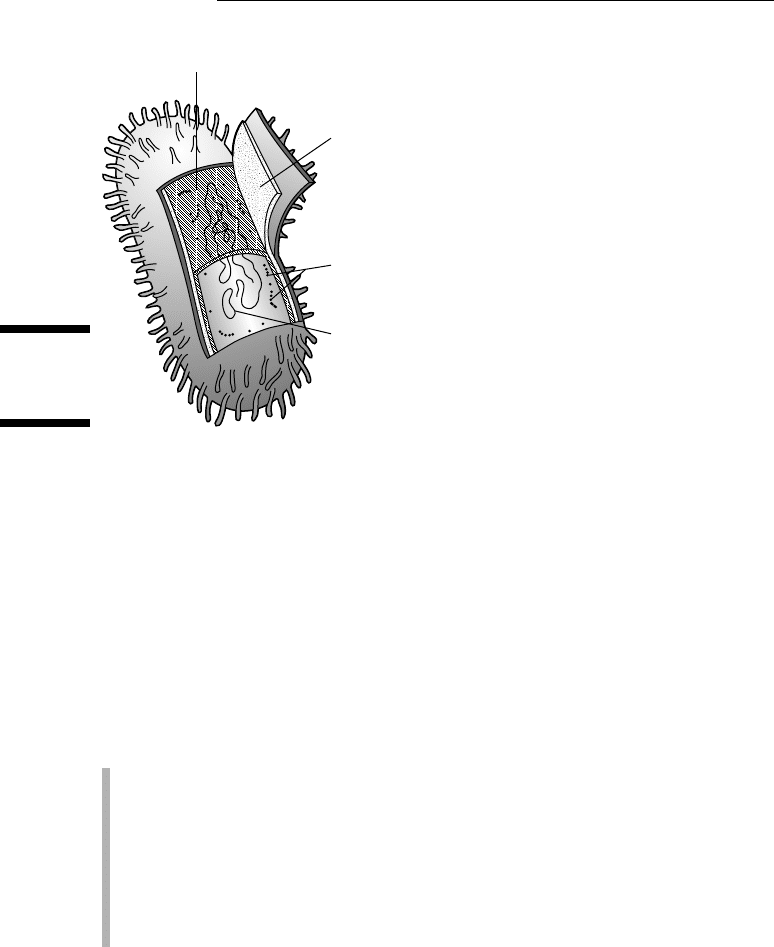
The majority of prokaryotic cells (like the one in Figure 4-2) share these
characteristics:
✓ A plasma membrane forms a barrier around the cell, and a rigid cell wall
outside the plasma membrane provides additional support to the cell.
✓ DNA, the genetic material of prokaryotes, is located in the cytoplasm, in
an area called the nucleoid.
✓ Ribosomes make proteins in the cytoplasm.
✓ Prokaryotes break down food using cellular respiration (which requires
oxygen, as explained in Chapter 5) and another type of metabolism
called fermentation (which doesn’t require oxygen).
08_598757-ch04.indd 4908_598757-ch04.indd 49 5/7/10 11:43 PM5/7/10 11:43 PM
50
Part I: Biology Basics
Figure 4-2:
A prokary-
otic cell.
Plasma membrane
Cell wall
DNA
Ribosomes
Examining the Structure
of Eukaryotic Cells
The living things you’re probably most familiar with — humans, animals,
plants, mushrooms, and molds — are all eukaryotes, but they’re not the only
members of the eukaryote family. Eukaryotes also include many inhabitants
of the microbial world, such as algae, amoebas, and plankton.
Eukaryotes have the following characteristics (see Figures 4-3 and 4-4 for dia-
grams of eukaryotic cells):
✓ A nucleus that stores their genetic information.
✓ A plasma membrane that encloses the cell and separates it from its
environment.
✓ Internal membranes, such as the endoplasmic reticulum and the Golgi
apparatus, that create specialized compartments inside the cells.
✓ A cytoskeleton made of proteins that reinforces the cells and controls
cellular movements.
08_598757-ch04.indd 5008_598757-ch04.indd 50 5/7/10 11:43 PM5/7/10 11:43 PM