
Kratz R.F., Siegfried D.R. Biology For Dummies
Подождите немного. Документ загружается.

51
Chapter 4: The Living Cell
✓ Organelles called mitochondria that combine oxygen and food to trans-
fer the energy from food to a form that cells can use.
✓ Organelles called chloroplasts, which use energy from sunlight plus
water and carbon dioxide to make food. (Chloroplasts are found only in
the cells of plants and algae.)
✓ A rigid cell wall outside of their plasma membrane. (This is found only in
the cells of plants, algae, and fungi; animal cells just have a plasma mem-
brane, which is soft.)
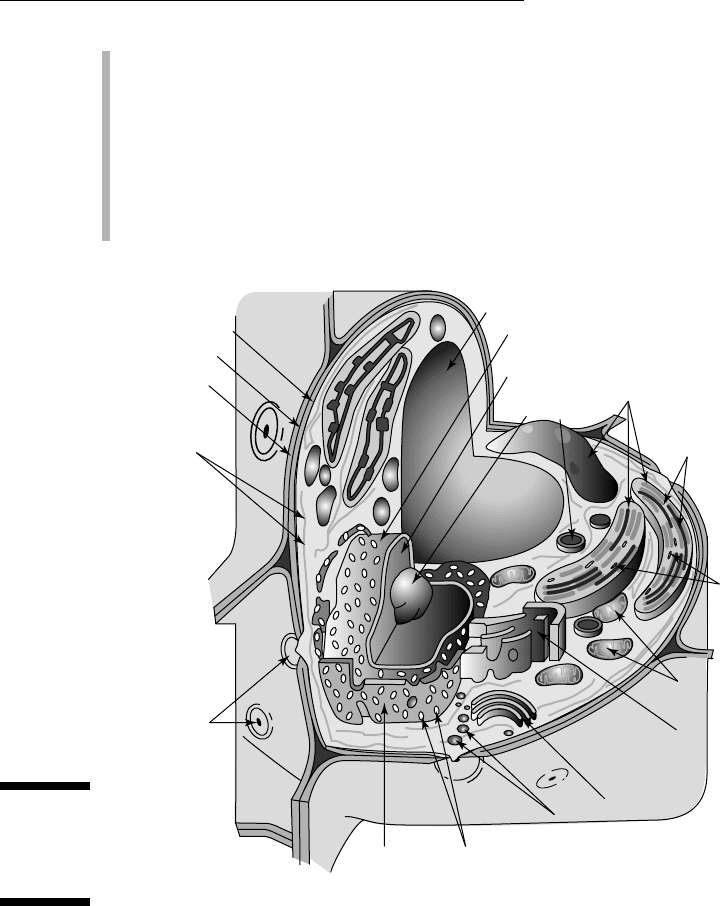
Figure 4-3:
Structures
in a typical
plant cell.
Plasma
membrane
Vacuole
Nuclear
envelope
Nucleus
Nucleolus
peroxisome
Chloroplasts
Thylakoid
membranes
Starch
grains
Mitochondria
Smooth
endoplasmic
reticulum
Golgi
apparatus
Golgi
vesicles
RibosomesRough
endoplasmic
reticulum
Plasmo-
desmata
Cell wall
Cytoskeleton
Wall of
adjoining
cell
08_598757-ch04.indd 5108_598757-ch04.indd 51 5/7/10 11:43 PM5/7/10 11:43 PM
52
Part I: Biology Basics
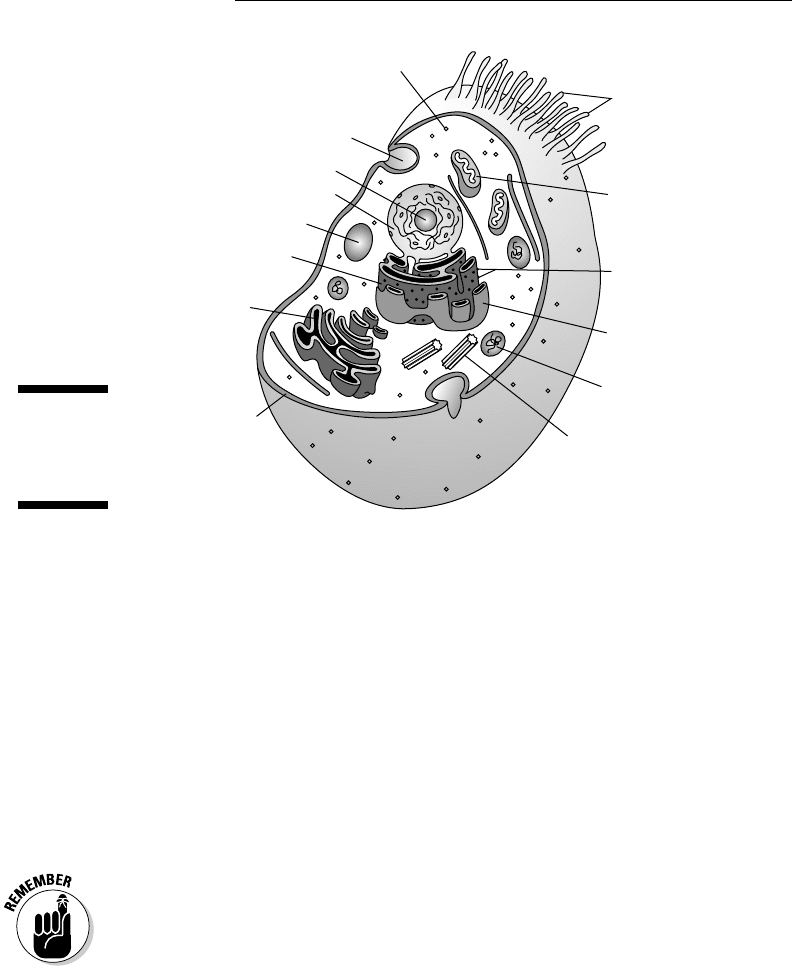
Figure 4-4:
Structures
in a typical
animal cell.
Cytoplasm
Vesicle formation
Nucleolus
Nucleus
Vacuole
Rough endoplasmic
reticulum
Golgi apparatus
Centriole
Plasma membrane
Lysosome
Smooth endoplasmic
reticulum
Ribosomes
Mitochondrion
Cilia
Cells and the Organelles: Not a
Motown Doo-wop Group
Your body is made of organs, which are made of tissues, which are made of
cells. Just like you have organs that perform specific functions for your body,
cells have organelles that perform specific functions for the cell. Some organ-
elles are responsible for metabolizing food; others are responsible for making
the structures the cell needs to function.
The sections that follow highlight the organelles found in eukaryotic cells and
get you acquainted with their specific functions.
Plant and animal cells are very similar, but they have a few significant differ-
ences in their organelles. Plant cells have chloroplasts, large central vacuoles,
and cell walls; animal cells don’t. What animal cells do have that plant cells
don’t are centrioles, small structures that are part of the cytoskeleton and
appear during animal cell division.
08_598757-ch04.indd 5208_598757-ch04.indd 52 5/7/10 11:43 PM5/7/10 11:43 PM

53
Chapter 4: The Living Cell
Holding it all together:
The plasma membrane
The membrane that encloses and defines all cells as separate from their envi-
ronment is called the plasma membrane, or the cell membrane. The job of the
plasma membrane is to separate the chemical reactions occurring inside the
cell from the chemicals outside the cell.
Thinking of the plasma membrane as an international border controlling what
enters and leaves a particular country is a good way of remembering the
plasma membrane’s function.
The fluid inside a cell, called the cytoplasm, contains all the organelles and
is very different from the fluid found outside the cell. (Cyto means “cell,” and
plasm means “shape.” So, cytoplasm literally means “cell shape,” which is fit-
ting because the plasma membrane is what defines cell shape.)
Animal cells are supported by a fluid protein-and-carbohydrate matrix called
the extracellular matrix. (Extra means “outside,” so extracellular literally
means “outside the cell.”) Plant cells are supported by a more solid struc-
ture, called a cell wall, that’s made of the carbohydrate cellulose.
The next sections explain the structure of the plasma membrane in detail and
describe how materials move through it in order to keep the cell healthy and
allow it to do its job.
Deciphering the fluid-mosaic model
Plasma membranes are made of several different components, much like a
mosaic work of art. Because membranes are a mosaic, and because they’re
flexible and fluid, scientists call the description of membrane structure the
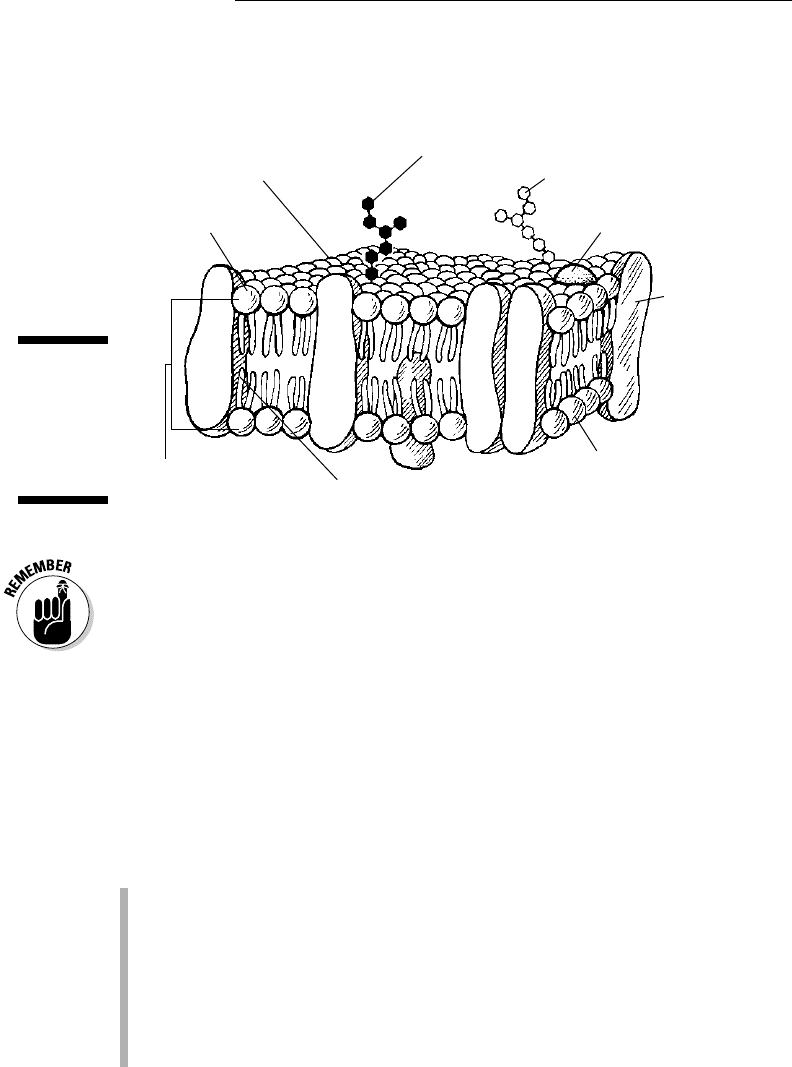
fluid-mosaic model. We’ve drawn the model for you in Figure 4-5 to help you
visualize all the parts that make up a plasma membrane.
Moving from the left of Figure 4-5 to the right, notice the phospholipid
bilayer. This serves as the foundation of the plasma membrane. Phospholipids
are a special kind of lipid (see Chapter 3 for more on lipids); they have water-
attracting and water-repelling parts. At body temperature, phospholipids
have the consistency of thick vegetable oil, which allows plasma membranes
to be flexible and fluid. Each phospholipid molecule has a hydrophilic head
that’s attracted to water and a hydrophobic tail that repels water. (Hydro
08_598757-ch04.indd 5308_598757-ch04.indd 53 5/7/10 11:43 PM5/7/10 11:43 PM
54
Part I: Biology Basics
means “water,” phile means “love,” and phobia means “fear,” so hydrophilic
literally means “water-loving” and hydrophobic literally means “water-fearing.”)
Figure 4-5:
The fluid-
mosaic
model of
plasma
membranes.
Hydrophilic head
External surface membrane
Phospholipid bilayer
Carbohydrate chain
Glycolipid
Glycoprotein
Protein
molecule
Internal surface membrane
Hydrophobic tail
In each cell, the hydrophilic heads point toward the watery environments
outside and inside the cell, sandwiching the hydrophobic tails between them
to form the phospholipid bilayer (see Figure 4-5). Because cells reside in a
watery solution (the extracellular matrix), and because they contain a watery
solution inside of them (cytoplasm), the plasma membrane forms a sphere
around each cell so that the water-attracting heads are in contact with the
fluid, and the water-repelling tails are protected on the inside.
In addition to phospholipids, proteins are a major component of plasma
membranes. The proteins are embedded in the phospholipid bilayer, but
they can drift in the membrane like ships sailing through an oily ocean.
Cholesterol and carbohydrates are minor components of plasma membranes,
but they play fairly significant roles.
✓ Cholesterol makes the membrane more stable and prevents it from
solidifying when your body temperature is low. (It keeps you from liter-
ally freezing when you’re “freezing.”)
✓ Carbohydrate chains attach to the outer surface of the plasma mem-
brane on each cell. When carbohydrates attach to the phospholipids,
they form glycolipids (and when they attach to the proteins, they form
glycoproteins). Your DNA determines which specific carbohydrates
attach to your cells, affecting characteristics such as your blood type.
08_598757-ch04.indd 5408_598757-ch04.indd 54 5/7/10 11:43 PM5/7/10 11:43 PM

55
Chapter 4: The Living Cell
Transporting materials through the plasma membrane
Cells are busy places. They manufacture materials that need to be shipped
out, and they need to take up materials such as food and signals. These
important exchanges take place at the plasma membrane.
Whether or not a molecule can cross a plasma membrane depends upon its
structure and the cell. Small, hydrophobic molecules such as oxygen and
carbon dioxide are compatible with the hydrophobic tails of the phosopho-
lipid bilayer, so they can easily scoot across membranes. Hydrophilic mol-
ecules such as ions can’t get through the tails by themselves, so they need
help to cross. Larger molecules (think food and hormones) also need help,
which comes in the form of transport proteins.
Some of these proteins help form openings called channels in the membrane.
Small molecules such as hormones and ions may be allowed to pass through
these channel proteins. Other proteins, called carrier proteins, pick up mol-
ecules on one side of a membrane and then drop them off on the other side.
Other proteins in the membrane act as receptors that detect the presence of
molecules the cell needs. When these molecules bind to receptors, the cell
allows the molecules to cross the plasma membrane with the help of trans-
port proteins.
Because the plasma membrane is choosy about what substances can pass
through it, it’s said to be selectively permeable. (Permeability describes
the ease with which substances can pass through a border, such as a cell
membrane. Permeable means that most substances can easily pass through.
Impermeable means substances can’t pass through. Selectively permeable and
semipermeable mean that only certain substances are able to pass through.)
Materials can pass through the plasma membrane either passively or
actively, as you discover in the following sections.
Passively moving along
Passive transport requires no energy on the part of the cell. Molecules can
move passively across membranes in one of two ways. In both cases, the mol-
ecules are moving from where they’re more concentrated to where they’re
less concentrated. (In other words, they spread themselves out randomly until
they’re evenly distributed.) Here are the two methods of passive transport:
✓ Diffusion: The movement of molecules other than water from an area
where they’re highly concentrated to an area where they’re less concen-
trated is diffusion. To go from a high concentration to a low concentra-
tion, the molecules need only diffuse (spread themselves) across the
membrane, separating the areas of concentration.
✓ Osmosis: The diffusion of water across a membrane is osmosis. It works
the same way as diffusion, but it can be a little confusing because the
movement of water is affected by the concentration of substances called
08_598757-ch04.indd 5508_598757-ch04.indd 55 5/7/10 11:43 PM5/7/10 11:43 PM
56
Part I: Biology Basics
solutes that are dissolved in the water. Basically, water moves from
areas where it’s more concentrated (more pure) to areas where it’s less
concentrated (where it has more solutes).
Try thinking about osmosis in terms of the solutes: Water moves toward
the area with the greatest concentration of solutes. For example, the
blood in your body contains a certain amount of salt. If the concentra-
tion of salt in your blood suddenly rises, water moves out of the blood
cells, and your blood cells shrivel up. On the other hand, if too much
fluid is in the bloodstream, the blood cells have too many molecules
of salt in comparison, so they take in water. If they need to take in too
much water to bring everything back into balance, they can swell and
burst.
The relative concentration of solutes on either side of a membrane is com-
pared in terms of the tonicity of the solutions. If a solution is isotonic, the con-
centrations of the substances (solutes) and water (solvent) on both sides of
the membrane are equal. If one solution is hypotonic, it has a lower concentra-
tion of substances (and more water) in it when compared to another solution.
If a solution is hypertonic, it has a higher concentration of substances in it (and
less water) when compared to another solution.
Actively helping molecules across
Active transport requires some energy from the cell to move molecules that
can’t cross the phospholipid bilayer on their own from where they’re less
concentrated to where they’re more concentrated. Carrier proteins, called
active transport proteins or pumps, use energy stored in the cell to concen-
trate molecules inside or outside of the cell.
Active transport is a little like having to pay to take the Staten Island Ferry.
The ferry is the carrier protein, and you’re the big molecule that needs
help getting from the bloodstream (New York Bay) to the inside of the cell
(New York City). The fee that you pay is equivalent to the energy molecules
expended by the cell.
Diffusion at work in your lungs
In the human body, one place that diffusion
occurs is in the lungs. You breathe in air, and
oxygen gets into the tiniest air sacs of the lungs,
called the alveoli. Surrounding the alveoli are
the tiniest blood vessels — the pulmonary cap-
illaries. The pulmonary capillaries contain the
lowest concentration of oxygen in the body
because by the time blood gets to them, most
of the oxygen has been used up by other organs
and tissues. This means the alveoli have a
higher concentration of oxygen than the pulmo-
nary capillaries. Oxygen from the alveoli of the
lungs diffuses across the membrane between
the air sac and the capillary, getting into the
bloodstream so it can travel around the body.
08_598757-ch04.indd 5608_598757-ch04.indd 56 5/7/10 11:43 PM5/7/10 11:43 PM
57
Chapter 4: The Living Cell
Supporting the cell: The cytoskeleton
Much like your skeleton reinforces the structure of your body, the cytoskel-
eton of a cell reinforces that cell’s structure. However, it provides that rein-
forcement in the form of protein cables rather than bones. The proteins of
the cytoskeleton reinforce the plasma membrane and the nuclear envelope
(covered in the next section). They also run through the cell like railroad
tracks, helping vesicles and organelles circulate around the cell.
Think of the cytoskeleton as a cell’s scaffolding and railroad tracks because it
reinforces the cell and allows things to move around within it.
Some cells have whiplike projections that help them swim or move fluids. If
the projections are short, like those shown in Figure 4-4, the structures are
called cilia. If the projections are long, they’re called flagella. Both cilia and
flagella contain cytoskeletal proteins. The proteins flex back and forth, making
the cilia and flagella beat like little whips. Cells with cilia exist in your respi-
ratory tract, where they wiggle their cilia to move mucus so you can cough
it out; they’re also found in your digestive tract, where they help move food
along. Flagella are present on human sperm cells; they’re what allow sperm to
swim rapidly toward an egg during sexual reproduction.
Controlling the show: The nucleus
Every cell of every living thing contains genetic material called DNA (which
is short for deoxyribonucleic acid, as explained in Chapter 3). In eukaryotic
cells, DNA is contained within a chamber called a nucleus that’s separated
from the cytoplasm by a membrane called the nuclear envelope (also known
as the nuclear membrane). In the nucleus of cells that aren’t multiplying, the
DNA is wound around proteins and loosely spread out in the nucleus. When
DNA is in this form, it’s called chromatin. However, right before a cell divides,
the chromatin coils up tightly into chromosomes. Human cells have 46 chro-
mosomes, each one of which is a separate piece of DNA.
DNA contains the instructions for building molecules, mostly proteins, that do
the work of the cell. Cell function depends upon the action of these proteins,
and organism function depends on cell function. So, ultimately, organism func-
tion depends upon the instructions in the DNA.
Consider the nucleus the library of the cell because it holds lots of informa-
tion. The chromosomes are the library’s books, full of instructions for building
cells.
Proteins in the nucleus copy the instructions from the DNA into molecules
that get shipped out to the cytoplasm, where they direct the behavior of the
cell. For example, each nucleus has a round mass inside it called a nucleolus.
08_598757-ch04.indd 5708_598757-ch04.indd 57 5/7/10 11:43 PM5/7/10 11:43 PM

58
Part I: Biology Basics
The nucleolus produces ribosomes, which move out to the cytoplasm to
help make proteins. In experiments where scientists transplant the nucleus
from one cell into the cytoplasm of another cell, the cell behaves according
to the instructions in the nucleus. So, the nucleus is the true control center
of the cell.
Creating proteins: Ribosomes
Ribosomes are small structures found in the cytoplasm of cells. The instruc-
tions for proteins are copied from the DNA into a new molecule called
messenger RNA (mRNA). The mRNA leaves the nucleus and carries the
instructions to the ribosomes out in the cytoplasm of the cell. The ribosomes
then organize the mRNA and other molecules that are needed to build
proteins (for the full scoop on how proteins are made, flip to Chapter 8).
Thinking of ribosomes like workbenches where proteins are built is a good
way to remember their function.
Serving as the cell’s factory:
The endoplasmic reticulum
The endoplasmic reticulum (ER) is a series of canals that connects the nucleus
to the cytoplasm of the cell. (Endo means “inside,” and reticulum refers to the
netlike appearance of the ER, so endoplasmic reticulum basically means “a
netlike shape inside the cytoplasm.”) As you can see in Figure 4-4, part of the
ER is covered in dots, which are actually ribosomes that attach to it during
the synthesis of certain proteins. This part is called the rough ER, or RER. The
part of the ER without ribosomes is called the smooth ER (SER).
Ribosomes on the RER make proteins that either get shipped out of the
cell or become part of the membrane. (Proteins that stay in the cell are put
together on ribosomes that float free in the cytoplasm.) The SER is involved
in the metabolism of lipids (fats). Proteins and lipids made at the ER get pack-
aged up into little spheres of membrane called transport vesicles that carry
the molecules from the ER to the nearby Golgi apparatus.
To help you remember the ER’s purpose, think of the ER as the cell’s internal
manufacturing plant because it produces proteins and lipids and then ships
them out (to the Golgi apparatus).
08_598757-ch04.indd 5808_598757-ch04.indd 58 5/7/10 11:43 PM5/7/10 11:43 PM

59
Chapter 4: The Living Cell
Preparing products for distribution:
The Golgi apparatus
The Golgi apparatus, which is located very close to the ER (as you can see
in Figure 4-4), looks like a maze with water droplets splashing off of it. The
“water droplets” are transport vesicles bringing material from the ER to the
Golgi apparatus.
Inside the Golgi apparatus, products produced by the cell, such as hormones
or enzymes, are chemically tagged and packaged for export either to other
organelles or to the outside of the cell. After the Golgi apparatus has pro-
cessed the molecules, it packages them back up into a vesicle and ships them
out again. If the molecules are to be shipped out of the cell, the vesicle finds
its way to the plasma membrane, where certain proteins allow a channel to
be produced so that the products inside the vesicle can be secreted to the
outside of the cell. Once outside the cell, the materials can enter the blood-
stream and be transported through the body to where they’re needed.
If it helps you remember, you can consider the Golgi apparatus the cell’s post
office because it receives molecular packages and tags them for shipping to
their proper destination.
Cleaning up the trash: Lysosomes
Lysosomes are special vesicles formed by the Golgi apparatus to clean up the cell.
Lysosomes contain digestive enzymes, which are used to break down products
that may be harmful to the cell and “spit” them back out into the extracellular
fluid. (We fill you in on enzymes in the later “Presenting Enzymes, the Jump-
Starters” section.) Lysosomes also remove dead organelles by surrounding them,
breaking down their proteins, and releasing them to construct a new organelle.
Essentially, lysosomes are the waste collectors of the cell; they gather materials
the cell no longer needs and break them down so some parts can be recycled.
Destroying toxins: Peroxisomes
Peroxisomes are little sacs of enzymes that break down many different types
of molecules and help protect the cell from toxic products. Peroxisomes help
in the breakdown of lipids, making their energy available to the cell.
08_598757-ch04.indd 5908_598757-ch04.indd 59 5/7/10 11:43 PM5/7/10 11:43 PM

60
Part I: Biology Basics
Some of the reactions that occur in peroxisomes produce hydrogen peroxide,
which is a dangerous molecule to cells. Peroxisomes prevent your cells from
being damaged by hydrogen peroxide by converting the hydrogen peroxide
into plain old water plus an extra oxygen molecule, both of which are always
needed by the body and can be used in any cell.
Peroxisomes are a little bit like food processors. They’re involved in break-
ing things down, just like the blades of a food processor are used to chop up
larger pieces of food.
Providing energy, ATP-style: Mitochondria
Mitochondria supply cells with the energy they need to move and grow by
breaking down food molecules, extracting their energy, and transferring it to
an energy-storing molecule that cells can easily use. That energy-storing mol-
ecule is ATP, short for adenosine triphosphate.
Recall the role of mitochondria by thinking of them as the power plants of the
cell because they produce the energy the cell needs.
The process mitochondria use to transfer the energy in foods to ATP is called
cellular respiration. What occurs during cellular respiration is like what occurs
when a campfire burns, just on a much smaller scale. In a campfire, wood
burns, consuming oxygen and transferring energy (heat and light) and matter
(carbon dioxide and water) to the environment. In a mitochondrion, food
molecules break down, consuming oxygen and transferring energy to cells (to
be stored in ATP) and the environment (as heat). For more details on cellular
respiration, see Chapter 5.
Converting energy: Chloroplasts
Chloroplasts are organelles found solely in plants and algae. They specialize
in transferring energy from the Sun into the chemical energy in food. They
often have a distinctly green color because they contain chlorophyll, a green
pigment that can absorb sunlight. During photosynthesis, the energy from
sunlight is used to combine the atoms from carbon dioxide and water to pro-
duce sugars, from which all types of food molecules can be made. (Turn to
Chapter 5 for more on photosynthesis.)
Consider chloroplasts the plant equivalent of solar-powered kitchens because
they use energy from the Sun and “ingredients” from the environment (carbon
dioxide and water) to make food.
08_598757-ch04.indd 6008_598757-ch04.indd 60 5/7/10 11:43 PM5/7/10 11:43 PM