
Li L.(E)., Halpern J., Bahl P., Wang Y., Wattenhofer R. A Cone-Based Distributed Topology-Control Algorithm for Wireless Multi-Hop Networks
Подождите немного. Документ загружается.

IEEE/ACM TRANSACTIONS ON NETWORKING, VOL. 13, NO. 1, FEBRUARY 2005 147
A Cone-Based Distributed Topology-Control
Algorithm for Wireless Multi-Hop Networks
Li (Erran) Li, Member, IEEE, Joseph Y. Halpern, Senior Member, IEEE, Paramvir Bahl, Senior Member, IEEE,
Yi-Min Wang, and Roger Wattenhofer
Abstract—The topology of a wireless multi-hop network can be
controlled by varying the transmission power at each node. In
this paper, we give a detailed analysis of a cone-based distributed
topology-control (CBTC) algorithm. This algorithm does not
assume that nodes have GPS information available; rather it
depends only on directional information. Roughly speaking, the
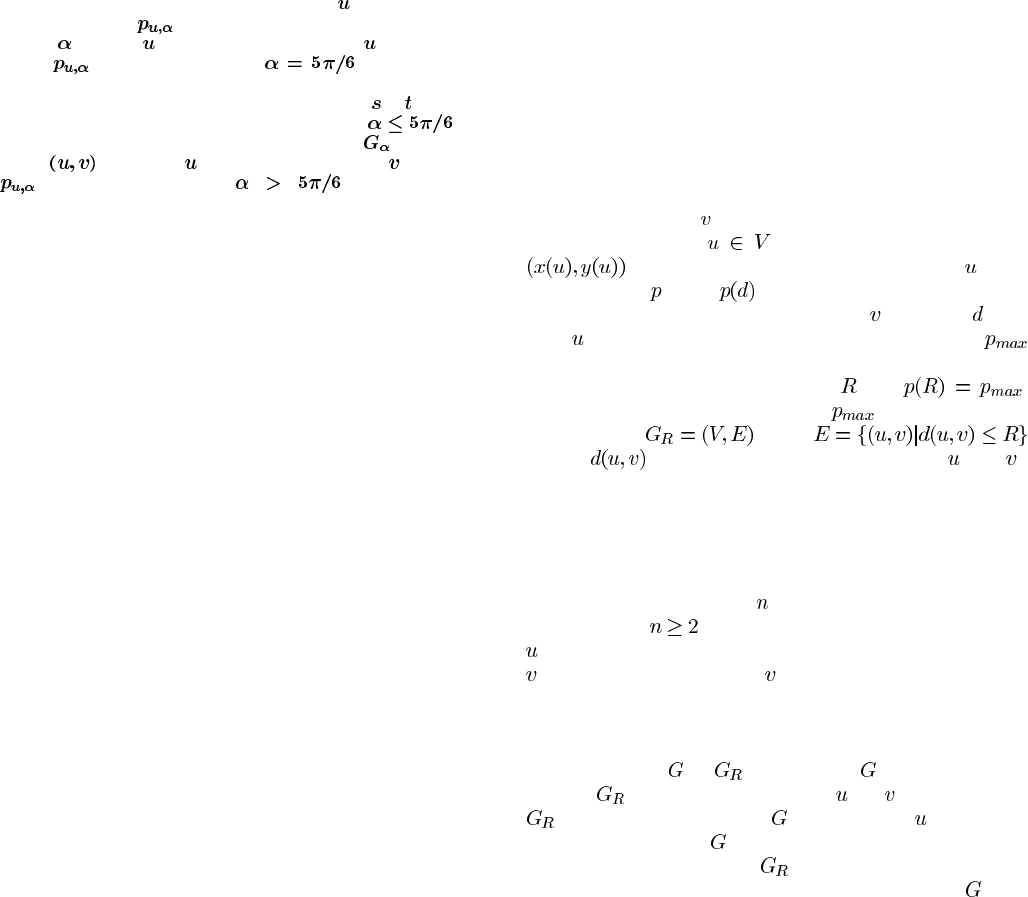
basic idea of the algorithm is that a node
transmits with the
minimum power
required to ensure that in every cone of
degree
around , there is some node that can reach with
power
. We show that taking is a necessary and
sufficient condition to guarantee that network connectivity is
preserved. More precisely, if there is a path from
to when every
node communicates at maximum power then, if
, there
is still a path in the smallest symmetric graph
containing all
edges
such that can communicate with using power
. On the other hand, if , connectivity is not
necessarily preserved. We also propose a set of optimizations that
further reduce power consumption and prove that they retain
network connectivity. Dynamic reconfiguration in the presence
of failures and mobility is also discussed. Simulation results are
presented to demonstrate the effectiveness of the algorithm and
the optimizations.
Index Terms—Connectivity, localized distributed algorithm,
power management, topology control.
I. INTRODUCTION
M
ULTI-HOP wireless networks, such as radio networks
[11], ad hoc networks [16], and sensor networks [4],
[18], are networks where communication between two nodes
may go through multiple consecutive wireless links. Unlike
wired networks, which typically have a fixed network topology
Manuscript received August 30, 2002; revised September 8, 2003; approved
by IEEE/ACM T
RANSACTIONS ON NETWORKING Editor K. Calvert. The work of
J. Y. Halpern and L. Li was supported in part by the National Science Founda-
tion under Grants IRI-96-25901, IIS-0090145, and NCR97-25251, and the Of-
fice of Naval Research under Grants N00014-00-1-03-41, N00014-01-10-511,
and N00014-01-1-0795. The work of R. Wattenhofer was supported in part by
the National Competence Center in Research on Mobile Information and Com-
munication Systems (NCCR-MICS), which is supported by the Swiss National
Science Foundation under Grant 5005-67322. This is a revised and extended ver-
sion of a paper which appeared in
Proceedings of ACM Principles of Distributed
Computing (PODC), 2001, and includes results from “Distributed topology con-
trol for power efficient operation in multihop wireless ad hoc networks,” by
R. Wattenhofer, L. Li, P. Bahl, and Y.-M. Wang, which appeared in the Pro-
ceedings of IEEE INFOCOM, 2001.
L. Li is with Bell Laboratories, Lucent Technologies, Holmdel, NJ 07733-
3030 USA (e-mail: erranlli@bell-labs.com).
J. Y. Halpern is with the Department of Computer Science, Cornell University,
Ithaca, NY 14853-7501 USA (e-mail: halpern@cs.cornell.edu).
P. Bahl and Y.-M. Wang are with Microsoft Research, Redmond, WA 98052
USA (e-mail: bahl@microsoft.com; ymwang@microsoft.com).
R. Wattenhofer is with ETH Zurich, 8092 Zurich, Switzerland (e-mail: wat-
tenhofer@inf.ethz.ch).
Digital Object Identifier 10.1109/TNET.2004.842229
(except in case of failures), each node in a wireless network
can potentially change the network topology by adjusting
its transmission power to control its set of neighbors. The
primary goal of topology control is to design power-efficient
algorithms that maintain network connectivity and optimize
performance metrics such as network lifetime and throughput.
As pointed out by Chandrakasan
et al. [2], network protocols
that minimize energy consumption are key to the successful
usage of wireless sensor networks. To simplify deployment
and reconfiguration in the presence of failures and mobility,
distributed topology-control algorithms that utilize only local
information and allow asynchronous operations are particularly
attractive.
The topology-control problem can be formalized as follows.
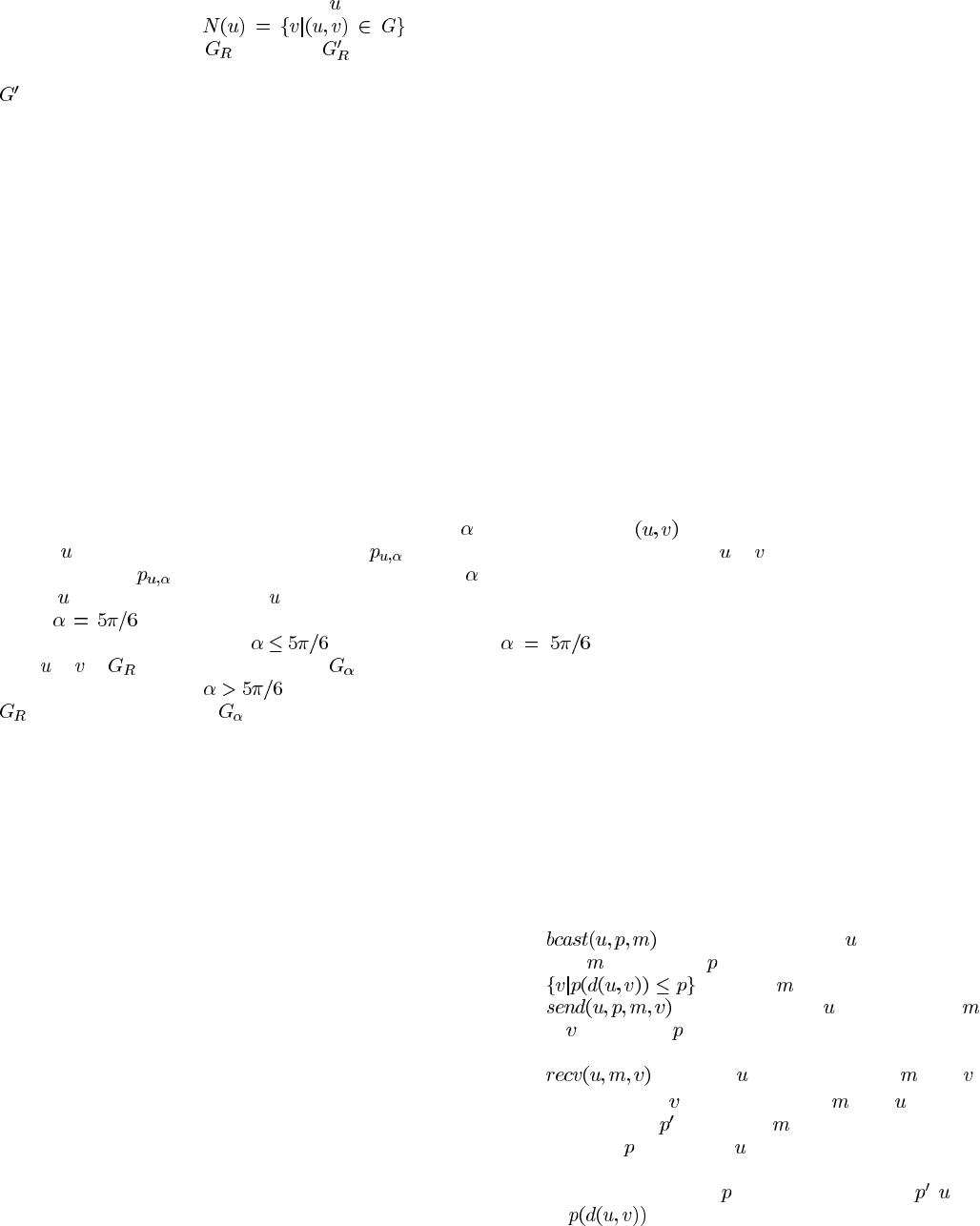
We are given a set
of possibly mobile nodes located in
the plane. Each node
is specified by its coordinates,
, at any given point in time. Each node has a
power function
where gives the minimum power needed
to establish a communication link to a node
at distance away
from
. Assume that the maximum transmission power
is the same for every node, and the maximum distance for any
two nodes to communicate directly is
, i.e., .
If every node transmits with power
, then we have an
induced graph
where
(where is the Euclidean distance between and ).
Although this model is not always appropriate, Rodouplu and
Meng [23] argue that it does capture various radio propagation
environments.
It is undesirable to have nodes transmit with maximum power
for two reasons. First, since the power required to transmit be-
tween nodes increases as the
th power of the distance between
them, for some
[22], it may require less power for a node
to relay messages through a series of intermediate nodes to
than to transmit directly to . Second, the greater the power
with which a node transmits, the greater the likelihood of the
transmission interfering with other transmissions.
Our goal in performing topology control is to find an undi-
rected
1
subgraph of such that (1) consists of all the
nodes in
but has fewer edges, (2) if and are connected in
, they are still connected in , and (3) a node can transmit
to all its neighbors in
using less power than is required to
transmit to all its neighbors in
. Since minimizing power con-
sumption is so important, it is desirable to find a graph
satis-
fying these three properties that minimizes the amount of power
that a node needs to use to communicate with all its neighbors.
1
Directed links complicate the design of routing and MAC protocols [19].
1063-6692/$20.00 © 2005 IEEE
148 IEEE/ACM TRANSACTIONS ON NETWORKING, VOL. 13, NO. 1, FEBRUARY 2005
Furthermore, for a topology control algorithm to be useful in
practice, it must be possible for each node
in the network to
construct its neighbor set
in a dis-
tributed fashion. Finally, if
changes to due to node fail-
ures or mobility, it must be possible to reconstruct a connected
without global coordination.
In this paper we consider a cone-based topology-control
(CBTC) algorithm, and show that it satisfies all these desiderata.
Most previous papers on topology control have utilized position
information, which usually requires the availability of GPS at
each node. There are a number of disadvantages with using
GPS. In particular, the acquisition of GPS location information
incurs a high delay, and GPS does not work in indoor environ-
ments or cities. By way of contrast, the cone-based algorithm
requires only the availability of directional information. That
is, it must be possible to estimate the direction from which
another node is transmitting. Techniques for estimating direc-
tion without requiring position information are available, and
discussed in the IEEE antenna and propagation community
as the Angle-of-Arrival problem. The standard way of doing
this is by using more than one directional antenna (see [12]).
Specifically, the direction of incoming signals is determined
from the difference in their arrival times at different elements
of the antenna.
2
The cone-based algorithm takes as a parameter an angle .
A node
then tries to find the minimum power such that
transmitting with
ensures that in every cone of degree
around , there is some node that can reach. We show that
taking
is necessary and sufficient to preserve con-
nectivity. That is, we show that if
, then there is a path
from
to in iff there is such a path in (for all possible
node locations) and that if
, then there exists a graph
that is connected while is not. Moreover, we propose
several optimizations and show that they preserve connectivity.
Finally, we discuss how the algorithm can be extended to deal
with dynamic reconfiguration and asynchronous operations.
There were a number of papers on topology control prior
to our work; as we said earlier, all assume that position in-
formation is available. Hu [9] describes an algorithm that
does topology control using heuristics based on a Delauney
triangulation of the graph. There seems to be no guarantee
that the heuristics preserve connectivity. Ramanathan and Ros-
ales-Hain [21] describe a centralized spanning tree algorithm
for achieving connected and biconnected static networks, while
minimizing the maximum transmission power. (They also
describe distributed algorithms that are based on heuristics
and are not guaranteed to preserve connectivity.) Rodoplu
and Meng [23] propose a distributed position-based topology
control algorithm that preserves connectivity; their algorithm
is improved by Li and Halpern [13]. Other researchers working
in the field of packet radio networks, wireless ad hoc networks,
and sensor networks have also considered the issue of power
efficiency and network lifetime, but have taken different ap-
proaches. For example, Hou and Li [8] analyze the effect of
adjusting transmission power to reduce interference and hence
2
Of course, if GPS information is available, a node can simply piggyback its
location to its message and the required directional information can be calcu-
lated from that.
achieve higher throughput as compared to schemes that use
fixed transmission power [24]. Heinzelman et al. [7] describe
an adaptive clustering-based routing protocol that maximizes
network lifetime by randomly rotating the role of per-cluster
local base stations (cluster-head) among nodes with higher
energy reserves. Chen et al. [3] and Xu et al. [30] propose
methods to conserve energy and increase network lifetime by
turning off redundant nodes. Wu et al. [29] and Monks et al.
[15] describe their power controlled MAC protocols to reduce
energy consumptions and increase throughput. They do this
through power control of unicast packets, but make no attempt
at reducing the power consumption of broadcast packets.
After the initial publication of our results on CBTC [14], [27],
there appeared a number of papers proposing different localized
topology-control algorithms [10], [26], [28]. CBTC was the first
algorithm that simultaneously achieved a variety of useful prop-
erties, such as symmetry, sparseness, and good routes; some of
the recent topology also aim to simultaneously achieve a number
of properties, most notably [26] and [10]. CBTC was also the
first topology-control algorithm that did not require GPS in-
formation, but used only angle-of-arrival information. The only
improvement toward this end that we are aware of is the XTC
topology-control algorithm [28]. The XTC algorithm is some-
what similar in spirit to the SMECN algorithm [13], in that it
removes an edge
if, according to some path-loss model,
there is a two-hop path from
to which nevertheless requires
less energy than the direct path.
The rest of the paper is organized as follows. Section II
presents the basic cone-based algorithm and shows that
is necessary and sufficient for connectivity. Sec-
tion III describes several optimizations to the basic algorithm
and proves their correctness. Section IV extends the basic
algorithm so that it can handle the reconfiguration necessary to
deal with failures and mobility. Section V describes network
simulation results that show the effectiveness of the basic
approach and the optimizations. Section VI summarizes this
paper.
II. T
HE BASIC CONE-BASED TOPOLOGY
CONTROL ALGORITHM
We consider three communication primitives: broadcast,
send, and receive, defined as follows:
•
is invoked by node to send mes-
sage
with power ; it results in all nodes in the set
receiving .
•
is invoked by node to sent message
to with power . This primitive is used to send unicast
messages, i.e., point-to-point messages.
•
is used by to receive message from .
We assume that when
receives a message from , it knows
the reception power
of message . This is, in general, less
than the power
with which sent the message, because of
radio signal attenuation in space. Moreover, we assume that,
given the transmission power
and the reception power , can
estimate
. This assumption is reasonable in practice.
For ease of presentation, we first assume a synchronous
model; that is, we assume that communication proceeds in
rounds, governed by a global clock, with each round taking
LI et al.: A CONE-BASED DISTRIBUTED TOPOLOGY-CONTROL ALGORITHM FOR WIRELESS MULTI-HOP NETWORKS 149
one time unit. (We deal with asynchrony in Section IV.) In
each round each node
can examine the messages sent to it,
compute, and send messages using the
and com-
munication primitives. The communication channel is reliable.
We later relax this assumption, and show that the algorithm is
correct even in an asynchronous setting.
The basic Cone-Based Topology-Control (
CBTC) algorithm
is easy to explain. The algorithm takes as a parameter an angle
. Each node tries to find at least one neighbor in every cone of
degree
centered at . Node starts running the algorithm by
broadcasting a “Hello” message using low transmission power,
and collecting Ack replies. It gradually increases the transmis-
sion power to discover more neighbors. It keeps a list of the
nodes that it has discovered and the direction in which they are
located. (As we said in Section I, we assume that each node
can estimate directional information.) It then checks whether
each cone of degree
contains a node. This check is easily per-
formed: the nodes are sorted according to their angles relative to
some reference node (say, the first node from which
received
a reply). It is immediate that there is a gap of more than
be-
tween the angles of two consecutive nodes iff there is a cone of
degree
centered at which contains no nodes. If there is such
a gap, then
broadcasts with greater power. This continues until
either
finds no -gap or broadcasts with maximum power.
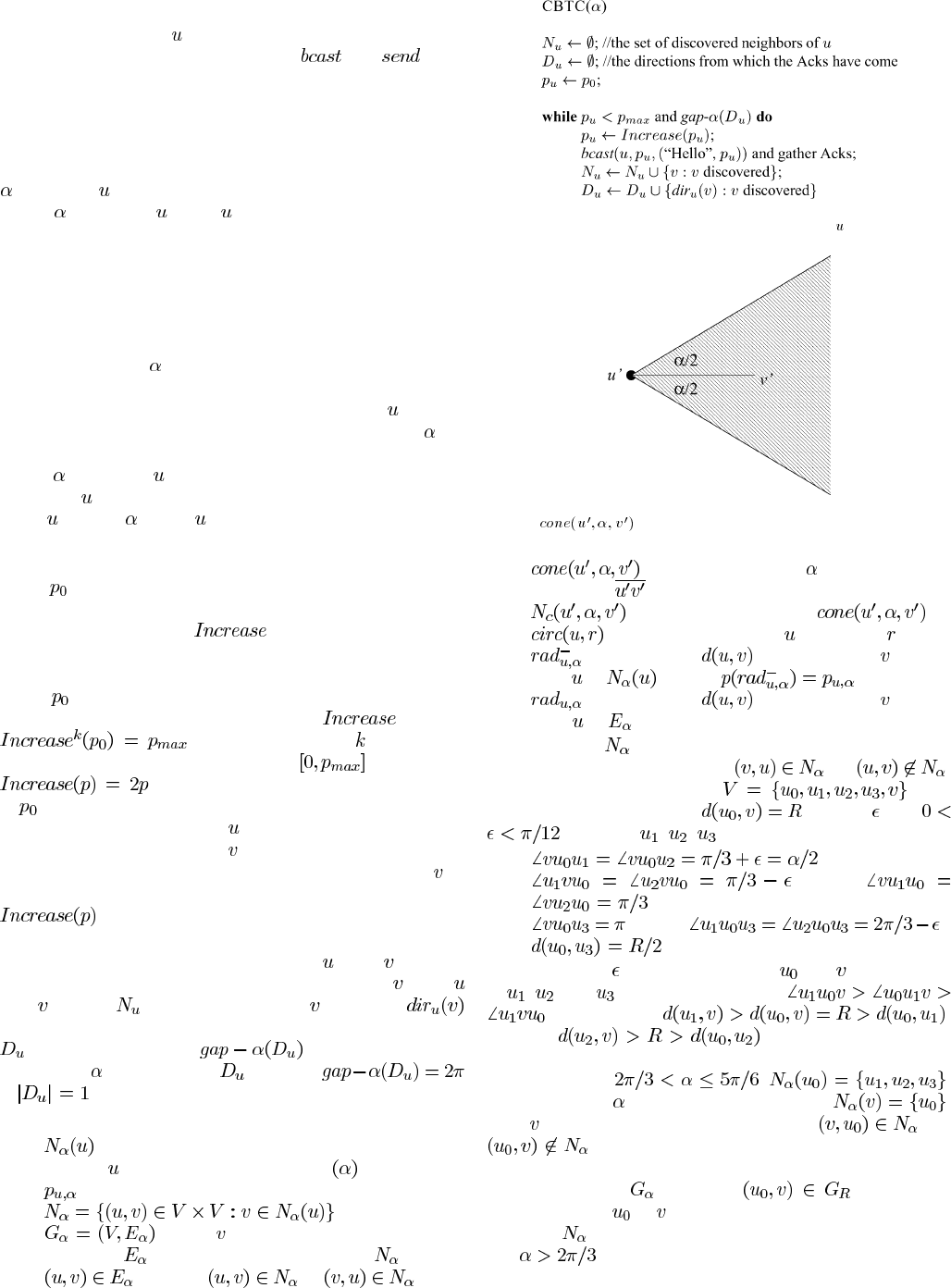
Fig. 1 gives the basic CBTC algorithm. In the algorithm, a
“Hello” message is originally broadcasted using some minimal
power
. In addition, the power used to broadcast the message
is included in the message. The power is then increased at each
step using some function
. As in [13] (where a sim-
ilar function is used, in the context of a different algorithm),
in this paper, we do not investigate how to choose the initial
power
, nor do we investigate how to increase the power at
each step. We simply assume some function
such that
for sufficiently large . If transmis-
sion power can be set continuously in
, one can set
for fast convergence. If the initial choice
of
is less than the total power actually needed, then it is easy
to see that this guarantees that
’s estimate of the transmission
power needed to reach a node
will be within a factor of 2 of
the minimum transmission power actually needed to reach
.If
transmission power can only be set to several discrete values,
can be set to each value in increasing order. We
adopt the latter approach in our simulation.
Upon receiving a “Hello” message from
, node responds
with an Ack message. Upon receiving the Ack from
, node
adds to its set of neighbors and adds ’s direction
(measured as an angle relative to some fixed angle) to its set
of directions. The test tests if there is a gap
greater than
in the angles in . (We take
if .)
We use the following notation throughout the paper.
•
is the final set of discovered neighbors computed
by node
at the end of running CBTC .
•
is the corresponding final power.
•
.
•
, where consists of all nodes in the net-
work and
is the symmetric closure of ; that is,
iff either or .
Fig. 1. Basic cone-based algorithm running at each node .
Fig. 2. .
•
is the cone of degree which is bisected
by the line
, as in Fig. 2.
•
is the set of nodes inside .
•
is the circle centered at with radius .
•
is the distance of the neighbor farthest
from
in ; that is, .
•
is the distance of the neighbor farthest
from
in .
Note that the
relation is not symmetric. As the following
example shows, it is possible that
but .
Example II.1: Suppose that
. (See
Fig. 3.) Further suppose that
. Choose with
and place , , so that:
1)
;
2)
(so that
);
3)
(so that );
4)
.
Note that, given
and the positions of and , the positions
of
, , and are determined. Since
, it follows that ;
similarly
. (Here and elsewhere we
use the fact that, in a triangle, larger sides are opposite larger
angles.) Assume
. ,
since there is no
-gap with this neighbor set. ,
since
has to reach maximum power. Thus, ,but
.
Example II.1 shows the need for taking the symmetric clo-
sure in computing
. Although , there would
be no path from
to if we considered just the edges deter-
mined by
, without taking the symmetric closure. (The fact
that
in this example is necessary. As we shall see in
Section III-B, taking the symmetric closure is not necessary if
150 IEEE/ACM TRANSACTIONS ON NETWORKING, VOL. 13, NO. 1, FEBRUARY 2005
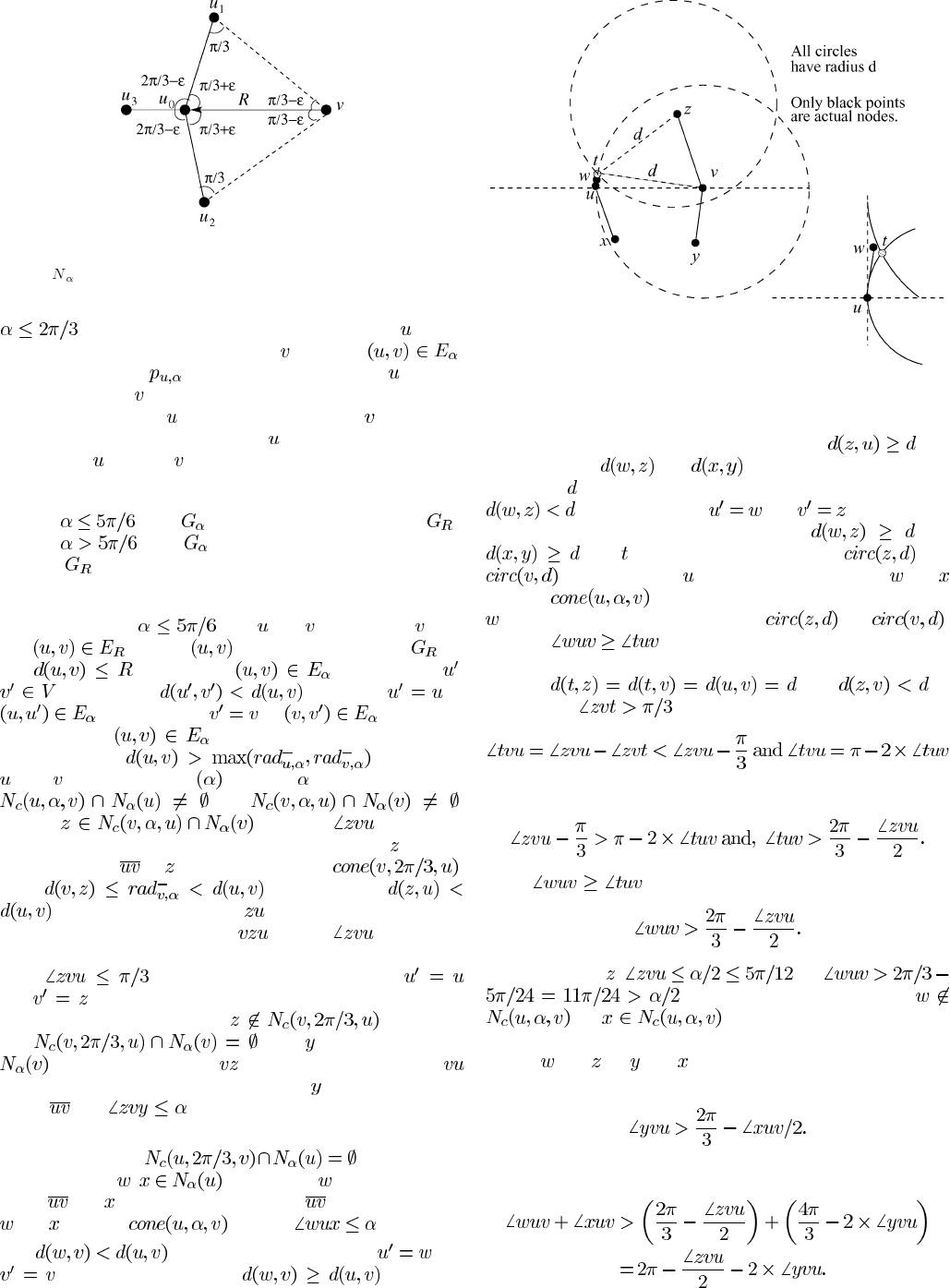
Fig. 3. may not be symmetric.
.) As we have already observed, each node knows
the power required to reach all nodes
such that :
it is just the max of
and the power required by to reach
each of the nodes
from which it received a “Hello” message.
(As we said earlier, if
receives a “Hello” from , since it in-
cludes the power used to transmit it,
can determine the power
required for
to reach .)
We now prove the two main results of this paper:
1)
if
, then preserves the connectivity of ;
2)
if
, then may not preserve the connectivity
of
.
The following lemma will be used in the proof of (1).
Lemma II.1: If , and and are nodes in such
that
(that is, is an edge in the graph ,so
that
), then either or there exist ,
such that (a) , (b) either or
, and (c) either or .
Proof: If
, we are done. Otherwise, it must
be the case that
. Thus, both
and terminate CBTC with no -gap. It follows that
and .
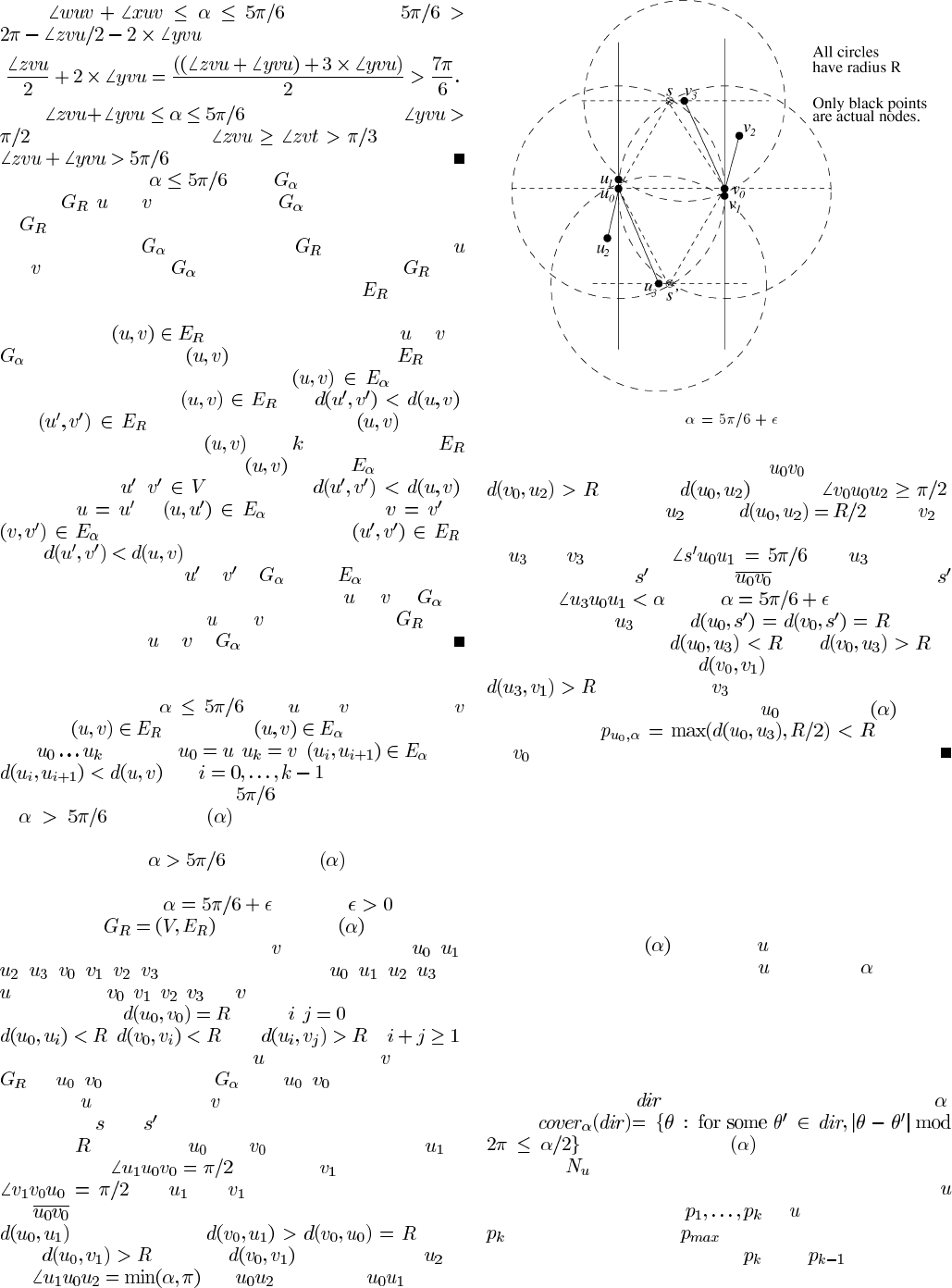
Choose
such that is minimal.
(See Fig. 4.) Suppose without loss of generality that
is in the
halfplane above
.If is actually located in ,
since
, it follows that
. For otherwise, the side would be at least as long
as any other side in the triangle
, so that would have
to be at least as large as any other angle in the triangle. But
since
, this is impossible. Thus, taking
and , the lemma holds in this case. So we can assume
without loss of generality that
(and, thus,
that
). Let be the first node in
that a ray that starts at would hit as it sweeps past
going counterclockwise. By construction, is in the half-plane
below
and .
Similar considerations show that, without loss of generality,
we can assume that
, and that there
exist two points
, such that (a) is in the halfplane
above
, (b) is in the halfplane below , (c) at least one of
and is inside , and (d) . See Fig. 4.
If
, then the lemma holds with and
, so we can assume that . Similarly,
Fig. 4. Illustration for the proof of Lemma II.1.
we can assume without loss of generality that .We
now prove that
and cannot both be greater than
or equal to
. This will complete the proof since, for example, if
, then we can take and in the lemma.
Suppose, by way of contradiction, that
and
. Let be the intersection point of and
that is closest to . Recall that at least one of and
is inside . As we show in Appendix A, since node
must be outside (or on)e both circles and ,
we have
(see the closeup on the far right side of
Fig. 4).
Since
, and ,it
follows that
. Thus,
and so
Since , we have that
(1)
By definition of
, ,so
. Thus, it must be the case that
,so .
Arguments identical to those used to derive (1) (replacing the
role of
and by and , respectively) can be used to show
that
(2)
From (1) and (2), we have
LI et al.: A CONE-BASED DISTRIBUTED TOPOLOGY-CONTROL ALGORITHM FOR WIRELESS MULTI-HOP NETWORKS 151
Since , we have that
. Thus,
Since , it easily follows that
. As we showed earlier, . Therefore,
. This is a contradiction.
Theorem II.2: If , then preserves the connec-
tivity of
; and are connected in iff they are connected
in
.
Proof: Since
is a subgraph of , it is clear that if
and are connected in , they must be connected in .
We now prove the converse. Order the edges in
by length.
We proceed by induction on the rank of the edge in the ordering
to show that if
, then there is a path from to in
. For the base case, if is the shortest edge in , then
it is immediate from Lemma II.1 that
. For note
that, by construction, if
and ,
then
and is a shorter edge than . For the
inductive step, suppose that
is the th shortest edge in
and, by way of contradiction, that is not in . By Lemma
II.1, there exist
, such that (a) ,
(b) either
or , and (c) either or
. As we observed, it follows that .
Since
, by the inductive hypothesis, it follows
that there is an path from
to in . Since is symmetric,
it is immediate that there is also a path from
to in .It
immediately follows that if
and are connected in , then
there is a path from
to in .
The proof of Theorem II.2 gives some extra information,
which we cull out as a separate corollary:
Corollary II.3: If
, and and are nodes in
such that , then either or there exists a
path
such that , , , and
, for .
Next we prove that degree
is a tight upper bound;
if
, then CBTC does not necessarily preserve
connectivity.
Theorem II.4: If
, then CBTC does not neces-
sarily preserve connectivity.
Proof: Suppose
for some . We con-
struct a graph
such that CBTC does not pre-
serve the connectivity of this graph.
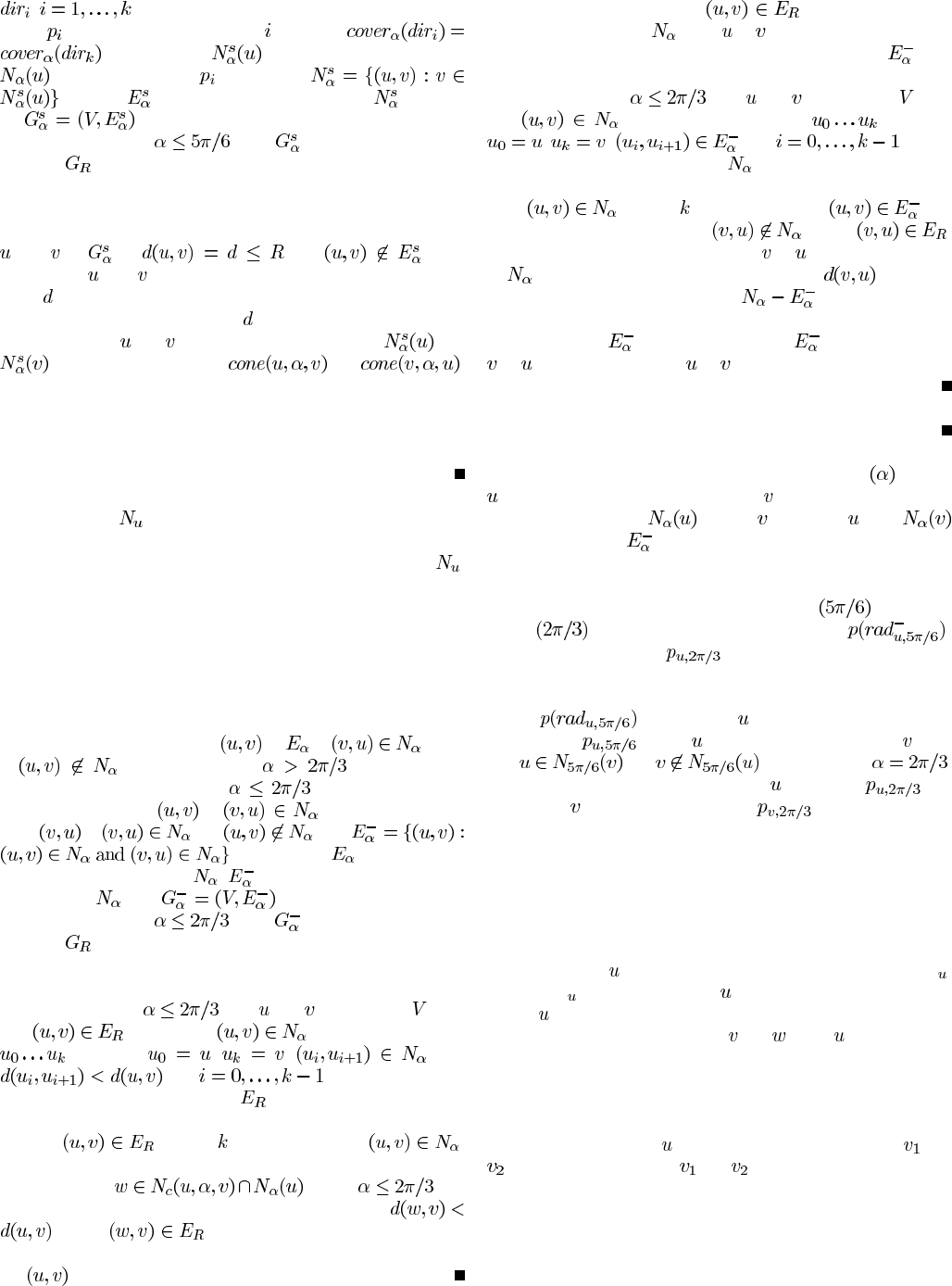
has eight nodes: , ,
, , , , , . (See Fig. 5.) We call , , , the
-cluster, and , , , the -cluster. The construction has
the property that
and for , ,1,2,3,wehave
, , and if .
That is, the only edge between the
-cluster and the -cluster in
is ( , ). However, in , the ( , ) edge disappears,
so that the
-cluster and the -cluster are disconnected.
In Fig. 5,
and are the intersection points of the circles
of radius
centered at and , respectively. Node is
chosen so that
. Similarly, is chosen so that
and and are on opposite sides of the
line
. Because of the right angle, it is clear that, whatever
is, we must have ; simi-
larly,
whatever is. Next, choose so
that
and comes after as a ray
Fig. 5. A disconnected graph if .
sweeps around counterclockwise from . It is easy to see that
, whatever is, since .
For definiteness, choose
so that . Node is
chosen similarly. The key step in the construction is the choice
of
and . Note that . Let be a point
on the line through
parallel to slightly to the left of
such that . Since , it is possible to
find such a node
. Since by con-
struction, it follows that
and .It
is clearly possible to choose
sufficiently small so that
. The choice of is similar.
It is now easy to check that when
runs CBTC , it will
terminate with
; similarly
for
. Thus, this construction has all the required properties.
III. OPTIMIZATIONS
In this section, we describe three optimizations to the basic
algorithm. We prove that these optimizations allow some of the
edges to be removed while still preserving connectivity.
A. The Shrink-Back Operation
In the basic CBTC
algorithm, is said to be a boundary
node if, at the end of the algorithm,
still has an -gap. Note
that this means that, at the end of the algorithm, a boundary
node broadcasts with maximum power. An optimization would
be to add a shrinking phase at the end of the growing phase
to allow each boundary node to broadcast with less power, if
it can do so without reducing its cone coverage. To make this
precise, given a set
of directions (angles) and an angle ,
define
. We modify CBTC so that, at each iteration,
a node in
is tagged with the power used the first time it
was discovered. Suppose that the power levels used by node
during the algorithm were .If is a boundary node,
is the maximum power . A boundary node successively
removes nodes tagged with power
, then , and so on, as
long as their removal does not change the coverage. That is, let
152 IEEE/ACM TRANSACTIONS ON NETWORKING, VOL. 13, NO. 1, FEBRUARY 2005
, , be the set of directions found with all power
levels
or less, then the minimum such that
is found. Let consist of all the nodes in
tagged with power or less. Let
, and let be the symmetric closure of . Finally,
let
.
Theorem III.1: If
, then preserves the connec-
tivity of
.
Proof: It is easy to check that the proof of Theorem II.2
depended only on the cone coverage of each node, so it goes
through without change. In more detail, given any two nodes
and in ,if and , then
either both
and did not use power sufficient to reach dis-
tance
in the basic CBTC algorithm or one or both of them used
enough power to reach distance
but then shrank back. In ei-
ther case, nodes
and must still have neighbors in and
fully covering the cones and ,
respectively, since any shrink-back operation can only remove
those neighbors that provide redundant cone coverage. Thus,
the proof of Lemma II.1 goes through with no change. The re-
mainder of the argument follows exactly the same lines as that
of the proof of Theorem II.2.
Note that this argument actually shows that we can remove
any nodes from
that do not contribute to the cone coverage.
However, our interest here lies in minimizing the power needed
for broadcast, not in minimizing the number of nodes in
.
There may be some applications where it helps to reduce the
degree of a node; in this case, removing further nodes may be a
useful optimization.
B. Asymmetric Edge Removal
As shown by Example II.1, in order to preserve connectivity,
it is necessary to add an edge
to if ,even
if
. In Example II.1, . This is not an
accident. As we now show, if
, not only do we not
have to add an edge
if , we can remove an
edge
if but . Let
. Thus, while is the smallest
symmetric set containing
, is the largest symmetric set
contained in
. Let .
Theorem III.2: If
, then preserves the connec-
tivity of
.
Proof: We start by proving the following lemma, which
strengthens Corollary II.3.
Lemma III.3: If
, and and are nodes in such
that
, then either or there exists a path
such that , , , and
, for .
Proof: Order the edges in
by length. We proceed by
strong induction on the rank of an edge in the ordering. Given
an edge
of rank in the ordering, if ,
we are done. If not, as argued in the proof of Lemma II.1, there
must be a node
. Since , the
argument in the proof of Lemma II.1 also shows that
. Thus, and has lower rank in the ordering
of edges. Applying the induction hypothesis, the lemma holds
for
. This completes the proof.
Lemma III.3 shows that if , then there is a path
consisting of edges in
from to . This is not good enough
for our purposes; we need a path consisting of edges in
. The
next lemma shows that this is also possible.
Lemma III.4: If
, and and are nodes in such
that
, then there exists a path such that
, , , for .
Proof: Order the edges in
by length. We proceed by
strong induction on the rank of an edge in the ordering. Given an
edge
of rank in the ordering, if ,we
are done. If not, we must have
. Since ,
by Lemma III.3, there is a path from
to consisting of edges
in
all of which have length smaller than .Ifanyof
these edges is asymmetric, i.e., in
, we can apply the
inductive hypothesis to replace the edge by a path consisting
only of edges in
. By the symmetry of , such a path from
to implies a path from to . This completes the inductive
step.
The proof of Theorem III.2 is now immediate from Lemmas
III.3 and III.4.
To implement asymmetric edge removal, the basic CBTC
needs to be enhanced slightly. After finishing CBTC
, a node
must send a message to each node to which it sent an Ack
message that is not in
, telling to remove from
when constructing . It is easy to see that the shrink-back op-
timization discussed in Section III-A can be applied together
with the removal of these asymmetric edges.
There is a tradeoff between using CBTC
and using
CBTC
with asymmetric edge removal. )
will be no greater than
if the Increase function is the
same, links are reliable, and Acks responding to one “Hello”
message are received before the next one is sent. However, the
power
with which needs to transmit may be
greater than
, since may need to reach nodes such
that
but . In contrast, if ,
then asymmetric edge removal allows
to still use and
may allow
to use power less than . Our experimental
results confirm this. (See Section V.)
C. Pairwise Edge Removal
The final optimization aims at further reducing the transmis-
sion power of each node. In addition to the directional informa-
tion, this optimization requires two other pieces of information.
First, each node
is assigned a unique integer ID denoted ID ,
and that ID
is included in all of ’s messages. Second, although
a node
does not need to know its exact distance from its neigh-
bors, given any pair of neighbors
and , node needs to know
which of them is closer. This can be achieved as follows. Re-
call that a node grows its radius in discrete steps. It includes its
transmission power level in each of the “Hello” messages. Each
discovered neighbor node also includes its transmission power
level in the Ack. When
receives messages from nodes and
, it can deduce which of and is closer based on the trans-
mission and reception powers of the messages.
Even after the shrink-back operation and possibly asym-
metric edge removal, there are many edges that can be removed
while still preserving connectivity. For example, if three
edges form a triangle, we can clearly remove any one of
LI et al.: A CONE-BASED DISTRIBUTED TOPOLOGY-CONTROL ALGORITHM FOR WIRELESS MULTI-HOP NETWORKS 153
them while still maintaining connectivity. In this section, we
improve on this result by showing that if there is an edge
from
to and from to , then we can remove the
longer edge even if there is no edge from
to , as long as
. Note that a condition
sufficient to guarantee that
is that (since the longest edge will be opposite
the largest angle).
To make this precise, we use the notion of an edge ID. Each
edge
is assigned an edge ID ,
where
, ID ID , and
ID ID . Edge IDs are compared lexicographically,
so that
iff either (a) , (b) and
, or (c) , , and .
Definition III.5: If
and are neighbors of , ,
and
, then is a redundant edge.
As the name suggests, redundant edges are redundant, in that
it is possible to remove them while still preserving connectivity.
The following theorem proves this.
Theorem III.6: For
, all redundant edges can be
removed while still preserving connectivity.
Proof: Let
consist of all the nonredundant edges in
. We show that if , then there is a path
from
to consisting only of edges in . Clearly, this suffices
to prove the theorem.
Let
be a listing of the redundant edges (i.e,
those in
) in increasing lexicographic order of edge
ID. We prove, by induction on
, that for every redundant edge
there is a path from to consisting of edges in
. For the base case, consider .Bydefinition,
there must exist an edge
such that
and . Since is the redundant edge
with the smallest edge ID,
cannot be a redundant edge.
Since
, it follows that .
If
, then (since is the
shortest redundant edge) and
, is the desired
path of nonredundant edges. On the other hand, if
then, since and ,
by Corollary II.3, there exists a path from
to consisting
of edges in
all shorter than . Since none of these
edges can be redundant edge, this gives us the desired path.
For the inductive step, suppose that for every
,
, we have found a path between and ,
which contains no redundant edges. Now consider
.
Again, by definition, there exists another edge
with
and .If is
a redundant edge, it must be one of
’s, where .
Moreover, if the path
(from Corollary II.3) between and
contains a redundant edge , we must have and
so
. By connecting with and replacing
every redundant edge
on the path with , we obtain a path
between and that contains no redundant edges. This
completes the proof.
Although Theorem III.6 shows that all redundant edges can
be removed, this does not mean that all of them should nec-
essarily be removed. For example, if we remove some edges,
the paths between nodes become longer, in general. Since some
overhead is added for each link a message traverses, having
fewer edges can affect network throughput. In addition, if routes
are known and many messages are being sent using point-to-
point communication between different senders and receivers,
having fewer edges is more likely to cause congestion. Since
we would like to reduce the transmission power of each node,
we remove only redundant edges with length greater than the
longest nonredundant edges. We call this optimization the pair-
wise edge removal optimization.
IV. D
EALING
WITH RECONFIGURATION
,ASYNCHRONY,
AND
FAILURES
In a multi-hop wireless network, nodes can be mobile. Even
if nodes do not move, nodes may die if they run out of energy.
In addition, new nodes may be added to the network. We need a
mechanism to detect such changes in the network. This is done
by the Neighbor Discovery Protocol (NDP). A NDP is usually a
simple beaconing protocol for each node to tell its neighbor that
it is still alive. The beacon includes the sending node’s ID and
the transmission power of the beacon. A neighbor is considered
failed if a pre-defined number of beacons are not received for a
certain time interval
. A node is considered a new neighbor
of
if a beacon is received from and no beacon was received
from
during the previous interval.
The question is what power a node should use for beaconing.
Certainly a node
should broadcast with sufficient power to
reach all of its neighbors in
(or ,if ). As
we will show, if
uses a beacon with power —the
power needed for
to reach all its neighbors in , then this is
sufficient for reconfiguration to work with the basic cone-based
algorithm (possibly combined with asymmetric edge removal if
, in which case we can use power ).
We define three basic events:
•
A
event happens when node detects a beacon
from node
for the first time.
•
A
event happens when node misses some
predetermined number of beacons from node
.
•
An
event happens when detects that ’s
angle with respect to
has changed. (Note this could be
due to movement by either
or .)
Our reconfiguration algorithm is very simple. It is convenient
to assume that each node is tagged with the power used when
it was first discovered, as in the shrink-back operation. (This is
not necessary, but it minimizes the number of times that CBTC
needs to be rerun.)
•
If a
event happens, and if there is an -gap
after dropping
from , node reruns CBTC
(as in Fig. 1), starting with power (i.e., taking
).
•
If a
event happens, computes and the
power needed to reach
. As in the shrink-back operation,
then removes nodes, starting with the farthest neighbor
nodes and working back, as long as their removal does not
change the coverage.
•
If an
event happens, node modifies the
set
of directions appropriately. If an -gap is then
detected, then CBTC
is rerun, again starting with
power
. Otherwise, nodes are removed, as in
the shrink-back operation, to see if less power can be
used.
154 IEEE/ACM TRANSACTIONS ON NETWORKING, VOL. 13, NO. 1, FEBRUARY 2005
In general, there may be more than one change event that is
detected at a given time by a node
. (For example, if moves,
then there will be in general several
, and
events detected by .) If more than one change event is detected
by
, we perform the changes suggested above as if the events
are observed in some order, as long as there is no need to rerun
CBTC. If CBTC needs to be rerun, it deals with all changes
simultaneously.
Intuitively, this reconfiguration algorithm preserves connec-
tivity. We need to be a little careful in making this precise, since
if the topology changes frequently enough, the reconfiguration
algorithm may not ever catch up with the changes, so there may
be no point at which the connectivity of the network is actually
preserved. Thus, what we want to show is that if the topology
ever stabilizes, so that there are no further changes, then the re-
configuration algorithm eventually results in a graph that pre-
serves the connectivity of the final network, as long as there are
periodic beacons. It should be clear that the reconfiguration al-
gorithm guarantees that each cone of degree
around a node
is covered (except for boundary nodes), just as the basic algo-
rithm does. Thus, the proof that the reconfiguration algorithm
preserves connectivity follows immediately from the proof of
Theorem II.2.
While this reconfiguration algorithm works in combination
with the basic algorithm CBTC
and in combination with
the asymmetric edge removal optimization, we must be careful
in combining it with the other optimizations discussed in Sec-
tion III. In particular, we must be very careful about what power
a node should use for its beacon. For example, if the shrink-
back operation is performed, using the power to reach all the
neighbors in
does not suffice. For suppose that the net-
work is temporarily partitioned into two subnetworks
and
; for every pair of nodes and , the dis-
tance
. Suppose that is a boundary node in
and is a boundary node in , and that, as a result of the
shrink-back operation, both
and use power .
Further suppose that later nodes
and move closer together
so that
.If is not sufficient power for to
communicate with
, then they will never be aware of each
other’s presence, since their beacons will not reach each other,
so they will not detect that the network has become reconnected.
Thus, network connectivity is not preserved.
This problem can be solved by having the boundary nodes
broadcast with the power computed by the basic CBTC
al-
gorithm, namely
in this case. Similarly, with the pairwise
edge removal optimization, it is necessary for
’s beacon to
broadcast with
, i.e., the power needed to reach all
of
’s neighbors in , not just the power needed to reach all of
’s neighbors in . It is easy to see that this choice of beacon
power guarantees that the reconfiguration algorithm works.
It is worth noting that a reconfiguration protocol works per-
fectly well in an asynchronous setting. In particular, the syn-
chronous model with reliable channels that has been assumed
up to now can be relaxed to allow asynchrony and both com-
munication and node failures. Now nodes are assumed to com-
municate asynchronously, messages may get lost or duplicated,
and nodes may fail (although we consider only crash failures:
either a node crashes and stops sending messages, or it follows
its algorithm correctly). We assume that messages have unique
identifiers and that mechanisms to discard duplicate messages
are present. Node failures result in
events, as do lost mes-
sages. If node
gets a message after many messages having
been lost, there will be a
event corresponding to the earlier
event.
V. E
XPERIMENTAL
RESULTS
How effective is our algorithm and its optimizations as com-
pared to other approaches? Before we answer this question, let
us briefly review existing approaches. To our knowledge, among
the topology-control algorithms in the literature [8], [9], [21],
[23], [24], only Rodoplu and Meng’s algorithm [23] attempts
to optimize for energy efficiency while maintaining network
connectivity. Following [13], we refer to Rodoplu and Meng’s
algorithm as the MECN algorithm (for minimum-energy com-
munication network). The algorithms in [8], [9], and [24]
try to maximize network throughput; they do not guarantee
network connectivity. Ramanathan and Rosales-Hain [21] have
considered minimizing the maximum transmission power of
all nodes by using centralized MST algorithms. However,
their distributed heuristic algorithms do not guarantee network
connectivity. Since we are only interested in algorithms that
preserve connectivity and are energy efficient, it seems that the
only relevant algorithm in the literature is the MECN algorithm.
However, since the SMECN algorithm outperforms MECN
[13], we will compare our algorithm with SMECN only.
We refer to the basic algorithm as CBTC, and to our
complete algorithm with all applicable optimizations as
OPT-CBTC.
3
Furthermore, we also make the comparison with
the no-topology-control case, where each node always uses the
maximum transmission power to send a packet (we refer to this
approach as MaxPower). In the case of no-topology-control,
the reason we choose maximum power is that it guarantees
that there will be no network partitions due to insufficient
transmission power.
A. Simulation Environment
The topology-control algorithms—CBTC, SMECN, and
MaxPower—are implemented in the ns-2 network simulator
[20], using the wireless extension developed at Carnegie Mellon
[6]. We generated 20 random networks, each with 200 nodes.
Each node has a maximum transmission range of 500 meters
and initial energy of 0.5 Joule. The nodes are placed uniformly
at random in a rectangular region of 1500 by 1500 meters.
Although there have been some papers on realistic topology
generation [1], [31], most of them have focused on the Internet
setting. Since large multihop wireless networks such as sensor
networks are often deployed in a somewhat random fashion (for
example, an airplane may drop sensors over some geographical
region), we believe that assuming nodes are placed uniformly
at random is not an unreasonable assumption.
3
For brevity, we will omit the parameter
in our presentation when it is clear
from the context.
LI et al.: A CONE-BASED DISTRIBUTED TOPOLOGY-CONTROL ALGORITHM FOR WIRELESS MULTI-HOP NETWORKS 155
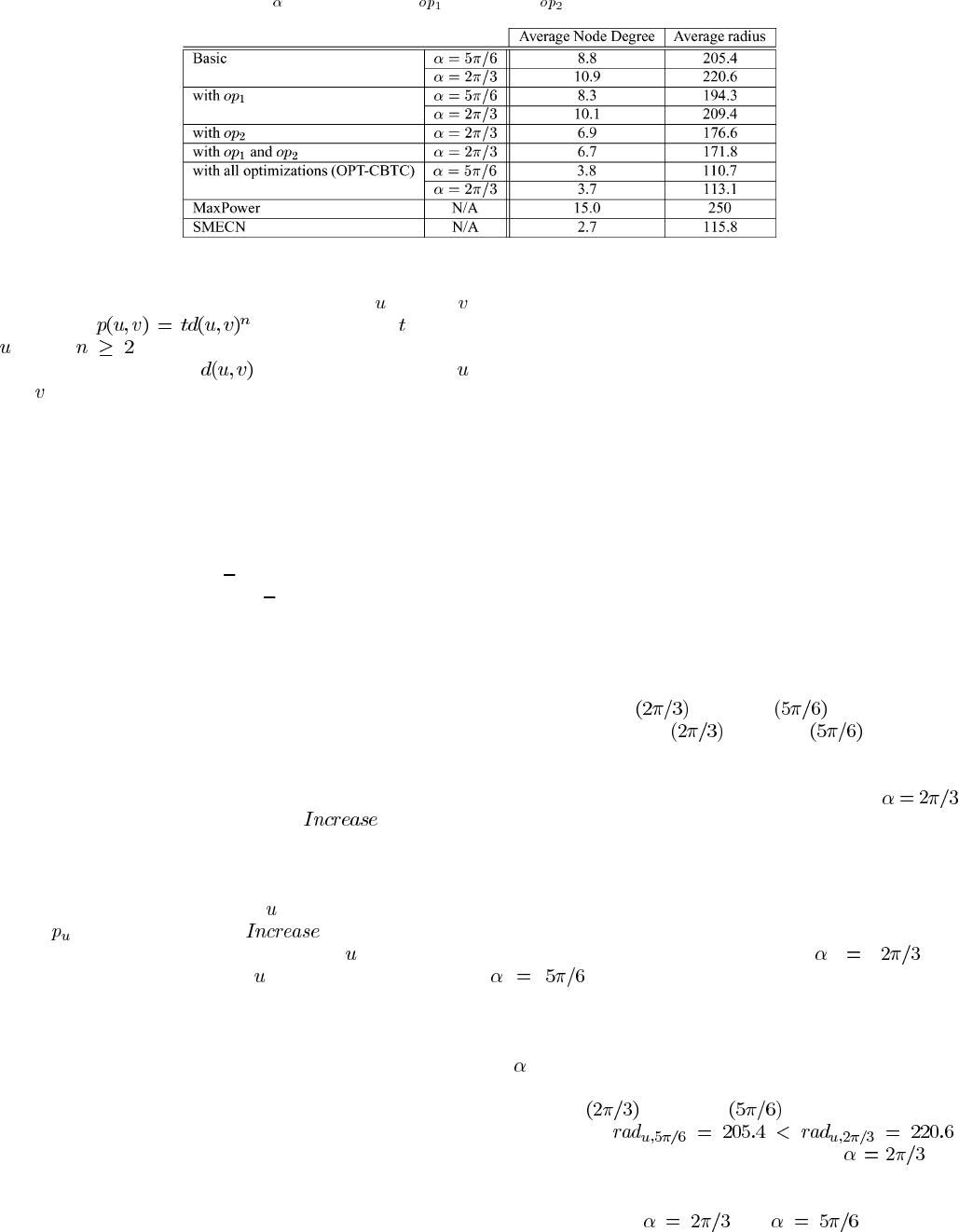
TABLE I
A
VERAGE DEGREE AND
RADIUS OF THE
CONE-BASED TOPOLOGY-CONTROL
ALGORITHM WITH
DIFFERENT
AND OPTIMIZATIONS
(
-SHRINK-BACK, -ASYMMETRIC
EDGE REMOVAL
)
We assume the two-ray propagation model for terrestrial
communication [22]. A transmission from node
to node
takes power for some constant at node
, where is the path-loss exponent of outdoor radio
propagation models, and
is the distance between
and . The model has been shown to be close to reality in
many environment settings [22]. Finally, we take the following
parameter settings, which are chosen to simulate the 914 MHz
Lucent WaveLAN DSSS radio interface:
• the carrier frequency is 914 MHz;
• the transmission raw bandwidth 2 MHz;
• antennas are omnidirectional with 0 dB gain, and the an-
tenna is placed 1.5 meters above a node;
• the receive threshold is
94 dBW;
• the carrier sense threshold is
108 dBW;
• the capture threshold is 10 dB.
In order to simulate the effect of power control in the
neighbor-discovery process, we made changes to the physical
layer of the ns-2 simulation code to support eight discrete power
levels. This seems to be more in keeping with current practice.
For example, currently the Aironet PC4800 supports five trans-
mission-power levels. Eight power levels seems sufficient to
provide a realistic simulation of the kind of scenarios that arise
in practice. In our simulation, power level 8 gives the maximum
transmission range of 250 meters. The
function in
Fig. 1 moves from one power level to the next higher level. For
the “Hello” packet in the CBTC algorithm, the transmission
power level is controlled by the algorithm itself. Specifically,
as we discussed in Section IV, node
broadcasts using the final
power
(as determined by the function in Fig. 1).
For point-to-point transmissions from a node
, the minimum
power level needed to reach all of
’s neighbors is used. We do
not use different power levels for different neighbors because
there is a delay associated with changing power levels in
practice (in the order of 10 ms [5] for certain wireless radio
hardware), which some applications may not be able to tolerate.
To simulate interference and collision, we choose the
WaveLAN-I [25] CSMA/CA MAC protocol. Since topology
control by itself does not provide routing, we used the AODV
[17] routing protocol in our simulation.
To simulate the network application traffic, we use the fol-
lowing application scenario: we choose 60 connections, i.e., 60
source–destination pairs. All the source and destination nodes
are distinct. For each of these 60 connections in sequence, the
source (if it is still alive) sends constant bit rate (CBR) traffic
to its destination. The sending rate is 2 packets/s and the packet
size is 512 bytes. This traffic pattern seems to generate sufficient
load in the network for our evaluation. We do not expect that the
results would be qualitatively different if fewer or more con-
nections were used. We use the same 60 connections in all our
experiments. Since we conduct the experiments in 20 random
networks, there is no need to randomize over the connections as
well.
B. Network Topology Characteristics
Before comparing CBTC with SMECN and MaxPower
through detailed network simulation, we first examine the
topology graphs that result from using each of these approaches
in the 20 random networks described previously.
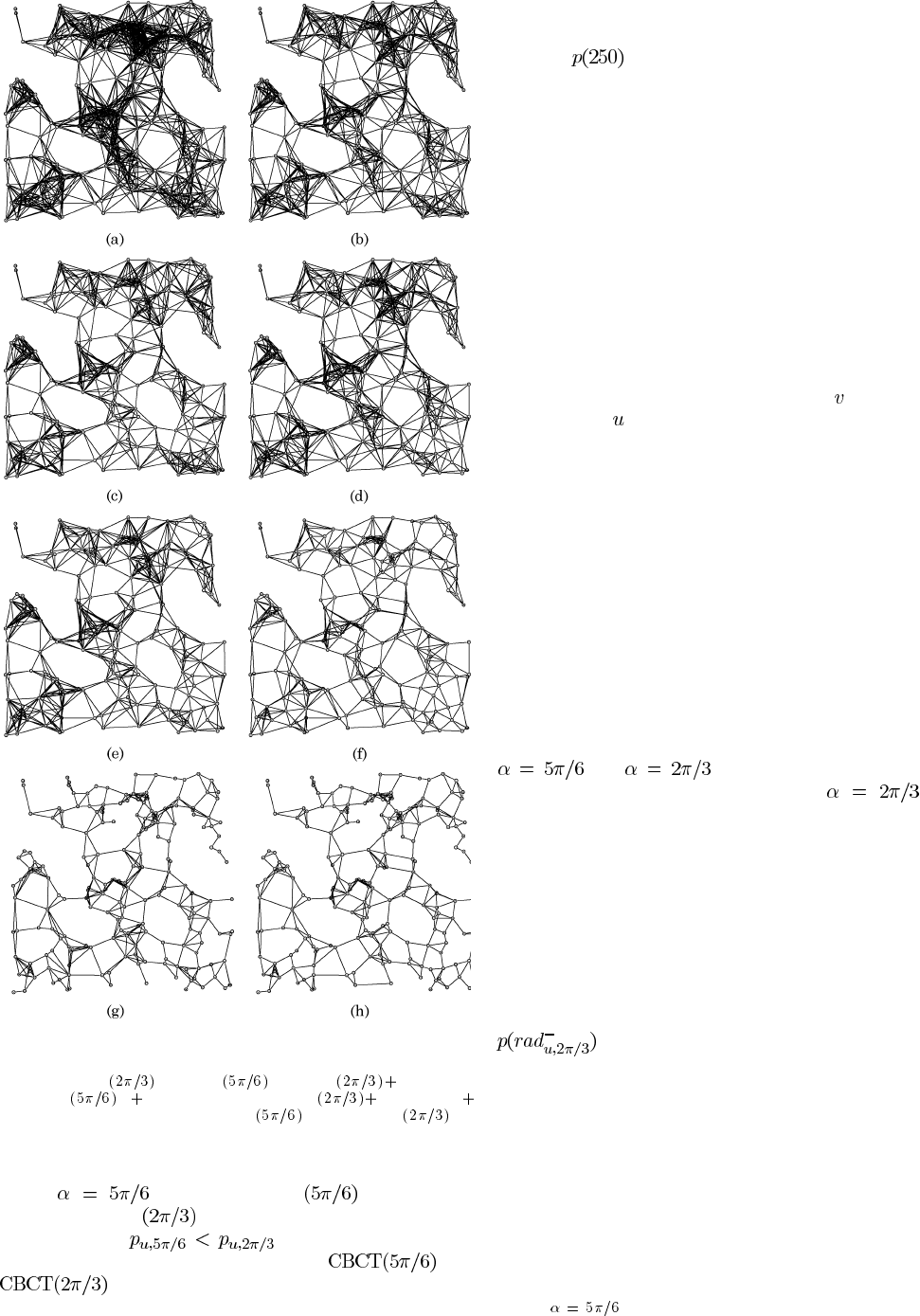
Fig. 6 illustrates how CBTC and the various optimizations
improve network topology using the results from one of the
random networks. Fig. 6(a) shows a topology graph produced
by MaxPower. Fig. 6(b) and (c) shows the corresponding graphs
produced by CBTC
and CBTC , respectively. We
can see that both CBTC
and CBTC allow nodes
in the dense areas to automatically reduce their transmission ra-
dius. Fig. 6(d) and (e) illustrates the graphs after the shrink-back
operation is performed. Fig. 6(f) shows the graph for
as a result of the shrink-back operation and the asymmetric
edge removal. Fig. 6(g) and (h) shows the topology graphs after
all applicable optimizations. We can see that the optimizations
are very effective in further reducing the transmission radius of
nodes.
Table I compares the network graphs resulted from the
cone-based algorithm parameterized by
and
, in terms of average node degree and average
radius. It also shows the corresponding results for SMECN
and MaxPower. The results are averaged over the 20 random
networks mentioned earlier. As expected, using a larger value
of
results in a smaller node degree and radius. However,
as we discussed in Section III-B, there is a tradeoff between
using CBTC
and CBTC . Using the basic algo-
rithm, we have
.
After applying asymmetric edge removal with
, the
resulting radius is 176.6. Hence, asymmetric edge removal
can result in significant savings. After applying all applicable
optimizations, both
and end up with
very similar results in terms of both average node degree and
156 IEEE/ACM TRANSACTIONS ON NETWORKING, VOL. 13, NO. 1, FEBRUARY 2005
Fig. 6. The network graphs after different optimizations. (a) No topology
control; (b) CBTC
; (c) CBTC ; (d) CBTC shrink-back;
(e) CBTC
shrink-back; (f) CBTC shrink-back
asymmetric edge removal; (g) OPT-CBTC ; (h) OPT-CBTC .
average radius. However, there are secondary advantages to
setting
. In general, CBTC will terminate
sooner than CBTC
and so expend less power during its
execution (since
). Thus, if reconfiguration
happens frequently, the advantage of using
over
in terms of reduction on power consumption can
be significant.
The sixth row (MaxPower) gives the performance numbers
for the case where each node uses the maximum transmission
power of
. We can see that using topology control cuts
down the average degree by a factor of more than 3 (3.8 versus
15.0) and the average radius by a factor of more than 2 (113.1 or
110.7 versus 250). This clearly demonstrates the effectiveness
of our topology-control algorithms.
The last row shows the results for SMECN. Recall that
SMECN requires GPS position information, while the CBTC
algorithms rely on only directional information. So our objec-
tive in the comparison is to study how well CBTC performs
with the lack of distance information. The average radius
numbers in Table I show that the performance of OPT-CBTC
is in fact very close to (and slightly better than) that of SMECN
(113.1 versus 115.8). Note that SMECN does achieve a smaller
average node degree (2.7 versus 3.7). However, with SMECN,
each node typically has more nodes within its radius that are
not its neighbors. This is because for a node
to be considered
a neighbor of
in SMECN, direct transmission has to take
less energy than any two-hop path. Two-hop paths are less
desirable than single-hop paths, they occupy the media for
twice as long as one-hop transmissions. On the other hand,
although OPT-CBTC reduces the power demand of nodes as
much as SMECN does, SMECN has the additional property of
preserving minimum-energy paths. If a different power level
can be used for each neighbor, and the amount of unicast traffic
is significantly greater than the amount of neighbor broadcast
traffic, using SMECN can be beneficial.
C. Network Performance Analysis
We next use detailed network simulations to evaluate the
algorithms in terms of energy consumption, number of de-
livered packets, and latency. Since the two CBTC settings
and produced similar network graphs
(as shown in Table I), we consider only
in the
remaining experiments.
4
We simulate CBTC, MaxPower, and
SMECN using the same traffic pattern and random networks for
performance measurements. As the power available to a node
is decreased after each packet reception or transmission, nodes
in the simulation die over time. After a node dies, the network
must be reconfigured. In our simulation, the NDP beacons
trigger the reconfiguration protocol. The beacons are sent once
per second for SMECN and CBTC, and each of them is jittered
randomly before it is actually sent to avoid synchronization
effects. For CBTC and OPT-CBTC, the beacons use power
. For SMECN, the beacons use the appropriate
power level as computed by SMECN’s neighbor discovery
process. Note that no beacon is required in the MaxPower
approach. For simplicity, we do not simulate node mobility,
although some of the effects of mobility—that is, the triggering
of the reconfiguration protocol—can already be observed when
nodes run out of energy. In the rest of this section, we compare
the performance of CBTC, OPT-CBTC, SMECN, and Max-
Power. All results are averaged over the 20 random networks
described in Section V-A.
4
Since we use only a few discrete power levels, there is no significant benefit
in using
.