
Li L.(E)., Halpern J., Bahl P., Wang Y., Wattenhofer R. A Cone-Based Distributed Topology-Control Algorithm for Wireless Multi-Hop Networks
Подождите немного. Документ загружается.

LI et al.: A CONE-BASED DISTRIBUTED TOPOLOGY-CONTROL ALGORITHM FOR WIRELESS MULTI-HOP NETWORKS 157
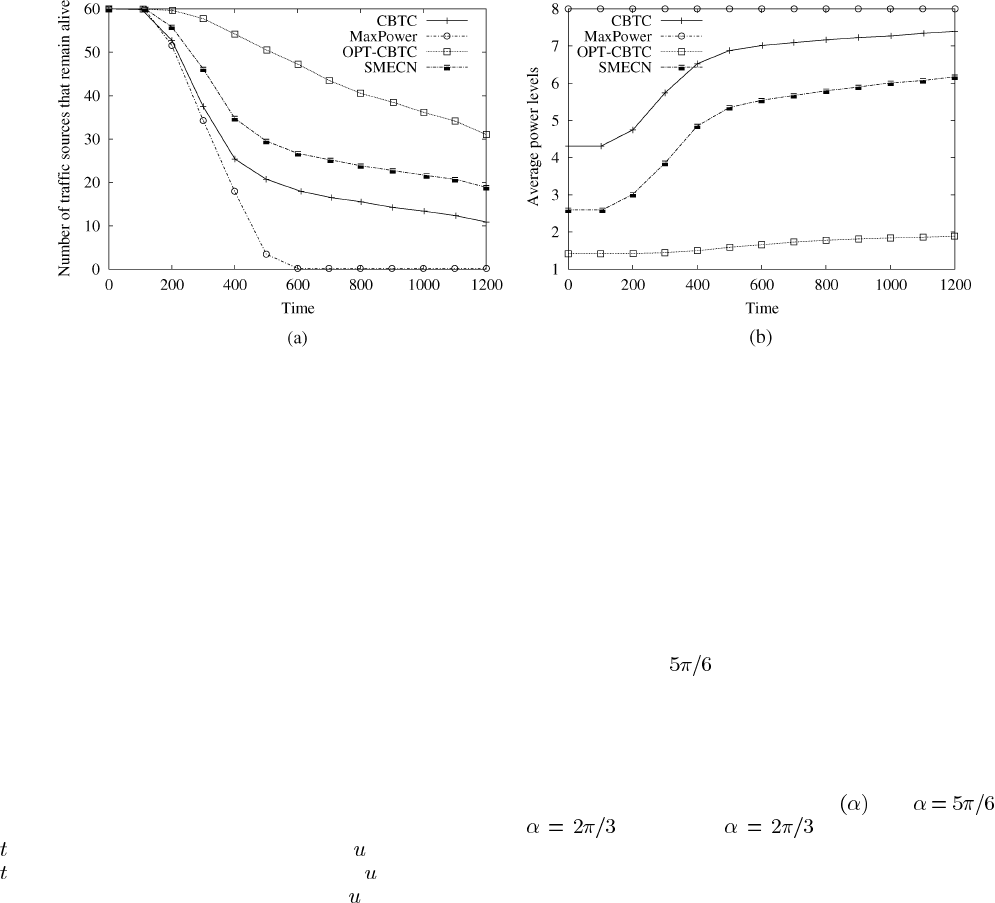
Fig. 7. Performance comparison through detailed network simulation. (a) Number of traffic sources that remain alive. (b) Average power levels.
1) Energy Consumption: We investigate the energy con-
sumption of the three approaches in terms of the number of
traffic sources alive and the average transmission power levels
over time. As can be seen from Fig. 7, OPT-CBTC has the
best performance. CBTC performs worse than the SMECN
algorithm, but uses only directional information. MaxPower
has significantly worse performance than the other algorithms.
Fig. 7(a) shows the number of traffic sources that remain alive
over time. We can see that when almost all the traffic sources
in MaxPower are dead at time 600, about 45% and 30% of the
traffic sources are still alive in SMECN and CBTC, respec-
tively, and more than 79% of the traffic sources are still alive
in OPT-CBTC. The basic CBTC algorithm does not perform
as well as OPT-CBTC, but it still performs much better than
MaxPower.
Next, we consider how the transmission power evolves over
time as nodes die over time. Fig. 7(b) shows the average power
level averaged over all nodes. The “average power level” at time
is computed by considering, for each node still alive at time
, the minimum power currently needed for to reach all its
neighbors (recall that this is the power that
uses in the simu-
lation to send all messages except the NDP “Hello” beacons),
and then averaging this number over all nodes still alive. For
MaxPower, the average power is constant over time because the
maximum power is always used. The curves show that, while
the average power level of CBTC and SMECN increases rapidly
over time as more nodes die, the power level of OPT-CBTC in-
creases rather slowly and remains much lower.
2) Total Number of Packets Delivered and Latency: We
collected packet delivery and latency statistics at the end of
our simulation. SMECN, CBTC and OPT-CBTC were able
to deliver 1.66, 1.44, and 2.94 times the amount of packets
delivered by MaxPower, respectively, throughout the simula-
tion. The statistics for packet delivery and the number of traffic
sources still alive together show that it is undesirable to transmit
with large radius because it increases energy consumption and
causes unnecessary interference, and consequently decreases
throughput. The average packet latencies in decreasing order
are 271, 170, 126, and 79 ms for MaxPower, OPT-CBTC,
CBTC, and SMECN, respectively. MaxPower has the highest
latency due to its low spatial reuse of the spectrum. That is, a
successful transmission by MaxPower reserves a large physical
area. Any node that hears the transmission within this area
backs off and does not transmit itself. Therefore, the larger the
area reserved, the fewer nodes can transmit at any particular
time. OPT-CBTC has higher latency than CBTC and SMECN
because it typically takes longer routes due to the use of lower
transmission power.
VI. C
ONCLUSION
We have analyzed the distributed cone-based algorithm
and proved that
is a tight upper bound on the cone
degree for the algorithm to preserve connectivity. We have
also presented three optimizations to the basic algorithm—the
shrink-back operation, asymmetric edge removal, and pairwise
edge removal—and proved that they improve performance
while still preserving connectivity. Finally, we showed that
there is a tradeoff between using CBTC
with and
, since using allows an additional opti-
mization, which can have a significant impact on reducing the
transmission radius. The algorithm extends easily to deal with
reconfiguration and asynchrony. Most importantly, simulation
results show that it is very effective in reducing power demands
and increases the overall throughput.
Since the focus of this paper has been on reducing energy
consumption, we conclude with some discussion of this goal.
Reducing energy consumption has been viewed as perhaps the
most important design metric for topology control. There are
two standard approaches to doing this: 1) reducing the trans-
mission power of each node as much as possible; and 2) re-
ducing the total energy consumption through the preservation
of minimum-energy paths in the underlying network. These two
approaches may conflict: reducing the transmission power re-
quired by each node may not result in minimum-energy paths
or vice versa. Furthermore, there are other metrics to consider,
such as network throughput and network lifetime. Reducing en-
ergy consumption tends to increase network lifetime. (This is
particularly true if the main reason that nodes die is loss of bat-
tery power.) However, there is no guarantee that it will. For
example, using minimum-energy paths for all communication
may result in hot spots and congestion, which in turn may drain
battery power and lead to network partition. Using approach
1) in this case may do better. If topology control is not done
158 IEEE/ACM TRANSACTIONS ON NETWORKING, VOL. 13, NO. 1, FEBRUARY 2005
carefully, network throughput can be hurt. As we have already
pointed out, eliminating edges may result in more congestion
and, hence, worse throughput, even if it saves power in the short
run. The right tradeoffs to make are very much application de-
pendent. Therefore, an algorithm that adapts to the specific ap-
plication setting is much needed. Reconfiguration in response to
node mobility and failure consumes precious energy resources.
Fast convergence of topology control is critical to keep the net-
work functioning well. It would be interesting to investigate how
much mobility CBTC can handle. We hope to explore these is-
sues in more detail in future work.
A
PPENDIX
PROOF FOR
THEOREM II.2
Fact A.1: The distance
between any two points in a
sector of a circle is no greater than the circle radius .
If both
and are not the center of the circle, then .
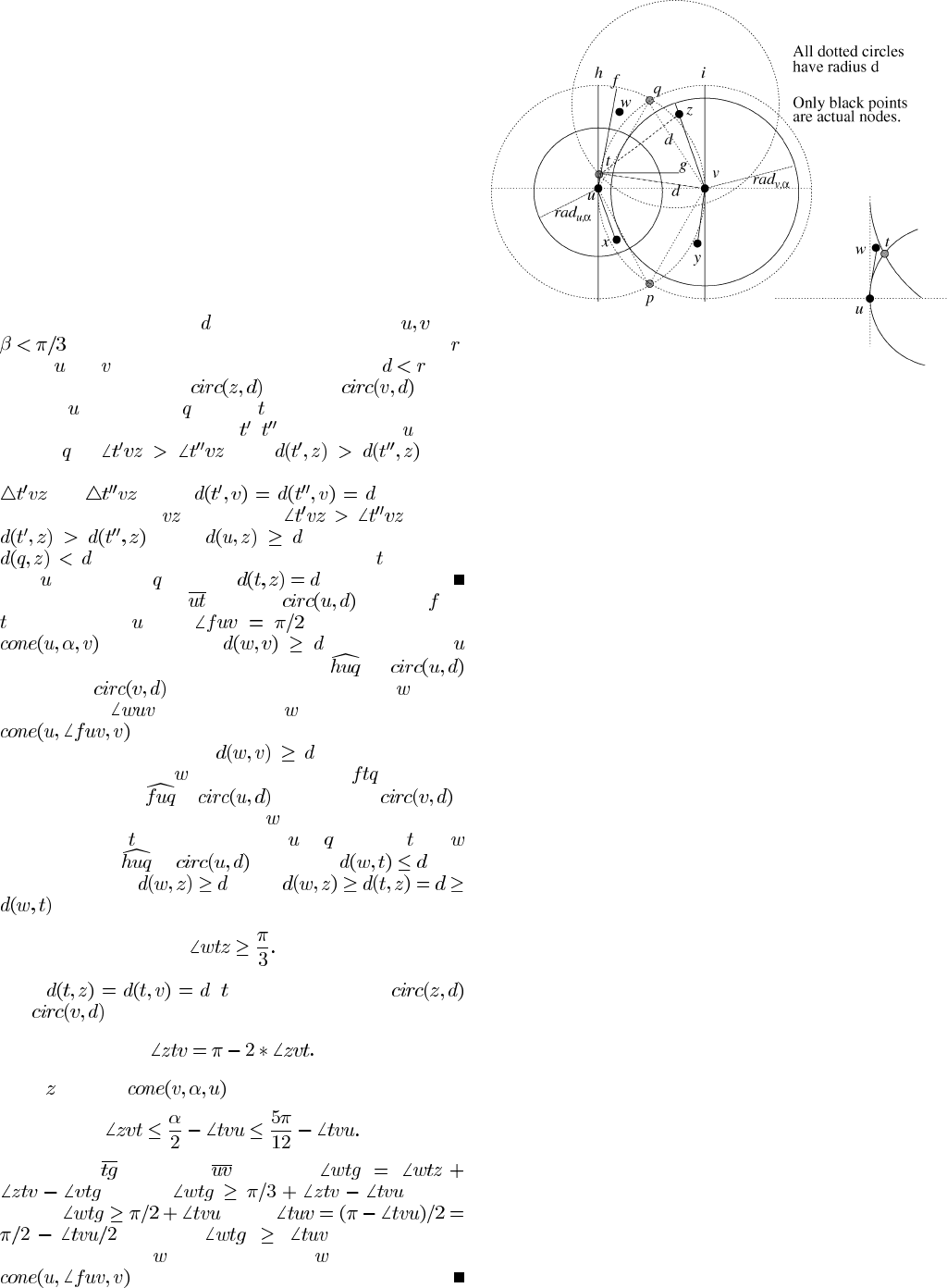
Lemma A.2: In Fig. 8,
intersects on the
arc from
clockwise to at point .
Proof: For any two points
, on the arc from clock-
wise to
,if , then . This
follows from a simple geometry argument. Consider triangles
and . Since and the tri-
angles have one side
in common, implies
. Since (by assumption) and
(by Fact A.1), there must be a point on the arc
from
clockwise to such that .
Lemma A.3: Let line intersect at point (if
is the same as , then ) in Fig. 8. To cover
, in the case of of Lemma II.1,
must have at lease one neighbor in sector of
and outside . Among these neighbors, let be the
one such that
is the smallest. cannot lie within the
.
Proof: For the case of
of Lemma II.1, we
only need to show that
cannot lie within the region (the
region inside sector
of and outside of ).
We prove by contradiction. Suppose
lies in that region. By the
previous lemma,
lies in the arc from to . So both and
are in the sector of . By Fact 1, . Our
assumption is that
. Thus,
. Therefore,
(3)
Since
( is the intersection of
and )
(4)
Since
is inside
(5)
Draw a line
parallel to .Wehave
. By (3), . By (4)
and (5),
. Since
,wehave . This contradicts
our assumption of
’s position. Thus, must be outside
.
Fig. 8. Illustration for the proof of Lemma A.2 and Lemma A.3.
REFERENCES
[1] K. Calvert, M. Doar, and E. W. Zegura, “Modeling internet topology,”
IEEE Commun. Mag., vol. 35, no. 6, pp. 160–163, Jun. 1997.
[2] A. Chandrakasan, R. Amirtharajah, S. H. Cho, J. Goodman, G. Kon-
duri, J. Kulik, W. Rabiner, and A. Wang, “Design considerations for
distributed microsensor systems,” in Proc. IEEE Custom Integrated Cir-
cuits Conf. (CICC), May 1999, pp. 279–286.
[3] B. Chen, K. Jamieson, H. Balakrishnan, and R. Morris, “Span: an en-
ergy-efficient coordination algorithm for topology maintenance in ad
hoc wireless networks,” in Proc. 7th Annu. ACM/IEEE Int. Conf. Mo-
bile Computing and Networking (MobiCom), 2001, pp. 85–96.
[4] L. P. Clare, G. J. Pottie, and J. R. Agre, “Self-organizing distributed
sensor networks,” in Proc. SPIE Conf. Unattended Ground Sensor Tech-
nologies and Applications, Apr. 1999, pp. 229–237.
[5] J. Gomez, A. T. Campbell, M. Naghshineh, and C. Bisdikian, “Con-
serving transmission power in wireless ad hoc networks,” in Proc. Int.
Conf. Network Protocols (ICNP), Nov. 2001, pp. 24–34.
[6] CMU Monarch Group. (1999, Oct.) Wireless and Mobility Extensions to
ns-2. [Online]. Available: http://www.monarch.cs.cmu.edu/cmu-ns.html
[7] W. R. Heinzelman, A. Chandrakasan, and H. Balakrishnan, “Energy-
efficient communication protocol for wireless micro-sensor networks,”
in Proc. IEEE Hawaii Int. Conf. System Sciences, Jan. 2000, pp. 4–7.
[8] T.-C. Hou and V. O. K. Li, “Transmission range control in multihop radio
networks,” IEEE Trans. Commun., vol. 34, no. 1, pp. 38–44, Jan. 1986.
[9] L. Hu, “Topology control for multihop packet radio networks,” IEEE
Trans. Commun., vol. 41, no. 10, pp. 1474–1481, Oct. 1993.
[10] L. Jia, R. Rajaraman, and C. Scheideler, “On local algorithms for
topology control and routing in ad hoc networks,” in Proc. SPAA, 2003,
pp. 220–229.
[11] R. E. Kahn, “The organization of computer resources into a packet radio
network,” IEEE Trans. Commun., vol. COM-25, no. 1, pp. 169–178, Jan.
1977.
[12] K. Krizman, T. E. Biedka, and T. S. Rappaport, “Wireless position loca-
tion: fundamentals, implementation strategies, and source of error,” in
Proc. IEEE 47th Vehicular Technology Conf., 1997, pp. 919–923.
[13] L. Li and J. Y. Halpern, “Minimum energy mobile wireless networks
revisited,” in Proc. IEEE Int. Conf. Communications (ICC), Jun. 2001,
pp. 278–283.
[14] L. Li, J. Y. Halpern, P. Bahl, Y. M. Wang, and R. Wattenhofer, “Anal-
ysis of distributed topology control algorithms for wireless multi-hop
networks,” in Proc. ACM Symp. Principles of Distributed Computing
(PODC), Aug. 2001, pp. 264–273.
[15] J. Monks, V. Bharghavan, and W. Hwu, “A power controlled multiple ac-
cess protocol for wireless packet networks,” in Proc. IEEE INFOCOM,
Apr. 2001, pp. 219–228.
[16] C. E. Perkins, Ad Hoc Networking. Reading, MA: Addison-Wesley,
2001.
[17] C. E. Perkins and E. M. Royer, “Ad-hoc on-demand distance vector
routing,” in Proc. 2nd IEEE Workshop on Mobile Computing Systems
and Applications, Feb. 1999, pp. 90–100.
[18] G. J. Pottie and W. J. Kaiser, “Wireless integrated network sensors,”
Commun. ACM, vol. 43, no. 5, pp. 51–58, May 2000.
LI et al.: A CONE-BASED DISTRIBUTED TOPOLOGY-CONTROL ALGORITHM FOR WIRELESS MULTI-HOP NETWORKS 159
[19] R. Prakash, “Unidirectional links prove costly in wireless ad hoc net-
works,” in Proc. Int. Workshop on Discrete Algorithms and Methods for
Mobile Computing and Communications (dialM), 1999, pp. 15–22.
[20] VINT Project. The UCB/LBNL/VINT Network Simulator—ns (Version
2). [Online]. Available: http://www.isi.edu/nsnam/ns
[21] R. Ramanathan and R. Rosales-Hain, “Topology control of multihop
wireless networks using transmit power adjustment,” in Proc. IEEE IN-
FOCOM, Mar. 2000, pp. 404–413.
[22] T. S. Rappaport, Wireless Communications: Principles and Prac-
tice. Englewood Cliffs, NJ: Prentice-Hall, 1996.
[23] V. Rodoplu and T. H. Meng, “Minimum energy mobile wireless net-
works,” IEEE J. Select. Areas Commun., vol. 17, no. 8, pp. 1333–1344,
Aug. 1999.
[24] H. Takagi and L. Kleinrock, “Optimal transmission ranges for randomly
distributed packet radio terminals,” IEEE Trans. Commun., vol. 32, no.
3, pp. 246–257, Mar. 1984.
[25] B. Tuch, “Development of WaveLAN, an ISM band wireless LAN,”
AT&T Tech. J., vol. 72, no. 4, pp. 27–33, 1993.
[26] Y. Wang and X. Y. Li, “Localized construction of bounded degree and
planar spanner for wireless ad hoc networks,” in Proc. ACM DIALM-
POMC Joint Workshop on Foundations of Mobile Computing, 2003, pp.
59–68.
[27] R. Wattenhofer, L. Li, P. Bahl, and Y. M. Wang, “Distributed topology
control for power efficient operation in multihop wireless ad hoc net-
works,” in Proc. IEEE INFOCOM, Apr. 2001, pp. 1388–1397.
[28] R. Wattenhofer and A. Zollinger, “XTC: a Practical Topology Control
Algorithm for Ad-Hoc Networks,” Computer Science Department, ETH
Zurich, Tech. Rep. 407, 2003.
[29] S. L. Wu, Y. C. Tseng, and J. P. Sheu, “Intelligent medium access control
for mobile ad hoc networks with busy tones and power control,” IEEE
J. Select. Areas Commun., vol. 18, no. 9, pp. 1647–1657, Sep. 2000.
[30] Y. Xu, J. Heidemann, and D. Estrin, “Geography-informed energy con-
servation for ad hoc routing,” in Proc. 7th Annu. ACM/IEEE Int. Conf.
Mobile Computing and Networking (MobiCom), 2001, pp. 70–84.
[31] E. W. Zegura, K. Calvert, and S. Bhattacharjee, “How to model an inter-
network,” in Proc. IEEE INFOCOM, vol. 2, 1996, pp. 594–602.
Li (Erran) Li (M’99) received the B.E. degree in au-
tomatic control from Beijing Polytechnic University,
China, in 1993, the M.E. degree in pattern recognition
from the Institute of Automation, Chinese Academy
of Sciences, Beijing, in 1996, and the Ph.D. degree
in computer science from Cornell University, Ithaca,
NY, in 2001, where Joseph Y. Halpern was his ad-
visor.
During his graduate study at Cornell University, he
worked at Microsoft Research and Bell Labs Lucent
as an intern, and at AT&T Research Center at ICSI
Berkeley as a visiting student. He is presently a member of the Networking Re-
search Center, Bell Labs, Holmdel, NJ. His research interests are in networking
with a focus on wireless networking and mobile computing. He has been a
member of ACM since 1999.
Joseph Y. Halpern (SM’00) received the B.Sc. de-
gree in mathematics from the University of Toronto,
Canada, in 1975 and the Ph.D. degree in mathematics
from Harvard University in 1981.
He spent two years as the head of the Mathematics
Department at Bawku Secondary School in Ghana.
He is currently a Professor of computer science at
Cornell University, Ithaca, NY, where he has been
since 1996. He has coauthored six patents, two books
(Reasoning About Knowledge and Reasoning About
Uncertainty), and over 100 journal publications and
100 conference publications. He is a former editor-in-chief of the Journal of the
ACM.
Together with his former student, Y. Moses, he pioneered the approach of ap-
plying reasoning about knowledge to analyzing distributed protocols and multi-
agent systems; he won a Gödel Prize for this work. He received the Publishers’
Prize for Best Paper at the International Joint Conference on Artificial Intelli-
gence in 1985 (joint with R. Fagin) and in 1989. He has been a Fellow of the
ACM since 2002.
Paramvir Bahl (SM’97) received the Ph.D. degree
in computer systems engineering from the University
of Massachusetts, Amherst.
He is a Senior Researcher and the Manager
of the Networking Group in Microsoft Research.
His research interests span a variety of problems
in wireless networking including low-power RF
communications; ubiquitous wireless Internet access
and services; location determination techniques and
services; self-organizing, self-managing multi-hop
community mesh networks; and real-time audio-vi-
sual communications. He has authored over 65 scientific papers, 44 issued and
pending patent applications, and book chapters in these areas.
Dr. Bahl is the founder and Chairman of the ACM Special Interest Group
in Mobility (SIGMOBILE); the founder and past Editor-in-Chief of the ACM
Mobile Computing and Communications Review, and the founder and Steering
Committee Chair of ACM/USENIX Mobile Systems Conference (MobiSys).
He has served on the editorial board of the IEEE J
OURNAL ON SELECTED AREAS
IN
COMMUNICATIONS, and is currently serving on the editorial boards of El-
sevier’s Ad hoc Networking Journal, Kluwer’s Telecommunications Systems
Journal, and ACM’s Wireless Networking Journal. He has served as a guest
editor for several IEEE and ACM journals and on networking panels and work-
shops organized by the National Science Foundation (NSF), the National Re-
search Council (NRC) and European Union’s COST. He has served as the Gen-
eral Chairman, Program Chair and Steering Committee member of several IEEE
and ACM conferences and on the Technical Program Committee of over 40 in-
ternational conferences and workshops. He is the recipient of Digital’s Doctoral
Engineering Award (1994) and the ACM SIGMOBILE’s Distinguished Service
Award (2001). He has been a Fellow of the ACM since 2003.
Yi-Min Wang received the B.S. degree from the
Department of Electrical Engineering at National
Taiwan University in 1986, and the Ph.D. degree
from the Department of Electrical and Computer
Engineering, University of Illinois at Urbana-Cham-
paign, in 1993, where he received the Robert T.
Chien Memorial Award from the Graduate College
for excellence in research.
From 1993 to 1997, he was with AT&T Bell Labs
and worked primarily in the area of checkpointing
and rollback recovery, both in theory and practice.
Since he joined Microsoft Research in 1998, he has expanded his research ef-
forts into distributed systems and home networking. He is currently a Senior
Researcher in the Systems and Networking group, leading an R&D effort in
systems management and diagnostics.
Roger Wattenhofer received the Ph.D. degree in
computer science from ETH Zurich, Switzerland, in
1998.
From 1999 to 2001, he was first with Brown
University, Providence, RI, then with Microsoft Re-
search, Redmond, WA. Currently, he is an Assistant
Professor at ETH Zurich. His research interests in-
clude a variety of algorithmic aspects in networking
and distributed computing, in particular, peer-to-peer
computing and ad hoc networks.
Dr. Wattenhofer has been a member of the ACM
since 1999.