
Masujima M. Applied Mathematical Methods in Theoretical Physics
Подождите немного. Документ загружается.

478 10 Calculus of Variations: Applications
We regard d
A
2
(p
2
), h
ψψ
(p
2
), and (q
2
) as slowly varying functions of p
2
and q
2
,
namely, the derivative of these functions is close to zero.
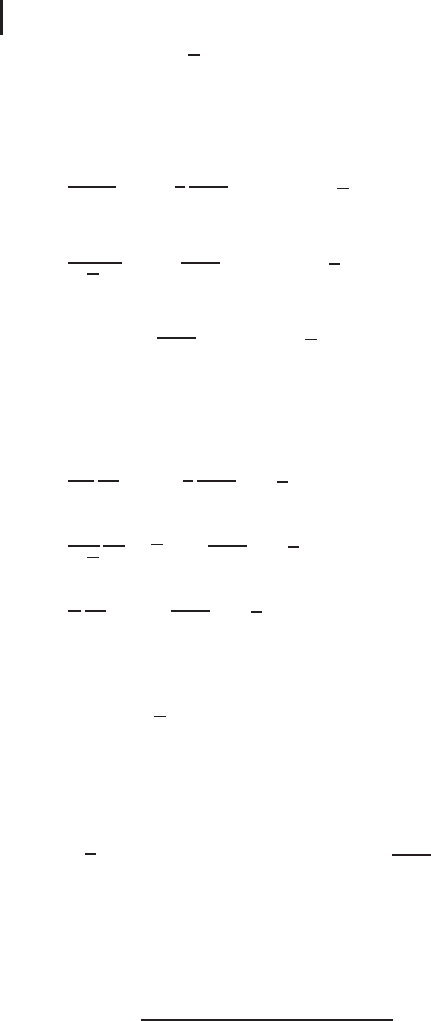
Equations (10.13.16) and (10.13.17) take the following form of a set of integral
equations:
1
d
A
2
(ς)
= 1 +
4
3
g
2
16π
2
0
ς
dz
2
(z)h
2
ψ
ψ
(z), (10.13.20)
1
h
ψψ
(ς)
= 1 −
g
2
16π
2
0
ς
dz
2
(z)h
2
ψ
ψ
(z)d
A
2
(z), (10.13.21)
(ς) = 1 +
g
2
16π
2
0
ς
dz
3
(z)h
2
ψ
ψ
(z)d
A
2
(z), ς = ln(p
2
m
2
). (10.13.22)
These equations are completely equivalent to the following set of differential
equations:
1
d
A
2
d
dς
(d
A
2
) =
4
3
g
2
16π
2
2
h
2
ψ
ψ
d
A
2
, (10.13.23)
1
h
ψψ
d
dς
(h
ψψ
) =−
g
2
16π
2
2
h
2
ψ
ψ
d
A
2
, (10.13.24)
1
d
dς
() =−
g
2
16π
2
2
h
2
ψ
ψ
d
A
2
, (10.13.25)
with the boundary conditions
d
A
2
(0) = h
ψψ
(0) = 1. (10.13.26)
The set of preceding nonlinear differential equations, (10.13.23)–(10.13.25), with
the boundary conditions, (10.13.26), can be solved explicitly as
h
ψψ
= , d
A
2
=
−4/3
, =
1 −(4/3)
g
2
16π
2
ς
3/4
. (10.13.27)
The connection between the bare or running coupling constant (or the bare
charge) and the observed coupling constant (or the observed charge) in this theory
takes the following form:
g
2
0
(
2
) =
g
2
1 −(4/3)
g
2
16π
2
ln
2
m
2
. (10.13.28)
The bare or running coupling constant gets large as the cut-off parameter
2
gets large. Thus, at high energies or at short distances, the theory becomes a

10.14 Asymptotic Freedom in QCD 479
strong coupling theory. Equation (10.13.28) can be solved for the observed coupling
constant (or the observed charge) as
g
2
=
g
2
0
(
2
)
1 +(4/3)
g
2
0
(
2
)16π
2
ln
2
m
2
. (10.13.29)
The observed coupling constant (or the observed charge) goes to zero if the local
limit p
2
=
2
→∞is taken.
10.14
Asymptotic Freedom in QCD
In this section, we derive the set of completely renormalized Schwinger–Dyson
equations which is free from overlapping divergence for non-Abelian gauge field
in interaction with the fermion field. With tri- approximation, we demonstrate
asymptotic freedom of non-Abelian gauge field in interaction with the fermion
field. This property arises from the non-Abelian nature of the gauge group and such
property is not present for Abelian gauge field like QED. Actually, no quantum
field theory is asymptotically free without non-Abelian gauge field .
We shall begin with the definition of generating functional of Green’s functions,
Z
F
[J, η, η] =
D[φ
a
]exp
i
d
4
x L
eff
(φ
a
)
, (10.14.1)
where the effective Lagrangian density is given by
L
eff
(φ
a
) =−(1/2)A(1)[D
A
2
]
−1
0
(1, 2)A(2)
+(ig
0
3!)
(0)
A
3
[1,2,3]A(1)A(2)A(3)
+
(ig
0
)
2
4!
(0)
A
4
[1,2,3,4]A(1)A(2)A(3)A(4)
+
c(1)
[
D
cc
]
−1
0
(1, 2)c(2) +ig
0
(0)
c
cA
[1,2,3]c(1)c(2)A(3)
+
ψ(1)[D
ψψ
]
−1
0
(1, 2)ψ(2) +ig
0
(0)
ψ
ψA
[1, 2, 3]ψ(1)ψ(2)A(3)
+
c(1)η
c
(1) +η
c
(1)c(1) +ψ(1)η
ψ
(1) +η
ψ
(1)ψ(1) +A(1)J
A
(1),
(10.14.2)
and the differential operators are given by
[D
A
2
]
−1
0
ab
µν
= δ
4
(x − y)δ
ab
)
−η
µν
∂
2
+ (1 −ξ )∂
µ
∂
ν
*
,
[D
c
c
]
−1
0
ab
= δ
4
(x − y)δ
ab
−∂
2
,
[D
ψψ
]
−1
0
ab
= δ
4
(x − y)δ
ab
(iγ
µ
∂
µ
− m
0
).
(10.14.3)
In the above, c(1) and c(1) are the Faddeev–Popov ghost fields.

480 10 Calculus of Variations: Applications
The vertex operators are given by
(0)
A
3
abc
µνλ
(x, y, z) = if
abc
1
η
µν
)
−2δ
4
(x − z)∂
y
λ
δ
4
(y − x)
+ δ
4
(x − y)∂
x
λ
δ
4
(x − z)
*
+ η
µλ
)
−2δ
4
(x − y)∂
x
ν
δ
4
(x − z)
+ δ
4
(x − z)∂
y
ν
δ
4
(x − y)
*
+ η
νλ
)
δ
4
(x − z)∂
y
µ
δ
4
(y − x)
+ δ
4
(x − y)∂
x
µ
δ
4
(x − z)
*2
,
(0)
c
cA
abc
µ
(x, y, z) =−if
abc
∂
z
µ
δ
4
(z − y)
δ
4
(x − z),
(0)
ψ
ψA
abc
αβµ
(x, y, z) =−δ
4
(x − z)δ
4
(z − y)(γ
µ
)
αβ
(t
c
)
ab
,
(0)
A
4
abcd
µνδσ
(z
1
, z
2
, z
3
, z
4
) = δ
4
(z
1
− z
2
)δ
4
(z
1
−z
3
)δ
4
(z
1
− z
4
)
×
)
f
pab
f
pcd
η
δµ
η
νσ
−η
µσ
η
νδ
+ f
pbc
f
pad
η
δσ
η
µν
− η
νδ
η
µσ
*
.
(10.14.4)
The ‘‘full’’ Green’s functions and the ‘‘full’’ vertex operators are defined by
D
A
2
(1, 2) =
1
i
δ
2
δJ
A
(1)δJ
A
(2)
ln Z
F
[J, η, η], (10.14.5a)
D
cc
(1, 2) =
1
i
δ
2
δη
c
(1)δη
c
(2)
ln Z
F
[J, η, η], (10.14.5b)
D
ψψ
(1, 2) =
1
i
δ
2
δη
ψ
(1)δη
ψ
(2)
ln Z
F
[J, η, η], (10.14.5c)
A
3
[1,2,3] =−
δ
(ig
0
)δ
A(3)
D
−1
A
2
(1, 2), (10.14.5d)
A
4
[1,2,3,4] =−
δ
2
(ig
0
)
2
δ
A(3)
δ
A(4)
D
−1
A
2
(1, 2), (10.14.5e)
c
c
A
[1,2,3] =−
δ
(ig
0
)δ
A(3)
D
−1
c
c
(1, 2), (10.14.5f )
ψψA
[1,2,3] =−
δ
(ig
0
)δ
A(3)
D
−1
ψ
ψ
(1, 2). (10.14.5g)
The set of functional equations for
A(2)
,
c(2)
,and
ψ(2)
are derived by the
standard method as
10.14 Asymptotic Freedom in QCD 481
[D
A
2
]
−1
0
(1, 2)
A(2)
−
g
0
2!
(0)
A
3
(1,2,3)
D
A
2
(2, 3) −
1
i
A(2)
A(3)
+
(ig
0
)
2
3!
(0)
A
4
(1,2,3,4)
δD
A
2
(2, 3)
δJ
A
(4)
−
1
i
A(2)
D
A
2
(3, 4) −
1
i
A(3)
D
A
2
(2, 4)
−
1
i
A(4)
D
A
2
(2, 3) −
A(2)
A(3)
A(4)
+ g
0
(0)
Ac
c
(1,2,3)
D
c
c
(3, 2) −
1
i
c(3)
c(2)
+g
0
(0)
Aψ
ψ
(1,2,3)
D
ψψ
(3, 2) −
1
i
ψ(3)
ψ(2)
= J
A
(1), (10.14.6a)
[D
cc
]
−1
0
(1, 2)
c(2)
− g
0
(0)
c
cA
(1,2,3)
δ
c(2)
δJ
A
(3)
−
1
i
c(2)
A(3)
= η
c
(1),
(10.14.6b)
[D
ψψ
]
−1
0
(1, 2)
ψ(2)
− g
0
(0)
ψ
ψA
(1,2,3)
δ
ψ(2)
δJ
A
(3)
−
1
i
ψ(2)
A(3)
= η
ψ
(1).
(10.14.6c)
The set of equations for the unrenormalized Green’s functions is obtained from
Eqs. (10.14.6a)–(10.14.6c) by taking the functional derivatives of the latter with
respect to the external hooks. Schwinger–Dyson equations are obtained as
[D
A
2
]
−1
(1, 2) = [D
A
2
]
−1
0
(1, 2) −(ig
0
)
(0)
A
3
(1,2,3)
A(3)
−
(ig
0
)
2
(0)
A
4
(1,2,3,4)
A(3)
A(4)
−
A
2
(1, 2), (10.14.7a)
[D
c
c
]
−1
(1, 2) = [D
c
c
]
−1
0
(1, 2) −
c
c
(1, 2), (10.14.7b)
[D
ψψ
]
−1
(1, 2) = [D
ψψ
]
−1
0
(1, 2) −
ψψ
(1, 2). (10.14.7c)
The proper self-energy part for the gauge field is defined by
A
2
(1, 1) = i
g
2
0
2
(0)
A
4
(1,2,3,1)D
A
2
(2, 3)
+i
g
2
0
2
(0)
A
3
(1,2,3)D
A
2
(2, 3)
A
3
(3, 2, 1)D
A
2
(2, 3)
+i
g
3
0
2
(0)
A
4
(1,2,3,4)
A(2)
D
A
2
(4, 3)
A
3
(3, 2, 1)D
A
2
(2, 3)
−
g
4
0
2
(0)
A
4
(1,2,3,4)D
A
2
(2, 4)
A
3
(4, 5, 6)D
A
2
(5, 2)

482 10 Calculus of Variations: Applications
×
A
3
(3, 2, 1)D
A
2
(3, 4)D
A
2
(6, 3)
−
g
4
0
3!
(0)
A
4
(1,2,3,4)D
A
2
(2, 2)
A
4
(4, 3, 2, 1)D
A
2
(3, 3)D
A
2
(4, 4)
−ig
2
0
(0)
Ac
c
(1, 2, 3)D
cc
(3, 3)
ccA
(3, 2, 1)D
cc
(2, 2)
−ig
2
0
(0)
Aψ
ψ
(1,2,3)D
ψψ
(3, 3)
ψψA
(3, 2, 1)D
ψψ
(2, 2).
The proper self-energy parts for the Faddeev–Popov ghost field and the fermion
field are defined by
cc
(1, 1) = ig
2
0
(0)
c
cA
(1,2,3)D
cc
(2, 2)
Acc
(3, 2, 1)D
A
2
(3, 3),
ψψ
(1, 1) = ig
2
0
(0)
ψ
ψA
(1,2,3)D
ψψ
(2, 2)
Aψψ
(3, 2, 1)D
A
2
(3, 3).
The external hook for the Faddeev–Popov ghost fields is switched off here.
We renormalize the physical quantities by
R
= Z
1
, D
R
c
c
= (Z
cc
2
)
−1
D
ψψ
, D
R
ψ
ψ
= (Z
ψψ
2
)
−1
D
ψψ
, D
R
A
2
= Z
−1
3
D
A
2
.
(10.14.8)
We express Eqs. (10.14.7a)–(10.14.7c) in terms of the renormalized quantities as
[D
R
A
2
]
−1
(1, 2) = Z
A
2
3
[D
A
2
]
−1
0
(1, 2) −(ig)Z
A
3
1
(0)
A
3
(1, 2, 3)
A
R
(3)
−
(ig)
2
Z
A
4
1
(0)
A
4
(1,2,3,4)
A
R
(3)
A
R
(4)
−
A
2
(1, 2),
(10.14.9a)
[D
R
c
c
]
−1
(1, 2) = Z
cc
2
[D
cc
]
−1
0
(1, 2) −
c
c
(1, 2), (10.14.9b)
[D
R
ψ
ψ
]
−1
(1, 2) = Z
ψψ
2
[D
ψψ
]
−1
0
(1, 2) −
ψψ
(1, 2). (10.14.9c)
The primes indicate the proper self-energy parts after the renormalization and we
made use of Ward–Takahashi–Slavnov–Taylor identities,
Z
A
3
1
Z
A
2
3
= Z
Acc
1
Z
cc
2
,
Z
A
4
1
= (Z
A
3
1
)
2
Z
A
2
3
,
Z
A
3
1
Z
A
2
3
= Z
Aψψ
1
Z
ψψ
2
,
(10.14.10)
g
2
= g
2
0
Z
A
3
1
(Z
A
2
3
)
3
. (10.14.11)
From the elimination of the ultraviolet divergences in Green’s functions, we have

10.14 Asymptotic Freedom in QCD 483
Z
A
2
3
= 1 + ∂
A
2
(k
2
0
)∂k
2
0
,
Z
cc
2
= 1 + ∂
c
c
(k
2
0
)∂k
2
0
,
Z
ψψ
2
= 1 +∂
ψψ
(k
2
0
)∂k
2
0
.
(10.14.12)
From the elimination of the ultraviolet divergences in the vertex operators, we
determine Z
1
-factors.
The renormalized Schwinger–Dyson equations are given by
[D
R
A
2
]
−1
(1, 2) = [D
A
2
]
−1
0
(1, 2) −(ig)Z
A
3
1
(0)
A
3
(1,2,3)
A
R
(3)
−
(ig)
2
Z
A
4
1
(0)
A
4
(1,2,3,4)
A
R
(3)
A
R
(4)
−
˜
R
A
2
(1, 2),
(10.14.13a)
[D
R
c
c
]
−1
(1, 2) = [D
cc
]
−1
0
(1, 2) −
˜
R
c
c
(1, 2), (10.14.13b)
[D
R
ψ
ψ
]
−1
(1, 2) = [D
ψψ
]
−1
0
(1, 2) −
˜
R
ψ
ψ
(1, 2), (10.14.13c)
where the proper self-energy parts in the above equations
˜
R
A
2
(k
2
) =
˜
A
2
(k
2
) − k
2
∂
˜
A
2
(k
2
0
)∂k
2
0
,
˜
R
c
c
(k
2
) =
˜
c
c
(k
2
) − k
2
∂
˜
c
c
(k
2
0
)∂k
2
0
,
˜
R
ψ
ψ
(k
2
) =
˜
ψ
ψ
(k
2
) − k
2
∂
˜
ψ
ψ
(k
2
0
)∂k
2
0
,
(10.14.14)
now do not contain the ultraviolet divergences. Here we note that k
2
0
is the
normalization point and that
˜
A
2
,
˜
c
c
,and
˜
ψ
ψ
are those parts of the proper
self-energy parts which are subject to the renormalization.
From the consideration of the overlapping divergences, we obtain
R
c
cA
(1,2,3) = Z
ccA
1
(0)
c
cA
(1, 2, 3)
+ ig
2
R
c
cA
(1, 2, 3)D
R
c
c
(2, 1)P
ccA
2
(1, 2, 3, 4)D
R
A
2
(4, 3), (10.14.15)
P
ccA
2
(1,2,3,4)= W
ccA
2
(1,2,3,4)
− ig
2
W
ccA
2
(1, 2, 3, 4)D
R
A
2
(4, 3)D
R
c
c
(2, 1)P
ccA
2
(1, 2, 3, 4), (10.14.16)
W
ccA
2
(1,2,3,4) =
δ
R
c
cA
(1,2,4)
(ig)δ
A
R
(3)
+
R
c
cA
(1, 2, 3)D
R
c
c
(2, 1)
R
c
cA
(1, 2, 4)
+
R
c
cA
(1, 2, 3)D
R
A
2
(3, 2)
R
c
cA
(2, 3, 4), (10.14.17)
R
ψ
ψA
(1, 2, 3) = Z
ψψA
1
(0)
ψ
ψA
(1,2,3)
+ig
2
R
ψ
ψA
(1, 2, 3)D
R
ψ
ψ
(2, 1)P
ψψA
2
(1, 2, 3, 4)D
R
A
2
(4, 3),
(10.14.18)

484 10 Calculus of Variations: Applications
P
ψψA
2
(1,2,3,4)= W
ψψA
2
(1,2,3,4)
−ig
2
W
ψψA
2
(1, 2, 3, 4)D
R
A
2
(4, 3)D
R
ψ
ψ
(2, 1)P
ψψA
2
(1, 2, 3, 4),
(10.14.19)
W
ψψA
2
(1,2,3,4)=
δ
R
ψ
ψA
(1,2,4)
(ig)δ
A
R
(3)
+
R
ψ
ψA
(1, 2, 3)D
R
ψ
ψ
(2, 1)
R
ψ
ψA
(1, 2, 4)
+
R
ψ
ψA
(1, 2, 3)D
R
A
2
(3, 2)
R
A
3
(2, 3, 4). (10.14.20)
We finally consider the asymptotic behavior of Green’s functions and the vertex
operators. We shall consider only the Faddeev–Popov ghost vertex operator
R
c
cA
(1,2,3) = Z
ccA
1
(0)
c
cA
(1,2,3)
+ig
2
R
c
cA
(1, 2, 3)D
R
c
c
(2, 1)P
ccA
2
1, 2, 3, 4
D
R
A
2
4, 3
, (10.14.15)
and the set of equations for the derivatives of Green’s functions,
d[D
R
A
2
]
−1
(p
2
)dp
2
= 1 −d
R
A
2
(p
2
)dp
2
,
d[D
R
c
c
]
−1
(p
2
)dp
2
= 1 −d
R
c
c
(p
2
)dp
2
,
d[D
R
ψ
ψ
]
−1
(p
2
)dp
2
= 1 −d
R
ψ
ψ
(p
2
)dp
2
.
(10.14.21)
By tri- approximation, we mean to replace
Z
ψψA
1
(0)
ψ
ψA
with
R
ψ
ψA
,
Z
ccA
1
(0)
c
cA
with
R
c
cA
,
Z
A
3
1
(0)
A
3
with
R
A
3
,
(10.14.22)
and to determine the vertex operator of the Faddeev–Popov ghost field by solving
simpler equation given by
R
c
cA
(1,2,3) = Z
ccA
1
(0)
c
cA
(1,2,3)
+ ig
2
R
c
cA
(1, 2, 3)D
R
c
c
(2, 1)
R
c
cA
1, 2, 3
D
R
A
2
3, 2
R
A
3
2, 3, 4
D
R
A
2
(4, 3)
+ig
2
R
c
cA
(1, 2, 3)D
R
c
c
(2, 1)
R
c
cA
1, 2, 4
D
R
c
c
2, 1
R
c
cA
1, 2, 3
D
R
A
2
4,
3
.
(10.14.23)
In order to separate the tensor structure of various quantities, we choose the
Feynman gauge which leads to the following equations:
[D
R
A
2
]
ab
µν
(p
2
) = δ
ab
η
µν
D
R
A
2
(p
2
),
[D
R
c
c
]
ab
(p
2
) = δ
ab
D
R
c
c
(p
2
),
[D
R
ψ
ψ
]
ab
αβ
(p
2
) ≈ δ
ab
(γ
µ
)
αβ
p
µ
D
R
ψ
ψ
(p
2
),
(10.14.24)

10.14 Asymptotic Freedom in QCD 485
(
R
c
cA
)
abc
µ
(p + k, p, k) = f
abc
p
µ
R
c
cA
(p + k, p, k),
(
R
A
3
)
abc
κσµ
(p + k, p, k) = f
abc
[η
κσ
(2p + k)
µ
−η
κµ
(2k + p)
σ
−η
σµ
(p − k)
κ
]
R
A
3
(p + k, p, k),
(
R
ψ
ψA
)
abc
αβµ
(p + k, p, k) =−(t
c
)
ab
(γ
µ
)
αβ
R
ψ
ψA
(p + k, p, k).
(10.14.25)
When these equations are substituted into Eqs. (10.14.21) and (10.14.23), the same
tensor structure is reproduced.
We seek the solutions of the following forms:
D
R
A
2
(p
2
) = d
A
2
(p
2
)p
2
,
D
R
c
c
(p
2
) = h
cc
(p
2
)p
2
,
D
R
ψ
ψ
(p
2
) = h
ψψ
(p
2
)p
2
,
(10.14.26)
R
A
3
(p + k, p, k) −→
A
3
(q
2
),
R
c
cA
(p + k, p, k) −→
c
c
A
(q
2
),
R
ψ
ψA
(p + k, p, k) −→
ψψA
(q
2
),
(10.14.27)
where q
2
is the largest four-momentum squared of the arguments of the
R
A
3
,
R
c
cA
and
R
ψ
ψA
functions. We regard the functions d
A
2
(p
2
), h
cc
(p
2
), h
ψψ
(p
2
),
A
3
(q
2
),
ccA
(q
2
), and
ψψA
(q
2
) as slowly varying functions of p
2
and q
2
;namely,the
derivative of these functions is close to zero.
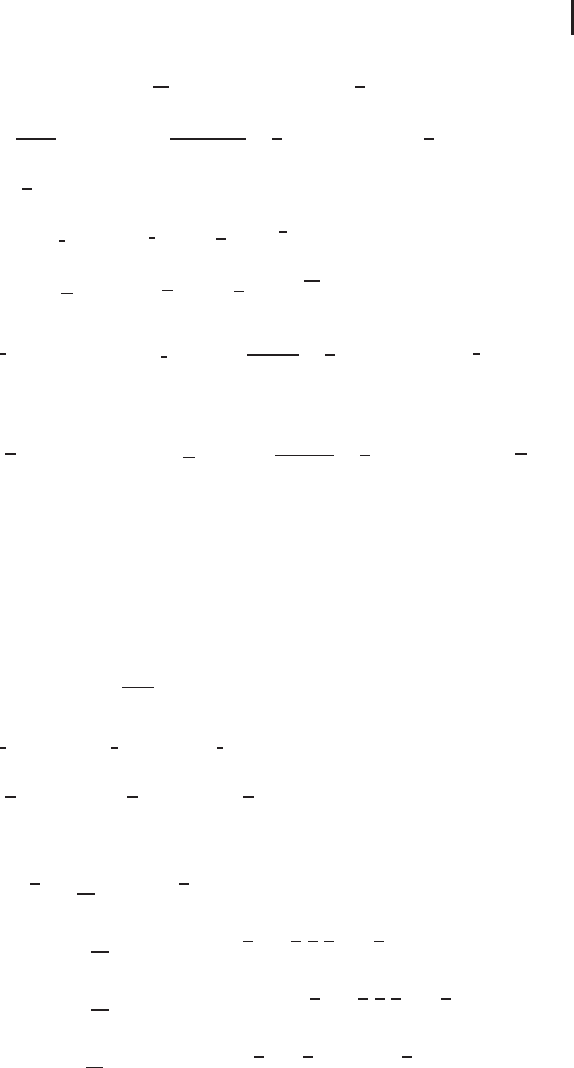
Equations (10.14.21) and (10.14.25) take the following form of a set of integral
equations:
1
d
A
2
(ς)
= 1 −
19
4
C
2
(G)
3
g
2
16π
2
0
ς
dz
2
A
3
(z)d
2
A
2
(z) −
C
2
(G)
12
g
2
16π
2
0
ς
dz
2
c
cA
(z)h
2
c
c
(z) +
8T(R)
6
g
2
16π
2
0
ς
dz
2
ψ
ψA
(z)h
2
ψ
ψ
(z), (10.14.28)
1
h
cc
(ς)
= 1 −
C
2
(G)
2
g
2
16π
2
0
ς
dz
2
c
cA
(z)h
cc
(z)d
A
2
(z), (10.14.29)
1
h
ψψ
(ς)
= 1 −
C
2
(G)
2
g
2
16π
2
0
ς
dz
2
ψ
ψA
(z)h
ψψ
(z)d
A
2
(z), (10.14.30)
ccA
(ς) = 1 +
C
2
(G)
8
g
2
16π
2
0
ς
dz
3
c
cA
(z)h
2
c
c
(z)d
A
2
(z)
+
3C
2
(G)
8
g
2
16π
2
0
ς
dz
2
c
cA
(z)
A
3
(z)d
2
A
2
(z)h
cc
(z), (10.14.31)
A
3
(ς)d
A
2
(ς) =
c
c
A
(ς)h
c
c
(ς),
A
3
(ς)d
A
2
(ς) =
ψψA
(ς)h
ψψ
(ς),
(10.14.32)
ς = ln(p
2
m
2
). (10.14.33)

486 10 Calculus of Variations: Applications
C
2
(G) is the quadratic Casimir operator and T(R)isdefinedby
Tr(t
a
t
b
) = T(R)δ
ab
. Equation (10.14.32) is the direct consequence of the
Ward–Takahashi–Slavnov–Taylor identity.
Equations (10.14.28)–(10.14.32) are completely equivalent to the set of differential
equations
1
d
A
2
d
dς
(d
A
2
) =−
19
4
C
2
(G)
3
g
2
16π
2
2
A
3
d
3
A
2
−
C
2
(G)
12
g
2
16π
2
2
c
cA
h
2
c
c
d
A
2
+
8T(R)
6
g
2
16π
2
2
ψ
ψA
h
2
ψ
ψ
d
A
2
, (10.14.34)
1
ccA
d
dς
(
ccA
) =−
C
2
(G)
8
g
2
16π
2
2
c
cA
h
2
c
c
d
A
2
−
3C
2
(G)
8
g
2
16π
2
ccA
A
3
d
2
A
2
h
cc
, (10.14.35)
1
h
cc
d
dς
(h
cc
) =−
C
2
(G)
2
g
2
16π
2
2
c
cA
h
2
c
c
d
A
2
, (10.14.36)
1
h
ψψ
d
dς
(h
ψψ
) =−
C
2
(G)
2
g
2
16π
2
2
ψ
ψA
h
2
ψ
ψ
d
A
2
, (10.14.37)
with Ward–Takahashi–Slavnov–Taylor identities,
A
3
d
A
2
=
ccA
h
cc
,
A
3
d
A
2
=
ψψA
h
ψψ
, (10.14.38)
and the boundary conditions
d
A
2
(0) = h
c
c
(0) = h
ψψ
(0) =
c
c
A
(0) = 1. (10.14.39)
The set of nonlinear differential equations, (10.14.34)–(10.14.38), with the bound-
ary conditions, (10.14.39), can be solved explicitly as
c
c
A
= h
c
c
= h
ψψ
= , d
A
2
=
κ−4
,
A
3
=
6−κ
, (10.14.40)
where and κ are, respectively, given by
=
1 +κ
C
2
(G)
2
g
2
16π
2
ς
−1κ
and κ =
22
3
1 −
4
11
T(R)
C
2
(G)
. (10.14.41)
Here κ is positive since
T(R) <
11
4
C
2
(G), (10.14.42)
which follows from the group identity,
rT(R) = d(R)C
2
(G), (10.14.43)

10.15 Renormalization Group Equations 487
where d(R)andr are the dimensionalities of the representation R and the group G.
The connection between the bare or running coupling constant (or the bare
charge) and the observed coupling constant (or the observed charge) in this theory
takes the following form:
g
2
0
(
2
) =
g
2
1 +κ(C
2
(G)2)(g
2
16π
2
)ln(
2
m
2
)
, (10.14.44)
which differs from the corresponding expression for the Abelian theories like QED
by the opposite sign in the denominator. The bare or running coupling constant
tends to zero as the cut-off parameter
2
goes to infinity. Thus, at high energies or
at short distances, the theory becomes asymptotically free. Equation (10.14.44) can
be solved for the observed coupling constant (or the observed charge) as
g
2
=
g
2
0
(
2
)
1 −κ(C
2
(G)2)(g
2
0
(
2
)16π
2
)ln(
2
m
2
)
. (10.14.45)
The observed coupling constant (or the observed charge) can assume any value if,
in the local limit p
2
=
2
→∞, the bare or running coupling constant (or the bare
charge) also tends to zero.
10.15
Renormalization Group Equations
As the renormalization group equation, we have Gell–Mann–Low equation, which
originates from the perturbative calculation of the massless QED with the use of
the mathematical theory of the regular variations . We also have Callan–Symanzik
equation,which is slightly different from the former. The relationship between the
two approaches is established in this section. We remark that the method of the
renormalization group essentially consists of separating out the field components
into the rapidly varying components (k
2
>
2
) and the slowly varying components
(k
2
<
2
), path-integrating out the rapidly varying components (k
2
>
2
)inthe
generating functional of the (connected parts of) Green’s functions, and focusing
our attention to the slowly varying components (k
2
<
2
) to analyze the low energy
phenomena at k
2
<
2
.
We first consider the renormalization in the path integral formalism, and take the
classical self-interacting scalar field as the model
L
φ(x), ∂
µ
φ(x)
=
1
2
∂
µ
φ(x)∂
µ
φ(x) −
1
2
m
2
φ
2
(x) −
g
4!
φ
4
(x).
We carry out the Fourier transformation of the self-interacting scalar field φ(x)as
φ(x) =
d
4
k
(2π)
4
exp[ikx ]
˜
φ(k), with
˜
φ
∗
(k) =
˜
φ(−k).