
Masujima M. Applied Mathematical Methods in Theoretical Physics
Подождите немного. Документ загружается.

498 10 Calculus of Variations: Applications
Renormalization Group of Callan–Symanzik for QED
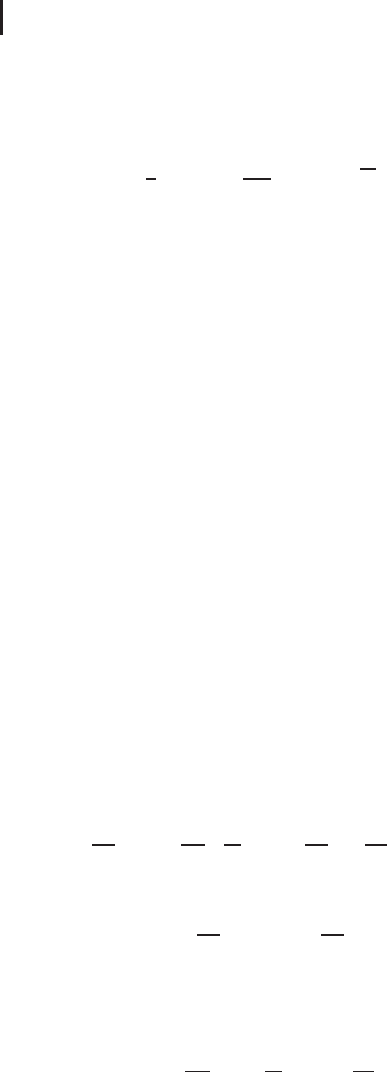
We now briefly mention the renormalization group equation for QED.Lagrangian
density for QED is given by
L
QED
=−
1
4
F
0µν
F
µν
0
−
1
2α
0
(∂
µ
A
0µ
)
2
+ ψ
0
(x)(iγ
µ
D
µ
− m
0
)ψ
0
(x), (10.15.42)
where the renormalized quantities are defined by
A
0µ
(x) = Z
1/2
3
A
µ
(x),
ψ
0
(x) = Z
1/2
2
ψ(x),
e
0
= Z
−1/2
3
e,
α
0
= Z
3
α,
(10.15.43)
with the Ward–Takahashi identity,
Z
1
= Z
2
. (10.15.44)
We define the (n + m) point Green’s function , G
(n,m)
(k
1
, ..., k
n
;p
1
, ..., p
m
;e), by
G
(n,m)
0
(k
1
, ..., k
n
;p
1
, ..., p
m
;e)
= Z
n2
3
(µ)Z
m2
2
(µ)G
(n,m)
k
1
, ..., k
n
;p
1
, ..., p
m
;e(µ)
, (10.15.45)
e
0
= Z
−12
3
e(µ), (10.15.46)
where n is the number of the photons A
µ
(x)andm is the number of the electrons
ψ(x)inthe(n + m) point Green’s function. We write down the renormalization
group equation from the independence of the unrenormalized Green’s function
upon the normalization point µ,
µ
∂
∂µ
+ β
e,
µ
m
p
∂
∂e
+ δ
e,
µ
m
p
, α
∂
∂α
+ γ
(n,m)
G
(n,m)
(k
i
, p
j
;µ, e) = 0,
(10.15.47)
γ
(n,m)
= nγ
ph
e,
µ
m
p
+ mγ
el
e,
µ
m
p
, α
. (10.15.48)
Callan–Symanzik equationsfor the j-fold mass insertion terms in QED are given
by
j+1
G
(n,m)
=
m
∂
∂m
+ β(e)
∂
∂e
+δ(e, α)
∂
∂α
+ γ
(n,m)
− j
1 −γ
S
(e, α)
j
G
(n,m)
,
(10.15.49)
10.16 Standard Model 499
with
Zm
0
(∂mm
0
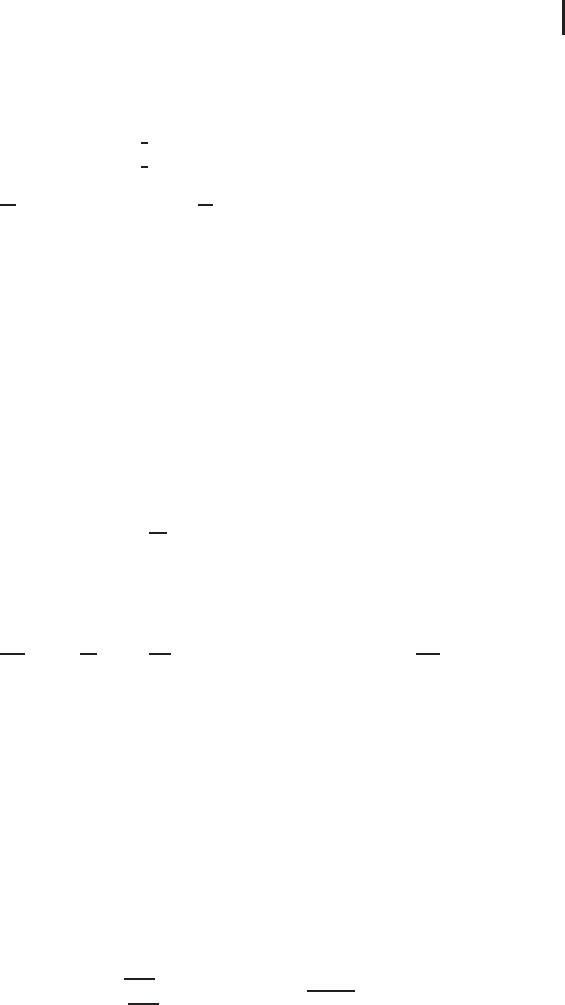
) = m,
β(e) = Zm
0
(∂e∂m
0
),
γ
el
(e, α) =
1
2
Zm
0
(∂ ln Z
2
∂m
0
),
γ
ph
(e) =
1
2
Zm
0
(∂ ln Z
3
∂m
0
),
δ(e, α) = Zm
0
(∂α ∂m
0
),
m
0
ψ
0
(x)ψ
0
(x) = Z
S
mψ(x)ψ(x),
γ
S
(e, α) = Zm
0
(∂ ln Z
S
∂m
0
).
(10.15.50)
Combining these equations with the Ward–Takahashi identity,
e = Z
12
3
e
0
and e
2
α = e
2
0
α
0
, (10.15.51)
we have
β(e) = eγ
ph
(e), δ(e, α) =−2αγ
ph
(e). (10.15.52)
We define the generating function of the j-fold mass insertion terms by
G
(n,m)
(p
i
;m, e, K) =
∞
j=0
K
j
j!
j
G
(n,m)
(p
i
;m, e). (10.15.53)
We obtain a homogeneous Callan–Symanzik equation for QED,
m
∂
∂m
+β(e)
∂
∂e
+δ(e)
∂
∂α
+ γ
(n,m)
−
1 +
1 −γ
S
(e)
K
∂
∂K
× G
(n,m)
(p
i
;m, e, K) = 0. (10.15.54)
10.16
Standard Model
Electro-Weak Unification
With strictly vanishing neutrino masses, the neutrinos always enter in the elemen-
tary processes in the left-handed state. So it is natural to consider the left-handed
doublets of the leptons and the right-handed singlets of the charged leptons.
l
eL
=
ν
eL
e
L
=
1−γ
5
2
ν
e
1−γ
5
2
e
, l
eR
= e
R
=
1 +γ
5
2
e. (10.16.1)
The most general transformation which commutes with the lepton number, the
Lorentz transformations, and the kinematic part of the Lagrangian density is

500 10 Calculus of Variations: Applications
ν
eL
e
L
−→ U ·
ν
eL
e
L
, e
R
−→ V · e
R
, (10.16.2)
where U is the 2 ×2 unitary matrix and V is the 1 ×1 unitary matrix. The group
G is U(2) × U(1). But this includes the lepton number phase transformations,
ν
eL
e
L
−→ exp[iα]
ν
eL
e
L
, e
R
−→ exp[iα]e
R
. (10.16.3)
Assuming that this is unbroken, we cannot let these transformations be the gauge
transformation. We want the group to include the charge phase transformations,
ν
eL
e
L
−→
10
0exp[iβ]
ν
eL
e
L
, e
R
−→ exp[iβ]e
R
. (10.16.4)
We take the generators of these transformations as T
1
, T
2
, T
3
,andQ with the
realizations given by
t
1L
=
g
2
01
10
, t
2L
=
g
2
0 −i
i 0
, t
3L
=
g
2
10
0 −1
;
t
jR
= 0,
(j = 1, 2, 3),
(10.16.5)
q
L
= e
00
0 −1
, q
R
=−e. (10.16.6)
If the weak hypercharge is defined by the Gell–Mann–Nishijima relation
Y ≡−2g
T
3
g
−
Q
e
, y
L
=−g
10
01
, y
R
=−2g
, (10.16.7)
we have
[Y,
T] = 0. (10.16.8)
So the group is G = SU(2)
weak isospin
×U(1)
weak hypercharge
. We assume that W
1µ
,
W
2µ
and W
3µ
are the generators of SU(2)
weak isospin
and that the neutral gauge field,
V
µ
, is the generator of U(1)
weak hypercharge
.
Covariant derivative of the lepton field ψ in terms of
W
µ
and V
µ
is given by
D
µ
ψ = ∂
µ
ψ + i
t
W
µ
ψ + i
y
2
V
µ
ψ. (10.16.9)
The unbroken linear combination of
t and y is the electric charge q which is given
by
10.16 Standard Model 501
q ∝
t
3
g
+
y
2g
∝ g
t
3
+g
y
2
,orA
µ
∝ g
W
3µ
+ gV
µ
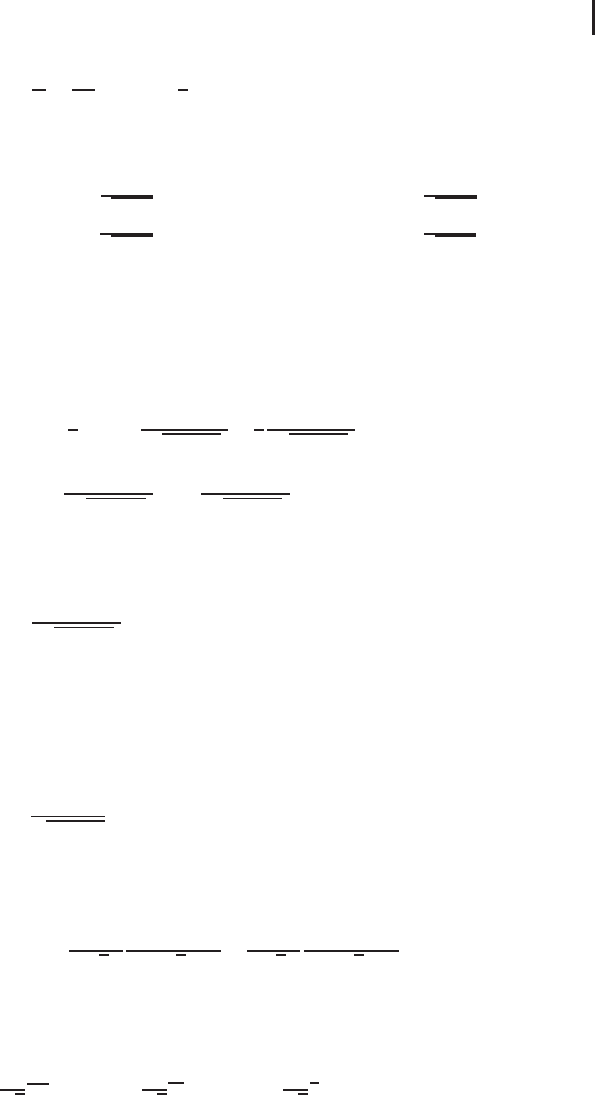
. (10.16.10)
Upon orthonormalization, we have the two neutral gauge fields,
A
µ
=
1
B
g
2
+g
2
[g
W
3µ
+ gV
µ
],
Z
0
µ
=
1
B
g
2
+g
2
[gW
3µ
− g
V
µ
],
or
W
3µ
=
1
B
g
2
+g
2
[g
A
µ
+ gZ
0
µ
],
V
µ
=
1
B
g
2
+g
2
[gA
µ
− g
Z
0
µ
].
(10.16.11)
We remark that these results are independent of spontaneous symmetry breaking,
but are only dependent on the charge conservation.
The neutral part of the covariant derivative is given by
t
3
W
3µ
+
y
2
V
µ
= t
3
g
A
µ
+ gZ
0
µ
B
g
2
+ g
2
+
y
2
gA
µ
− g
Z
0
µ
B
g
2
+ g
2
= A
µ
g
t
3
+gy2
B
g
2
+g
2
+ Z
0
µ
gt
3
− g
y2
B
g
2
+ g
2
. (10.16.12)
Hence the electric charge q is given by
q =
g
t
3
+ gy2
B
g
2
+g
2
. (10.16.13)
For the electron, we have t
3
=−g2, y =−g
, for the left-handed component,
t
3
= 0, y =−2g
, for the right-handed component, and q =−e, so that the elemen-
tary charge is given by
e =
gg
B
g
2
+ g
2
. (10.16.14)
The charged part of the covariant derivative with k = 1, 2, is given by
t
k
W
kµ
=
t
1
− it
2
√
2
W
1µ
+ iW
2µ
√
2
+
t
1
+ it
2
√
2
W
1µ
− iW
2µ
√
2
= t
−
W
+
µ
+ t
+
W
−
µ
.
(10.16.15)
The charged current interaction is given by
g
√
2
ν
eL
γ
µ
e
L
W
+
µ
,
g
√
2
e
L
γ
µ
ν
eL
W
−
µ
,
g
√
2
pγ
µ
nW
+
µ
. (10.16.16)

502 10 Calculus of Variations: Applications
The effective interaction is given by
g
√
2
e
L
γ
µ
ν
eL
1
m
2
W
±
g
√
2
p
L
γ
µ
n
L
=
g
2
8m
2
W
±
eγ
µ
(1 −γ
5
)ν
e
pγ
µ
(1 −γ
5
)n, (10.16.17)
to be compared with
G
F
√
2
eγ
µ
(1 −γ
5
)ν
e
pγ
µ
(1 −γ
5
)n, G
F
= 1.02 × 10
−5
m
−2
p
, (10.16.18)
resulting in
g
2
8m
2
W
±
=
G
F
√
2
. (10.16.19)
We define the Weinberg angle θ
W
by
g
g = tan θ
W
, g = e sin θ
W
, g
= e cos θ
W
. (10.16.20)
Then we have
m
W
±
=
g
2
√
2
8G
F
=
e
sin θ
W
√
2
8G
F
=
37.3Gev
sin θ
W
. (10.16.21)
To give the electron its mass, we introduce the doublet of SU(2)
weak isospin
Higgs
scalar field,
φ =
φ
+
φ
0
,
t
3
=+g2,
t
3
=−g2,
y = g
,
y = g
.
(10.16.22)
Covariant derivative of Higgs scalar field is given by
(D
µ
φ)
α
=
∂
µ
δ
αβ
+ i(
t)
αβ
W
µ
+ i
y
2
V
µ
δ
αβ
φ
β
. (10.16.23)
As the Higgs scalar Lagrangian density L
Higgs
, we choose
L
Higgs
=−
D
µ
φ(x)
†
D
µ
φ(x) −V
φ(x)
, (10.16.24a)
V(φ) =−m
2
φ
†
φ +
λ
2
(φ
†
φ)
2
, λ>0, m > 0. (10.16.24b)
We generate the masses of the leptons by the Yukawa coupling of the leptons to
Higgs scalar field, φ,
L
lepton
Yukawa
=−
f =e,µ,τ
/
G
f
l
f L
φl
f R
+h.c.
0
. (10.16.25)

10.16 Standard Model 503
Higgs scalar field φ develops the vacuum expectation value such that
φ
=
0
v
with v = m
√
λ. (10.16.26)
Then we have the lepton mass term as
L
lepton mass
=−
l=e,µ,τ
/
vG
l
l
L
l
R
+ v
∗
G
∗
l
l
R
l
L
0
. (10.16.27)
Thus we obtain
m
l
= G
l
v, m
ν
l
= 0, l = e , µ, τ. (10.16.28)
The covariant derivative term in the Higgs scalar Lagrangian density which depends
on the vacuum expectation value
φ
quadratically becomes
v
2
g
2
4
(W
2
1µ
+ W
2
2µ
) +
1
4
(gW
3µ
− g
V
µ
)
2
. (10.16.29)
We have the masses for the intermediate vector bosons, W
±
µ
and Z
0
µ
,as
m
W
±
=
1
√
2
vg,
m
Z
0
=
1
√
2
v
B
g
2
+g
2
,
m
γ
= 0, v 247 GeV. (10.16.30)
The lepton–gauge couplings result from the lepton Lagrangian density
L
lepton
=
f =e,µ,τ
/
l
f L
iγ
µ
D
µ
l
f L
+ l
f R
iγ
µ
D
µ
l
f R
0
. (10.16.31)
Writing this Lagrangian density in terms of the physical fields, we obtain
L
lepton-A
µ
coupling
=
gg
B
g
2
+ g
2
A
µ
l=e,µ,τ
lγ
µ
l,
L
lepton-Z
0
µ
coupling
=−
B
g
2
+ g
2
Z
0
µ
f =e,µ,τ
l
f
γ
µ
t
3
1 −γ
5
2
− Q
l
f
sin
2
θ
W
l
f
,
L
lepton-W
±
µ
coupling
=
g
√
2
l=e,µ,τ
W
+
µ
ν
l
γ
µ
1 −γ
5
2
l + h.c.
.
The total Lagrangian density L
GWS
for the Glashow–Weinberg–Salam model with-
out the gauge-fixing term and the Faddeev–Popov ghost term is
L
GWS
=−
1
4
∂
µ
W
αν
− ∂
ν
W
αµ
− gε
αβγ
W
βµ
W
γν
2
−
1
4
∂
µ
V
ν
− ∂
ν
V
µ
2
504 10 Calculus of Variations: Applications
+
∂
µ
+ i
t
W
µ
+ i
y
2
V
µ
φ
†
∂
µ
+ i
t
W
µ
+ i
y
2
V
µ
φ
+ m
2
φ
†
φ −
λ
2
(φ
†
φ)
2
+
f =e,µ,τ
/
l
f L
iγ
µ
D
µ
l
f L
+l
f R
iγ
µ
D
µ
l
f R
0
−
f =e,µ,τ
/
G
f
l
f L
φl
f R
+ h.c.
0
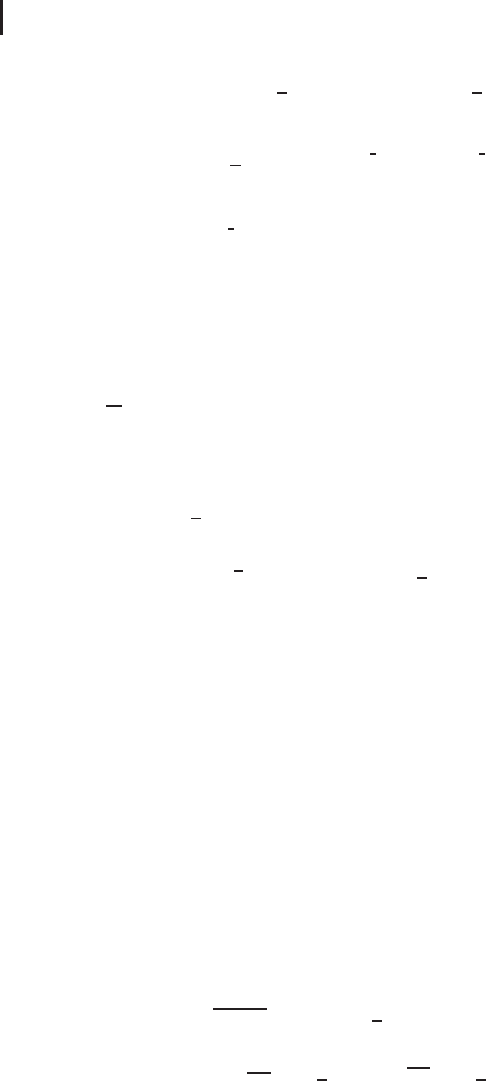
. (10.16.32)
Standard Model: As for the strong interaction, we choose SU(3)
color
as the gauge
group. We assume that the quark field q
n
(x) transforms under the fundamental
representation of SU(3)
color
,
t
α
=
g
3
2
λ
α
,(t
adj
α
)
β,γ
=−ig
3
f
αβγ
, α, β, γ = 1, ...,8. (10.16.33)
We have the quark–gluon Lagrangian density L
quark–gluon
as
L
quark–gluon
=−
1
4
∂
µ
A
αν
(x) − ∂
ν
A
αµ
(x) − g
3
f
αβγ
A
βµ
(x)A
γν
(x)
2
+
q=u,d,c,s,t,b
q
n
(x)iγ
µ
∂
µ
δ
nm
+ ig
3
1
2
λ
α
nm
A
αµ
(x)
q
m
(x),
(10.16.34)
where
q
n
(x) : Quark (color triplet), n = 1, 2, 3,
A
αµ
(x) : Gluon (color octet), α = 1, ...,8.
(10.16.35)
Here the indices n and α refer to the color degrees of freedom of the quark–gluon
system.
The interaction Lagrangian density for the quarks and the gluons can be easily
read off from Eq. (10.16.34). There also exists the cubic and quartic self-interaction
of the gluons. The explicit form of the self-interaction Lagrangian density can be
easily read off from Eq. (10.16.34).
The quark degrees of freedom have further gauge couplings upon gauging
SU(2)
weak isospin
×U(1)
weak hypercharge
,
L
quark-gauge
=
j=1,2,3
(u
j
, d
j
)
L
iγ
µ
i
t
W
µ
+ i
y
2
V
µ
u
j
d
j
L
+
j=1,2,3
/
u
jR
iγ
µ
i
y
2
V
µ
u
jR
+ d
jR
iγ
µ
i
y
2
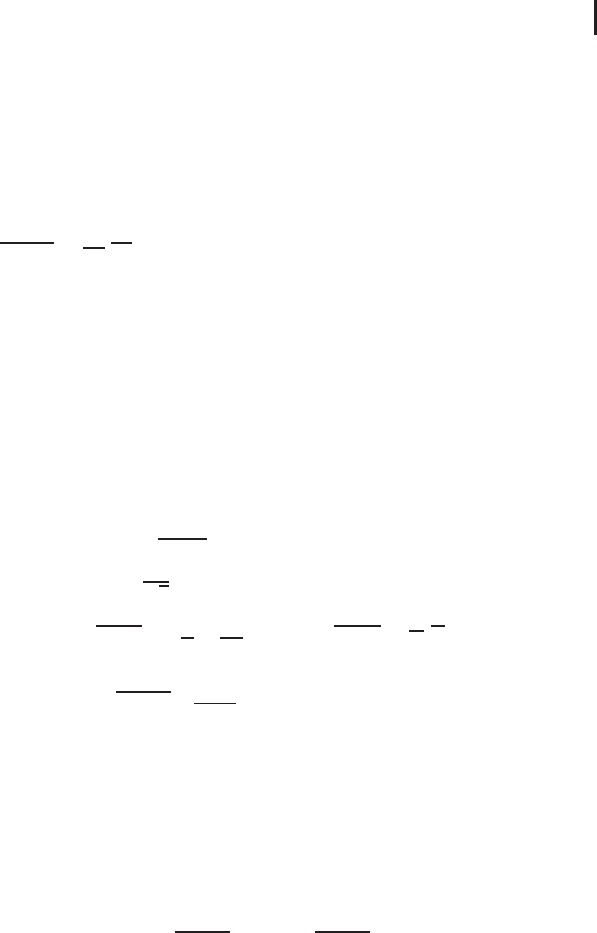
V
µ
d
jR
0
. (10.16.36)
10.16 Standard Model 505
Here, we designate
u
j
d
j
j=1,2,3
∼
j = 1, j = 2, j = 3,
u
L
, c
L
, t
L
, t
3
=+g2, y =+g
3,
d
L
, s
L
, b
L
, t
3
=−g2, y =+g
3,
u
R
, c
R
, t
R
, t
3
= 0, y =+4g
3,
d
R
, s
R
, b
R
, t
3
= 0, y =−2g
3,
(10.16.37)
(u
j
, d
j
)
L
≡ (u
jL
, d
jL
). (10.16.38)
In terms of W
±
µ
, Z
0
µ
,andA
µ
, we write the interaction Lagrangian density of the
electro-weak coupling of the quarks in the following form:
L
quark-gauge
= L
quark-A
µ
coupling
+L
quark-Z
0
µ
coupling
+ L
quark-W
±
µ
coupling
,
(10.16.39)
where
L
quark-A
µ
coupling
= eA
µ
j
µ
e.m.
, (10.16.40)
L
quark-Z
0
µ
coupling
=−
g
cos θ
W
Z
0
µ
j
µ
L,3
− sin
2
θ
W
j
µ
e.m.
, (10.16.41)
L
quark-W
±
µ
coupling
=
g
√
2
W
+
µ
j
µ
L,−
+ h.c.
, (10.16.42)
j
µ
e.m.
=
j=1,2,3
(u
j
, d
j
)γ
µ
t
3
g
+
y
2g
u
j
d
j
,
(u
j
, d
j
) ≡ (u
j
, d
j
), (10.16.43)
j
µ
L,3 or ±
=
j=1,2,3
(u
j
, d
j
)
L
γ
µ
t
3or±
g
u
j
d
j
L
, t
±
= t
1
±it
2
. (10.16.44)
We note that the neutral currents, j
µ
e.m.
and j
µ
L,3
, are flavor diagonal, and therefore
they do not provide the interactions which bridge over the different generations.
The charged current, j
µ
L,±
, is not flavor diagonal, but it still does not provide the
interactions which bridge over the different generations.
We observe that the quarks acquire the masses from the Yukawa coupling to
Higgs scalar field, φ,via
L
quark
Yukawa
=−
j=1,2,3
/
G
u
j
(u
j
, d
j
)
L
φ
c
u
jR
+G
d
j
(u
j
, d
j
)
L
φd
jR
+ h.c.
0
. (10.16.45)
As long as the quarks, q
L
, in the left-handed doublets are in the eigenstates of the
mass matrix, we cannot provide the interactions which bridge over the different
generations, since the Lagrangian density does not contain the term which bridges
over the different generations of the quarks. Since the standard model is incapable
of providing the interactions which bridge over the different generations of the

506 10 Calculus of Variations: Applications
quarks, we shall mix the bottom components of the doublet of the quarks by hand.
We write
d
s
b
= M
d
s
b
. (10.16.46)
The explicit form of the matrix M was given by M. Kobayashi and T. Maskawa as
M =
c
1
−s
1
c
3
−s
1
s
3
s
1
c
2
c
1
c
2
c
3
− s
2
s
3
exp[iδ] c
1
c
2
s
3
+ s
2
c
3
exp[iδ]
s
1
s
2
c
1
s
2
s
3
+ c
2
s
3
exp[iδ] c
1
s
2
s
3
− c
2
c
3
exp[iδ]
, (10.16.47)
where
c
i
= cos θ
i
, s
i
= sin θ
i
, i = 1, 2, 3. (10.16.48)
Since we are mixing the bottom components of the doublet of the quarks by hand,
we must determine the mixing angles, θ
i
,(i = 1, 2, 3), and δ, from the experiment.
In this respect, the standard model contains too many adjustable parameters and is
far from satisfactory as the ultimate model of the unification of the weak interaction,
the electromagnetic interaction and the strong interaction.
We write down the Lagrangian density for the standard model for the sake of
completeness, with the gauge-fixing term, without the Faddeev–Popov ghost term,
and with the bottom components of the doublet of the quarks Kobayashi–Maskawa
rotated:
L
SM
=−
1
4
∂
µ
W
αν
−∂
ν
W
αµ
−gε
αβγ
W
βµ
W
γν
2
−
1
4
∂
µ
V
ν
−∂
ν
V
µ
2
+
∂
µ
+ i
t
W
µ
+ i
y
2
V
µ
φ
†
∂
µ
+ i
t
W
µ
+ i
y
2
V
µ
φ + m
2
φ
†
φ
−
λ
2
(φ
†
φ)
2
+
f =e,µ,τ
/
l
f L
iγ
µ
D
µ
l
f L
+ l
f R
iγ
µ
D
µ
l
f R
0
−
f =e,µ,τ
/
G
f
l
f L
φl
f R
+ h.c.
0
−
1
4
∂
µ
A
αν
(x) − ∂
ν
A
αµ
(x) − g
3
f
αβγ
A
βµ
(x)A
γν
(x)
2
+
q=u,d
,c,s
,t,b
q
n
(x)iγ
µ
∂
µ
δ
nm
+ ig
3
1
2
λ
α
nm
A
αµ
(x)
q
m
(x)
+ eA
µ
j
µ
e.m.
−
g
cos θ
W
Z
0
µ
j
µ
L,3
− sin
2
θ
W
j
µ
e.m.
+
g
√
2
W
+
µ
j
µ
L,−
+ h.c.
−
j=1,2,3
/
G
u
j
(u
j
, d
j
)
L
φ
c
u
jR
+ G
d
j
(u
j
, d
j
)
L
φd
jR
+ h.c.
0
−
ξ
2
(∂
µ
A
αµ
)
2
−
ξ
2
∂
µ
W
+
µ
−
i
ξ
m
W
±
φ
+
2
−
ξ
2
∂
µ
Z
0
µ
−
i
ξ
m
Z
0
√
2
φ
0
2
−
ξ
2
(∂
µ
A
µ
)
2
,
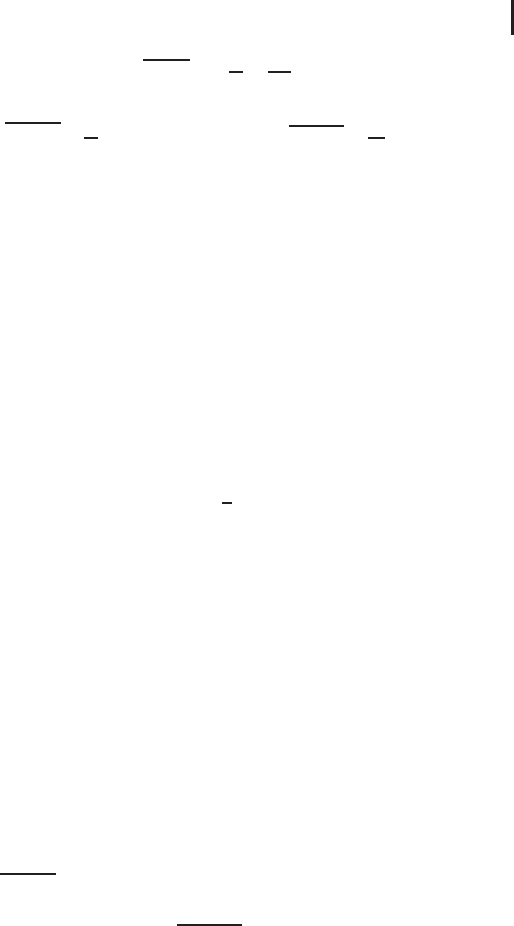
(10.16.49)
10.16 Standard Model 507
φ =
φ
+
φ
0
, j
µ
e.m.
=
j=1,2,3
(u
j
, d
j
)γ
µ
t
3
g
+
y
2g
u
j
d
j
, (10.16.50a)
j
µ
L,3
=
j=1,2,3
(u
j
, d
j
)
L
γ
µ
t
3
g
u
j
d
j
L
, j
µ
L,±
=
j=1,2,3
(u
j
, d
j
)
L
γ
µ
t
±
g
u
j
d
j
L
.
(10.16.50b)
Instanton, Strong CP-Violation, and Axion
In the SU(2) gauge field theory, we have Belavin–Polyakov–Schwartz–Tyupkin
instanton solution which is a classical solution to field equation in Euclidean
space–time. Proper account for the instanton solution in the path integral formal-
ism requires the addition of the strong CP-violating term to the QCD Lagrangian
density. Peccei–Quinn axion hypothesis resolves this strong CP-violation problem.
We first discuss the instanton solution. The instanton is the solution to the
classical equation, which makes Euclidean action functional stationary and finite.
We note that the arbitrary element of the SU(2) gauge group can be expressed as
g(x) = exp[iω
a
T
a
] = a(x) +
b(x), T
a
=
1
2
τ
a
, a = 1, 2, 3, (10.16.51a)
g(x)g(x)
†
= a(x )
2
+
b(x)
2
= 1. (10.16.51b)
From the requirement that Euclidean action functional is finite, we require
F
aµν
(x) −→ 0as
|
x
|
−→ ∞ .
In another word, the gauge field A
µ
(x) approaches to the configuration which is
equivalent to the vacuum,
A
µ
(x) −→ − ig(x)∂
µ
g(x)
†
as
|
x
|
−→ ∞ . (10.16.52)
Explicitly the instanton solution is given by
A
µ
(x) ≡−
r
2
r
2
+ ρ
2
ig(x)∂
µ
g(x)
†
, (10.16.53a)
r
2
= (x
4
)
2
+(
x )
2
=
|
x
|
2
, g(x) ≡
x
4
+ i
xτ
r
. (10.16.53b)
This solution appears and disappears instantly, and so we call this solution as an
instanton.
In order to gain a proper understanding of the instanton, we consider QCD
vacuum carefully. We shall consider QCD in the temporal gauge
A
α0
(x) = 0, (10.16.54a)