
Molina-Par?s C., Lythe G. (editors) Mathematical Models and Immune Cell Biology
Подождите немного. Документ загружается.

12 Reassessing Germinal Centre Reaction Concepts 243
7. Recycling: the original idea, proposed by MacLennan et al. in 1991 [32],
suggested that centroblasts migrate from the dark to the light zone, become cen-
trocytes and as such stop SHM. They are then submitted to selection; surviving
cells migrate from the light to the dark zone where they again become cen-
troblasts activating the SHM mechanism. This cycle is supposed to be repeated
several times. A later theoretical analysis of the affinity maturation process,
based on an optimization criterion [33], was taken as support for this hypotheti-
cal view (see discussion). The original recycling idea was later modified so that
no physical migration between zones was required
8. High(er) affinity centrocytes are induced to differentiate into either memory
B cells or long-lived plasma cells, exiting the GC
9. Gradual decrease of the dark zone, until a single, smaller zone remains where
centrocytes and centroblasts are mixed
10. Gradual decrease by death/migration of centrocytes and centroblasts, so that the
secondary follicle gradually recovers the phenotype of a primary follicle
11. The whole process takes about 3 weeks
The population dynamics and transient nature of GCs as well as the mutation-
selection processes taking place there, raise very interesting problems, amenable
to analysis by mathematical and computational tools. Such analyses can focus on
different points of view, for instance, on developmental (tissue organization and
remodelling), ecological, microevolutionary or health aspects.
However, empirical descriptions of the kinetics applying to different aspects of
GC dynamics, such as initiation, maturation and decline, compartmentalization or
B-cell selection, are based on experimental procedures that are technically limited
with respect to the kinetics of individual GCs. This means many relevant processes
can either not be observed directly or not in the relevant time scales. Thus, most if
not all of the dynamic data relates to the global GC reaction and not to the average
individual GC [34], leaving essential questions open [3].
In the ideal case, questions are answered directly from experimental data (“Do
GCs contain T cells? Yes, immunohistology shows that they do”). If direct exper-
imental observation is not possible, then assumptions have to be made in order to
draw inferences from indirect experimental data. Often, mathematical models are
used to obtain indirect estimates from these assumptions. For instance, assuming
that B cells do not enter the GC after its formation, and proliferate at a constant rate,
with certain assumptions on the selection process, one can set up a mathematical
model where the results are compared to V region Ig sequences from GC B cells in
order to estimate the rate of SHM [35].
However, some problems can arise in interpreting data. Firstly, measurement er-
rors can be large enough to give misleading results. Secondly, if data only comprises
a small sample, effects of sampling have to be considered. Thirdly, if the conclusion
stems from indirect experimental observation, then the validity of the assumptions
has to be assessed. Finally, averages over many events can be erroneously taken to
reflect the behaviour of individual events [34].
An additional problem is that concepts resulting from data observation are
usually presented without clearly distinguishing between truly established facts
244 J. Faro and M. Or-Guil
and those that are hypotheses, observational interpretations, assumptions or even
“reasonable” beliefs. As a consequence, scientists can be easily mislead, particularly
newcomers to the field. This is highly relevant because such potential interpretations
or assumptions may impinge on models of GC dynamics or affinity maturation. Pre-
senting those assumptions as facts prevents their own analysis and constrains future
analysis of the models.
As a way to clarify this conundrum, we wanted to critically reassess key papers
that contributed to the dominant picture of GC dynamics. We sought to disclose
potential interpretations, hypotheses or assumptions that may have been accepted
later as facts.
In this paper, we focus on a particular issue, namely, the proposal that GCs are
founded oligoclonally. This is to exemplify how apparently good and simple quan-
titative experimental designs can provide results that are in fact ambiguous with a
large margin of error, thus leaving the original question unresolved.
An oligoclonal GC is one that was founded and then populated by only a few
clones. A clone comprises cells that originate from the same precursor cell. Hence, a
B cell clone will consist of B cells with the same rearranged Ig heavy (Igh) and light
(Igl) V-region sequences, although these sequences might have acquired mutations
due to SHM.
Clonal diversity and clonal size distribution of GCs are a consequence of the
interplay of migration, proliferation, selection, and differentiation processes, and
hence provide information that can help unveil underlying dynamic processes.
Therefore, investigators initially focused on determining the clonal composition of
GCs. Both direct and indirect methods were used to assess this question. The first ex-
perimental approach to the question of clonal diversity that comes to mind is directly
measuring Igh and/or Igl V-region sequence diversity in individual GCs. However,
probably due to technical limitations at the time, this approach was not the first to
be developed. A second, clever approach, and historically the first to be followed, is
to estimate the clonal diversity indirectly by measuring only a qualitative GC trait.
The conclusion drawn from these analyses is that GCs are founded oligoclonally
by around two to eight precursor cells. Reading the original papers, however, one
realizes that the data included potentially important sources of error, thus casting
reasonable doubts on the reliability of the authors’ interpretations. We will present
the data in question and discuss their interpretation in the following sections.
Analysis of the Experimental Basis for the Concept
of Oligoclonal Seeding of GCs
Indirect Experimental Evidence
The concept of oligoclonal GCs originated from evaluating indirect evidence based
on the assumption that all GCs are founded by n B cells, and become virtually
closed structures for Ag-specific B cells arriving later. Within this closed structure,
12 Reassessing Germinal Centre Reaction Concepts 245
the founder B cell populations expand at the same rate. Under these assumptions,
the theoretical approach behind the indirect method is the following. Assume there
are two B cell populations named A and B with, in principle, the same diversity,
but with two different phenotypic traits – for instance, a plasma membrane allelic
marker without functional differences between alleles. Let us call q and p.D1 q/
the fractions corresponding to populations A and B, respectively. If GCs are seeded
by a similar number n of cells then the expected fraction of GCs seeded by k cells
of type A and n k cells of type B is:
n
k
!
p
nk
q
k
: (12.1)
In particular, the expected fractions of GCs seeded by only A cells (f
A
), only B
cells (f
B
)oramixtureofA and B cells (f
Mix
) are, respectively,
f
A
D q
n
(12.2)
f
B
D p
n
(12.3)
f
Mix
D 1 q
n
p
n
: (12.4)
The number n of founder B cells can then be calculated using (12.2), (12.3)or
(12.4) alone from knowing the fraction p and the observed value for f
A
, f
B
or f
Mix
(denoted here as f
ob
A
, f
ob
B
and f
ob
Mix
). Two experimental system variants have been
used that allow identification of two B cell populations and hence measurement of
p, f
ob
A
, f
ob
B
and f
ob
Mix
:
(1) Immunization with two Ags. This strategy involves analyzing the GC reactions
triggered by two different Ags injected simultaneously [36,37]. In the paper by
Liu et al. [36] rats primed with spider crab hemocyanin (MSH) were boosted 4
weeks later with a mixture of dinitrophenyl (DNP) and 2-phenyloxazolone(Ox)
coupled independently to MSH. The fractions of splenic GCs monospecific for
either Ox or DNP were determined by immunohistology 3 days later. In the
experimental setting of Jacob et al. [37] (C57BL/6BALB/c)F
1
mice (Igh
b/a
)
were immunized with nitrophenyl (NP) coupled to chicken gamma globulin
(NP–CG). In this system it is expected that the majority of anti-NP B cells bear
the
1
L chain and that this is Igh
b
-associated. Then the fractions of GCs with
B cells expressing
1
, binding CG, or both were determined.
A general problem with those two experimental settings is that the responses
to each Ag are not comparable. This is due to likely differences in the number
of Ag-specific precursor B cells, the affinities of the responding cells for their
respective Ag, and Ag valence (Ox vs DNP in the first case, and NP vs CG
epitopes in the second case). These are important unknown factors that affect
estimates of the proportions of pre-response B cells specific for each Ag (as-
sumedtobe1:1in[37]), and the differential quality of activated Ag-specific
B cells’ response before the GC reaction starts. For instance, small fluctuations
in the in situ proportions of B cells specific for each Ag may be highly amplified
246 J. Faro and M. Or-Guil
by higher affinity/avidity of B cell–Ag interactions leading mostly to extrafol-
licular plasma cell differentiation [38,39]. Due to all of the above, these settings
are inadequate because they introduce too many uncertainties.
(2) Two phenotypically different B-cell populations. Historically this was the first
approach, and the most cited original papers are those of Kroese and colleagues
[40–42]. In their experiments they used rats with two populations of lympho-
cytes bearing different alleles of a given membrane protein. In the first paper
[40] lethally X-irradiated rats of AO strain were reconstituted with different
proportions of thoracic duct lymphocytes (TDL) from (AOBN)F
1
rats (with
MHC class II molecules of hybrid allotypes RT1
u=n
)andAO!(AOBN)F
1
chimeras (with MHC class II molecules of allotype RT1
u
). The reconstituted
rats were immunized with sheep erythrocytes (SRBC) and their spleens ana-
lyzed for GCs 5 days later.
As the authors acknowledged, a major drawback of that system is the dif-
ference in MHC between TDL rat donors and rat hosts, which would lead to a
graft-vs-host reaction. This was circumvented by using TDL derived from bone
marrow chimeras. However, these cells were still weakly reactive against host
type cells [40].
The weak reactivity in the above system was avoided in a second paper by
using PVG rats congenic for the RT7.2 allotype (CD45, a cell-membrane phos-
phatase). Lethally X-irradiated PVG rats (RT7.1) were reconstituted with a 1:1
mixture of TDL from both allotypes, immunized with SRBC and their spleens
analyzed for GCs 7 or 10 days later.
A common source of error in those two papers was that, manipulating cells
ex vivo and injecting particular ratios of them into X-irradiated hosts, meant
that the real proportion of surviving, functional B cells of each allotype able
to respond to the immunizing Ag becomes highly uncertain. In the 1988 paper
[41], this is reflected in the widely different measured percentages of pure RT7.1
and pure RT7.2 GCs, 19% and 45%, respectively, in animals receiving a 1:1
ratio of RT7.1 and RT7.2 B cells. This strongly contrasts with the expected
similar frequencies for both types of GCs. Finally, in both reports only one of
the cell types was scored for presence/absence. All this makes the data [40,41]
highly unreliable for estimating the number of GC founding B cells.
In contrast to the above two experimental systems, another animal model [42]
used rat hemopoietic chimeras. Those were obtained by transferring congenic
PVG RT7.2 embryonic liver cells into PVG (RT7.1) newborn rats. As in the
previous papers, only the presence/absence of RT7.2 cells was analyzed. For
our present purpose the best set of data in that paper corresponds to a chimera
where the allelic B cell population fractions were p D 0:21 (population B)
and q D 0:79 (population A). In this case, the fractions of pure GC sections
were found to be f
ob
A
D 0:14 for population A (allotype RT7.1), f
ob
B
D 0:06
for population B (allotype RT7.2), while 80 % of GC sections showed a mixed
population. Using this simple model, the number of founder cells is estimated
by (12.3)toben
A
8 andby(12.4)toben
B
2.

12 Reassessing Germinal Centre Reaction Concepts 247
This system has the advantage of using normal animals, without ex vivo
manipulation of cells, which leads to an accurate determination of allelic
B-cell population fractions. We therefore considered this work best from a
methodological point of view and will focus on their data in the following
analyses.
Consistency Test
We first asked if experimental findings and model assumptions are internally con-
sistent. Does the data reported by Hermans et al. point to a binomial distribution of
B cell population fractions in GCs? Table 12.1 shows the percentage of GCs with
cells of types A, B, and mixed populations determined experimentally, as well as
the expected values calculated from (12.2)to(12.4) using the estimation of n
A
or
n
B
, along with the corresponding
2
values. In all cases,
2
is much larger than
10.827 (corresponding to a probability of 0.001 and 1 df). This indicates that the
reported values are inconsistent with the model assumption.
A first source of error is that the authors of the above papers took sections as to
represent whole GCs. However, sections are small samples of GCs, and as such do
not always reflect the true GC composition. Consider, for instance, a GC seeded by
k cells of type A and n k cells of type B, and totaling M cells. This GC will have
M
k
n
cells of type A. However, a section containing m cells (with m M.1
k
n
/)
will consist, with a probability
M.1
k
n
/
m
=
M
m
, exclusively of type B cells, feigning
a single population GC. This shows that sampling errors lead to overestimating the
number of single population GCs.
Additionally, errors of observation can lead to a further overestimation. For one
thing, the experimenter sets a subjective and arbitrary cut-off due to T cells possibly
being counted as B cells [42]. As a consequence, estimating the absence of one of the
Table 12.1 Analysis of internal consistency of data in [42]usedto
estimate n from chimera with p D0:21. X
2
of observed vs expected
fractions f
A
, f
B
and f
Mix
were calculated taking either observed f
A
(f
ob
A
)
or observed f
B
(f
ob
B
) as the reference values
n
A
D log
.1p/
.f
ob
A
/n
B
D log
p
.f
ob
B
/
(%) (%)
Observed Expected
a
Observed Expected
b
f
A
14 – 14 65.4
f
B
6 2:2 10
4
6–
f
Mix
80 86.0 80 28.6
X
2
161996
c
132:6
c
a
Expected f
B
was calculated as p
n
A
b
Expected f
A
was calculated as .1 p/
n
B
c
2
(prob.: 0.001; df: 1) D 10:827

248 J. Faro and M. Or-Guil
two B cell populations in sections may dismiss 10–30% of that population. Finally,
if only one population is positively analyzed for presence/absence, and the other
B cell population is simply inferred, as in [40–42], GC sections scored as 100%
positive for the former population because all cells were apparently labelled could
in fact contain cells of the other population. Real absence of the second population
can only be determined by staining for that population.
We propose the following modified, refined model to take measurement and
sampling errors into account. Our aim is to more accurately estimate the expected
fractions of single and mixed GCs.
An Extension of the Basic Model
To take the above sources of errors into account, we introduced a parameter l
T
m
representing the maximum number of cells that can be overlooked, that is, sections
with up to l
T
B cells of one type are scored as pure sections of the other type.
Now taking into account both sampling and observation errors, we extend (12.1)
and find that the probability of a mixed GC, seeded by k cells of type B (1 k<n),
yielding an apparently pure section of type A is:
n
k
!
p
k
q
nk
min
Œ
l
T
;
k
n
M
X
lDmax
Œ
0;mM.1
k
n
/
M
k
n
M
ml
k
n
M
l
M
m
(12.5)
Hence, the total fractions of sections expected to be scored as pure A, pure B and
mixed are, respectively:
f
A
.n/ D
n1
X
kD0
n
k
!
p
k
q
nk
min
Œ
l
T
;
k
n
M
X
lDmax
Œ
0;mM.1
k
n
/
M
k
n
M
ml
k
n
M
l
M
m
(12.6)
f
B
.n/ D
n
X
kD1
n
k
!
p
k
q
nk
min
Œ
l
T
;M.1
k
n
/
X
lDmax
Œ
0;m
k
n
M
M
k
n
M
ml
k
n
M
l
M
m
(12.7)
f
Mix
.n/ D 1 f
A
.n/ f
B
.n/ (12.8)
A further extension of the basic model addresses its simplifying assumption that
all GCs are seeded by the same number n of cells. In fact, it can be expected a
priori that the number of cells seeding GCs covers a relatively wide, rather than a
very narrow distribution. We therefore replaced this assumption by considering an
exponential distribution with mean hniD1=, such that the fraction of GCs seeded
by n
i
B cells is:
P
.n
i
/ D
Z
n
i
n
i
1
e
n
dn (12.9)
12 Reassessing Germinal Centre Reaction Concepts 249
Then the fractions of sections expected to be scored as pure A, pure B and mixed
from GCs seeded by n B cells are, respectively:
F
A
.; n/ D P
.n/f
A
.n/; F
B
.; n/ D P
.n/f
B
.n/; F
Mix
.; n/ D P
.n/f
Mix
.n/:
(12.10)
Finally, the total fractions of sections expected to be scored as pure A, pure B and
mixed are given by the equations:
F
A
./ D
1
X
nD1
F
A
.; n/ ; F
B
./ D
1
X
nD1
F
B
.; n/ ; F
Mix
./ D
1
X
nD1
F
Mix
.; n/ :
(12.11)
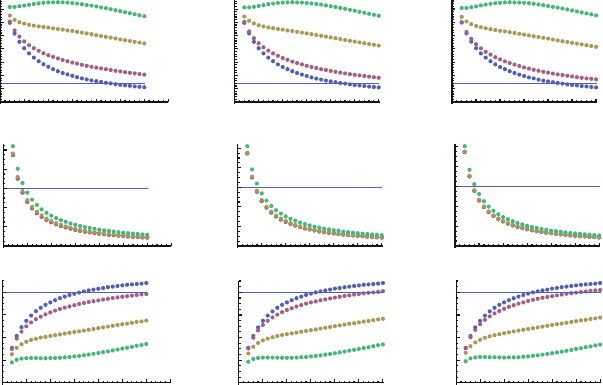
This refined model can now be used to estimate the fractions of GC sections
expected to be scored as type A, type B or mixed, for different values of the average
number hni of GC founder B cells, the size m of GC sections and scoring errors,
l
T
A
and l
T
B
. The results of a systematic analysis of (12.6)–(12.11), taking l
T
A
D
l
T
B
D l
T
are shown in Fig. 12.1.
Consistent with the observed data shown in Table 12.1, the results with the ex-
tended model indicate that the scoring error must have been l
T
A
10% for counting
“pure” GC sections of type A ( i.e., truly pure + false positives). However, this error
for cells of type B must have been much higher than 30%, since the estimated F
B
5 10 15 20 25 30
0.2
0.4
0.6
5 10 15 20 25 30 5 10 15 20 25 30
5 10 15 20 25 30
0.02
0.04
0.06
0.08
0.10
5 10 15 20 25 30 5 10 15 20 25 30
5 10 15 20 25 30 5 10 15 20 25 30 5 10 15 20 25 30
0.2
0.4
0.6
0.8
0.2
0.4
0.6
0.02
0.04
0.06
0.08
0.10
0.2
0.4
0.6
0.8
0.2
0.4
0.6
0.02
0.04
0.06
0.08
0.10
0.2
0.4
0.6
0.8
F
A
F
B
F
Mix
m = 50 cells m = 100 cells m = 200 cells
‹n› ‹n› ‹n›
l
T
= 30%
20%
10%
0%
Fig. 12.1 Fractions of GC sections estimated as being scored type A.F
A
/, type B.F
B
/ or mixed
.F
Mix
/, using the extended model (12.6)–(12.11). hni, Average number of GC founding B cells; l
T
,
scoring error; m, size of GC sections. Horizontal lines correspond to the observed fractions in [42]
250 J. Faro and M. Or-Guil
should reach at least the observed value f
ob
B
D 0:06. Hence, we need to assume that
the observation errors are different for each of the two populations if the extended
model is compatible with the observed data.
In addition, we can ask if the extended model and the data on pure and mixed
GC sections in [42] are consistent. The values reported in the original paper were
compared with the expected values according to the extended model (12.6)–(12.11).
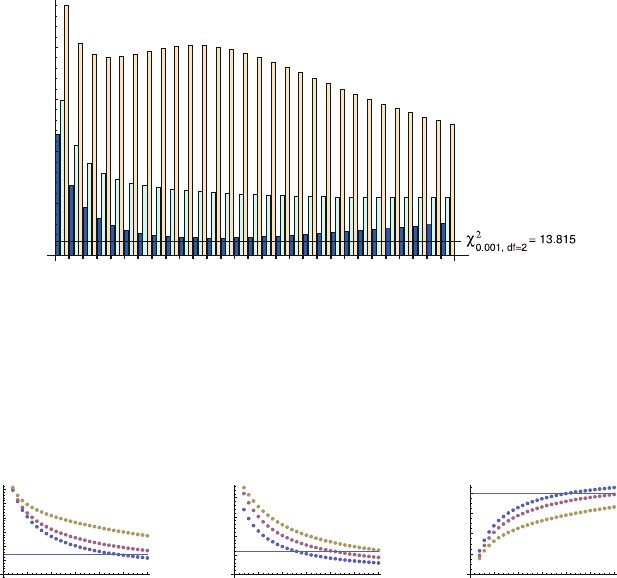
Figure 12.2 shows the corresponding X
2
for different average numbers of seeding
B cells and different error thresholds l
T
(once more taking l
T
A
D l
T
B
D l
T
).
Consistent with the previous result, in all cases the
2
test indicates that the reported
values are too different from the expected ones to be due to random variations. We
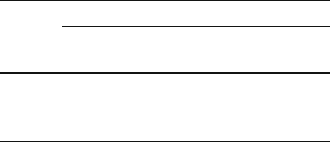
therefore re-estimated F
A
for l
T
A
D 5%, 10% and 15%, and F
B
for l
T
B
D 50%,
55% and 60%. The results clearly show that only scoring errors of 5 10%for
l
T
A
and 55 60%forl
T
B
generate values of F
A
, F
B
and F
Mix
compatible with the
observed values and predict the same value for hni (Fig. 12.3). Applying the
2
test
for observation errors l
T
A
D 5%andl
T
B
D 55%, we obtain a minimum value of
2 4 6 8 10 12 14 16 18 20 22 24 26 28 30
100
50
150
200
X
2
‹n›
Fig. 12.2
2
test of observed vs expected fractions of GC sections of type A.F
A
/, type B.F
B
/
or mixed .F
Mix
/, using the extended model (12.6)–(12.11). hni, average number of GC founder
B cells. Horizontal line,
2
for a probability of 0.001 and 2 df. Blue, green and yellow bars are
results obtained with l
T
D 10, 20 and 30%, respectively. Calculations made assuming a GC size
of M D 5;000 cells, and a GC section size of m D 200 B cells
5 10 15 20 25 30
0.1
0.2
0.3
0.4
0.5
0.6
0.05
0.10
0.15
0.20
0.2
0.4
0.6
0.8
m = 200 cells
F
A
F
B
‹n›
5 1015202530
‹n›
5 1015202530
‹n›
F
Mix
10%
5%
l
TA
= 15%
55%
50%
l
TB
= 60%
Fig. 12.3 Fractions of GC sections estimated as being scored type A.F
A
/, type B.F
B
/ or mixed
.F
Mix
/ for the indicated values of l
T
A
and l
T
s
B
, using the extended model (12.6)–(12.11). hni,aver-
age number of GC founder B cells. Horizontal lines correspond to the observed fractions in [42].
GC size, M D 5;000 cells
12 Reassessing Germinal Centre Reaction Concepts 251
X
2
D 0:064 for hniD23, while l
T
A
D 10%andl
T
B
D 60% gives a minimum
value of X
2
D 0:094 for hniD37. This indicates that the model is now sufficiently
accurate to explain the data. Thus the predicted average number of GC founder B
cells given by this refined model is hniD23 37 cells.
Direct Experimental Evidence
Direct experimental observation of the B cell clonal diversity in GCs involves de-
termining the number of distinct Igh and/or Igl sequences in individual GCs. Small
clusters of B cells from single GC sections are isolated and then analyzed for the se-
quence diversity of rearranged V
H
or V
L
gene segments from particular V families.
The data usually cited is that of Igh CDR3 region sequences obtained at different
times in a primary IR [29, 43]. The experimental procedure for each GC analyzed
involved the following steps: (a) sampling (sample A) of a cell cluster (50 cells)
from a GC section; (b) PCR amplification of sequences related to a particular ref-
erence V
H
gene segment; (c) extremely small sampling (sample B)ofthePCR
products (the sample size was typically a fraction 10
12
-10
10
of the total se-
quences); (d) sequencing of sample B.
The published diversity within sample B from GC sections harvested at day 16
or earlier is one to nine different sequences, corresponding to one to nine different
clones. The data on frequency distribution of the different sequences per GC section
can be analyzed to estimate clonal diversity using methods borrowed from ecol-
ogy, such as the abundant coverage estimator (ACE) [44] or the statistical model
of Yule–Simon [45,46]. Those methods have already been applied to estimate TCR
diversity in murine splenic CD4
C
T cell populations [47, JF, unpublished]. Note
that these methods underestimate true diversity, specially ACE which usually gives
particularly low estimates [JF, unpublished]. The results of such analyses applied
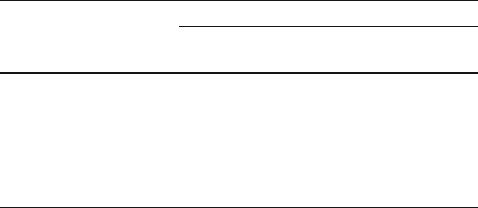
to V-region sequences from GCs are shown in Tables 12.2 and 12.3. Interestingly,
the Yule estimator suggests a severe reduction of diversity after day 10 of a primary
IR (Table 12.3), a time when selection likely starts to reduce, as well as bias the
clonal composition of GCs [35]. Before such contraction ( i.e., for GCs before day
14 of the response) the diversity is estimated to be in the range of 20–30 clones
(Table 12.3; Yule estimator).
Note that again these diversity estimates are for GC sections, which are them-
selves small samples of GCs. Therefore the GC diversity can be expected to
Table 12.2 Clonal diversity
estimation of GC B cells
using the ACE and Yule
methods. GCs are from day
10 of a primary IR. Data
from [43]
Diversity
Estimated Estimated
GC Observed (ACE) (Yule)
B8 5 6 19
B12 4 13 13
B15 2 2 3
252 J. Faro and M. Or-Guil
Table 12.3 Clonal diversity estimation of GC B cells using the ACE
and Yule methods. GCs are from a primary IR. Data from [29]
Diversity
Estimated Estimated
Day GC Observed (ACE) (Yule)
4H4 3 4 7
6J5 9 >45 29
8 M16 1 – 18
10 B8 6 9 32
14 D2 2 3 3
16 61AA02 2 3 4
be larger than the values estimated. Moreover, the experimental studies further
underestimated polyclonality by restricting the analysis to particular V to J rear-
rangements. Thus, in contrast to the original interpretation that the data provided
additional support for the pauciclonal/oligoclonal view of GC seeding, our diversity
analysis of the little data available from individual GCs points to a clonal diversity
before day 14 that is at least tenfold larger than the minimum values (2–5 clones)
previously suggested.
Examples of Other Issues Worth Re-Assessing
As with the oligoclonal seeding of GCs, there are other issues that, being determi-
nant elements in the GC scheme, lack strong experimental support (or any support
at all) but are also generally presented as given facts.
Maximally efficient, affinity-dependent selection of GC B cells. This is at the
heart of the recycling idea in most of its various versions. Initially proposed by
MacLennan et al. [32], the recycling hypothesis gained great popularity after a rig-
orous analysis of the affinity maturation process based on SHM and selection in
GCs [33]. Although not explicitly stated by Kepler and Perelson, the essence of
their analysis can be summarized as follows:
It assumes that GC B cells are subject to continuous selection for competitive Ag
binding.
It applies optimization theory to find the temporal mutational regime that, under
the previous assumption, will maximize affinity increase within a relatively short
time period.
The crux of the above analysis lies in the “hidden hypothesis” that affinity mat-
uration is maximized in GCs. Despite its importance, this concept has never been
put to test. Thus, this concept and the linked initial recycling idea, far from be-
ing established facts, are working hypotheses with many implications, and as such
worth testing experimentally. Moreover, existing data are also consistent with the